
Showing 11 items matching "bravery honours"
-
 Marysville & District Historical Society
THE TRIANGLE NEWS-VOL 38 NO 30-AUGUST 26 2011
... ...bravery honours...Marysville & District Historical Society 39 Darwin Street Marysville yarra-valley-and-the-dandenong-ranges marysville victoria australia bravery honours governor general quentin bryce australian bravery decorations black saturday bushfires gallipoli park mary meadows track horse riding marysville saddle tramps wilkes creek australian lions children's mobility foundation hart walker lions work with community notice to residents roadwork activities church notices buxton progress assocn mops THE TRIANGLE NEWS-VOL 38 NO 30-AUGUST 26 2011 ...marysville, victoria, australia, bravery honours, governor general quentin bryce, australian bravery decorations, black saturday bushfires, gallipoli park, mary meadows track, horse riding, marysville saddle tramps, wilkes creek, australian lions children's mobility foundation, hart walker, lions work with community, notice to residents, roadwork activities, church notices, buxton progress assocn, mops -
4th/19th Prince of Wales's Light Horse Regiment Unit History Room
Book, Major General Gordon Maitland, Honours and Awards of the Army, 2014
... 248 page soft covered book describing Australian honours and awards and stories of recipients, categories: appointments to orders of chivalry, including the Australian Order, bravery or distinguished service decorations, operational service (campaign) medals, meritorious service & long service and good conduct melds. special awards on commemorative occasions, other awards or insignia, foreign awards....4th/19th Prince of Wales's Light Horse Regiment Unit History Room 4/19 PWLH Regiment, Building 78 Simpson Barracks Macleod melbourne honours awards medals ISBN 978-0-9925154-0-9 248 page soft covered book describing Australian honours and awards and stories of recipients, categories: appointments to orders of chivalry, including the Australian Order, bravery or distinguished service decorations, operational service (campaign) medals, meritorious service & long service and good conduct melds. special awards on commemorative occasions, other awards or insignia, foreign awards. ...248 page soft covered book describing Australian honours and awards and stories of recipients, categories: appointments to orders of chivalry, including the Australian Order, bravery or distinguished service decorations, operational service (campaign) medals, meritorious service & long service and good conduct melds. special awards on commemorative occasions, other awards or insignia, foreign awards.ISBN 978-0-9925154-0-9honours, awards, medals -
 Yarra City Council
Sculpture - Figurative, William Eicholtz, Courage, 2014
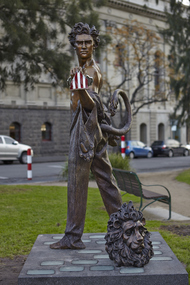
... Yarra City Council See website for various locations melbourne 'Courage' honours the contribution, culture and diversity of the Gay, Lesbian, Bisexual, Transgender, Intersex and Queer (GLBTIQ) community, and is dedicated to the legacy of Ralph McLean (1957–2010), Australia’s first openly gay elected official (City of Fitzroy, 1982) and Mayor (1984), an advocate for gay rights and social justice, and a champion of the arts. Launched as part of the official Cultural Program of the 20th International AIDS Conference in Melbourne in July 2014. LGTBQIA+ Wizard Oz Ralph McLean Eicholtz Accompanying plaque Bronze statue of a male figure half dressed in a lion costume holding a medal of bravery ...'Inspired by the iconic character of the Cowardly Lion in the story 'The Wonderful Wizard of Oz' and his contemplation of what it means to possess the courage to be yourself, no matter who you are.''Courage' honours the contribution, culture and diversity of the Gay, Lesbian, Bisexual, Transgender, Intersex and Queer (GLBTIQ) community, and is dedicated to the legacy of Ralph McLean (1957–2010), Australia’s first openly gay elected official (City of Fitzroy, 1982) and Mayor (1984), an advocate for gay rights and social justice, and a champion of the arts.Bronze statue of a male figure half dressed in a lion costume holding a medal of bravery with a lions head/mask resting on his foot. Accompanying plaquelgtbqia+, wizard oz, ralph mclean, eicholtz -
 Ithacan Historical Society
Photograph, OXI Day celebration, Platrithia, 28 October 1951
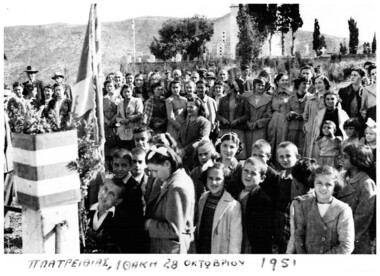
... The celebration of this day throughout Greece honours the determination and bravery of the Greek people throughout the war when they suffered severe deprivation and hardship during the German occupation of their country. ...The photo was taken on 'Oxi' Day 28 October 1951 which is commemorated throughout Greece and Cyprus and world-wide Greek communities. The day commemorates the rejection by the Greek prime minister, Ioannis Metaxas of the ultimatum presented to him by the Italian ambassador on the 28 October 1940 to allow the Axis forces, namely Italy, Germany and Bulgaria to occupy strategic locations of Greece or face war. A black and white photograph of a crowd of people - men, women and children - gathered around a Greek flag in an open area. A church is visible in the background. High mountains are also visible across the skyline.The original is handwritten across the bottom of the photo in Greek which translated reads: PLATRITHIA. ITHACA 28 OCTOBER 1951.world war 2 -
 Vision Australia
Administrative record - Text, 73rd Annual Report 1968 Association for the Blind of Victoria, 1969
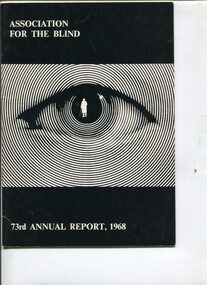
... bravery, Prime Minister Hon. J.G. Gorton opening the Ballarat section of the Guiding Light Appeal, Victorian Governor General Sir Rohan Delacombe the Bendigo section and Victorian Premier Sir Henry Bolte the Metropolitan section, Hubert Opperman being knighted in the Queen's Birthday honours, waiting list time for admission is 18 months - two years and are almost exclusively nursing cases as the peak for active aged recedes, erection of the two storey wing at Brighton thanks to grant from estate of the late Herbert Engelbert, the demolishing of the 100 year house at Brighton required for the extension, Mrs Laura Clarke - a resident of Mirridong - celebrated turning 102, and the need for additional room and accommodation for a resident caretaker has necessitated the purchase of a block of flats facing Glenferrie Road, with the assistance of the William Buckland Trust....bravery, Prime Minister Hon. J.G. Gorton opening the Ballarat section of the Guiding Light Appeal, Victorian Governor General Sir Rohan Delacombe the Bendigo section and Victorian Premier Sir Henry Bolte the Metropolitan section, Hubert Opperman being knighted in the Queen's Birthday honours, waiting list time for admission is 18 months - two years and are almost exclusively nursing cases as the peak for active aged recedes, erection of the two storey wing at Brighton thanks to grant from estate of the late Herbert Engelbert, the demolishing of the 100 year house at Brighton required for the extension, Mrs Laura Clarke - a resident of Mirridong - celebrated turning 102, and the need for additional room and accommodation for a resident caretaker has necessitated the purchase of a block of flats facing Glenferrie Road, with the assistance of the William Buckland Trust. ...Articles in annual report include: branch committees, President's report, finance report, balance sheet, hospital homes, community centre, welfare, volunteer service group, auxiliaries, life governors, guiding light appeal, Isadore Smith's bravery, Prime Minister Hon. J.G. Gorton opening the Ballarat section of the Guiding Light Appeal, Victorian Governor General Sir Rohan Delacombe the Bendigo section and Victorian Premier Sir Henry Bolte the Metropolitan section, Hubert Opperman being knighted in the Queen's Birthday honours, waiting list time for admission is 18 months - two years and are almost exclusively nursing cases as the peak for active aged recedes, erection of the two storey wing at Brighton thanks to grant from estate of the late Herbert Engelbert, the demolishing of the 100 year house at Brighton required for the extension, Mrs Laura Clarke - a resident of Mirridong - celebrated turning 102, and the need for additional room and accommodation for a resident caretaker has necessitated the purchase of a block of flats facing Glenferrie Road, with the assistance of the William Buckland Trust.16 pages of text and photographsassociation for the blind, isadore smith, e.a. soderstrom, miss tobias, annual reports -
 St Kilda Historical Society
Ephemera - Flyer, Capt Albert Jacka VC MC Appeal, 1932
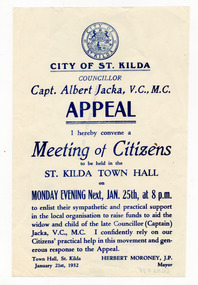
... bravery on the Western Front. He received a hero's welcome on his return to Melbourne in January 1920 and an estimated 50,000 people turned up to watch his funeral procession to St Kilda Cemetery, where he was buried with full military honours. ...bravery on the Western Front. He received a hero's welcome on his return to Melbourne in January 1920 and an estimated 50,000 people turned up to watch his funeral procession to St Kilda Cemetery, where he was buried with full military honours. ...Notice of a meeting of citizens, convened by the Mayor of St Kilda, to raise funds for the widow and child of the late Albert Jacka, former St Kilda Councillor (from 1929) and Mayor (1930). The meeting was held in the St Kilda Town Hall on 25 January 1932. Albert Jacka had collapsed on 14 December 1931 after a council meeting and was admitted to Caulfield Military Hospital. He died on 17 January 1932 at the age of 39. Albert Jacka is most well-known for his military service in WWI, having received the Victoria Cross medal for his actions during the Gallipoli campaign and two more decorations for his bravery on the Western Front. He received a hero's welcome on his return to Melbourne in January 1920 and an estimated 50,000 people turned up to watch his funeral procession to St Kilda Cemetery, where he was buried with full military honours. On 29 January, the appeal committee, chaired by Brigadier-General Brand, decided to call for donations to the Albert Jacka Fund by 29 February. The Fund had two objectives: 'In the first instance, the erection of a simple, suitable and inexpensive memorial stone over the grave of the dead hero, and secondly the placing of the residue of the fund in the hands of trustees for the benefit of his widow and child.'White paper, discoloured with age, printed in blue on one side.albert jacka, city of st kilda, jacka appeal -
 St Kilda Historical Society
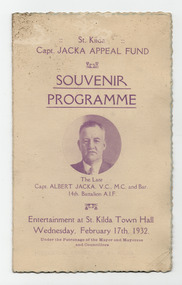
Ephemera - Special event program, Capt. Jacka Appeal Fund Souvenir Programme, 1932
... bravery on the Western Front. He received a hero's welcome on his return to Melbourne in January 1920 and an estimated 50,000 people turned up to watch his funeral procession to St Kilda Cemetery, where he was buried with full military honours. ...bravery on the Western Front. He received a hero's welcome on his return to Melbourne in January 1920 and an estimated 50,000 people turned up to watch his funeral procession to St Kilda Cemetery, where he was buried with full military honours. ...Concert program of entertainment as aprt of fundraising for the Jacka Appeal, held on 17 February 1932 at St Kilda Town Hall. The headline performer was Gladys Moncreiff, 'Australia's Queen of Song'. Albert Jacka, a St Kilda Councillor, collapsed on 14 December 1931 after a council meeting and was admitted to Caulfield Military Hospital. He died on 17 January 1932 at the age of 39. He is most well-known for his military service in WWI, having received the Victoria Cross medal for his actions during the Gallipoli campaign and two more decorations for his bravery on the Western Front. He received a hero's welcome on his return to Melbourne in January 1920 and an estimated 50,000 people turned up to watch his funeral procession to St Kilda Cemetery, where he was buried with full military honours. The Albert Jacka Fund had two objectives: the erection of a simple, suitable and inexpensive memorial stone over the grave of the dead hero; the placing of the residue of the fund in the hands of trustees for the benefit of his widow and child.Folded cream card with scalloped edges and printed in purplealbert jacka, jacka appeal, gladys moncreiff -
 Flagstaff Hill Maritime Museum and Village
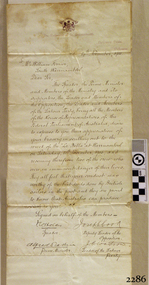
Letter - William Ferrier, 14th November 1905
... The letter to William Ferrier from the Australian Government acknowledges the bravery of ordinary Australians who risked their lives to save victims of shipwrecks along the coast. The letter is significant to the history of Warrnambool as it honours William Ferrier, a local fisherman whose descendants continue to live in the area. ...The letter to William Ferrier of South Warrnambool from the Prime Minister and the Parliament of the Commonwealth recognised the significance of William’s brave and courageous lifesaving act to the people of Australia; “They all feel that your conduct was worthy of the best deeds done by British sailors in the past and they are proud to know that Australia can produce such as you.” The story of that brave rescue follows on below … The ship from which the sailors were rescued was the three-masted, iron and steel barquentine the La Bella, built in Norway in 1893. She was one of two iron and steel ships by Johan Smith, The company was one of the leading shipping families in Tvedestrand, Norway. She was significant to Norwegian shipping, being one of only 27 iron and steel ships ever built in Norway. She was registered in New Zealand and engaged from 1902 in inter-colonial trading of timber in the Pacific, between New Zealand and Australia and was often in Port Phillip Bay, Victoria. On 5th October 1905, the twelve-year-old La Bella left Lyttleton, New Zealand carrying a cargo of timber bound for Warrnambool, Australia. She was manned by a crew of twelve: the Master, (Captain Mylius, previously 1st Mate of La Bella, appointed Captain to La Bella on 6th February 1903) 2 Mates, Cook, six able seamen, one ordinary seaman and a boy. Bad weather en route caused her to shelter at Burnie on Tasmania's North West coast. On November 10th, the 37th day of her journey, La Bella approached Warrnambool. Captain Mylius steered her towards Lady Bay Channel in heavy south-west seas and evening mist. He ordered the helmsman to steer for the light. As the ship came round, a tremendous sea struck her on the port quarter, causing her to breach broadside in a north-westerly direction into breakers. The helm was brought round twice more, but each time heavy seas broke over her, the third time throwing the La Bella on to a submerged reef in Lady Bay now known as La Bella Reef (about 100 yards from the Warrnambool breakwater). The sea was so rough that it even wrenched a one-and-a-half ton anchor from its fastenings and into the sea. As Captain Mylius headed to the steel wheelhouse, intending to send up a rocket flare, a huge sea slammed the steel door into him (resulting in massive bruising front and back) Despite his injuries he still managed to set off a blue light, which he held up in his hands. La Bella’s lifeboats were filled with seawater and broke up on their chocks. The blue light was the first indication to people on the shore that there was a ship in distress. The Harbour Master, Captain Roe (who lived in the Harbour Master’s House opposite Flagstaff Hill), organised a group of volunteers to crew the lifeboat because the trained crew was unavailable; the crewmen were working on a steamer in Port Fairy at the time. He then poured oil onto the water to try and smooth the sea. At around 11 pm three of the crew took shelter in the steel forecastle but the sea crashed into it and broke it up. While the rest of the crew and onlookers watched helplessly in the moonlight the bodies were washed away into the sea, never to be seen again. Some of the crew lashed themselves to the weather rail to keep from being washed away. Watson, the ordinary seaman, became tangled in the rigging lines and was too weak to move, so the 2nd Mate, Robertson, put a line onto him so that he wouldn’t wash off. Around 11 pm three of the crew were unconscious from exhaustion. The situation on La Bella was becoming dangerous. The 2nd Mate moved to the ‘house’ and soon afterwards the ship slipped in the heavy sea. The lashings of the 1st Mate and the ‘boy’ Denham had kept them safe until about 2 am when they were washed overboard; no one was able to help. One by one, the exhausted crew were being washed overboard, too weak to hold on any longer. During the night the La Bella had broken into two and the deckhouse ran out towards the sea. Two more men drowned when trying to reach the lifeboat. By sunrise, the only survivors of the twelve were the Master, 2nd Mate and three seamen. Early in the morning, Captain Roe used the rocket apparatus on shore to try and shoot a line to the ship for a safer rescue but each attempt fell short of the target. Several attempts were made by the lifeboat to rescue the stricken sailors, but the rough conditions made this difficult for the boat to get close enough to the ship and the lifeboat had to return to shore. During a final attempt to reach the ship Captain Mylius ordered his men to jump into the sea. Leonard Robertson, 2nd mate, jumped and swam towards the lifeboat, taking hold of the boat hook offered to him. Oscar Rosenholme managed to reach the boat floating on a piece of timber from the ship’s load and a third survivor, Noake, also made the boat. Along with the lifeboat rescue crew, 25-year-old William Ferrier rowed his small dingy through the heavy seas and managed to rescue the Captain, whom he landed on the breakwater. Ferrier then returned to the ship to attempt a final rescue, losing his oars and rowlocks into the high sea. Using just a spare paddle he skulled towards the La Bella, reaching her stern in time to cut loose the lone surviving sailor, Payne, from the lashing that held him to the ship; the terrified sailor dropped from the ship and into the dingy. Shortly after the last man was rescued, the La Bella was lifted by a huge wave and crashed back down on the reef; she broke up and sank. The ordeal had lasted ten hours. The survivors were taken to the nearby Bay View Hotel and gratefully received warm food and clothing, medical attention and a place to sleep. In the following days, an unidentified body of a young person has washed ashore; it was either Watson or Denham. The body was buried in the Warrnambool cemetery with an appropriate gravestone and inscription. William Ferrier became a national hero as news of the daring rescue spread. In recognition of his bravery in the two daring rescues, he was awarded the Silver Medal for Bravery by the Royal Humane Society and was honoured in the letter from the Prime Minister and the Parliament of the Commonwealth, telegrams and a cheque for £20 from the Governor-General, over £150 subscribed by the public, including Warrnambool and district and readers of The Argus, and a gold medal from the Glenelg Dinghy Club of South Australia. Ferrier’s rescue efforts are one of the most heroic in Victoria’s shipwreck history. (William Ferrier’s son, Frank, received a similar award almost fifty years later when he helped rescue four members of the crew on the yacht Merlan after it ran on to a reef near the Point Lonsdale Lighthouse. ) The wreck of La Bella now lies on her port side in 13 metres of sheltered water inside the reef she struck. The bow section is relatively intact and part of the stern has drifted north-easterly towards the mouth of the Hopkins River. The reef the La Bella struck now bears its name. Those five rescued from the La Bella were Captain George Mylius, Leonard Robertson (2nd Mate, 21 years old), R. Payne, Oscar Rosenholme and Jack Noake. Those seven who lost their lives were Mr Coulson (1st mate), Charles Jackman (cook) Gustave Johnson, Pierre Johann and Robert Gent (all able seamen), Harry Watson (ordinary seaman) and Jack Denham (ship’s boy), Captain Mylius was found guilty of careless navigation; he had sailed into the bay without the services of a pilot. His Master Certificate was suspended for twelve months. Later he was also charged with the manslaughter of one of the crew who had died when the La Bella was wrecked but found not guilty. The event’s adverse publicity and damage to his career took a toll on his health and he died of a heart attack six months after the wreck; he was only thirty-seven. His body was buried in the Melbourne General Cemetery. The La Bella was “the best documented of all sailing ships owned in New Zealand”. Her record books, ship logs, correspondence and supporting papers are still available. At the time of the tragedy, she was owned by Messers David C.Turnbull and Co. of Timaru, New Zealand timber merchants and shipping agents, who had purchased her on 13th December 1901. A detailed account of the last journey of La Bella can be read in “Leonard Robertson, the Whangaroa & La Bella” written by Jack Churchouse, published in 1982 by Millwood Press Ltd, Wellington, NZ. As well as this letter, Flagstaff Hill’s La Bella Collection includes a photograph of the wrecked La Bella, a brass rail holder and a postcard of William Ferrier with four of the survivors. Some 15 – 17 ships are believed to have sunk in Lady Bay, but only two have been discovered on the seafloor; the “La Bella” and the “Edinburgh Castle”. Both wrecks are popular diving sites and are preserved as significant historical marine and marine archaeological sites. This original congratulatory letter sent to William Ferrier by the Prime Minister and Government of Australia demonstrates the importance attached to his efforts for Victoria and to Australia. The letter is part of the La Bella Collection and is significant at both a local and state level. Its connection to the La Bella shipwreck and the rescue of five survivors highlights the dangers of Victoria’s Shipwreck Coast. The letter to William Ferrier from the Australian Government acknowledges the bravery of ordinary Australians who risked their lives to save victims of shipwrecks along the coast. The letter is significant to the history of Warrnambool as it honours William Ferrier, a local fisherman whose descendants continue to live in the area. It highlights the way of life of people who lived in coastal towns in 19th century Victoria and the effects of shipwrecks upon them. The letter connects to the postcard of William Ferrier with four of the five rescued crew, the photograph of the wreck of the La Bella and the artefact from the wreck, the rail holder. This letter is significant because of its association with the sailing ship “La Bella”. The “La Bella” is of local and state and national significance. It is one of the only two shipwrecks discovered in Lady Bay, Warrnambool, out of the 15-17 shipwrecks in the bay. Letter to William Ferrier of South Warrnambool from the Prime Minister and Members of Parliament commending him on his bravery. The printed letterhead includes a coat of arms in the top centre and the official address. The letter is very neatly hand written in black pen and includes 4 signatures of Members of Parliament. The rectangular paper is cream coloured with some yellow/brown discolouring. It has the letterhead on the right hand side of it and the written letter begins below the letterhead. The paper has been folded so that the right side becomes the cover page of the letter. The writing is continued onto the inside right hand page of the folded paper and the writing ends here. There is more recent writing on the bottom right hand corner of the back page. The paper has been officially folded in half a total 3 times and there is heavy discolouration on the sections that form the front and back of the folded letter. There is a 4th fold line that is less pronounced that the other folds and would make the paper the size to fit into a pocket. At several fold creases the paper has worn through. The edges of the paper have minor tears. The printed coat of arms is that of the House of Representatives. Underneath is printed “The Parliament of the Commonwealth, / Parliament House / Melbourne”. The hand written, letter is dated “14th November, 1905” and addressed to “Mr. William Ferrier / South Warrnambool” The letter begins “The Speaker, the Prime Minister and Members of the Ministry and its supporters, the Leader and Members of the Opposition, the Leader and Members of the Labour Party, being all the Members of the House of Representatives of the Federal Parliament of Australia” … It continues “desire to express to you their appreciation of your bravery in skulling out to the wreck of the “La Bella” at Warrnambool on Saturday, 11th November, 1905, and recovering therefrom two of the crew who were in imminent danger of their lives. They all feel that your conduct was worthy of the best deeds done by British sailors in the past and they are proud to know that Australia can produce such as you.” The letter is “Signed on behalf of the Members – Speaker (Frederick Holder ), Deputy Leader of the Opposition (Joseph Cook ), Prime Minister (Alfred Deakin), Leader of the Labour Party ( J.C. Watson)” On the back of the letter is blue ink handwriting “OWNER / G. FERRIER / TO. BE. PHOTOGRAPHED / 27-4-76”la bella, william ferrier, bill ferrier, lady bay, 1905, 10th november 1905, 11th november 1905, parliament of the commonwealth, prime minister, australian government, new zealand, flagstaff hill, warrnambool, shipwrecked coast, flagstaff hill maritime museum, maritime museum, shipwreck coast, flagstaff hill maritime village -
 Flagstaff Hill Maritime Museum and Village
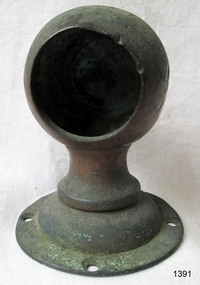
Functional object - Rail holder, About 1893, when the ship was made
... The letter to William Ferrier from the Australian Government acknowledges the bravery of ordinary Australians who risked their lives to save victims of shipwrecks along the coast. The letter is significant to the history of Warrnambool as it honours William Ferrier, a local fisherman whose descendants continue to live in the area. ...This brass rail holder fixture would have been used to hold the end of a rail in place. There is no information as to where the fitting or rail would have been placed on the ship; sailing ships had many brass fittings. It was recovered from the wreck of the La Bella, which lies at the bottom of the Warrnambool Harbour. Some 15 ships are believed to have been wrecked in Lady Bay, but only two have been discovered on the sea floor; the La Bella and the Edinburgh Castle. Both wrecks are popular diving sites and are preserved as significant historical marine and marine archaeological sites. The story of the final voyage of the La Bella is summarised as follows … The ship from which the sailors were rescued was the three-masted, iron and steel barquentine the La Bella, built in Norway in 1893. She was one of two iron and steel ships by Johan Smith, the company being one of the leading shipping families in Tvedestrand, Norway. She was significant to Norwegian shipping, being one of only 27 iron and steel ships ever built in Norway. She was registered in New Zealand and engaged from 1902 in inter-colonial trading of timber in the pacific, between New Zealand and Australia and was often in Port Phillip Bay, Victoria. On 5th October, 1905, the twelve year old La Bella left Lyttleton, New Zealand carrying a cargo of timber bound for Warrnambool, Australia . She was manned by a crew of twelve: the Master, (Captain Mylius, previously 1st Mate of La Bella, appointed Captain to La Bella on 6th February 1903) 2 Mates, Cook, six able seamen, one ordinary seaman and a boy. . Bad weather en route caused her to shelter at Burnie on Tasmania's North West coast. On November 10th, the 37th day of her journey, La Bella approached Warrnambool. Captain Mylius steered her towards Lady Bay Channel in heavy south-west seas and evening mist. He ordered the helmsman to steer for the light. As the ship came round, a tremendous sea struck her on the port quarter, causing her to breach broadside in a north-westerly direction into breakers. The helm was brought round twice more, but each time heavy seas broke over her, the third time throwing the La Bella on to a submerged reef in Lady Bay now known as La Bella Reef (about 100 yards from the Warrnambool breakwater). The sea was so rough that it even wrenched a one-and-a-half ton anchor from its fastenings and into the sea. As Captain Mylius headed to the steel wheelhouse, intending to send up a rocket flare, a huge sea slammed the steel door into him (resulting in massive bruising front and back) Despite his injuries he still managed to set off a blue light, which he held up in his hands. La Bella’s lifeboats were filled with sea water and broke up on their chocks. The blue light was the first indication to people on shore that there was a ship in distress. The Harbour Master, Captain Roe (who lived in the Harbour Master’s House opposite Flagstaff Hill), organised a group of volunteers to crew the lifeboat because the trained crew was unavailable; the crewmen were working on a steamer in Port Fairy at the time. He then poured oil onto the water to try and smooth the sea. At around 11pm three of the crew took shelter in the steel forecastle but the sea crashed into it and broke it up. While the rest of the crew and onlookers watched helplessly in the moonlight the bodies were washed away into the sea, never to be seen again. Some of the crew lashed themselves to the weather rail to keep from being washed away. Watson, the ordinary seaman, became tangled in the rigging lines and was too weak to move, so the 2nd Mate, Robertson, put a line onto him so that he wouldn’t wash off. Around 11pm three of the crew were unconscious from exhaustion. The situation on La Bella was becoming dangerous. The 2nd Mate moved to the ‘house’ and soon afterwards the ship slipped in the heavy sea. The lashings of the 1st Mate and the ‘boy’ Denham had kept them safe until about 2am when they were washed overboard; no one was able to help. One by one, the exhausted crew were being washed overboard, too weak to hold on any longer. During the night the La Bella had broken into two and the deckhouse ran out towards the sea. Two more men drowned when trying to reach the lifeboat. By sunrise the only survivors of the twelve were the Master, 2nd Mate and three seamen. Early in the morning Captain Roe used the rocket apparatus on shore to try and shoot a line to the ship for a safer rescue but each attempt fell short of the target. Several attempts were made by the lifeboat to rescue the stricken sailors, but the rough conditions made this difficult for the boat to get close enough to the ship and the lifeboat had to return to shore. During a final attempt to reach the ship Captain Mylius ordered his men to jump into the sea. Leonard Robertson, 2nd mate, jumped and swam towards the lifeboat, taking hold of the boat hook offered to him. Oscar Rosenholme managed to reach the boat floating on a piece of timber from the ship’s load and a third survivor, Noake, also made the boat. Along with the lifeboat rescue crew, 25 year old William Ferrier rowed his small dingy through the heavy seas and managed to rescue the Captain, whom he landed on the breakwater. Ferrier then returned to the ship to attempt a final rescue, losing his oars and rowlocks into the high sea. Using just a spare paddle he skulled towards the La Bella, reaching her stern in time to cut loose the lone surviving sailor, Payne, from the lashing that held him to the ship; the terrified sailor dropped from the ship and into the dingy. Shortly after the last man was rescued, the La Bella was lifted by a huge wave and crashed back down on the reef; she broke up and sank. The ordeal had lasted ten hours. The survivors were taken to the nearby Bay View Hotel and gratefully received warm food and clothing, medical attention and a place to sleep. In the following days an unidentified body of a young person was washed ashore; it was either Watson or Denham. The body was buried in the Warrnambool cemetery with an appropriate gravestone and inscription. William Ferrier became a national hero as news of the daring rescue spread. In recognition of his bravery in the two daring rescues he was awarded the Silver Medal for Bravery by the Royal Humane Society and was honoured in the letter from the Prime Minister and the Parliament of the Commonwealth, telegrams and a cheque for £20 from the Governor General, over £150 subscribed by the public, including Warrnambool and district and readers of The Argus, and a gold medal from the Glenelg Dinghy Club of South Australia. Ferrier’s rescue efforts are one of the most heroic in Victoria’s shipwreck history. (William Ferrier’s son, Frank, received a similar award almost fifty years later, when he helped rescue four members of the crew on the yacht Merlan, after it ran on to a reef near the Point Lonsdale Lighthouse. ) The wreck of La Bella now lies on her port side in 13 metres of sheltered water inside the reef she struck. The bow section is relatively intact and part of the stern has drifted north-easterly towards the mouth of the Hopkins River. The reef the La Bella struck now bears its name. Those five rescued from the La Bella were Captain George Mylius, Leonard Robertson (2nd Mate, 21 years old), R. Payne, Oscar Rosenholme and Jack Noake. Those seven who lost their lives were Mr Coulson (1st mate), Charles Jackman (cook) Gustave Johnson, Pierre Johann and Robert Gent (all able seamen), Harry Watson (ordinary seaman) and Jack Denham (ship’s boy), Captain Mylius was found guilty of careless navigation; he had sailed into the bay without the services of a pilot. His Master Certificate was suspended for twelve months. Later he was also charged with manslaughter of one of the crew who had died when the La Bella was wrecked, but found not guilty. The event’s adverse publicity and damage to his career took a toll on his health and he died of a heart attack six months after the wreck; he was only thirty-seven. His body was buried in the Melbourne General Cemetery. The La Bella was “the best documented of all sailing ships owned in New Zealand”. Her record books, ship logs, correspondence and supporting papers are still available. At the time of the tragedy, she was owned by Messers David C.Turnbull and Co. of Timaru, New Zealand timber merchants and shipping agents, who had purchased her on 13th December 1901. A detailed account of the last journey of La Bella can be read in “Leonard Robertson, the Whangaroa & La Bella” written by Jack Churchouse, published in 1982 by Millwood Press Ltd, Wellington, NZ. Some 15 – 17 ships are believed to have sunk in Lady Bay, but only two have been discovered on the seafloor; the “La Bella” and the “Edinburgh Castle”. Both wrecks are popular diving sites and are preserved as significant historical marine and marine archaeological sites. As well as this letter, Flagstaff Hill’s La Bella Collection includes a photograph of the wrecked La Bella, a brass rail holder and a postcard of William Ferrier with four of the survivors. This original congratulatory letter sent to William Ferrier by the Prime Minister and Government of Australia demonstrates the importance attached to his efforts for Victoria and to Australia. The letter is part of the La Bella Collection and is significant at both a local and state level. Its connection to the La Bella shipwreck and the rescue of five survivors highlights the dangers of Victoria’s Shipwreck Coast. The letter to William Ferrier from the Australian Government acknowledges the bravery of ordinary Australians who risked their lives to save victims of shipwrecks along the coast. The letter is significant to the history of Warrnambool as it honours William Ferrier, a local fisherman whose descendants continue to live in the area. It highlights the way of life of people who lived in coastal towns in 19th century Victoria and the effects of shipwrecks upon them. The letter connects to the postcard of William Ferrier with four of the five rescued crew, the photograph of the wreck of the La Bella and the artefact from the wreck, the rail holder. This item is significant because of its association with the sailing ship “La Bella” . the “La Bella” is of local and state and national significance. It is one of the only two shipwrecks discovered in Lady Bay, Warrnambool, out of the 15-17 shipwrecks in the bay. Brass rail holder from the wreck "La Bella". This rail holder would have been used as a fitting for the end of a rail. It is made up of two parts and looks a little like a goblet in shape. The top is a hollow spherical shape with a circular hole cut out on one side, into which the end of a round rail would fit. There are two gouge marks close to each other on one side of the hole, about one centimetre apart, at 1 and 2 o’clock position. The sphere has a hollow pipe-like stem with a screw thread turned into the outside of the lower section and the bottom of the stem has been flared out after having the base fitted. The base is round and has a mound in the centre. The edge has four evenly spaced fixture holes around its edge. The metal shows signs of pitting and has mild encrustation. The fitting of the base is loose, allowing it to swivel in a complete circle. The top of the sphere is rough and has a dent in it. Underneath the base there is verdigris; some has flaked off and reveals a bright golden colour underneath. rail holder, brass rail holder, la bella, lady bay, norway, 1893, new zealand, captain mylius, william ferrier, flagstaff hill, warrnambool, shipwrecked coast, flagstaff hill maritime museum, maritime museum, shipwreck coast, flagstaff hill maritime village -
 Moorabbin Air Museum
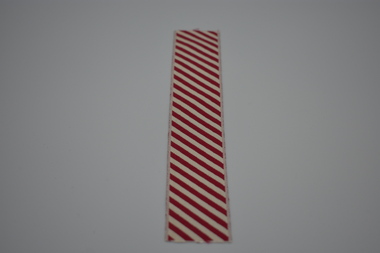
Badge (item) - Military Medal Ribbon, Air Force Medal (AFM)
... The Air Force Medal represents bravery and skill in non-combat roles. It honours those who perform with excellence under pressure, often in dangerous or critical situations that require precision and calm....The Air Force Medal represents bravery and skill in non-combat roles. It honours those who perform with excellence under pressure, often in dangerous or critical situations that require precision and calm. ... -
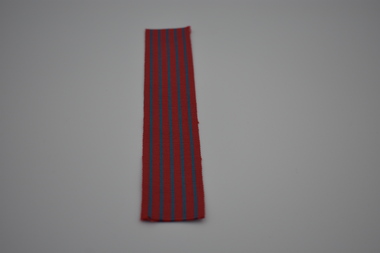 Moorabbin Air Museum
Badge (item) - Military Medal Ribbon, George Medal (GM)
... The George Medal was instituted in 1940 by King George VI for acts of great bravery by civilians and military personnel where military honours would not typically be awarded. ...The George Medal was instituted in 1940 by King George VI for acts of great bravery by civilians and military personnel where military honours would not typically be awarded. ...
