
Showing 3 items matching "breakfast dishes"
-
 Emerald Museum & Nobelius Heritage Park
Domestic object - Silver breakfast set
... ...Breakfast dishes...Emerald Victoria Australia Silverware Breakfast dishes Mrs Jackie Nagel Silver breakfast set comprising sugar basin, butter dish with cover, two butter knives, 1 salt spoon, child's pusher and four egg cupes on stand with handle Domestic object Silver breakfast set. ...Silver breakfast set comprising sugar basin, butter dish with cover, two butter knives, 1 salt spoon, child's pusher and four egg cupes on stand with handleemerald, victoria, australia, silverware, breakfast dishes, mrs jackie nagel -
 Eltham District Historical Society Inc
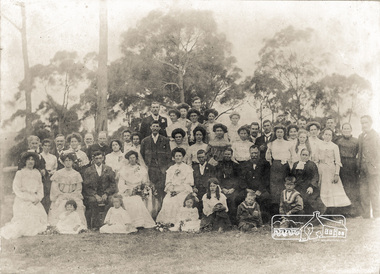
Photograph, Wedding of Sarah Ann Bird (b.1881) to Edward Ernest Pepper (b.1874) held at the Bird family home of "View Hill', Eltham, 1904, 1904
... Bird, silver breakfast cruet; Miss N. Bird, bread board and knife; Master A. Bird, pair glass dishes; Master R. ...Bird, silver breakfast cruet; Miss N. Bird, bread board and knife; Master A. Bird, pair glass dishes; Master R. ...Sarah Bird 4th from left (seated) and Edward Pepper on her left (standing). George Bird, 2nd from right (seated). George Bird her great-grandfather and Sarah Bird and Edward Pepper, her grandparents. [from Evelyn Observer and Bourke East Record, morning edition, 18 November 1904, p. 3:] ORANGE BLOSSOM. The marriage of Miss Sarah A. Bird, eldest daughter of Mr George Bird, of "View Hill," Eltham, to Mr Ernest Edward Pepper, of Diamond Creek, was celebrated at the residence of the bride's parents on Wednesday, 9th November, 1904. The ceremony took place at 4 p.m. and was performed by the Rev Percey Knight, B.A., of Alphington. The bride entered the drawing room with her father who gave her away, and the Wedding March, was nicely played by Miss Wild. The bride was prettily dressed in creme voile nicely tucked and gathered, trimmed with guipure lace and silk ruching, sprays of orange blossom, wreath and veil, and she carried a shower bouquet. Her travelling dress was a very pretty blue. The brides-maids were Miss Ethel Barker dressed in pale green voile trimmed with creme guipure lace and silk ruching; and Miss Button in creme voile, guipure lace, silk ruching; both carried pretty bouquets. The groomsmen were Mr Lorimer, of Diamond Creek, and Mr George Bird, brother of the bride. Between forty and fifty relatives and friends partook of a bountifully provided and nicely laid out breakfast. The usual toasts were honored, and congratulations were freely tendered "to the happy couple". The decorations were very tastefully executed by Miss Beatrice Nelson, and Mr Sayers. The evening was very pleasantly spent in singing, recitations, games, and other suitable pastimes, while others "tipped the light fantastic toe". About 10 p.m., "while all was merry as a marriage bell", the bride and bridegroom departed secretly "to cheat surprise and prying eyes". The presents were numerous and handsome:– Parents of the bride, sewing machine; Miss A. Bird, silver breakfast cruet; Miss N. Bird, bread board and knife; Master A. Bird, pair glass dishes; Master R. Bird, pair photo frames; Mr Sayers, tea set; Miss Kidd, silver jam dish and spoon; Miss Wilkinson, carpet; Mr J. Kilpatrick, cheque; Mr W. Kilpatrick, clock; Miss Kilpatrick, silver butter knife; Mr J. H. Kilpatrick, hand painted mirror; Mrs Kerwin, pictures; Mrs Gilsenan, the handsome wedding cake; Mrs Nelson, Japanese occasional table; Misses Nelson, jugs and candlestick; Mrs Bunker, silver cruet stand; Miss Bunker, hand-painted vases; Miss E. Bunker, epergne; Mr E. Bunker, crumb tray and brush; Miss Jessie Gilsenan, cake stand; Mr Harold Gilsenan, auger basin and ornaments; Mr Lorimer, silver breakfast cruet; Mr A. Collins and Miss Jones, epergne; Miss Cassie Sweeney, jardiniere; Miss Ida and Ollie Cooper, silver butter dish; Miss Mills, large vases; Misses M. and F. Shillinglaw, handsome oak clock; Misses C. and E. Shillinglaw, pair large pictures; Mr Lucas and Miss Sutton, silver butter dish and knife, and silver jam dish and spoon; Miss M. and A. Short, teapot, cheese dish, and tumblers; Mr and Mrs J. Anderson, butter dish; Miss Williams, pen tray; Miss Griffiths, vases; Mr I. Hill, cheque; Miss Wild, biscuit barrel; Mr, Mrs and Miss Brown, trifle bowl and crystal jug; Mrs Weller, water jug and glasses; Mrs Hadfield, pair glass dishes and butter dish; Mr and Mrs Blackney, photo frames; Mr Wilson, beaded basket pin cushion; Mr Linsy, cheque; Mrs Linsy, fruit dish; Mrs Stebbing, pair candle sticks; Mrs Blanchard, pictures.Digital copy of framed sepia photographanderson, bird, blanchard, blackney, bunker, collins, cooper, edward ernest pepper, george bird, george bird jnr, gilsenan, griffiths, hadfield, hill, jones, kerwin, kidd, kilpatrick, linsy, mills, nelson, sarah ann bird, sayers, shillinglaw, short, stebbing, sutton, sweeney, view hill, wedding, weller, wild, wilkinson, williams, wilson, brown, lesley mitchell (nee pepper) collection -
 Emerald Museum & Nobelius Heritage Park
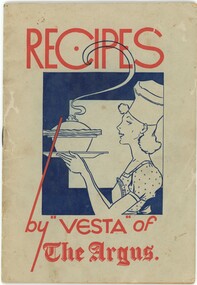
Booklet - The Argus Recipe Book, Stella Allan, Recipes by Vesta of the Argus, Circa 1939
... Books Domestic Life 1930s Cooking The Argus This is a recipe book, with sections for recipes for "Soups", "Meat Dishes", "Breakfast, Luncheon and Supper Dishes", "Egg Dishes and Pastry Recipes", "Sweets Course", and "For Afternoon Tea". ...This is a recipe book, with sections for recipes for "Soups", "Meat Dishes", "Breakfast, Luncheon and Supper Dishes", "Egg Dishes and Pastry Recipes", "Sweets Course", and "For Afternoon Tea". The pages alternate between a page on the left containing recipes, and a page on the right instructing readers to paste recipes cut out from the Argus there. "Vesta," also known as Stella Allan, began her journalistic career as an active feminist and socialist in New Zealand who, after qualifying to practice law, overcame gendered exclusion from the all-male press gallery to work a prestigious position as a parliamentary correspondent. After moving to Melbourne in 1903, she was swiftly employed by the Argus newspaper and became the lead writer for the women's sections in 1908, continuing to work in the role until she retired in 1939. During this time she extensively covered domestic and community welfare topics, alongside advice columns replying to a vast quantity of letters; her writing contributed to creating a space in newspaper journalism to address the interests of women at the time. During her time at the Argus she moved away from the radical activism of her youth, becoming an establishment figure over the course of her long career. She was a prominent figure in Melbourne life as President of the Victorian Women’s Writers’ Club, the Lyceum Club, and a foundation member of the Australian Journalists’ Association. Even after her retirement from the Argus, her journalism continued to have an influence; during the Second World War, Stella reported from England on the wartime experiences of women and children. This recipe book was one of several written by "Vesta" - most likely, this is the 1939 edition - and aimed to provide a collection of nutritious recipes to aid women in choosing meals to cook for their households. The introduction to the book stresses the importance of nutrition, referring to a League of Nations survey that revealed that "in spite of our abundant and varied food supply, nutritional and dental diseases are much too prevalent in Australia." It calls on the women of Australia to fulfil the "great responsibility," of choosing and cooking nutritious meals.The cardstock front cover of this 32-page booklet features text denoting the title and author in red, and an illustration in blue of a woman wearing a chef's hat holding a pie in front of her, with steam rising from it. The rear features publication information and an advertisement. The booklet is bound with a single staple through the spine, and constructed from eight individual pieces of paper each with two pages of text printed on each side.non-fictionThis is a recipe book, with sections for recipes for "Soups", "Meat Dishes", "Breakfast, Luncheon and Supper Dishes", "Egg Dishes and Pastry Recipes", "Sweets Course", and "For Afternoon Tea". The pages alternate between a page on the left containing recipes, and a page on the right instructing readers to paste recipes cut out from the Argus there. "Vesta," also known as Stella Allan, began her journalistic career as an active feminist and socialist in New Zealand who, after qualifying to practice law, overcame gendered exclusion from the all-male press gallery to work a prestigious position as a parliamentary correspondent. After moving to Melbourne in 1903, she was swiftly employed by the Argus newspaper and became the lead writer for the women's sections in 1908, continuing to work in the role until she retired in 1939. During this time she extensively covered domestic and community welfare topics, alongside advice columns replying to a vast quantity of letters; her writing contributed to creating a space in newspaper journalism to address the interests of women at the time. During her time at the Argus she moved away from the radical activism of her youth, becoming an establishment figure over the course of her long career. She was a prominent figure in Melbourne life as President of the Victorian Women’s Writers’ Club, the Lyceum Club, and a foundation member of the Australian Journalists’ Association. Even after her retirement from the Argus, her journalism continued to have an influence; during the Second World War, Stella reported from England on the wartime experiences of women and children. This recipe book was one of several written by "Vesta" - most likely, this is the 1939 edition - and aimed to provide a collection of nutritious recipes to aid women in choosing meals to cook for their households. The introduction to the book stresses the importance of nutrition, referring to a League of Nations survey that revealed that "in spite of our abundant and varied food supply, nutritional and dental diseases are much too prevalent in Australia." It calls on the women of Australia to fulfil the "great responsibility," of choosing and cooking nutritious meals.books, domestic life, 1930s, cooking, the argus
