
Showing 8 items matching "british broadcasting commission"
-
 Federation University Historical Collection
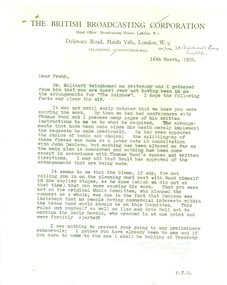
Correspondence, Frank Wright, British Broadcasting Corporation to Frank Wright, 1951, March 1951
... ...british broadcasting commission...The Frank Wright Medal at the Royal South Street competition is awarded to an individual recognized as making an outstanding contribution to brass music in Australia. frank wright british broadcasting commission thomas wood the rainbow brass bands 1). ...Frank Wright was a renown resident of Smeaton, where he was born on 2 August 1901. He lived at Laura Villa, and attended Smeaton State School. His father William was a gold miner and his mother's name was Sarah. Their family won many singing and instrumental awards. Frank was tutored by Percy Code and was awarded a gold medal for the highest marks in the ALCM examinations in the British Colonies at the age of seventeen years. He became the Australian Open Cornet Champion by the age of eighteen. A year later, Frank conducted the City of Ballarat Band, and later the Ballarat Soldiers’ Memorial Band. He formed the Frank Wright Frisco Band and Frank Wright and his Coliseum Orchestra. These bands won many South Street awards, and Frank as conductor won many awards in the Australian Band Championship contest. In 1933 Frank Wright sailed to England to conduct the famous St Hilda’s Band and was later appointed Musical Director of the London County Council, where he organized many amazing concerts in parks, in and around the London district. He was made Professor of Brass and Military Band Scoring and conducted at the Guildhall of Music and Drama. Frank was often invited to adjudicate Brass Band Championships around Europe, in Australia, including South Street and in New Zealand. The Frank Wright Medal at the Royal South Street competition is awarded to an individual recognized as making an outstanding contribution to brass music in Australia.Three typed pieces of correspondence, two from Dennis of the British Broadcasting Corporation and one from Frank Wright to this same Dennis. They are regarding a misunderstanding over 'The Rainbow', a piece of work which Frank scored for Thomas Wood who wrote the music. 1). is written on letter head.1). The header address crossed out in blue pen and a private address added, plus name - Dennis 2). Date added in black pen frank wright, british broadcasting commission, thomas wood, the rainbow, brass bands -
 Eltham District Historical Society Inc
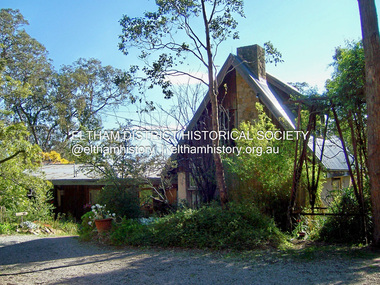
Photograph - Digital Photograph, Marguerite Marshall, Former home of Professor William MacMahon Ball, York Street, Eltham, 24 May 2007
... In 1945 he helped establish the United Nations, as political consultant to the Australian Delegation at the San Francisco Conference.3 Then in 1946 Mac was appointed British Commonwealth Representative on the Allied Council for Japan, which is recorded in detail in his diary.4 In 1948 Mac led an Australian Government Goodwill Mission to South East Asia. However, Mac was perhaps most successful as an academic and public speaker.5 He was a commentator on the Australian Broadcasting Commission, from the early 1930s to the early 1960s. ...In 1945 he helped establish the United Nations, as political consultant to the Australian Delegation at the San Francisco Conference.3 Then in 1946 Mac was appointed British Commonwealth Representative on the Allied Council for Japan, which is recorded in detail in his diary.4 In 1948 Mac led an Australian Government Goodwill Mission to South East Asia. However, Mac was perhaps most successful as an academic and public speaker.5 He was a commentator on the Australian Broadcasting Commission, from the early 1930s to the early 1960s. ...Situated at the eastern end of York Street, Eltham, 'Shinrone', the former home of Professor William (Mac) MacMahon Ball was one of the first in the Shire of Eltham to incorporate mud-brick. Professor MacMahon Ball, a political scientist, writer, broadcaster and diplomat and family moved to York Street, Eltham in 1945 into a timber cottage built around the 1890s and in poor repair. Mac asked Alistair Knox to renovate the home and he expanded the living area and added verandahs. In 1948 Montsalvat artist and sculptor Sonia Skipper supervised the building of most of the mud-brick studio. Neighbour Gordon Ford made the mud-bricks. Mac also asked John Harcourt, who had worked with him as a journalist in shortwave broadcasting, to build a pise (rammed earth) and stone addition to the largely timber house. Harcourt built two bedrooms - including an attic bedroom - a balcony with a shower and toilet, a nd a fireplace and chimney of local stone. Published: Nillumbik Now and Then / Marguerite Marshall 2008; photographs Alan King with Marguerite Marshall.; p141 At the eastern tip of York Street, Eltham, stands Shinrone, the former home of one of Australia’s intellectual leaders. Professor William Macmahon Ball, was one of the first to bring Asia as a foreign policy issue to the Australian public.1 He was a political scientist, writer, broadcaster and diplomat. The house was one of the first in Eltham Shire to incorporate mud-brick,2 because of the acute shortage of building materials after World War Two. Its novice builders later become leaders in Eltham’s built and garden design. Mac (as he was usually called), who was the son of a Church of England minister, was born in Casterton, Victoria in 1901 and died in 1986. In 1945 he helped establish the United Nations, as political consultant to the Australian Delegation at the San Francisco Conference.3 Then in 1946 Mac was appointed British Commonwealth Representative on the Allied Council for Japan, which is recorded in detail in his diary.4 In 1948 Mac led an Australian Government Goodwill Mission to South East Asia. However, Mac was perhaps most successful as an academic and public speaker.5 He was a commentator on the Australian Broadcasting Commission, from the early 1930s to the early 1960s. He was also Controller of the Short-Wave Broadcasting Unit during World War Two, which later became Radio Australia. From 1923 he taught at The University of Melbourne, then became foundation Professor of Political Science in 1949 and was Chair until his retirement in 1968.6 In 1942, as the government expected a Japanese invasion, Mac’s wife Katrine and their only child Jenny, moved from Kew to Eltham as temporary evacuees. However Mac and Katrine lived in Eltham for almost the rest of their lives. After staying with friends, they rented a house in Reynolds Road, where, as it was wartime, they needed to keep horses for transport and a cow and poultry for milk and eggs. In 1945 the family moved to the house at York Street, which was then a timber cottage, built around the 1890s and in poor repair. The underground well, cellar and part of the garden are all that remain of what stood on the original 18 acre (7.3ha) allotment. Thanks largely to Katrine’s hard work, the house was gradually renovated and extended. The long rambling house was partially built by several young neighbours, who were inspired by the cheap mud-brick and stone building style of Montsalvat, the Eltham artists’ colony. Mac asked Alistair Knox to renovate Shinrone, named after an Irish village near Katrine’s family home. Knox later popularised the mud-brick style of house construction, for which Eltham became known. He expanded the living area and added verandas. In 1948 Montsalvat artist and sculptor Sonia Skipper supervised the building of most of the mud-brick studio. Another neighbour, Gordon Ford, who was to have a major influence on the Australian garden style, made the mud-bricks. Mac also asked John Harcourt, who had worked with him as a journalist in short-wave broadcasting, to build a pisé (rammed earth) and stone addition to the largely timber house. Harcourt built two bedrooms – including an attic bedroom – a balcony with a shower and toilet, and a fireplace and chimney of local sandstone. With pioneering work naturally came mistakes, including one particularly dramatic incident when Harcourt was building walls with unsupported sections. Jenny Ellis, Mac’s daughter, remembers being awakened from sleep by a thundering shudder. The wall of her room had fallen down – fortunately away from her! In 1950 artist Peter Glass – another neighbour and later landscape designer – built Katrine a mud-brick pottery. As a result, the house features at one end Harcourt’s characteristic steep gable roof, while at the other the flatter construction characteristic of Knox. Mac referred to the home as the Eltham ‘experimental building site’.7 Surprisingly, the combination works, perhaps partly because it has the warm inviting feel of timber, mud-brick and stone.This collection of almost 130 photos about places and people within the Shire of Nillumbik, an urban and rural municipality in Melbourne's north, contributes to an understanding of the history of the Shire. Published in 2008 immediately prior to the Black Saturday bushfires of February 7, 2009, it documents sites that were impacted, and in some cases destroyed by the fires. It includes photographs taken especially for the publication, creating a unique time capsule representing the Shire in the early 21st century. It remains the most recent comprehenesive publication devoted to the Shire's history connecting local residents to the past. nillumbik now and then (marshall-king) collection, eltham, alistair knox, gordon ford, john harcourt, mudbrick construction, pise construction, professor macmahon ball, shinrone, sonia skipper, york street -
 Bendigo Historical Society Inc.
Document - ROYAL PRINCESS THEATRE COLLECTION: VICTORIAN SYMPHONY ORCHESTRA, c1954
... Broadcasting Commission; committee members. Photos: Juan Jose Castro, Cover. Joan Jones, page 4. Advertisements: QANTAS and B O A C , Qantas Empire Airways LTD. (incorporated I Queensland) in parallel with BRITISH...Broadcasting Commission; committee members. Photos: Juan Jose Castro Cover. Joan Jones page 4. Advertisements: QANTAS and B O A C Qantas Empire Airways LTD. (incorporated I Queensland) in parallel with BRITISH ...Victorian Symphony Orchestra, Royal Princess Theatre, Bendigo. Direction: Australian Broadcasting Commission. Conducted by Juan Jose Castro. Soloist: Donald Westlake (Clarinet). This series of concerts is arranged by the Australian Broadcasting Commission in Conjunction with the Government of Victoria. Royal Princess Theatre, Bendigo, Thur., 12 Nov. 8 p.m. Programme. Juan Jose Castro. Since he left Australia last November on six months' leave, Mr. Castro has been conducting and holidaying in Europe, and with his wife re-visited South America for the first time in eighteen months. In Italy he corrected the publisher's proofs of his opera, 'Proserpina and the Stranger,' which won the Verdi Prize award by La Scala I 1952, and is now . . . Analytical Notes . . . Personnel of the Orchestra. Conductor: Juan Jose Castro. Associate Conductor: Clive Douglass. First Violins: Bertha Jorgensen (leader), Harry Hutchins (Assistant Leader), Frank Schieblich, Norman Deerson, Paul O'Brien, William Glassford, Ruth Michael, Alex Burlakov. Second Violins: Hyman Lenzer, Robert Pattison, George Paton, Donald Weekes, Marie Bull, Harvey Davis. Violas: Coin Kerr, Mischa Kogan, Marion Ogilvie, Winifred Roberts. Cellos: Don Howley, Henri Touzeau, Valerie Awburn, Ezio Neri. Basses: Guill Fraillon, Frank Cerbasi, Samuel Shiffron. Flutes: Richard Chugg, Leslie Barklamb, Audrey Walklate. Oboes: Jiri Tancibudek, David Woolley. Clarinets: Thomas White, Isobel Carter. Bassoons: Roy White, Gordon Miller, Gordon Grieve, Graham Bickford. Trumpets: Mervyn Simpson, John Geary. Trombones: Stanley Code, John McGade. Bass Trombone: Harold Willis. Tuba: Ron Stevens. Tympani: Gordon Craig. Percussion: Ernest Lighton, Bert Crawford. Harp: Adrian Bendall. Australian Broadcasting Commission; R J F Boyer M.A., Chairman. E R Dawes, Vice-Chairman. Sir John Medley, KT., D.C.L., L.L.D., M.A. P Vanthoff, M.V.O. The Hon. Dame Enid Lyons, G.B.E. J C Stewart, M W O'Donnell, B.E.C. Charles Moses, General Manager. T S Duckmanton, A./Manager for Victoria. Dorrie O'Neil, Concert Manager for Victoria. Photos: Juan Jose Castro, Donald Westlake. Advertisements: Notice to subscribers; Annual General Meeting for Albury, Bendigo, Shepparton, for 1954. TAA serves the Nation. Country Club, Tailored by Buckwalter. GMH, The whole story from A to Z. Carnegie's, 106 Elizabeth St. b/ Victorian Symphony Orchestra, Conducted by Juan Jose Castro, Soloist: Joan Jones (Contralto). This series of concerts is arranged by the Australian Broadcasting Commission in conjunction with the Government of Victoria. Town Hall, Swan Hill. Programme. Juan Jose Castro, (first 4 paragraphs reads as per 4280a). At the end of his 1953 Australian season, Mr. Castro is in conduct concerts in Italy, Paris and London, as well as being re-engaged for Yugo-Slavia, which he visited for the second time last December. With his wife he had the thrill of experiencing . . . Analytical Notes. Personnel of the Orchestra. Conductor: Juan Jose Castro. Associate Conductor: Clive Douglas. First Violins: Bertha Jorgensen (Leader), Harry Hutchins (Assistant Leader), Frank Schieblich, Norman Deerson, Paul O'Brien, William Glasford, Ruth Michael, Alex Burlakov. Second Violins: Hyman Lenzer, Reginald Bradley, Robert Pattison, Donald Weekes, Marie Bull, Harvey Davis Violas: Colin Kerr, Mischa Kogan, Marion Ogilvie, Winifred Roberts. Cellos: Don Howley, Henri Touzeau, Valerie Awburn, Ezio Neri. Basses: Guill Fraillon, Frank Cerbasi, Milinor Morton. Flutes: Richard Chugg, Leslie Barklamb, Audrey Walklate. Oboes: Jiri Tancibudek, David Woolley. Clarinets: Thomas White, Isobel Carter. Bassoons: Thomas Wightman, Noel Hunt. Trumpets: Mervyn Simpson, Standish Roberts. Trombones: Stanley Code, John McGlade. Bass Trombone: Harold Willis, Tuba: Ron Stevens. Tympani: Gordon Craig. Percussion: Ernest Lighton, Bert Crawford. Harp: Adrian Bendall. Australian Broadcasting Commission; committee members. Photos: Juan Jose Castro, Cover. Joan Jones, page 4. Advertisements: QANTAS and B O A C , Qantas Empire Airways LTD. (incorporated I Queensland) in parallel with BRITISH OVERSEAS AIRWAYS CORPORATION. Coming orchestra dates for: Shepparton & Bendigo. Country Club, Tailored by Buckwalter. Carnegie's 'The House of Pianos'.program, theatre, orchestra, a/ victorian symphony orchestra, royal princess theatre, bendigo. direction: australian broadcasting commission. conducted by juan jose castro. soloist: donald westlake (clarinet). this series of concerts is arranged by the australian broadcasting commission in conjunction with the government of victoria. royal princess theatre, bendigo, thur., 12 nov. 8 p.m. programme. juan jose castro. which won the verdi prize award by la scala i 1952, and is now . . . analytical notes . . . orchestra. conductor: juan jose castro. associate conductor: clive douglass. first violins: bertha jorgensen (leader), harry hutchins (assistant leader), frank schieblich, norman deerson, paul o'brien, william glassford, ruth michael, alex burlakov. second violins: hyman lenzer, robert pattison, george paton, donald weekes, marie bull, harvey davis. violas: coin kerr, mischa kogan, marion ogilvie, winifred roberts. cellos: don howley, henri touzeau, valerie awburn, ezio neri. basses: guill fraillon, frank cerbasi, samuel shiffron. flutes: richard chugg, leslie barklamb, audrey walklate. oboes: jiri tancibudek, david woolley. clarinets: thomas white, isobel carter. bassoons: roy white, gordon miller, gordon grieve, graham bickford. trumpets: mervyn simpson, john geary. trombones: stanley code, john mcgade. bass trombone: harold willis. tuba: ron stevens. tympani: gordon craig. percussion: ernest lighton, bert crawford. harp: adrian bendall. australian broadcasting commission; r j f boyer m.a., chairman. e r dawes, vice-chairman. sir john medley, kt., d.c.l., l.l.d., m.a. p vanthoff, m.v.o. the hon. dame enid lyons, g.b.e. j c stewart, m w o'donnell, b.e.c. charles moses, general manager. t s duckmanton, a./manager for victoria. dorrie o'neil, concert manager for victoria. photos: juan jose castro, donald westlake. bendigo, 1954. taa. buckwalter. gmh, the whole story from a to z. carnegie's, 106 elizabeth st. b/ soloist: joan jones (contralto). this series of concerts is arranged by the australian broadcasting commission. town hall. juan jose castro. 1953 australian season, analytical notes. personnel of the orchestra. first violins: second violins: reginald bradley. violas: cellos: don howley, henri touzeau, valerie awburn, ezio neri. basses: guill fraillon, frank cerbasi, milinor morton. flutes:. oboes:. clarinets:, bassoons: thomas wightman, noel hunt. trumpets: standish roberts. trombones:. bass trombone:, tuba:. tympani:. percussion:. harp:. photos: juan jose castro. joan jones, qantas and b o a c , qantas empire airways ltd. british overseas airways corporation: bendigo. country club, buckwalter. carnegie's a/ victorian symphony orchestra, royal princess theatre, bendigo. direction: australian broadcasting commission. conducted by juan jose castro. soloist: donald westlake (clarinet). australian broadcasting commission government of victoria., thur., 12 nov. 8 p.m. juan jose castro. mr. castro has been conducting and holidaying in europe, and with his wife re-visited south america in italy he corrected the publisher's proofs of his opera, 'proserpina and the stranger, ' verdi prize award by la scala i 1952, .associate conductor: clive douglass. first violins: bertha jorgensen (leader), harry hutchins (assistant leader), frank schieblich, norman deerson, paul o'brien, william glassford, ruth michael, alex burlakov. second violins: hyman lenzer, robert pattison, george paton, donald weekes, marie bull, harvey davis. violas: coin kerr, mischa kogan, marion ogilvie, winifred roberts. cellos: don howley, henri touzeau, valerie awburn, ezio neri. basses: guill fraillon, frank cerbasi, samuel shiffron. flutes: richard chugg, leslie barklamb, audrey walklate. oboes: jiri tancibudek, david woolley. clarinets: thomas white, isobel carter. bassoons: roy white, gordon miller, gordon grieve, graham bickford. trumpets: mervyn simpson, john geary. trombones: stanley code, john mcgade. bass trombone: harold willis. tuba: ron stevens. tympani: gordon craig. percussion: ernest lighton, bert crawford. harp: adrian bendall. abccommittee: r j f boyer m.a., chairman. e r dawes, vice-chairman. sir john medley, kt., d.c.l., l.l.d., m.a. p vanthoff, m.v.o. the hon. dame enid lyons, g.b.e. j c stewart, m w o'donnell, b.e.c. charles moses, general manager. t s duckmanton, a./manager for victoria. dorrie o'neil, concert manager for victoria. photos: juan jose castro, donald westlake. advertisements: notice to subscribers; annual general meeting for albury, bendigo, shepparton, for 1954. taa. country club, . gmh, b/ victorian symphony orchestra, conducted by juan jose castro, soloist: joan jones (contralto). at the end of his 1953 australian season, mr. castro is in conduct concerts in italy, paris and london, as well as being re-engaged for yugo-slavia, . analytical notes. personnel of the orchestra. associate conductor: clive douglas. first violins: bertha jorgensen (leader), harry hutchins (assistant leader), frank schieblich, norman deerson, paul o'brien, william glasford, ruth michael, alex burlakov. second violins: hyman lenzer, reginald bradley, robert pattison, donald weekes, marie bull, harvey davis violas: colin kerr, mischa kogan, marion ogilvie, winifred roberts. cellos: don howley, henri touzeau, valerie awburn, ezio neri. basses: guill fraillon, frank cerbasi, milinor morton. flutes: richard chugg, leslie barklamb, audrey walklate. oboes: jiri tancibudek, david woolley. clarinets: thomas white, isobel carter. bassoons: thomas wightman, noel hunt. trumpets: mervyn simpson, standish roberts. trombones: stanley code, john mcglade. bass trombone: harold willis, tuba: ron stevens. tympani: gordon craig. percussion: ernest lighton, bert crawford. harp: adrian bendall. australian broadcasting commission; committee members. photos: juan jose castro, cover. joan jones, page 4. advertisements: qantas and b o a c , qantas empire airways ltd. (incorporated i queensland) in parallel with british overseas airways corporation. coming orchestra dates for: shepparton & bendigo. country club, tailored by buckwalter. carnegie's 'the house of pianos'. -
 Broadmeadows Historical Society & Museum
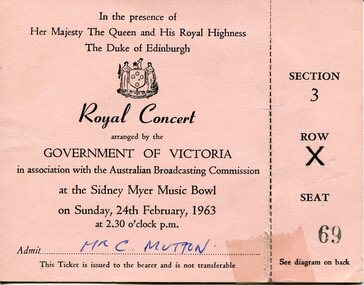
Ephemera - Ticket, Government of Victoria, Royal Concert Ticket, 1963, 1962/63
... The ticket documents a Royal Concert held during the 1963 visit of the British monarch and consort to Australia, organised by the Government of Victoria with the Australian Broadcasting Commission, reflecting its civic and national significance. ...The ticket documents a Royal Concert held during the 1963 visit of the British monarch and consort to Australia, organised by the Government of Victoria with the Australian Broadcasting Commission, reflecting its civic and national significance. ...The ticket documents a Royal Concert held during the 1963 visit of the British monarch and consort to Australia, organised by the Government of Victoria with the Australian Broadcasting Commission, reflecting its civic and national significance. Hosted at Melbourne’s Sidney Myer Music Bowl, the event required large-scale crowd management, evidenced by the printed access map on the ticket. The named bearer and fixed, non-transferable seating indicate controlled attendance and heightened security appropriate to a royal event.This item has local historic significance for Broadmeadows and Campbellfield, providing primary evidence of major industrial development and civic engagement in Victoria during the 1960s.This item is of historic and social significance as tangible evidence of civic life, monarchy-related public events, and state-organised cultural programming in Victoria during the early 1960s. It documents public engagement with royal visits and the ceremonial relationship between Australia and the British Crown in the mid 20th century.Single sheet of pale pink paper, printed in black ink, folded vertically. The recto contains formal event text and seat information. The verso contains a printed location map and directional diagram.Recto (front): “In the presence/of Her Majesty The Queen and His Royal Highness/The Duke of Edinburgh”/“Royal Concert”/“arranged by/the Government of Victoria”/“in association with the Australian Broadcasting Commission”/“at the Sidney Myer Music Bowl”/“on Sunday, 24th February, 1963”/“at 2.30 o’clock p.m.”/“Admit… Mr C. Mutton” / “This Ticket is issued to the bearer and is not transferable”/“SECTION 3”/“ROW X”/“SEAT 69” Verso (back): “From Linlithgow Ave”/“King George V Memorial”/“Swan St Bridge”/“Alexandra Ave”/“To Sections 2 & 3”/ Hand-applied label: “WI-4242” royal visit, royal concert, 1963, sidney myer music bowl, victoria government, australian broadcasting commission, queen elizabeth ii, duke of edinburgh, melbourne, souvenir, admission ticket, civic ceremony, crowd management, seated allocation, cultural event -
 Royal Australian Air Force Band
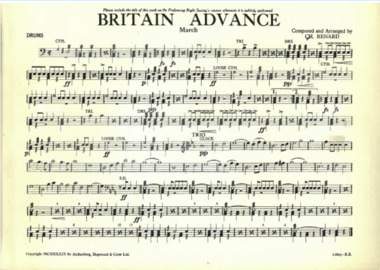
March Card, CH. Renard (Composer, Arranger), Britain Advance, Composed: 1939
... Broadcasting Commission Marching Band Concert Band Outer Envelope: Title, Composer, Instrumentation and Publisher information, QM22. On Inner Envelope: QM22, Q271 16 Parts Brass Band Instrumentation Quick March Ascherberg's Brass and Military Band Journal Key Signature: Ab Major Instrumentation: Repiano Cornet Bb Eb Soprano Cornet Solo Cornet Bb 2nd Cornet Bb 3rd Cornet Bb Solo Tenor Horn Eb 2nd Tenor Horn Eb 3rd Tenor Horn Eb 1st Baritone Bb 2nd Baritone Bb 1st Tenor Trombone 2nd Tenor Trombone Bass Trombone Bb Euphonium (Treble Clef) Eb Basses Bb Basses Drums Britain Advance March Card CH. ...In 1932 the call was put out to the ABC to start a military band. The band’s task was to record music to play on air four times a week, and to perform live concerts for the public. By November 1933 a band was put together with 40 musicians from around Australia. The band was initially conducted by Captain H. E. Adkins, Director of the Royal Military School of Music, Kneller Hall, London. After the tour, Adkins returned to his position at Kneller Hall, and Stephen Yorke, a retired bandmaster of the Gloucestershire Regiment, was brought out to Australia to become the permanent director and conductor of the band, which he did until the band closed in 1951. During the band’s 17 year history they presented a sizable program of music. Their final concert received a standing ovation from its audience of 1500, with a teary-eyed Yorke. 16 Parts Brass Band Instrumentation Quick March Ascherberg's Brass and Military Band Journal Key Signature: Ab Major Instrumentation: Repiano Cornet Bb Eb Soprano Cornet Solo Cornet Bb 2nd Cornet Bb 3rd Cornet Bb Solo Tenor Horn Eb 2nd Tenor Horn Eb 3rd Tenor Horn Eb 1st Baritone Bb 2nd Baritone Bb 1st Tenor Trombone 2nd Tenor Trombone Bass Trombone Bb Euphonium (Treble Clef) Eb Basses Bb Basses DrumsOuter Envelope: Title, Composer, Instrumentation and Publisher information, QM22. On Inner Envelope: QM22, Q271brass band, australian broadcasting commission, marching band, concert band -
 Royal Australian Air Force Band
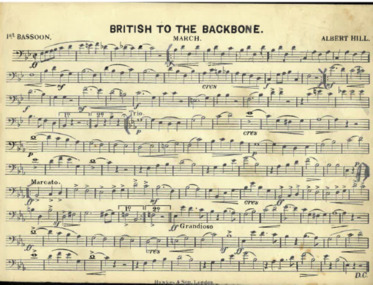
March Card, Albert Hill (Composer), British to the Backbone, Composed: 1916
... Stamped on the reverse of each card: Australian Broadcasting Commission *Sydney* 24 Parts Concert Band Instrumentation Quick March Key Signature: Bb Major Included hand written 1st Clarinet part Instrumentation: Eb Flute & Piccolo Oboes Eb Clarinet 1st Bb Clarinet 2nd Bb Clarinet 3rd & 4th Bb Clarinets Solo Eb Saxhorn (Eb Alto) 1st Bb Baritone (Bb Tenor) 1st Bassoon 2nd Bassoon Solo Bb Cornet (Conductor pencilled in) 1st Bb Cornet 2nd Bb Cornet 1st Eb Horn 2nd Eb Horn 3rd Eb Horn 4th Eb Horn 1st Trombone 2nd Trombone Bass Trombone Euphonium (Baritone) (Bass Clef) Bombardon (Tuba) Side Drum Bass Drum British to the Backbone March Card Albert Hill (Composer) Hawkes & Son, London ...In 1932 the call was put out to the ABC to start a military band. The band’s task was to record music to play on air four times a week, and to perform live concerts for the public. By November 1933 a band was put together with 40 musicians from around Australia. The band was initially conducted by Captain H. E. Adkins, Director of the Royal Military School of Music, Kneller Hall, London. After the tour, Adkins returned to his position at Kneller Hall, and Stephen Yorke, a retired bandmaster of the Gloucestershire Regiment, was brought out to Australia to become the permanent director and conductor of the band, which he did until the band closed in 1951. During the band’s 17 year history they presented a sizable program of music. Their final concert received a standing ovation from its audience of 1500, with a teary-eyed Yorke. 24 Parts Concert Band Instrumentation Quick March Key Signature: Bb Major Included hand written 1st Clarinet part Instrumentation: Eb Flute & Piccolo Oboes Eb Clarinet 1st Bb Clarinet 2nd Bb Clarinet 3rd & 4th Bb Clarinets Solo Eb Saxhorn (Eb Alto) 1st Bb Baritone (Bb Tenor) 1st Bassoon 2nd Bassoon Solo Bb Cornet (Conductor pencilled in) 1st Bb Cornet 2nd Bb Cornet 1st Eb Horn 2nd Eb Horn 3rd Eb Horn 4th Eb Horn 1st Trombone 2nd Trombone Bass Trombone Euphonium (Baritone) (Bass Clef) Bombardon (Tuba) Side Drum Bass DrumOn envelope: QM23, Stamp indicating 19 NOV 1943. Q20, 389 (crossed out). Stamped on the reverse of each card: Australian Broadcasting Commission *Sydney*brass band, australian broadcasting commission, marching band, concert band -
 Royal Australian Air Force Band
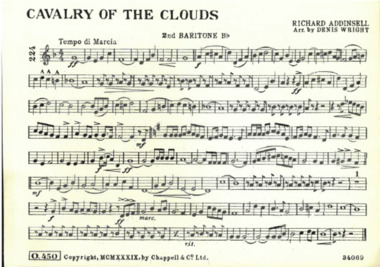
March Card, Addinsell, Richard (Composer) et al, Cavalry Of The Clouds, Composed: 1939
... Brass Band Australian Broadcasting Commission Marching Band Concert Band On envelope:QM31, The Chappell Band Club., A Stirring March Featured in The Great British Film "The Lion Has Wings", Brass Band 2/6, O. 450 16 Parts Brass Band Instrumentation Quick March Key Signature: Eb Major Instrumentation: Repiano Cornet Bb Soprano Cornet Eb Solo Cornet Bb (Conductor) 2nd Cornet Bb 3rd Cornet Bb 1st Horn Eb (or Solo Tenor) 2nd Horn Eb (or 1st Tenor 1st Baritone Bb (& Tenor Saxophone Bb) 2nd Baritone Bb 3rd Horn Eb (or 2nd Tenor) 1st Trombone 2nd Trombone Bass Trombone Euphonium Bb (Treble Clef) Eb Bass (Treble Clef) Contre Bass Bb (Treble Clef) Drums Cavalry Of The Clouds March Card Addinsell, Richard (Composer) Denis Wright (Arranger) Chappell & Co. ...In 1932 the call was put out to the ABC to start a military band. The band’s task was to record music to play on air four times a week, and to perform live concerts for the public. By November 1933 a band was put together with 40 musicians from around Australia. The band was initially conducted by Captain H. E. Adkins, Director of the Royal Military School of Music, Kneller Hall, London. After the tour, Adkins returned to his position at Kneller Hall, and Stephen Yorke, a retired bandmaster of the Gloucestershire Regiment, was brought out to Australia to become the permanent director and conductor of the band, which he did until the band closed in 1951. During the band’s 17 year history they presented a sizable program of music. Their final concert received a standing ovation from its audience of 1500, with a teary-eyed Yorke. 16 Parts Brass Band Instrumentation Quick March Key Signature: Eb Major Instrumentation: Repiano Cornet Bb Soprano Cornet Eb Solo Cornet Bb (Conductor) 2nd Cornet Bb 3rd Cornet Bb 1st Horn Eb (or Solo Tenor) 2nd Horn Eb (or 1st Tenor 1st Baritone Bb (& Tenor Saxophone Bb) 2nd Baritone Bb 3rd Horn Eb (or 2nd Tenor) 1st Trombone 2nd Trombone Bass Trombone Euphonium Bb (Treble Clef) Eb Bass (Treble Clef) Contre Bass Bb (Treble Clef) DrumsOn envelope:QM31, The Chappell Band Club., A Stirring March Featured in The Great British Film "The Lion Has Wings", Brass Band 2/6, O. 450brass band, australian broadcasting commission, marching band, concert band -
 Royal Australian Air Force Band
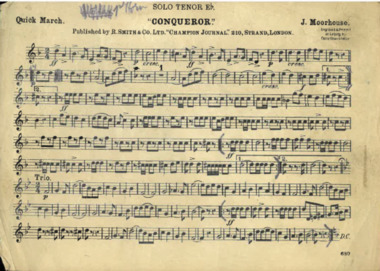
March Card, Moorhouse, J. (Composer), Conqueror, Composed: Unknown (Between 1908-1960)
... Broadcasting Commission Marching Band Concert Band On envelope: QM38, The Conqueror, Moorhouse. Q24 (pencilled), 207. Stamped on the reverse of each card: Australian Broadcasting Commission *Sydney*, Charles Godfrey 21 Parts Concert Band Instrumentation Quick March Key Signature: F Minor Published by R. Smith & Co. LTD "Champion Journal". 210, Strand, London Engraved & Printed at Leipzig by Oscar Brandstetter "The British ...In 1932 the call was put out to the ABC to start a military band. The band’s task was to record music to play on air four times a week, and to perform live concerts for the public. By November 1933 a band was put together with 40 musicians from around Australia. The band was initially conducted by Captain H. E. Adkins, Director of the Royal Military School of Music, Kneller Hall, London. After the tour, Adkins returned to his position at Kneller Hall, and Stephen Yorke, a retired bandmaster of the Gloucestershire Regiment, was brought out to Australia to become the permanent director and conductor of the band, which he did until the band closed in 1951. During the band’s 17 year history they presented a sizable program of music. Their final concert received a standing ovation from its audience of 1500, with a teary-eyed Yorke. 21 Parts Concert Band Instrumentation Quick March Key Signature: F Minor Published by R. Smith & Co. LTD "Champion Journal". 210, Strand, London Engraved & Printed at Leipzig by Oscar Brandstetter "The British Bandsman" 2nd Weekly Instrumentation: Piccolo Oboes Clarinet Eb 1st Clarinet Bb 2nd Clarinet Bb 3rd Clarinet Bb Bassoons Solo Tenor Eb (1st Horn) 1st Tenor Eb (2nd Horn) 2nd & 3rd Tenors Eb (3rd & 4th Horns) Trumpets Eb Repiano Bb (Solo 1st Cornet) 2nd Cornet Bb 1st Trombone 2nd Trombone Bass Trombone 1st Baritone Bb Euphonium Contre Bass Contre Bass (Tuba) Drums On envelope: QM38, The Conqueror, Moorhouse. Q24 (pencilled), 207. Stamped on the reverse of each card: Australian Broadcasting Commission *Sydney*, Charles Godfreybrass band, australian broadcasting commission, marching band, concert band
