
Showing 5 items matching "british sloop"
-
 Flagstaff Hill Maritime Museum and Village
Craft - Ship Model, Mr Edward Howard Grainger (ship model maker), Skylark, circa 1980s
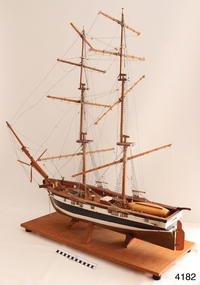
... ...British sloop...The warship represents the British Sloop, Seagull Class, HMS Skylark 1806-1812. ...The warship represents the British Sloop, Seagull Class, HMS Skylark 1806-1812. ...This handmade ship model was built and donated by mr E H Grainger in the late 20th century. The warship represents the British Sloop, Seagull Class, HMS Skylark 1806-1812. The brig-rigged, two-masted HMS Skylark was built at William Rowes' Yard on the River Tyne for the Royal Navy of the United Kingdom in 1806. The ship was armed with 14 British 24-pound Carronades and 2 British 6-pounders. It could carry a crew of 95. This model is an example of the craft of ship model making, which has been a popular hobby for hundreds of years. Our collection has many ship models, some of which were built by professional model makers, others by naval enthusiasts. The model is also an example of British warships that predate the colonisation of Australia.Ship model, Skylark. 2-masted sailing ship, hull painted, with a white strip on white. Separate wooden lifeboat. "Skylark" on each side of the bow and across the stern. The rudder pivots. Mounted on a timber stand. Model built by Mr E.H. Grainger."SKYLARK" on both sides of the bow. "SKYLARK HULL" across bowflagstaff hill, flagstaff hill maritime museum and village, warrnambool, maritime museum, maritime village, great ocean road, shipwreck coast, ship model, skylark, two-masted ship, sailing ship, hobby, war ship, hms skylark, british sloop, british brig, carronade, brig of war, 1806 -
 Flagstaff Hill Maritime Museum and Village
Craft - Scrimshaw, Late 20th century
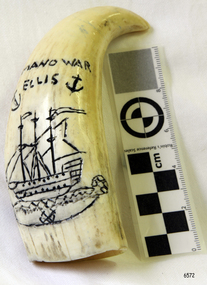
... Spencer set off in chase while shortly thereafter Esperance saw two vessels, a schooner and a sloop, and she and Bonetta set off after them. Spencer sailed south by south-east and the other two British vessels sailed south-west by west, with the result that they lost sight of each other. ...Spencer set off in chase while shortly thereafter Esperance saw two vessels, a schooner and a sloop, and she and Bonetta set off after them. Spencer sailed south by south-east and the other two British vessels sailed south-west by west, with the result that they lost sight of each other. ...The ship “Ellis” started life as the Clementina, launched in America in 1781. The vessel was first listed in Lloyd's Register in 1784 and under this name began serving as a slave ship sailing out of Liverpool. A Lloyd’s database records of slave-trading voyages by vessels from Liverpool makes it clear that Clementina was a slave trader. The next year Captain J. Elworthy sailed her to West Central Africa and St Helena. He transported his slaves to South Carolina. Then in 1785 Elworthy gathered slaves in the Bight of Biafra and the Gulf of Guinea Islands for delivery to Jamaica. In 1786 Bent & Co. purchased the Clementina and renamed her Ellis, presumably after the then owner Ellis Bent. She remained in the slave trade and In 1788 Captain John Ford sailed the now renamed Ellis to the Bight of Biafra and the Gulf of Guinea to gather slaves. He delivered this batch of slaves to the island of Grenada. The next year, 1789 the Ellis was almost completely rebuilt, and from the change in subsequent reports of her cargo loading or (burthen), she was enlarged. In 1791, Captain Joseph Matthews became master and sailed the Ellis to the Gold Coast then delivering his consignment of slaves to the island of St Vincent. During this voyage, some misfortune may have befallen Matthews because records show the Ellis command was transferred to Thomas Given. In 1792, Given sailed to the Bight of Biafra and the Islands in the Gulf of Guinea, again collecting slaves for delivery to Jamaica. There is a parallel record, also for 1793, that the Ellis under the command of Thomas Heart, undertook the same journey and with the same itinerary and cargo. In 1793, Bent & Co. decided to use the Ellis as a privateer with John Levingston as the master. After receiving a letter of "marque” on the 3rd of June 1793, that allowed any armed vessel to commit acts on the high seas which would otherwise have constituted piracy. Thus the Ellis began to operate as a combat ship under the endorsement of the British navy. The Ellis was three times captured first by the French frigate Gracieuse, under the command of Captain Chevillard on 22 July 1793. The French took her into service and renamed her as ”Elise”. Later that summer the Spanish captured her and in November ownership returned to the French who then renamed her the “Esperance”. On the 8th of June 1794, Esperance arrived in Jacmel, Saint-Domingue (present-day Haiti), from France with the official proclamation of the abolition of slavery. Leger-Felicite Sonthonax was one of the Civil Commissioners of Saint-Domingue and he had already unilaterally proclaimed the island for the French colony the year before amid a slave rebellion and attacks from British and Spanish forces. Ironically, Esperance also brought the news to the Civil Commissioners that the National Convention of France had impeached them on 16th July 1793 and ordered them to return promptly to France. On 8 January 1795, HMS Argonaut, under the command of Captain Alexander John Ball, captured Esperance while she was on the North America station. At this time the Esperance was armed with 22 guns (4 and 6-pounders) and had a crew of 130 men. She was under the command of Lieutenant de vaisseau De St. Laurent and had been out at sea for 56 days from Rochfort, bound for the American Chesapeake Bay area. The French ambassador to the United States registered a complaint with the President of the United States that Argonaut, by stating that by entering Lynnhaven bay, either before she captured Esperance or shortly thereafter, had violated a treaty between France and the United States. The French also accused the British of having brought the Esperance into Lynnhaven for refitting for a cruise. The British Consul replied that the capture had taken place some 10 leagues offshore as the bad weather had forced Argonaut and her prize to shelter within the Chesapeake area for some days, but that they had left as soon as practicable. Furthermore, Argonaut had paroled her French prisoners on arrival at Lynnhaven, and if she had entered American territorial waters solely to parole her French prisoners no one would have thought that objectionable. Royal Navy Service: Because the Esperance was captured in good order and sailed well, Rear Admiral George Murray, the British commander in chief of the North American station, put a British crew aboard and sent the Esperance out on patrol with HMS Lynx, under the command of John Poo Beresford, on 31st January. On 1st March the two vessels captured the Cocarde Nationale (or National Cockade), a privateer from Charleston, South Carolina, of 14 guns, six swivel cannons and a crew of 80 men. Esperance and the lynx went on to recaptured the ship Norfolk, of Belfast, and the brig George, of Workington. On 20 July, Esperance, in company with frigates Thetis and Hussar, intercepted the American vessel Cincinnatus, of Wilmington, sailing from Ireland to Wilmington. They pressed many men on board into service, narrowly missing the Irish revolutionary Wolfe Tone, who was on his way to Philadelphia. Esperance was formally commissioned in 1795 into the Royal Navy in August under the Command of Jonas Rose. On 4 May 1796 Esperance was sailing in company with HMS Spencer and Bonetta when they sighted a suspicious vessel. Spencer set off in chase while shortly thereafter Esperance saw two vessels, a schooner and a sloop, and she and Bonetta set off after them. Spencer sailed south by south-east and the other two British vessels sailed south-west by west, with the result that they lost sight of each other. Spencer captured the French gun-brig Volcan, while Bonetta and Esperance captured the French schooner Poisson Volant. The Esperance eventually arrived at Portsmouth on the 3rd of November 1797, the crew was paid off and on 31st May 1798 the Admiralty listed the Esperance for sale and she was sold in June 1798 for £600.The subject scrimshaw is a modern reproduction crudely done of a historic vessel and the scene is believed to be engraved onto a synthetic substance. Scrimshaw art crudely carved into non-natural material in the shape of a tooth. The line artwork is an image of a three-masted sailing ship with a poop deck, and anchors, are coloured black. Inscription is engraved into tooth.Engraved "Man o War Ellis" warrnambool, flagstaff-hill, flagstaff-hill-maritime-museum, maritime-museum, shipwreck-coast, flagstaff-hill-maritime-village, scrimshaw, ellis, esperance, clementina, elise, hms ship, man of war, leter of marque, privateer, slave ship, slavery, ellis bent, american war of inderpendance, marine art, marine artifact, whale tooth, ivory tooth, resin, plastic, craft, engraving, carving -
![Section [side] view drawing of the German Yacht 'Komet](/media/collectors/4f729f7e97f83e03086018d1/items/62f705c1dc1a26e6fcda425b/item-media/62f70650dc1a26e6fcda4d9d/item-fit-380x285.jpg?cb=6) Queenscliffe Maritime Museum
Queenscliffe Maritime MuseumDrawing - 'Komet'
... The sloop was used to patrol the areas of New Guinea, New Britain, New Hebrides and Malayan waters. ...The sloop was used to patrol the areas of New Guinea, New Britain, New Hebrides and Malayan waters. ...HMAS Una was a Royal Australian Navy sloop that began its life as the German motor launch Komet. The ship, and her 57 crew, was captured by an infantry detachment of the Australian Naval and Military Expeditionary Force 9 October 1914, with no loss of life. Komet was then sailed to Sydney as a prize. During the time in which the Una was in service under Australia, the sloop was used as a Patrol and General Purpose Vessel. The sloop was used to patrol the areas of New Guinea, New Britain, New Hebrides and Malayan waters. After World War I, Una was decommissioned and taken to Port Phillip Bay, renamed Akuna and used as a pilot vessel. She was finally broken up in Melbourne in 1955.After World War I, HMAS Una was decommissioned and taken to Port Phillip Bay, renamed Akuna and used as a pilot vessel. She was finally broken up in Melbourne in 1955.A sclae drawing showing side view of the double screw passenger steam boat 'Komet' which was captuered by the RAN in WWI Doppelschrauben Passagierdampfer Aussen Haut [Double Screws, Passenger Steam Boat, Outside Hight]akuna, ppps, port phillip, hmas una, ran -
 Queenscliffe Maritime Museum
Anchor from Akuna - ex Komet, 1911
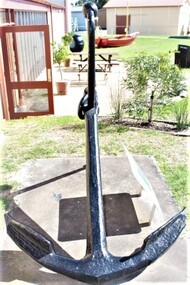
... The sloop was used to patrol the areas of New Guinea, New Britain, New Hebrides and Malayan waters. ...The sloop was used to patrol the areas of New Guinea, New Britain, New Hebrides and Malayan waters. ...HMAS Una was a Royal Australian Navy sloop that began its life as the German motor launch Komet. The ship and her 57 crew was captured by an infantry detachment of the Australian Naval and Military Expeditionary Force led by John Paton on 9 October 1914, with no loss of life. Komet was then sailed to Sydney as a prize. During the time in which the Una was in service under Australia, the sloop was used as a Patrol and General Purpose Vessel. The sloop was used to patrol the areas of New Guinea, New Britain, New Hebrides and Malayan waters. In December 1918, Una was sent to Darwin to protect Administrator John Gilruth, following the Darwin Rebellion. She arrived on Christmas Eve anchoring beneath the Government House cliffs until HMAS Encounter arrived in early 1919. After World War I, Una was decommissioned and taken to Port Phillip Bay, renamed Akuna and used as a pilot vessel. She was finally broken up in Melbourne in 1955.Anchor from ex German Yacht KOMET built in Hamburg in 1911, captured in New Guinea 1914. Acquired by PPPS 1925 renamed UNA then AKUNA. In service 1925 - 1954 Made of Cast Ironanchor, komet, una, akuna, pilot vessel -
 Wangaratta RSL Sub Branch
Document - Framed Document, Instrument of Surrender of Japanese Forces, C1945
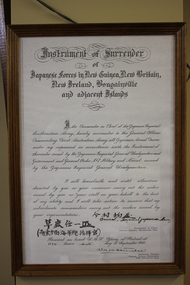
... At 0900 hours, sloop HMS Hart picked up Hitoshi Imamura and Jinichi Kusaka at Kabanga Bay, who would sign the surrender documents aboard HMS Glory at 1127 hours which surrendered 139,000 remaining personnel at Rabaul plus all forces in Australian territory in the South Pacific. The surrender of Imperial Japan was announced on August 15 and formally signed on September 2, 1945, bringing the hostilities of World War II to a close. The surrender ceremony at Rabaul, New Britain ...With the Japanese cities of Hiroshima and Nagasaki destroyed by atomic weapons, the will of the Japanese leadership was tested Emperor Showa of Japan announced his intention to surrender to the Allies unconditionally over public radio on 15 Aug 1945. The date of Japan's formal surrender was 2 Sep 1945, and it took place aboard American battleship Missouri in Tokyo Bay. There were other surrender ceremonies including that on Sept 6 1945. At 0900 hours, sloop HMS Hart picked up Hitoshi Imamura and Jinichi Kusaka at Kabanga Bay, who would sign the surrender documents aboard HMS Glory at 1127 hours which surrendered 139,000 remaining personnel at Rabaul plus all forces in Australian territory in the South Pacific. The surrender of Imperial Japan was announced on August 15 and formally signed on September 2, 1945, bringing the hostilities of World War II to a close. The surrender ceremony at Rabaul, New Britain took place on 6 Sep 1945 aboard the British carrier HMS Glory surrendering 139,000 remaining personnel at Rabaul plus all forces in Australian territory in the South Pacific. Light brown frame with glass, of a black and white photocopy. Script is very ornate and has Japanese lettering at the bottom. Instument of Surrender of Japanese Forces in New Guinea, New Britain, New Ireland, Bougainville and adjacent Islands. I the Commander in Chief of the Japanese Imperial Southeastern Army, hereby surrender to the General Officer Commanding First Australian Army all Japanese Armed Forces under my command in accordance with the Instrument of Surrender issued by the Japanese Imperial General Headquarters and Government and General Order No.1 Military and Naval issued by the Japanese imperial General Headquarters. I will henceforth and until otherwise directed by you or your successor carry out the orders issued by you or your staff on your behalf to the best of my ability and I will take action to ensure that my subordinate commanders carry out the orders issued by your representatives. Commander in Chief Japanese Imperial Southeastern Army. Received on board H.M.S. Glory off Rabaul at 1130 hours sixth day of September 1945. Lieutenant General General Officer Commanding First Australian Army.wwii, world war 2, imperial japanese army, japanese army, surrender, rabaul
