
Showing 38 items matching "bullock cart"
-
 Box Hill Historical Society
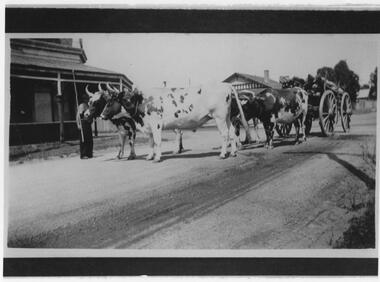
Photograph - Bullock cart, c.1932
... Bullock cart...Bullock cart...Bullock cart, corner Whitehorse Road and Nelson Road...Bullock cart, corner Whitehorse Road and Nelson Road Bullock cart Transport Whitehorse Road Nelson Road Carts and wagons B&w photo Photograph Bullock cart ...Bullock cart, corner Whitehorse Road and Nelson RoadB&w photobullock cart, transport, whitehorse road, nelson road, carts and wagons -
 University of Melbourne, Burnley Campus Archives
Photograph - Black and white print, Bullock Cart, Unknown
... Bullock Cart...Photocopy of a black and white photograph. Empty cart drawn by 14 bullocks in a suburban street. Not digitised....cart bullocks suburban street Photocopy of a black and white photograph. ...Photocopy of a black and white photograph. Empty cart drawn by 14 bullocks in a suburban street. Not digitised.cart, bullocks, suburban street -
 Stawell Historical Society Inc
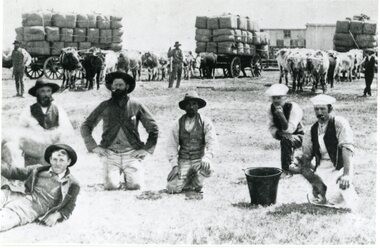
Photograph, Workers in front of Bullock Drawn Wool Carts and Shearing Sheds at "Carrs Plain"
... Carrs Plains Wool Carting showing Bullock Drawn Wool Carts and Shearing Sheds in background....Six workers around bucket with bullock drawn wool carts in background...Carrs Plains Wool Carting showing Bullock Drawn Wool Carts and Shearing Sheds in background. carrs plains Six workers around bucket with bullock drawn wool carts in background Workers in front of Bullock Drawn Wool Carts and Shearing Sheds at "Carrs Plain" Photograph ...Carrs Plains Wool Carting showing Bullock Drawn Wool Carts and Shearing Sheds in background.Six workers around bucket with bullock drawn wool carts in backgroundcarrs plains -
 Stawell Historical Society Inc
Photograph, Wool Caring Carrs Plains
... Carrs Plains Wool Carting showing Bullock Drawn Wool Carts and Shearing Sheds in background....Six men and two dogs around bucket in front of Bullock Drawn Wool Carts and Shearing Sheds at "Carrs Plain" ...Carrs Plains Wool Carting showing Bullock Drawn Wool Carts and Shearing Sheds in background. carrs plains Carrs Plains Six men and two dogs around bucket in front of Bullock Drawn Wool Carts and Shearing Sheds at "Carrs Plain" Wool Caring Carrs Plains Photograph ...Carrs Plains Wool Carting showing Bullock Drawn Wool Carts and Shearing Sheds in background.Six men and two dogs around bucket in front of Bullock Drawn Wool Carts and Shearing Sheds at "Carrs Plain" Carrs Plainscarrs plains -
Emerald Museum & Nobelius Heritage Park
Photograph - Bullock Team, c.1920, Unknown photographer, 1890s-1940s
... It shows a form of transport, the number of bullocks used in a team, as well as the style and size of the bullock cart....This photograph depicts a bullock team pulling a large cart loaded with wood. There is a lady in the foreground wearing long clothes and a hat. ...It shows a form of transport, the number of bullocks used in a team, as well as the style and size of the bullock cart. Bullock teams were extremely important in early Australian colonisation for carrying large and heavy loads such as wood, hay, household goods and even houses. ...It shows a form of transport, the number of bullocks used in a team, as well as the style and size of the bullock cart.Bullock teams were extremely important in early Australian colonisation for carrying large and heavy loads such as wood, hay, household goods and even houses. It shows a form of transport.Black and white rectangular photograph printed on matte photographic paper. This photograph depicts a bullock team pulling a large cart loaded with wood. There is a lady in the foreground wearing long clothes and a hat. Trees are seen in the background.bullock teams -
Tatura Irrigation & Wartime Camps Museum
Book, Harnessed Waters - a River Dammed
... Back cover has two oval photos by the river with bullock cart and wool, paddle steamer and barge tied to river bank...Back cover has two oval photos by the river with bullock cart and wool, paddle steamer and barge tied to river bank Harnessed Waters - a River Dammed Book Book ...Soft cover featuring photos of the Yarrawonga weir and formation of Lake Mulwala. Back cover has two oval photos by the river with bullock cart and wool, paddle steamer and barge tied to river bank -
 Halls Gap & Grampians Historical Society
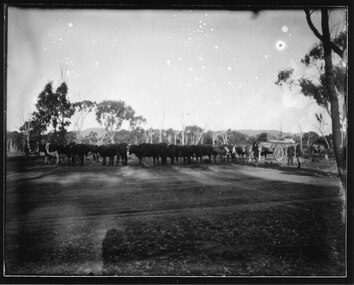
Photograph - B/W
... The photo shows a bullock team carting honey to Horsham....Photo shows a bullock team pulling a loaded cart. The team is standing on the side of a wide, unsurfaced road. ...The photo shows a bullock team carting honey to Horsham. TRANSPORT Bullock team Photo shows a bullock team pulling a loaded cart. ...The photo shows a bullock team carting honey to Horsham.Photo shows a bullock team pulling a loaded cart. The team is standing on the side of a wide, unsurfaced road. There are two men standing in front of the cart.transport, bullock team -
 Lorne Historical Society
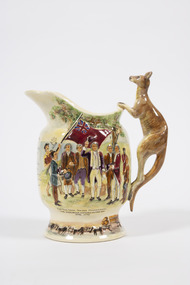
Souvenir - Musical jug, Crown Devon Fieldings, c. 1935
... Along the base is a color painted relief of a bullock cart containing logs....Along the base is a color painted relief of a bullock cart containing logs. Souvenir Musical jug Crown Devon Fieldings ...Bone China jug, with kangaroo shaped handle with hand painted relief scenes First Nations Peoples brandishing spears at Captain Cook’s sailors, Captain Cook taking possession of the country at Botany Bay April 1770 The words to Advance Australia Fair are also printed . Along the base is a color painted relief of a bullock cart containing logs.souvenirs, captain cook, botany bay, advance australia fair, indigenous, kangaroo, endeavour -
Lakes Entrance Historical Society
Memorabilia, Early Farming Scenes of East Gippsland, 1985
... 1986 Calendar, beige coloured plastic cover with white spiral bound plastic spine, photo on front cover is of Bullock Team carting a wagon with wool bales...Calendar issued as part of Victorian 150th Anniversary celebrations DOCUMENTS Calendars 1986 Calendar, beige coloured plastic cover with white spiral bound plastic spine, photo on front cover is of Bullock Team carting a wagon with wool bales Early Farming Scenes of East Gippsland Memorabilia ...Calendar issued as part of Victorian 150th Anniversary celebrations1986 Calendar, beige coloured plastic cover with white spiral bound plastic spine, photo on front cover is of Bullock Team carting a wagon with wool balesdocuments, calendars -
 Lake Bolac & District Historical Society
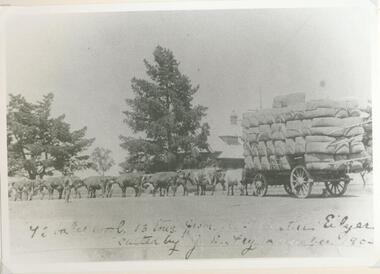
Black and white photograph, Bullock drawn wool wagon, "Eilyer"
... Bullock wagon carting "Eilyer" wool in November, 1903. ...Bullock wagon carting "Eilyer" wool in November, 1903. ...Bullock wagon carting "Eilyer" wool in November, 1903. Wagon carrying 72 bales or 13 tons of wool. Team is driven by J E Fry.wool, bullock team, 1903, eilyer, -
 Emerald Museum & Nobelius Heritage Park
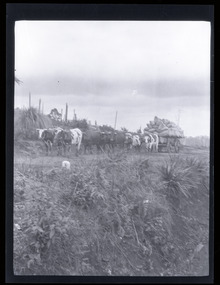
Negative - Image of Bullock Team, Baker & Rouse, Early20th century
... This one is of a bullock team pulling a cart loaded with bags of possibly potatoes or grain. ...Portrait view, black and white photograph of bullock team pulling a cart loaded with sacks of possibly potatoes or grain in Gembrook circa early 20th century. ...This one is of a bullock team pulling a cart loaded with bags of possibly potatoes or grain. ...This negative is part of a batch of ten negatives apparently taken around the same time at Gembrook c. early 20th century. This one is of a bullock team pulling a cart loaded with bags of possibly potatoes or grain. There are two other photos of this same bullock team taken in the batch. These negatives provide a glimpse of the early 20th century cartage in Gembrook.Portrait view, black and white photograph of bullock team pulling a cart loaded with sacks of possibly potatoes or grain in Gembrook circa early 20th century. Negative has been kept in a packet which is not original.Handwritten on packet: 'Bullock train on road / Gembrook'gembrook, bullock team, early 20th century -
Emerald Museum & Nobelius Heritage Park
Photograph - Man with bullock team
... A bullock team is a mode of transport where a group of bullocks pull a cart of goods....A bullock team is a mode of transport where a group of bullocks pull a cart of goods. Bullocky was an important mode of transportation in Emerald back in the old days bullock teams Reverse: VEMUP0806 A black-and-white photograph of a man with a bullock team. ...A bullocky is an Australian English term for the driver of a bullock team. A bullock team is a mode of transport where a group of bullocks pull a cart of goods.Bullocky was an important mode of transportation in Emerald back in the old daysA black-and-white photograph of a man with a bullock team.Reverse: VEMUP0806bullock teams -
 Emerald Museum & Nobelius Heritage Park
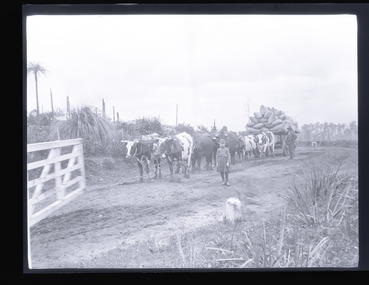
Negative - Image of Girl and Bullock Team, Baker & Rouse, Early20th century
... This one is of a child (titled 'Miss Heath') standing in front of a bullock team pulling a cart loaded with sacks of possibly potatoes. ...Black and white negative showing girl standing in front of bullock team which is carting a load of sacks of possibly potatoes or grain. ...This one is of a child (titled 'Miss Heath') standing in front of a bullock team pulling a cart loaded with sacks of possibly potatoes. ...This negative is one of a batch of ten images taken apparently around the same time at Gembrook c. early 20th century. This one is of a child (titled 'Miss Heath') standing in front of a bullock team pulling a cart loaded with sacks of possibly potatoes. Two other negatives feature this same girl: one standing with the same bullock team and the other playing backyard cricket. An additional negative features the same bullock team with no people.These negatives provide a glimpse of early 20th century cartage in Gembrook.Black and white negative showing girl standing in front of bullock team which is carting a load of sacks of possibly potatoes or grain. A man is standing next to the bullock team. An open gate is visible in the foreground. The negative has been kept inside a packet which is not original.Handwritten on packet containing negative: 'Miss Heath with Bullock train / Gembrook'gembrook, bullock team, miss heath, potatoes, early 20th century -
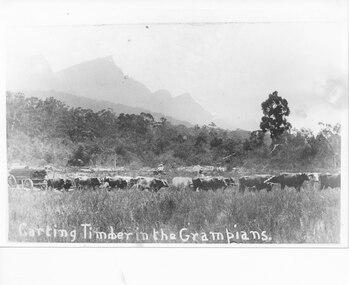 Halls Gap & Grampians Historical Society
Photograph - B/W
... The photo shows a team of bullocks pulling a cart loaded with timber. There is a man standing directly behind the team. ...TIMBER INDUSTRIES Logging TRANSPORT Bullock team The photo shows a team of bullocks pulling a cart loaded with timber. There is a man standing directly behind the team. ...The photo shows a bullock team on Dunkeld Road, towards Yarram Gap.The photo shows a team of bullocks pulling a cart loaded with timber. There is a man standing directly behind the team. Further back a buggy carrying two people can be seen. There are pointy peaks rising in the background.timber industries, logging, transport, bullock team -
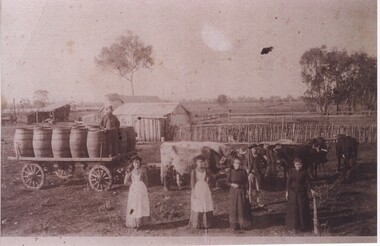 Rutherglen Historical Society
Image, c1890
... Black and white photograph of a four women, two wearing aprons, a team of bullocks hauling a cart of wine barrels. There is one man standing on the cart, and one standing next to the bullocks, with a long pole for controlling them. ...Place and date of the photo unknown - maybe Millthorpe's bullocks millthorpe wine industry agriculture Black and white photograph of a four women, two wearing aprons, a team of bullocks hauling a cart of wine barrels. There is one man standing on the cart, and one standing next to the bullocks, with a long pole for controlling them. ...Place and date of the photo unknown - maybe Millthorpe'sBlack and white photograph of a four women, two wearing aprons, a team of bullocks hauling a cart of wine barrels. There is one man standing on the cart, and one standing next to the bullocks, with a long pole for controlling them. bullocks, millthorpe, wine industry, agriculture -
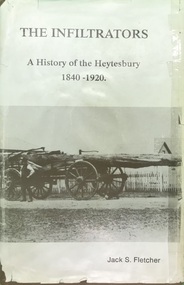 Heytesbury District Historical Society Inc.
Book, The Shire of Heytesbury, The Infiltrators :A History of the Heytesbury 1840-1920 by Jack S. Fletcher, First Edition 1985
... A tan hard cover book with title in gold lettering & a dust cover with a photo of a bullock team & wagon carting a large log, with two bullockies driving. ...The other accompanying book is titled "And We Who Followed: A History of the Heytesbury, 1921-1987", and follows "The Infiltrators". churches education agriculture history port campbell pioneers timboon cobden heytesbury princetown sports A tan hard cover book with title in gold lettering & a dust cover with a photo of a bullock team & wagon carting a large log, with two bullockies driving. ...The book relates to the triumphs & the achievements, the hardships & the tribulations, of the pioneers & settlers of the district.This book gives a detailed history of the Heytesbury district, including the settlerment of the townships of Port Campbell, Timboon, Princetown. This incorporates the development and establishment of industry, commerce, agriculture, education and social and religious events. Reference to families from the area are listed in index. This book is one of 2 by the author. The other accompanying book is titled "And We Who Followed: A History of the Heytesbury, 1921-1987", and follows "The Infiltrators".A tan hard cover book with title in gold lettering & a dust cover with a photo of a bullock team & wagon carting a large log, with two bullockies driving. The book has a locality map.contents,index,ledger entries & black & white photographschurches, education, agriculture, history, port campbell, pioneers, timboon, cobden, heytesbury, princetown, sports -
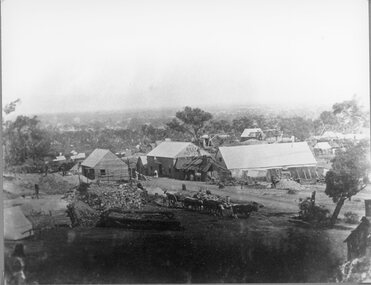 Stawell Historical Society Inc
Photograph, First known photograph of The Reefs and Reef Hotel Pleasant Creek with a bullock team in front 1858 -1861
... Spoil heaps in foreground with other mining activities and with bullock team and cart. Man can be seen standing on slab hut roof at centre and woman in street. ...Spoil heaps in foreground with other mining activities and with bullock team and cart. Man can be seen standing on slab hut roof at centre and woman in street. ...B/W Photo The Reefs Hotel and Assembly Hall Pleasant Creek with Bullock team in front. 1858 -1861 Three windlasses over mineshafts can be seen, two on the left and one in front of the assembly hall. Some horse driven Whims can be seen in the background above the Assembly Hall. This hotel was built right among the mines in upper Main Street. The first licence was held by William Pond in 1858. Robert Young in 1859 and John Steele in 1861. It had a short life as only rates were paid in 1862.Earliest known photograph of the Reefs Pleasant Creek.Several buildings in mining area with trees in background, one building labelled The Reefs Hotel. Spoil heaps in foreground with other mining activities and with bullock team and cart. Man can be seen standing on slab hut roof at centre and woman in street. stawell, hotel -
 Greensborough Historical Society
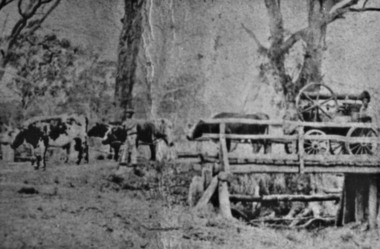
Photograph - Digital Image, Ruston bullock team Panton Hill 1860, 1860_
... By 1858 he had saved enough to buy his own bullock team and carted flour from the mill on the Plenty near Janefield to Greensborough and St Andrews. ...By 1858 he had saved enough to buy his own bullock team and carted flour from the mill on the Plenty near Janefield to Greensborough and St Andrews. ...Peter Ruston was born in 1824 in Yorkshire. He migrated to Australia in 1850 where he found work as a bullock driver. By 1858 he had saved enough to buy his own bullock team and carted flour from the mill on the Plenty near Janefield to Greensborough and St Andrews. He later carted quartz from the mine at Queenstown (St Andrews) to the crushing plant at Panton Hill.A pioneer Greensborough family.Digital copy of black and white photograph.peter rustin, peter ruston -
 Eltham District Historical Society Inc
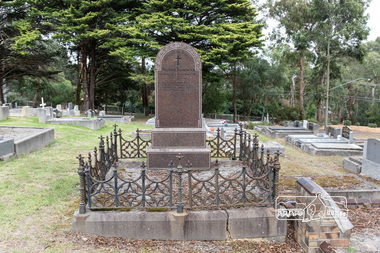
Photograph, Peter Pidgeon, Grave of Patrick Carrucan, Eltham Cemetery, Victoria, 5 April 2021
... Patrick died 6 October 1894 aged 63, reputedly from a broken back after being run over by his own bullock cart. Mary died in 2 Nov 1927 aged 90. ...Patrick died 6 October 1894 aged 63, reputedly from a broken back after being run over by his own bullock cart. Mary died in 2 Nov 1927 aged 90. ...Whilst the three original Carrucan pioneers and their spouses are all buried at Eltham, only one gravestone (that of Patrick Carrucan) exists. Like many of the poor farmers of these early times, their graves were not marked with any permanent stone monuments and have deteriorated to become unmarked graves over the years. Patrick Carrucan, born in 1831 in Ireland, was the second oldest son of Patrick and Bridget Carrucan. He married Mary O'Brien in Ireland in 1856 before migrating to Australia, accompanied by Mary’s father, to join his sister Bridget Coleman in Eltham who had migrated in 1853. Patrick and Mary purchased a farm at the corner of Dalton and Bible Streets, initially living in a hut. After a few years, a more substantial house was built with assistance from Mary's father, who then returned to Ireland. The farm gradually prospered, with cattle, poultry and an orchard. Patrick and Mary had ten children (Bridget, Michael, Susan, Patrick, Thomas, Mary Anne, Catherine, Margaret, Frances and Annie) and lived in Eltham for the rest of their lives. In later years, the Sweeney and the Carrucan families intermarried, as did most of the old Catholic farming families of the Eltham District. Patrick died 6 October 1894 aged 63, reputedly from a broken back after being run over by his own bullock cart. Mary died in 2 Nov 1927 aged 90. They, together with other family members, are buried in a family plot in Eltham Cemetery, though only Patrick is recorded on the gravestone. Patrick's gravestone was in such disrepair that Betty Erickson (nee Carrucan) paid to have a new one erected in the late 1970s. Unfortunately, this gravestone, like the original, only honours Patrick Carrucan and does not record the other family members buried in this family plot. Betty wrote in 1989 "our people were farmers; the Sweeneys well-educated and prosperous, the Carrucans on a somewhat less favoured scale, but solid workers and providers." Patrick Carrucan Who departed this life 6 Oct. 1894 Aged 63 yearsBorn Digitaleltham cemetery, gravestones, patrick carrucan -
 Bendigo Historical Society Inc.
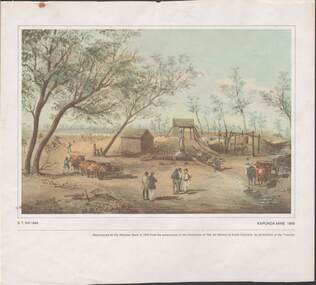
Painting - CAROL HOLSWORTH COLLECTION: 1970 NATIONAL BANK PAINTING 'KAPUNDA MINE 1845' BY S.T. GILL
... The beginnings of a town are shown in the background .There are two Bullock teams with carts and drivers , five men in the fore-ground, and the mine workings are shown in the centre with men operating a sluice.A horse is used to power a winding mechanism...The beginnings of a town are shown in the background .There are two Bullock teams with carts and drivers , five men in the fore-ground, and the mine workings are shown in the centre with men operating a sluice.A horse is used to power a winding mechanism Painting CAROL HOLSWORTH COLLECTION: 1970 NATIONAL BANK PAINTING 'KAPUNDA MINE 1845' BY S.T. ...1970 National Bank painting reproduction Kapunda Mine 1845 by S.T. Gill Below the picture title the words - Reproduced by the National Bank in 1970 from the watercolour in the collection of the Art Gallery of South Australia by permission of the Trustees. The beginnings of a town are shown in the background .There are two Bullock teams with carts and drivers , five men in the fore-ground, and the mine workings are shown in the centre with men operating a sluice.A horse is used to power a winding mechanismpainting, watercolour, gold diggers -
Ringwood and District Historical Society
Biography, He heard Dickens, Disraeli, 21-Jul-44
... .; His first memory was that of travelling with his parents to the gold diggings in Victoria by bullock cart in 1852 at the age of three years. ....; His first memory was that of travelling with his parents to the gold diggings in Victoria by bullock cart in 1852 at the age of three years. ...Handwritten article about Captain Edward Thomas Miles 21-Jul-1944, copied from a newspaper.This is a handwritten copy from an unnamed newspaper. Refer also to the Australian Dictionary of Biography.; 21-Jul-1944 - Newspaper.; He heard Dickens, Disraeli; Captain Edward Thomas Miles who died recently at Ringwood where he had lived in retirement for many years, was born in Hobart 1849 and gained Master Mariners Certificate at 21 and his first command two years later. Served in the China, South African and Indian Wars. Was on the China - London tea run.; Pioneered the coastal trade of Tasmania.; was warden of Hobart marine Board, Member for Glamorgan in the Tasmanian House of Assembly for 12 years and also a minister before Federation.; In 1905 got Concession from Siam to form the Tongkah Harbour Tin Dredging Company, which later won 2,000,000 pounds worth of Tin. Sons and Grandsons managed the original company until present war, and one son and three grandsons remained to become prisioners of war.; Met Cecil Rhodes when he went to the Cape with his first sample of diamonds from the Kimberley.; With all other ship's officers was called out as special policeman to quell the Fenian riots in London.; Heard on several occasions Charles Dickens reading his own works. Listened to Disraeli and Gladstone speaking in the House of Commons.; With his partners built the Zeehan to Strahan railway, Tasmania, 29 miles. Was shipwrecked 3 times.; His first memory was that of travelling with his parents to the gold diggings in Victoria by bullock cart in 1852 at the age of three years. +Additional Keywords: Miles, Captain Edward Thomas / Dickens, Charles / Disraeli / Rhodes / Gladstone -
 Emerald Museum & Nobelius Heritage Park
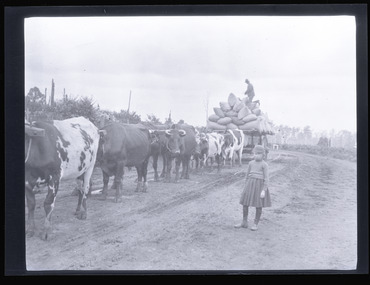
Negative - Image of Girl and Bullock Team, Baker & Rouse, Early20th century
... This negative shows a young girl, entitled 'Miss Heath' standing in the foreground near a bullock team pulling a cart loaded with sacks of possibly potatoes or grain. ...Negative showing a girl standing in the foreground near a bullock team which is pulling a cart loaded with sacks of possibly potatoes or grain. ...This negative shows a young girl, entitled 'Miss Heath' standing in the foreground near a bullock team pulling a cart loaded with sacks of possibly potatoes or grain. ...This is one of a batch of ten negatives apparently taken close to the same time in Gembrook in the early 20th century. This negative shows a young girl, entitled 'Miss Heath' standing in the foreground near a bullock team pulling a cart loaded with sacks of possibly potatoes or grain. A man is kneeling on top of the sacks doing some adjustments. There are two other negatives in this batch of the same bullock team with one of them featuring the same girl. There is also another negative showing the same girl playing backyard cricket. This negative provides a glimpse of the early 20th century cartage in Gembrook.Negative showing a girl standing in the foreground near a bullock team which is pulling a cart loaded with sacks of possibly potatoes or grain. A man is kneeling on top of the sacks doing some adjustments. The negative has been kept in a packet which is not original.Handwritten on packet: 'Miss Heath with Bullock Train / Gembrook'gembrook, bullock team, miss heath, potatoes, early 20th century -
 Orbost & District Historical Society
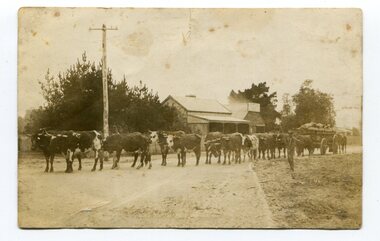
black and white photograph, 1911
... This photo shows Jas Lynn of Orbost driving a team of bullocks pulling a large cart of maize. They are taking it to the fisherman's Wharf in Lakes Entrance. ...A black / white photograph of a bullock team pulling a large, loaded cart. It is being driven by a man standing on the side of the road, holding a whip. ...This photo shows Jas Lynn of Orbost driving a team of bullocks pulling a large cart of maize. They are taking it to the fisherman's Wharf in Lakes Entrance. ...This photo shows Jas Lynn of Orbost driving a team of bullocks pulling a large cart of maize. They are taking it to the fisherman's Wharf in Lakes Entrance. Maize has been grown on the Orbost flats since the late 19th century. Transport was always an obstacle to economic sucess. For a few years prior to the First World War and the construction of the railway line from Bairnsdale to Orbost, a lot of maize was carted by horse and bullock teams to Lakes Entrance for transhipment to the Melbourne market. At that .time yields of 90 to 100 bushels of maize were quite a common occurrence. James Lynn, a member of the East Gippsland Maize Board, farmed at Jarrahmond.This photograph is associated with the large maize growing industry in the Orbost region. A black / white photograph of a bullock team pulling a large, loaded cart. It is being driven by a man standing on the side of the road, holding a whip. In the background are houses and a telegraph pole.on back - " Carting maize to Lakes Entrance in 1911."transport-bullocks maize-orbost lynn-james -
 Flagstaff Hill Maritime Museum and Village
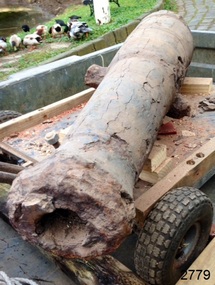
Weapon - Cannon, circa 1825
... bullocks, 7 horses, 5000 London house bricks, 6 whaling boats with associated gear, and general trade goods including beef, pork, tobacco, tipe, butter, lime juice, horse hair, curtains, lead shot, beer and spirits. The hurricane-force winds drove the Children into the limestone stack at the entrance to the cove. The seas smashed it into pieces within twenty minutes. The bodies of sixteen of those who had lost their lives were spread across the shore, along with wreckage from the ship and the cargo of animals. Those who survived suffered injuries; they were rescued and taken by horse and cart...bullocks, 7 horses, 5000 London house bricks, 6 whaling boats with associated gear, and general trade goods including beef, pork, tobacco, tipe, butter, lime juice, horse hair, curtains, lead shot, beer and spirits. The hurricane-force winds drove the Children into the limestone stack at the entrance to the cove. The seas smashed it into pieces within twenty minutes. The bodies of sixteen of those who had lost their lives were spread across the shore, along with wreckage from the ship and the cargo of animals. Those who survived suffered injuries; they were rescued and taken by horse and cart ...In an article dated 26 March 1963, the Warrnambool Standard reported: “A cannon which has lain on the ocean floor since the barque, Children, was wrecked at Childer’s Cove on January 15, 1839, was raised by three Warrnambool skindivers at the weekend … The cannon, weighing about 750 lb. and 4-ft. 6-in. in length … is in excellent order considering the length of time it has remained underwater”. No conservation measures were taken at that time, other than chipping off the marine growth with hammers and cold chisels. The minutes for the 4 February 1974 meeting of the Flagstaff Hill Planning Board recorded that “a cannon recovered some time ago was lying in the garden of [one of the three original divers] and that it could be picked up at any time”. Peter Ronald, past Manager and Diver for Flagstaff Hill, notes that the CHILDREN cannon would have been recovered by the other divers around 1964. When the cannon came into care of Flagstaff Hill, it was given basic conservation relevant to the time. (At the same meeting, the Board was advised of the recovery of an anchor from the wreck of the CHILDREN by Flagstaff Hill divers (Peter Ronald, Colin Goodall and Gary Hayden, and Hank Howey and Andrew Coffee), and its interim relocation in the sea at the end of the Warrnambool Breakwater while awaiting conservation). About the ship CHILDREN 1825-1839: The sailing ship Children was a wooden, three-masted barque constructed of pitch pine in 1825 at Liverpool. It was felt sheathed and was coppered during an upgrade in 1837. The ship was only 29 metres long and 254 tons in weight; it had two decks and a square stern. The James Henty & Co., a pioneering family from Portland, Victoria, purchased the Children in 1837 for use as a coastal trader. The Children, under the command of Captain H. Browne, was on a voyage from Launceston to Adelaide when it foundered in rough conditions at Childers Cove, west of Peterborough, on 14 January 1839. On board were 14 crew members and 24 passengers, including 9 children. The ship’s cargo was awkwardly balanced: it carried 1500 sheep, 8 bullocks, 7 horses, 5000 London house bricks, 6 whaling boats with associated gear, and general trade goods including beef, pork, tobacco, tipe, butter, lime juice, horse hair, curtains, lead shot, beer and spirits. The hurricane-force winds drove the Children into the limestone stack at the entrance to the cove. The seas smashed it into pieces within twenty minutes. The bodies of sixteen of those who had lost their lives were spread across the shore, along with wreckage from the ship and the cargo of animals. Those who survived suffered injuries; they were rescued and taken by horse and cart to Campbell’s farm, near the whaling station at Port Fairy. They arrived at Portland eleven days after the wreck. The wrecking of the Children is one of colonial Victoria’s earliest and most significant maritime disasters. Little is left to mark the tragedy, apart from some house bricks intended for the Henty family’s Portland Bay settlement. Artefacts recovered in the 1960s to early 1970s include this signal cannon, an anchor, the bottom half of her ship’s bell, and two portions of a ship’s fitting, at one time thought to be a brass porthole frame, London housing bricks and timber flooring. Despite its poor condition, the CHILDREN’s signal cannon remains an important and interpretable record of its demise. From 2015, the CHILDREN cannon has been undergoing the first stages of further conservation.The signal cannon recovered from the Children's wreck is significant as part of the original fittings of the early 19th-century barque. It is an example of maritime defence in the early to mid-19th century. The 1839 wreck and recovered artefacts are examples of the construction methods and materials used in that era and can be used to study the evolution of shipbuilding methods and principles. The wreck of the Children is of state significance as one of colonial Victoria’s earliest and most significant maritime disasters, and one of the first vessels lost in the Western District. This is recognised by its inclusion on the Victorian Heritage Register, VHR No. S116. Little is left on the seabed to mark the tragedy, apart from some of the house bricks intended for the Henty settlement. Signal cannon: a 1.3 metre iron 6pdr cannon recovered from the wreck of the CHILDREN. The shape of the cannon tapers from a thick round breech to a flared muzzle, with an 8-centimetre bore, and two side trunnions for pivoting on a wooden gun carriage. It was recovered from the shipwreck site of the CHILDREN by local divers in 1963. This small muzzle-loading signal cannon is in poor and unrestored condition. The cannon’s upper profile of smooth grey metal casing has corroded off, leaving an extensively oxidised rough red surface of crumbling iron. The bottom half of the cannon remains intact, although the outer smooth casing also appears to be separating from the iron core of the barrel. The original grey casting is also missing from the breech and muzzle ends of the cannon. Corrosion and spalling of the upper surface layer of the cannon have removed the maker’s marks and specificationsflagstaff hill, flagstaff hill maritime museum and village, warrnambool, maritime museum, maritime village, great ocean road, shipwreck coast, shipwreck artefact, children, barque, three-masted, liverpool, childer’s cove, port campbell, 1839 shipwreck, 1939 wreck, james henty and co, henty brothers, captain h. browne, first mate t. gay, second mate w. wentworth, portland, portland bay, 1939, ship’s cannon, signal cannon, conservation of marine artefacts, 6pdr small bore cannon, defence -
 Upper Yarra Museum
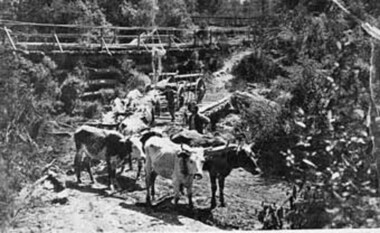
Negative Photographic Reproduction, Bullock team at Yarra Junction
... bullock team carts bridge yarra junction Bullock team at Yarra Junction Negative Black white Scanned at 600 dpi. ...Bullock team at Yarra Junction Negative Black white Scanned at 600 dpi.bullock team carts bridge yarra junction -
Glenelg Shire Council Cultural Collection
Photograph - Photograph reprint of scan of photograph - Henty Street Casterton, n.d
... Image is oval inshape, shows Henty Street Casterton. Bullock team and dray, horse and cart on right of street, horse and carriage with two horses and a woman and small child, centre of street. ...Image is oval inshape, shows Henty Street Casterton. Bullock team and dray, horse and cart on right of street, horse and carriage with two horses and a woman and small child, centre of street. ...Vern McCallum CollectionReprint of scan of black and white photograph. Image is oval inshape, shows Henty Street Casterton. Bullock team and dray, horse and cart on right of street, horse and carriage with two horses and a woman and small child, centre of street. Various other horsedrawn vehicles in bakground. Casterton Hotel and railway Hotel on right. Print is mounted on white, archival mountboard frame.Front: Front- 'Henty Street Casterton, Victoria' across bottom print. -
 Orbost & District Historical Society
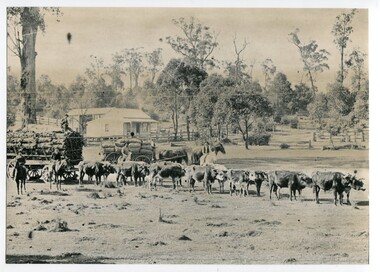
black and white photograph, 1889
... A large black / white photograph of a bullock team pulling a laden cart. A man is sitting on top of the freight. ...This is a pictorial record of transport used in the late 19th century in Orbost. orbost transport-bullock-teams horse-drawn-transport on back - " At the foot of the township - 1889" A large black / white photograph of a bullock team pulling a laden cart. A man is sitting on top of the freight. ...This photograph shows a large bullock team at the foot (eastern side?) of the Orbost township.This is a pictorial record of transport used in the late 19th century in Orbost.A large black / white photograph of a bullock team pulling a laden cart. A man is sitting on top of the freight. In the background is a horse - drawn cart loaded with sacks (maize?) with a man on a horse to the side and another standing on the shafts. In the foreground are two men on horses. There is a small house and barn in the background.on back - " At the foot of the township - 1889"orbost transport-bullock-teams horse-drawn-transport -
 Orbost & District Historical Society
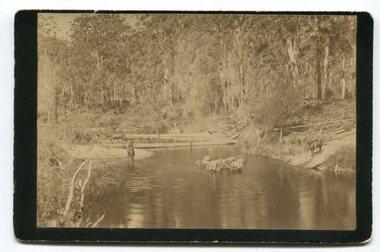
black and white photograph, late 19th - early 20th century
... bullock wagon, horse pulled dray, pack horse or simply by foot. This is a pictorial record of transport in the mid 18th - early 19th century. Pack horses were vital for the delivery of goods, responding to emergencies as they could travel in country inaccessible to larger horse - drawn carts or wagons. transport pack-horses A black / white photograph on a black buff card. ...In the late 1800's early 1900's transporting goods by road was difficult and at times impossible because roads as thoroughfares did not exist.The means of travelling along the roads in the 1800's was by bullock wagon, horse pulled dray, pack horse or simply by foot. This is a pictorial record of transport in the mid 18th - early 19th century. Pack horses were vital for the delivery of goods, responding to emergencies as they could travel in country inaccessible to larger horse - drawn carts or wagons.A black / white photograph on a black buff card. It is of a group of pack horses being guided across a waterway with a man on horseback on either side of the river.transport pack-horses -
 Orbost & District Historical Society
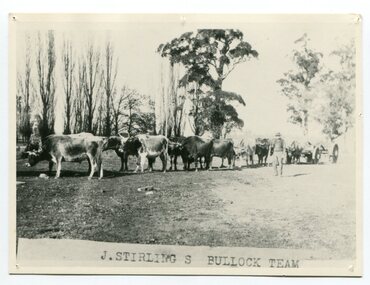
black and white photograph, late 19th century - early 20th century
... The better roads were closer to the towns, and the further away from the town, the worse the conditions of the roads. Bullock teams drew heavily laden carts full of provisions, equipment and people from town to town and into the countryside to isolated homes. ...Aged 19 James Stirling arrived in Melbourne on January 26, 1842 with his family - parents, three sisters and two brothers. James Stirling moved around a lot to Whittlesea, Ballarat goldfields, Cunninghame, (now Lakes Entrance), then to the Old Station about 36 miles to the east along the coast near the mouth of the Snowy River and for a time settled there with his wife also from Wigton, Scotland, and their family four sons two daughters (James, John, William, George, Margaret and Polly). The first settler to occupy the Marlo township area was James Stirling around the year 1875. He built a bark hut on the bluff that had two rooms, bark walls, earthen floors and a shingle roof. By 1884, this structure had expanded to a 9 roomed accommodation house and in 1886 became the Marlo Hotel when a liquor license was granted. (more information from “Snowy River Mail”, Wednesday, April 13th 1977: MEMORIES OF MARLO by Mrs Elsbeth Conlon (nee Stirling ) During the 19th century bullock teams were the most effective means of transporting people and goods inland, as the roads were badly made and in poor condition. The better roads were closer to the towns, and the further away from the town, the worse the conditions of the roads. Bullock teams drew heavily laden carts full of provisions, equipment and people from town to town and into the countryside to isolated homes. This item is associated with that era. It is also associated with James Sterling a very early settler of Marlo.A black / white photograph of a bullock team with a man standing beside it.on front - J STIRLING S BULLOCK TEAMstirling-james marlo-history bullock-team transport -
 Orbost & District Historical Society
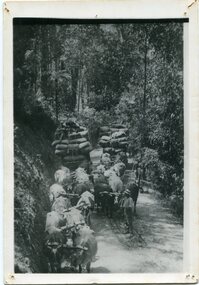
black and white photograph, late 19th - early 20th century
... Bullock teams could travel in country inaccessible to larger horse - drawn carts or wagon. transport-bullocks Cann-River A black / white photograph of two bullock teams travelling side by side along a bush road. black and white photograph ...This is a photograph of bullock teams on the Cann Road. out of Cann River, East Gippsland.This is a pictorial record of transport in the mid 18th - early 19th century. Bullock teams could travel in country inaccessible to larger horse - drawn carts or wagon.A black / white photograph of two bullock teams travelling side by side along a bush road.transport-bullocks cann-river
