
Showing 3 items matching "bullock wagon chain"
-
 Clunes Museum
Equipment - BULLOCK WAGON CHAIN
... BULLOCK WAGON CHAIN...BULLOCK WAGON CHAIN...CAST IRON BULLOCK WAGON CHAIN. CONSISTING OF A LARGE HOOK AT EACH END ATTACHED TO ONG SHAFTS JOINED BY SMALLER LINKS....BULLOCK WAGON CHAIN FARM EQUIPMENT CHAIN CAST IRON BULLOCK WAGON CHAIN. ...CAST IRON BULLOCK WAGON CHAIN. CONSISTING OF A LARGE HOOK AT EACH END ATTACHED TO ONG SHAFTS JOINED BY SMALLER LINKS.bullock wagon chain, farm equipment, chain -
 Orbost & District Historical Society
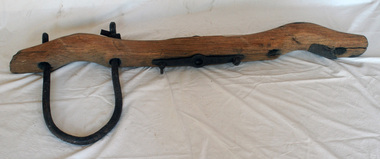
bullock yoke
... bullock teams. These teams were very important in Australia during the 19th century, hauling heavy loaded wagons of goods to remote settlements and rural produce to cities and ports over rough unmade roads. The bullocks were yoked together in pairs. Chains ...This is a small yoke, made for young calves. It was made by Fred Mundy of Jarrahmond for his children to play at being bullock drivers with their calves. Note: photograph 3354 of Jack and Fred Mundy and their team of 4 calves. Yokes like this one were key components used to control bullock teams. These teams were very important in Australia during the 19th century, hauling heavy loaded wagons of goods to remote settlements and rural produce to cities and ports over rough unmade roads. The bullocks were yoked together in pairs. Chains joined the yoked pairs. A heavy wooden bullock yoke with only one metal collar. One is missing. The fittings are iron. There is a small leather patch tacked on to one end. The yoke is made from a length of wood of roughly rectangular cross-section. It has been shaped to form curved depressions that allow it to rest across the necks of two bullocks and yoke them together. bullock-yokes transport -
 Otway Districts Historical Society
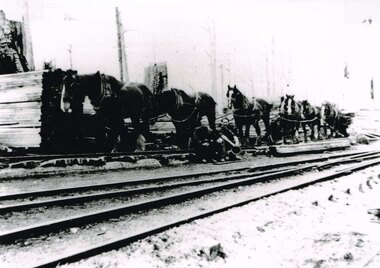
Photograph, Knox Collection, Pettit's Siding: A loader, teamster and their six-horse load, c.1920
... The sawn timber was initially carted out by bullock wagon but the mud and slush caused such difficulties that Pettits caused a thirty chain incline to be built from the mill to a tramway. ...The sawn timber was initially carted out by bullock wagon but the mud and slush caused such difficulties that Pettits caused a thirty chain incline to be built from the mill to a tramway. ...Originally known as Smith's Siding, in November 1914 the siding was renamed "Pettits" following the sale of a nearby mill to the north. The sawn timber was initially carted out by bullock wagon but the mud and slush caused such difficulties that Pettits caused a thirty chain incline to be built from the mill to a tramway. The tramway connected the mill to the railway until 1924. An annual average of 2,450 tonnes of timber was despatched from the siding. No provision was made for passenger traffic. After ten years Pettit Brothers had cut out the area and moved on, abandoning the siding which was put out of commission on 23 September 1924. However, local residents, not wishing to suffer the loss of railway facilities, managed to have the siding reopened in February 1925 for goods and passengers. It was lightly patronised until all traffic ceased in 1936. B/W. Sam Knox, timber loader and tallyman, and George Pritchard, a teamster, resting at Pettit's Siding after delivering a six-horse-drawn load of timber to the Siding. Stacks of wood awaiting transport by rail are in the background.pettits siding; wyelangta; railways; smith's siding; sam knox; george pritchard;
