
Showing 198 items matching "burke museum exhibitions"
-
 The Beechworth Burke Museum
Photograph, c1990
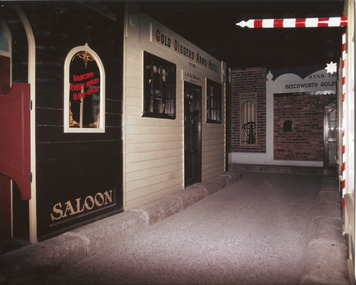
... ...Burke Museum exhibitions...Taken in the 1990's, this photograph depicts a row of shop fronts in the 'Street of Shops' exhibition in the Burke Museum in Beechworth. This exhibition was created and opened in 1979 and was intended to reflect and imitate a historic peirod in the town's past. ...Beechworth Burke Museum Street of Shops Gold Rush Indigo Shire gold rush 1850s Beechworth Burke Museum exhibitions Saloon Gold buyer Hotel historical streetscape gold rush immigration Obverse: Dancing every night 8pm-6am [mirror] / Gold Diggers Arms Hotel façade / Star / Beechworth Gold / J. ...Taken in the 1990's, this photograph depicts a row of shop fronts in the 'Street of Shops' exhibition in the Burke Museum in Beechworth. This exhibition was created and opened in 1979 and was intended to reflect and imitate a historic peirod in the town's past. The time period decpicted is that of the Gold Rush which swept through many Victorian towns from the 1850's onwards. For the town of Beechworth, the gold rush began in 1852, when gold was discovered in Spring Creek, drawing in many new residents seeking to make a fortune and transforming a once remote town into a bustling centre brimming with hope and opportunity. By 1857, the town contained over 200,000 residents and with this, the need for more amenities and intsitutions arose. Multiple churches, banks, schools, shops, hospitals and other essential buildings appearing over the years. The wealth acquired through the gold rush is largely responsible for the vast development of the town and many of its significant buildings which still remain to this day. This photograph also highlights the significance of this type of exhibition, providing a new mode of experiencing and learning about the past. The street depicts the many supporting trades and industries that arose from the mass migration during the gold rush. The creation of the Street of Shops in 1979 was envisioned by Roy Harvey who was the curator at the time, with the intention of recreating an authentic feel to the environment while collecting from the community to accurately portray the multiculturalism that is ingrainded in many towns and communities of Victoria. This photograph contains historical significance as it relates to and portrays an especially important period of time within Beechworth and Victoria's history. The gold rush phenomena ushered in a wave of hope and prosperity for citizens and immigrants alike. It provided many with the opportunity to strike it rich, while the town prospered and grew in many ways. This widespread development that accompanied the gold rush occured throughout Victoria and holds great historical importance when recording the social, economic and communal developments that occured throughout the time period which gave way to the beloved towns and communities we know today. Beechworth itself is acknowledged as Victoria's best-preserved gold mining town and deserves recognition of its significance. it also showcases the great significance of social develpment and globalization that occured throughout the state during this period. Coloured rectangular photograph printed on matte photographic paper and unmounted. Obverse: Dancing every night 8pm-6am [mirror] / Gold Diggers Arms Hotel façade / Star / Beechworth Gold / J. Davidson / Saloon Reverse: 3306 beechworth, burke museum, street of shops, gold rush, indigo shire gold rush, 1850s beechworth, burke museum exhibitions, saloon, gold buyer, hotel, historical streetscape, gold rush immigration -
 The Beechworth Burke Museum
Photograph, 1999
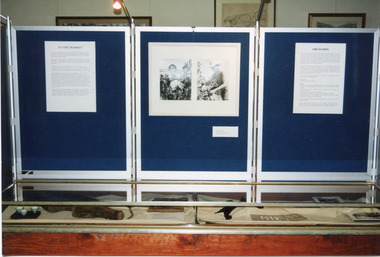
... Burke Museum...Promoting settlement...Living in country towns...Making regional centres...Preserving traditions and commemorating...Farming and agriculture...orchards...exhibitions...Burke Museum exhibitions...fruitpicking...building local economies...transforming land...Victorian agricultural history...Marketing and promoting agricultural products...growing fruit and vegetables...The Harvest exhibition...This photograph features three display board sections showing information and photographs from 'The Harvest' exhibition inside the Burke Museum at Beechworth in 1999. ...This photograph features three display board sections showing information and photographs from 'The Harvest' exhibition inside the Burke Museum at Beechworth in 1999. ...This photograph features three display board sections showing information and photographs from 'The Harvest' exhibition inside the Burke Museum at Beechworth in 1999. The boards are titled 'To the Market' and 'Orchards'; the accompanying text cannot be read. The two accompanying photographs depict a man and woman picking fruit.This photograph is of social significance to Burke Museum and the Beechworth community, documenting an exhibition, The Harvest, held in 1999 to communicate the importance of agricultural development, specifically of orchards, in the area. The expansion of vineyards and horticulture in the Beechworth district followed gold rush prosperity in the mid-1850s, with nearly ninety acres of gardens and small farms under vineyards by 1865. There were 400 Chinese market gardeners and hawkers in the area in 1868. The growth of agriculture in the Ovens district in the mid -1860s led to advocacy by local farmers for the extension of railway infrastructure from Melbourne to improve access to distant markets.Colour rectangular photograph printed on matte AGFA photographic paper.Obverse: TO THE MARKET / ORCHARDS/ Reverse: 2856beechworth, burke museum, promoting settlement, living in country towns, making regional centres, preserving traditions and commemorating, farming and agriculture, orchards, exhibitions, burke museum exhibitions, fruitpicking, building local economies, transforming land, victorian agricultural history, marketing and promoting agricultural products, growing fruit and vegetables, the harvest exhibition, harvests, vineyards, victorian gold rush towns -
 The Beechworth Burke Museum
Photograph, Estimate 1999
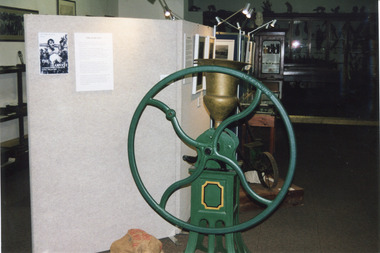
... Burke Museum...Promoting settlement...Living in country towns...Making regional centres...Preserving traditions and commemorating...Farming and agriculture...exhibitions...Burke Museum exhibitions...building local economies...transforming land...Victorian agricultural history...Marketing and promoting agricultural products...The Harvest exhibition...This photograph was taken in 1999 at 'The Harvest' exhibition at the Burke Museum for members of Baking Industry Victoria. ...This photograph may be of interest to researchers who wish to observe an image of the Purshouse grain mill. beechworth Burke Museum Promoting settlement Living in country towns Making regional centres Preserving traditions and commemorating Farming and agriculture exhibitions Burke Museum exhibitions building local economies transforming land Victorian agricultural history Marketing and promoting agricultural products The Harvest exhibition harvests Victorian gold rush towns grain mill BM Purshouse crops and grain Baking Industry Victoria Obverse: THE HARVEST / THE HARVEST Reverse: 2854 Colour rectangular photograph printed on matte AGFA photographic paper. ...This photograph was taken in 1999 at 'The Harvest' exhibition at the Burke Museum for members of Baking Industry Victoria. The grain mill, manufactured by B.M. Purshouse in Wolverhampton, England, was of special interest.This photograph is of primary social significance to the Beechworth community because it depicts a 19th-century grain mill, manufactured by B.M. Purshouse in Wolverhampton, England, which was probably used at flour mills in the Ovens District, such as that at Tarrawingee, which opened in 1866. The purchase of agricultural machinery such as the grain mill accompanied the expansion of agriculture, including grain growing, in the Ovens District following the gold mining prosperity of the 1850s. This photograph may be of interest to researchers who wish to observe an image of the Purshouse grain mill.Colour rectangular photograph printed on matte AGFA photographic paper.Obverse: THE HARVEST / THE HARVEST Reverse: 2854beechworth, burke museum, promoting settlement, living in country towns, making regional centres, preserving traditions and commemorating, farming and agriculture, exhibitions, burke museum exhibitions, building local economies, transforming land, victorian agricultural history, marketing and promoting agricultural products, the harvest exhibition, harvests, victorian gold rush towns, grain mill, bm purshouse, crops and grain, baking industry victoria -
 The Beechworth Burke Museum
Textile - Banner, c1872
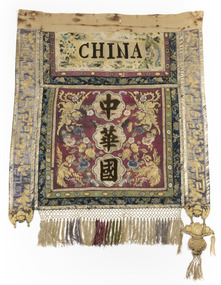
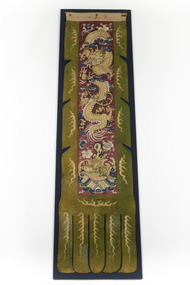
... Burke Museum...Chinese...Benevolent Asylum...Ovens District Hospital...Beechworth Carnival processions...Carnival...processions...Beechworth Chinese community...Beechworth Fine Arts Exhibition...These banners had been purchased in China by a social envoy from Beechworth then presented to the Chinese community during the Beechworth Fine Arts Exhibition in May of that same year, by Donald Fiddes, President of the Ovens District Hospital. The Burke Museum's...Burke Museum in 2006 by Carol Campbell of Phoenix Conservation Services with funding from Victoria’s Heritage Grants. In 2015, with the enormous support of the Copland Foundation and fundraising activities by the Friends of the Bur Museum Committee, conservation of the third banner was undertaken by Artlab Australia in Adelaide. The banners display traditional Chinese textile techniques and are visually beautiful and very rare and are considered of local and national significance, with the potential to be deemed internationally significant. Beechworth Burke Museum Chinese Benevolent Asylum Ovens District Hospital Beechworth Carnival processions Carnival processions Beechworth Chinese community Beechworth Fine Arts Exhibition ...This banner was one of five banners gifted to the Beechworth Chinese community in recognition of their support of the Hospital and Benevolent Asylum in 1875, from the Carnival Committee. These banners had been purchased in China by a social envoy from Beechworth then presented to the Chinese community during the Beechworth Fine Arts Exhibition in May of that same year, by Donald Fiddes, President of the Ovens District Hospital. The Burke Museum's Chinese Collection presents the history of Chinese settlement in Beechworth from 1856 and its involvement in local community affairs in the second half of the 19th century. In settling in the area they formed their own community with distinctive Chinese cultural traditions, forming their own 'camps' with laid out streets, housing a Temple, Chinese Theatre and restaurants, hotels, stores, gambling houses and dwellings. Members of the Chinese community took an active interest in town affairs and were generous donors to the appeal to build the Ovens District Hospital in 1856/7. The vibrant colours and dynamic graphics of the silk embroidered Chinese banners were a highlight of Beechworth Charitable processions that took place in the main street. Two of the Chinese banners were conserved for the Burke Museum in 2006 by Carol Campbell of Phoenix Conservation Services with funding from Victoria’s Heritage Grants. In 2015, with the enormous support of the Copland Foundation and fundraising activities by the Friends of the Bur Museum Committee, conservation of the third banner was undertaken by Artlab Australia in Adelaide. The banners display traditional Chinese textile techniques and are visually beautiful and very rare and are considered of local and national significance, with the potential to be deemed internationally significant.Multi panelled banner with embroidery and applied design motifs on front. Back panel is painted design of two men. The front panels have been constructed using strips of various weaves and colours of silk that have been embroidered or had a design applied prior to the overall construction of the piece. The embroidery is predominantly gold work with both plyed and floss silk threads. Silk macrame fringe and tassels to central panel and padded lotus and bowl motif hanging tassel from side panels. Velvet lettering applied to front "CHINA" CHINA /beechworth, burke museum, chinese, benevolent asylum, ovens district hospital, beechworth carnival processions, carnival, processions, beechworth chinese community, beechworth fine arts exhibition, donald fiddes -
 The Beechworth Burke Museum
Textile - Banner, c1872
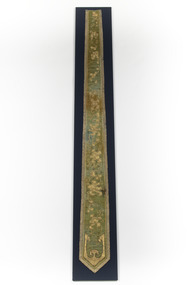
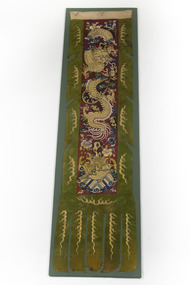
... Burke Museum...Chinese...Benevolent Asylum...Ovens District Hospital...Beechworth Carnival processions...Carnival...processions...Beechworth Chinese community...Beechworth Fine Arts Exhibition...These banners had been purchased in China by a social envoy from Beechworth then presented to the Chinese community during the Beechworth Fine Arts Exhibition in May of that same year, by Donald Fiddes, President of the Ovens District Hospital. The Burke Museum's Chinese Collection presents the history of Chinese settlement in Beechworth from 1856 and its involvement in local community affairs in the second half of the 19th century. ...Burke Museum in 2006 by Carol Campbell of Phoenix Conservation Services with funding from Victoria’s Heritage Grants. In 2015, with the enormous support of the Copland Foundation and fundraising activities by the Friends of the Bur Museum Committee, conservation of the third banner was undertaken by Artlab Australia in Adelaide. The banners display traditional Chinese textile techniques and are visually beautiful and very rare and are considered of local and national significance, with the potential to be deemed internationally significant. Beechworth Burke Museum Chinese Benevolent Asylum Ovens District Hospital Beechworth Carnival processions Carnival processions Beechworth Chinese community Beechworth Fine Arts Exhibition ...This banner was one of five banners gifted to the Beechworth Chinese community in recognition of their support of the Hospital and Benevolent Asylum in 1875, from the Carnival Committee. These banners had been purchased in China by a social envoy from Beechworth then presented to the Chinese community during the Beechworth Fine Arts Exhibition in May of that same year, by Donald Fiddes, President of the Ovens District Hospital. The Burke Museum's Chinese Collection presents the history of Chinese settlement in Beechworth from 1856 and its involvement in local community affairs in the second half of the 19th century. In settling in the area they formed their own community with distinctive Chinese cultural traditions, forming their own 'camps' with laid out streets, housing a Temple, Chinese Theatre and restaurants, hotels, stores, gambling houses and dwellings. Members of the Chinese community took an active interest in town affairs and were generous donors to the appeal to build the Ovens District Hospital in 1856/7. The vibrant colours and dynamic graphics of the silk embroidered Chinese banners were a highlight of Beechworth Charitable processions that took place in the main street. Two of the Chinese banners were conserved for the Burke Museum in 2006 by Carol Campbell of Phoenix Conservation Services with funding from Victoria’s Heritage Grants. In 2015, with the enormous support of the Copland Foundation and fundraising activities by the Friends of the Bur Museum Committee, conservation of the third banner was undertaken by Artlab Australia in Adelaide.The banners display traditional Chinese textile techniques and are visually beautiful and very rare and are considered of local and national significance, with the potential to be deemed internationally significant.Multi panelled banner with embroidery and applied design motifs on front. The front panels have been constructed using strips of various weaves and colours of silk that have been embroidered or had a design applied prior to the overall construction of the piece. The embroidery is predominantly gold work with both plyed and floss silk threads.beechworth, burke museum, chinese, benevolent asylum, ovens district hospital, beechworth carnival processions, carnival, processions, beechworth chinese community, beechworth fine arts exhibition, donald fiddes -
 The Beechworth Burke Museum
Textile - Banner, c1872
... Burke Museum...Chinese...Benevolent Asylum...Ovens District Hospital...Beechworth Carnival processions...Carnival...processions...Beechworth Chinese community...Beechworth Fine Arts Exhibition...These banners had been purchased in China by a social envoy from Beechworth then presented to the Chinese community during the Beechworth Fine Arts Exhibition in May of that same year, by Donald Fiddes, President of the Ovens District Hospital. The Burke Museum's Chinese Collection presents the history of Chinese settlement in Beechworth from 1856 and its involvement in local community affairs in the second half of the 19th century. ...Burke Museum in 2006 by Carol Campbell of Phoenix Conservation Services with funding from Victoria’s Heritage Grants. In 2015, with the enormous support of the Copland Foundation and fundraising activities by the Friends of the Bur Museum Committee, conservation of the third banner was undertaken by Artlab Australia in Adelaide. The banners display traditional Chinese textile techniques and are visually beautiful and very rare and are considered of local and national significance, with the potential to be deemed internationally significant. Beechworth Burke Museum Chinese Benevolent Asylum Ovens District Hospital Beechworth Carnival processions Carnival processions Beechworth Chinese community Beechworth Fine Arts Exhibition ...This banner was one of five banners gifted to the Beechworth Chinese community in recognition of their support of the Hospital and Benevolent Asylum in 1875, from the Carnival Committee. These banners had been purchased in China by a social envoy from Beechworth then presented to the Chinese community during the Beechworth Fine Arts Exhibition in May of that same year, by Donald Fiddes, President of the Ovens District Hospital. The Burke Museum's Chinese Collection presents the history of Chinese settlement in Beechworth from 1856 and its involvement in local community affairs in the second half of the 19th century. In settling in the area they formed their own community with distinctive Chinese cultural traditions, forming their own 'camps' with laid out streets, housing a Temple, Chinese Theatre and restaurants, hotels, stores, gambling houses and dwellings. Members of the Chinese community took an active interest in town affairs and were generous donors to the appeal to build the Ovens District Hospital in 1856/7. The vibrant colours and dynamic graphics of the silk embroidered Chinese banners were a highlight of Beechworth Charitable processions that took place in the main street. Two of the Chinese banners were conserved for the Burke Museum in 2006 by Carol Campbell of Phoenix Conservation Services with funding from Victoria’s Heritage Grants. In 2015, with the enormous support of the Copland Foundation and fundraising activities by the Friends of the Bur Museum Committee, conservation of the third banner was undertaken by Artlab Australia in Adelaide. The banners display traditional Chinese textile techniques and are visually beautiful and very rare and are considered of local and national significance, with the potential to be deemed internationally significant.Multi panelled banner with embroidery and applied design motifs on front. The front panels have been constructed using strips of various weaves and colours of silk that have been embroidered or had a design applied prior to the overall construction of the piece. The embroidery is predominantly gold work with both plyed and floss silk threads.beechworth, burke museum, chinese, benevolent asylum, ovens district hospital, beechworth carnival processions, carnival, processions, beechworth chinese community, beechworth fine arts exhibition, donald fiddes -
 The Beechworth Burke Museum
Textile - Banner, c1872
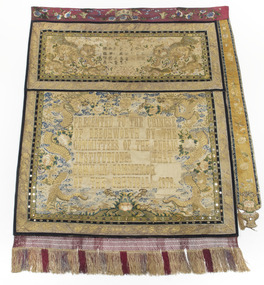
... Burke Museum...Chinese...Benevolent Asylum...Ovens District Hospital...Beechworth Carnival processions...Carnival...processions...Beechworth Chinese community...Beechworth Fine Arts Exhibition...These banners had been purchased in China by a social envoy from Beechworth then presented to the Chinese community during the Beechworth Fine Arts Exhibition in May of that same year, by Donald Fiddes, President of the Ovens District Hospital. The Burke Museum's Chinese Collection presents the history of Chinese settlement in Beechworth from 1856 and its involvement in local community affairs in the second half of the 19th century. ...Burke Museum in 2006 by Carol Campbell of Phoenix Conservation Services with funding from Victoria’s Heritage Grants. In 2015, with the enormous support of the Copland Foundation and fundraising activities by the Friends of the Bur Museum Committee, conservation of the third banner was undertaken by Artlab Australia in Adelaide. The banners display traditional Chinese textile techniques and are visually beautiful and very rare and are considered of local and national significance, with the potential to be deemed internationally significant. Beechworth Burke Museum Chinese Benevolent Asylum Ovens District Hospital Beechworth Carnival processions Carnival processions Beechworth Chinese community Beechworth Fine Arts Exhibition ...This banner was one of five banners gifted to the Beechworth Chinese community in recognition of their support of the Hospital and Benevolent Asylum in 1875, from the Carnival Committee. These banners had been purchased in China by a social envoy from Beechworth then presented to the Chinese community during the Beechworth Fine Arts Exhibition in May of that same year, by Donald Fiddes, President of the Ovens District Hospital. The Burke Museum's Chinese Collection presents the history of Chinese settlement in Beechworth from 1856 and its involvement in local community affairs in the second half of the 19th century. In settling in the area they formed their own community with distinctive Chinese cultural traditions, forming their own 'camps' with laid out streets, housing a Temple, Chinese Theatre and restaurants, hotels, stores, gambling houses and dwellings. Members of the Chinese community took an active interest in town affairs and were generous donors to the appeal to build the Ovens District Hospital in 1856/7. The vibrant colours and dynamic graphics of the silk embroidered Chinese banners were a highlight of Beechworth Charitable processions that took place in the main street. Two of the Chinese banners were conserved for the Burke Museum in 2006 by Carol Campbell of Phoenix Conservation Services with funding from Victoria’s Heritage Grants. In 2015, with the enormous support of the Copland Foundation and fundraising activities by the Friends of the Bur Museum Committee, conservation of the third banner was undertaken by Artlab Australia in Adelaide.The banners display traditional Chinese textile techniques and are visually beautiful and very rare and are considered of local and national significance, with the potential to be deemed internationally significant.The banner has a narrow fuchsia embroidered top border, a wider embroidered panel depicting 2 dogs with embroidered Chinese text and a larger lower panel with the embroidered text “PRESENTED TO THE CHINESE OF BEECHWORTH BY THE COMMITEES OF THE PUBLIC INSTITUTIONS (missing) THAT TOWN IN COMMEMOR (missing) OF THE CARNIVAL 1873” The 2 lower panels have narrow decorative borders decorated with mirrors and extensive embroidery. There is an additional embroidered tab running along the right hand edge. The bottom edge has a wide knotted fringe. The back is lined with fabric decorated with a painted scene. Refer Attachment 1 quote ARTLAB AustPRESENTED TO THE CHINESE / OF BEECHWORTH BY THE / COMMITEES OF THE PUBLIC / INSTITUTIONS THAT / TOWN IN COMMEMOR / OF THE CARNIVAL 1873beechworth, burke museum, chinese, benevolent asylum, ovens district hospital, beechworth carnival processions, carnival, processions, beechworth chinese community, beechworth fine arts exhibition, donald fiddes -
 The Beechworth Burke Museum
Textile - Banner, c1872
... Burke Museum...Chinese...Benevolent Asylum...Ovens District Hospital...Beechworth Carnival processions...Carnival...processions...Beechworth Chinese community...Beechworth Fine Arts Exhibition...These banners had been purchased in China by a social envoy from Beechworth then presented to the Chinese community during the Beechworth Fine Arts Exhibition in May of that same year, by Donald Fiddes, President of the Ovens District Hospital. The Burke Museum's Chinese Collection presents the history of Chinese settlement in Beechworth from 1856 and its involvement in local community affairs in the second half of the 19th century. ...Burke Museum in 2006 by Carol Campbell of Phoenix Conservation Services with funding from Victoria’s Heritage Grants. In 2015, with the enormous support of the Copland Foundation and fundraising activities by the Friends of the Bur Museum Committee, conservation of the third banner was undertaken by Artlab Australia in Adelaide. The banners display traditional Chinese textile techniques and are visually beautiful and very rare and are considered of local and national significance, with the potential to be deemed internationally significant. Beechworth Burke Museum Chinese Benevolent Asylum Ovens District Hospital Beechworth Carnival processions Carnival processions Beechworth Chinese community Beechworth Fine Arts Exhibition ...This banner was one of five banners gifted to the Beechworth Chinese community in recognition of their support of the Hospital and Benevolent Asylum in 1875, from the Carnival Committee. These banners had been purchased in China by a social envoy from Beechworth then presented to the Chinese community during the Beechworth Fine Arts Exhibition in May of that same year, by Donald Fiddes, President of the Ovens District Hospital. The Burke Museum's Chinese Collection presents the history of Chinese settlement in Beechworth from 1856 and its involvement in local community affairs in the second half of the 19th century. In settling in the area they formed their own community with distinctive Chinese cultural traditions, forming their own 'camps' with laid out streets, housing a Temple, Chinese Theatre and restaurants, hotels, stores, gambling houses and dwellings. Members of the Chinese community took an active interest in town affairs and were generous donors to the appeal to build the Ovens District Hospital in 1856/7. The vibrant colours and dynamic graphics of the silk embroidered Chinese banners were a highlight of Beechworth Charitable processions that took place in the main street. Two of the Chinese banners were conserved for the Burke Museum in 2006 by Carol Campbell of Phoenix Conservation Services with funding from Victoria’s Heritage Grants. In 2015, with the enormous support of the Copland Foundation and fundraising activities by the Friends of the Bur Museum Committee, conservation of the third banner was undertaken by Artlab Australia in Adelaide. The banners display traditional Chinese textile techniques and are visually beautiful and very rare and are considered of local and national significance, with the potential to be deemed internationally significant.Multi panelled banner with embroidery and applied design motifs on front. The front panels have been constructed using strips of various weaves and colours of silk that have been embroidered or had a design applied prior to the overall construction of the piece. The embroidery is predominantly gold work with both plyed and floss silk threads. beechworth, burke museum, chinese, benevolent asylum, ovens district hospital, beechworth carnival processions, carnival, processions, beechworth chinese community, beechworth fine arts exhibition, donald fiddes -
 The Beechworth Burke Museum
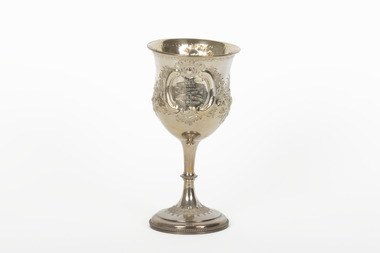
Award - Trophy, 1877
... Burke Museum Collection and the history of Beechworth. Due to its historical associations with the Beechworth Double-Hose Competition in 1877, it holds significance as an important item representing Beechworth's history. It further provides a point of research in this area, and further investigation into Beechworth's history. Street of Shops Exhibition ...This trophy represents the winning the of Beechworth V.F.C at the 1877 Double-Hose Competition on the 26th of December against Wangaratta. This competition was an annual event which took place as part of the Christmastide Festivities in Beechworth on Boxing Day. This Trophy was created by the British silver manufacturing company, Hilliard and Thomason in Birmingham, England in 1877.This trophy holds significance for the Burke Museum Collection and the history of Beechworth. Due to its historical associations with the Beechworth Double-Hose Competition in 1877, it holds significance as an important item representing Beechworth's history. It further provides a point of research in this area, and further investigation into Beechworth's history.A silver trophy cup.THE CUP AND FIVE GUINEAS / won by / THE BEECHWORTH V.F.C. / AT WANGARATTA / 26TH Dec. 1877 / DOUBLE HOSE COMPETITION / TIME 59 SECONDSstreet of shops exhibition, silver trophy, double-hose competition, beechworth, wangaratta, 1877 v.f.c -
 The Beechworth Burke Museum
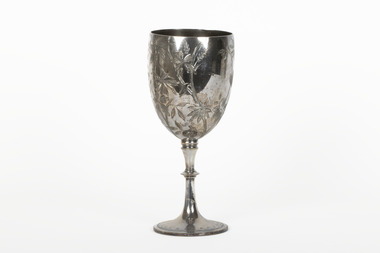
Award - Trophy
... Burke Museum C.F. Falck Watchmaker & Jeweller display in the Street of Shops Exhibition. ...This trophy was made in 1879 and used in Beechworth in the same year, 1879. Donated by Miss Ethel Spencer this trophy belonged to Catherine Mitchell Pyle. Miss Ethel Spencer was bridesmaid to Catherine Mitchell Pyle's daughter Jessie Pyle. Catherine Mitchell Pyle came to live with Ethel Spencer at Black Springs where she remained until she died in 1921. Ethel recalled that Catherine had a strong will and 'ruled the house inside and out'. Besides making beautiful bread, she also grew chrysanthemums. This silver trophy has been part of Beechworth history since 1879, and is currently held in the Burke Museum C.F. Falck Watchmaker & Jeweller display in the Street of Shops Exhibition.Deep hollow silver cup tapers to pedestal, engraved with branches and leaves. Base decorated with engraved lines, dots and half-moon pattern. Not inscribed. A00632 / 79.88 / 1.5 / Walker & Hall / Silver Cutlers / Silver Smiths Sheffield / 719 silver, trophy, walker & hall -
 The Beechworth Burke Museum
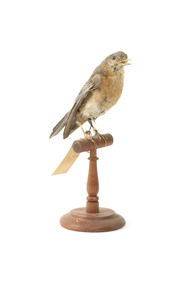
Animal specimen - Bluebird
... These skins were then mounted by members of the Burke Museum Committee and put-on display in the formal space of the Museum’s original exhibition hall where they continue to be on display. ...These skins were then mounted by members of the Burke Museum Committee and put-on display in the formal space of the Museum’s original exhibition hall where they continue to be on display. ...Eastern bluebirds are well-known song birds that live in eastern North America. They are sexually dimorphic, easily recognised by the male's bright royal blue upper plumage, chest of reddish brown and white abdomen. The females is duller in colour than the male, with greyer upperparts and blue tinges to her wings. These Bluebirds, the European variety, are the most common of the three Bluebird species. When not nesting, these birds fly in small flocks around the countryside. Bluebirds feed on small insects including moths, termites and mosquitoes. They also eat grasshoppers, crickets and caterpillars. The Bluebird can spot caterpillars and other insects in tall grass from a distance of over 45 meters. The Bluebird is commonly identified in numerous cultures as being symbolic as a harbinger of happiness. Often in Russian fairytales, the Bluebird is used as a symbol of hope. This specimen is part of a collection of almost 200 animal specimens that were originally acquired as skins from various institutions across Australia, including the Australian Museum in Sydney and the National Museum of Victoria (known as Museums Victoria since 1983), as well as individuals such as amateur anthropologist Reynell Eveleigh Johns between 1860-1880. These skins were then mounted by members of the Burke Museum Committee and put-on display in the formal space of the Museum’s original exhibition hall where they continue to be on display. This display of taxidermy mounts initially served to instruct visitors to the Burke Museum of the natural world around them, today it serves as an insight into the collecting habits of the 19th century.This specimen is part of a significant and rare taxidermy mount collection in the Burke Museum. This collection is scientifically and culturally important for reminding us of how science continues to shape our understanding of the modern world. They demonstrate a capacity to hold evidence of how Australia’s fauna history existed in the past and are potentially important for future environmental research. This collection continues to be on display in the Museum and has become a key part to interpreting the collecting habits of the 19th century.This female bluebird (likely Eastern) has a medium brown head and back, a rufous breast, and a cream belly. The bird has blue-tinged wing and tail feathers. The bill is short and has been stylized with the bill partly open to provide the illusion that the bird is making a call. This specimen stands upon a wooden mount and has an identification tag tied around its leg. The bird's plumage has faded since it was first preserved; females generally have duller colouring than their male counterparts but the colour of this particular specimen is paler than it would have been.Label: 122a. Blue-Bird / Catalogue Page 29. / Metal tag: 107taxidermy mount, taxidermy, animalia, burke museum, beechworth, australian museum, skin, reynell eveleigh johns, bird, american birds, bluebird -
 The Beechworth Burke Museum
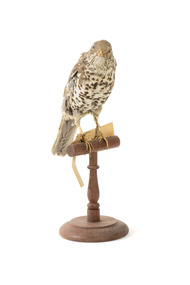
Animal specimen - Mistle Thrush, Trustees of the Australian Museum, 1860-1880
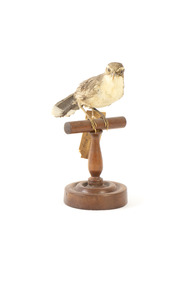
... These skins were then mounted by members of the Burke Museum Committee and put-on display in the formal space of the Museum’s original exhibition hall where they continue to be on display. ...These skins were then mounted by members of the Burke Museum Committee and put-on display in the formal space of the Museum’s original exhibition hall where they continue to be on display. ...The Mistle Thrush is native to Ireland and Scotland, North Africa and parts of Asia. It is known as a large, aggressive and powerful bird. They have several different calls: the main call, given by both sexes, is a dry chattering 'krrrr', louder when the birds are alarmed or excited. There is also a squeaky 'tuk' contact call. This specimen is part of a collection of almost 200 animal specimens that were originally acquired as skins from various institutions across Australia, including the Australian Museum in Sydney and the National Museum of Victoria (known as Museums Victoria since 1983), as well as individuals such as amateur anthropologist Reynell Eveleigh Johns between 1860-1880. These skins were then mounted by members of the Burke Museum Committee and put-on display in the formal space of the Museum’s original exhibition hall where they continue to be on display. This display of taxidermy mounts initially served to instruct visitors to the Burke Museum of the natural world around them, today it serves as an insight into the collecting habits of the 19th century.This specimen is part of a significant and rare taxidermy mount collection in the Burke Museum. This collection is scientifically and culturally important for reminding us of how science continues to shape our understanding of the modern world. They demonstrate a capacity to hold evidence of how Australia’s fauna history existed in the past and are potentially important for future environmental research. This collection continues to be on display in the Museum and has become a key part to interpreting the collecting habits of the 19th century. The Mistle Thrush has a pale grey-brown upperpart and a greyish-white chin. The yellow/buff breast and off-white belly are marked with round black spots. The long tail has white tips on the outer feathers, and the underwing coverts are white. The glass eyes are dark brown and the bill is blackish with a yellow base to the lower mandible. The legs and feet are yellow/brown. There is no plumage differences between the male and the female Mistle Thrush. This particular specimen stands upon a wooden platform and has an identification tag tied around its leg.Label: 111a. / Mistle Thrush / Catalogue, Page 28. / Other Label: 57. / Turdus viscivorus /taxidermy mount, cancel, taxidermy, burke museum, beechworth, australian museum, bird, mistle thrush -
 The Beechworth Burke Museum
Animal specimen - White-Browed Babbler, Trustees of the Australian Museum, 1860-1880
... These skins were then mounted by members of the Burke Museum Committee and put-on display in the formal space of the Museum’s original exhibition hall where they continue to be on display. ...These skins were then mounted by members of the Burke Museum Committee and put-on display in the formal space of the Museum’s original exhibition hall where they continue to be on display. ...The white-browed babbler is a a very active bird and is often found in noisy social groups. It lays two nests: one to lay its eggs in, and a separate nest to roost in. The Babbler is located in dry sclerophyll woodlands throughout mainland Australia. The diet of this species is varied: including insects, spiders and other invertebrates, small amphibians, crustaceans and reptiles. These birds will also eat fruits and seeds. This specimen is part of a collection of almost 200 animal specimens that were originally acquired as skins from various institutions across Australia, including the Australian Museum in Sydney and the National Museum of Victoria (known as Museums Victoria since 1983), as well as individuals such as amateur anthropologist Reynell Eveleigh Johns between 1860-1880. These skins were then mounted by members of the Burke Museum Committee and put-on display in the formal space of the Museum’s original exhibition hall where they continue to be on display. This display of taxidermy mounts initially served to instruct visitors to the Burke Museum of the natural world around them, today it serves as an insight into the collecting habits of the 19th century.This specimen is part of a significant and rare taxidermy mount collection in the Burke Museum. This collection is scientifically and culturally important for reminding us of how science continues to shape our understanding of the modern world. They demonstrate a capacity to hold evidence of how Australia’s fauna history existed in the past and are potentially important for future environmental research. This collection continues to be on display in the Museum and has become a key part to interpreting the collecting habits of the 19th century. The White-browed Babbler is a small bird with dark brown/grey plumage. It has a white throat, a white tipped tail and a long, pointed curved bill. This species have a distinct white brow and dark eye stripe which inspired its name. The specimen stands upon a wooden mount and has an identification tag tied around its leg.Label: 68a. / White-[illegible] Pomatostomus superciliosus /See Catalogue, page 20 /taxidermy mount, cancel, taxidermy, burke museum, beechworth, australian museum, bird, white browed babbler -
 The Beechworth Burke Museum
Animal specimen - Spotted Pardalote, Trustees of the Australian Museum, 1860-1880
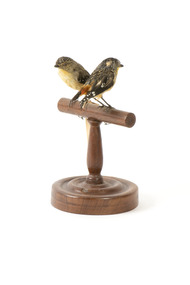
... These skins were then mounted by members of the Burke Museum Committee and put-on display in the formal space of the Museum’s original exhibition hall where they continue to be on display. ...These skins were then mounted by members of the Burke Museum Committee and put-on display in the formal space of the Museum’s original exhibition hall where they continue to be on display. ...The spotted pardalote is the smallest of all Australian birds. It has a tendency to nest in a long horizontal tunnel, often dug into the soil of creek banks, the embankments of railway cuttings, and quarries. Its call is characterised by a very clear and repetitive double "ding". The spotted pardalote is common in woodlands and eucalypt forest areas in Australia. This specimen is part of a collection of almost 200 animal specimens that were originally acquired as skins from various institutions across Australia, including the Australian Museum in Sydney and the National Museum of Victoria (known as Museums Victoria since 1983), as well as individuals such as amateur anthropologist Reynell Eveleigh Johns between 1860-1880. These skins were then mounted by members of the Burke Museum Committee and put-on display in the formal space of the Museum’s original exhibition hall where they continue to be on display. This display of taxidermy mounts initially served to instruct visitors to the Burke Museum of the natural world around them, today it serves as an insight into the collecting habits of the 19th century.This specimen is part of a significant and rare taxidermy mount collection in the Burke Museum. This collection is scientifically and culturally important for reminding us of how science continues to shape our understanding of the modern world. They demonstrate a capacity to hold evidence of how Australia’s fauna history existed in the past and are potentially important for future environmental research. This collection continues to be on display in the Museum and has become a key part to interpreting the collecting habits of the 19th century. One of Australia's smallest native birds, the male spotted pardalotte is covered with small, distinct white spots. Males have a pale eyebrow, a yellow throat and a red rump. Females are similar but have less-distinct markings. 10060 comprises of one male and one female. This specimen stands upon a wooden platform and has an identification tag tied around its legLabel: 14a. / Spotted Diamond Bird / See Catalogue, page 9. /taxidermy mount, cancel, taxidermy, burke museum, beechworth, australian museum, bird, spotted pardalote -
 The Beechworth Burke Museum
Animal specimen - Eastern Meadowlark, Trustees of the Australian Museum, 1860-1880
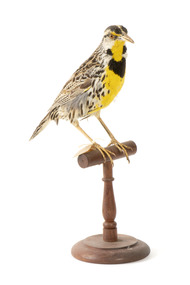
... These skins were then mounted by members of the Burke Museum Committee and put-on display in the formal space of the Museum’s original exhibition hall where they continue to be on display. ...These skins were then mounted by members of the Burke Museum Committee and put-on display in the formal space of the Museum’s original exhibition hall where they continue to be on display. ...Eastern Meadowlarks live throughout the grasslands and farms in eastern North America. On the ground, their brown-and-black dappled upperparts camouflage the birds among dirt clods and dry grasses. When in flight or perching, they reveal bright-yellow breasts and bellies, and a striking black chevron across the chest. The Eastern Meadowlark has a diet which consists of mainly insects and seeds. These birds forage by walking on the ground and taking insects and seeds from the ground and from low plants. In winter, these birds may choose to forage in flocks. This specimen is part of a collection of almost 200 animal specimens that were originally acquired as skins from various institutions across Australia, including the Australian Museum in Sydney and the National Museum of Victoria (known as Museums Victoria since 1983), as well as individuals such as amateur anthropologist Reynell Eveleigh Johns between 1860-1880. These skins were then mounted by members of the Burke Museum Committee and put-on display in the formal space of the Museum’s original exhibition hall where they continue to be on display. This display of taxidermy mounts initially served to instruct visitors to the Burke Museum of the natural world around them, today it serves as an insight into the collecting habits of the 19th century.This specimen is part of a significant and rare taxidermy mount collection in the Burke Museum. This collection is scientifically and culturally important for reminding us of how science continues to shape our understanding of the modern world. They demonstrate a capacity to hold evidence of how Australia’s fauna history existed in the past and are potentially important for future environmental research. This collection continues to be on display in the Museum and has become a key part to interpreting the collecting habits of the 19th century. This Eastern Meadowlark has a yellow breast and throat with black plumage in the shape of a 'V' on it's throat. This particular specimen has a long pointed bill which is in the shape of a spear. The crown of the bird is a dark brown and it also has lighter brown/yellow stripes on the brow. The back, wings, and tail are light brown with dark brown mottling. This specimen stands upon a wooden platform and has an identification tag tied around its leg. The legs are long and the specimen has been styalised in an upright position.Label: [illegible] Ant-Eating Thrush / Catalogue, Page 66. /taxidermy mount, taxidermy, animalia, burke museum, beechworth, australian museum, skin, reynell eveleigh johns, bird, american birds, eastern meadowlark, meadowlark -
 The Beechworth Burke Museum
Photograph, 02/12/2005
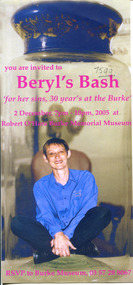
... 7599.1 Obverse: You are invited to Beryl's Bash, 'for her sins, 30 year's at the Burke' 2 December, 7pm-10pm, 2005 at Robert O'Hara Burke Memorial Museum, RSVP to Burke Museum, 03 57 28 8067 / 7599 7599.1 Reverse: and Christmas Party at the Burke Memorial Museum on 2 December, 2005 7-10pm, RSVP to the Burke by 29th November / 7599 7599.2 Obverse: Library Burke / Burke Museum / Open 10am- 5pm 7599.2 Reverse: Burke Museum / Robert O'Hara Burke Memorial [Mus]eum / Exhibitions / Notices / 1856 7599.3 Obverse: Newsagent / Est. 1853 / (illegible) ...As a curator Beryl would have had significant influence over the running and display of the museum, therefore having photographic evidence is a way for the community to reminisce and connect. invitation christmas party staff party Burke Museum Beechworth Beryl Witkowski 2000s employees curator celebration 2000s photo editing 7599.1 Obverse: You are invited to Beryl's Bash, 'for her sins, 30 year's at the Burke' 2 December, 7pm-10pm, 2005 at Robert O'Hara Burke Memorial Museum, RSVP to Burke Museum, 03 57 28 8067 / 7599 7599.1 Reverse: and Christmas Party at the Burke Memorial Museum on 2 December, 2005 7-10pm, RSVP to the Burke by 29th November / 7599 7599.2 Obverse: Library Burke / Burke Museum / Open 10am- 5pm 7599.2 Reverse: Burke Museum / Robert O'Hara Burke Memorial [Mus]eum / Exhibitions / Notices / 1856 7599.3 Obverse: Newsagent / Est. 1853 / (illegible) Some coloured and some black and white photographs printed on paper. ...This series of photos all depict Burke Museum curator Beryl Witkowski. The invitation was created in 2005, the other photographs seem to be throughout Beryl Witkowski's career, however it is not possible to determine exactly what date they are from. The photographs show Beryl in front of the main museum building, standing beside exhibits, receiving awards and holding antiques.This series of photographs are centred around the Burke Museum curator Beryl Witkowski. The collection consists of an invitation that features mid-2000s photo editing and numerous photographs of Beryl throughout her career. The invitation provides artistic/ aesthetic significance for its interesting photo editing technique, as photo editing was becoming increasingly popular during this time. Socially, the collection of photographs are significant to the community of Beechworth and to the Burke Museum. As a curator Beryl would have had significant influence over the running and display of the museum, therefore having photographic evidence is a way for the community to reminisce and connect.Some coloured and some black and white photographs printed on paper.7599.1 Obverse: You are invited to Beryl's Bash, 'for her sins, 30 year's at the Burke' 2 December, 7pm-10pm, 2005 at Robert O'Hara Burke Memorial Museum, RSVP to Burke Museum, 03 57 28 8067 / 7599 7599.1 Reverse: and Christmas Party at the Burke Memorial Museum on 2 December, 2005 7-10pm, RSVP to the Burke by 29th November / 7599 7599.2 Obverse: Library Burke / Burke Museum / Open 10am- 5pm 7599.2 Reverse: Burke Museum / Robert O'Hara Burke Memorial [Mus]eum / Exhibitions / Notices / 1856 7599.3 Obverse: Newsagent / Est. 1853 / (illegible) invitation, christmas party, staff party, burke museum, beechworth, beryl witkowski, 2000s, employees, curator, celebration, 2000s photo editing -
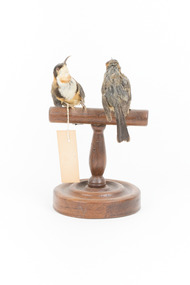 The Beechworth Burke Museum
Animal specimen - Eastern Spinebill, Trustees of the Australian Museum, 1860-1880
... These skins were then mounted by members of the Burke Museum Committee and put-on display in the formal space of the Museum’s original exhibition hall where they continue to be on display. ...These skins were then mounted by members of the Burke Museum Committee and put-on display in the formal space of the Museum’s original exhibition hall where they continue to be on display. ...The Eastern Spinebill is found along the eastern coast of Australia, from Queensland to South Australia. It lives in wooded areas. It is an insectivore and also eats nectar, which is why its beak is a long slender shape. Females and males have slight aesthetic differences; the males have more distinct markings on the head. The female birds build nests and incubate eggs, but both parent birds will feed the young. The Eastern Spinebill has a bright rust coloured belly and throat, with black wings, crown and tail. Its back is light brown. There is a white stripe on its chest which stretches up underneath its eyes. The eyes are red. This taxidermy specimen is not a good representation of the live bird because it is considerably faded and their feathers are very ruffled. This specimen is part of a collection of almost 200 animal specimens that were originally acquired as skins from various institutions across Australia, including the Australian Museum in Sydney and the National Museum of Victoria (known as Museums Victoria since 1983), as well as individuals such as amateur anthropologist Reynell Eveleigh Johns between 1860-1880. These skins were then mounted by members of the Burke Museum Committee and put-on display in the formal space of the Museum’s original exhibition hall where they continue to be on display. This display of taxidermy mounts initially served to instruct visitors to the Burke Museum of the natural world around them, today it serves as an insight into the collecting habits of the 19th century.This specimen is part of a significant and rare taxidermy mount collection in the Burke Museum. This collection is scientifically and culturally important for reminding us of how science continues to shape our understanding of the modern world. They demonstrate a capacity to hold evidence of how Australia’s fauna history existed in the past and are potentially important for future environmental research. This collection continues to be on display in the Museum and has become a key part to interpreting the collecting habits of the 19th century.There are two birds on a wooden stand. One has its beak in the air and the catalogue tag attached to its foot (main bird). It has some minor pest damage around its eye. The opposite bird looks straight ahead. The birds are placed next to each other, facing opposite directions. They are faded and have some ruffled feathers. 60a/ Spine Bill / See catalogue, page 18taxidermy mount, taxidermy, animalia, burke museum, beechworth, australian museum, skin, reynell eveleigh johns, bird, eastern spinebill -
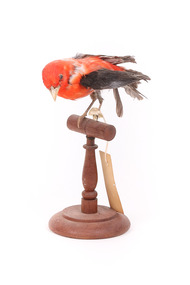 The Beechworth Burke Museum
Animal specimen - Scarlet Tanager (male), Trustees of the Australian Museum, 1860-1880
... These skins were then mounted by members of the Burke Museum Committee and put-on display in the formal space of the Museum’s original exhibition hall where they continue to be on display. ...These skins were then mounted by members of the Burke Museum Committee and put-on display in the formal space of the Museum’s original exhibition hall where they continue to be on display. ...The Scarlet Tanager is an American songbird of medium size with bright coloured plumage. They are commonly located in eastern North America and in northwestern South America. They can often be found within woodlands that have oaks. On occasion, the Tanager can be seen in suburban areas including parks and gardens. These birds are sociable and often join with other foraging flocks. They are carnivores (insectivores) and feed on insects including wasps, ants, moths, beetles, butterflies and grasshoppers. The numbers of these birds in America are declining due to exposure and starvation during the colder months. These birds can also die from collisions with man made objects which includes the TV and radio towers, buildings and cars. They also have high rates of predation and brood parasitism. However, at current the IUCN classifies this species as Least Concern and note that their numbers are stable. This specimen is part of a collection of almost 200 animal specimens that were originally acquired as skins from various institutions across Australia, including the Australian Museum in Sydney and the National Museum of Victoria (known as Museums Victoria since 1983), as well as individuals such as amateur anthropologist Reynell Eveleigh Johns between 1860-1880. These skins were then mounted by members of the Burke Museum Committee and put-on display in the formal space of the Museum’s original exhibition hall where they continue to be on display. This display of taxidermy mounts initially served to instruct visitors to the Burke Museum of the natural world around them, today it serves as an insight into the collecting habits of the 19th century.This specimen is part of a significant and rare taxidermy mount collection in the Burke Museum. This collection is scientifically and culturally important for reminding us of how science continues to shape our understanding of the modern world. They demonstrate a capacity to hold evidence of how Australia’s fauna history existed in the past and are potentially important for future environmental research. This collection continues to be on display in the Museum and has become a key part to interpreting the collecting habits of the 19th century.The Scarlet Tanager specimen stands perched on a wooden platform looking towards the ground. It has bright red/orange feathers on the main body and head with dark black feathers on the tail and wings. Overall, whilst retaining a bright appearance the bird has faded in contrast to it's original colouring This particular specimen has disheveled feathers and is missing one leg. The bill is short and pale and the specimen has been provided with glass eyes made in a dark colour. The specimen has two paper identification tags attached to the damaged leg.Swing tag: 114a / unnamed / catalogue, page 59 Cotton tag: A.4440 /taxidermy mount, taxidermy, animalia, burke museum, beechworth, australian museum, skin, reynell eveleigh johns, bird, australian birds, american, american birds, scarlet tanager, tanager, medium bird, small bird -
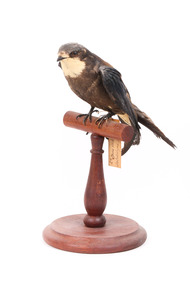 The Beechworth Burke Museum
Animal specimen - White-Throated Needletail, Trustees of the Australian Museum, 1860-1880
... These skins were then mounted by members of the Burke Museum Committee and put-on display in the formal space of the Museum’s original exhibition hall where they continue to be on display. ...These skins were then mounted by members of the Burke Museum Committee and put-on display in the formal space of the Museum’s original exhibition hall where they continue to be on display. ...The White-Throated Needletail is a highly sociable bird commonly seen in large flocks containing a hundred plus birds. This species is also known to mingle with birds of different species. They have a distinctive white throat and undertail. This species is mainly airborne, however they are known to reside in trees when on land. They can mainly be spotted along the north and east parts of Australia. This species is listed as vulnerable and threatened in the Australian Capital Territory, Queensland and Victoria. Since this is a taxidermy mount, it is not an accurate depiction of the White-Throated Needletail. The species should have a predominantly grey-brown plumage, with the exception of the throat and undertail which are white. There should also be a green tint to the species feathers. This specimen is part of a collection of almost 200 animal specimens that were originally acquired as skins from various institutions across Australia, including the Australian Museum in Sydney and the National Museum of Victoria (known as Museums Victoria since 1983), as well as individuals such as amateur anthropologist Reynell Eveleigh Johns between 1860-1880. These skins were then mounted by members of the Burke Museum Committee and put-on display in the formal space of the Museum’s original exhibition hall where they continue to be on display. This display of taxidermy mounts initially served to instruct visitors to the Burke Museum of the natural world around them, today it serves as an insight into the collecting habits of the 19th century.This specimen is part of a significant and rare taxidermy mount collection in the Burke Museum. This collection is scientifically and culturally important for reminding us of how science continues to shape our understanding of the modern world. They demonstrate a capacity to hold evidence of how Australia’s fauna history existed in the past and are potentially important for future environmental research. This collection continues to be on display in the Museum and has become a key part to interpreting the collecting habits of the 19th century.This White-Throated Needletail had grey-brown feathers. It has distinctive white patches on its throat and under the tail. The back of the bird is a light brown with a white patch in the center of the back. This specimen stands upon a wooden mount and has an identification tag tied around its leg. The bill is short and the wings are long and pointed. The bird's tail is short and square in shape with protruding feather shafts which give a spiky appearance.2a / Spine-Tailed Swift / See catalogue, page 7taxidermy mount, taxidermy, burke museum, beechworth, australian museum, skin, reynell eveleigh johns, bird, white-throated needletail, australian birds -
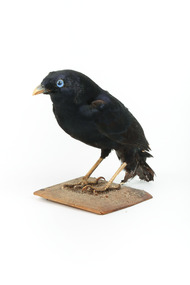 The Beechworth Burke Museum
Animal specimen - Satin Bowerbird (male), 1860-1880
... These skins were then mounted by members of the Burke Museum Committee and put-on display in the formal space of the Museum’s original exhibition hall where they continue to be on display. ...These skins were then mounted by members of the Burke Museum Committee and put-on display in the formal space of the Museum’s original exhibition hall where they continue to be on display. ...The Satin Bowerbird is commonly located around the eastern and south-eastern coast of Australia. They reside in wetter forests and woodlands, and nearby open areas. They feed mostly on fruits throughout the year but in summer will supplement their food supply with insects and in winter with leaves. The Satin Bowerbird is most commonly known for it's practice of building and decorating it's bower. They will often collect objects of bright blue to decorate the bower including straws, clothes peg, parrot feathers, pens, marble, string, glass and bottle tops. This decoration is done by a male Bowerbird in the effort to attract females. This specimen is part of a collection of almost 200 animal specimens that were originally acquired as skins from various institutions across Australia, including the Australian Museum in Sydney and the National Museum of Victoria (known as Museums Victoria since 1983), as well as individuals such as amateur anthropologist Reynell Eveleigh Johns between 1860-1880. These skins were then mounted by members of the Burke Museum Committee and put-on display in the formal space of the Museum’s original exhibition hall where they continue to be on display. This display of taxidermy mounts initially served to instruct visitors to the Burke Museum of the natural world around them, today it serves as an insight into the collecting habits of the 19th century.This specimen is part of a significant and rare taxidermy mount collection in the Burke Museum. This collection is scientifically and culturally important for reminding us of how science continues to shape our understanding of the modern world. They demonstrate a capacity to hold evidence of how Australia’s fauna history existed in the past and are potentially important for future environmental research. This collection continues to be on display in the Museum and has become a key part to interpreting the collecting habits of the 19th century.This taxidermy Satin Bowerbird specimen has dark black/blue glossy plumage and a pale coloured bill of small size. The bird is of a medium size compared to other species of birds and has pale legs with short talons. The eyes are made of strikingly blue coloured glass which represents the violet-blue iris of this bird while living. The bird has a short tale and has been stylized in a leaning/crouched position with it's back arched upwards and head out long. This specimen stands on a small platform and there is some deterioration to the tail feathers which protrude beyond the platform which may have otherwise provided some protection. Donor - Mr. E.T. / BH. RO. /taxidermy mount, taxidermy, animalia, burke museum, beechworth, australian museum, skin, reynell eveleigh johns, bird, australian birds, bower, bowerbird, satin bowerbird -
 The Beechworth Burke Museum
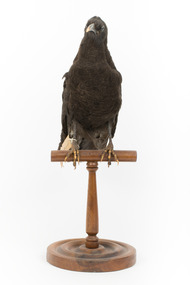
Animal specimen - American Crow, Trustees of the Australian Museum, 1860-1880
... These skins were then mounted by members of the Burke Museum Committee and put-on display in the formal space of the Museum’s original exhibition hall where they continue to be on display. ...These skins were then mounted by members of the Burke Museum Committee and put-on display in the formal space of the Museum’s original exhibition hall where they continue to be on display. ...The American Crow is common throughout North America. They reside in areas with open view and trees but can often frequent city parks, suburbs of large cities and along the seashore. The Crow is a robber and therefore, find living in locations which they can raid for food perfect. These birds are sociable animals and are often found in small groups made up of family members. All their lives they reside in the one location; however, they do migrate south during the autumn. They usually find their food by walking along the ground and eat both plant and animal foods. This includes worms, larvae, insects and fruits and nuts. Crows are also known to feed on small rabbits, frogs and mice. They are also identified as nest predators because they feed on eggs. In areas occupied by humans, the Crow will find their food source from trash and also road kill. The American Crow is not considered to be an endangered species and list them on the IUCN Red List as Least Concern. However, large amounts of crows are killed for sporting and during campaigns (having a desire to reduce the population of the Crow in America). This specimen is part of a collection of almost 200 animal specimens that were originally acquired as skins from various institutions across Australia, including the Australian Museum in Sydney and the National Museum of Victoria (known as Museums Victoria since 1983), as well as individuals such as amateur anthropologist Reynell Eveleigh Johns between 1860-1880. These skins were then mounted by members of the Burke Museum Committee and put-on display in the formal space of the Museum’s original exhibition hall where they continue to be on display. This display of taxidermy mounts initially served to instruct visitors to the Burke Museum of the natural world around them, today it serves as an insight into the collecting habits of the 19th century.This specimen is part of a significant and rare taxidermy mount collection in the Burke Museum. This collection is scientifically and culturally important for reminding us of how science continues to shape our understanding of the modern world. They demonstrate a capacity to hold evidence of how Australia’s fauna history existed in the past and are potentially important for future environmental research. This collection continues to be on display in the Museum and has become a key part to interpreting the collecting habits of the 19th century.This American Crow has black plumage which has slightly faded in colour. This colour fading could also indicate that the bird was molting because the feathers of the American Crow appear brownish when the are about to molt and these feathers give way to new glossy black feathers. The specimen has two black glass eyes, a dark bill and dark legs with talons. Both the edges of the bill and the talons are faded into a pale buff colour. It is likely that the legs and talons were painted a dark black by the taxidermist and the paint has either worn off or faded over the years. The bird is standing tall on a wooden mount and looking forwards. It has a paper identification tag attached to the right leg. The tail is short and the feathers are rounded at the ends.153a. / See catalogue page 61taxidermy mount, taxidermy, animalia, burke museum, beechworth, australian museum, skin, reynell eveleigh johns, bird, america, crow, american crow -
 The Beechworth Burke Museum
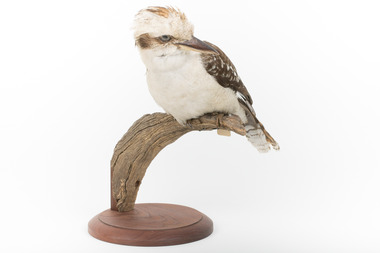
Animal specimen - Kookaburra, Trustees of the Australian Museum, 1860-1880
... These skins were then mounted by members of the Burke Museum Committee and put-on display in the formal space of the Museum’s original exhibition hall where they continue to be on display. ...These skins were then mounted by members of the Burke Museum Committee and put-on display in the formal space of the Museum’s original exhibition hall where they continue to be on display. ...The Kookaburra is a sociable bird commonly seen in small flocks. These flocks mainly consist of family members. If not in flocks, these birds are commonly seen in pairs. They have a distinct appearance with brown wings, back and brown around the eyes, with majority of the plumage being white. This species reside in woodlands and open forests, however they can be seen in parks, wetlands, farms and any other space that is open with grass. This native Australian bird can mainly be found across the eastern Australia, however they have been introduced Tasmania, South-west Western Australia and New Zealand. Although this is a taxidermy mount, it looks exactly like a Kookaburra in real life. This specimen is part of a collection of almost 200 animal specimens that were originally acquired as skins from various institutions across Australia, including the Australian Museum in Sydney and the National Museum of Victoria (known as Museums Victoria since 1983), as well as individuals such as amateur anthropologist Reynell Eveleigh Johns between 1860-1880. These skins were then mounted by members of the Burke Museum Committee and put-on display in the formal space of the Museum’s original exhibition hall where they continue to be on display. This display of taxidermy mounts initially served to instruct visitors to the Burke Museum of the natural world around them, today it serves as an insight into the collecting habits of the 19th century.This specimen is part of a significant and rare taxidermy mount collection in the Burke Museum. This collection is scientifically and culturally important for reminding us of how science continues to shape our understanding of the modern world. They demonstrate a capacity to hold evidence of how Australia’s fauna history existed in the past and are potentially important for future environmental research. This collection continues to be on display in the Museum and has become a key part to interpreting the collecting habits of the 19th century.This Kookaburra has a predominantly white body. The back, wings and tail are a light shade of brown. There is a strip of brown going across the eyes. This specimen stands upon a wooden branch and has an identification tag ties around its leg. This bird is stout in shape and has a medium length tail and a broad bill. This bill is darker on top and lighter in colour on the bottom.W8083 / taxidermy mount, taxidermy, animalia, burke museum, beechworth, australian museum, skin, reynell eveleigh johns, bird, kookaburra, australian birds, laughing kookaburra -
 The Beechworth Burke Museum
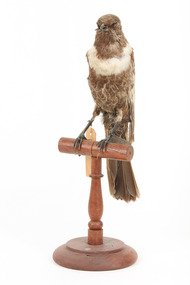
Animal specimen - Ring Ouzel, Trustees of the Australian Museum, 1860-1880
... These skins were then mounted by members of the Burke Museum Committee and put-on display in the formal space of the Museum’s original exhibition hall where they continue to be on display. ...These skins were then mounted by members of the Burke Museum Committee and put-on display in the formal space of the Museum’s original exhibition hall where they continue to be on display. ...The Ring Ouzel can commonly be found in small flocks or pairs. They have a distinctive white strip across their chest which helps to identify this species. They generally reside in large open grassy spaces such as farmlands, and can be found in mountainous areas with large boulders and slopes. They are located across Western Europe, the Mediterranean and Northern Africa. In some countries such as Ireland, England and Wales, the Ring Ouzel is endangered due to human disturbances, however elsewhere the species thrives. Although this is a taxidermy mount, it is highly similar to the real female Ring Ouzel. This specimen is part of a collection of almost 200 animal specimens that were originally acquired as skins from various institutions across Australia, including the Australian Museum in Sydney and the National Museum of Victoria (known as Museums Victoria since 1983), as well as individuals such as amateur anthropologist Reynell Eveleigh Johns between 1860-1880. These skins were then mounted by members of the Burke Museum Committee and put-on display in the formal space of the Museum’s original exhibition hall where they continue to be on display. This display of taxidermy mounts initially served to instruct visitors to the Burke Museum of the natural world around them, today it serves as an insight into the collecting habits of the 19th century.This specimen is part of a significant and rare taxidermy mount collection in the Burke Museum. This collection is scientifically and culturally important for reminding us of how science continues to shape our understanding of the modern world. They demonstrate a capacity to hold evidence of how Australia’s fauna history existed in the past and are potentially important for future environmental research. This collection continues to be on display in the Museum and has become a key part to interpreting the collecting habits of the 19th century.This female Ring Ouzel is a predominantly brown in color. It has a white strip across its chest. The torso is a lighter shade of brown. The tale of the Ring Ouzel is long and a darker shade of brown when compared to the red colouring of the body. This specimen stands upon a wooden perch and has an identification tag tied around its leg. The bill is thin and has a pointed appearance. It has been styalised by the taxidermist in an open position which conveys the idea that this bird is mid call.Swing tag: 109a / Ring Thrush / Catalogue Page 27 / Metal tag: 4139 /taxidermy, taxidermy mount, animalia, burke museum, beechworth, australian museum, skin, reynell eveleigh johns, bird, ring ouzel, ouzel, european birds, african birds, mediterranean birds -
 The Beechworth Burke Museum
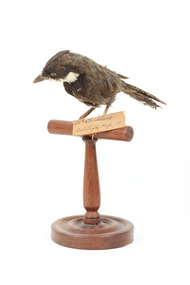
Animal specimen - Eastern Whipbird, Trustees of the Australian Museum, 1860-1880
... These skins were then mounted by members of the Burke Museum Committee and put-on display in the formal space of the Museum’s original exhibition hall where they continue to be on display. ...These skins were then mounted by members of the Burke Museum Committee and put-on display in the formal space of the Museum’s original exhibition hall where they continue to be on display. ...The Eastern Whipbird isusually be found in pairs. They have a distinct white stripe on either side of the beak which helps to identify this bird. This species generally resides in wet habitats such as wetlands and rainforests, where there is dense vegetation. The Eastern Whipbird can be commonly found along the east coast of Australia. Since this is a taxidermy mount, there are a few inconsistencies. The main inconsistency is the colour of the specimen, the plumage should be an olive-green colour. This particular colouring has likely faded due to the taxidermy process and also the age of the specimen. There should also be black plume on top of the head which is missing from this specimen. This specimen is part of a collection of almost 200 animal specimens that were originally acquired as skins from various institutions across Australia, including the Australian Museum in Sydney and the National Museum of Victoria (known as Museums Victoria since 1983), as well as individuals such as amateur anthropologist Reynell Eveleigh Johns between 1860-1880. These skins were then mounted by members of the Burke Museum Committee and put-on display in the formal space of the Museum’s original exhibition hall where they continue to be on display. This display of taxidermy mounts initially served to instruct visitors to the Burke Museum of the natural world around them, today it serves as an insight into the collecting habits of the 19th century.This specimen is part of a significant and rare taxidermy mount collection in the Burke Museum. This collection is scientifically and culturally important for reminding us of how science continues to shape our understanding of the modern world. They demonstrate a capacity to hold evidence of how Australia’s fauna history existed in the past and are potentially important for future environmental research. This collection continues to be on display in the Museum and has become a key part to interpreting the collecting habits of the 19th century.This Eastern Whipbird is a small species of bird which has a dramatic stripe of white colouring on either side of the small bill and the crest is black. The belly and throat are black while the back, wings and tail are dark brown. This specimen stands upon a wooden perch and has an identification tag tied around its leg.25a / Thickhead / catalogue page 11taxidermy mount, taxidermy, animalia, burke museum, beechworth, australian museum, skin, reynell eveleigh johns, bird, eastern whipbird, australian birds -
 The Beechworth Burke Museum
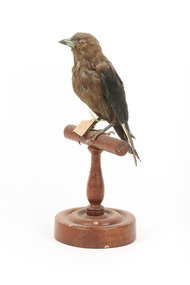
Animal specimen - Dusky Woodswallow, Trustees of the Australian Museum, 1860-1880
... These skins were then mounted by members of the Burke Museum Committee and put-on display in the formal space of the Museum’s original exhibition hall where they continue to be on display. ...These skins were then mounted by members of the Burke Museum Committee and put-on display in the formal space of the Museum’s original exhibition hall where they continue to be on display. ...The Dusky Woodswallow is often found in flocks which can be located in two separate populations. The Eastern population if located in Atherton Tableland in Queensland south to Tasmania and west to Eyre Peninsula in South Australia. The other population is found in south-west Western Australia. They reside in open forests and woodlands. This species is surprisingly aggressive and may fight with other Woodswallows for territory and nest sights. They will even chase raptors away from their homes. This species flies in flocks of around 10 to 30 birds which cluster together. In terms of diet, these birds eat insects and nectar from flowers. This specimen is part of a collection of almost 200 animal specimens that were originally acquired as skins from various institutions across Australia, including the Australian Museum in Sydney and the National Museum of Victoria (known as Museums Victoria since 1983), as well as individuals such as amateur anthropologist Reynell Eveleigh Johns between 1860-1880. These skins were then mounted by members of the Burke Museum Committee and put-on display in the formal space of the Museum’s original exhibition hall where they continue to be on display. This display of taxidermy mounts initially served to instruct visitors to the Burke Museum of the natural world around them, today it serves as an insight into the collecting habits of the 19th century.This specimen is part of a significant and rare taxidermy mount collection in the Burke Museum. This collection is scientifically and culturally important for reminding us of how science continues to shape our understanding of the modern world. They demonstrate a capacity to hold evidence of how Australia’s fauna history existed in the past and are potentially important for future environmental research. This collection continues to be on display in the Museum and has become a key part to interpreting the collecting habits of the 19th century.The Dusky Woodswallow has largely deep brown colouring with some areas of grey on the head, neck and chest. There is a deeper brown colouring between the wings on the back of the specimen and the wings are black. This bird has a small curved bill which is grey and white. The legs are dark grey and the bird has long talons with an extra long toe in the centre. The eyes are made of brown glass with a back pupil. The bird is styalised standing on a wooden mount and has a paper identification tag attached to its right leg.[torn] / 9 /taxidermy mount, taxidermy, animalia, burke museum, beechworth, australian museum, skin, reynell eveleigh johns, bird, australian birds, swallow, woodswallow, dusky woodswallow -
 The Beechworth Burke Museum
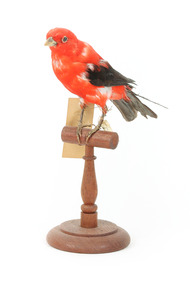
Animal specimen - Scarlet Tanager (male), Trustees of the Australian Museum, 1860-1880
... These skins were then mounted by members of the Burke Museum Committee and put-on display in the formal space of the Museum’s original exhibition hall where they continue to be on display. ...These skins were then mounted by members of the Burke Museum Committee and put-on display in the formal space of the Museum’s original exhibition hall where they continue to be on display. ...The Scarlet Tanager is an American songbird of medium size with bright coloured plumage. They are commonly located in eastern North America and in northwestern South America. They can often be found within woodlands that have oaks. On occasion, the Tanager can be seen in suburban areas including parks and gardens. These birds are sociable and often join with other foraging flocks. They are carnivores (insectivores) and feed on insects including wasps, ants, moths, beetles, butterflies and grasshoppers. The numbers of these birds in America are declining due to exposure and starvation during the colder months. These birds can also die from collisions with man made objects which includes the TV and radio towers, buildings and cars. They also have high rates of predation and brood parasitism. However, at current the IUCN classifies this species as Least Concern and note that their numbers are stable. This specimen is part of a collection of almost 200 animal specimens that were originally acquired as skins from various institutions across Australia, including the Australian Museum in Sydney and the National Museum of Victoria (known as Museums Victoria since 1983), as well as individuals such as amateur anthropologist Reynell Eveleigh Johns between 1860-1880. These skins were then mounted by members of the Burke Museum Committee and put-on display in the formal space of the Museum’s original exhibition hall where they continue to be on display. This display of taxidermy mounts initially served to instruct visitors to the Burke Museum of the natural world around them, today it serves as an insight into the collecting habits of the 19th century.This specimen is part of a significant and rare taxidermy mount collection in the Burke Museum. This collection is scientifically and culturally important for reminding us of how science continues to shape our understanding of the modern world. They demonstrate a capacity to hold evidence of how Australia’s fauna history existed in the past and are potentially important for future environmental research. This collection continues to be on display in the Museum and has become a key part to interpreting the collecting habits of the 19th century.The Scarlet Tanager specimen stands perched on a wooden platform looking forwards in a raised position. It has bright red/orange feathers on the main body and head with dark black feathers on the tail and wings. Overall, whilst retaining a bright appearance the bird has faded in contrast to it's original colouring. The bill is short and pale and the specimen has been provided with glass eyes made in a dark colour. The specimen has two paper identification tags attached to the right leg.Swing tag: 143a / unnamed / catalogue page 59 Metal tag: A4439 /taxidermy mount, taxidermy, animalia, burke museum, beechworth, australian museum, skin, reynell eveleigh johns, bird, australian birds, american, american birds, scarlet tanager, tanager, medium bird, small bird -
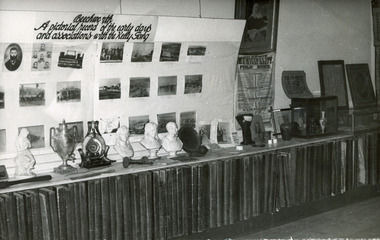 The Beechworth Burke Museum
Photograph, unknown
... This photograph was taken in the Burke Museum c1970 and depicts an exhibition about the Kelly Gang. ...This photograph was taken in the Burke Museum c1970 and depicts an exhibition about the Kelly Gang. ...This photograph was taken in the Burke Museum c1970 and depicts an exhibition about the Kelly Gang. This photograph is of social significance due to its connection with the Burke Museum as well as the Kelly Gang. The Kelly Gang story is integral to the formation of an Australian identity and highlights the Irish oppression during the 1800s. Ned Kelly is an Australian icon, mythologised in Australian literature, art, folklore and history, and the Kelly Gang story permeates Australia's national consciousness. The Burke Museum is significant here also, as the image shows the importance of the Kelly Story to the Beechworth area and local identity. This photograph is also of research potential due to the great interest in the Kelly Gang history in Australia, and also for its presentation of a historical museum exhibition in Beechworth.Black and white, rectangular photograph, printed on photographic paperObverse: Beechworth/a pictorial record of the early days/and associations with the Kelly Gang Reverse: BMA03314 1997.3125/Agfaned kelly, kelly gang, burke museum, australia, museum, display, photograph, pictorial record, beechworth municipality, beechworth, exhibit, bust, clock, urn, vase, painting -
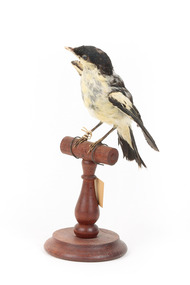 The Beechworth Burke Museum
Animal specimen - White Winged Triller, 1860-1880
... These skins were then mounted by members of the Burke Museum Committee and put-on display in the formal space of the Museum’s original exhibition hall where they continue to be on display. ...These skins were then mounted by members of the Burke Museum Committee and put-on display in the formal space of the Museum’s original exhibition hall where they continue to be on display. ...The White Winged Triller is a small member of the Campephagidae family. They can be found all over the Australian mainland, but there have also been sightings in Tasmania, Papua New Guinea and Indonesia. Their breeding season is from September to December, when they migrate to southern Australia for the warmer months. The males can be very noisy during this time, when they 'trill' all day, granting them their name. Throughout the winter they can be found in northern Australia. This species can be found in open areas with shrub and lots of ground cover, in woodlands, forests, scrub and waterways. The males and females are noticeably different, particularly when breeding. Breeding males are the most conspicuous, with black on their heads, bodies and wing coverts, with a white body, lower face and lower wings. Females are brown, with a light body, a faint brow and a dark line through their eyes. When not in the breeding season, males are similar to females, though they have a greyer rump. These birds have a netted pattern on their wings. When in flight they undulate, and when they land they often shuffle and re-fold their wings. This species predominantly forage for insects on the ground or tree foliage, but also 'hawks' insects from higher perches. They build nests on horizontal branches or forks, and can be found sometimes using empty nests of other birds. Many of these birds can be found nesting in the same tree as a colony, and both parents incubate and brood their two to three nestlings. This specimen is a male White Winger Triller, which is apparent from his black and white colouring. While missing some plumage, the distinction between black wings, tail, cap and wing covert are still clear against his white body and under-wings. This specimen is part of a collection of almost 200 animal specimens that were originally acquired as skins from various institutions across Australia, including the Australian Museum in Sydney and the National Museum of Victoria (known as Museums Victoria since 1983), as well as individuals such as amateur anthropologist Reynell Eveleigh Johns between 1860-1880. These skins were then mounted by members of the Burke Museum Committee and put-on display in the formal space of the Museum’s original exhibition hall where they continue to be on display. This display of taxidermy mounts initially served to instruct visitors to the Burke Museum of the natural world around them, today it serves as an insight into the collecting habits of the 19th century.This specimen is part of a significant and rare taxidermy mount collection in the Burke Museum. This collection is scientifically and culturally important for reminding us of how science continues to shape our understanding of the modern world. They demonstrate a capacity to hold evidence of how Australia’s fauna history existed in the past and are potentially important for future environmental research. This collection continues to be on display in the Museum and has become a key part to interpreting the collecting habits of the 19th century.This male White Winged Triller has a black cap on its head. It has black wings with black wing coverts, and a black tail. It has a white lower face and body, a white shoulder bar and white under-wings. This specimen stands upon a wooden post, attached to a wooden post and has an identification tag tied around its leg. Swing-tag: 22a / White shouldered Campephagidae/ See catalogue, page 11. /taxidermy mount, taxidermy, animalia, burke museum, beechworth, australian museum, skin, reynell eveleigh johns, bird, triller, white winged triller, campephagidae, australian birds -
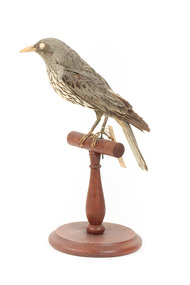 The Beechworth Burke Museum
Animal specimen - Olive-Backed Oriole, Trustees of the Australian Museum, 1860-1880
... These skins were then mounted by members of the Burke Museum Committee and put-on display in the formal space of the Museum’s original exhibition hall where they continue to be on display. ...These skins were then mounted by members of the Burke Museum Committee and put-on display in the formal space of the Museum’s original exhibition hall where they continue to be on display. ...The Olive-Backed Oriole are very common birds for northern and eastern Australia, as well as New Guinea. Similar to the Yellow Oriole, this species is more versatile yet less distinctive in colouring. The streaked underparts and red bill and eyes are easy identification features of this bird. Both sexes look very similar, with female colouring being slightly duller than males. This species frequents open forests and woodlands, and can tolerate dry climates. Most of this species breeds from September to January during the tropical wet season in northern Australia, but some are known to migrate south to breed in the summer. This species eats mainly native fruit, berries, and insects. This specimen is a good example of this species, but the colouring is very dull compared to living birds. This specimen has one red eye, which is a good example of a distinctive feature of this species. This specimen is part of a collection of almost 200 animal specimens that were originally acquired as skins from various institutions across Australia, including the Australian Museum in Sydney and the National Museum of Victoria (known as Museums Victoria since 1983), as well as individuals such as amateur anthropologist Reynell Eveleigh Johns between 1860-1880. These skins were then mounted by members of the Burke Museum Committee and put-on display in the formal space of the Museum’s original exhibition hall where they continue to be on display. This display of taxidermy mounts initially served to instruct visitors to the Burke Museum of the natural world around them, today it serves as an insight into the collecting habits of the 19th century.This specimen is part of a significant and rare taxidermy mount collection in the Burke Museum. This collection is scientifically and culturally important for reminding us of how science continues to shape our understanding of the modern world. They demonstrate a capacity to hold evidence of how Australia’s fauna history existed in the past and are potentially important for future environmental research. This collection continues to be on display in the Museum and has become a key part to interpreting the collecting habits of the 19th century.This Olive-Backed Oriole has a faint olive-green head and back, and a faint red-tinged beak. Its body is cream coloured with brown streaks. It has one red eye. This specimen appears to be immature and/or female, as it has a pale pill and a duller-olive green back, with streaks quite high up on it's chin, which is indicative of an immature female of this species. This specimen stands upon a wooden platform and has an identification tag tied around its leg.Swing-tag: 52a / Australian Oriole / See catalogue page 17. taxidermy mount, taxidermy, animalia, burke museum, beechworth, australian museum, skin, reynell eveleigh johns, bird, oriole, olive-backed oriole, yellow oriole, australian birds -
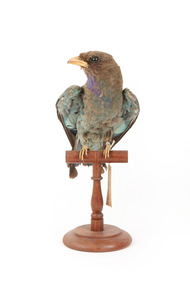 The Beechworth Burke Museum
Animal specimen - Dollarbird, Trustees of the Australian Museum, 1860-1880
... These skins were then mounted by members of the Burke Museum Committee and put-on display in the formal space of the Museum’s original exhibition hall where they continue to be on display. ...These skins were then mounted by members of the Burke Museum Committee and put-on display in the formal space of the Museum’s original exhibition hall where they continue to be on display. ...The Dollarbird is so-named because of the coin-shaped patches on the tips of their wings, which is clear when in flight. They have distinctive blue-green colouring on their backs and wings, and a bright blue throat. This species migrates to northern and eastern Australia for breeding, between the months of September and April. These birds migrate to New Guinea and nearby islands in the Winter, but can be found in Japan and India also. This species resides in open wooded areas, preferring hollow-bearing trees for nesting. They can be found spending most of their time perched on high branches in search of insects, and will often 'hawk' at dusk above the tree-tops, hovering on the wing for lengthy periods. This specimen is a good example of this species, however the distinctive coin-patches on the tips of the wings are partially hidden by the tuck of the wing. This specimen is part of a collection of almost 200 animal specimens that were originally acquired as skins from various institutions across Australia, including the Australian Museum in Sydney and the National Museum of Victoria (known as Museums Victoria since 1983), as well as individuals such as amateur anthropologist Reynell Eveleigh Johns between 1860-1880. These skins were then mounted by members of the Burke Museum Committee and put-on display in the formal space of the Museum’s original exhibition hall where they continue to be on display. This display of taxidermy mounts initially served to instruct visitors to the Burke Museum of the natural world around them, today it serves as an insight into the collecting habits of the 19th century.This specimen is part of a significant and rare taxidermy mount collection in the Burke Museum. This collection is scientifically and culturally important for reminding us of how science continues to shape our understanding of the modern world. They demonstrate a capacity to hold evidence of how Australia’s fauna history existed in the past and are potentially important for future environmental research. This collection continues to be on display in the Museum and has become a key part to interpreting the collecting habits of the 19th century.This adult Dollarbird has a brown body and head, blue-green back and wings. It has a distinctive bright blue or purple plumage around its throat. The tips of the wings are brown. The pale-blue coin shaped patches on the tips of the wings are just visible. This specimen stands upon a wooden platform and has an identification tag tied around its leg.Swing-tag: 96a / Australian Roller / Catalogue, page, 25. taxidermy mount, taxidermy, animalia, burke museum, beechworth, australian museum, skin, reynell eveleigh johns, bird, dollarbird, australian birds, broad-billed roller
