
Showing 7 items matching "bush knife"
-
 Wangaratta RSL Sub Branch
Accessory - Machete Scabbard, H Carson Ltd, c1941
... ...Bush knife...WW2 New Guinea Bob Iskov Bush knife Machete Scabbard H C Co LTD 941 Brown leather scabbard with belt loop and strap fitted with brass stud attached by three studs to sheath. ...This leather scabbard was mostly likely made by H Carson Ltd in Canada who were suppliers to the military during WW2 of leather sheaths/scabbards. The item is from a collection that belonged to Robert Francis ISKOV VX15237 born at Glenrowan served with the 59th Battalion CMF before joining the 2/14th Battalion at Caulfield in September 1940. He disembarked for the Middle East in November, 1940 and fought in the Syrian campaign in 1941. In 1942 the 2/14th Battalion returned to Australia and sent to New Guinea where he fought at the Battle of Isurava before the battalion was sent to Gona. On 1943 Bob returned to Australia to undertake officer training and in 1945 with the 2/23rd Battalion sailed to Morotai and served with the battalion on Tarakan. He returned to Australia in November, 1945 and discharged a month later.Brown leather scabbard with belt loop and strap fitted with brass stud attached by three studs to sheath.H C Co LTD 941ww2, new guinea, bob iskov, bush knife, machete, scabbard -
 Flagstaff Hill Maritime Museum and Village
Instrument - Fob watch, 1882
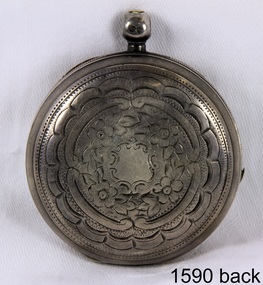
... He managed to cling to a bush lower down until rescued. Seaman Julius Gebauhr later gave his knife, in its hand crafted leather sheath, to F. ...He managed to cling to a bush lower down until rescued. Seaman Julius Gebauhr later gave his knife, in its hand crafted leather sheath, to F. ...The watch was given to William James Robe by the captain of the barque Fiji as a token for helping to save his life and that of the crew on September 6th 1891 when the steel barque Fiji had foundered off “wreck beach" near Moonlight Head Warrnambool during a voyage from Hamburg to Melbourne. William or Bill as he was called was the one who had hauled out the last man, the captain, after he had become tangled in the kelp. William along with many other onlookers on the beach at the time had taken it in turns to go into the surf and drag half-drowned seamen to safety. These rescuers along with William James Robe, included Edwin Vinge, Hugh Cameron, Fenelon Mott, Arthur Wilkinson and Peter Carmody. Years later Bill passed the watch on to his brother-in-law Gilbert Hulands as payment of a debt. The grandson of Gilbert Hulands, John Hulands, has donated this watch to Flagstaff Hill Maritime Museum. The Fiji Wreck: The three-masted iron barque Fiji had been built in Belfast, Ireland, in 1875 by Harland and Wolfe for a Liverpool based shipping company. The ship departed Hamburg on 22nd May 1891 bound for Melbourne, under the command of Captain William Vickers with a crew of 25. On September 5th, one hundred days out from Hamburg in squally and boisterous south-west winds the Cape Otway light was sighted on a bearing differing from Captain Vickers' calculation of his position. At about 2:30 am, Sunday 6th September 1891 land was reported 4-5 miles off the port bow. The captain tried to put the ship on the other tack, but she would not respond. He then tried to turn her the other way but just as the manoeuvre was being completed Fiji struck rock only 274 metres from shore. The place is known as Wreck Bay, Moonlight Head. Blue lights were burned and rockets fired whilst an effort was made to lower boats but all capsized or swamped and smashed to pieces. Two of the younger crewmen volunteered to swim for the shore, taking a line. One, a Russian named Daniel Carkland, drowned after he was swept away when the line broke. The other, 17-year-old able seaman Julius Gebauhr, a German, reached shore safely on his second attempt but without the line, which he had cut loose with his sheath-knife when it becomes tangled in kelp. He rested on the beach a while then climbed the cliffs in search of help. At about 10 am on Sunday a party of land selectors - including F. J. Stanmore, Leslie Dickson (or Dixon) and Mott - found Gebauhr. They were near Ryans Den, on their travels on horseback from Princetown towards Moonlight Head, and about 5km from the wreck. They found Gebauhr lying in scrub and a poor state, bleeding and scantly dressed and with a sheath-knife. At first, they were concerned about his appearance and gibberish speech, taking him to be an escaped lunatic. They were reassured after Gebauhr threw his knife away realising he was speaking half-English, half-German. They gave him food and brandy and some clothing and were then able to gain information about the wreck. Some of the men took him to Rivernook, a nearby guest house owned by John Evans, where he was cared for. Stansmore and Dickson rode off to try and summon help. Others went down to the site of the wreck. Messages for rescuing the rest of the crew were sent both to Port Campbell for the rocket rescue crew and to Warrnambool for the lifeboat. The S.S. Casino sailed from Portland towards the scene. After travelling the 25 miles to the scene, half of the Port Campbell rocket crew and equipment arrived and set up the rocket tripod on the beach below the cliffs. By this time the crew of Fiji had been clinging to the jib-boom for almost 15 hours, calling frantically for help. Mr Tregear from the Rocket Crew fired the line. The light line broke and the rocket was carried away. A second line was successfully fired across the ship and made fast. The anxious sailors then attempted to come ashore along the line but, with as many as five at a time, the line sagged considerably and some were washed off. Others, nearly exhausted, had to then make their way through masses of seaweed and were often smothered by waves. Only 14 of the 24 who had remained on the ship made it to shore. Many onlookers on the beach took it in turns to go into the surf and drag half-drowned seamen to safety. One of the rescuers Arthur Wilkinson, a 29-year-old land selector, swam out to the aid of one of the ship's crewmen, a carpenter named John Plunken who was attempting to swim to shore. Two or three times both men almost reached the shore but were washed back to the wreck, a line was thrown to them. It was thought that Wilkinson had struck his head on the anchor during the rescue and had remained unconscious, the carpenter survived this ordeal but Wilkinson died and his body was washed up the next day. The wreck of Fiji smashed apart within 20 minutes of the captain being brought ashore, and it finally settling in 6m of water. Of the 26 men on Fiji, 11 in total lost their lives. The remains of 7 bodies were washed onto the beach. They were buried on the clifftop above the wreck. Captain Vickers was severely reprimanded for his mishandling of the ship and his is Masters Certificate was suspended for 12 months. At the time there was also a great deal of public criticism at the slow and disorganised rescue attempt to save those on board. The important canvas ‘breech buoy’ or ‘bucket chair’ and the heavy line from the Rocket Rescue was in the half of the rocket outfit that didn’t make it in time for the rescue: they had been delayed at the Gellibrand River ferry. Communications to Warrnambool were down so the call for help didn’t get through on time and the two or three boats that had been notified of the wreck failed to reach it in time. Much looting occurred of the cargo that washed up on the shore, with nearly every visitor leaving the beach with bulky pockets. One looter was caught with a small load of red and white rubber balls, which were duly confiscated and he was 'detained' for 14 days. The essence of peppermint mysteriously turned up in many settlers homes. Sailcloth was salvaged and used for horse rugs and tent flies. Soon after the wreck "Fiji tobacco" was being advertised around Victoria. A Customs officer, trying to prevent some of the looting, was assaulted by looters and thrown over a cliff. He managed to cling to a bush lower down until rescued. Seaman Julius Gebauhr later gave his knife, in its hand crafted leather sheath, to F. J. Stansmore for caring for him when he came ashore. Flagstaff Hill’s Fiji collection is of historical significance at a State level because of its association with the wreck Fiji, which is on the Victorian Heritage Register (S 259). The collection also represents key aspects of Victoria’s shipping history and its items offer the potential to interpret maritime historical events and social history of the time. Along with the potential to yield information that will contribute to an understanding of Victoria’s cultural history.Sterling silver fob watch Fusee movement face has a white background with black Roman numerals on it. The minute hand is gold coloured with a leaf shape. Seconds dial is inset at position 6, with Arabic numerals around it. Watch has machine engraving flower pattern front and back. The spherical winder has a number and a symbol on the upper face and a hole through the centre, the ring for the chain is missing. Back of a the watch opens to reveal a concave cover with a winding hole, which has a border of overlapping crescent-shapes. Inside cover a diamond with initials “JR”(John Rotherham) inside, a date letter “G” (1882) with a Lion Passant (Sterling Silver) also 3 numbers “8 1 9“embossed beside each other. The clock face has “Rotherhams / London” printed on it. The winder is also marked with a maker and sterling silver mark. “Y” and numbers “688” “3 CI A” “3309” “819” “555 A” and other numbers including a set engraved around the edge possibly jewelers marks who did repairs or maintenance on the item over the years.1891, shipwrecked coast, flagstaff hill, flagstaff hill maritime museum, maritime museum, shipwrecked artefact, flagstaff hill maritime village, shipwreck coast, warrnambool, fiji, pocket watch, william vickers, william robe, bill robe, fiji watch -
 Eltham District Historical Society Inc
Book, Hyland House, Alan Marshall's Australia, 1981
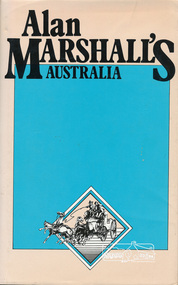
... bush eccentrics, lairs and yarn spinners. Go further back and remember Conversation Lollies, the cigarette cards you collected and the school yard games. Can you recall how to test an axe blade, choose a pocket knife...bush eccentrics, lairs and yarn spinners. Go further back and remember Conversation Lollies, the cigarette cards you collected and the school yard games. Can you recall how to test an axe blade, choose a pocket knife ...One of a collection of books by local writer Alan Marshall held at EDHS. This one is of "anecdotes and yarns" as described by Marshall before its publication in July 1981 in the Canberra Times. Alan Marshall's Australia, the Australia of "I Can Jump Puddles" has vanished. No longer do we have time to sit on the sliprail and exchange yarns, to drive buggies down long, quiet dusty roads, or to watch the king-hit merchant operating in some small hotel. Even the Cu-nims hold no terrors for a Boeing 427! And yet - Alan Marshall's Australia lives for all those who read this book. Meet Lance Skuthorpe who tethered an old bull in Bourke Street and offered £5 to anyone who could ride it for half a minute and Binjarrpooma, the Arnhem Land terror. Accompany Alan in his horse-drawn caravan or buggy to country sales, pubs and stations and listen with him to great bush eccentrics, lairs and yarn spinners. Go further back and remember Conversation Lollies, the cigarette cards you collected and the school yard games. Can you recall how to test an axe blade, choose a pocket knife, or the penetrating power of Goanna Oil? But this book is more than a nostalgic journey into the past ; it is history for the young and a timely reminder for us all - it is our roots. - Front end papers viii, 165 p. : ill. ; Two copiesISBN 0908090390alan marshall, prose, short stories, ancedotes, australia, tales, yarms -
 Warrnambool and District Historical Society Inc.
Knife, Knife and sheaf
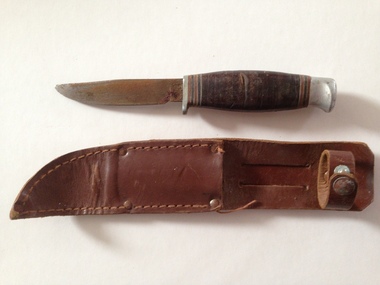
... knife and sheaf is not known. They were popular items for boys and young men to carry, especially when working in the bush or fishing. ...knife and sheaf is not known. They were popular items for boys and young men to carry, especially when working in the bush or fishing. ...Information on the history of this knife and sheaf is not known. They were popular items for boys and young men to carry, especially when working in the bush or fishing. They are still in use today. These items have no known provenance and are useful for display only This is a belt knife, much rusted with a curved blade and a brown metal handle, silver-coloured at the top and end and brown-coloured with red and black bands near the end. The handle has a metal screw at the tip. The knife is in a leather sheaf or holder which is curved to suit the shape of the knife. It has stitching on the curved section with metal studs, two slots to enable the sheaf to be attached to a belt and a circular leather strop with a metal stud to hold the knife in place. The leather is rubbed. The belt may not originally have been for this knife.belt knife and sheaf, warrnambool -
 Chiltern Athenaeum Trust
Domestic object - Butter knife belonging to W.C.Busse
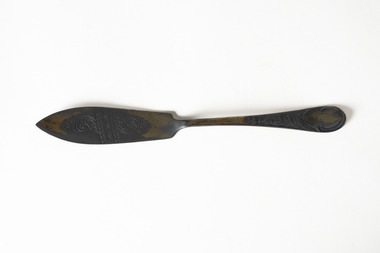
... bush lifestyle. He was a respected Barrister and was the unofficial historian of the Chiltern Athenaeum for many years. This butter knife ...Wilfred Clarence Busse, born in Chiltern in 1898, His family moved to the region during the gold rush and continued to reside in the area, purchasing land adjacent the Murray River. Busse completed his secondary education at Wesley College in Melbourne then studied law at the University of Melbourne. Busse went on to become a barrister, often in the chambers of Sir Leo Finn Bernard Cussen (1859-1933) a judge of the Supreme Court of Victoria. He worked most of his life in Chiltern as a Barrister and Solicitor and gained the unofficial title of historian of Chiltern, leaving behind several manuscript histories and a scrap book. Busse was an avid fictional writer and in 1930 he published two novels. Time spent on a Victorian station in his early twenties, as well as careful documentary research, informed the writing of his historical novels of bush life. "The Blue Beyond; A Romance of the Early Days in South Eastern Australia” and "The Golden Plague: A Romance of the Early Fifties." "The Golden Plague” won the T. E. Role gold medal for the best historical novel which went on to become a best seller. Busse often drew inspiration for his novels from his younger years living Chiltern. His passion for the region lead him to write “The History of Chiltern” which was published in a serial form in the Chiltern Federal Standard from 1922-1923. Wilfred Clarence Busse was a member of Chiltern Athenaeum (where this object is now held) up until his death in 1960, he is buried in the Barnawartha Cemetery. Likely Silverplate due to the intensity of the tarnishing of the metal, with indecipherable hallmarks on the handle, the method of production and the maker mark are unclear. The delicate swirling fernlike motif on this particular butter knife appears to be stylised in either Art deco the decorative arts and craft style favoured in Europe between 1880-1930's and less representational than examples of Australiana flora captured in silversmithing from the 1850's onwards produced in Australia. It is likely that those producing silverware at the time would be drawing on the decorative arts movement while incorporating elements of the natural beauty in the flora of their newfound environment into the silverware they produced.Wilfred Clarence Busse was of social significance to Chiltern, he helped to document the cultural story of the area in his published works "The Golden Plague" and "The Beyond Blue" by recounting his own upbringing in a bush lifestyle. He was a respected Barrister and was the unofficial historian of the Chiltern Athenaeum for many years. This butter knife represents a window into the domestic life of this person who was well loved in the area, and it continues its relationship to Busse as well as Chiltern by being held within the very collection he helped to maintain in his life. Domestic objects tell us the story about how people lived, objects of daily use hold particular meaning in that they can tell us the story of an individual, we feel closer to their life and habits, it humanises and connects us across time. Wilfred Busse ate food, he buttered his bread and he did it with a wonderfully decorated silver butter knife.A tarnished metal butter knife with engraved and embossed spiral fern details on the knife and handlesilverware, wilfred clarence busse, busse, chiltern, chiltern athenaeum, federal standard, t. e. role, "the blue beyond, a romance of the early days in south eastern australia”, "the golden plague: a romance of the early fifties.", "the golden plague”, wesley college, university of melbourne, sir leo finn bernard cussen, supreme court of victoria, gold rush, murray river, “the history of chiltern”, silversmithing, decorative arts, floral, flora, australiana, australian flora, arts and craft movement, australian silver, cussen, cutlery, butter knife, knife, silverplate -
 Chiltern Athenaeum Trust
Domestic object - Knife, T. Turner & Co, 1907
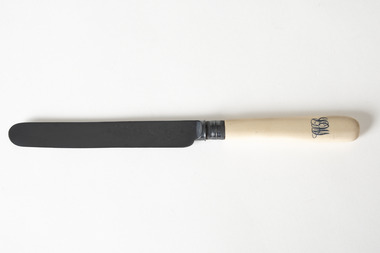
... knife displays the initials 'WB', potentially indicating it was made to order. Wilfred Clarence Busse was born in Chiltern in 1898. He went to school at Wesley College in Melbourne, studied law at the University of Melbourne and became a barrister. Additionally, after spending time on a Victorian station in his early twenties, he wrote two historical novels about bush...knife displays the initials 'WB', potentially indicating it was made to order. Wilfred Clarence Busse was born in Chiltern in 1898. He went to school at Wesley College in Melbourne, studied law at the University of Melbourne and became a barrister. Additionally, after spending time on a Victorian station in his early twenties, he wrote two historical novels about bush ...This knife is believed to belong to the household of Chiltern writer and historian, W.C. Busse. It displays a level of tarnish indicating it may be comprised of silver or silver plate. The blade contains the mark 'EP' which may indicate silverplate over steel. The blade also contains the maker's mark 'Wingfield', which was the trademark of T. Turner & Co but could also refer to the company Wingfield Rowbotham. Both factories are located in Sheffield, United Kingdom. The trademark is ascribed to goods produced in approximately 1907. The handle of the knife displays the initials 'WB', potentially indicating it was made to order. Wilfred Clarence Busse was born in Chiltern in 1898. He went to school at Wesley College in Melbourne, studied law at the University of Melbourne and became a barrister. Additionally, after spending time on a Victorian station in his early twenties, he wrote two historical novels about bush life. His first novel was 'The Blue Beyond: a Romance of the Early Days in South Eastern Australia', written in 1928 and published in 1930. Busse's second novel was titled 'The Golden Plague: A Romance of the Early Fifties'. The judges of the Henry Lawson Society's T.E. Rofe competition to advance Australian literature unanimously awarded it the Gold Medal in 1931 for the best historical novel of 1930. Newspaper articles about the award mention the writer's meticulous documentary and oral history research regarding life on the Gold Fields in the 1850s. It became a best-seller. Busse also wrote a series of articles about local history for "The Federal Standard" newspaper in Chiltern. He was a member of the Chiltern Athenaeum. He died in 1960.This knife is significant for the detail it conveys of ordinary domestic life in the household of a significant Victorian writer with special reference to Chiltern and the surrounding region. Knife with tarnished patina and cream-coloured handle with owner's initials engraved or stamped.WBw.c. busse, chiltern, gold fields, gold mining, gold rush, north-east victoria, indigo shire, wingfield, t.turner & co, wingfield rowbotham, silver, silverplate, knife, cutlery, silverware, tableware, barrister, wesley college, melbourne, historical fiction, golden plague, blue beyond, henry lawson society, t.e. rofe, 1930s, 1850s -
 Ballarat Tramway Museum
Book, Australian Commonwealth Engineering Standards Association, "Electrical Voltages and electrical frequencies for new installations", "Overhead Line wire material for telegraph and telephone purposes", "Telephone cable, paper insulated lead covered", "Dimensions and Resistances of Bare Annealed Copper Wire for Electrical Machinery and Apparatus", "Slate Slabs for Electrical Purposes", "Moulded Flat Top Insulation Bushes", "Insulation dimensions and resistance of enamelled plain copper wire for instruments and apparatus", "Watertight Glands for electric cables", "Air-break knife switches and laminated brush switches for voltages not exceeding 660Volts", 1926-1930
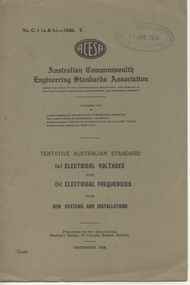
... .1 - Book - 8 pages + grey covers, side stapled, issued by the Australian Standards Association, "Electrical Voltages and electrical frequencies for new installations ", C1 (a&b) - 1926, December 1926. .2 - Book - 36 pages + grey covers, side stapled, issued by the Australian Commonwealth Engineering Standards Association, Tentative Australian Standard - "Overhead Line wire material for telegraph and telephone purposes", C3-11-1925, November 1925. .3 - Book - 20 pages + brown covers, side stapled, issued by the Australian Commonwealth Engineering Standards Association, Tentative Australian Standard - "Telephone cable, paper insulated lead covered", C12 - 1928, January 1928. .4 - Book - 24 pages + grey covers, side stapled, issued by the Australian Commonwealth Engineering Standards Association, Tentative Australian Standard - "Marking for Switchboard bus-bars and connections" C13 - 1925, December 1925 - with a pasted green label noting that the "tentative standard is now endorsed as Australian Standard without amendment" - dated Oct. 1930. .5 - Book - 32 pages + grey covers, side stapled, issued by the Australian Standards Association, Tentative Australian Standard "Dimensions and Resistances of Bare Annealed Copper Wire for Electrical Machinery and Apparatus", C 18-1926, October 1926. .6 - Book - 12 pages + grey covers, side stapled, issued by the Australian Commonwealth Engineering Standards Association, Tentative Australian Standard "Slate Slabs for Electrical Purposes", C19 - 1926, July 1926. .7 - Book - 16 pages + grey covers, side stapled, issued by the Australian Commonwealth Engineering Standards Association, Tentative Australian Standard - "Moulded Flat Top Insulation Bushes" C20-1926, October 1926. .8 - Book - 16 pages + brown covers, side stapled, issued by the Australian Commonwealth Engineering Standards Association, Australian Standard "Insulation dimensions and resistance of enamelled plain copper wire for instruments and apparatus" C21-1928, January 1928. .9 Book - 20 pages + grey covers, side stapled, issued by the Australian Commonwealth Engineering Standards Association, Tentative Australian Standard - "Watertight Glands for electric cables" C22-1926, September 1926. .10 - Book - 20 pages + grey covers, side stapled, issued by the Australian Commonwealth Engineering Standards Association, Tentative Australian Standard - "Air-break knife switches and laminated brush switches for voltages not exceeding 660Volts" - C23 - 1926, August 1926" ...Trams tramways Power Station Standards Materials Electrical Systems On top right hand corner has the date stamp of the "The Electric Supply Co. of Victoria Ltd Ballarat" .1 - Book - 8 pages + grey covers, side stapled, issued by the Australian Standards Association, "Electrical Voltages and electrical frequencies for new installations ", C1 (a&b) - 1926, December 1926. .2 - Book - 36 pages + grey covers, side stapled, issued by the Australian Commonwealth Engineering Standards Association, Tentative Australian Standard - "Overhead Line wire material for telegraph and telephone purposes", C3-11-1925, November 1925. .3 - Book - 20 pages + brown covers, side stapled, issued by the Australian Commonwealth Engineering Standards Association, Tentative Australian Standard - "Telephone cable, paper insulated lead covered", C12 - 1928, January 1928. .4 - Book - 24 pages + grey covers, side stapled, issued by the Australian Commonwealth Engineering Standards Association, Tentative Australian Standard - "Marking for Switchboard bus-bars and connections" C13 - 1925, December 1925 - with a pasted green label noting that the "tentative standard is now endorsed as Australian Standard without amendment" - dated Oct. 1930. .5 - Book - 32 pages + grey covers, side stapled, issued by the Australian Standards Association, Tentative Australian Standard "Dimensions and Resistances of Bare Annealed Copper Wire for Electrical Machinery and Apparatus", C 18-1926, October 1926. .6 - Book - 12 pages + grey covers, side stapled, issued by the Australian Commonwealth Engineering Standards Association, Tentative Australian Standard "Slate Slabs for Electrical Purposes", C19 - 1926, July 1926. .7 - Book - 16 pages + grey covers, side stapled, issued by the Australian Commonwealth Engineering Standards Association, Tentative Australian Standard - "Moulded Flat Top Insulation Bushes" C20-1926, October 1926. .8 - Book - 16 pages + brown covers, side stapled, issued by the Australian Commonwealth Engineering Standards Association, Australian Standard "Insulation dimensions and resistance of enamelled plain copper wire for instruments and apparatus" C21-1928, January 1928. .9 Book - 20 pages + grey covers, side stapled, issued by the Australian Commonwealth Engineering Standards Association, Tentative Australian Standard - "Watertight Glands for electric cables" C22-1926, September 1926. .10 - Book - 20 pages + grey covers, side stapled, issued by the Australian Commonwealth Engineering Standards Association, Tentative Australian Standard - "Air-break knife switches and laminated brush switches for voltages not exceeding 660Volts" - C23 - 1926, August 1926" "Electrical Voltages and electrical frequencies for new installations", "Overhead Line wire material for telegraph and telephone purposes", "Telephone cable, paper insulated lead covered", "Dimensions and Resistances of Bare Annealed Copper Wire for Electrical Machinery and Apparatus", "Slate Slabs for Electrical Purposes", "Moulded Flat Top Insulation Bushes", "Insulation dimensions and resistance of enamelled plain copper wire for instruments and apparatus", "Watertight Glands for electric cables", "Air-break knife switches and laminated brush switches for voltages not exceeding 660Volts" Book Australian Commonwealth Engineering Standards Association ....1 - Book - 8 pages + grey covers, side stapled, issued by the Australian Standards Association, "Electrical Voltages and electrical frequencies for new installations ", C1 (a&b) - 1926, December 1926. .2 - Book - 36 pages + grey covers, side stapled, issued by the Australian Commonwealth Engineering Standards Association, Tentative Australian Standard - "Overhead Line wire material for telegraph and telephone purposes", C3-11-1925, November 1925. .3 - Book - 20 pages + brown covers, side stapled, issued by the Australian Commonwealth Engineering Standards Association, Tentative Australian Standard - "Telephone cable, paper insulated lead covered", C12 - 1928, January 1928. .4 - Book - 24 pages + grey covers, side stapled, issued by the Australian Commonwealth Engineering Standards Association, Tentative Australian Standard - "Marking for Switchboard bus-bars and connections" C13 - 1925, December 1925 - with a pasted green label noting that the "tentative standard is now endorsed as Australian Standard without amendment" - dated Oct. 1930. .5 - Book - 32 pages + grey covers, side stapled, issued by the Australian Standards Association, Tentative Australian Standard "Dimensions and Resistances of Bare Annealed Copper Wire for Electrical Machinery and Apparatus", C 18-1926, October 1926. .6 - Book - 12 pages + grey covers, side stapled, issued by the Australian Commonwealth Engineering Standards Association, Tentative Australian Standard "Slate Slabs for Electrical Purposes", C19 - 1926, July 1926. .7 - Book - 16 pages + grey covers, side stapled, issued by the Australian Commonwealth Engineering Standards Association, Tentative Australian Standard - "Moulded Flat Top Insulation Bushes" C20-1926, October 1926. .8 - Book - 16 pages + brown covers, side stapled, issued by the Australian Commonwealth Engineering Standards Association, Australian Standard "Insulation dimensions and resistance of enamelled plain copper wire for instruments and apparatus" C21-1928, January 1928. .9 Book - 20 pages + grey covers, side stapled, issued by the Australian Commonwealth Engineering Standards Association, Tentative Australian Standard - "Watertight Glands for electric cables" C22-1926, September 1926. .10 - Book - 20 pages + grey covers, side stapled, issued by the Australian Commonwealth Engineering Standards Association, Tentative Australian Standard - "Air-break knife switches and laminated brush switches for voltages not exceeding 660Volts" - C23 - 1926, August 1926" On top right hand corner has the date stamp of the "The Electric Supply Co. of Victoria Ltd Ballarat" trams, tramways, power station, standards, materials, electrical systems
