
Showing 105 items matching "business enterprise"
-
 Bendigo Historical Society Inc.
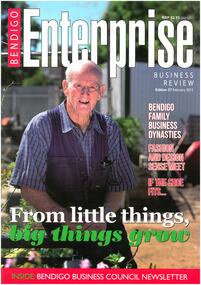
Magazine - BENDIGO ENTERPRISE BUSINESS REVIEW - EDITION 37 FEBRUARY 2015
... BENDIGO ENTERPRISE BUSINESS REVIEW - EDITION 37 FEBRUARY 2015...Contains 34 colour pages of artcles and advertorials about various Bendigo businesses and the people who own and run them. Magazine BENDIGO ENTERPRISE BUSINESS REVIEW - EDITION 37 FEBRUARY 2015 ...BHS CollectionColour magazine with glossy front and back covers. Front cover has full colour photograph of a man in dark blue overalls and a blue checked shirt leaning against a post and rail fence. Greenery and a shed are in the background. Contains 34 colour pages of artcles and advertorials about various Bendigo businesses and the people who own and run them.Published by the Bendigo Advertiser -
 Federation University Historical Collection
Book - Book - Scrapbook, University of Ballarat: Scrapbook of Newspaper cutting; Book 3, July 1998 to November 1998
... ...business enterprise centre...The cuttings cover the period from 29 July 1998 to 27 November 1998. . employment advertisements application for enrolment outline of courses university of ballarat smb campus ub call for more voluntary literacy tutors student mechanics challenged workskill university's asian links student waiter event agri excellence uni opportunities training ground for hairdressers workskill events $1.8m tafe campaign $800000 technology funding 'trembling' excellent irish fairy tale open day at ub facelift at smb site business enterprise centre doug sarah arrests in city protest protest against abolition of abstudy technology giant ricoh jodie lowe in study award national workskill olympics course for fish farmers webskills course wealth from minds not mines mark latham smb places to go pat forward aeu vice president $500000 contract national rural education conference doug sarah-cover story rural news pc to the paddock $1.2m funding boost education expo prison pottery breaks out writers' centre campaign international graduands dinner dane allison - award winner archimede fusillo - children's author students' anthology Book with yellow cover, front. ...Newspaper cuttings relating to the University of Ballarat, SMB Campus. These are from various newspapers and include The Age, Ballarat Courier, The Australian, The Herald. The cuttings cover the period from 29 July 1998 to 27 November 1998. . Book with yellow cover, front. Spiral bound.employment advertisements, application for enrolment, outline of courses, university of ballarat, smb campus, ub, call for more voluntary literacy tutors, student mechanics challenged, workskill, university's asian links, student waiter event, agri excellence, uni opportunities, training ground for hairdressers, workskill events, $1.8m tafe campaign, $800000 technology funding, 'trembling' excellent, irish fairy tale, open day at ub, facelift at smb site, business enterprise centre, doug sarah, arrests in city protest, protest against abolition of abstudy, technology giant ricoh, jodie lowe in study award, national workskill olympics, course for fish farmers, webskills course, wealth from minds not mines, mark latham, smb places to go, pat forward aeu vice president, $500000 contract, national rural education conference, doug sarah-cover story, rural news, pc to the paddock, $1.2m funding boost, education expo, prison pottery breaks out, writers' centre campaign, international graduands dinner, dane allison - award winner, archimede fusillo - children's author, students' anthology -
Victorian Aboriginal Corporation for Languages
Video, David Channing, Meetings mean business, 2000
... Indigenous business enterprise...Indigenous business enterprise Jimmy Little videocassette Jimmy Little offers help to newly-established Aboriginal corporations in successfully running meetings. ...Jimmy Little offers help to newly-established Aboriginal corporations in successfully running meetings. He outlines the suitable qualities of a chairperson, the duties of other office bearers such as the Treasurer and the Secretary and runs through definitions of "quorum","agenda" and "minutes".videocassetteindigenous business enterprise, jimmy little -
 Victorian Aboriginal Corporation for Languages
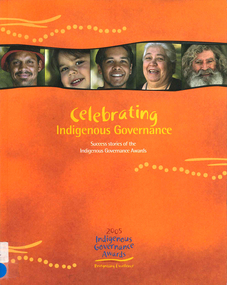
Book, Rowena Withers, Celebrating Indigenous governance : success stories of the Indigenous governance awards, 2005
... business enterprise...business enterprise Indigenous business colour photographs Good governance means good business What is governance? ...Good governance means good business What is governance? The Indigenous Governance Awards Key elements of good governance Finalists 2005: Koorie Heritage Trust, Victoria; Central Australian Aboriginal Congress, NT; Sunrise Health Service, NT; Goldfields Land and Sea Council, WA; Institute for Aboriginal Development, NT; Maari Ma Health Aboriginal Corporation NSW; North Coast Aboriginal Corporation for Community Health Qld; Tiwi Islands Local Government, NT What works: lessons from the 2005 Indigenous Governance awards Governing body: choosing the board; Size and frequency of meetings; Board change and continuity; Processes of decision-making; Making good decisions; Financial decision-making; Accountability tools Managing and implementing decisions: carrying out recommendations; Informing stakeholders Conflict resolution: conflicts among the board; Complaints from members; Staff conflicts Leadership development: developing youth; Staff development and training Cultural norms and values: Boards and elders; Community and culture Future planning.colour photographsbusiness enterprise, indigenous business -
Vision Australia
Audio - Sound recording, Brian Crozier International, Steps in the Right Direction: Jenny Scown - move to Coorparoo, 12/7/2010
... Jenny Scown, team leader at Business Enterprises at Coorparoo, talks about she became blind and her journey through life including the move to the new office at Coorparoo....Jenny Scown, team leader at Business Enterprises at Coorparoo, talks about she became blind and her journey through life including the move to the new office at Coorparoo. ...Jenny Scown, team leader at Business Enterprises at Coorparoo, talks about she became blind and her journey through life including the move to the new office at Coorparoo.1 wmv file stored on hard drivevision australia, jenny scown, coorparoo, oral history -
 Linton and District Historical Society Inc
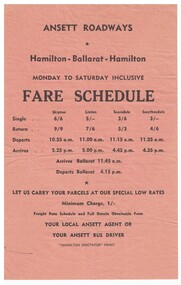
Document - Leaflet, Ansett Roadways Fare Schedule
... Fare schedule issued by Ansett Roadways for the run Hamilton - Ballarat - Hamilton, early in the history of Reg Ansett's business enterprises. The year this was printed is not known, but fares are in shillings and pence, so it was before 1966....Fare schedule issued by Ansett Roadways for the run Hamilton - Ballarat - Hamilton, early in the history of Reg Ansett's business enterprises. The year this was printed is not known, but fares are in shillings and pence, so it was before 1966. ...Fare schedule issued by Ansett Roadways for the run Hamilton - Ballarat - Hamilton, early in the history of Reg Ansett's business enterprises. The year this was printed is not known, but fares are in shillings and pence, so it was before 1966.Rectangular orange-coloured fare schedule and timetable for Ansett Roadways.Text: ANSETT ROADWAYS / Hamilton - Ballarat - Hamilton / MONDAY TO SATURDAY INCLUSIVE / FARE SCHEDULE.ansett roadways, sir reginald ansett, road transport -
 Linton and District Historical Society Inc
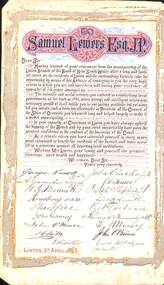
Illuminated Address, Illuminated Address Presented to Samuel Lewers Esq. JP, 1895, 1895
... JP", and is signed by nineteen residents of Linton and district, many of whom were owners of pastoral properties or business enterprises in and around Linton, and/or also involved in local government. ...JP", and is signed by nineteen residents of Linton and district, many of whom were owners of pastoral properties or business enterprises in and around Linton, and/or also involved in local government. ...Samuel Lewers was the first manager of the Bank of New South Wales in Linton, was president of the Shire of Grenville, and also acted as a JP and magistrate.A certificate of appreciation in the form of an "address", presented to Samuel Lewers on his retirement in 1895. The address has been printed on cardboard in decorative lettering, it is headed "To Samuel Lewers, Esq. JP", and is signed by nineteen residents of Linton and district, many of whom were owners of pastoral properties or business enterprises in and around Linton, and/or also involved in local government. The certificate is dated "Linton, 5th April, 1895".samuel lewers, george russell, john clarke, alexander tyers, j.c. fraser, w.g. bennett, joseph shepherd, armstrong kerr, george smith, thomas wise, robert cochrane, john garvey, thomas kennedy, john o'meara, e. morey, a. j. smith, john o'beirne, e. hartley, david mcfadzean, george smith -
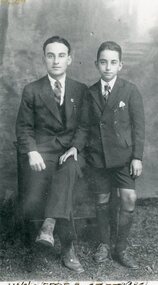 Ithacan Historical Society
Photograph, Stathi Raftopoulos with Uncle Efthimios, January 1934
... Members of the family initially settled in Mildura and Merbein where they operated various business enterprises. Some family members later came to Melbourne. ...Members of the family initially settled in Mildura and Merbein where they operated various business enterprises. Some family members later came to Melbourne. ...Pictured is Efthimios Raftopoulos and his nephew Stathis Raftopoulos. The Raftopoulos (Levendi) family commenced migration in the late 1890s. Members of the family initially settled in Mildura and Merbein where they operated various business enterprises. Some family members later came to Melbourne. The photograph was taken shortly after Stathi's arrival in Australia in 1934. His Uncle Efthimio arrived in Australia in the early 1900s. A sepia studio photograph of man seated and a young boy standing next to him. Both are wearing suits. A larger scanned copy of this photograph is in the duplicate folder. efthimios raftopoulos, stathis raftopoulos, levendi -
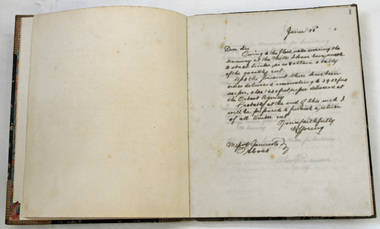 Orbost & District Historical Society
letter book, 1900
... A letter is a book in which letters or copies of letters are kept especially to provide a running account of a business or enterprise. This one was probably used by H. ...A letter is a book in which letters or copies of letters are kept especially to provide a running account of a business or enterprise. This one was probably used by H. ...A letter is a book in which letters or copies of letters are kept especially to provide a running account of a business or enterprise. This one was probably used by H. James & Co. with some letters written by Alan Richardson. Henry James (1860-1932) was an agent and auctioneer. Record secretary of the Snowy River Shipping company. Shire councillor. Foundation member of Butter Factory. This iotem is an example of very early book-keeping in Orbost and is probably associated with Henry James who was a prominent Orbost identity very much involved in the local community.A correspondence book with a blue suede fabric cover and brown binding. It has a red label on the spine. the end papers are marbled. It contains handwritten copies of correspondence.on spine - Letter Bookbook-keeping correspondence-book h.james-&-co richardson-alan -
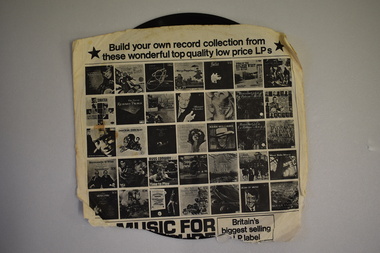 Warrnambool and District Historical Society Inc.
33.3 R.P.M. Record (Warrnambool Technical School), H.M.S. Pinafore, 1971
... This record was made by a local business existing in the 1960s and early 70s, Warrnambool Recording Enterprises. ...This record was made by a local business existing in the 1960s and early 70s, Warrnambool Recording Enterprises. ...This record was made by a local business existing in the 1960s and early 70s, Warrnambool Recording Enterprises. This business used a local landmark, the Tower Hill State Park, as its logo and label. The recording is of the 1971 production of ‘H.M.S. Pinafore’ by the students of Warrnambool Technical College. This school was established in 1913 in Timor Street and in 1973, as Warrnambool Technical School, was relocated to Caramut Road and re-named Brauer college in 1990. The Timor Street site is now the South West TAFE College. This record is of interest as a memento both of the Warrnambool Technical College’s musical performance in 1971 and of the production of records such as this one by a local business, Warrnambool Recording Enterprises in the early 1970s. This is a 33.3 R.P.M. record with a part-image of a guitar and a yellow label in the centre with black printing and typing. It is in a paper sleeve which is tattered with the bottom section mostly missing. The cover does not appear to belong to the record. Tower Hill HMS Pinafore presented by students of Warrnambool Technical School 1971 Custom Recording by Warrnambool Recording Enterprises P.O. Box 123 Warrnambool Phone 8223warrnambool technical school, warrnambool recording enterprises tower hill label, history of warrnambool, ‘h.m.s. pinafore’ -
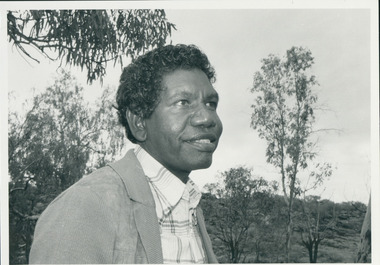 Uniting Church Archives - Synod of Victoria
Photograph, Rev. Djiniyini Gondarra, 1986
... He is also Director of Yirrkala Business Enterprises. Over the years, Rev Djiniyini has served on many committees and councils including: Member of the Steering Committee of the Australian Indigenous Cultural Network (1998-2001), CEO of Aboriginal Resource and Development Services Inc (1998-2001), CEO of the Northern Regional Council of the Uniting Aboriginal and Islander Christian Congress (1998-2001), Director of Reconciliation Australia Limited (2000-2001), Member of Council for Aboriginal Reconciliation (1998-2000), Chairman of Uniting Aboriginal and Islander Christian Congress (1995-2000 & 1990-1993), Member of Central Committee of the World Council of Churches (1991-1994), Moderator of Northern Synod, Uniting Church in Australia (1985-1987), Secretary of newly formed Aboriginal Presbytery, Northern Synod, Uniting Church in Australia (1985), and Vice-President of Uniting Aboriginal and Islander Christian Congress Uniting Church in Australia (1983-1987). ...He is also Director of Yirrkala Business Enterprises. Over the years, Rev Djiniyini has served on many committees and councils including: Member of the Steering Committee of the Australian Indigenous Cultural Network (1998-2001), CEO of Aboriginal Resource and Development Services Inc (1998-2001), CEO of the Northern Regional Council of the Uniting Aboriginal and Islander Christian Congress (1998-2001), Director of Reconciliation Australia Limited (2000-2001), Member of Council for Aboriginal Reconciliation (1998-2000), Chairman of Uniting Aboriginal and Islander Christian Congress (1995-2000 & 1990-1993), Member of Central Committee of the World Council of Churches (1991-1994), Moderator of Northern Synod, Uniting Church in Australia (1985-1987), Secretary of newly formed Aboriginal Presbytery, Northern Synod, Uniting Church in Australia (1985), and Vice-President of Uniting Aboriginal and Islander Christian Congress Uniting Church in Australia (1983-1987). ...Rev Dr Djiniyini Gondarra OAM, was born in Milingimbi, eastern Arnhemland in 1945. He was educated at Milingimbi Mission School and pursued his theological education as a youth leader and Sunday School teacher through the Methodist Church, before attending college in Brisbane. In 1969 he trained as a Minister in Papua New Guinea and the Solomon Islands under the Uniting Church, before returning to Arnhemland to minister his own people at the Galiwin’ku parish, firstly as a lay pastor (1971-1972) and then as a Minister from 1976-1982. In 1983-84, Rev Djiniyini worked as a Lecturer in Theology at Nungalinya College, Darwin. He was honoured with a Diploma of Theology (Honorary) from there in 1984, and in 1991 received a Cultural Doctorate in Literature (Honorary) from the World University, Roundtable, Arizona USA. Rev Djiniyini was awarded the Order of Australia Medal (OAM) in 1995. As well as being the Chairman of ALPA since 1993, Rev Djiniyini is currently the Director of Duduy’ngu Pty Ltd, which provides consultancy and cross-cultural services. He is also Director of Yirrkala Business Enterprises. Over the years, Rev Djiniyini has served on many committees and councils including: Member of the Steering Committee of the Australian Indigenous Cultural Network (1998-2001), CEO of Aboriginal Resource and Development Services Inc (1998-2001), CEO of the Northern Regional Council of the Uniting Aboriginal and Islander Christian Congress (1998-2001), Director of Reconciliation Australia Limited (2000-2001), Member of Council for Aboriginal Reconciliation (1998-2000), Chairman of Uniting Aboriginal and Islander Christian Congress (1995-2000 & 1990-1993), Member of Central Committee of the World Council of Churches (1991-1994), Moderator of Northern Synod, Uniting Church in Australia (1985-1987), Secretary of newly formed Aboriginal Presbytery, Northern Synod, Uniting Church in Australia (1985), and Vice-President of Uniting Aboriginal and Islander Christian Congress Uniting Church in Australia (1983-1987). Rev Dr Djiniyini Gondarra OAM has also been extensively published, and his works include: • Information Papers (co authored), Aboriginal Resource and Development Services: • Confusion Between Cultures (1998) • MHead & Shoulders of Djiniyini Gondarra facing right of picture."Rev. Djiniyini Gondarra 1986. Moderator Northern Synod and Vice President of Uniting Aboriginal and Islander Christian Conference."gondarra, djiniyini, uaicc, northern synod uca -
 Flagstaff Hill Maritime Museum and Village
Weapon - Shotgun, Double Barrel, ISAAC HOLLIS & SONS, ca. 1904
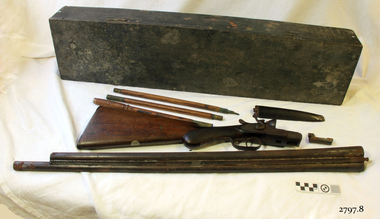
... In 1861, Sheath left the partnership and emigrated to New Zealand, where he conducted several enterprises and was elected as a provincial councillor. He died in Christchurch on 19th May 1897. In 1861, after Isaac Sheath left, the business name became Isaac Hollis & Sons. ...In 1861, Sheath left the partnership and emigrated to New Zealand, where he conducted several enterprises and was elected as a provincial councillor. He died in Christchurch on 19th May 1897. In 1861, after Isaac Sheath left, the business name became Isaac Hollis & Sons. ...The proof marks on the barrels (a crown and letters BV) denote that the shotgun design was made from the year 1904, and that it was nitro-proof tested in Birmingham, England. David Melville Carrison (1895 to 1960) of Port MacDonnell was the previous owner of this Isaac Hollis & Sons double-barrel shotgun. His grandfather, Adam Kerrison Carrison (1833-1903), was an early settler who worked as a fisherman in that once-bustling seaport. His uncle John was a a horse-breaker, a boat hand, and a member of the lifeboat crew, receiving a medal for his part in saving the crew of a French barque. Currently, no connection has been made between the gun, its owner, and the note with the word “Enterprise”: a New Zealand-built, two-masted schooner that was wrecked in Lady Bay, Warrnambool, in 1950. Gun makers, ISAAC HOLLIS & SONS: The Hollis Brothers were first recorded as operating from 11 Weaman Row in 1840, although evidence suggests the business may have commenced before then. Over time, the firm became known as Isaac Hollis & Sons, with claims of its establishment dating back to 1814. This earlier date is supported by records of Richard and William Hollis trading in Bath Street, Birmingham, between 1814 and 1818, which raises the possibility that Isaac and Frederick Hollis were their descendants. The principal brothers involved in the business were Isaac Hollis, born in 1815, and Frederick Hollis, whose birth date remains unknown. Frederick’s life was cut short when he died on 20 December 1839. According to the 1841 census, Isaac Hollis resided in Weaman Row and was listed as a 25-year-old gun and pistol maker. He was married to Emma, who was born in 1821, and together they had two children: Isaac, born in 1837, and Henry, born in 1839. Following Frederick’s death, Isaac continued to operate under the name Hollis Brothers until 1845, after which he renamed the business Hollis Brothers & Co. This entity remained active up to 1848. In 1844, Isaac Hollis entered a brief partnership with William Tranter at 10 & 11 Weaman Row, likely to fulfil a specific contract or to supply parts. This partnership continued until 1849. In 1848, Isaac Hollis formed a partnership with Isaac Brentnall Sheath, establishing the firm of Hollis & Sheath and expanding their operations into 10 Weaman Row. The partnership saw Hollis & Sheath become licensed manufacturers of percussion breech-loading guns, positioning the company as a notable presence in the industry. In 1861, Sheath left the partnership and emigrated to New Zealand, where he conducted several enterprises and was elected as a provincial councillor. He died in Christchurch on 19th May 1897. In 1861, after Isaac Sheath left, the business name became Isaac Hollis & Sons. By approximately 1870, Isaac Hollis and Henry Hollis had assumed responsibility for the daily management of the firm, with Isaac overseeing the overall management and marketing of the company's products, and Henry managing the manufacturing processes. During this period, the company became known for producing large volumes of affordable trade guns and sporting guns, catering to customers in South Africa and the British colonies. In 1870, Isaac Hollis & Sons opened a retail location at 44a Cannon Street in London, and in 1871, it operated at 83 Cheapside Street. Isaac Hollis Jnr passed away in October 1875 in Birmingham at the age of 37, having never married. In 1876/1877, Henry Hollis registered a limited liability company under the name Isaac Hollis & Sons Ltd. However, by 1879, trading resumed under the name Isaac Hollis & Sons, and the London shop moved to 6 Great Winchester Street. From 1932 to 1933, the business operated in London as Hollis, Bentley & Playfair. The final closure of Hollis, Bentley & Playfair occurred in Birmingham in 1953. The shotgun was manufactured by Isaac Hollis & Sons, a firm with a strong reputation for producing firearms. This early 1900s example represents a standard pattern that was produced in large quantities for everyday use. This double-barrel shotgun is 12-gauge, complete with a cleaning rod and a wooden storage box. The firearm has been altered from its original configuration: the right barrel has been cut shorter, resulting in sharp edges at the muzzle, and a metal extension has been fitted to the stock. The cleaning rod consists of three separate segments that screw together for use. The shotgun is housed in a black-painted wooden case with a hinged lid showing inscriptions for the maker and Serial Number. Maker was I. HOLLIS & SONS, Serial Number SN 84245. David Melville Carrison of Port MacDonnell was the previous owner. A handwritten note that had the word 'Enterprise' was with the gun. "I. HOLLIS & SONS". SN on stock “84245”. Badge on both sides “Crown [symbol] / BV”. “Crown [symbol] / NP”, “12G inside Diamond [symbol]”, “NITRO PROOF”, “STEEL 84245” Paper note included with gun, written in felt tip pen “ENTERPRISE”. flagstaff hill, maritime museum, maritime village, warrnambool, great ocean road, shipwreck coast, firearm, gun, double-barrel, shotgun, cleaning rod, gunsmith, smithed, 12 gauge, sn 84245, serial number 84245, david melville carrison, early 1900s, richard and william hillis, herbert & co., herbert & co. london, hollis & sons, isaac hollis & sons, isaac hillis & sons ltd., hollis bentley & playfair., isaac hollis, frederick hollis, isaac brentnall sheath, isaac sheath, william tranter, gun manufacturer, pistol manufacturer, gun and pistol maker, birmingham, military supplies, enterprise, 1904 -
 Flagstaff Hill Maritime Museum and Village
Weapon - Gun, ISAAC HOLLIS & SONS, Mid 19th Century
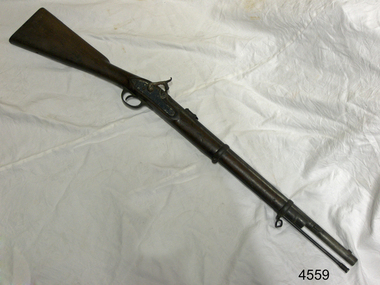
... enterprises and was elected as a provincial councillor. He died in Christchurch on 19th May 1897. Following the departure of Isaac Sheath in 1861, the business underwent a name change to Isaac Hollis & Sons. ...enterprises and was elected as a provincial councillor. He died in Christchurch on 19th May 1897. Following the departure of Isaac Sheath in 1861, the business underwent a name change to Isaac Hollis & Sons. ...The Hollis Brothers were first recorded as operating from 11 Weaman Row in 1840, although evidence suggests that the business may have commenced prior to this date. Over time, the firm evolved and became known as Isaac Hollis & Sons, with claims of its establishment dating back to 1814. This earlier date is supported by records of Richard and William Hollis trading in Bath Street, Birmingham, between 1814 and 1818, which raises the possibility that Isaac and Frederick Hollis were their descendants. The principal brothers involved in the business were Isaac Hollis, born in 1815, and Frederick Hollis, whose birth date remains unknown. Frederick’s life was cut short when he died on 20 December 1839. According to the 1841 census, Isaac Hollis resided in Weaman Row and was listed as a 25-year-old gun and pistol maker. He was married to Emma, who was born in 1821, and together they had two children: Isaac, born in 1837, and Henry, born in 1839. Following Frederick’s death, Isaac continued to operate under the name Hollis Brothers until 1845, after which he renamed the business Hollis Brothers & Co. This entity remained active up to 1848. In 1844, Isaac Hollis entered a brief partnership with William Tranter at 10 & 11 Weaman Row, likely to fulfil a specific contract or to supply particular parts. This partnership continued until 1849. In 1848, Isaac Hollis formed a partnership with Isaac Brentnall Sheath, establishing the firm of Hollis & Sheath and expanding their operations into 10 Weaman Row. The partnership saw Hollis & Sheath become licensed manufacturers of percussion breech-loading guns, positioning the company as a notable presence in the industry. In 1861, Sheath left the partnership and emigrated to New Zealand, where he conducted several enterprises and was elected as a provincial councillor. He died in Christchurch on 19th May 1897. Following the departure of Isaac Sheath in 1861, the business underwent a name change to Isaac Hollis & Sons. By approximately 1870, Isaac Hollis and Henry Hollis had assumed responsibility for the daily management of the firm, with Isaac overseeing the overall management and marketing of the company's products, while Henry managed the manufacturing processes. During this period, the company became known for producing large volumes of affordable trade guns and sporting guns, catering to customers in South Africa and the British colonies. In 1870, Isaac Hollis & Sons opened a retail location at 44a Cannon Street in London, subsequently relocating to 83 Cheapside in 1871. Isaac Hollis Jnr passed away in October 1875 in Birmingham at the age of 37, having never married. In 1876/1877, Henry Hollis registered a limited liability company under the name Isaac Hollis & Sons Ltd. However, by 1879, trading resumed under the name Isaac Hollis & Sons, and the London shop moved to 6 Great Winchester Street. From 1932 to 1933, the business operated in London as Hollis, Bentley & Playfair. The final closure of Hollis, Bentley & Playfair occurred in Birmingham in 1953. This firearm serves as an exemplary representation of the type of weapon distributed to the colony’s military forces in 1861. It was specifically manufactured by Isaac Hollis & Sons, a prominent gunmaker of the period, to meet the requirements of military use. Distribution was facilitated through Hebbert & Sons, an established military supplier based in London. Before it arrived in Tasmania, Australia, around 1861, the firearm was likely issued from the Hythe Armoury, which functioned as a British military training facility. Probably, the gun was originally allocated to British troops or police before being transferred for use in the colony. Gun: Percussion Carbine, .577 Cal. Colonial Tasmanian issue Artillery carbine, Pattern 1861. Muzzle-loading "Cap and Ball" musket. Wood stock and ramrod. Inscriptions are on the stock and breech. Gun was made for Herbert & Co., London, by Isaac Hollis & Sons, Birmingham.Stamped on stock "SOLD 95", " ISAAC HOLLIS & SONS" "GUN & PISTOL MANUFACTURES" "BIRMINGHAM" "J ASTON ARMOURER HYTHE" "MANUFACTURED EXPRESSLY FOR HEBBERT & CO LONDON". Stamped on breech "25", and "25C ---05"flagstaff hill, maritime museum, maritime village, warrnambool, great ocean road, shipwreck coast, firearm, gun, percussion, carbine, .577 cal, colonial tasmanian issue, artillery carbine, military gun, pattern 1861, muzzle-loading, muzzle-loading musket, cap and ball, musket, wood stock, 1861, percussion breech-loading guns, richard and william hillis, herbert & co., herbert & co. london, hollis & sons, isaac hollis & sons, isaac hillis & sons ltd., hollis bentley & playfair., isaac hollis, frederick hollis, isaac brentnall sheath, isaac sheath, william tranter, gun manufacturer, pistol manufacturer, gun and pistol maker, birmingham, j aston armourer, hythe, hythe armoury, military supplies -
 Federation University Historical Collection
Booklet, The Ballarat School of Mines and Industries 1870-1920 Jubilee Booklet, 1920 (estimated)
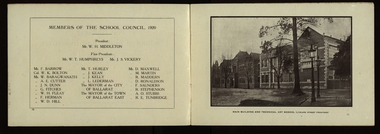
... enterprise which seemsto animate mining populations generally. Money was plentiful, and they launched out into ventures, which later, were to develop and take the place of the gold mines, while what is more to the point, they understood the value of education. the old digging days were passing away. So far as Ballarat itself was concerned the day of the cradle and tin dish had already passed into an antiquity "as dead and distant as the age of the Tubal Caon," said dir redmond Barry on declaring the School open. Mining had become a serious business...enterprise which seemsto animate mining populations generally. Money was plentiful, and they launched out into ventures, which later, were to develop and take the place of the gold mines, while what is more to the point, they understood the value of education. the old digging days were passing away. So far as Ballarat itself was concerned the day of the cradle and tin dish had already passed into an antiquity "as dead and distant as the age of the Tubal Caon," said dir redmond Barry on declaring the School open. Mining had become a serious business ...The first school of Mines in Australia was established at Ballarat in 1870. At the time of its jubilee (1930) the following people were members of the School Council: W.H. Middleton (President), W.T. Humphreys (VP), J.S. Vickery (VP), F. Barrow, Col. W.K. Bolton, William Baragwanath, A.E. Cutter, J.N. Dunn, G. Fitches, W.H. Fleay, F. Herman. W.D. Hill, T. Hurley, K. Kean. J. Kelly, L. Lederman, Mayor of Ballarat, Mayour of Ballarat East, D. Maxwell, M. Martin, R. Maddern, D. Ronaldson, F. Saunders, R. Stephenson, A.O. Stubbs, R.E. Tunbridge. The School Staff in 1920 comprised: Herbert H. Smith, Walter Rowbotham, Reginald L. Cutter, M.C. Young, Hilda Wardle, M. Wiliamson, P.S. Richards, L.H. Archibald, J. Woods, Ken Moss, W. Kenneth, Mrs McIlvena. B. Robinson, S. Rowe, E. Hope-Jones, Miss Abrams, L.St.G.P. Austin, Alfred Mica Smith, J.R. Pound, Herbert R. Murphy, N.H. Junner, Maurice Copland, L.H. Archibald, E.J.A. McConnon, Newton King, D.m. Hull, T.R. Gordon, John M. Sutherland, T.K. Jebb, Dick Richards, C. Tonkin, A.W. Steane, J. Paterson, H.W. Malin, R.V. Maddison, S.M. Mayo, F.A. King, W.H. Steane, T.R. Gordon, T.A. Williams, H. Waldron, G. Black, E.J. McConnon, R.V. Duncan. R. Cutter, E.G. Vawdrey, Hilda WardleWhite stapled booklet - landscape format - 20pp + soft covers with blue writing. Includes an historical sketch of the Ballarat School of Mines. Contains images of the school from around 1920. The history outlined in the booklet follows: 'Ballarat has helped to influence the life and destinies of Australia in many ways, the recital of which would perhaps prove tedious to the citizens of less favoured localities! However, it can be said, without much fear of contradiction, that only less known thought Australia than its fame as a gold field is the reputation won for it by its school of Mines, ... Ballarat was still quite a new place when the School was founded, but a very propserous and popular place all the same, with a go-ahead lot of citizens brim full of the spirit of enterprise which seemsto animate mining populations generally. Money was plentiful, and they launched out into ventures, which later, were to develop and take the place of the gold mines, while what is more to the point, they understood the value of education. the old digging days were passing away. So far as Ballarat itself was concerned the day of the cradle and tin dish had already passed into an antiquity "as dead and distant as the age of the Tubal Caon," said dir redmond Barry on declaring the School open. Mining had become a serious business, and the mining engineer, the metallurgist, and the geologist had become a power in the land. In these circumstances the suggestions to found a School of Mines met with ready acceptance. The late Mr James M. Bickett had the honor of bringing forward the proposition at a meeting of the Ballarat Mining Board in October, 1869. it was agreed to, and the Government, having been approached for assistance, granted a lease of the old Supreme Court buildings at a nominal reantal. A modest sum, including 100 pounds from the Borough Council of Ballarat West, was subscribed by a number of sympathisers, and on the 26th October, 1870, the inaugural address was delivered by Sir Redmond Barry, the first President of the School. Classes were commenced on the 23rd January, 1871. The students at first were mostly adults. They were chiefly men emloyed at the mines, who had the wisdom and energy to devote their spare time to study, and, though their attendance was somewhat irregular, they made very good progress. Old prints which have been preserved show them at work at furnaces, big bearded men of the old-fashioned type of miner. It is interesting to note that among those who gave evidence and encouragement was Sir Roderick Murchison, who many years before had advised Cornish miners to emigrate to Australia to search for gold, and who in 1848 was in possession of gold ore sent from this country. Sir Roderick sent a parcel of books for the library, and gave useful advice as to the curriculum which should be adopted. The Museum, which now contains a most valuable collection of minerals, was one of the first things attended to, and the reports presented to the Council from time to time speak of additions being made from all parts of the world. New equipment was constantly being added to the School, a good deal of assay work was done, and some specimens were sent from the East Indies for examination as far back as 1873. By this time there was a difficulty in providing accomodation for the students who wished to enrol, and the number of instructors had grown from two to four. In 1882 the first building was being erected on what was then part of the gaol reserve. A little more than ten years afterwards a buildnig formerly serving as a Methodist Church was absorbed, while later on, the demand for accomodation increasing, the attack upon the gaol was renewed. The School continued to grow in reputation and size, and became the science centre of the district, and in 1889 a learge new building was opened by Sir Alexander Peacock. Students came from over seas as well as from all the States of Australia, and after going through their courses they took with them the name and fame of the old School to all parts of the globe. School of Mines boys have played a great part in developing the mining fields of Western Australia, South Australia, and africa, while old students who have made a name in their profession are constantly dropping in to see how the old place is getting along. It was not to be expected, however, that the Ballarat School would be left without rivals, its very success inspiring competition. Mining Schools were started in other parts of Australia, and, at the same time, Victoria ceased to hold first place as a mining state. On the other hand there was a great advance in manufacturing, and the demand for technicaly trained men became a great and as insistent as ever it had been for trained mining men. The Council was quick to adapt the school to the new conditions, and the result is seen in the institution, which is one of Ballarat's proudest possession. Instruction is given in all branches of technical work, and the classes are filled with students who are building up for Ballarat a reputation as an industrial centre, which promises to equal that which it formerly held as a mining town. Owing to its bracing climate, its abundant opportunities for recreations, and its accessibilty, Ballarat as a city is an ideal place for educational purposed, and is yearly becoming more and more appreciated throughout the State. The chairman of one of Ballarat's biggests industries claims that the workman can do twice the day's work here that he can do in Melbourne. he was a little enthusiastic over it, perhaps, but it is a well-known fact that the healthy and invigourating Ballarat climate is conducive to both physical and mental activity, and the records of the School provide ample proof of it. One of the most interesting and successful branches of the School of Mines and Industries - if the name be enlarged with the enlargement of its scope - is the Technical Art School. "The City of Statues" has from its earliest days been a stronghold of art. Art schools have flourised here, and in 1905 the Education Department came to the conclusion that the best thing to do with them was to place them under the management of the School of Mines Council. A magnificent new Technical Art School was built at a cost of some 12,000 pounds on the site of the old Supreme Court building, and was formally opened on the 23rd July, 1915. The results have not only been justified but surpassed all anticipations. The most comprehensive list of subjects is taught, and this list is constantly added to. Students have flocked to the art School, which may be said to occupy a unique position in Australia, and its record of success is really astonishing. Its students supply art teachers for the newer schools that are being built, and many occupy leading positinos in important business houses. So well is its reputation known that orders are constantly being received, not only from Victoria, but from other States, for honor boards and challenge shields to be designed and made. The most recent addition to the School of Mines and Industries is the Junior Technical School, for which a new building is now being erected on a portion of the gaol site, transferred to the School of Mines Counci by the Government. At the present moment temporary quarters are being occupied. Some students after passing through the Junior School go straight to employment, continuing perhaps to attend the evening trade classes, while others move on to the senior School. In a review of the work of the School of Mines mention must be made of a series of industrial research carried out under supervision of the Principal. One in particular, regarding the suitability of the local ores for the manufacture of pigments attracted much attention, while the experiemtns on the manufacture of white potery from Victorian clayes were considered of sufficient importance by the Federal Advisory Council of Science and Industry to warrant the appointment of a special investigator. The results of these have been most encouraging, and may have far-reaching consequences. The vocational training of returned soldiers also should not be overlooked. The work was taken in hand from the first, before the Repatriation Department gave assistance, and now with the help of the department of the School has become one of the largest vocational training centres in Victoria outside of Melbourne. The soldiers, trained in a variety of occupations, have made remarkable progress, and already considerable numbers have found employment in local workshops and factories. To sum up, the School is divided into the following departments, each well staffed and equipped: - The School of Mines, science, and Engineering; the Techncial Art School, the Boys' Junior Technical School, the Girl's Preparatory Technical Classes, Trade Classes, and the Commercial School. The school of Mines, science and Engineering, comprises the following branches: - Mining, Metallurgy, Geology, Electrical Engineering, Civil Engineering, Mechanical Engineering, Applied Chemistry, and Pharmacy. Battery treatments, Cyanide Testing, Smelting, Assays, and Clay Testing from a regular part of the School's work. Students gaining qualifications obtain concession in their courses at the university, should they proceed there to continue their studies. The technical Art school curriculum includes training in all branches of pictorial and applied art, an Architectural Diploma Course, a Draughtman's Course, technical Art teachers' Course, Photography,Ticket Writing, Art Metal Work, Woodcarving, Needlework, and Leather work. The Trade Classes give instruction in Telephone Mechanics, telegraphy, Carpentry, Cabinet Making, Plumbing, Blacksmithing, Fitting, Electric Wiring, and Printing. Numerous Scholarships are offered every year, and altogether students will find few places to equal the Ballarat School of Mines and Industries as a training place for their life's work. One of the first in the continent to be established, its Jubilee finds it still in the front rank, keeping pace with the times, and offering to the youths of this country the means of taking advantage of Australia's teeming opportunities. william, battery, smith, herbert, drawing from the antique, ballarat school of mines botanical gardens, ballarat school of mines, redmond barry, alfred mica smith, james bickett, museum, dick richards, ballarat junior technical school, s m b, ballarat school of mines and industries, ballarat technical art school, model mine, james m bickett, j m bickett, roderick murchison, vocational training rooms, wesley church, methodist church, alexander peacock, lathes, repatriation, repatriatin department, war service, school council, baragwanath, gold mining, mining laboratory, plaster cast, r.w. richards, anniversary, jubilee -
 Federation University Historical Collection
Photograph - Photograph - Colour, Planning Greenhill Enterprise Centre, 1996, 1996
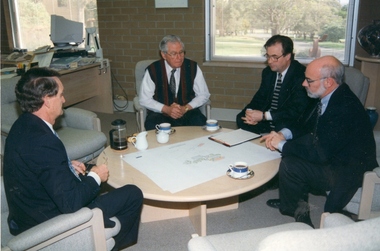
... businesses to thrive and prosper, in a dynamic and supportive environment. This fast evolving precinct encourages and supports the development of emerging and existing technology-oriented enterprises. ...businesses to thrive and prosper, in a dynamic and supportive environment. This fast evolving precinct encourages and supports the development of emerging and existing technology-oriented enterprises. ...At the Ballarat Technology Park (BTP) the spirit of innovation and entrepreneurship enables techno-driven businesses to thrive and prosper, in a dynamic and supportive environment. This fast evolving precinct encourages and supports the development of emerging and existing technology-oriented enterprises. Currently, more than 30 enterprises are located at the Park, including IBM, State Revenue Office, Emergency Services Telecommunications Authority, Primary Health Care and others. The Park's ideal location on the outskirts of Ballarat provides great lifestyle opportunities as well as having the convenience of being close to Melbourne, Geelong, Bendigo and Western Victoria. The BTP is a prestigious 29 hectare site set in a park-like environment, 7km from the thriving regional city of Ballarat. It is easily accessible from Melbourne, Geelong and Bendigo. Adjacent to Federation University's Mt Helen Campus, the BTP is ideally situated to support innovative technology-based enterprises grow and prosper. Enterprises can access skilled graduates through the University, as well as take advantage of the applied, academic and research knowledge available. BTP has been successfully supporting and fostering industry, innovation and job creation since 1995.Colour photograph of four men are seated at a low round table viewing design development drawings of the Greenhill Enterprise Centre prior to commencing documentation for tender purposes. They are Alan Webb (University of Ballarat Director, Buildings and Grounds), Professor David James (University of Ballarat Vice Chancellor), Michael Vincent (architect) and James Crisp (architect).ballarat technology park, university of ballarat., greenhill enterprise centre -
 Federation University Historical Collection
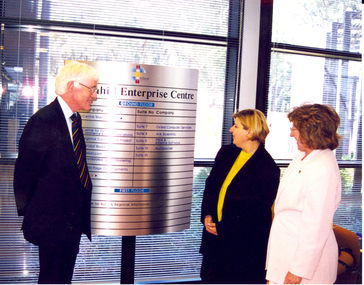
Photograph - Colour, Greenhill Enterprise Centre, 2000, 08/03/2000
... Enterprise Centre. They are, from left to right, Robert Hook (University of Ballarat Head of Finance), Marsha Thomson (Victorian Small Business Minister) and Sue Jenkins (Greenhill Enterprise Centre)...Enterprise Centre. They are, from left to right, Robert Hook (University of Ballarat Head of Finance), Marsha Thomson (Victorian Small Business Minister) and Sue Jenkins (Greenhill Enterprise Centre) Greenhill Enterprise Centre, 2000 Photograph - Colour ...Greenhill Enterprise Centre is part of the Federation University Ballarat Technology Park .Colour photograph showing three people looking at the facilities at the Greenhill Enterprise Centre. They are, from left to right, Robert Hook (University of Ballarat Head of Finance), Marsha Thomson (Victorian Small Business Minister) and Sue Jenkins (Greenhill Enterprise Centre)ballarat technology park, hook, robert hook, thomson -
 Federation University Historical Collection
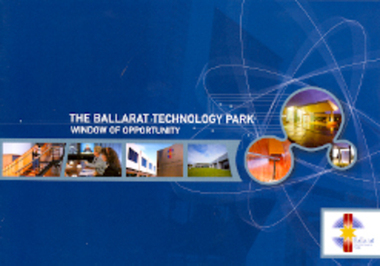
Booklet, The Ballarat Technology Park: Window of Opportunity, c2001
... The Greenhill Enterprise Centre is an IT incubator which, by the end of 2000, housed 20 businesses. ...The Greenhill Enterprise Centre is an IT incubator which, by the end of 2000, housed 20 businesses. ballarat technology park greenhill enterprise centre ibm global services kerry cox robert hook southern region data centre oztrak ross haby 8 page colour booklet outlining the Ballarat Technology Park. ...The Ballarat Technology Park is located on a 29 hectare site on the Mt Helen campus of Federation University Australia, and was officially launched in February 1995. The first tenant was IBM Global Services which employed 200 staff. The Greenhill Enterprise Centre is an IT incubator which, by the end of 2000, housed 20 businesses. 8 page colour booklet outlining the Ballarat Technology Park.ballarat technology park, greenhill enterprise centre, ibm global services, kerry cox, robert hook, southern region data centre, oztrak, ross haby -
 Flagstaff Hill Maritime Museum and Village
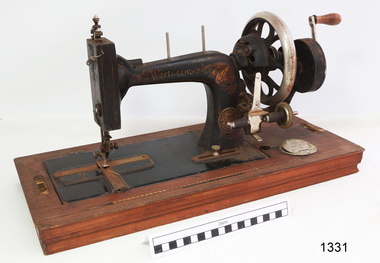
Domestic object - Sewing Machine, 1903
... business. In 1908 Wertheim opened a large, innovative piano factory at Richmond, Melbourne, intending to produce 2000 pianos and player pianos annually, predominantly using Australian materials. In laying the foundation stone, Prime Minister Alfred Deakin observed that “few men with such opportunities for a life of ease would have embarked on such an enterprise” Hugo died of chronic hepatitis on 11 July 1919 at his home at South Yarra, his wife, two daughters and three sons survived him; Herbert Joseph (1886-1972), the eldest, continued the business. ...business. In 1908 Wertheim opened a large, innovative piano factory at Richmond, Melbourne, intending to produce 2000 pianos and player pianos annually, predominantly using Australian materials. In laying the foundation stone, Prime Minister Alfred Deakin observed that “few men with such opportunities for a life of ease would have embarked on such an enterprise” Hugo died of chronic hepatitis on 11 July 1919 at his home at South Yarra, his wife, two daughters and three sons survived him; Herbert Joseph (1886-1972), the eldest, continued the business. ...Hugo Wertheim (1854-1919), was a merchant and manufacturer and was born on the 12th July 1854 at Lispenhausen, in the German electorate of Hesse-Kassel, son of Meyer Wertheim and his wife Minna, née Heinemann. Hugo reached Melbourne in October 1875. He soon began advertising, from premises at 39 Flinders Lane East, as agent for his father's cousin Joseph Wertheim, a well-established manufacturer of sewing machines. Hugo returned to Germany where he married Joseph Wertheim's daughter Sophie Emilie (1864-1953) on 30 August 1885 at Frankfurt. the couple then came to Melbourne. In a short time, with extensive advertising, Hugo established a substantial business, selling sewing machines, bicycles, pianos and other mechanical devices, under brands such as Wertheim, Electra, Planet, Griffin and Hapsburg. He also mounted elaborate displays at agricultural shows and in 1901 at the Pan American Exposition, Buffalo, United States of America. O. C. Beale worked with him before setting up his own piano business in New South Wales. Hugo continued to own 25 per cent of one of Beale's companies, which became Wertheim's Queensland business. In 1908 Wertheim opened a large, innovative piano factory at Richmond, Melbourne, intending to produce 2000 pianos and player pianos annually, predominantly using Australian materials. In laying the foundation stone, Prime Minister Alfred Deakin observed that “few men with such opportunities for a life of ease would have embarked on such an enterprise” Hugo died of chronic hepatitis on 11 July 1919 at his home at South Yarra, his wife, two daughters and three sons survived him; Herbert Joseph (1886-1972), the eldest, continued the business. Rupert became a share broker and went on to represent Victoria in inter-State tennis in 1913-27 and Australia in Davis Cup matches against Czechoslovakia in 1922. The piano factory closed in 1935, becoming a Heinz food processing plant and in 1955, GTV Channel 9 studios and offices.Early Australians had to be self-reliant in regards to making and mending their clothes and utensils. This sewing machine was one of many items used that exhibit the skill and craftsmanship of the women in these early families. A sewing machine was a necessary part of each home and this item demonstrates how women of the time managed had to become self-reliant in the repair and making of their families clothes to make their household budgets go further.Wertheim sewing machine in carry case, hand operated with two spindles, handle with locking pin, which turns lever between spokes of main handle, hand brake. The machine is table-mounted with a Turkish walnut base. The base can be attached to a cast iron table with a foot treadle as an optional extra. The walnut base has marquetry to the front set out as a measure for material. There is also an accessory box inside the carry case containing 20 additional items for use with the machine. Wertheim brass trademark badge riveted to the body of the machine of a crouching dwarf with a hammer with the name of the company Wertheim and Frankfurt. Gold filigree decoration in gold paint adorns the main body of the machine. flagstaff hill, warrnambool, shipwrecked-coast, flagstaff-hill, flagstaff-hill-maritime-museum, maritime-museum, shipwreck-coast, flagstaff-hill-maritime-village, sewing machine, hand operated sewing machine, crank handle sewing machine, wertheim, dressmaking, taylor, domestic, clothing, hugo wertheim, joseph wertheim -
 Flagstaff Hill Maritime Museum and Village
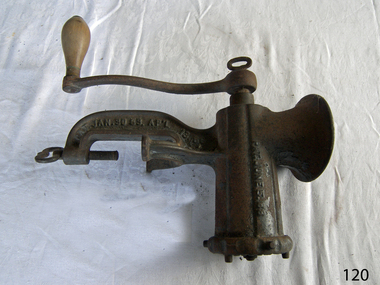
Domestic object - Food Mincer, Enterprise Manufacturing Company, circa 1911
... Enterprise Manufacturing Co. remained in business until 1956 when it was bought by Silex Co....Enterprise Manufacturing Co. remained in business until 1956 when it was bought by Silex Co. ...This particular food mincer was manufactured by Enterprise Manufacturing Company. Located in Philadelphia, this company specialized in making hardware products. The company was especially known for its cherry pitters, apple peelers, and coffee mills. The company was founded in 1864 and was located on the corner of Dauphin, 3rd, and American Streets. Enterprise Manufacturing Co. remained in business until 1956 when it was bought by Silex Co.A mass produced early domestic item made for home food preparation this item's first patent design was approved in 1897. Manufactured by a well known company in the USA the "Enterprise Manufacturing Company” up until 1956. They specialised in making kitchen appliances of various types for domestic use and for export. Food mincers of the subject items design are still being produced today under the brand name of "Universal" made by Universal Trading Inc USA.Food mincer, metal, clamp on bench style, with rotating wooden handle. Inscriptions stamped on metal.Marked "Enterprise tinned Meat Chopper" "No. 10" "Enterprise MF'G Co. PHILA. USA" "PAT. JAN.30.83" flagstaff hill, warrnambool, flagstaff hill maritime museum, flagstaff hill maritime village, great ocean road, mincer, food mincer, meat mincer, food preparation, kitchen utensil, domestic object, enterprise manufacturing company, kitchen appliance -
 Flagstaff Hill Maritime Museum and Village
Photograph - Vessels, Steam and Sail, Vessels in the bay, 1890's
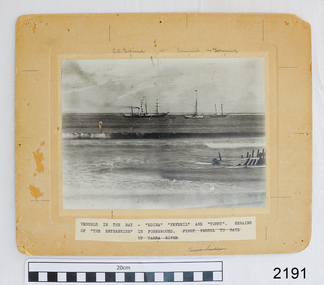
... business community. Her original ‘fair maid of Judea’ figurehead was broken to pieces in a collision with another vessel (the SS Dandenong) in a gale off Warrnambool, Victoria, in 1870. The photograph is significant for its association wreck of the Victorian Heritage Listed schooner Enterprise, VHR S238, being a New Zealand-built but Australian-owned coastal trader. ...The photograph, taken in the 1890s, shows sailing ships and a wreck in Lady Bay, Warrnambool. Lady Bay was once a very busy port of trade in Warrnambool and was also called the Port of Warrnambool or Warrnambool Harbour. ENTERPRISE (1847-1850) NOTE: The “Enterprise” wrecked in 1850 in Warrnambool should not be confused with John Pascoe Faulkner’s ‘Enterprise’, which was wrecked in NSW in 1847. The 58-ton schooner Enterprise was built by David Hay in Waiheke, New Zealand in 1847 and registered by owners John Watson and Edward Byam in Melbourne, Australia. She was a single-deck sailing ship with two masts, used for carrying cargo such as local agricultural produce and general commodities between Melbourne and other colonial ports. On September 14th, 1850 the Enterprise had sailed from Melbourne under the control of the ship’s Master, James Gardiner Caught, and was moored in at the Tramway Jetty in Lady Bay, laden with wheat and potatoes. The vessel rode out a south-easterly gale but eventually dragged anchor and was beached, bow first and then broadside. Buckwall, a local indigenous man, braved the heavy surf and reached the stricken vessel with a rescue line, saving all five crew on board. There were no passengers on board. The Enterprise wreck was in an area called Tramway Jetty in Lady Bay. Since then the area has become the location of Lady Bay Hotel and now, in 2019, it is in the grounds of the Deep Blue Apartments. In fact, with the constantly changing coastline through built-up sand, the wreck site is now apparently under the No 2 Caravan Park on Pertobe Road, perhaps 150 metres from the high tide. Its location was found by Ian McKiggan (leader of the various searches in the 1980s for the legendary Mahogany Ship). The Warrnambool Wreck Enterprise is listed on the Victorian Heritage Database VHR S238. DIFFERENTIATING the New Zealand Schooner “Enterprise” from John Fawkner’s “Enterprize“ Dr Murray Johns, Melbourne, says in his article The Mahogany Ship Story, “…the Enterprise, wrecked in Lady Bay, Warrnambool in 1850 ... was soon covered by sand but was exposed again after several storms in 1887. “Samples of timber were then cut from the wreck, which would then have been buried for 37 years. In November 1887 the Warrnambool Standard reported that “the timber looks sound and hard, a penknife scarcely making any impression.” “For many years there was confusion about the identity of that ship in Lady Bay. Most people believed it was the wreck of John Pascoe Fawkner’s Enterprize, which had sailed from Tasmania to Victoria bringing the pioneer settlers to Melbourne in 1835. “In fact, as I documented in 1985, the Warrnambool wreck was of an entirely different ship, also called Enterprize [Enterprise], but built in New Zealand in 1847. Fawkner’s ship had already been sold to Captain Sullivan in 1845 and was wrecked on the Richmond Pier in northern New South Wales early in 1847. “In 1985 a piece of timber from the local Enterprise, which had been kept at the Warrnambool Museum since 1892, was identified histologically as a New Zealand timber, not Tasmanian timber such as blue gum, from which Fawkner’s Enterprize would have been built in 1830. This confirmed the identity of the Warrnambool Enterprize.”[Dr. M.W. Johns later wrote an article called “The Schooner Enterprise: A Final Word on a Historic Wreck.”] ABOUT THE S S EDINA The three-masted iron screw steamer SS Edina was built in Glasgow, Scotland, in 1854 by Barclay and Curle. She was adorned with the figurehead of the ‘fair maid of Judea’. The many years of service made SS Edina famous worldwide as the longest-serving screw steamer. (The term screw steamer comes from being driven by a single propeller, sometimes called a screw, driven by a steam engine.) SS Edina’s interesting history includes English Chanel runs, serving in the Crimean Ware carrying ammunition, horses and stores to the Black Sea, and further service in the American Civil War and later, serving in the western district of Victoria as well as in Queensland and carried gold, currency and gold prospectors Australia to New Zealand. SS Edina had the privilege of being an escort vessel to H.R.H. the Duke of Edinburgh during his visit to Australia in 1867. In March 1863 SS Edina arrived in Port Phillip Bay, Melbourne and was bought by Stephen Henty, of Portland fame, to work the cargo and passenger run from Melbourne – Warrnambool – Port Fairy - Portland. After a short time of working the run from Australia to New Zealand, with passengers and cargo that included gold and currency, she returned to her Melbourne - Warrnambool – Port Fairy run, with cargo including bales of wool produced in the western district of Victoria. The Warrnambool Steam Packet Company purchased SS Edina in 1867; she was now commanded by Captain John Thompson and Chief Engineer John Davies. She survived several mishaps at sea, had a complete service and overhaul and several changes of commanders. In 1870 SS Edina was in Lady Bay, Warrnambool, when a gale sprung up and caused a collision with the iron screw steamer SS Dandenong. SS Edina’s figurehead was broken into pieces and it was not ever replaced. SS Edina was re-fitted in 1870 and was then used as a coastal trader in Queensland for a period. She was then brought to Melbourne to carry cargo and passengers between Melbourne and Geelong and performed this service from 1880-1938. During this time (1917) she was again refitted with a new mast, funnel, bridge and promenade deck, altering her appearance. In 1938, after more collisions, SS Edina was taken out of service. However, she was later renamed Dinah and used as a ‘lighter’ (a vessel without an engine or superstructure) to be towed and carry wool and general cargo between Melbourne and Geelong. In 1957, after 104 years, the SS Edina was broken up at Footscray, Melbourne. Remains of SS Edina’s hull can be found in the Maribyrnong River, Port Phillip Bay. This photograph is significant for its association with the screw steamer SS Edina, heritage listed on the Victorian Heritage Database VHR S199. She had endeared herself to the people of Port Phillip Bay as a passenger ferry, part of their history and culture. She played a significant role in the Crimean War, the American Civil War and the gold rush in New Zealand. She also served western Victoria for many years in her cargo and passenger runs. The SS Edina is famous for being the longest-serving screw steamer in the world. After spending her first nine years overseas she arrived in Melbourne and her work included running the essential service of transporting cargo and passengers between Melbourne and the western Victoria ports of Warrnambool, Port Fairy and Portland. The SS Edina was purchased in the late 1860s by the local Warrnambool business, the Warrnambool Steam Packet Co. and continued trading from there as part of the local business community. Her original ‘fair maid of Judea’ figurehead was broken to pieces in a collision with another vessel (the SS Dandenong) in a gale off Warrnambool, Victoria, in 1870. The photograph is significant for its association wreck of the Victorian Heritage Listed schooner Enterprise, VHR S238, being a New Zealand-built but Australian-owned coastal trader. The wreck was also significant for its association with the local indigenous hero, Buckawall, who saved the lives of the five crew on board. Photograph "Vessels in the Bay". Black and white photograph of several vessels in Lady Bay, Warrnambool, including some small vessels and "S.S. Edina", the "Peveril" and "Tommy", plus the remains of the wrecked vessel "Enterprise" in the foreground. Photograph is mounted on beige card with label describing the vessels, plus pencilled vessel names. There are several pin holes in each corner of the photograph. Typed label under the photograph “VESSELS IN THE BAY – “EDINA” “PEREVIL” AND “TOMMY”. / REMAINS OF “THE ENTERPRISE” IN FOREGROUND. (Also crossed out on the label “FIRST VESSEL TO SAIL UP YARRA RIVER). In pencil script above the vessels on the photograph “S.S. Edina”, “Peveril” “Tommy”. On the reverse is a printed sticker with “F-Ph 59/2 74”, red felt-tip pen “88”, green pen script repeating the text that is under the photograph on the front.flagstaff hill, warrnambool, shipwrecked-coast, flagstaff-hill, flagstaff-hill-maritime-museum, maritime-museum, shipwreck-coast, flagstaff-hill-maritime-village, enterprize, port of warrnambool, warrnambool harbour, peveril, tommy, ss edina, lighter dinah, warrnambool steam packet company, lady bay, pleasure steamer, edina, trade, travel, screw ship, coastal trader, cargo, victoria, buckawall, indigenous rescue, indigenous hero -
 Flagstaff Hill Maritime Museum and Village
Domestic object - Sewing Machine and case, Joseph Wertheim, late 19th century
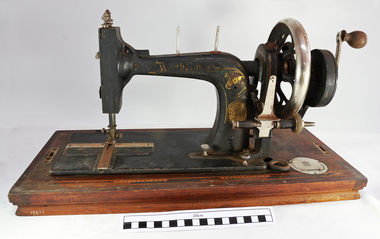
... business. In 1908 Wertheim opened a large, innovative piano factory at Richmond, Melbourne, intending to produce 2000 pianos and player pianos annually, predominantly using Australian materials. In laying the foundation stone, Prime Minister Alfred Deakin observed that “few men with such opportunities for a life of ease would have embarked on such an enterprise” Hugo died of chronic hepatitis on 11 July 1919 at his home at South Yarra, his wife, two daughters and three sons survived him; Herbert Joseph (1886-1972), the eldest, continued the business. ...business. In 1908 Wertheim opened a large, innovative piano factory at Richmond, Melbourne, intending to produce 2000 pianos and player pianos annually, predominantly using Australian materials. In laying the foundation stone, Prime Minister Alfred Deakin observed that “few men with such opportunities for a life of ease would have embarked on such an enterprise” Hugo died of chronic hepatitis on 11 July 1919 at his home at South Yarra, his wife, two daughters and three sons survived him; Herbert Joseph (1886-1972), the eldest, continued the business. ...Hugo Wertheim (1854-1919), was a merchant and manufacturer and was born on the 12th July 1854 at Lispenhausen, in the German electorate of Hesse-Kassel, son of Meyer Wertheim and his wife Minna, née Heinemann. Hugo reached Melbourne in October 1875. He soon began advertising, from premises at 39 Flinders Lane East, as agent for his father's cousin Joseph Wertheim, a well-established manufacturer of sewing machines. Hugo returned to Germany where he married Joseph Wertheim's daughter Sophie Emilie (1864-1953) on 30 August 1885 at Frankfurt. the couple then came to Melbourne. In a short time, with extensive advertising, Hugo established a substantial business, selling sewing machines, bicycles, pianos and other mechanical devices, under brands such as Wertheim, Electra, Planet, Griffin and Hapsburg. He also mounted elaborate displays at agricultural shows and in 1901 at the Pan American Exposition, Buffalo, United States of America. O. C. Beale worked with him before setting up his own piano business in New South Wales. Hugo continued to own 25 per cent of one of Beale's companies, which became Wertheim's Queensland business. In 1908 Wertheim opened a large, innovative piano factory at Richmond, Melbourne, intending to produce 2000 pianos and player pianos annually, predominantly using Australian materials. In laying the foundation stone, Prime Minister Alfred Deakin observed that “few men with such opportunities for a life of ease would have embarked on such an enterprise” Hugo died of chronic hepatitis on 11 July 1919 at his home at South Yarra, his wife, two daughters and three sons survived him; Herbert Joseph (1886-1972), the eldest, continued the business. Rupert became a share broker and went on to represent Victoria in inter-State tennis in 1913-27 and Australia in Davis Cup matches against Czechoslovakia in 1922. The piano factory closed in 1935, becoming a Heinz food processing plant and in 1955, GTV Channel 9 studios and offices.Early Australians had to be self-reliant in regards to making and mending their clothes and utensils. This sewing machine was one of many items used that exhibit the skill and craftsmanship of the women in these early families. A sewing machine was a necessary part of each home and this item demonstrates how women of the time managed had to become self-reliant in the repair and making of their families clothes to make their household budgets go further.Sewing machine, Wertheim brand “ Syst 182” hand crank operated machine with folding handle, timber case and carry handle. Metal machine is painted black, with remnants of gold, red and green scrolls and floral decoration. Machine has base with inlaid measuring rule across front and 2 holes drilled through the base (perhaps for mounting machine to a bench). Machine tilts open, hinged on one side, after thumb screw is unwound, revealing machine’s workings and serial number. Base has a fitted round, concave, silver metal pin holder with lid that hinges open, and symbol pressed into lid; several pins are inside. Body of machine has brand name transfer across front and oval metal trademark disc on front. Metal sliding covers over footplates have stamped lettering. Timber machine case or cover includes an accessory box with sliding cover and metal hook and eye latch, and inside the box are 23 metal sewing attachments, a disc and a stick of black crayon with maker’s trademark on it paper cover. Workings of machine have seized up. The crayon wrapper has printed on it “For the wonderful Wertheim new family machine made in Germany ‘Syst. 182’”, and the maker’s symbol with “Trademark” beside it. Made for Hugo Wertheim.“WERTHEIM” transfer across front and back of machine body. Cover of pin holder has symbol ‘Wings above a shield’. Maker’s trademark on gold oval disc, “WERTHEIM / FRANCFURT” and picture of a dwarf with a hammer. Left footplate has script “Syst 182”, right footplate has stamp in oval shape “MANUFACTURED IN - - /SPECIALLY FOR / HUGO WERTHEIM” Serial Number “7501”flagstaff hill, warrnambool, shipwrecked-coast, flagstaff-hill, flagstaff-hill-maritime-museum, maritime-museum, shipwreck-coast, flagstaff-hill-maritime-village, sewing machine, hand crank sewing machine, hugo wertheim, wertheim, clothing manufacturer, sewing, syst 182 -
 Flagstaff Hill Maritime Museum and Village
Equipment - Rowing Oar
... business in 1946 and continued making high-end cabinetry for seven decades. Under director Geoff Woodfield, in the 1950s, the company embarked on the production of Fleetcraft plywood boats. Another water-related enterprise...business in 1946 and continued making high-end cabinetry for seven decades. Under director Geoff Woodfield, in the 1950s, the company embarked on the production of Fleetcraft plywood boats. Another water-related enterprise ...The family-owned timber manufacturing business Pelco was started by Cecil Victor Woodfield in 1937. The joinery company Pelco began by making wooden ladders and was registered as the Palmerston Extension Ladder Company. C V Woodfield, who lived from 1884 -1959, arrived in Palmerston North from Canterbury NZ in the aftermath of the Great Depression to work in construction. The company got its first step up when Woodfield was asked by a commercial painter to make a ladder, and the founder set up shop in a garage on Ruahine St. According to the company website, Pelco made its name in New Zealand with its Oregon Extension Ladders, and up until its closure, manufactured non-conductive Lamilite Ladders for the electrical supply and service industry worldwide. The company was incorporated as a joinery business in 1946 and continued making high-end cabinetry for seven decades. Under director Geoff Woodfield, in the 1950s, the company embarked on the production of Fleetcraft plywood boats. Another water-related enterprise followed, with the manufacture of oars and paddles. Its branded Gull Superior Oars and Paddles business began exporting in 1972 to Australia and subsequently to the United States, UK and Japan. The company ceased trading in April 2018 and was placed into receivership.This pair of lightweight oars represents the maritime tradition of handmade oar making, which has evolved over the centuries. Their shape is still similar to early oars and continues to serve the same purpose, to steer and propel a boat. Pair of blonde varnished Tasman Fir oars with a flattened paddle at one end. Made by Gull of New Zealand, sold by James Edwards & Sons of Melbourne. Inscriptions on printed labels on the oars."GULL Superior Oars and Paddles, Pelco, Palmerston North NZ" "JAS. EDWARDS & SONS, Boat Builders, Oar and Skull Makers, & Importers, PRINCES BRIDGE MELBOURNE"warrnambool, flagstaff-hill, flagstaff-hill-maritime-museum, maritime-museum, shipwreck-coast, flagstaff-hill-maritime-village, oar, oars, gull oars and paddles, new zealand oars and paddles, jas edwards and sons melbourne, rowing equipment, new zealand oak, paddle, james edwards and sons melbourne, james edwards, tasman fir, gull superior oars, marine equipment, marine technology, ship fitting, boat fitting, rowing oar, boat oar -
Federation University Historical Collection
Booklet, The Ballarat School of Mines and Industries 1870-1920 Jubilee Booklet, 1920 (estimated)
... enterprise which seemsto animate mining populations generally. Money was plentiful, and they launched out into ventures, which later, were to develop and take the place of the gold mines, while what is more to the point, they understood the value of education. the old digging days were passing away. So far as Ballarat itself was concerned the day of the cradle and tin dish had already passed into an antiquity "as dead and distant as the age of the Tubal Caon," said dir redmond Barry on declaring the School open. Mining had become a serious business...enterprise which seemsto animate mining populations generally. Money was plentiful, and they launched out into ventures, which later, were to develop and take the place of the gold mines, while what is more to the point, they understood the value of education. the old digging days were passing away. So far as Ballarat itself was concerned the day of the cradle and tin dish had already passed into an antiquity "as dead and distant as the age of the Tubal Caon," said dir redmond Barry on declaring the School open. Mining had become a serious business ...The first school of Mines in Australia was established at Ballarat in 1870. At the time of its jubilee (1930) the following people were members of the School Council: W.H. Middleton (President), W.T. Humphreys (VP), J.S. Vickery (VP), F. Barrow, Col. W.K. Bolton, William Baragwanath, A.E. Cutter, J.N. Dunn, G. Fitches, W.H. Fleay, F. Herman. W.D. Hill, T. Hurley, K. Kean. J. Kelly, L. Lederman, Mayor of Ballarat, Mayour of Ballarat East, D. Maxwell, M. Martin, R. Maddern, D. Ronaldson, F. Saunders, R. Stephenson, A.O. Stubbs, R.E. Tunbridge. The School Staff in 1920 comprised: Herbert H. Smith, Walter Rowbotham, Reginald L. Cutter, M.C. Young, Hilda Wardle, M. Wiliamson, P.S. Richards, L.H. Archibald, J. Woods, Ken Moss, W. Kenneth, Mrs McIlvena. B. Robinson, S. Rowe, E. Hope-Jones, Miss Abrams, L.St.G.P. Austin, Alfred Mica Smith, J.R. Pound, Herbert R. Murphy, N.H. Junner, Maurice Copland, L.H. Archibald, E.J.A. McConnon, Newton King, D.m. Hull, T.R. Gordon, John M. Sutherland, T.K. Jebb, Dick Richards, C. Tonkin, A.W. Steane, J. Paterson, H.W. Malin, R.V. Maddison, S.M. Mayo, F.A. King, W.H. Steane, T.R. Gordon, T.A. Williams, H. Waldron, G. Black, E.J. McConnon, R.V. Duncan. R. Cutter, E.G. Vawdrey, Hilda WardleWhite stapled booklet - landscape format - 20pp + soft covers with blue writing. Includes an historical sketch of the Ballarat School of Mines. Contains images of the school from around 1920. The history outlined in the booklet follows: 'Ballarat has helped to influence the life and destinies of Australia in many ways, the recital of which would perhaps prove tedious to the citizens of less favoured localities! However, it can be said, without much fear of contradiction, that only less known thought Australia than its fame as a gold field is the reputation won for it by its school of Mines, ... Ballarat was still quite a new place when the School was founded, but a very propserous and popular place all the same, with a go-ahead lot of citizens brim full of the spirit of enterprise which seemsto animate mining populations generally. Money was plentiful, and they launched out into ventures, which later, were to develop and take the place of the gold mines, while what is more to the point, they understood the value of education. the old digging days were passing away. So far as Ballarat itself was concerned the day of the cradle and tin dish had already passed into an antiquity "as dead and distant as the age of the Tubal Caon," said dir redmond Barry on declaring the School open. Mining had become a serious business, and the mining engineer, the metallurgist, and the geologist had become a power in the land. In these circumstances the suggestions to found a School of Mines met with ready acceptance. The late Mr James M. Bickett had the honor of bringing forward the proposition at a meeting of the Ballarat Mining Board in October, 1869. it was agreed to, and the Government, having been approached for assistance, granted a lease of the old Supreme Court buildings at a nominal reantal. A modest sum, including 100 pounds from the Borough Council of Ballarat West, was subscribed by a number of sympathisers, and on the 26th October, 1870, the inaugural address was delivered by Sir Redmond Barry, the first President of the School. Classes were commenced on the 23rd January, 1871. The students at first were mostly adults. They were chiefly men emloyed at the mines, who had the wisdom and energy to devote their spare time to study, and, though their attendance was somewhat irregular, they made very good progress. Old prints which have been preserved show them at work at furnaces, big bearded men of the old-fashioned type of miner. It is interesting to note that among those who gave evidence and encouragement was Sir Roderick Murchison, who many years before had advised Cornish miners to emigrate to Australia to search for gold, and who in 1848 was in possession of gold ore sent from this country. Sir Roderick sent a parcel of books for the library, and gave useful advice as to the curriculum which should be adopted. The Museum, which now contains a most valuable collection of minerals, was one of the first things attended to, and the reports presented to the Council from time to time speak of additions being made from all parts of the world. New equipment was constantly being added to the School, a good deal of assay work was done, and some specimens were sent from the East Indies for examination as far back as 1873. By this time there was a difficulty in providing accomodation for the students who wished to enrol, and the number of instructors had grown from two to four. In 1882 the first building was being erected on what was then part of the gaol reserve. A little more than ten years afterwards a buildnig formerly serving as a Methodist Church was absorbed, while later on, the demand for accomodation increasing, the attack upon the gaol was renewed. The School continued to grow in reputation and size, and became the science centre of the district, and in 1889 a learge new building was opened by Sir Alexander Peacock. Students came from over seas as well as from all the States of Australia, and after going through their courses they took with them the name and fame of the old School to all parts of the globe. School of Mines boys have played a great part in developing the mining fields of Western Australia, South Australia, and africa, while old students who have made a name in their profession are constantly dropping in to see how the old place is getting along. It was not to be expected, however, that the Ballarat School would be left without rivals, its very success inspiring competition. Mining Schools were started in other parts of Australia, and, at the same time, Victoria ceased to hold first place as a mining state. On the other hand there was a great advance in manufacturing, and the demand for technicaly trained men became a great and as insistent as ever it had been for trained mining men. The Council was quick to adapt the school to the new conditions, and the result is seen in the institution, which is one of Ballarat's proudest possession. Instruction is given in all branches of technical work, and the classes are filled with students who are building up for Ballarat a reputation as an industrial centre, which promises to equal that which it formerly held as a mining town. Owing to its bracing climate, its abundant opportunities for recreations, and its accessibilty, Ballarat as a city is an ideal place for educational purposed, and is yearly becoming more and more appreciated throughout the State. The chairman of one of Ballarat's biggests industries claims that the workman can do twice the day's work here that he can do in Melbourne. he was a little enthusiastic over it, perhaps, but it is a well-known fact that the healthy and invigourating Ballarat climate is conducive to both physical and mental activity, and the records of the School provide ample proof of it. One of the most interesting and successful branches of the School of Mines and Industries - if the name be enlarged with the enlargement of its scope - is the Technical Art School. "The City of Statues" has from its earliest days been a stronghold of art. Art schools have flourised here, and in 1905 the Education Department came to the conclusion that the best thing to do with them was to place them under the management of the School of Mines Council. A magnificent new Technical Art School was built at a cost of some 12,000 pounds on the site of the old Supreme Court building, and was formally opened on the 23rd July, 1915. The results have not only been justified but surpassed all anticipations. The most comprehensive list of subjects is taught, and this list is constantly added to. Students have flocked to the art School, which may be said to occupy a unique position in Australia, and its record of success is really astonishing. Its students supply art teachers for the newer schools that are being built, and many occupy leading positinos in important business houses. So well is its reputation known that orders are constantly being received, not only from Victoria, but from other States, for honor boards and challenge shields to be designed and made. The most recent addition to the School of Mines and Industries is the Junior Technical School, for which a new building is now being erected on a portion of the gaol site, transferred to the School of Mines Counci by the Government. At the present moment temporary quarters are being occupied. Some students after passing through the Junior School go straight to employment, continuing perhaps to attend the evening trade classes, while others move on to the senior School. In a review of the work of the School of Mines mention must be made of a series of industrial research carried out under supervision of the Principal. One in particular, regarding the suitability of the local ores for the manufacture of pigments attracted much attention, while the experiemtns on the manufacture of white potery from Victorian clayes were considered of sufficient importance by the Federal Advisory Council of Science and Industry to warrant the appointment of a special investigator. The results of these have been most encouraging, and may have far-reaching consequences. The vocational training of returned soldiers also should not be overlooked. The work was taken in hand from the first, before the Repatriation Department gave assistance, and now with the help of the department of the School has become one of the largest vocational training centres in Victoria outside of Melbourne. The soldiers, trained in a variety of occupations, have made remarkable progress, and already considerable numbers have found employment in local workshops and factories. To sum up, the School is divided into the following departments, each well staffed and equipped: - The School of Mines, science, and Engineering; the Techncial Art School, the Boys' Junior Technical School, the Girl's Preparatory Technical Classes, Trade Classes, and the Commercial School. The school of Mines, science and Engineering, comprises the following branches: - Mining, Metallurgy, Geology, Electrical Engineering, Civil Engineering, Mechanical Engineering, Applied Chemistry, and Pharmacy. Battery treatments, Cyanide Testing, Smelting, Assays, and Clay Testing from a regular part of the School's work. Students gaining qualifications obtain concession in their courses at the university, should they proceed there to continue their studies. The technical Art school curriculum includes training in all branches of pictorial and applied art, an Architectural Diploma Course, a Draughtman's Course, technical Art teachers' Course, Photography,Ticket Writing, Art Metal Work, Woodcarving, Needlework, and Leather work. The Trade Classes give instruction in Telephone Mechanics, telegraphy, Carpentry, Cabinet Making, Plumbing, Blacksmithing, Fitting, Electric Wiring, and Printing. Numerous Scholarships are offered every year, and altogether students will find few places to equal the Ballarat School of Mines and Industries as a training place for their life's work. One of the first in the continent to be established, its Jubilee finds it still in the front rank, keeping pace with the times, and offering to the youths of this country the means of taking advantage of Australia's teeming opportunities. william, battery, smith, herbert, drawing from the antique, ballarat school of mines botanical gardens, ballarat school of mines, redmond barry, alfred mica smith, james bickett, museum, dick richards, ballarat junior technical school, s m b, ballarat school of mines and industries, ballarat technical art school, model mine, james m bickett, j m bickett, roderick murchison, vocational training rooms, wesley church, methodist church, alexander peacock, lathes, repatriation, repatriatin department, war service, school council, baragwanath, gold mining, mining laboratory, plaster cast, r.w. richards, anniversary, jubilee -
Federation University Historical Collection
Book - Book - Scrapbook, Ballarat School of MInes: Scrapbook of Newspaper Cuttings, Book 35, April 1988 to July 1988
... business program...industry oriented training scheme...rob webber...new enterprise...The papers concerned are The Courier, Ballarat, The Australian, The Age over the period of 22 July 1988 to 3 October 1987. teaching positions advertised pre-employment courses courses available enrolment for smb courses aboriginal flag for smb $600000 for science studies building arbor day at victoria park smb and local industry smb's marketing company inskill ltd open learning for maths students pilot business program industry oriented training scheme rob webber new enterprise incentives scheme gerardine christou myra morgan art and craft teacher 1950s new computer software for engineers more adults return to school cuts to special school funding transition program hospitality studies - certificate of catering anne-marie allison christine brady robert reilly sue collins sculptor peter blizzard student andrew burnham ricky hains wins tippett award kandra chapman award winner sheetmetal women's access group smb women's trade and technical program offended girl mechanic hit back mining course at smb kerrie cross council president adult literacy tutors june huggins josie micich hospitality traineeship system launched farm manager computer program course peter quinn peter davis federal grant to john valves special course on stoneware glazes ceramics instructor neville french players find home at smb michael staley winning apprentice ballarat small business centre quality control course at smb calligraphyteacher eddie goodson Book with green cover, front, spiral bound. ...Collection of newspaper articles related to Ballarat School Of Mines.They cover activities and advertisements for staff. The papers concerned are The Courier, Ballarat, The Australian, The Age over the period of 22 July 1988 to 3 October 1987.Book with green cover, front, spiral bound. teaching positions advertised, pre-employment courses, courses available, enrolment for smb courses, aboriginal flag for smb, $600000 for science studies building, arbor day at victoria park, smb and local industry, smb's marketing company inskill ltd, open learning for maths students, pilot business program, industry oriented training scheme, rob webber, new enterprise incentives scheme, gerardine christou, myra morgan art and craft teacher 1950s, new computer software for engineers, more adults return to school, cuts to special school funding, transition program, hospitality studies - certificate of catering, anne-marie allison, christine brady, robert reilly, sue collins, sculptor peter blizzard, student andrew burnham, ricky hains wins tippett award, kandra chapman award winner sheetmetal, women's access group, smb women's trade and technical program, offended girl mechanic hit back, mining course at smb, kerrie cross council president, adult literacy tutors, june huggins, josie micich, hospitality traineeship system launched, farm manager computer program course, peter quinn, peter davis, federal grant to john valves, special course on stoneware glazes, ceramics instructor neville french, players find home at smb, michael staley winning apprentice, ballarat small business centre, quality control course at smb, calligraphyteacher eddie goodson -
Federation University Historical Collection
Book - Book - Scrapbook, Ballarat School of MInes: Scrapbook of Newspaper Cuttings, Book 42, December 1989 to March 1990
... business...$20000 grant for new enterprise incentive scheme...The papers concerned are The Courier, Ballarat, The Australian, The Age over the period of 30 December 1989 to 30 March 1990. teaching positions advertised pre-employment courses courses available enrolment for smb courses koorie support unit jean phillips computers for hospitality students kaye mcfarlane richard de fegely mlc traineeships offer more training to boost career prospects fiona watson artist milivoj micich leah willian mature aged student martin murley co-ordinator vocational information centre art laboratory leaves ballarat jan falls program to 'aid the disadvantage' job and course explorer program le restaurant at smb richard stevenson family services centre woodworkers show craft vocational information centre opened rose douglas john mildren peter kellock minister of education debra nicholson belinda stone anne bartlett sally tse barry jones minister for science-customs and small business $20000 grant for new enterprise incentive scheme workshop for tutors gay stanway lois whiteley judy demeye co-ordinator joan goldsmith trina hosking apprentice fitter and turner Book with yellow cover, front, spiral bound. ...Collection of newspaper articles related to Ballarat School Of Mines.They cover activities and advertisements for staff. The papers concerned are The Courier, Ballarat, The Australian, The Age over the period of 30 December 1989 to 30 March 1990.Book with yellow cover, front, spiral bound. teaching positions advertised, pre-employment courses, courses available, enrolment for smb courses, koorie support unit, jean phillips, computers for hospitality students, kaye mcfarlane, richard de fegely mlc, traineeships offer more, training to boost career prospects, fiona watson, artist milivoj micich, leah willian mature aged student, martin murley co-ordinator, vocational information centre, art laboratory leaves ballarat, jan falls, program to 'aid the disadvantage', job and course explorer program, le restaurant at smb, richard stevenson, family services centre, woodworkers show craft, vocational information centre opened, rose douglas, john mildren, peter kellock minister of education, debra nicholson, belinda stone, anne bartlett, sally tse, barry jones minister for science-customs and small business, $20000 grant for new enterprise incentive scheme, workshop for tutors, gay stanway, lois whiteley, judy demeye, co-ordinator joan goldsmith, trina hosking apprentice fitter and turner -
Federation University Historical Collection
Book - Book - Scrapbook, Ballarat School of MInes: Scrapbook of Newspaper Cuttings, Book 52, May 1992 to August 1992
... business course award...women get opportunities in trades...new tertiary course guide...basic reading and numeracy skills...new course for sole parents...local enterprise...The papers concerned are The Courier, Ballarat, The Australian, The Age over the period of 18 May 1992 to 5 August 1992. teaching positions advertised pre-employment courses courses available enrolment for smb courses matthew clamp and christine mildren scholarship awards victorian waiters' olympiad loiuse trigg diane collins ropes of retailing threat to body making course michelle cocking best hairdressing apprentice child care graduates karen crick business course award women get opportunities in trades new tertiary course guide basic reading and numeracy skills new course for sole parents local enterprise development initiative ledi queen elizabeth centre course motor mechanic tutors in ballarat Book with green cover, front, spiral bound. ...Collection of newspaper articles related to Ballarat School Of Mines.They cover activities and advertisements for staff. The papers concerned are The Courier, Ballarat, The Australian, The Age over the period of 18 May 1992 to 5 August 1992.Book with green cover, front, spiral bound. teaching positions advertised, pre-employment courses, courses available, enrolment for smb courses, matthew clamp and christine mildren scholarship awards, victorian waiters' olympiad, loiuse trigg, diane collins, ropes of retailing, threat to body making course, michelle cocking best hairdressing apprentice, child care graduates, karen crick business course award, women get opportunities in trades, new tertiary course guide, basic reading and numeracy skills, new course for sole parents, local enterprise development initiative, ledi, queen elizabeth centre course, motor mechanic tutors in ballarat -
 Federation University Historical Collection
Negative - Object, Lantern Slides, pre 1914
... enterprise was established in 1845, first as the partnership of Phelps & Gurley and in 1852 as W. & L. E. Gurley. William Gurley and his younger brother Lewis E. were both engineering alumni of Rensselaer Polytechnic Institute, in Troy, NY, and brought to the business a hunger for technical innovation and unrivaled marketing skill. ...enterprise was established in 1845, first as the partnership of Phelps & Gurley and in 1852 as W. & L. E. Gurley. William Gurley and his younger brother Lewis E. were both engineering alumni of Rensselaer Polytechnic Institute, in Troy, NY, and brought to the business a hunger for technical innovation and unrivaled marketing skill. ...The Gurley enterprise was established in 1845, first as the partnership of Phelps & Gurley and in 1852 as W. & L. E. Gurley. William Gurley and his younger brother Lewis E. were both engineering alumni of Rensselaer Polytechnic Institute, in Troy, NY, and brought to the business a hunger for technical innovation and unrivaled marketing skill. Exposure at the Centennial Exposition in 1876 launched the company into international prominence from which it never fell. The brothers built a factory in 1852 that operated in departments, each department turning out different components, which were then assembled. This revolutionized the industry which, to that time, operated as small shops making, essentially, individual instruments. Gurley was able to roughly halve the price of their instruments over those of their competition, while maintaining quality. (https://www.gurley.com/history)A timber box of 30 lantern Slides.astronomy, lantern slides, gunn's, w. & l.e. gurley -
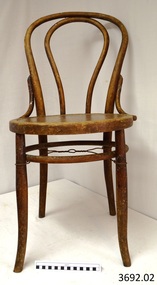 Flagstaff Hill Maritime Museum and Village
Furniture - Chair, early 29th century
... business again, the Gebruder Thonet to include his sons (translated “Brothers Thonet”). He produced the “No. 1” Bentwood chair. He received a bronze medal for his Vienna bentwood chairs at the World Fair in London in 1851, and a silver medal in Paris in 1855. In 1856 he opened a new factory in Koritchan (Moravia), where there were extensive woods of beech trees available for his enterprise...business again, the Gebruder Thonet to include his sons (translated “Brothers Thonet”). He produced the “No. 1” Bentwood chair. He received a bronze medal for his Vienna bentwood chairs at the World Fair in London in 1851, and a silver medal in Paris in 1855. In 1856 he opened a new factory in Koritchan (Moravia), where there were extensive woods of beech trees available for his enterprise ...The Bentwood chair has been called ‘the world’s most popular chair’. The original Bentwood chair, was designed by German-Austrian cabinet maker and Master Joiner, Michael Thonet (b.1796 - d.1871) and introduced to the market in 1859. Thonet started his business in his home town of Boppard as an independent cabinet maker in 1819. In the 1830’s he began trying to make furniture from glued (laminated) and bent wooden slats. Over the next few years his attempts to patent this process failed in Germany, Great Britain, France, and Russia. He then began using lightweight, strong wood and bending it into elegant, comfortable furniture. The Bentwood technology took Thonet years to perfect. In simple terms, the wooden rods or lengths were wet by soaking or steaming, bent into shape and then held in place until they hardened into the moulded curved shape or pattern. The wood usually chosen for the bentwood chairs was maple or beech. Thonet had revolutionised an older process by industrialising the process. The dowels of wood were cut and prepared as components of furniture, treated by the ‘bentwood’ process, then ready immediately for assembling with very little extra workmanship needed. Thonet held 2 patents for this process, the second one ended on 10th July 1869 and was non-renewable. At the Trade Fair at Koblenz of 1841 Prince Klemens Wenzel von Mettemich was very impressed with Thonet’s furniture, especially the chairs. In 1842 Thonet sold his Boppard business and emigrated to Vienna, and began working, along with his sons, on the interior decoration of the Palais Leichtenstein, for the Carl Leistler establishment. In 1849 he began his own business again, the Gebruder Thonet to include his sons (translated “Brothers Thonet”). He produced the “No. 1” Bentwood chair. He received a bronze medal for his Vienna bentwood chairs at the World Fair in London in 1851, and a silver medal in Paris in 1855. In 1856 he opened a new factory in Koritchan (Moravia), where there were extensive woods of beech trees available for his enterprise. In the next years, five more Eastern European production sites were established in Bystritz (1862), Nagy-Ugrócz (1866), Wsetin (1867), Hallenkau(1867) and Nowo-Radomsk(1880). Thonet’s 1859 No. 14 “chair of chairs” (or “Konsumstuhl Nr. 14” – coffee shop chair no. 14) was the most famous of all of Thonet’s Bentwood chairs. In 1867 he received a gold medal at the Paris World Fair. This new style of furniture making became very popular. Up until 1830 50 million of these chairs had been produced. By the 1870’s Thonet owned offices in almost 20 countries, with sales locations across Europe, in Chicago and New York. In 1889 he set Thonet set up a head office in Frankenberg, Hesse. Bentwood models designed in the mid to late 19th century featured hand-caned or laminated wood seats and were usually stamped with the country of origin. The Bentwood elements were the backrest, seat rim and legs. Typically the seat was covered with ‘bucket’ leather. After the Patent ran out in 1869, companies such as Jacob & Josef Kohn began the production of bentwood furniture.The popularity of the Bentwood chair that was introduced by Michael Thonet in the 1850s is due to its versatility and timeless quality. Its style, whether varnished or painted, suits any room in the house. The lightweight chairs are also popular for café and restaurant seating, as well as for public gatherings. They can be easily moved around and grouped in a variety of ways to suit any occasion.Chair, bentwood, pair of two. Backrest has full length inverted U inside frame. Support rail and wire reinforcing between legs. 3692.01 seat has floral pattern pressed into wood 3692.02 seat is plain (replacement seat). Made by Harnison & Co.3692.01 chair's marks; Label ""HARNISON & CO./ NEUSOL / BUDAPEST" and "WIENER NOBEL" and "(symbol) N inside circle, under Crown" flagstaff hill, warrnambool, shipwrecked coast, flagstaff hill maritime museum, maritime museum, shipwreck coast, flagstaff hill maritime village, great ocean road, domestic furniture, dining furniture, bentwood chair, harnison & co., neusol, budapest, wiener nobel -
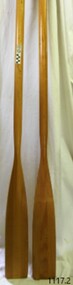 Flagstaff Hill Maritime Museum and Village
Equipment - Rowing Oars
... business in 1946, and continued making high-end cabinetry for seven decades. Under director Geoff Woodfield, in the 1950s, the company embarked on the production of Fleetcraft plywood boats. Another water-related enterprise...business in 1946, and continued making high-end cabinetry for seven decades. Under director Geoff Woodfield, in the 1950s, the company embarked on the production of Fleetcraft plywood boats. Another water-related enterprise ...The family-owned timber manufacturing business Pelco was started by Cecil Victor Woodfield in 1937. The joinery company Pelco began by making wooden ladders and was registered as the Palmerston Extension Ladder Company. C V Woodfield, who lived from 1884 -1959, arrived in Palmerston North from Canterbury NZ in the aftermath of the Great Depression to work in construction. The company got its first step up when Woodfield was asked by a commercial painter to make a ladder, and the founder set up shop in a garage on Ruahine St. According to the company website, Pelco made its name in New Zealand with its Oregon Extension Ladders, and up until its closure, manufactured non-conductive Lamilite Ladders for the electrical supply and service industry worldwide. The company was incorporated as a joinery business in 1946, and continued making high-end cabinetry for seven decades. Under director Geoff Woodfield, in the 1950s, the company embarked on the production of Fleetcraft plywood boats. Another water-related enterprise followed, with the manufacture of oars and paddles Its branded Gull Superior Oars and Paddles business began exporting in 1972 to Australia and subsequently to the United States, UK and Japan. The company ceased trading in April 2018 and was placed into receivership.This pair of lightweight oars represents the maritime tradition of handmade oar making, which has evolved over the centuries. Their shape is still similar to early oars and continues to serve the same purpose, to steer and propel a boat. The oars are associated with a significant family business situated in Palmerston New Zealand that along with making ladders also graduated into making wooden boats and oars.Pair of blonde varnished Tasman Fir oars with a flattened paddle at one end. Made by Gull of New Zealand, sold by James Edwards & Sons of Melbourne. Inscriptions on printed labels on the oars.(1) "GULL Superior Oars and Paddles, Pelco, Palmerston North NZ" (2) "JAS. EDWARDS & SONS, Boat Builders, Oar and Skull Makers, & Importers, PRINCES BRIDGE MELBOURNE"warrnambool, flagstaff-hill, flagstaff-hill-maritime-museum, maritime-museum, shipwreck-coast, flagstaff-hill-maritime-village, oar, oars, gull oars and paddles, new zealand oars and paddles, jas edwards and sons melbourne, rowing equipment, new zealand oak, paddle, james edwards and sons melbourne, james edwards, tasman fir, gull superior oars, marine equipment, marine technology, ship fitting, boat fitting, rowing oar, boat oar -
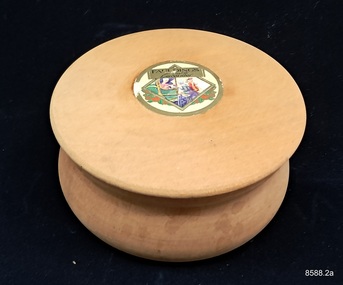 Flagstaff Hill Maritime Museum and Village
Container - Wooden Box, 1930s
... One pharmaceutical enterprise which put greater emphasis on the manufacturing side of its business and whose successors strengthened this emphasis was Faulding's. ...One pharmaceutical enterprise which put greater emphasis on the manufacturing side of its business and whose successors strengthened this emphasis was Faulding's. ...One pharmaceutical enterprise which put greater emphasis on the manufacturing side of its business and whose successors strengthened this emphasis was Faulding's. A pharmacist, Francis H. Faulding, started his shop in Adelaide in 1841 and formed a partnership with an English physician, L. Scammel, in 1861. From its beginnings the firm showed a flare for innovation. After Simpson's discovery of the anaesthetic properties of chloroform in 1847, Francis Faulding was the first to import chloroform; in 1858 he distributed cocaine preparations; in 1864 he produced the first olive oil from South Australian olives and, after J. Lister's reports in Lancet on the reduction of mortality after surgery with the use of phenol, Faulding began production of antiseptics ('Solyptol') in 1867. Faulding was also the first to utilize the medicinal and antiseptic properties of eucalyptus oil which was obtained from distilleries on Kangaroo Island The Second World War in Europe disrupted the supply of cod liver oil, an important source of Vitamin A. Faulding chemists found an alternative source in white schnapper shark, which sustained supplies in Australia as well as generated exports to the UK . When supplies of I.G. Farben's newly discovered sulpha drugs ran out, Faulding became involved in the national program organised by the Medical Equipment Control Committee (MECC) and, jointly with universities, synthesised sulphanilamide. Following the transfer of American knowhow. Faulding's was also the first private enterprise to produce yet another life saving drug of military importance, penicillin. After the war basic synthesis of antibiotics became difficult to sustain by private enterprise because of the gigantic scale advantages of competing US producers, and competition in the synthesis of new drugs demanded huge investment in R & D; Fauldings maintained their business by a combination of marketing, wholesaling and producing consumer and medical products. In the 1970s, however, Fauldings set a remarkable precedent in research strategy and achievement in the Australian pharmaceutical business. They decided to concentrate their research on drugs which had proven efficacy, but which also suffered from certain shortcomings restricting their clinical usefulness, and to seek advances overcoming these shortcomings. This was an imaginative new strategy, a way of grafting Australian knowhow on to major products, in keeping with local resources and yet offering opportunities for sophisticated skill. At the same time it promised to open internatiSurgeon and onal markets, since the major producers of the basic drugs could hardly ignore significant advances. https://www.samhs.org.au/Virtual%20Museum/Medicine/drugs_nonsurg/Fauldings_drug/Fauldings_drugs.html This decorative gift box once containing Faulding’s Old English Lavender soap or powder belonged to Dr. Angus' wife, Gladys. It was donated to Flagstaff Hill Maritime Village by his daughter, Bernice McDade. It is part of the “W.R. Angus Collection” that includes historical medical equipment, surgical instruments and material once belonging to Dr Edward Ryan and Dr Thomas Francis Ryan, (both of Nhill, Victoria) as well as Dr Angus’ own belongings. The Collection’s history spans the medical practices of the two Doctors Ryan, from 1885-1926 plus that of Dr Angus, up until 1969. Powder or soap in boxes such as this was perfumed and used as part of a women’s personal grooming in the early to mid 20th century. Faulding’s Company began in Adelaide, Australia, in 1845 and made a wide range of cosmetic and perfume products as well as pharmaceuticals. The company is still in operation today. ABOUT THE “W.R.ANGUS COLLECTION” Doctor William Roy Angus M.B., B.S., Adel., 1923, F.R.C.S. Edin.,1928 (also known as Dr Roy Angus) was born in Murrumbeena, Victoria in 1901 and lived until 1970. He qualified as a doctor in 1923 at University of Adelaide, was Resident Medical Officer at the Royal Adelaide Hospital in 1924 and for a period was house surgeon to Sir (then Mr.) Henry Simpson Newland. Dr Angus was briefly an Assistant to Dr Riddell of Kapunda, then commenced private practice at Curramulka, Yorke Peninsula, SA, where he was physician, surgeon and chemist. In 1926, he was appointed as new Medical Assistant to Dr Thomas Francis Ryan (T.F. Ryan, or Tom), in Nhill, Victoria, where his experiences included radiology and pharmacy. In 1927 he was Acting House Surgeon in Dr Tom Ryan’s absence. Dr Angus had become engaged to Gladys Forsyth and they decided he further his studies overseas in the UK in 1927. He studied at London University College Hospital and at Edinburgh Royal Infirmary and in 1928, was awarded FRCS (Fellow from the Royal College of Surgeons), Edinburgh. He worked his passage back to Australia as a Ship’s Surgeon on the on the Australian Commonwealth Line’s T.S.S. Largs Bay. Dr Angus married Gladys in 1929, in Ballarat. (They went on to have one son (Graham 1932, born in SA) and two daughters (Helen (died 12/07/1996) and Berenice (Berry), both born at Mira, Nhill ) According to Berry, her mother Gladys made a lot of their clothes. She was very talented and did some lovely embroidery including lingerie for her trousseau and beautifully handmade baby clothes. Dr Angus was a ‘flying doctor’ for the A.I.M. (Australian Inland Ministry) Aerial Medical Service in 1928 . Its first station was in the remote town of Oodnadatta, where Dr Angus was stationed. He was locum tenens there on North-South Railway at 21 Mile Camp. He took up this ‘flying doctor’ position in response to a call from Dr John Flynn; the organisation was later known as the Flying Doctor Service, then the Royal Flying Doctor Service. A lot of his work during this time involved dental surgery also. Between 1928-1932 he was surgeon at the Curramulka Hospital, Yorke Peninsula, South Australia. In 1933 Dr Angus returned to Nhill and purchased a share of the Nelson Street practice and Mira hospital (a 2 bed ward at the Nelson Street Practice) from Dr Les Middleton one of the Middleton Brothers, the current owners of what previously once Dr Tom Ryan’s practice. Dr Tom and his brother had worked as surgeons included eye surgery. Dr Tom Ryan performed many of his operations in the Mira private hospital on his premises. He had been House Surgeon at the Nhill Hospital 1902-1926. Dr Tom Ryan had one of the only two pieces of radiology equipment in Victoria during his practicing years – The Royal Melbourne Hospital had the other one. Over the years Dr Tom Ryan had gradually set up what was effectively a training school for country general-practitioner-surgeons. Each patient was carefully examined, including using the X-ray machine, and any surgery was discussed and planned with Dr Ryan’s assistants several days in advance. Dr Angus gained experience in using the X-ray machine there during his time as assistant to Dr Ryan. When Dr Angus bought into the Nelson Street premises in Nhill he was also appointed as the Nhill Hospital’s Honorary House Surgeon 1933-1938. His practitioner’s plate from his Nhill surgery is now mounted on the doorway to the Port Medical Office at Flagstaff Hill Maritime Village, Warrnambool. When Dr Angus took up practice in the Dr Edward and Dr Tom Ryan’s old premises he obtained their extensive collection of historical medical equipment and materials spanning 1884-1926. A large part of this collection is now on display at the Port Medical Office at Flagstaff Hill Maritime Village in Warrnambool. In 1939 Dr Angus and his family moved to Warrnambool where he purchased “Birchwood,” the 1852 home and medical practice of Dr John Hunter Henderson, at 214 Koroit Street. (This property was sold in1965 to the State Government and is now the site of the Warrnambool Police Station. and an ALDI sore is on the land that was once their tennis court). The Angus family was able to afford gardeners, cooks and maids; their home was a popular place for visiting dignitaries to stay whilst visiting Warrnambool. Dr Angus had his own silk worm farm at home in a Mulberry tree. His young daughter used his centrifuge for spinning the silk. Dr Angus was appointed on a part-time basis as Port Medical Officer (Health Officer) in Warrnambool and held this position until the 1940’s when the government no longer required the service of a Port Medical Officer in Warrnambool; he was thus Warrnambool’s last serving Port Medical Officer. (Masters of immigrant ships arriving in port reported incidents of diseases, illness and death and the Port Medical Officer made a decision on whether the ship required Quarantine and for how long, in this way preventing contagious illness from spreading from new immigrants to the residents already in the colony.) Dr Angus was a member of the Australian Medical Association, for 35 years and surgeon at the Warrnambool Base Hospital 1939-1942, He served as a Surgeon Captain during WWII1942-45, in Ballarat, Victoria, and in Bonegilla, N.S.W., completing his service just before the end of the war due to suffering from a heart attack. During his convalescence he carved an intricate and ‘most artistic’ chess set from the material that dentures were made from. He then studied ophthalmology at the Royal Melbourne Eye and Ear Hospital and created cosmetically superior artificial eyes by pioneering using the intrascleral cartilage. Angus received accolades from the Ophthalmological Society of Australasia for this work. He returned to Warrnambool to commence practice as an ophthalmologist, pioneering in artificial eye improvements. He was Honorary Consultant Ophthalmologist to Warrnambool Base Hospital for 31 years. He made monthly visits to Portland as a visiting surgeon, to perform eye surgery. He represented the Victorian South-West subdivision of the Australian Medical Association as its secretary between 1949 and 1956 and as chairman from 1956 to 1958. In 1968 Dr Angus was elected member of Spain’s Barraquer Institute of Barcelona after his research work in Intrasclearal cartilage grafting, becoming one of the few Australian ophthalmologists to receive this honour, and in the following year presented his final paper on Living Intrasclearal Cartilage Implants at the Inaugural Meeting of the Australian College of Ophthalmologists in Melbourne In his personal life Dr Angus was a Presbyterian and treated Sunday as a Sabbath, a day of rest. He would visit 3 or 4 country patients on a Sunday, taking his children along ‘for the ride’ and to visit with him. Sunday evenings he would play the pianola and sing Scottish songs to his family. One of Dr Angus’ patients was Margaret MacKenzie, author of a book on local shipwrecks that she’d seen as an eye witness from the late 1880’s in Peterborough, Victoria. In the early 1950’s Dr Angus, painted a picture of a shipwreck for the cover jacket of Margaret’s book, Shipwrecks and More Shipwrecks. She was blind in later life and her daughter wrote the actual book for her. Dr Angus and his wife Gladys were very involved in Warrnambool’s society with a strong interest in civic affairs. He had an interest in people and the community They were both involved in the creation of Flagstaff Hill, including the layout of the gardens. After his death (28th March 1970) his family requested his practitioner’s plate, medical instruments and some personal belongings be displayed in the Port Medical Office surgery at Flagstaff Hill Maritime Village, and be called the “W. R. Angus Collection”.Fauldings Company is a very historical Australian company, still in operating today. The powder box is an example of fashion and grooming in the 1930's in Australia. The W.R. Angus Collection is significant for still being located at the site it is connected with, Doctor Angus being the last Port Medical Officer in Warrnambool. The collection of medical instruments and other equipment is culturally significant, being an historical example of medicine from late 19th to mid-20th century. Dr Angus assisted Dr Tom Ryan, a pioneer in the use of X-rays and in ocular surgery.Container, wooden powder box with separate lid. Round box is made from light coloured timber and was sold containing Faulding’s Old English Lavender cosmetic powder. The wooden bowl is light in colour and the lid has a decal with text and images of two ladies facing each other, a gentleman looking over his shoulder at them, and red roses. From the W.R. Angus Collection.Faulding's Old English Lavender, and picture of old English men and women in period costume.flagstaff hill maritime museum and village, great ocean road, shipwreck coast, warrnambool, shipwtreck coast, dr w r angus, faulding's, lavender, powder, cosmetic
