
Showing 6 items matching "butt plate"
-
 Flagstaff Hill Maritime Museum and Village
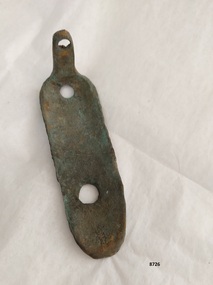
Weapon - Gun Butt Plate, circa 1870's
... Gun Butt Plate......Butt Plate... This Butt Plate was salvaged from the wreck of the Loch Ard, on the southwest coast of Victoria and donated by a friend of the diver. ...This Butt Plate was salvaged from the wreck of the Loch Ard, on the southwest coast of Victoria and donated by a friend of the diver. ...This Butt Plate was salvaged from the wreck of the Loch Ard, on the southwest coast of Victoria and donated by a friend of the diver. Butt plates were fittings added to the end of guns or rifles in order to protect the wood from splitting or suffering damage. The ship Loch Ard was built on the River Clyde in Scotland in 1873 for the prestigious Loch Line of colonial clipper ships, designed for the Australian run. It sailed from England on 1st March 1878 carrying 37 crew, 17 passengers and a load of cargo including "firearms" worth 173 Pounds (plus 22 tons of lead shot). The general cargo reflected the affluence of Melbourne at the time. Also on board were straw hats, umbrellas, perfumes, clay pipes, pianos, clocks, confectionary, linen and candles, as well as a heavier load of railway irons, cement, lead and copper. There were items included that were intended for display in the Melbourne International Exhibition in 1880 - a diverse general cargo ranging from luxury items to bulk railway iron. On 1 June 1878, emerging from fog and hearing too late the sound of breakers against the tall limestone cliffs, the vessel struck the southern foot of Mutton Bird Island and sank in 23 metres of water. Of the fifty-four people on board only two survived, one young male crewman, Tom Pearce, and one young female passenger, Eva Carmichael. Ten days after the Loch Ard tragedy, salvage rights to the wreck were sold at auction for £2,120. Cargo valued at £3,000 was salvaged and placed on the beach, but most washed back into the sea when another storm developed. The wreck of Loch Ard still lies at the base of Mutton Bird Island. Much of the cargo has now been salvaged and some was washed up into what is now known as Loch Ard Gorge. Cargo and artefacts have also been illegally salvaged over many years before protective legislation was introduced in 1976. One of the most unlikely pieces of cargo to have survived the shipwreck was a Minton porcelain peacock - one of only seven in the world. The peacock was destined for the Melbourne International Exhibition in 1880. It had been well packed, which gave it adequate protection during the violent storm. Today, the Minton peacock can be seen at the Flagstaff Hill Maritime Museum in Warrnambool. From Australia's most dramatic shipwreck it has now become Australia's most valuable shipwreck artefact and is one of very few 'objects' on the Victorian State Heritage Register.Flagstaff Hill’s collection of artefacts from LOCH ARD is significant for being one of the largest collections of artefacts from this shipwreck in Victoria. It is significant for its association with the shipwreck, which is on the Victorian Heritage Register (VHR S417). The collection is significant because of the relationship between the objects, as together they have a high potential to interpret the story of the LOCH ARD. The LOCH ARD collection is archaeologically significant as the remains of a large international passenger and cargo ship. The LOCH ARD collection is historically significant for representing aspects of Victoria’s shipping history and its potential to interpret sub-theme 1.5 of Victoria’s Framework of Historical Themes (living with natural processes). The collection is also historically significant for its association with the LOCH ARD, which was one of the worst and best known shipwrecks in Victoria’s history.An L shaped metal plate with one long, concave side (with two formed holes) and a narrow, short vertical arm with one hole. It is hand-forged and shaped with no joins and has green oxidation patina (indicating a copper based metal) on the inner side and green verdigris and a rusty, flaking layer on the outer side.flagstaff hill maritime museum and village, warrnambool, great ocean road, shipwreck coast, firearms, butt plate, gun butt plate, rifle butt plate, salvage, loch ard, loch ard wreck, loch ard salvage -
 Tennis Australia
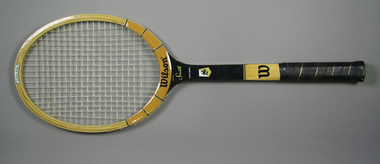
Racquet, Circa 1974
... Leather handle grip features quatrefoil perforations. Butt cap has metallic plate adhered to it, engraved with the name 'JOE'. ...Leather handle grip features quatrefoil perforations. Butt cap has metallic plate adhered to it, engraved with the name 'JOE'. ...A Wilson Stan Smith Monterey tennis racquet. Base of head features Wilson logo. Throat and shaft feature model name and gold and white shield device with 'S' at centre. Lower shaft and butt cap feature 'W' trademark. Leather handle grip features quatrefoil perforations. Butt cap has metallic plate adhered to it, engraved with the name 'JOE'. Materials: Wood, Nylon, Leather, Glue, Metal, Lacquer, Paint, Adhesive tape, Ribbon, Plastictennis -
 Federation University Historical Collection
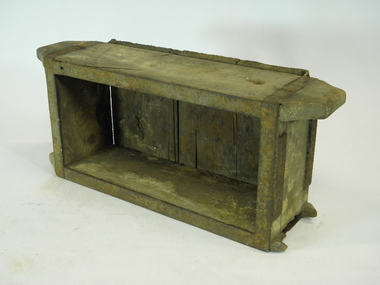
Tool, Brick mould and brick, 1) UNKNOWN .2) c.1888
... butt joints are used. Iron strapping wraps around the vertical pieces of timber and across the top edge of the box. The longest pieces of vertical timber protrude past the end and are shaped like solid handles - one is broken. On each end piece there are small, blank iron plates...butt joints are used. Iron strapping wraps around the vertical pieces of timber and across the top edge of the box. The longest pieces of vertical timber protrude past the end and are shaped like solid handles - one is broken. On each end piece there are small, blank iron plates ...John Nunn was one of the earliest brickmakers on record in Ballarat and has a road named for him - Nunn Street - where he resided..1) An oblong-shaped timber box open at top. Only butt joints are used. Iron strapping wraps around the vertical pieces of timber and across the top edge of the box. The longest pieces of vertical timber protrude past the end and are shaped like solid handles - one is broken. On each end piece there are small, blank iron plates held with screws. The base piece of timber is made from two different width weatherboard-style timbers. The nails in the base piece appear to be hand-made. Remnants of clay still line the interior. .2) Light brown brick. Please note: Brick mould and brick may be from different sources..1) Handwritten (possibly in ink) on one long side: MR H. G. SMITH ...(illegible) Ballarat .2) Imprinted: J. NUNNjohn nunn, j nunn, brick, mould, brick mould, industrial mould, brickmaker, ballarat, clay, ceramics -
 Flagstaff Hill Maritime Museum and Village
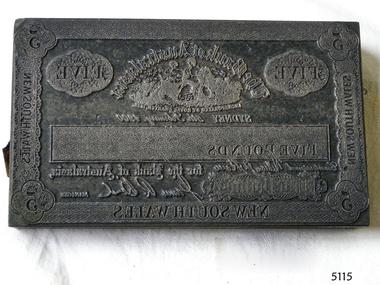
Currency - Engravers Plate, Five-pound
... Butt was the Manager of the Warrnambool Branch in 1895. This significant item of early Australian social history gives a snapshot into the founding and early development of the banking system in Australia. The plate ...This banknote plate was created for the Sydney branch of the Bank of Australasia in February 1900, before the Federation of Australia. After printing the banknotes from this plate the printer would have overprinted the banknotes with a unique serial number and the denomination of the banknote in capital letters using a contrasting ink. The Bank of Australasia was incorporated by Royal Charter of England in March 1834. It first came to Australia on 14th December 1835, opening in Sydney. In that year, the Acting Superintendent of the Bank of Australasia in Sydney was David Charters McArthur. He went on to become the Superintendent from 1867-to 1876. The Melbourne branch of the Bank of Australasia opened on 28th August 1838. In 1951 the Bank of Australasia amalgamated with the Union Bank to form the Australia and New Zealand Bank, now known as the ANZ. Then in 1970 the ANZ merged with both the ES&A and the London Bank of Australia to form the ANZ Banking Group Limited. The ANZ Banking Group Ltd kindly donated a variety of historic items from the Bank of Australasia. BANK of AUSTRALASIA, WARRNAMBOOL – The Bank of Australasia was the first bank in Warrnambool. It was established in 1854 and operated from leased buildings on Merri Street and then Timor Street. The bank opened its own building on May 21, 1860, on the northeast corner of Timor and Kepler Streets. Mr A Butt was the Manager of the Warrnambool Branch in 1895. This significant item of early Australian social history gives a snapshot into the founding and early development of the banking system in Australia. The plate has historical significance as it belonged to the Bank of Australasia which was established in 1834 by Royal Charter and opened in Sydney, Australia, in Sydney in 1835. The plate is significant for its association with the Bank of Australasia, which had a branch in Warrnambool. Warrnambool's branch was the first bank in Warrnambool, established in 1854. The bank continued to operate until its merger in 1951 when it became the ANZ Bank, which is still in operation today. The Bank was an integral part of the establishment and growth of commerce in Colonial Warrnambool and throughout Australia.Printer's plate for a five-pound note, attached to a block comprising several layers of different varieties of wood. Rectangular metal plate embossed with the banknote's design and produced by the Sydney, New South Wales, branch of the Bank of Australasia. The border includes numbers and text. The image of the bank's logo is included, along with the banknote's denomination in letters and numerals, a signature and a date of 15th February 1900.On the border: in each corner "5", on sides and base "NEW SOUTH WALES" Within the border "FIVE" "The Bank of Australasia / INCORPORATED BY ROYAL CHARTER IN 1835" "FIVE POUNDS' "SYDNEY 5th of February 1900" "for the Bank of Australasia" (Signature) , "MANAGER" Image: (Bank's logo) [Two female figures seated together in a paddock, produce beside them, sheep and buildings in the background]flagstaff hill, warrnambool, shipwrecked coast, flagstaff hill maritime museum, maritime museum, shipwreck coast, flagstaff hill maritime village, great ocean road, bank of australasia, union bank, australia & new zealand bank, anz bank, sydney, new south wales, currency, banknote, legal tender, commerce, banking, five-pound note, banknote plate, printing plate -
 Waverley RSL Sub Branch
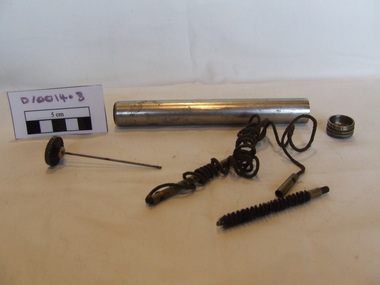
Canister cleaning kit for .303 Enfield
... butt and covered by a hinged cover. Cleaning of rifles was imperative to allow the rifles to function consistently especially in field conditions. Rifle .303 lee enfield pullthrough cleaning kit Nickel plated ...The cleaning kit was issued with all lee enfield .303 rifles. They were kept in a chamber in the butt and covered by a hinged cover. Cleaning of rifles was imperative to allow the rifles to function consistently especially in field conditions.Nickel plated brass canister with two removable screw ends containing oil with applicator and brass weighted cord pullthrough with brush for cleaning and mainenance of .303 Enfield riflerifle, .303 lee enfield, pullthrough, cleaning kit -
 Tennis Australia
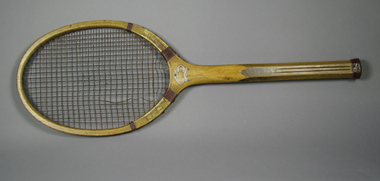
Racquet, Circa 1920
... Deep grooved handle; silver shaped plate attached to throat on obverse. Racquet maintenance instructions impressed across butt cover. ...Deep grooved handle; silver shaped plate attached to throat on obverse. Racquet maintenance instructions impressed across butt cover. ...A wooden tennis racquet with cloth tape reinforced shoulders, and string whipping. Deep grooved handle; silver shaped plate attached to throat on obverse. Racquet maintenance instructions impressed across butt cover. Materials: Wood, Lacquer, Glue, Metal, Gut, Leather, Ink, Cloth tape, Stringtennis
