
Showing 13 items matching "café chair"
-
 Flagstaff Hill Maritime Museum and Village
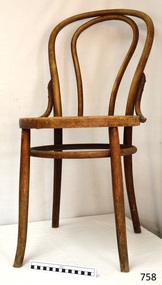
Furniture - Chair, Harnisch & Co, 1876-1918
... ...café chair...The design of this pair (RN 758 & 759) is based on Thonet’s No. 18 chair, which was originally produced in 1876 by Thonet, and is still one of the best-selling designs for café and restaurant owners. ...It was a place for Council meetings, community events and entertainment, theatrical and musical. flagstaff hill warrnambool shipwrecked-coast flagstaff-hill flagstaff-hill-maritime-museum maritime-museum shipwreck-coast flagstaff-hill-maritime-village bentwood chair café chair restaurant chair thonet design chair neusohler fabrik fur nobel k.u.k. approved manufacturer hungry Harnisch & Co k.u.k. public hall chair Toc H Marks; pressed into rim under seat is "3", and "Crown [over] (N)", Paper label, cream with black print, on rim; Left side has Mark “N inside circle under crown”. ...The design of this pair (RN 758 & 759) is based on Thonet’s No. 18 chair, which was originally produced in 1876 by Thonet, and is still one of the best-selling designs for café and restaurant owners. It is elegant, sophisticated and durable. The label notes the design as “AUS MASSIV GEBOGENEM HOLZE vorm” which translates to “solid curved sandals shape”, a good description for the back of the chair. The chairs have marks, paper labels and symbols on them that show that the maker was Harnisch & Co., Neuschler (also called Banská Bystrica) Furniture Factory in Neuschol (Beszterczebanya), Hungary, privileged makers for the Imperial and Royal Austrian-Hungarian Empire 1867 – 1918. Bentwood chairs are made by a process of wetting wood in water, bending it into curved shapes, then allowing it to dry so that the shape becomes permanent. This process originated by Michael Thonet, who had been given the right to bend wood into desired curves by the Austrian Courts in 1842. In 1856 he was granted a 13 year patent to manufacture chairs and table legs of bent wood treated by steam or boiling water. In 1859 his company Gebruder Thonet produced his original design. Thonet’s early designs also featured hand carved or laminated wooden seats. His Model No. 14 produced in the 1850’s, was his most popular design. After Michael’s death in 1871 the family went on designing and producing chairs. The No. 18 chair was produced in 1876, one of a group of chars with back inserts consisting of curves and loops of bentwood. These bentwood chairs are believed to be associated with the either the original Warrnambool Town Hall or the Toc H Group in Warrnambool. The Warrnambool Town Hall played a significant role in the both the local government and the social events of local and district areas. It was a place for Council meetings, community events and entertainment, theatrical and musical.Chair, bentwood, 'French Bistro Chair' with a floral pattern carved in seat. Backrest has inverted U shape inside that extends to the seat. Supports on either side of backrest's base join to back of seat. Legs have a wooded bracing ring. Marks are embossed into rim under seat. Paper label, cream with black print, on rim; Right side of label has the symbol of Heraldic Shield. Text on label. Made by NEUSOHLER FABRIK FUR MOBEL, AUS MASSIV GEBOGENEM HOLZE, vorm. HARNISCH & Co, NEUSOHL (BESZTERCaZEBANYA) UNGARN ' Hand written under seat "T H" in black paint, "T H " in white chalk.Marks; pressed into rim under seat is "3", and "Crown [over] (N)", Paper label, cream with black print, on rim; Left side has Mark “N inside circle under crown”. Right side has symbol of Heraldic Shield. Text on label “Trade – K.u.K.- Mark / NEUSOHLER FABRIK FUR MOBEL/ AUS MASSIV GEBOGENEM HOLZE, vorm. HARNISCH&Co / NEUSOHL (BESZTERCaZEBANYA) UNGARN ' Hand written under seat "T H" in black paint, "T H " in white chalk. flagstaff hill, warrnambool, shipwrecked-coast, flagstaff-hill, flagstaff-hill-maritime-museum, maritime-museum, shipwreck-coast, flagstaff-hill-maritime-village, bentwood chair, café chair, restaurant chair, thonet design chair, neusohler fabrik fur nobel, k.u.k. approved manufacturer, hungry, harnisch & co, k.u.k., public hall chair, toc h -
 Flagstaff Hill Maritime Museum and Village
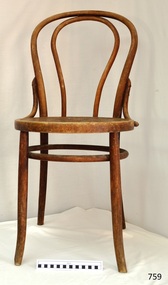
Furniture - Chair, Harnisch & Co, 1876-1918
... ...café chair...The design of this pair (RN 758 & 759) is based on Thonet’s No. 18 chair, which was originally produced in 1876 by Thonet, and is still one of the best-selling designs for café and restaurant owners. ...Flagstaff Hill Flagstaff Hill Maritime Museum and Village Warrnambool Maritime Museum Maritime Village Great Ocean Road Shipwreck Coast bentwood chair café chair restaurant chair meeting hall chair thonet design chair harnisch & co k.u.k. neusohler fabrik fur nobel approved manufacturer NEUSOHL (BESZTERCaZEBANYA) UNGARN Marks; pressed into rim under seat is "3" and "4", and "Crown [over] N", Paper label, cream with black print, on rim; Left side has Mark “N inside circle under crown”. ...The design of this pair (RN 758 & 759) is based on Thonet’s No. 18 chair, which was originally produced in 1876 by Thonet, and is still one of the best-selling designs for café and restaurant owners. It is elegant, sophisticated and durable. The label notes the design as “AUS MASSIV GEBOGENEM HOLZE vorm” which translates to “solid curved sandals shape”, a good description for the back of the chair. The chairs have marks, paper labels and symbols on them that show that the maker was Harnisch & Co., Neuschler (also called Banská Bystrica) Furniture Factory in Neuschol (Beszterczebanya), Hungary, privileged makers for the Imperial and Royal Austrian-Hungarian Empire 1867 – 1918. Bentwood chairs are made by a process of wetting wood in water, bending it into curved shapes, then allowing it to dry so that the shape becomes permanent. This process originated by Michael Thonet, who had been given the right to bend wood into desired curves by the Austrian Courts in 1842. In 1856 he was granted a 13 year patent to manufacture chairs and table legs of bent wood treated by steam or boiling water. In 1859 his company Gebruder Thonet produced his original design. Thonet’s early designs also featured hand carved or laminated wooden seats. His Model No. 14 produced in the 1850’s, was his most popular design. After Michael’s death in 1871 the family went on designing and producing chairs. The No. 18 chair was produced in 1876, one of a group of chars with back inserts consisting of curves and loops of bentwood. The popularity of the Bentwood chair, even now, is due to its versatility and timeless quality. Its style, whether varnished or painted, suits any room in the house. The lightweight chairs are also popular for café and restaurant seating, as well as for public gatherings. They can be easily moved around and grouped in a variety of ways to suit any occasion.Chair, bentwood, 'French Bistro Chair' with pattern carved in seat. Backrest has inverted U shape inside that extends to the seat. Supports on eitherside of backrest's base join to back of seat. Legs have a wooded bracing ring. Marks; pressed into rim under seat. Paper label, cream with black print, on rim. Right side of label has symbol of Heraldic Shield. Text on label. Made by Harnisch & Co.Marks; pressed into rim under seat is "3" and "4", and "Crown [over] N", Paper label, cream with black print, on rim; Left side has Mark “N inside circle under crown”. Right side has symbol of Heraldic Shield. Text on label “Trade – K.u.K.- Mark / NEUSOHLER FABRIK FUR MOBEL/ AUS MASSIV GEBOGENEM HOLZE, vorm. HARNISCH & Co / NEUSOHL (BESZTERCaZEBANYA) UNGARN ' Hand written under seat "T H" in black paint, "T H " in white chalk. flagstaff hill, flagstaff hill maritime museum and village, warrnambool, maritime museum, maritime village, great ocean road, shipwreck coast, bentwood chair, café chair, restaurant chair, meeting hall chair, thonet design chair, harnisch & co, k.u.k., neusohler fabrik fur nobel, approved manufacturer, neusohl (besztercazebanya) ungarn -
 Flagstaff Hill Maritime Museum and Village
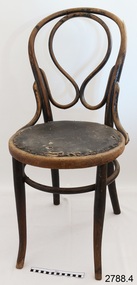
Chair, 1907-1914
... ...café chair...The design of this set of four lightweight chairs is based on Thonet’s bentwood designs, which are still some of the best-selling designs for café and restaurant owners. ...It was a place for Council meetings, community events and entertainment, theatrical and musical. flagstaff hill warrnambool shipwrecked-coast flagstaff-hill flagstaff-hill-maritime-museum maritime-museum shipwreck-coast flagstaff-hill-maritime-village bentwood chair café chair restaurant chair josef jaworek austrian chairs furniture Marked with handwritten "TH", in both black paint & white chalk. ...The design of this set of four lightweight chairs is based on Thonet’s bentwood designs, which are still some of the best-selling designs for café and restaurant owners. It is elegant, sophisticated and durable. Some of these chairs still have their original seat, under which the letters “TH” or “RSL” are hand written. Flagstaff Hill has several bentwood chairs with these letters on them, in either chalk, black paint, or both. It is believed that the chairs were used in the original Warrnambool Town Hall, and later the RSL. The Town Hall was completed in 1891, built on the corners of Timor and Liebig Streets. (In 1977 the Town Hall was declared unsafe and was later replaced by the Warrnambool Performing Arts Centre.) Some of the chairs have marks, paper labels and symbols on them that show that the maker was Josef Jaworek, who had a small furniture factory in east Sinensia, which was at that time in Austria, from 1907 - 1914. Bentwood chairs are made by a process of wetting wood in water, bending it into curved shapes, then allowing it to dry so that the shape becomes permanent. This process originated by Michael Thonet, who had been given the right to bend wood into desired curves by the Austrian Courts in 1842. In 1856 he was granted a 13 year patent to manufacture chairs and table legs of bent wood treated by steam or boiling water. In 1859 his company Gebruder Thonet produced his original design. Thonet’s early designs also featured hand carved or laminated wooden seats. His Model No. 14 was produced in the 1850’s and his most popular design. After Michael’s death in 1871 the family went on designing and producing chairs. These bentwood chairs are believed to be associated with the original Warrnambool Town Hall. The Warrnambool Town Hall played a significant role in the both the local government and the social events of local and district areas. It was a place for Council meetings, community events and entertainment, theatrical and musical.Bentwood chair (4 of 4), painted black, inner back is curled loop, seat has leather cover attached with studs, ventilation holes under seat, legs are splayed and have a bracing ring. Marks: under seat, handwritten and stamped into wood.Marked with handwritten "TH", in both black paint & white chalk. Under rim is label printed "65" Stamped into wood on rim under chair "95".flagstaff hill, warrnambool, shipwrecked-coast, flagstaff-hill, flagstaff-hill-maritime-museum, maritime-museum, shipwreck-coast, flagstaff-hill-maritime-village, bentwood chair, café chair, restaurant chair, josef jaworek, austrian chairs, furniture -
 Flagstaff Hill Maritime Museum and Village
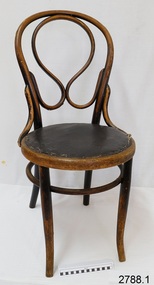
Chair, 1907-1914
... ...Café chair...The design of this set of four lightweight chairs is based on Thonet’s bentwood designs, which are still some of the best-selling designs for café and restaurant owners. ...Flagstaff Hill Warrnambool Shipwrecked coast Flagstaff Hill Maritime Museum Maritime Museum Shipwreck coast Flagstaff Hill Maritime Village Great Ocean Road Bentwood chair Café chair Restaurant chair Josef Jaworek Austrian chairs Under seat are various Marks; hand painted in black "TH", printed on small piece of paper "400", stamped in wood "400" Bentwood chair (1 of 4), painted black, inner back is curled loop. ...The design of this set of four lightweight chairs is based on Thonet’s bentwood designs, which are still some of the best-selling designs for café and restaurant owners. It is elegant, sophisticated and durable. Some of these chairs still have their original seat, under which the letters “TH” or “RSL” are hand written. Flagstaff Hill has several bentwood chairs with these letters on them, in either chalk, black paint, or both. It is believed that the chairs were used in the original Warrnambool Town Hall, and later the RSL. The Town Hall was completed in 1891, built on the corners of Timor and Liebig Streets. (In 1977 the Town Hall was declared unsafe and was later replaced by the Warrnambool Performing Arts Centre.) Some of the chairs have marks, paper labels and symbols on them that show that the maker was Josef Jaworek, who had a small furniture factory in east Sinensia, which was at that time in Austria, from 1907 - 1914. Bentwood chairs are made by a process of wetting wood in water, bending it into curved shapes, then allowing it to dry so that the shape becomes permanent. This process originated by Michael Thonet, who had been given the right to bend wood into desired curves by the Austrian Courts in 1842. In 1856 he was granted a 13 year patent to manufacture chairs and table legs of bent wood treated by steam or boiling water. In 1859 his company Gebruder Thonet produced his original design. Thonet’s early designs also featured hand carved or laminated wooden seats. His Model No. 14 was produced in the 1850’s and his most popular design. After Michael’s death in 1871 the family went on designing and producing chairs. These bentwood chairs are believed to be associated with the original Warrnambool Town Hall. The Warrnambool Town Hall played a significant role in the both the local government and the social events of local and district areas. It was a place for Council meetings, community events and entertainment, theatrical and musical.Bentwood chair (1 of 4), painted black, inner back is curled loop. Seat is padded leather, attached by studs. Splayed legs. Patterned ventilation holes under seat. Under seat are various Marks; hand painted, printed on small piece of paper, stamped in wood.Under seat are various Marks; hand painted in black "TH", printed on small piece of paper "400", stamped in wood "400" flagstaff hill, warrnambool, shipwrecked coast, flagstaff hill maritime museum, maritime museum, shipwreck coast, flagstaff hill maritime village, great ocean road, bentwood chair, café chair, restaurant chair, josef jaworek, austrian chairs -
 Flagstaff Hill Maritime Museum and Village
Furniture - Chair, 1900-1914
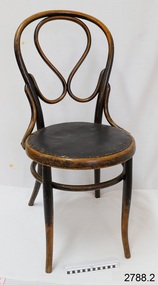
... ...Café chair...Flagstaff Hill Warrnambool Flagstaff Hill Maritime Museum Maritime Museum Shipwreck coast Flagstaff Hill Maritime Village Great Ocean Road Bentwood chair Café chair Restaurant chair Josef Jaworek Austrian chairs furniture Gebrüder Thonet Marks: "3" is pressed into some legs, chalk letters under seat "RS", makers label, cream with dark print; on either side are 2 coins, top left coin has bust of a man, top right has an emblem with 1885 under it. ...Bentwood furniture is a type of furniture made by bending wooden rods into the required shape after they have been heated with steam. Mundus bentwood chairs are among the most successful examples of early mass-produced furniture. The inventor of manufacturing chairs using this method was Gebrüder Thonet. The subject item was made at Josef Jaworek small factory that produced bentwood chairs and was the only Polish member associated with the Mundus furniture company of Vienna. This company was founded in 1907 and Mundus went on to merge with J & J Kohn in August of 1914. Mundus furniture was a significant manufacturing company, active in several places in the Austro Hungarian Empire, at the end of the 19th century and early 20th century. Factories seem to have existed in multiple locations including Poland. Their products carry diverse labels, such as "Budapest", "Borlova", "Czechoslovakia", etc, some of the furniture was co-signed with "Jacob and Josef Kohn". Mundus also merged with Gebrüder Thonet in 1922 the inventor of the bentwood chair.The subject item is believed to be associated with the original Warrnambool Town Hall and would have been part of the buildings furnishings. The town Hall played a significant role in both local government and social events of local and district areas. It was not only a place for Council meetings but community events and social events. The item is significant as it is an early example of mass-produced manufactured furniture from a company in Austria that pioneered this type of furniture around the turn of the late 19th and early 20th centuries. This item is now regarded as a collector's piece giving it additional significance and interest.Bentwood chair (2 of 4), painted black, inner back is curled loop. Seat has leather cover, attached with studs. Ventilation holes under seat in star pattern. Splayed legs with bracing ring. Marks: pressed into some legs, under seat, paper label on rim under seat says the chair is made in Austrla.Marks: "3" is pressed into some legs, chalk letters under seat "RS", makers label, cream with dark print; on either side are 2 coins, top left coin has bust of a man, top right has an emblem with 1885 under it. Text of label "MOBEL-FABRIKEN / von / JOSEF JAWOREK / Teschen, osterr, Schlesien"flagstaff hill, warrnambool, flagstaff hill maritime museum, maritime museum, shipwreck coast, flagstaff hill maritime village, great ocean road, bentwood chair, café chair, restaurant chair, josef jaworek, austrian chairs, furniture, gebrüder thonet -
 Flagstaff Hill Maritime Museum and Village
Furniture - Chair, 1900-1914
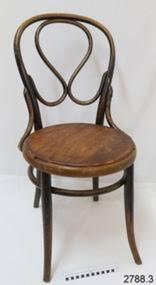
... ...Café chair...Flagstaff Hill Warrnambool Flagstaff Hill Maritime Museum Maritime Museum Shipwreck coast Flagstaff Hill Maritime Village Great Ocean Road Bentwood chair Café chair Restaurant chair Josef Jaworek Austrian chairs furniture Gebrüder Thonet Marks; Stamped into wood under seat is "49" and a small paper label with "49". ...Bentwood furniture is a type of furniture made by bending wooden rods into the required shape after they have been heated with steam. Mundus bentwood chairs are among the most successful examples of early mass-produced furniture. The inventor of manufacturing chairs using this method was Gebrüder Thonet. The subject item was made at Josef Jaworek small factory that produced bentwood chairs and was the only Polish member associated with the Mundus furniture company of Vienna. This company was founded in 1907 and Mundus went on to merge with J & J Kohn in August of 1914. Mundus furniture was a significant manufacturing company, active in several places in the Austro Hungarian Empire, at the end of the 19th century and early 20th century. Factories seem to have existed in multiple locations including Poland. Their products carry diverse labels, such as "Budapest", "Borlova", "Czechoslovakia", etc, some of the furniture was co-signed with "Jacob and Josef Kohn". Mundus also merged with Gebrüder Thonet in 1922 the inventor of the bentwood chair.The subject item is believed to be associated with the original Warrnambool Town Hall and would have been part of the buildings furnishings. The town Hall played a significant role in both local government and social events of local and district areas. It was not only a place for Council meetings but community events and social events. The item is significant as it is an early example of mass-produced manufactured furniture from a company in Austria that pioneered this type of furniture around the turn of the late 19th and early 20th centuries. This item is now regarded as a collector's piece giving it additional significance and interest.Bentwood chair (3 of 4), painted black, inner back is curled loop. Seat is plain wood (replacing original). Splayed legs with bracing ring. Marks; Stamped into wood under seat, a small paper label and a label, cream with dark print. Paper label on rim under seat says the chair is made in Austria.Marks; Stamped into wood under seat is "49" and a small paper label with "49". Makers label, cream with dark print; on either side are 2 coins, top left coin has bust of a man, top right has an emblem with 1885 under it. Text of label "MOBEL-FABRIKEN / von / JOSEF JAWOREK / Teschen, osterr, Schlesien" flagstaff hill, warrnambool, flagstaff hill maritime museum, maritime museum, shipwreck coast, flagstaff hill maritime village, great ocean road, bentwood chair, café chair, restaurant chair, josef jaworek, austrian chairs, furniture, gebrüder thonet -
 Flagstaff Hill Maritime Museum and Village
Chair, late 19th -- early 20th century
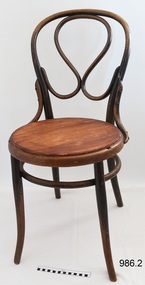
... ...cafe chair...Bentwood chair. flagstaff hill warrnambool shipwrecked-coast flagstaff-hill flagstaff-hill-maritime-museum maritime-museum shipwreck-coast flagstaff-hill-maritime-village bentwood chair cafe chair furniture Chair wooden Bentwood (pair of 2). ...Bentwood chair.Chair wooden Bentwood (pair of 2). Back is curled 'u' shape. Splayed legs and inner supporting circle. Seats are not the original seats.flagstaff hill, warrnambool, shipwrecked-coast, flagstaff-hill, flagstaff-hill-maritime-museum, maritime-museum, shipwreck-coast, flagstaff-hill-maritime-village, bentwood chair, cafe chair, furniture -
 Flagstaff Hill Maritime Museum and Village
Chair, late 19th - early 20th century
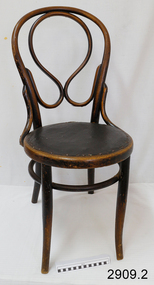
... ...cafe chair...flagstaff hill warrnambool shipwrecked-coast flagstaff-hill flagstaff-hill-maritime-museum maritime-museum shipwreck-coast flagstaff-hill-maritime-village furniture bentwood chair cafe chair "T H" painted in black, also "TH" in white chalk under seat. "398" on paper on base under seat. ...Chair Bentwood, (pair of 2), dark brown colour, round back with curled inverted 'U' design inside backrest, legs with bracing ring. Seat on chair is padded, with metal studs, holes in star pattern underneath. Inscriptions under seat."T H" painted in black, also "TH" in white chalk under seat. "398" on paper on base under seat.flagstaff hill, warrnambool, shipwrecked-coast, flagstaff-hill, flagstaff-hill-maritime-museum, maritime-museum, shipwreck-coast, flagstaff-hill-maritime-village, furniture, bentwood chair, cafe chair -
 Flagstaff Hill Maritime Museum and Village
Chair, late 19th - early 20th C
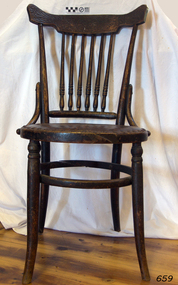
... ...dining chair...cafe...flagstaff hill warrnambool shipwrecked-coast flagstaff-hill flagstaff-hill-maritime-museum maritime-museum shipwreck-coast flagstaff-hill-maritime-village bentwood chair dining chair cafe or bistro chair Mark pressed into wood "15" Chair, bentwood, wooden, dark stain, curved backrest with carved leaf pattern, 6 turned spindles. ...Chair, bentwood, wooden, dark stain, curved backrest with carved leaf pattern, 6 turned spindles. Fabric padded seat attached with studs, upholstery webbing is visible underneath. Bentwood legs have bracing ring, front legs have truned rings on top. Mark; pressed into wood under seat.Mark pressed into wood "15"flagstaff hill, warrnambool, shipwrecked-coast, flagstaff-hill, flagstaff-hill-maritime-museum, maritime-museum, shipwreck-coast, flagstaff-hill-maritime-village, bentwood chair, dining chair, cafe or bistro chair -
 Flagstaff Hill Maritime Museum and Village
Furniture - Chair, early 29th century
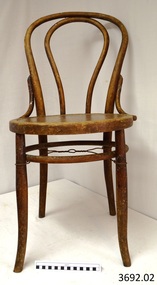
... The lightweight chairs are also popular for café and restaurant seating, as well as for public gatherings. ...The Bentwood chair has been called ‘the world’s most popular chair’. The original Bentwood chair, was designed by German-Austrian cabinet maker and Master Joiner, Michael Thonet (b.1796 - d.1871) and introduced to the market in 1859. Thonet started his business in his home town of Boppard as an independent cabinet maker in 1819. In the 1830’s he began trying to make furniture from glued (laminated) and bent wooden slats. Over the next few years his attempts to patent this process failed in Germany, Great Britain, France, and Russia. He then began using lightweight, strong wood and bending it into elegant, comfortable furniture. The Bentwood technology took Thonet years to perfect. In simple terms, the wooden rods or lengths were wet by soaking or steaming, bent into shape and then held in place until they hardened into the moulded curved shape or pattern. The wood usually chosen for the bentwood chairs was maple or beech. Thonet had revolutionised an older process by industrialising the process. The dowels of wood were cut and prepared as components of furniture, treated by the ‘bentwood’ process, then ready immediately for assembling with very little extra workmanship needed. Thonet held 2 patents for this process, the second one ended on 10th July 1869 and was non-renewable. At the Trade Fair at Koblenz of 1841 Prince Klemens Wenzel von Mettemich was very impressed with Thonet’s furniture, especially the chairs. In 1842 Thonet sold his Boppard business and emigrated to Vienna, and began working, along with his sons, on the interior decoration of the Palais Leichtenstein, for the Carl Leistler establishment. In 1849 he began his own business again, the Gebruder Thonet to include his sons (translated “Brothers Thonet”). He produced the “No. 1” Bentwood chair. He received a bronze medal for his Vienna bentwood chairs at the World Fair in London in 1851, and a silver medal in Paris in 1855. In 1856 he opened a new factory in Koritchan (Moravia), where there were extensive woods of beech trees available for his enterprise. In the next years, five more Eastern European production sites were established in Bystritz (1862), Nagy-Ugrócz (1866), Wsetin (1867), Hallenkau(1867) and Nowo-Radomsk(1880). Thonet’s 1859 No. 14 “chair of chairs” (or “Konsumstuhl Nr. 14” – coffee shop chair no. 14) was the most famous of all of Thonet’s Bentwood chairs. In 1867 he received a gold medal at the Paris World Fair. This new style of furniture making became very popular. Up until 1830 50 million of these chairs had been produced. By the 1870’s Thonet owned offices in almost 20 countries, with sales locations across Europe, in Chicago and New York. In 1889 he set Thonet set up a head office in Frankenberg, Hesse. Bentwood models designed in the mid to late 19th century featured hand-caned or laminated wood seats and were usually stamped with the country of origin. The Bentwood elements were the backrest, seat rim and legs. Typically the seat was covered with ‘bucket’ leather. After the Patent ran out in 1869, companies such as Jacob & Josef Kohn began the production of bentwood furniture.The popularity of the Bentwood chair that was introduced by Michael Thonet in the 1850s is due to its versatility and timeless quality. Its style, whether varnished or painted, suits any room in the house. The lightweight chairs are also popular for café and restaurant seating, as well as for public gatherings. They can be easily moved around and grouped in a variety of ways to suit any occasion.Chair, bentwood, pair of two. Backrest has full length inverted U inside frame. Support rail and wire reinforcing between legs. 3692.01 seat has floral pattern pressed into wood 3692.02 seat is plain (replacement seat). Made by Harnison & Co.3692.01 chair's marks; Label ""HARNISON & CO./ NEUSOL / BUDAPEST" and "WIENER NOBEL" and "(symbol) N inside circle, under Crown" flagstaff hill, warrnambool, shipwrecked coast, flagstaff hill maritime museum, maritime museum, shipwreck coast, flagstaff hill maritime village, great ocean road, domestic furniture, dining furniture, bentwood chair, harnison & co., neusol, budapest, wiener nobel -
 Tatura Irrigation & Wartime Camps Museum
Furniture - Chair, Blue Bird Cafe
... Later used in the Boomerang Café next door which was owned by Mrs Myers. chairs bluebird cafe boomerang cafe mrs myers tatura cafes Metal framed chair with wooden seat. ...Originally from the "Bluebird Café" in Tatura. Later used in the Boomerang Café next door which was owned by Mrs Myers.Metal framed chair with wooden seat. Seat was originally blue but has been painted black.chairs, bluebird cafe, boomerang cafe, mrs myers, tatura cafes -
 Wodonga & District Historical Society Inc
Slide - Mann Collection Album - High Street West from Lawrence Street, C. 1940s
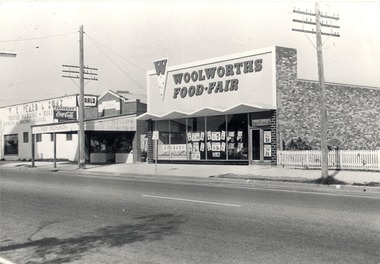
... Roy Benson was listed as a Grocer in the telephone directory, but he apparently had a few tables and chairs and was also a milk bar/café. He was heavily involved in the community including committee roles in Wodonga Dramatic Club, Wodonga & District Progress Association, Wodonga Carpet Bowls Association, Wodonga Chamber of Commerce and Wodonga Shire Council. ...Roy Benson was listed as a Grocer in the telephone directory, but he apparently had a few tables and chairs and was also a milk bar/café. He was heavily involved in the community including committee roles in Wodonga Dramatic Club, Wodonga & District Progress Association, Wodonga Carpet Bowls Association, Wodonga Chamber of Commerce and Wodonga Shire Council. ...Elaine Mann was married to David Mann, a successful Wodonga businessman and community leader who passed away in Wodonga in June 2012. David was a member of the Mann family who began their business in Wodonga in 1920. Elaine was a teacher in Wodonga for many years and an active member of the community.This photo collection is of significance as it documents how the businesses and buildings in Wodonga have evolved and contributed to community throughout the late 20th century.This image is reproduced from a set of coloured slides. Peard & Sons Plumbing on the corner of Lawrence and High, Roy Benson's store and Woolworths Food-Fair. Peards were located here in the 1940s. By November 1966 to C. 1973 this building was occupied by Tower Tyre Service, followed by Repco Auto Parts until 1985. It is now Lee Corner Chinese restaurant. Roy Benson was listed as a Grocer in the telephone directory, but he apparently had a few tables and chairs and was also a milk bar/café. He was heavily involved in the community including committee roles in Wodonga Dramatic Club, Wodonga & District Progress Association, Wodonga Carpet Bowls Association, Wodonga Chamber of Commerce and Wodonga Shire Council. He was President of the RSL for 25 years from the early 1920s.wodonga businesses, high street wodonga, woolworths food fair, peard plumbing, roy benson -
 Port Melbourne Historical & Preservation Society
Postcard - Manhattan Portage at Salford Lad's Club café, Port Melbourne, Steve Gourlay, 2000s
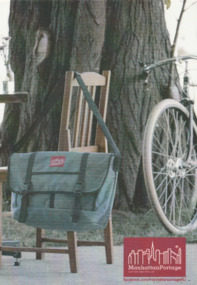
... chair and the front wheel of a bicycle. Manhattan Portage is a travel accessory company & Salford Lads Club a cafe now closed. Postcard Manhattan Portage at Salford Lad's Club café, Port Melbourne Steve Gourlay ...One of four postcards for Manhattan Portage. Photographed at Salford Lad's Club Cafe, Port Melbourne. Card shows a blue computer bag hanging on a chair and the front wheel of a bicycle. Manhattan Portage is a travel accessory company & Salford Lads Club a cafe now closed.business and traders, manhattan portage, steve gourlay, salford lad's club
