
Showing 3 items matching "camel drivers"
-
 The Beechworth Burke Museum
Photograph, unknown
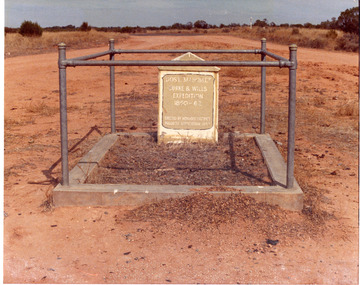
... ...camel drivers...He was one of three camel drivers on who were employed for the expedition. ...He was one of three camel drivers on who were employed for the expedition. ...The gravestone commemorates Dost Mahomet, who was a camel driver for the Burke and Wills expedition 1860-2. He was one of three camel drivers on who were employed for the expedition. He was buried outside the town of Menindee upon his death in 1881. The fence was erected around his gravesite and the headstone placed in 1952.This photograph is significant as it depicts the grave of one of the members of the ill-fated Burke and Wills expedition of 1860-2 where they perished. It also commemorates a member of the expedition who came from an Arab background.Colour rectangular photograph printed on paper1. Reverse 4744-1 2. Reverse 4744-2grave site, burke and wills expedition, burke and wills, 1860s, camel drivers, headstone, menindee -
 8th/13th Victorian Mounted Rifles Regimental Collection
Photograph
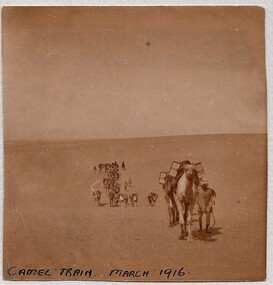
... Sepia photograph of camels with drivers in desert....As Japanese threat to the mainland declined the regiment was disbanded. " Camel train March 1916 " Sepia photograph of camels with drivers in desert. Photograph ...Part of a collection of photographs taken by unknown photographer serving with 8th Light Horse Regiment in Middle East 1916-1918.The 8th Light Horse Regiment AIF was raised at Broadmeadows Victoria in September 1914 under the command of Lieutenant Colonel Alexander White and formed part of the 3rd Light Horse Brigade. The regiment served at Gallipoli where in a courageous but ill-fated charge at the Nek on 7 August 1915 it suffered horrendous casualties including Lieutenant Colonel White. Rebuilt in Egypt under the command of Lieutenant Colonel Leslie Maygar VC the regiment went on the serve throughout the Middle East Campaign. Colonel Maygar died of wounds at Beersheba when the regiment was attacked by enemy aircraft while waiting to follow up the successful charge of the 4th LH Brigade on 30 October 1917. The 8th Light Horse AIF was disbanded in 1919, but soon after re-raised as the 8th (Indi) Light Horse in the Citizen Military Forces, superseding 16th (Indi) Light Horse. It had its headquarters at Benalla with sub-units throughout the Upper Murray and Northeast Victoria. In December 1941, the regiment converted from horse to mechanised, initially as 8th Reconnaissance Battalion then in July 1942 it became 8th Cavalry Regiment and served in Northern Territory. As Japanese threat to the mainland declined the regiment was disbanded.Sepia photograph of camels with drivers in desert." Camel train March 1916 " -
 Wodonga & District Historical Society Inc
Booklet - The Legend Goes to Darwin - The Ghan Inaugural Journey Adelaide to Darwin, Great Southern Railway Travel Pty Ltd, 2004
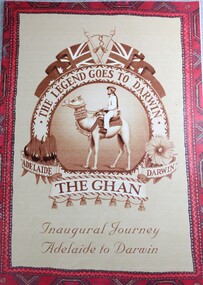
... The Ghan takes its name from the 19th century Afghan camel drivers who arrived in Australia and helped to explore the country's remote interior. ...Brochure published to commemorate the inaugural journey of the Ghan from Adelaide to Darwin. The Ghan takes its name from the 19th century Afghan camel drivers who arrived in Australia and helped to explore the country's remote interior. The original line linked Adelaide to Alice Springs was completed in 1929. After 126 years of planning, and at a cost of $1.3 billion, the first passenger train reached Darwin on 3 February 2004.non-fictionBrochure published to commemorate the inaugural journey of the Ghan from Adelaide to Darwin. The Ghan takes its name from the 19th century Afghan camel drivers who arrived in Australia and helped to explore the country's remote interior. The original line linked Adelaide to Alice Springs was completed in 1929. After 126 years of planning, and at a cost of $1.3 billion, the first passenger train reached Darwin on 3 February 2004.the ghan, railways australia, inland railways australia, railway adelaide to darwin
