Showing 5 items matching "camp 4 thailand"
-
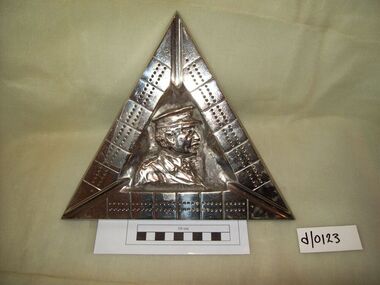
Waverley RSL Sub BranchCrib board
... ...Camp 4 Thailand...Brown during his internment as a P.O.W. at Camp 4 Thailand Date To the best of our knowledge these boards were commercially made between WWI and WWII. ...Brown during his internment as a P.O.W. at Camp 4 Thailand Date To the best of our knowledge these boards were commercially made between WWI and WWII. ...This cribbage Board was carried by W. H. Brown during his internment as a P.O.W. at Camp 4 Thailand Date To the best of our knowledge these boards were commercially made between WWI and WWII. Our research has turned up no definite date but it is possible they were made shortly after his death in 1931 Silver triangular shape,with embossed head and shoulders General Sir John MonashEngraved with General Sir John Monashjohn monash, general sir john monash, crib board, w. h. brown, camp 4 thailand, burma railway, p. o. w. -
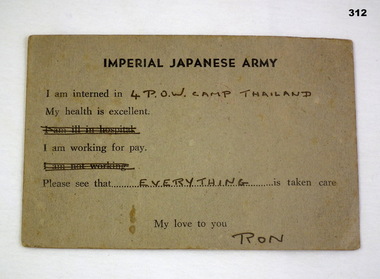
Bendigo Military MuseumPostcard - POSTCARD POW, C.1941 - 45
... Sent by Ron MORRELL4985826 who was a POW in Changi and on the Burma Railway Sent from Camp 4 in Thailand...Bendigo Military Museum 37 - 39 Pall Mall Bendigo goldfields Sent by Ron MORRELL4985826 who was a POW in Changi and on the Burma Railway Sent from Camp 4 in Thailand Postcards Japanese POW’s Gey coloured Post card Japanese Army Japanese Army issue. ...Sent by Ron MORRELL4985826 who was a POW in Changi and on the Burma Railway Sent from Camp 4 in ThailandGey coloured Post card Japanese Army Japanese Army issue.postcards japanese, pow’s, -
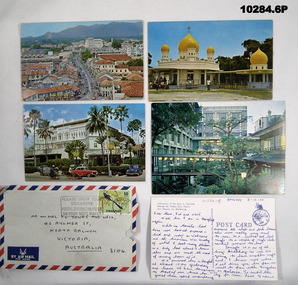
Bendigo Military MuseumPostcard - PHOTOGRAPHIC POSTCARDS, C. 1967 - 68
... Postcards penang thailand national service ga jones .1) On rear, "28.12.67 Penang - Dear Mum, Dad & Neil" .2) On rear, "31.12.67 - Dear Mum, Dad & Neil" .3) On rear, "Note > 1.2.68 - Dear Mum, Dad & Neil" .4) On rear, "Kyoto Japan 22.11.68 - Dear Mum, Dad & Neil" .5) On rear, "Bangkok 8.12.68 - Dear Mum, Dad & Neil" .6) On rear, "Sender 3790932 Pte Jones G.A. 1 PLN A Coy 8RAR Terendak Camp Malacca Malaysia" .1) Postcard, colour showing a busy spot of Penang, rear has blue text relating to Penang. ...Collection re G.A. Jones 3790932, refer Cat No 10053.2P for his service details. The following where all written by Graeme Jones. .1) Writes about a trip around the Island of Penang and places visited. .2) Writes about it being New Years Eve and staying in a Hotel for the night, hiring a motor scooter, buying camera gear. .3) Writes about 12 months to go, staying in Commonwealth Servicemen's Club, buying electronic gear, Akai items. .4) Writes about visiting Japan, cost of meals there, changing money, on Bullet Train. .5) Writes about Bangkok again for two days, touring around, night out with one of the blokes re his birthday..1) Postcard, colour showing a busy spot of Penang, rear has blue text relating to Penang. Hand written letter in black pen. .2) Postcard, colour showing recently built Penang Hill Mosque, rear has blue text relating to the Mosque. Hand written letter in black pen. .3) Postcard, colour showing Raffles Hotel, hand written letter on rear in black pen. .4) Postcard, colour showing Hotel Tozankaku in Kyoto Japan, hand written letter on rear in blue pen. .5) Postcard, colour showing cultivation of Rice in Thailand, hand written letter on rear in blue pen. .6) Envelope, red, white and blue, one stamp green colour, Singapore stamped, addressed on front in black pen and sender on rear..1) On rear, "28.12.67 Penang - Dear Mum, Dad & Neil" .2) On rear, "31.12.67 - Dear Mum, Dad & Neil" .3) On rear, "Note > 1.2.68 - Dear Mum, Dad & Neil" .4) On rear, "Kyoto Japan 22.11.68 - Dear Mum, Dad & Neil" .5) On rear, "Bangkok 8.12.68 - Dear Mum, Dad & Neil" .6) On rear, "Sender 3790932 Pte Jones G.A. 1 PLN A Coy 8RAR Terendak Camp Malacca Malaysia"postcards, penang, thailand, national service, ga jones -

Returned Nurses RSL Sub-branchBook, Ernest Edward Dunlop, The war diaries of Weary Dunlop : Java and the Burma-Thailand railway 1942-1945, 1986
... Returned Nurses RSL Sub-branch ANZAC House Level 3 4 Collins Street Melbourne 'Weary' worked a lot with, and valued nurses Australian Nurses World War Two WWII WW2 Prisoner of War Japan 'More than forty years ago Sir Edward Dunlop, then a lieutenant-colonel, began these diaries at the start of his imprisonment by the Japanese in Java and on the Burma-Thailand Railway. His meticulous observations of prison camp ...'More than forty years ago Sir Edward Dunlop, then a lieutenant-colonel, began these diaries at the start of his imprisonment by the Japanese in Java and on the Burma-Thailand Railway. His meticulous observations of prison camp life were concealed all through the war; by the time peace cam in 1945, he carried with him a unique record of the lives of prisoners-of-war. As a commanding officer and a surgeon, 'Weary' became a hero and a legend to thousands of Australian and allied prisoners, whose lives were saved with meagre medical supplies and the instruments the medical officers carried on their backs through Java and Thai jungles. He says himself: 'Of some 22,000 who entered captivity, more than 7,000 died or were killed. Of their sufferings... only those who were present can fully comprehend the seeming hopelessness of it all as their bodies wasted and their friends died.' Sir Edward describes how the cmps were organised; he records deaths, cholera epidemics, operations, and torture; his own - rare - despair; the movement of prisoners up and down the line; and his constant struggle to protect the sick from being drafted into Japanese work parties. From February 1942 he was in the following Japanese prison camps; Bandoeng, Tjimahi, Makasura, Changi, Konyu, Hintok, Tarsau, Chungkai and Nakom Patom.' [From inside front dust jacket]Book with a red dustjacket, had a photograph of a seated older man on cover and white text on cover and spinenon-fiction'More than forty years ago Sir Edward Dunlop, then a lieutenant-colonel, began these diaries at the start of his imprisonment by the Japanese in Java and on the Burma-Thailand Railway. His meticulous observations of prison camp life were concealed all through the war; by the time peace cam in 1945, he carried with him a unique record of the lives of prisoners-of-war. As a commanding officer and a surgeon, 'Weary' became a hero and a legend to thousands of Australian and allied prisoners, whose lives were saved with meagre medical supplies and the instruments the medical officers carried on their backs through Java and Thai jungles. He says himself: 'Of some 22,000 who entered captivity, more than 7,000 died or were killed. Of their sufferings... only those who were present can fully comprehend the seeming hopelessness of it all as their bodies wasted and their friends died.' Sir Edward describes how the cmps were organised; he records deaths, cholera epidemics, operations, and torture; his own - rare - despair; the movement of prisoners up and down the line; and his constant struggle to protect the sick from being drafted into Japanese work parties. From February 1942 he was in the following Japanese prison camps; Bandoeng, Tjimahi, Makasura, Changi, Konyu, Hintok, Tarsau, Chungkai and Nakom Patom.' [From inside front dust jacket]australian nurses, world war two, wwii, ww2, prisoner of war, japan -
Returned Nurses RSL Sub-branchBook, Ernest Edward Dunlop, The war diaries of Weary Dunlop : Java and the Burma-Thailand railway 1942-1945, 1986
... Returned Nurses RSL Sub-branch ANZAC House Level 3 4 Collins Street Melbourne 'Weary' worked a lot with, and valued nurses Australian Nurses World War Two WWII WW2 Prisoner of War Japan 'More than forty years ago Sir Edward Dunlop, then a lieutenant-colonel, began these diaries at the start of his imprisonment by the Japanese in Java and on the Burma-Thailand Railway. His meticulous observations of prison camp ...'More than forty years ago Sir Edward Dunlop, then a lieutenant-colonel, began these diaries at the start of his imprisonment by the Japanese in Java and on the Burma-Thailand Railway. His meticulous observations of prison camp life were concealed all through the war; by the time peace cam in 1945, he carried with him a unique record of the lives of prisoners-of-war. As a commanding officer and a surgeon, 'Weary' became a hero and a legend to thousands of Australian and allied prisoners, whose lives were saved with meagre medical supplies and the instruments the medical officers carried on their backs through Java and Thai jungles. He says himself: 'Of some 22,000 who entered captivity, more than 7,000 died or were killed. Of their sufferings... only those who were present can fully comprehend the seeming hopelessness of it all as their bodies wasted and their friends died.' Sir Edward describes how the cmps were organised; he records deaths, cholera epidemics, operations, and torture; his own - rare - despair; the movement of prisoners up and down the line; and his constant struggle to protect the sick from being drafted into Japanese work parties. From February 1942 he was in the following Japanese prison camps; Bandoeng, Tjimahi, Makasura, Changi, Konyu, Hintok, Tarsau, Chungkai and Nakom Patom.' [From inside front dust jacket]Book with a red dustjacket, had a photograph of a seated older man on cover and white text on cover and spinenon-fiction'More than forty years ago Sir Edward Dunlop, then a lieutenant-colonel, began these diaries at the start of his imprisonment by the Japanese in Java and on the Burma-Thailand Railway. His meticulous observations of prison camp life were concealed all through the war; by the time peace cam in 1945, he carried with him a unique record of the lives of prisoners-of-war. As a commanding officer and a surgeon, 'Weary' became a hero and a legend to thousands of Australian and allied prisoners, whose lives were saved with meagre medical supplies and the instruments the medical officers carried on their backs through Java and Thai jungles. He says himself: 'Of some 22,000 who entered captivity, more than 7,000 died or were killed. Of their sufferings... only those who were present can fully comprehend the seeming hopelessness of it all as their bodies wasted and their friends died.' Sir Edward describes how the cmps were organised; he records deaths, cholera epidemics, operations, and torture; his own - rare - despair; the movement of prisoners up and down the line; and his constant struggle to protect the sick from being drafted into Japanese work parties. From February 1942 he was in the following Japanese prison camps; Bandoeng, Tjimahi, Makasura, Changi, Konyu, Hintok, Tarsau, Chungkai and Nakom Patom.' [From inside front dust jacket]australian nurses, world war two, wwii, ww2, prisoner of war, japan