
Showing 20 items matching "camp goals"
-
 Tatura Irrigation & Wartime Camps Museum
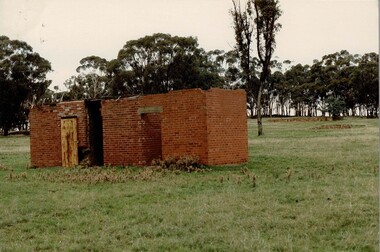
Photograph, Camp 1 prison, 1989
... ...camp goals...Foam backed copy in file. camp 1 tatura victoria camp goals camp building remains Coloured photograph. ...The building is the remains of the prison at Camp 1. Foam backed copy in file.Coloured photograph. Red brick building in foreground. To left of building there is a wooden door. Two other doorways, no doors, flat roof.camp 1, tatura victoria, camp goals, camp building remains -
 Tatura Irrigation & Wartime Camps Museum
Photograph - copy, 1989 copy
... Copy of black and white photograph. Camp goal under construction. Two workers wearing peaked caps....Copy of original black and white photograph early stage of Camp 13. camp 13 murchison victoria internment camps internment camp buildings Copy of black and white photograph. Camp goal under construction. Two workers wearing peaked caps. ...Copy of original black and white photograph early stage of Camp 13.Copy of black and white photograph. Camp goal under construction. Two workers wearing peaked caps.camp 13, murchison victoria, internment camps, internment camp buildings -
 Tatura Irrigation & Wartime Camps Museum
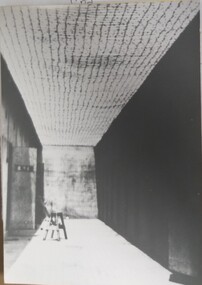
Photograph, Camp 13 Goal Construction, 1941
... Camp 13 Goal Construction......Internment camp goal construction...Construction work of the camp goal in camp 13...Black and white photograph of the somber goal under construction at Camp 13. Carpenters "horse" left centre....Construction work of the camp goal in camp 13 camp 13 construction work in victorian camps Internment camp goal construction Black and white photograph of the somber goal under construction at Camp 13. ...Construction work of the camp goal in camp 13Black and white photograph of the somber goal under construction at Camp 13. Carpenters "horse" left centre.camp 13, construction work in victorian camps, internment camp goal construction -
 Tatura Irrigation & Wartime Camps Museum
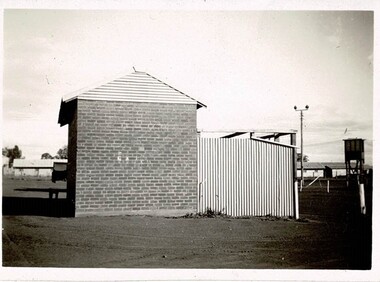
Photograph - Photograph - copy, The Red House Camp 3, Copy 1989
... The building is known as "the little red house" and was used to hold offenders at the camp. It was the camp goal. Larger print also in file....The building is known as "the little red house" and was used to hold offenders at the camp. It was the camp goal. Larger print also in file. rushworth victoria internment camp 3 internment camps australia Black and white. ...This was taken at Camp 3, Rushworth. The building is known as "the little red house" and was used to hold offenders at the camp. It was the camp goal. Larger print also in file.Black and white. Slightly to the left is a brick building with a galvanized iron roof. Attached to the right of the brick structure is a galvanized iron structure, approximately the same width as the brick wall. Appears to be a photograph of the back of the building.rushworth victoria, internment camp 3, internment camps australia -
 Tatura Irrigation & Wartime Camps Museum
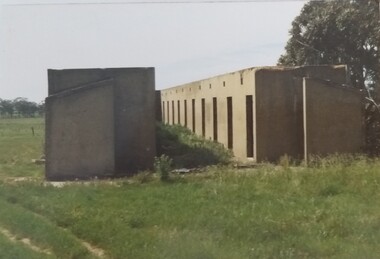
Photograph, Arthur Knee, Camp 13 Goal, 1989
... Camp 13 Goal...goal...prison cells...pow...camp...Camp 13, Murchison. Property owned by Jim Finnegan. German, Italian, Japanese prisoners of war held between 1941 - 1946. Shows the remains of what is left of the goal used by Camp 13 Murchison during WW2....Camp 13, Camp Road, Murchison. Camp 13 goal. Solid brick building showing individual cells, roofless, tree right mid-distrance. ...Camp 13 Goal Photograph Photograph Arthur Knee ...Camp 13, Murchison. Property owned by Jim Finnegan. German, Italian, Japanese prisoners of war held between 1941 - 1946. Shows the remains of what is left of the goal used by Camp 13 Murchison during WW2.Camp 13, Camp Road, Murchison. Camp 13 goal. Solid brick building showing individual cells, roofless, tree right mid-distrance. murchison victoria, goal, prison cells, pow, camp internees, jim finnegan -
Tatura Irrigation & Wartime Camps Museum
Photograph, Arthur Knee, 1989
... Camp 13 goal. Towards s-sw of whole area. Ruins....Camp 13, Camp Road, Murchison, Victoria. Brick, timber, cement sheeting, wire fencing, ruins of POW goal....Camp 13 goal. Towards s-sw of whole area. Ruins. ...Camp 13 goal. Towards s-sw of whole area. Ruins.Camp 13, Camp Road, Murchison, Victoria. Brick, timber, cement sheeting, wire fencing, ruins of POW goal.camp 13, murchison victoria, pow, ruins, internment camp -
 Tatura Irrigation & Wartime Camps Museum
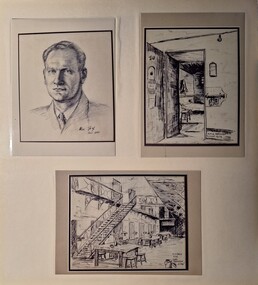
Photograph, Bathurst Goal 1939, 1990 copy
... camp 1...Bathurst Goal...Hans Beck, Sydney based wool buyer, interned Bathurst Goal and Camp 1....Hans Beck, Sydney based wool buyer, interned Bathurst Goal and Camp 1. wool buyers camp 1 Bathurst Goal Hans Beck Max Graf Square cream board with 3 Black and white photograph of 3 sketches, laminated onto board: a head and shoulders sketch of a man in a suit and tie, drawn by Max Graf (internee), inscription Max Graf 1940; looking into a cell, inscription H M G Bathurst 30 Sept 1939; Sketch of a section of Bathurst goal, inscription Mr H Beck Esq Goal Bathurst A Hall. ...Sketch of Hans Beck by Max Graf; unknown who did other two sketches. Hans Beck, Sydney based wool buyer, interned Bathurst Goal and Camp 1.Square cream board with 3 Black and white photograph of 3 sketches, laminated onto board: a head and shoulders sketch of a man in a suit and tie, drawn by Max Graf (internee), inscription Max Graf 1940; looking into a cell, inscription H M G Bathurst 30 Sept 1939; Sketch of a section of Bathurst goal, inscription Mr H Beck Esq Goal Bathurst A Hall.wool buyers, camp 1, bathurst goal, hans beck, max graf -
 Bendigo Historical Society Inc.
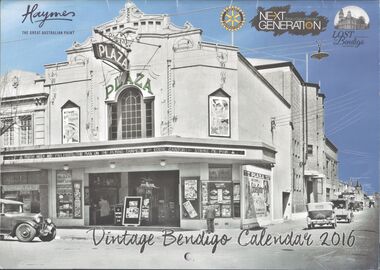
Ephemera - Vintage Calendar of Bendigo. 2016
... January: Pall Mall, 1870's; February, Bendigo Mall, opened in 1981; March, aerial view of Bendigo Goal and Camp Hill, 1922; April, Easter Monday, Howard Place, 1903; May, 'Aldo's Auto Repairs', St. ...January: Pall Mall, 1870's; February, Bendigo Mall, opened in 1981; March, aerial view of Bendigo Goal and Camp Hill, 1922; April, Easter Monday, Howard Place, 1903; May, 'Aldo's Auto Repairs', St. ...2016 Vintage Bendigo calendar. 12-month calendar. One historic image of Bendigo per month. January: Pall Mall, 1870's; February, Bendigo Mall, opened in 1981; March, aerial view of Bendigo Goal and Camp Hill, 1922; April, Easter Monday, Howard Place, 1903; May, 'Aldo's Auto Repairs', St. Andrews Avenue; June, Charing Cross, 1920's; July, Bendigo Municipal pool; August, Ordinance Factory, Shop Number 9, 1940's; September, Gillies corner, 1960's; October, Jim Elvey's View Point Hotel at Charing Cross; 1960's; November, Mitchell Street, 1950's; December, Pall Mall, 1940's. This calendar has not been used, and has no personal notations made on it. At the back are a list of Public Holidays for each state and territory, and a list of sponsors/advertisers, including Haymes, Rotary Club and Lost Bendigo.bendigo, business, calendar -
Tatura Irrigation & Wartime Camps Museum
Document - music score, Under The Southern Sun
... Goal...Tatura Internment camp...He was interned in 1939 in Bathurst Goal and then transferred to Tatura. Whils in Tatura camp he wrote "Siege" later to be known as "Under the Southern Cross"....He was interned in 1939 in Bathurst Goal and then transferred to Tatura. Whils in Tatura camp he wrote "Siege" later to be known as "Under the Southern Cross". ...Music score written by William Henrich Wallbaum, who emigrated to Australia, settled in Manly and worked for an importing firm in Sydney NSW. He was interned in 1939 in Bathurst Goal and then transferred to Tatura. Whils in Tatura camp he wrote "Siege" later to be known as "Under the Southern Cross".3 plastic sleeves containing music scores - conductors score, complete band instrumental parts and original piano composition.william heinrich, bathurts goal, tatura internment camp, siege, under the southern cross -
Tatura Irrigation & Wartime Camps Museum
document, Prisoner of war camps
... Collected from goal museum and other sources in Fremantle and Perth P.O.W and internment camps in Western Australia Black clear fronted plastic folder with photocopied material Prisoner of war camps document ...Collected from goal museum and other sources in Fremantle and PerthBlack clear fronted plastic folder with photocopied materialP.O.W and internment camps in Western Australia -
Tatura Irrigation & Wartime Camps Museum
Photograph - copy, 1989 copy
... Copy of original black and white photograph early stage of Camp 13. camp 13 murchison victoria internment camps internment camp buildings Copy of black and white photograph. Interior of goal under construction. ...Copy of original black and white photograph early stage of Camp 13.Copy of black and white photograph. Interior of goal under construction. Workhorse in mid picture.camp 13, murchison victoria, internment camps, internment camp buildings -
 Tatura Irrigation & Wartime Camps Museum
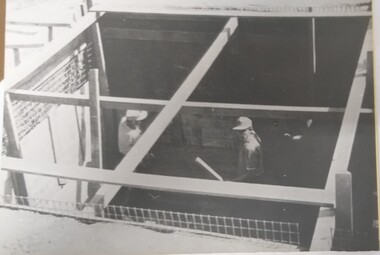
Photograph, Camp 13 Construction Work
... Camp 13 building construction, probably goal....Camp 13 building construction, probably goal. camp 13 Building construction in camps Black and white photograph of a building in course of construction probably be the goal. ...Camp 13 building construction, probably goal.Black and white photograph of a building in course of construction probably be the goal.camp 13, building construction in camps -
Tatura Irrigation & Wartime Camps Museum
Book, Hay and Its People Since 1900, 1980
... Goal...Hay POW Camp...Many aspects of Hay, including schools, council, shops, historical society, transport, families, WW2, services clubs. hay Hay Goal Hay POW Camp Hay residents Written to record life in Hay. ...Many aspects of Hay, including schools, council, shops, historical society, transport, families, WW2, services clubs.Written to record life in Hay. NSW. Red cover showing swing bridge 1906.hay, hay goal, hay pow camp, hay residents -
Tatura Irrigation & Wartime Camps Museum
Small booklet, Photographs - 38 colour photos taken by Niela Laws
... Goal museum. There is also a "Dunera" Internees plaque, erected for the 50th Anniversary by the Hay Shire Council.- to mark the arrival from England of 1.984 refugees on the "Dunera" Many joined the AMF on their release from internment and made Australia their homeland.There is also a plaque to commemorate the existence of a POW camp at Hay. ...Goal museum. There is also a "Dunera" Internees plaque, erected for the 50th Anniversary by the Hay Shire Council.- to mark the arrival from England of 1.984 refugees on the "Dunera" Many joined the AMF on their release from internment and made Australia their homeland.There is also a plaque to commemorate the existence of a POW camp at Hay. ...Scenes of visit to Hay NSW by Tatura Historical society members. Local photos include Heritage centre, Hay Railway station, Royal Mail hotel,and Hay Goal museum. There is also a "Dunera" Internees plaque, erected for the 50th Anniversary by the Hay Shire Council.- to mark the arrival from England of 1.984 refugees on the "Dunera" Many joined the AMF on their release from internment and made Australia their homeland.There is also a plaque to commemorate the existence of a POW camp at Hay. The plaque is on a fountain at the Hay racecourseTatura and District Historical society trip to Peppin Heritage centre May 1st 1993. Included in the visit was the Hay Intenment camp and local scenes.dunera, -
 Ballarat Tramway Museum
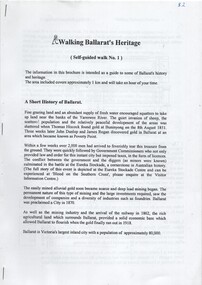
Ephemera - Tour Notes, Jennifer Barnes, 'Walking Ballarat's Heritage', Aug. 1998
... Page 1 incorporates a short history of Ballarat, followed by tour commencing at Ballarat Visitor Information Centre, 33 Sturt St., west to Lydiard St., south to former goal (jail) and return to Railway station. Returning to Sturt St. via Mair and Camp Streets finishing up in Bridge St. ...Page 1 incorporates a short history of Ballarat, followed by tour commencing at Ballarat Visitor Information Centre, 33 Sturt St., west to Lydiard St., south to former goal (jail) and return to Railway station. Returning to Sturt St. via Mair and Camp Streets finishing up in Bridge St. ...18 page self-guided walk No. 1 of Ballarat with three staples along left hand edge. Page 1 incorporates a short history of Ballarat, followed by tour commencing at Ballarat Visitor Information Centre, 33 Sturt St., west to Lydiard St., south to former goal (jail) and return to Railway station. Returning to Sturt St. via Mair and Camp Streets finishing up in Bridge St. Mall. Interest: Page 3, under "2. Sturt St.", on paragraph on electric trams and second re 'Ballarat Vintage Tramway'. Mrs. Jennifer Barnes is the wife of City of Ballarat Councillor, Mr. John Barnes$2 (in blue biro top left hand corner page 1) - cost price of purchase from Ballarat Visitor Information Centre.local history, ballarat railway station, heritage buildings, tourism -
 City of Ballarat Libraries
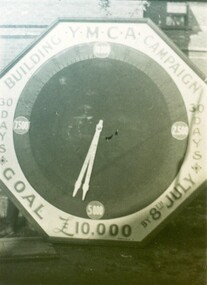
Photograph - Card Box Photographs, YMCA building appeal clock circa 1938
... The goal of the appeal was to reach £10 000 to construct the YMCA building in Camp Street....The goal of the appeal was to reach £10 000 to construct the YMCA building in Camp Street. ...The goal of the appeal was to reach £10 000 to construct the YMCA building in Camp Street.ymca, fundraising, camp street, ballarat, social -
 Melbourne Legacy
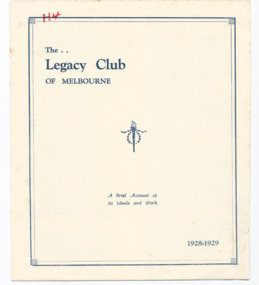
Pamphlet, The Legacy Club of Melbourne 1923-28 : A brief account of its ideals and works (H4), 1928
... camp, cycle club, and rambles as arranged. There is help for vocational options for the children. See also 01480 for a copy from 1930. This is one of the first documents that promotes Legacy and summarises its objective and services. legacy promotion history goals objectives Handwritten H4 in red pen. ...A brochure explaining 'A brief account of its ideals and work' in 1928. The notation H4 in red pen shows that it was part of the archive project that was trying to capture the history of Legacy. The brochure lays out the history of the young organisation, it has 146 members in 1927, and clubs had started in state capital and Geelong, Ballarat, and Bendigo. Members were all men who had served in the forces of the British Empire during the war. It shows the work of Legacy as : Junior Legacy Club - for sons (aged 9 to 21) of deceased soldiers. Members of the Legacy Club were in constant touch and acted as Big Brothers. Boys' Literary and Debating Branch - approximately 80 boys attended weekly meetings of a debating society at Anzac House. Boys' Physical Training Branch - for the boys physical welfare classes and conducted weekly by a permanent instructor (paid by Legacy). There were 161 boys attending. Also cricket, football, Lacrosse and swimming clubs, all supervised and coached. A holiday camp is held each Christmas at the seaside- 67 attended the previous year at Balnarring (led by Stan Savige). Girls' Physical Training Branch - started in 1927 and now over 120 girls were being instructed by Mrs AM Gilles (the wife of a Legatee). Lending Library of over 400 books. Vocational placements for junior legatees. Meetings were held in the Victoria Coffee Palace at 1pm on Tuesdays and included a half hour lecture. The policy and objectives were laid out including to preserve the memory of fallen comrades and to assist their dependents, particularly the children. Also to maintain a spirit of comradeship, and to safeguard the good standing and interests of ex-service men in the community and to assist the the to secure suitable employment. The brochure shows activities as: Employment Committee, Comradeship Committee, a pledge to assist the National War Memorial being established on the Domain site, and for the children the 'Deceased Soldiers' Children's Welfare Committee. A schedule of Boys' and Girls' Classes is included to show the options for the children. Also picnics, Christmas camp, cycle club, and rambles as arranged. There is help for vocational options for the children. See also 01480 for a copy from 1930.This is one of the first documents that promotes Legacy and summarises its objective and services. Brochure describing the ideal and activities of the Legacy Club in 1928.Handwritten H4 in red pen.legacy promotion, history, goals, objectives -
 Melbourne Legacy
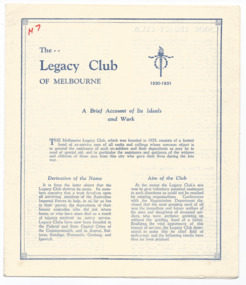
Pamphlet, The Legacy Club of Melbourne 1930-31 : A brief account of its ideals and works (H7), 1930
... camp, cycle club, and rambles as arranged. There is help for vocational options for the children. It is mentioned during 1930 which consisted of 'a hospital ward, mess room seating 80, a kitchen and storeroom. Also tent frames and necessary offices are provided and the total value of the building and equipment owned by the Club is our £600.' See also 01478 for a copy from 1928. This is one of the first documents that promotes Legacy and summarises its objective and services. legacy promotion history goals ...A brochure explaining 'A brief account of its ideals and work' in 1930. The notation H4 in red pen shows that it was part of the archive project that was trying to capture the history of Legacy. The brochure mentions clubs had started in the Federal and state capitals, and Geelong, Ararat, Ballarat, Fremantle, Ipswich and Bendigo. Members were all men who had served in the forces of the British Empire during the war. It shows the work of Legacy as : Junior Legacy Club - which had been running for 5 years, for sons (aged 9 to 21) of deceased soldiers. Members of the Legacy Club were in constant touch and acted as Big Brothers. Boys' Literary and Debating Branch - approximately 95 boys attended weekly meetings of a debating society at Anzac House. Boys' Physical Training Branch - for the boys physical welfare classes and conducted weekly by a permanent instructor (paid by Legacy). There were 270 boys attending. Also cricket, football, Lacrosse and swimming clubs, all supervised and coached. 'A permanent camp has been erected at Balnarring East, and this is occupied by the boys at the Christmas vacation under the control of Legatee Stan Savige, and the girls at Easter, with Mrs Gilles in charge. The value of these camps in enabling Junior Legatees to become better acquainted and in the development of character and the Legacy spirit cannot be overestimated'. Girls' Physical Training Branch - started in 1927 and now over 200 girls were being instructed by Mrs AM Gilles (the wife of a Legatee). Lending Library of over 600 books. Vocational placements for junior legatees. Meetings were held in the Victoria Palace Hotel, Little Collins St, on Tuesdays and included an informative lecture. The policy and objectives were laid out including to preserve the memory of fallen comrades and to assist their dependents, particularly the children. Also to maintain a spirit of comradeship, and to safeguard the good standing and interests of ex-servicemen in the community. The brochure shows activities as: Employment Committee, Comradeship Committee, a pledge to assist the National War Memorial being established on the Domain site, and for the children the 'Deceased Soldiers' Children's Welfare Committee. Also picnics, Christmas camp, cycle club, and rambles as arranged. There is help for vocational options for the children. It is mentioned during 1930 which consisted of 'a hospital ward, mess room seating 80, a kitchen and storeroom. Also tent frames and necessary offices are provided and the total value of the building and equipment owned by the Club is our £600.' See also 01478 for a copy from 1928.This is one of the first documents that promotes Legacy and summarises its objective and services. Brochure describing the ideal and activities of the Legacy Club in 1930.Handwritten H4 in red pen.legacy promotion, history, goals, objectives -
 Allan Doney Collection, Bendigo Historical Society Inc.
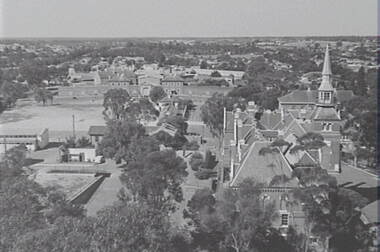
Negative - Urban Scene - Camp Hill School Bendigo - Goal, Allan Doney, 1950 -1970
... Urban Scene - Camp Hill School Bendigo - Goal...Negative Urban Scene - Camp Hill School Bendigo - Goal Allan Doney ...In the years of Allan Doney’s photography, landmark buildings succumbed to fire, neglect and redevelopment. He photographed the grey sand hills from Bendigo’s mining past, the streetscapes, poppet heads, miners’ cottages, gracious homes with ornate verandahs, trams and much more. Above all, his photographs show how much of the city has survived from the 19th century – and how much has not. Through two decades of great change, Allan Doney was there to capture ways people interacted with it. Although he travelled to many other places in Northern Victoria and beyond in search of subjects for his art, he seemed to always return to Bendigo for inspiration. -
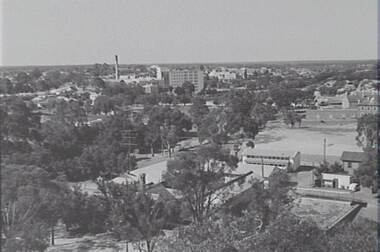 Allan Doney Collection, Bendigo Historical Society Inc.
Negative - Urban Scene - Camp Hill School Bendigo - Goal, Allan Doney, 1950 -1970
... Urban Scene - Camp Hill School Bendigo - Goal...Negative Urban Scene - Camp Hill School Bendigo - Goal Allan Doney ...In the years of Allan Doney’s photography, landmark buildings succumbed to fire, neglect and redevelopment. He photographed the grey sand hills from Bendigo’s mining past, the streetscapes, poppet heads, miners’ cottages, gracious homes with ornate verandahs, trams and much more. Above all, his photographs show how much of the city has survived from the 19th century – and how much has not. Through two decades of great change, Allan Doney was there to capture ways people interacted with it. Although he travelled to many other places in Northern Victoria and beyond in search of subjects for his art, he seemed to always return to Bendigo for inspiration.
