
Showing 27 items matching "captured weapon"
-
 National Vietnam Veterans Museum (NVVM)
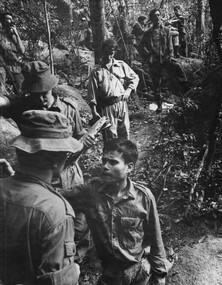
Photograph, Gibbons, Denis, Another Cache
... ...Captured Weapon...A black and white photograph of a captured NVA/VC leads Diggers of 6 RAR/NZ to another underground cache of weapons and supplies at the K76A Hospital captured on the Nui May Tao Mountain by 6 RAR/NZ during Operation Marsden. ...Photograph NVA/VC 6 RAR/NZ K76A Hospital Operation Marsden Nui May Tao Mountain Gibbons Collection Catalogue Diggers NVA/VietCong 6 RAR/NZ (ANZAC) Underground Cache Denis Gibbons Captured NVA Viet Cong Sapper Captured Weapon A black and white photograph of a captured NVA/VC leads Diggers of 6 RAR/NZ to another underground cache of weapons and supplies at the K76A Hospital captured on the Nui May Tao Mountain by 6 RAR/NZ during Operation Marsden. ...Denis Gibbons (1937 – 2011) Trained with the Australian Army, before travelling to Vietnam in January 1966, Denis stayed with the 1st Australian Task Force in Nui Dat working as a photographer. For almost five years Gibbons toured with nine Australian infantry battalions, posting compelling war images from within many combat zones before being flown out in late November 1970 after sustaining injuries. The images held within the National Vietnam Veterans Museum make up the Gibbons Collection. A black and white photograph of a captured NVA/VC leads Diggers of 6 RAR/NZ to another underground cache of weapons and supplies at the K76A Hospital captured on the Nui May Tao Mountain by 6 RAR/NZ during Operation Marsden. photograph, nva/vc, 6 rar/nz, k76a hospital, operation marsden, nui may tao mountain, gibbons collection catalogue, diggers, nva/vietcong, 6 rar/nz (anzac), underground cache, denis gibbons, captured nva viet cong sapper, captured weapon -
 Bendigo Military Museum
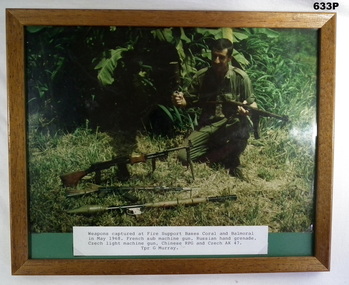
Photograph - PHOTOGRAPH VIETNAM, FRAMED, 1968
... Colour photo of G Murray with captured weapons. Label at bottom details time, place and weapons. ...Vietnam 3 cav weapons Colour photo of G Murray with captured weapons. Label at bottom details time, place and weapons. ...Geoff Murray No 3411521, Vietnam 3 Cav Regt 27.11.67 to 22.10.68, Survey Corp 15.10.69 to 15.10.70. Refer 638P.Colour photo of G Murray with captured weapons. Label at bottom details time, place and weapons. Frame is brown stained wood.vietnam, 3 cav, weapons -
 National Vietnam Veterans Museum (NVVM)
Photograph, Various Weapons
... Framed coloured photo of what appears to be captured weapons including a rocket launcher, serveral rockets and land mines. civilian men, women and children can be seen in the background....Photograph Weapons Framed coloured photo of what appears to be captured weapons including a rocket launcher, serveral rockets and land mines. civilian men, women and children can be seen in the background. ...Framed coloured photo of what appears to be captured weapons including a rocket launcher, serveral rockets and land mines. civilian men, women and children can be seen in the background.photograph, weapons -
 Beechworth RSL Sub-Branch
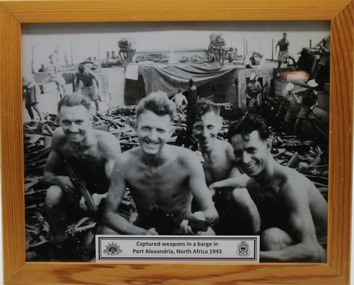
Photograph - Photo soldiers on a barge containing captured weapons - Port Alexandria North Africa 1943, Captured Weapons on Barg
... Soldiers working with captured weapons ...Soldiers working with captured weapons Spoils of war Soldier receiving captured weapons Photograph in wooded frame Captured Weapons on Barg Photograph Photo soldiers on a barge containing captured weapons - Port Alexandria North Africa 1943 ...Soldiers working with captured weapons Photograph in wooded frame spoils of war, soldier receiving captured weapons -
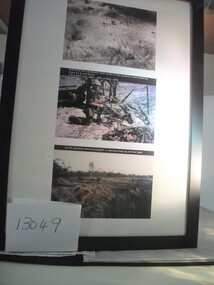 National Vietnam Veterans Museum (NVVM)
Photograph
... Aerial shot of battlefield-tanks and soldiers pictured 2. Checking captured weapons. Soldier in kneeling position holding rifle. 3. ...Aerial shot of battlefield-tanks and soldiers pictured 2. Checking captured weapons. Soldier in kneeling position holding rifle. 3. ...Framed and glass fronted photograph. Three panel photograph 1. Aerial shot of battlefield-tanks and soldiers pictured 2. Checking captured weapons. Soldier in kneeling position holding rifle. 3. Troops returning with NVA prisoners. Four pictured.CORAL BALMORAL COLLECTIONtanks, prisoners, photograph, battle of coral-balmoral -
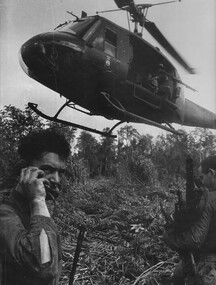 National Vietnam Veterans Museum (NVVM)
Photograph, Gibbons, Denis, Captured Weapons
... A black and white photograph of a Digger from 11 Platoon, D Company 6 RAR/NZ (ANZAC) directing a RAAF Huey 'slick' helicopter into land to collect the captured weapons held by one of their number and taken from the dead and wounded VietCong during an ambush at Bien Hoa, South Vietnam....Captured Weapons Photograph Gibbons, Denis ...Denis Gibbons (1937 – 2011) Trained with the Australian Army, before travelling to Vietnam in January 1966, Denis stayed with the 1st Australian Task Force in Nui Dat working as a photographer. For almost five years Gibbons toured with nine Australian infantry battalions, posting compelling war images from within many combat zones before being flown out in late November 1970 after sustaining injuries. The images held within the National Vietnam Veterans Museum make up the Gibbons Collection.A black and white photograph of a Digger from 11 Platoon, D Company 6 RAR/NZ (ANZAC) directing a RAAF Huey 'slick' helicopter into land to collect the captured weapons held by one of their number and taken from the dead and wounded VietCong during an ambush at Bien Hoa, South Vietnam.photograph, 11 platoon, d coy, 6 rar/nz, operation lavarack, huey helicopter, viet cong, bien hoa, gibbons collection catalogue, denis gibbons, photographer, vietnam war, digger, 6 rar/nz (anzac), raaf -
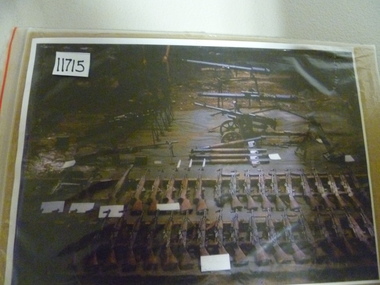 National Vietnam Veterans Museum (NVVM)
Photograph, Weapons Capture (Viet Cong) 1966
... Weapon captured at Long Tan on 18 August 1966...Weapon captured at Long Tan on 18 August 1966 Weapons Capture (Viet Cong) 1966 Photograph Photograph Processed by Kodak ...Photograph on cardboard encased in plastic leaf of a collection of captured Viet Cong weapons. Dark photograph of weapons laid out on canvas. Weapon captured at Long Tan on 18 August 1966photograph, viet cong -
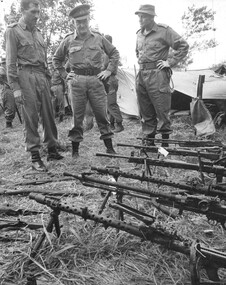 National Vietnam Veterans Museum (NVVM)
Photograph, Gibbons, Denis, Captured Heavy Weapons
... A black and white photograph of Maj Gen MacDonald discusses with the 1st ATF Commander Brig Sandy Pearson and the 6 RAR/NZ Intelligence Officer some of the heavy weapons captured in the NVA/VC K76A Hospital during Operation Marsden ...Photograph Brig Sandy Pearson 6 RAR/NZ K76A Hospital Operation Marsden Gibbons Collection Catalogue Maj Gen MacDonald 1st ATF 1st Australian Task Force Intelligence Officers NVA/VC Denis Gibbons A black and white photograph of Maj Gen MacDonald discusses with the 1st ATF Commander Brig Sandy Pearson and the 6 RAR/NZ Intelligence Officer some of the heavy weapons captured in the NVA/VC K76A Hospital during Operation Marsden Captured Heavy Weapons Photograph Gibbons, Denis ...Denis Gibbons (1937 – 2011) Trained with the Australian Army, before travelling to Vietnam in January 1966, Denis stayed with the 1st Australian Task Force in Nui Dat working as a photographer. For almost five years Gibbons toured with nine Australian infantry battalions, posting compelling war images from within many combat zones before being flown out in late November 1970 after sustaining injuries. The images held within the National Vietnam Veterans Museum make up the Gibbons Collection. A black and white photograph of Maj Gen MacDonald discusses with the 1st ATF Commander Brig Sandy Pearson and the 6 RAR/NZ Intelligence Officer some of the heavy weapons captured in the NVA/VC K76A Hospital during Operation Marsden photograph, brig sandy pearson, 6 rar/nz, k76a hospital, operation marsden, gibbons collection catalogue, maj gen macdonald, 1st atf, 1st australian task force, intelligence officers, nva/vc, denis gibbons -
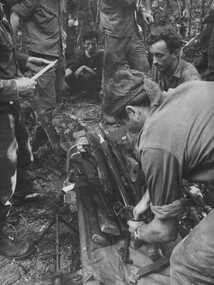 National Vietnam Veterans Museum (NVVM)
Photograph, Gibbons, Denis, Another Cache
... A black and white photograph of a Digger straps captured NVA/VietCong weapons to a stretcher found in a cache disclosed by the enemy VietCong prisoner, who watches on, led the 6RAR/NZ (ANZAC) elements to the cache. ...Photograph 6RAR/NZ Operation Marsden Nui May Tao Mountain Gibbons Collection Catalogue Digger NVA/VC VC Prisoner NVA Viet Cong Viet Cong Prisoner 6 RAR/NZ (ANZAC) Underground Cache Denis Gibbons A black and white photograph of a Digger straps captured NVA/VietCong weapons to a stretcher found in a cache disclosed by the enemy VietCong prisoner, who watches on, led the 6RAR/NZ (ANZAC) elements to the cache. ...Denis Gibbons (1937 – 2011) Trained with the Australian Army, before travelling to Vietnam in January 1966, Denis stayed with the 1st Australian Task Force in Nui Dat working as a photographer. For almost five years Gibbons toured with nine Australian infantry battalions, posting compelling war images from within many combat zones before being flown out in late November 1970 after sustaining injuries. The images held within the National Vietnam Veterans Museum make up the Gibbons Collection.A black and white photograph of a Digger straps captured NVA/VietCong weapons to a stretcher found in a cache disclosed by the enemy VietCong prisoner, who watches on, led the 6RAR/NZ (ANZAC) elements to the cache. The VietCong, at the K76A Hospital led the Aussies to many such caches during Operation Marsden on Nui May Tao Mountain.photograph, 6rar/nz, operation marsden, nui may tao mountain, gibbons collection catalogue, digger, nva/vc, vc prisoner, nva viet cong, viet cong prisoner, 6 rar/nz (anzac), underground cache, denis gibbons -
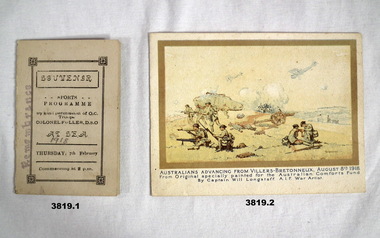 Bendigo Military Museum
Card - CARDS WW1, 1918
... Card shows 2 paintings & 2 images of weapons captured by Australians....Card shows 2 paintings & 2 images of weapons captured by Australians. Card CARDS WW1 ....1) This troop ship was the HMAS A18 Wiltshire which embarked from Sydney on 2.2.1928. This was ascertained by deciphering one of the hand written signatures who was in the 8th Reinforcements 39th Batt AIF..1) Card, folding, Souvenir Sports programme at sea Thursday 7th February 1918 at 2pm. Inside has events & is hand signed by many men. Rear has details of the planning committee. .2) Card folding, from Australian Comforts Fund Xmas & New Year 1918-19. Card shows 2 paintings & 2 images of weapons captured by Australians..2) “Greetings from Will”cards, souvenir, hmas, comforts fund -
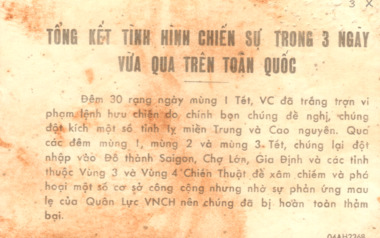 National Vietnam Veterans Museum (NVVM)
Pamphlet, A Summary of the War Situation in the country over the past days
... captured. Summary: Our casualties: 706, Enemy casualties 7,561. Enemy weapons captured: 144 crew-served weapon; 2,253 individual weapons....captured. Summary: Our casualties: 706, Enemy casualties 7,561. Enemy weapons captured: 144 crew-served weapon; 2,253 individual weapons. ...From the 30th to the 1st day of Tet (Lunar New Year), the VC have shamelessly violated the truce that they themselves proposed. The have attacked a number of town in Central Vietnam and in the Highlands. On the nights of the 1st, 2nd, and 3rd of Tet, they have taken advantage to infiltrate into the capital, Saigon - and into Gia Dinh and Cho Lon. They have also attacked in the provinces of the 3rd and the 4th Tactical Zones to destroy infrastructure and public utilities. However, thanks to the rapid reaction of the Republic of Vietnam Armed Forces, they have been completely and humiliatingly defeated. (1968) On the reverse side reads: Herewith are the casualty rates of us and the enemy: Period: 30-01-68 - Our causalities 282 killed and wounded. Enemy 2,338 killed on the spot, 182 captured. Period 1-02-68 - Our soldiers: 203 killed and wounded. Enemy 2,617 killed, 198 captured. Period 2-02-68 to 12 midday: Our soldiers 211 killed and wounded. enemy 2,112 killed, 119 captured. Summary: Our casualties: 706, Enemy casualties 7,561. Enemy weapons captured: 144 crew-served weapon; 2,253 individual weapons.TONG KET TINH HINH CHIEN SU TRON 3 NGAY - VUA QUA TREN TOAN QUOC - A Summary of the war situation in the country over the past days: On one side there is information in Vietnamese and on the reverse side the information is in a table format.pamphlet, psycological warfare, propaganda, nva/vc, viet cong, 7th battalion, 1st battalion, the royal australian regiment, terry michael collie, 2790361, lunar new year, central vietnam, saigon, gia dinh, cho lon -
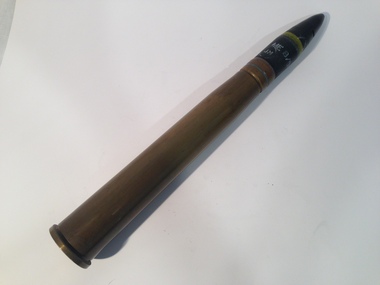 Montmorency–Eltham RSL Sub Branch
Weapon - 40mm L60 Bofors Anti-Aircraft Round
... captured guns were used by the Germans and Japanese. The Bofors had a rate of fire between 80 - 100 rounds per minute when hand-loaded via 4-round clips. Effective maximum range was approx. 3,800m. On land, the guns were mounted singly on numerous types of chassis whilst Naval guns were either single or dual mountings. A few countries still use the Bofors Gun to this day. Brass case with iron/steel projectile Weapon ...The Bofors gun (which fired this round) was designed in the 1930s by AB Bofors, a Swedish arms manufacturer. It proved to be one of the most successful light anti-aircraft guns used during World War II. Apart from being used by most of the Allied forces, captured guns were used by the Germans and Japanese. The Bofors had a rate of fire between 80 - 100 rounds per minute when hand-loaded via 4-round clips. Effective maximum range was approx. 3,800m. On land, the guns were mounted singly on numerous types of chassis whilst Naval guns were either single or dual mountings. A few countries still use the Bofors Gun to this day.Brass case with iron/steel projectile -
 Flagstaff Hill Maritime Museum and Village
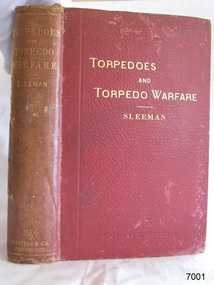
Book - Reference/History/Naval Armaments Technical Manual, Griffin & Co. (Publishers by appointment to Her Majesty and H.R.H. the Duke of Edinburugh), Torpedoes and Torpedo Warfare, 1889
... weapon. The original edition by Sleeman was published in 1880 by Griffin & Co., Portsmouth, and this date is identified as a first edition. The “1989” date is therefore not the original publication date so the subject volume is a later reprint. This work is significant, mainly as an early comprehensive handbook on torpedoes and submarine warfare rather than as a literary classic. It is historically important because it captures ...Torpedoes and Torpedo Warfare is a late-19th century naval history/manual about the development of submarine warfare, torpedoes, mines, and the vessels and tactics used to deploy them. It was originally written as a technical survey of the weapon’s rise and practical use, with diagrams and detailed descriptions. The book traces the evolution of torpedo warfare from early submarine mines through the introduction of electric detonation and later improvements. It is part history, part technical handbook.Torpedoes and Torpedo Warfare, by C. Sleeman. Containing a complete account of the progress of submarine warfare; also a detailed description of matters appertaining thereto, including the latest improvements, with 83 full-page illustrations, diagrams etc. Second Edition. 1889. Published by Griffin & Co, U.K. Hard-cover, bound book, red with gold lettering. Inscription inside the cover. non-fictionTorpedoes and Torpedo Warfare is a late-19th century naval history/manual about the development of submarine warfare, torpedoes, mines, and the vessels and tactics used to deploy them. It was originally written as a technical survey of the weapon’s rise and practical use, with diagrams and detailed descriptions. The book traces the evolution of torpedo warfare from early submarine mines through the introduction of electric detonation and later improvements. It is part history, part technical handbook. warrnambool, shipwrecked-coast, flagstaff-hill, flagstaff-hill-maritime-museum, maritime-museum, shipwreck-coast, flagstaff-hill-maritime-village, shipwrecked-artefact, book, c. sleeman author, torpedo warfare, submarine warfare -
 Running Rabbits Military Museum operated by the Upwey Belgrave RSL Sub Branch
Field Gun
... Weapon WW1 Army WWI Field Gun, M15 Skoda, German Army, Captured in St Martins Wood France by 5th Battalion 23rd August 1918 Field Gun ...WWI Field Gun, M15 Skoda, German Army, Captured in St Martins Wood France by 5th Battalion 23rd August 1918weapon, ww1, army -
4th/19th Prince of Wales's Light Horse Regiment Unit History Room
Uniform, Service Dress WW1, c 1914
... On 31 October 1917 he led his men, many of them from his own district, at full gallop over two miles into Turkish entrenchments and on for a further two miles (3.2 km) into Beersheba to capture vital wells before the Turks could destroy them. Lacking sabres, the regiment used bayonets held in their hands as shock weapons. ...On 31 October 1917 he led his men, many of them from his own district, at full gallop over two miles into Turkish entrenchments and on for a further two miles (3.2 km) into Beersheba to capture vital wells before the Turks could destroy them. Lacking sabres, the regiment used bayonets held in their hands as shock weapons. ...Sir Murray William James Bourchier (1881-1937), grazier, soldier and politician, was born on 4 April 1881 at Pootilla, Bungaree, Victoria, eldest son of Edward Bourchier, Geelong-born farmer, and his wife Francis (Fanny), née Cope. In 1878 Edward and his three brothers had taken up four adjoining selections on the Murray River near Tocumwal. Within a few years their properties had expanded considerably: Edward's, near Strathmerton, was called Woodland Park; the other three were known collectively as Boomagong. After a private education in Melbourne, Murray returned to Woodland Park. From 1909 until the outbreak of World War I he commanded a troop of light horse at Numurkah, attending annual camps and courses. Bourchier's military service was distinguished. He enlisted in the Australian Imperial Force in August 1914 and sailed as a lieutenant in the 4th Light Horse Regiment, serving seven months on Gallipoli. After the Sinai campaign in 1916-17, during which he was promoted lieutenant-colonel commanding his regiment, he made the crucial final assault on Beersheba. On 31 October 1917 he led his men, many of them from his own district, at full gallop over two miles into Turkish entrenchments and on for a further two miles (3.2 km) into Beersheba to capture vital wells before the Turks could destroy them. Lacking sabres, the regiment used bayonets held in their hands as shock weapons. For this exploit he was awarded the Distinguished Service Order and earned the sobriquet 'Bourchier of Beersheba'. Eleven months later, after fighting north through Palestine, he commanded a joint force of the 4th and 12th Light Horse regiments (Bourchier Force) in the final advance on Damascus; on entering the city the 4th captured 12,000 Turks and set about relieving their sufferings. Bourchier was three times mentioned in dispatches. He was appointed C.M.G. in June 1919 and his A.I.F. appointment ended in October. In 1921 he was promoted colonel, commanding the 5th Cavalry Brigade, and in 1931 brigadier, in charge of the 2nd Cavalry Division. He returned to Strathmerton but later farmed a property at Katandra, which he named Kuneitra. - Source: Australian Dictionary of BiographyService dress of General Sir Murray Bourchier, complete with jacket, trousers, shirt, tie, boots (high rise),Sam Browne belt, peaked cap, medal ribbons, badges of rank, medal ribbons -
4th/19th Prince of Wales's Light Horse Regiment Unit History Room
Uniform, Mess Kit, c 1914
... On 31 October 1917 he led his men, many of them from his own district, at full gallop over two miles into Turkish entrenchments and on for a further two miles (3.2 km) into Beersheba to capture vital wells before the Turks could destroy them. Lacking sabres, the regiment used bayonets held in their hands as shock weapons. ...On 31 October 1917 he led his men, many of them from his own district, at full gallop over two miles into Turkish entrenchments and on for a further two miles (3.2 km) into Beersheba to capture vital wells before the Turks could destroy them. Lacking sabres, the regiment used bayonets held in their hands as shock weapons. ...Sir Murray William James Bourchier (1881-1937), grazier, soldier and politician, was born on 4 April 1881 at Pootilla, Bungaree, Victoria, eldest son of Edward Bourchier, Geelong-born farmer, and his wife Francis (Fanny), née Cope. In 1878 Edward and his three brothers had taken up four adjoining selections on the Murray River near Tocumwal. Within a few years their properties had expanded considerably: Edward's, near Strathmerton, was called Woodland Park; the other three were known collectively as Boomagong. After a private education in Melbourne, Murray returned to Woodland Park. From 1909 until the outbreak of World War I he commanded a troop of light horse at Numurkah, attending annual camps and courses. Bourchier's military service was distinguished. He enlisted in the Australian Imperial Force in August 1914 and sailed as a lieutenant in the 4th Light Horse Regiment, serving seven months on Gallipoli. After the Sinai campaign in 1916-17, during which he was promoted lieutenant-colonel commanding his regiment, he made the crucial final assault on Beersheba. On 31 October 1917 he led his men, many of them from his own district, at full gallop over two miles into Turkish entrenchments and on for a further two miles (3.2 km) into Beersheba to capture vital wells before the Turks could destroy them. Lacking sabres, the regiment used bayonets held in their hands as shock weapons. For this exploit he was awarded the Distinguished Service Order and earned the sobriquet 'Bourchier of Beersheba'. Eleven months later, after fighting north through Palestine, he commanded a joint force of the 4th and 12th Light Horse regiments (Bourchier Force) in the final advance on Damascus; on entering the city the 4th captured 12,000 Turks and set about relieving their sufferings. Bourchier was three times mentioned in dispatches. He was appointed C.M.G. in June 1919 and his A.I.F. appointment ended in October. In 1921 he was promoted colonel, commanding the 5th Cavalry Brigade, and in 1931 brigadier, in charge of the 2nd Cavalry Division. He returned to Strathmerton but later farmed a property at Katandra, which he named Kuneitra. Source: Australian Dictionary of BiographyMess kit of General Sir Murray Bourchier complete with peaked cap, jacket, cummerbund, shirt, tie, waistcoat, trousers, shoes, AMF lapel badges & badges of rank -
Warrnambool RSL Sub Branch
CAPTURED GERMAN DOCUMENT RELATING TO A SECRET WEAPON(?)
... Snape Collection CAPTURED GERMAN DOCUMENT RELATING TO A SECRET WEAPON(?) ...snape collection -
 National Vietnam Veterans Museum (NVVM)
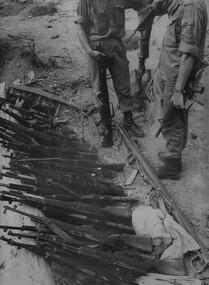
Photograph, Gibbons, Denis, Captured Weapons
... A black and white photograph of the Commanding Officer of 6 RAR/NZ (ANZAC) Lt Col David Butler, along his Radio Operator and Intellegence Officer inspects the weapons found in the large underground cache at the K76A Hospital captured on the Nui May Tao Mountain by 6 RAR/NZ. ...Captured Weapons Photograph Gibbons, Denis ...Denis Gibbons (1937 – 2011) Trained with the Australian Army, before travelling to Vietnam in January 1966, Denis stayed with the 1st Australian Task Force in Nui Dat working as a photographer. For almost five years Gibbons toured with nine Australian infantry battalions, posting compelling war images from within many combat zones before being flown out in late November 1970 after sustaining injuries. The images held within the National Vietnam Veterans Museum make up the Gibbons Collection. A black and white photograph of the Commanding Officer of 6 RAR/NZ (ANZAC) Lt Col David Butler, along his Radio Operator and Intellegence Officer inspects the weapons found in the large underground cache at the K76A Hospital captured on the Nui May Tao Mountain by 6 RAR/NZ. photograph, 6 rar/nz, k76a hospital, operation marsden, nui may tao mountain, lt col butler, gibbons collection catalogue, intelligence officers, commanding officer, radio operator, underground cache, denis gibbons, 6 rar/nz (anzac) -
 National Vietnam Veterans Museum (NVVM)
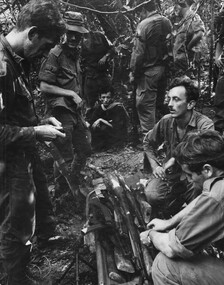
Photograph, Gibbons, Denis, Examining Captured Weapons
... A black and white photograph of a captured NVA/VC looks on as Diggers inspect the weapons found in the large underground cache at the K76A Hospital captured on the Nui May Tao Mountain by 6 RAR/NZ during Operation Marsden. ...Examining Captured Weapons Photograph Gibbons, Denis ...Denis Gibbons (1937 – 2011) Trained with the Australian Army, before travelling to Vietnam in January 1966, Denis stayed with the 1st Australian Task Force in Nui Dat working as a photographer. For almost five years Gibbons toured with nine Australian infantry battalions, posting compelling war images from within many combat zones before being flown out in late November 1970 after sustaining injuries. The images held within the National Vietnam Veterans Museum make up the Gibbons Collection. A black and white photograph of a captured NVA/VC looks on as Diggers inspect the weapons found in the large underground cache at the K76A Hospital captured on the Nui May Tao Mountain by 6 RAR/NZ during Operation Marsden. photograph, 6 rar/nz, k76a hospital, nui may tao mountain, operation marsden, gibbons collection catalogue, captured nva viet cong sapper, nva/vietcong, 6 rar/nz (anzac), diggers, denis gibbons -
 National Vietnam Veterans Museum (NVVM)
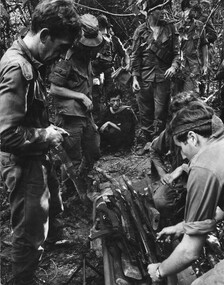
Photograph, Gibbons, Denis, Captured Weapons
... A black and white photograph of the Commanding Officer of 6 RAR/NZ Lt Col Butler, his Radio Operator and Intellegence Officer inspects the weapons found in the large underground cache at the K76A Hospital captured on the Nui May Tao Mountain by 6 RAR/NZ during Operation Marsden. ...Captured Weapons Photograph Gibbons, Denis ...Denis Gibbons (1937 – 2011) Trained with the Australian Army, before travelling to Vietnam in January 1966, Denis stayed with the 1st Australian Task Force in Nui Dat working as a photographer. For almost five years Gibbons toured with nine Australian infantry battalions, posting compelling war images from within many combat zones before being flown out in late November 1970 after sustaining injuries. The images held within the National Vietnam Veterans Museum make up the Gibbons Collection. A black and white photograph of the Commanding Officer of 6 RAR/NZ Lt Col Butler, his Radio Operator and Intellegence Officer inspects the weapons found in the large underground cache at the K76A Hospital captured on the Nui May Tao Mountain by 6 RAR/NZ during Operation Marsden. photograph, 6 rar/nz, lt col butler, k76a hospital, nui may tao mountain, operation marsden, gibbons collection catalogue, commanding officer, radio operator, intelligence officers, 6 rar/nz (anzac), underground cache, weapons, denis gibbons -
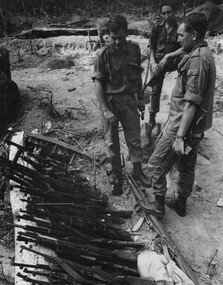 National Vietnam Veterans Museum (NVVM)
Photograph, Gibbons, Denis, Captured Weapons
... A black and white photograpf of the Commanding Officer of 6 RAR/NZ Lt Col Butler, his Radio Operator and Intellegence Officer inspects the weapons found in the large underground cache at the K76A Hospital captured on the Nui May Tao Mountain by 6 RAR/NZ during Operation Marsden. ...Captured Weapons Photograph Gibbons, Denis ...Denis Gibbons (1937 – 2011) Trained with the Australian Army, before travelling to Vietnam in January 1966, Denis stayed with the 1st Australian Task Force in Nui Dat working as a photographer. For almost five years Gibbons toured with nine Australian infantry battalions, posting compelling war images from within many combat zones before being flown out in late November 1970 after sustaining injuries. The images held within the National Vietnam Veterans Museum make up the Gibbons Collection. A black and white photograpf of the Commanding Officer of 6 RAR/NZ Lt Col Butler, his Radio Operator and Intellegence Officer inspects the weapons found in the large underground cache at the K76A Hospital captured on the Nui May Tao Mountain by 6 RAR/NZ during Operation Marsden. photograph, 6 rar/nz, k76a hospital, lt col butler, nui may tao mountain, operation marsden, gibbons collection catalogue, commanding officer, radio operator, intelligence officers, 6 rar/nz (anzac), denis gibbons -
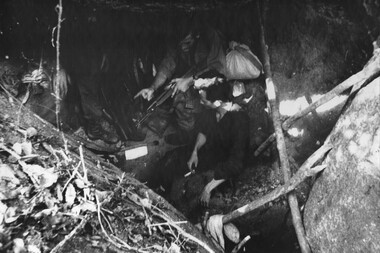 National Vietnam Veterans Museum (NVVM)
Photograph, Gibbons, Denis, Weapon Explanation
... A black and white photograph of a Viet Cong patient captured, in one of the wards by elements of 6 RAR/NZ (ANZAC) during Operation Marsden, explains the weapons and their significance to the Battalion Intelligence Officer in one of the many caves revealed by the prisoner...Photograph K76A Hospital Nui May Tao Mountain 6 RAR/NZ Gibbons Collection Catalogue Intelligence Officers VC Prisoner Wounded Viet Cong Soldier Operation Marsden Battalion Intelligence Officer 6 RAR/NZ (ANZAC) Denis Gibbons A black and white photograph of a Viet Cong patient captured, in one of the wards by elements of 6 RAR/NZ (ANZAC) during Operation Marsden, explains the weapons and their significance to the Battalion Intelligence Officer in one of the many caves revealed by the prisoner Weapon Explanation Photograph Gibbons, Denis ...Denis Gibbons (1937 – 2011) Trained with the Australian Army, before travelling to Vietnam in January 1966, Denis stayed with the 1st Australian Task Force in Nui Dat working as a photographer. For almost five years Gibbons toured with nine Australian infantry battalions, posting compelling war images from within many combat zones before being flown out in late November 1970 after sustaining injuries. The images held within the National Vietnam Veterans Museum make up the Gibbons Collection. A black and white photograph of a Viet Cong patient captured, in one of the wards by elements of 6 RAR/NZ (ANZAC) during Operation Marsden, explains the weapons and their significance to the Battalion Intelligence Officer in one of the many caves revealed by the prisonerphotograph, k76a hospital, nui may tao mountain, 6 rar/nz, gibbons collection catalogue, intelligence officers, vc prisoner, wounded viet cong soldier, operation marsden, battalion intelligence officer, 6 rar/nz (anzac), denis gibbons -
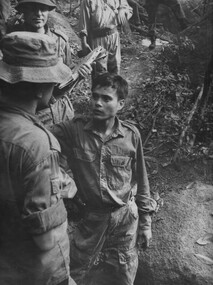 National Vietnam Veterans Museum (NVVM)
Photograph, Gibbons, Denis, Another Cache
... A black and white photograph of a captured NVA/VietCcong prisoner, caputed in one of wards, during Operation Marsden, at the NVA/VietCong K76A Hospital, siturated on the Nui may Tao Mountain, Phouc Tuy Province, leads elements of 6 RAR/NZ (ANZAC) to yet another cache of weapons and supplies....Photograph 6 RAR/NZ K76A Hospital Nui May Tao Mountain Operation Marsden Gibbons Collection Catalogue VC Prisoner NVA/VC 6 RAR/NZ (ANZAC) Underground Cache NVA/VietCong Viet Cong Prisoner Denis Gibbons A black and white photograph of a captured NVA/VietCcong prisoner, caputed in one of wards, during Operation Marsden, at the NVA/VietCong K76A Hospital, siturated on the Nui may Tao Mountain, Phouc Tuy Province, leads elements of 6 RAR/NZ (ANZAC) to yet another cache of weapons and supplies. ...Denis Gibbons (1937 – 2011) Trained with the Australian Army, before travelling to Vietnam in January 1966, Denis stayed with the 1st Australian Task Force in Nui Dat working as a photographer. For almost five years Gibbons toured with nine Australian infantry battalions, posting compelling war images from within many combat zones before being flown out in late November 1970 after sustaining injuries. The images held within the National Vietnam Veterans Museum make up the Gibbons Collection.A black and white photograph of a captured NVA/VietCcong prisoner, caputed in one of wards, during Operation Marsden, at the NVA/VietCong K76A Hospital, siturated on the Nui may Tao Mountain, Phouc Tuy Province, leads elements of 6 RAR/NZ (ANZAC) to yet another cache of weapons and supplies.photograph, 6 rar/nz, k76a hospital, nui may tao mountain, operation marsden, gibbons collection catalogue, vc prisoner, nva/vc, 6 rar/nz (anzac), underground cache, nva/vietcong, viet cong prisoner, denis gibbons -
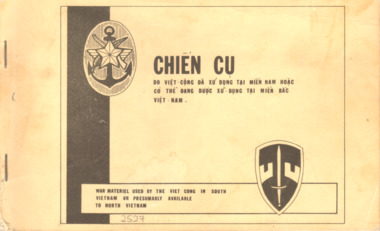 National Vietnam Veterans Museum (NVVM)
Booklet, US Army, Chien Cu - Identifying weaponry, 1/02/1966 12:00:00 AM
... These US created booklets served as crucial field guides for identifying captured or encountered enemy weaponry, from small arms to heavier ordnance. Weapons Vehicles Vietnam - Military Vietnam War - artillery 1961-1975 Armoured vehicles Language: Vietnamese Vietnam War 1961-1975 - Weapons Sgt A Moylan 4 Platoon B Coy 7 RAR 7th Battalion 16063 Royal Australian Infantry Corps chien cu Booklet. ...These US created booklets served as crucial field guides for identifying captured or encountered enemy weaponry, from small arms to heavier ordnance.Booklet. Front Page Heading "Chien Cu". Two Badges - one in top left hand corner, the other in bottom right hand corner. Vietnamese writing under "Chien Cu" heading and english writing next to bottom shield. Book shows line drawings of arms, vehicles and other equipment available to the Viet Cong and North Vietnamese. Specifications and descriptions of weapons and equipment in both Vietnamese and English. 184 pagesChien Cu / Do Viet Cong da xu Dung tai mien.../ War material used by the VietCong in South Vietnam or presumably available to North Vietnamweapons, vehicles, vietnam - military, vietnam war - artillery, 1961-1975, armoured vehicles, language: vietnamese, vietnam war, 1961-1975 - weapons, sgt a moylan, 4 platoon, b coy, 7 rar, 7th battalion, 16063, royal australian infantry corps, chien cu -
 Wangaratta RSL Sub Branch
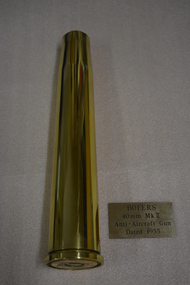
Memorabilia - Brass Shell Casing
... It was one of the most popular medium-weight anti-aircraft systems during World War II, used by most of the western Allies as well as some captured systems being used by the Axis powers. A small number of these weapons remain in service to this day, and saw action as late as the Persian Gulf War....It was one of the most popular medium-weight anti-aircraft systems during World War II, used by most of the western Allies as well as some captured systems being used by the Axis powers. A small number of these weapons remain in service to this day, and saw action as late as the Persian Gulf War. anti-aircraft gun shell casing brass wwii world war 2 bofers 40mm. ...The Bofors 40 mm gun, often referred to simply as the Bofors gun, is an anti-aircraft autocannon designed in the 1930s by the Swedish arms manufacturer AB Bofors. It was one of the most popular medium-weight anti-aircraft systems during World War II, used by most of the western Allies as well as some captured systems being used by the Axis powers. A small number of these weapons remain in service to this day, and saw action as late as the Persian Gulf War.Brass shell casing 40 mm. and gold coloured plaque with black writing.40mm. MK4. LOT 428 MF A^N 1955. Plaque: Bofers 40mm Mk II Anti-Aircraft Gun Dated 1955.anti-aircraft gun, shell casing, brass, wwii, world war 2, bofers -
 Wodonga & District Historical Society Inc
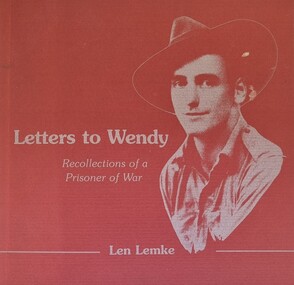
Book - Letters to Wendy - Recollections of a Prisoner of War, Len Lemke, 2003
... captured and became prisoners of war in Changi. On the 15th February, 1942, fifty thousand allied soldiers became prisoners of war when Singapore fell to the Japanese army. Approximately thirteen thousand of those were Australians. They were told to surrender their weapons ...The author was a son of Ernie and Susan Lemke who lived at "Waterford" Wodonga and raised a family of six boys and one daughter. Len and one of his brothers were captured and became prisoners of war in Changi. On the 15th February, 1942, fifty thousand allied soldiers became prisoners of war when Singapore fell to the Japanese army. Approximately thirteen thousand of those were Australians. They were told to surrender their weapons and then marched for three days to Changi and then Selerang Barracks in the north-east of the island. Len Lemke, known as "Loo" to his army mates, was one of those soldiers. In these collected letters he tells the story of his experiences at Changi and on the Thai-Burma Railway - the starvation, the hardships, the cruelty, the comradeship. The letters were written to his daughter Wendy and compiled by her into this book. Len Lemke died on 26 March 2009 in Wodonga, Victoria.A publication of 96 pages including illustrations and images.The author was a son of Ernie and Susan Lemke who lived at "Waterford" Wodonga and raised a family of six boys and one daughter. Len and one of his brothers were captured and became prisoners of war in Changi. On the 15th February, 1942, fifty thousand allied soldiers became prisoners of war when Singapore fell to the Japanese army. Approximately thirteen thousand of those were Australians. They were told to surrender their weapons and then marched for three days to Changi and then Selerang Barracks in the north-east of the island. Len Lemke, known as "Loo" to his army mates, was one of those soldiers. In these collected letters he tells the story of his experiences at Changi and on the Thai-Burma Railway - the starvation, the hardships, the cruelty, the comradeship. The letters were written to his daughter Wendy and compiled by her into this book. Len Lemke died on 26 March 2009 in Wodonga, Victoria. world war 11, lemke family wodonga, australian prisoners of war -
 Magnet Galleries Melbourne Inc
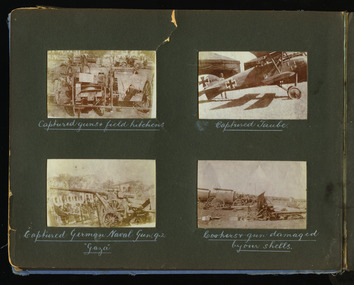
captured german weapons etc, robertson thomas142.tif
... ww1 world war 1 captured taube field kitchens german gaza naval gun four photos on a page from an album robertson thomas142.tif captured german weapons etc ...four photos on a page from an albumww1, world war 1, captured, taube, field kitchens, german, gaza, naval gun
