
Showing 2 items matching "carbon dioxide absorbers"
-
 Geoffrey Kaye Museum of Anaesthetic History
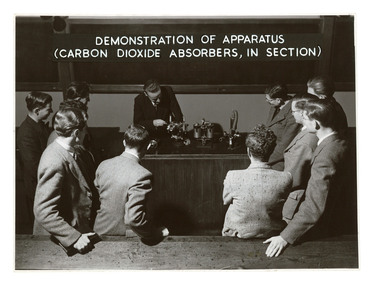
Photograph, c1940s
... ...carbon dioxide absorbers...Black and white photograph showing ten unidentified male students standing around a lecture theatre table watching the unidentified male instructor as he points to one of four anaesthesia apparatus, carbon dioxide absorbers....•Black paper label glued on top of photograph with caption written in all caps in white ink: Demonstration of apparatus (Carbon Dioxide absorbers, in section). •Handwritten in black ink on reverse: Frame 14. ...Students anaesthetic equipment carbon dioxide absorbers •Black paper label glued on top of photograph with caption written in all caps in white ink: Demonstration of apparatus (Carbon Dioxide absorbers, in section). ...Black and white photograph showing ten unidentified male students standing around a lecture theatre table watching the unidentified male instructor as he points to one of four anaesthesia apparatus, carbon dioxide absorbers.•Black paper label glued on top of photograph with caption written in all caps in white ink: Demonstration of apparatus (Carbon Dioxide absorbers, in section). •Handwritten in black ink on reverse: Frame 14. •Handwritten in grey pencil on reverse: 16. 14 has been crossed out.students, anaesthetic equipment, carbon dioxide absorbers -
 Geoffrey Kaye Museum of Anaesthetic History
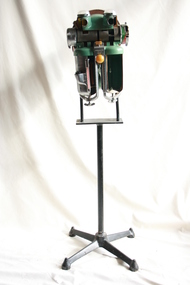
Machine - Coxeter-Mushin carbon dioxide absorber MK II, sectioned, c. 1945
... The Coxeter-Mushin carbon dioxide absorber consists of the main metal body, painted aquamarine, fixed to a stand. ...Machine Coxeter-Mushin carbon dioxide absorber MK II, sectioned A. Charles King Ltd. ...The Coxeter-Mushin carbon dioxide absorber consists of the main metal body, painted aquamarine, fixed to a stand. The cylindrical silver metal cannister on the left was used to contain ether, while that on the right contained soda lime. The apparatus has been sectioned to show the inside of the two cannisters, the right of which has an arrow drawn inside to indicate the flow of air breathed out by a patient. The front cover over the control dials has also been removed to show the mechanism. The two circular holes above the dials, facing forward, are where two corrugated tubes would attach; both of these tubes attached to the mask of the patient. The round yellow knob in the centre controls the Compensating Valve, which allowed the anaesthetist to raise or lower the rebreathing bag to allow air into the circuit or expel anaesthetic gas.anaesthesia, carbon dioxide, ether, soda lime
