
Showing 6 items matching "cast block engines"
-
 Moorabbin Air Museum
Book - Aircraft piston engines, A History of Aircraft Piston Engines
... engine...Cast block engines...Aircraft piston engines Introduction to piston engines The early birds The separate cylinder liquid cooled in-line engine The rotary engine Cast block engines The radial engine to 1930 The major radial engines The smaller radial engines The air cooled in-line engine The opposed engine Lost causes/oddballs & unconventional engines History of the aircraft piston engine from Manly Balzer to Continental Tiara, circa 1981 A History of Aircraft Piston Engines Book Aircraft piston engines ...History of the aircraft piston engine from Manly Balzer to Continental Tiara, circa 1981non-fictionHistory of the aircraft piston engine from Manly Balzer to Continental Tiara, circa 1981introduction to piston engines, the early birds, the separate cylinder liquid cooled in-line engine, the rotary engine, cast block engines, the radial engine to 1930, the major radial engines, the smaller radial engines, the air cooled in-line engine, the opposed engine, lost causes/oddballs & unconventional engines -
Moorabbin Air Museum
Machine - Rolls Royce Kestrel 700 Hp Liquid Cooled V 12
... Description: The Rolls Royce Kestrel was the company’s first cast block engine. The Kestrel was introduced in 1927 and powered many interwar British military types such as the Hawker Fury and Hawker Demon. ...Description: The Rolls Royce Kestrel was the company’s first cast block engine. The Kestrel was introduced in 1927 and powered many interwar British military types such as the Hawker Fury and Hawker Demon. ...Historical Details: . Description: The Rolls Royce Kestrel was the company’s first cast block engine. The Kestrel was introduced in 1927 and powered many interwar British military types such as the Hawker Fury and Hawker Demon. They were extensively exported and a number even powered G. Level of Importance: State -
 Bay Steamers Maritime Museum
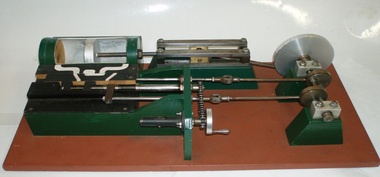
model steam engine
... engine.) The white portions of the model painted nearest to the cylinder represent the two steam ports cast into the main cylinder block, whilst one section painted in between those two represents the exhaust outlet (which may be connected to a condenser to conserve water, or to the open air). ...engine.) The white portions of the model painted nearest to the cylinder represent the two steam ports cast into the main cylinder block, whilst one section painted in between those two represents the exhaust outlet (which may be connected to a condenser to conserve water, or to the open air). ...This model was found in the collection of Bay Steamers Maritime Museum. It is not knowt who created it but it is supposed that it was constructed to educate the many masters of the Wattle in the operation of a steam engine - a not so common mode of power these days. A Bay Steamers Maritime Museum examined the model in March 2012 and discovered that is was in poor repair. Using his existing knowledge, and with reference to some historic texts, he made some repairs and returned the model to working order. Here is his anaylsis of the situation as an excerpt from the Bay Steamers Maritime Museum newsletter Steamlines May 2012 "I was confronted with a model of a steam engine used years ago as a training aid for hopeful steam engineers. Already having a knowledge of steam operations, I considered a museum write-up for that model a ‘piece of cake’. However, on turning the model’s crankshaft, the valve timing seemed ‘out of kilter’ with the movement of the piston. Problem was that the two eccentrics on the crankshaft were not properly secured to it. Eventually I fastened the two eccentrics to the crankshaft where I felt that they should be and then realized that one of them had a chain-driven valve-timing device attached. This would be adjusted while an engine was running to achieve best performance and fuel economy whilst in operation by accurately controlling the period of time during which steam under pressure from the boiler would be admitted to the cylinder and give greater time for the steam to expand in the cylinder, move the piston and turn the crankshaft and thus, drive the attached apparatus. When the valves were correctly set up it was then possible to get the model to function properly.The model comprises a green section, which is the actual the model mounted on a brown painted board. There are two parts of the model, painted white representing the steam passages, and black representing the cast- iron portions of the cylinder-block casting, and of the main valve sliding between the cylinder a second sliding valve. Of the black portions, one slides back and forth being connected to a rod which is connected to an eccentric clamped to the crankshaft and is the nearer to the flywheel of two eccentrics. This eccentric is attached to the crankshaft at an angle of 90 degrees to the crank-pin attached to the flywheel. To operate the model simply turn the flywheel by means of the handle attached to its crank-pin. A second eccentric is also attached to the crankshaft, further away from the first eccentric, and it is adjusted to operate 90 degrees from the first eccentric (that is, 180 degrees from the crank-pin) A piston (painted silver) is located in a plastic cylinder and has a piston rod which passes through one end of the cylinder, (in actual practice a steam-proof gland seals the cylinder against loss of steam) terminating in a cross-head slide between four rails guiding it. From this cross-head, a connecting rod joins the piston-rod to the flywheel via the crank-pin attached to the flywheel which is part of the crankshaft. (In actual practice, a flywheel may not be used, particularly in a multi-cylinder engine.) The white portions of the model painted nearest to the cylinder represent the two steam ports cast into the main cylinder block, whilst one section painted in between those two represents the exhaust outlet (which may be connected to a condenser to conserve water, or to the open air). The main slide valve has three white-painted portions painted thereon. It has two white-painted marks representing the steam passages to the steam ports into the cylinder, and a third section in between the other two, being that part of the valve through which exhaust steam passes in line with the ports in the cylinder block. By rotating the flywheel, the operations of an engine will be observed as steam is admitted to the main valve via the gap between the two jaws of two moveable portions of a second sliding valve which is operated by the second eccentric attached to the crank-shaft. This eccentric is used to finely tune the valve timing of this model to obtain best running results of an engine. There are various methods used for reversing a steam engine. model compound steam engine, steam engine, model, crankshaft, valve, flywheel, wattle, engineer, eccentrics -
 Trafalgar Holden Museum
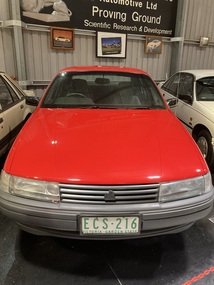
Vehicle - VN Commodore, 1988
... This was to be the Holden’s answer and coincided with the return of Peter Brock back to the Holden team from 1987.Mechanically the cars were fitted with reworked version of Holden’s 4.9 litre V8. The engine block was cast for additional strength, modified cylinder heads roller rockers and high fuel flow fuel injection was applied. ...This was to be the Holden’s answer and coincided with the return of Peter Brock back to the Holden team from 1987.Mechanically the cars were fitted with reworked version of Holden’s 4.9 litre V8. The engine block was cast for additional strength, modified cylinder heads roller rockers and high fuel flow fuel injection was applied. ...The VN Commodore was available in Executive, S, SS, Berlina and Calais specification levels, although a more basic SL model (opt. code A9K) was supposedly offered to government and fleet buyers, as it was not officially listed as part of the Commodore range. Changes in the relative values of the Australian dollar, the Japanese yen, and the US dollar made it impractical to continue with the well-regarded Nissan engine of the VL. Instead, Holden manufactured their own 90-degree V6 based on an old Buick design from the US, although initially it was imported. The 5.0-litre V8 remained optional and received a power boost to 165 kW (221 hp). Both these engines used multi point GM EFI and the V6 using 3 coil-packs for ignition. Holden and HSV developed this car as the basis for racing in Group A Confederation of Australian Motor Sport events. While the minimum number of cars built to qualify in Australian Touring car Championships, with modified body kit, brakes or engine is 500, only 302 VN were built but CAMS granted an exemption allowing them to compete.Holden and HSV had worked hard to develop this car to be a serious competitor to the Skyline, Ford Sierra and the BMW which had dominated in the previous years. This was to be the Holden’s answer and coincided with the return of Peter Brock back to the Holden team from 1987.Mechanically the cars were fitted with reworked version of Holden’s 4.9 litre V8. The engine block was cast for additional strength, modified cylinder heads roller rockers and high fuel flow fuel injection was applied. Output was 215 kw at 5200revs and, though at today’s standard, that is not that much it was very impressive at that time. The drive was through a six speed ZF gearbox with a heavy duty racing clutch and a limited slip differential.Under the Hawke government's Button car plan, which saw a reduction in the number of models manufactured locally, and the introduction of model sharing, the VN Commodore was rebadged as the Toyota Lexcen, named after the late America's Cup yacht designer, Ben Lexcen. Subsequently, the Toyota Corolla and Camry were, similarly, badged as the Holden Nova and Holden Apollo.Red executive 4 door sedanHolden Lion and stone emblem grille centre, Commodore boot LHS, Lion and stone emblem boot RHS.vehicle, vn commodore, holden, car -
 Parks Victoria - Maldon State Battery
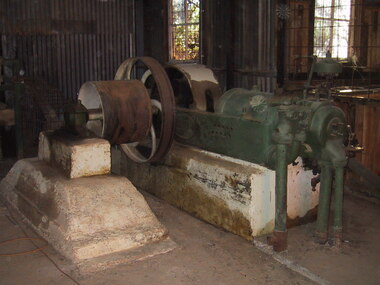
Engine, gas
... Large green cast iron engine sitting on large white concrete block, with inscriptions on both sides. ...Large green cast iron engine sitting on large white concrete block, with inscriptions on both sides. ...This engine turned belts to power battery operation. Used from C 1910-1920, some are parts missing. 'Tangye' had offices in Sydney.The first gas engine, a 1 nominal horsepower two-cycle type, was sold in 1881, and in 1890 the firm commenced manufacture of the four-cycle gas engine. Incorporated as a limited company from 1881, in 1894 they produced their first hot bulb engine.[2] Richard Tangye was knighted in 1894. After the deaths of Richard (1906) and George (1920), with the family owning the majority of shares, their sons entered the business.[2] In 1919, the company started production of large-scale industrial diesel engines, pumps and hydraulic equipment. Engine production was stopped after World War Two. A Tangye 35HP suction gas engine. (incomplete). Large green cast iron engine sitting on large white concrete block, with inscriptions on both sides. The green engine has 3 outlet/inlet pipes and joins onto one belt wheel; belt wheel joins onto another belt wheel which is sitting on another white concrete block."Tangye/patents/birmingham" -
Maldon Vintage Machinery Museum Inc
One Ton Truck
... On cast wheel hub nuts "GB" Graham Brothers flat bed one ton truck. In-line four cylinder engine. Blue body with white engine housing, red engine block, cream wheel trim and upholstery maroon chasis. ...Used in annual Maldon Easter parade.Graham Brothers flat bed one ton truck. In-line four cylinder engine. Blue body with white engine housing, red engine block, cream wheel trim and upholstery maroon chasis. Natural timber seat frame, tray and running boards. Chrome radiator housing and headlights. Retrofitted electric turning indicators.Etched plate on dashboard "1 Ton CAUTION Truck / Over-loading or over-speeding / will void your warranty / Speed 25 miles per hour / Maximum allowable load capacity 2000 lbs / Allowable for weight of body 1000 lbs / Total weight of chassis body -------- / and load not to exceed 5515 lbs / deduct excess body weight from rated load / Graham Brothers Detroit. U. S. A. / A division of Dodge Brothers Inc." On cast wheel hub nuts "GB"
