
Showing 9 items matching "casting line"
-
 Port Fairy Historic Lifeboat Station
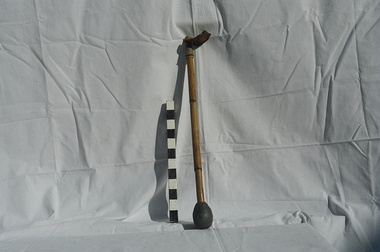
Tool - Heaving Cane
... ...Casting line...Shipwreck Shipwreck rescue Lead weight Casting line Cane handle with heavy lead bulb at one end. leather strap bound to cane handle with cotton thread. ...Cane handle with heavy lead bulb at one end. leather strap bound to cane handle with cotton thread.shipwreck, shipwreck rescue, lead weight, casting line -
 Stawell Historical Society Inc
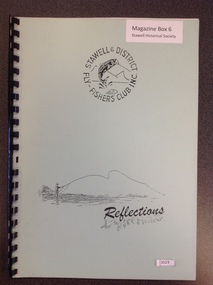
Book, Ian Holwell, Reflections, 1995
... Medium Blue/Geen Card cover with Black Plastic binding Black line drawing of a hooked jumping fish surrounded by print Line drawing of a man standing in water casting a fishing line with title below...Below drawing: Reflections Medium Blue/Geen Card cover with Black Plastic binding Black line drawing of a hooked jumping fish surrounded by print Line drawing of a man standing in water casting a fishing line with title below Reflections Book Ian Holwell ...A Brief history of the Stawell & District Fly Fishers' Club Inc.Medium Blue/Geen Card cover with Black Plastic binding Black line drawing of a hooked jumping fish surrounded by print Line drawing of a man standing in water casting a fishing line with title belowIn Circle Curving up left to right: Stawell & District In Circle curving down left to right: Fly Fishers Club Inc. Below drawing: Reflectionsstawell sport -
 Flagstaff Hill Maritime Museum and Village
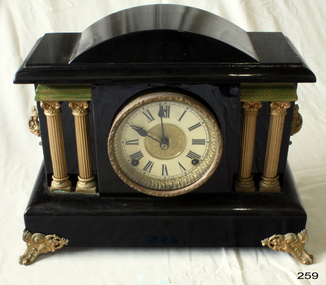
Instrument - Clock, 1920s
... Within a few years the Sessions Clock Company was producing clock movements, cases, dials, artwork and castings for their line of mechanical clocks. Between 1903 and 1933 Sessions produced 52 models of mechanical clocks, ranging from Advertisers, large and small clocks with logos of various businesses, to wall, or regulator clocks, and shelf or mantel clocks, designed for the home. ...Within a few years the Sessions Clock Company was producing clock movements, cases, dials, artwork and castings for their line of mechanical clocks. Between 1903 and 1933 Sessions produced 52 models of mechanical clocks, ranging from Advertisers, large and small clocks with logos of various businesses, to wall, or regulator clocks, and shelf or mantel clocks, designed for the home. ...In 1902, William E Sessions and other family members purchased a controlling interest in the E.N. Welch Company, a clock manufacturer located in Forestville, Connecticut. Sessions' father owned a foundry located in the town of Bristol, Connecticut that produced cases for E.N Welch Co. On January 9, 1903, the company was reorganized and registered as The “Sessions Clock Company”. Within a few years the Sessions Clock Company was producing clock movements, cases, dials, artwork and castings for their line of mechanical clocks. Between 1903 and 1933 Sessions produced 52 models of mechanical clocks, ranging from Advertisers, large and small clocks with logos of various businesses, to wall, or regulator clocks, and shelf or mantel clocks, designed for the home. Many of the Session clocks from this period are prized by collectors. In 1930, the company expanded to produce electric clocks and timers for radios, while continuing to produce traditional brass mechanical movements. Beginning at the end of World War II Sessions W Model (electric) was widely used by various casting companies for their clocks. The dial of the W Model read Movement by Sessions. In the early 1950s Sessions begin to produce timers for television. In 1956, Sessions was absorbed by a company interested mainly in their timing devices. In 1959, William K. Sessions, grandson of William E. Sessions left the Sessions Clock Company and formed the New England Clock Company. In 1960, one of the Sessions Clock buildings was sold to the Bristol Instrument Gears Company. Kept as the Sessions Company, the new owners ran the operation until 1969 when changes in the market forced the Sessions Company into liquidation. In 1970, the remaining buildings were sold to Dabko Industries, a machine parts manufacturer.The item marks a time when clock production in America was at it’s peak producing clocks for sale in many countries, they were keenly priced, mass produced and available to all. The company had a relatively short life span life regards clock manufacture later diversifying into electric timer mechanisms. Yet it was perhaps inevitable with the advent of electricity along with stiff competition from other clock manufactures that would ultimately herald the end in 1935 of the Sessions company's ability to continue manufacturing mechanical clocks. Clock mantle type face set in a painted black case designed to represent a Greek building with gold decorative pillars. Free standing with decorative feet. No markings or inscriptions on clock case or mechanism flagstaff hill, warrnambool, shipwrecked-coast, flagstaff-hill, flagstaff-hill-maritime-museum, maritime-museum, shipwreck-coast, flagstaff-hill-maritime-village, sessions, mantel clock, clock, clock industries -
 Flagstaff Hill Maritime Museum and Village
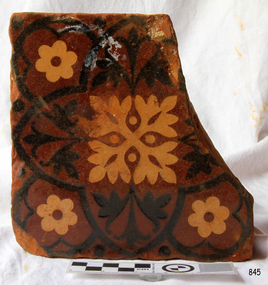
Ceramic - Tile, circa 1878
... casting. When fired, the resulting tile was colour-fast and design-fast. A brief history of the Loch Ard (1873-1878): - The sailing ship Loch Ard was one of the famous Loch Line ships that sailed from England to Australia. ...casting. When fired, the resulting tile was colour-fast and design-fast. A brief history of the Loch Ard (1873-1878): - The sailing ship Loch Ard was one of the famous Loch Line ships that sailed from England to Australia. ...This Minton floor tile is from the wreck of the LOCH ARD along with other examples of this manufacture recovered from the wreck site and form part of the collection at Flagstaff Hill. The iron-hulled clipper ship from the Loch Line was heading for Port Phillip from London when it ran into the cliffs of Mutton Bird Island near Port Campbell and was wrecked on June 1st, 1878. The LOCH ARD was laden with high-value cargo including luxury goods intended for display at the Melbourne International Exhibition in 1880. One notable survivor from the ship’s freight manifest was the well-packed Minton porcelain peacock, a two-metre-high ceramic masterpiece of vivid glazed colours. The almost total loss of life and property from the LOCH ARD registered as a shocking tragedy for the Colony of Victoria, at a time when social confidence and economic optimism were otherwise high. The wealth generated from Gold and Wool was increasingly being spent on grandiose private residences and imposing public buildings. The demand for quality furnishings and fittings was therefore strong. Among the products consigned to burgeoning colonial markets by the Milton Pottery at Stoke upon Trent, were their new range of colourfully patterned but very durable floor tiles – ideal for the high-traffic spaces in the large civic buildings then being constructed in Australia and America. These new floor tiles were “encaustic”, meaning that their designs and colours were encased “within” the depth of the tile. Rather than their decorative patterns being glazed onto the surface of the tile, their inlaid designs were created during the manufacturing process, as “coloured slips” (or liquid clay) were poured into a deep pre-moulded casting. When fired, the resulting tile was colour-fast and design-fast. A brief history of the Loch Ard (1873-1878): - The sailing ship Loch Ard was one of the famous Loch Line ships that sailed from England to Australia. Barclay, Curdle and Co. built the three-masted iron vessel in Glasgow in 1873. It had sailed three trips to Australia and one trip to Calcutta before its fateful voyage. Loch Ard left England on March 2, 1878, under the command of recently married, 29-year-old Captain Gibbs. It was bound for Melbourne with a crew of 37, plus 17 passengers. The general cargo reflected the affluence of Melbourne at the time. Onboard were straw hats, umbrellas, perfumes, clay pipes, pianos, clocks, confectionery, linen and candles, and a heavier load of railway irons, cement, lead and copper. Other cargo included items intended for display in the Melbourne International Exhibition of 1880. The Loch Ard had been sailing for three months and was close to its destination on June 1, 1878. Captain Gibbs had expected to see land at about 3 am but the Loch Ard ran into a fog that greatly reduced visibility and there was no sign of land or the Cape Otway lighthouse. The fog lifted at 4 am and the sheer cliffs of Victoria's west coast were much closer to them than Captain Gibbs expected. He tried to manage the vessel but failed and the ship struck a reef at the base of Mutton Bird Island, near Port Campbell. The top deck loosened from the hull, and the masts and rigging crashed down, knocking passengers and crew overboard. The lifeboat was launched by Tom Pearce but crashed into the side of Loch Ard and capsized. He clung onto its overturned hull and sheltered under it. He drifted out to sea and the tide brought him back to what is now called Loch Ard Gorge. He swam to shore and found a cave for shelter. A passenger, Eva Carmichael, had raced onto the deck to find out what was happening and was confronted by towering cliffs above the ship. She was soon swept off the ship by a huge wave. Eva saw Tom Pearce on a small rocky beach and yelled to attract his attention. He swam out and dragged her to the shelter of the cave. He revived her with a bottle of brandy from a case that had washed up on the beach. Tom scaled a cliff in search of help and followed some horse hoof prints. He came from two men from Glenample Station, three and a half miles away. He told the men of the tragedy and then returned to the gorge while the two men rode back to the station to get help. They reached Loch Ard Gorge and took the two shipwreck survivors to Glenample Station to recover. Eva stayed at the station for six weeks before returning to Ireland by steamship. In Melbourne, Tom Pearce received a hero's welcome and was presented with a medal and some money. Of the 54 crew members and passengers on board, only two survived: the apprentice, Tom Pearce and the young woman passenger, Eva Carmichael, who lost her family in the tragedy. One of the most unlikely pieces of cargo to have survived the shipwreck was a Minton porcelain peacock - one of only nine in the world. The peacock was destined for the Melbourne International Exhibition in 1880. It had been well packed, which gave it adequate protection during the violent storm. Today, the Minton peacock can be seen at the Flagstaff Hill Maritime Museum in Warrnambool. From Australia's most dramatic shipwreck, it has now become Australia's most valuable shipwreck artefact and is one of very few 'objects' on the Victorian State Heritage Register. The Minton floor tile is significant for its hard-wearing yet attractive design. The shipwreck of the LOCH ARD is of State significance. Victorian Heritage Register S417. Flagstaff Hill’s collection of artefacts from LOCH ARD is significant for being one of the largest collections of artefacts from this shipwreck in Victoria. It is significant for its association with the shipwreck, which is on the Victorian Heritage Register (VHR S417). The collection is significant because of the relationship between the objects, as together they have a high potential to interpret the story of the LOCH ARD. The LOCH ARD collection is archaeologically significant as the remains of a large international passenger and cargo ship. The LOCH ARD collection is historically significant for representing aspects of Victoria’s shipping history and its potential to interpret sub-theme 1.5 of Victoria’s Framework of Historical Themes (living with natural processes). The collection is also historically significant for its association with the LOCH ARD, which was one of the worst and best-known shipwrecks in Victoria’s history. A square Minton floor tile with a black and apricot pattern against a chocolate brown background. There is a large chip missing. This decorative floor tile was recovered from the shipwreck of the LOCH ARD. On the back, or base, of the tile is inscribed the number “46” and the letters “Minton & Co Patent Stoke upon Trent”.flagstaff hill, warrnambool, shipwrecked coast, flagstaff hill maritime museum, maritime museum, shipwreck coast, flagstaff hill maritime village, great ocean road, loch line, loch ard, captain gibbs, eva carmichael, tom pearce, glenample station, mutton bird island, loch ard gorge, encaustic tile, melbourne international exhibition, floor tile, minton floor tile -
 City of Moorabbin Historical Society (Operating the Box Cottage Museum)
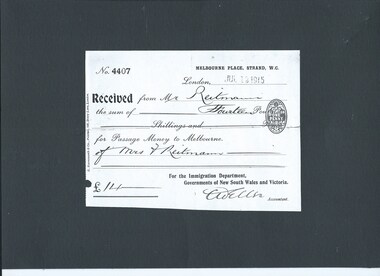
Document, x 2 ,Photograph colour x1, Reciept NSW Govt. Immigration Dept., Ticket Orient Line 'Osterley' 1915 Mr Rietmann, Osterley steam ship, 1915
... 'Osterley' SS of the Orient Line, 12,129 tons, was a Royal Mail Steam- Ship sailing to and from Australia c1915 The Rietman family is an example of the diverse nationalities that lived and worked productively in Moorabbin Shire 1871–1933 , the City of Moorabbin 1934-1994 and continues today in the Cities of Glen Eira, Kingston, Bayside, and Monash. August, a sculptor and stone mason, was employed by Corben Pty Ltd Clifton Hill to carve WW1 Memorials before establishing his own successful masonry business in the Box Cottage during the latter 1920s. After becoming interested in pressed cement casting ...August Rietmann (1877-1951) of Lustdorf ,Switzerland, married Maria Frieda Oesschlager (2/21878- 22/7/1942) of Baden Baden, Germany on 6/8/1910 In August 8th 1915 August and his wife Frieda migrated to Melbourne, Victoria, Australia sailing on the Steam Ship ‘Osterley’ from Marseilles to Melbourne They leased Box Cottage, Ormond in 1917 and raised two children, Stefanie (1918 -2006) and William (1920- 1997). 1935 August purchased the property and the family used the Cottage during the day and slept in the Front House. August was a monumental mason, potter and sculptor, and was employed at Corbens Ltd Clifton Hill, to carve war memorials in Victoria post WW1 c 1915-1922. During the 1920's August set up his own business in pressed cement making pot plants, columns,paving slabs and lampstands. He continued to carve headstones and figures and took contract work for Artists eg Paul Mountford. He built a workshop in the Barn and used the Cottage for plaster moulding. His son William joined the business and and the family continued to use the site after August died in 1951. Rietmann Landscaping Ltd moved to Bay Road Highett in 1953 and later to Carrum. The land, containing the Box Cottage, was sold to Lewis Timber Pty Ltd in 1970 and Mr Lewis proposed that Moorabbin City Council should preserve the heritage Cottage. In 1984 the Cottage was dismantled and reconstructed in the adjacent Joyce Park. 'Osterley' SS of the Orient Line, 12,129 tons, was a Royal Mail Steam- Ship sailing to and from Australia c1915The Rietman family is an example of the diverse nationalities that lived and worked productively in Moorabbin Shire 1871–1933 , the City of Moorabbin 1934-1994 and continues today in the Cities of Glen Eira, Kingston, Bayside, and Monash. August, a sculptor and stone mason, was employed by Corben Pty Ltd Clifton Hill to carve WW1 Memorials before establishing his own successful masonry business in the Box Cottage during the latter 1920s. After becoming interested in pressed cement casting, he took on apprentices (1930s Depression) and among his products were garden furniture, pots and also street lamp standards, some of which were installed in St Kilda Road. After August’s death in 1951, his family continued the business ‘Rietman’s Landscaping Ltd.’, at Highett and Carrum.Printed Documents a) Mr A Rietmann Receipt from Immigration Department of New South Wales Australia; b) Original Ticket Orient Line Ship 'Osterley' Marseilles to Melbourne 1915 c) Photograph colour of 'Osterley' Steam Shipa) No. 4407 MELBOURNE PLACE, THE STRAND W.C. /London July 12 1915/ Received from Mr Rietmann Fourteen Pounds for passage Money to Melbourne b) ORIENT LINE/ ROYAL MAIL STEAM-SHIPS TO AUSTRALIA/ ............THIRD CLASS PASSENGER CONTRACT TICKET..............OSTERLEY ... to take in passengers of the Port of Marseilles for ..........MELBOURNE............on the Eighth day of August 1915 ..........Mr August Rietmann .......................£15:4 : - to be paid before embarkation c) Osterly Steam ship en route to Melbourneport of marseilles france, melbourne australia, orient steam ship line, osterley steam ship,rietmann august, rietman august, rietmann frieda, rietman frieda, stonnington city town hall, war memorials, world war 1 1914-1918, rietman stefanie, rennick stefanie, francis stefanie, rietman william, rietman ray, mountford paul, malvern city town hall,box cottage museum ormond, box william, box elizabeth, joyce park ormond, rietman's landscaping pty ltd, bay road highett, macrobertson pty ltd, coleraine soldier memorial 1921, -
 Glenelg Shire Council Cultural Collection
Functional object - Hand Casting Blanks, n.d
... Identification numbers: 7559 a, b Two hand casting blanks for 'bottom bobbing' when fishing from a boat. Wooden rectangular shape, semi-circle cut from each end to accommodate fishing line. ...Identification numbers: 7559 a, b Two hand casting blanks for 'bottom bobbing' when fishing from a boat. Wooden rectangular shape, semi-circle cut from each end to accommodate fishing line. ...Identification numbers: 7559 a, b Two hand casting blanks for 'bottom bobbing' when fishing from a boat. Wooden rectangular shape, semi-circle cut from each end to accommodate fishing line. Wooden handle screwed to top edge. -
 Wannon Water
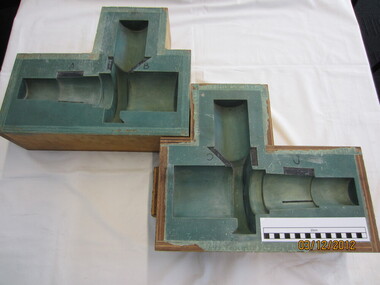
High pressure scour valve mould (casting) watermains, Mould
... 2 wooden boxes each contain the mould for casting valves for wtaermains pipelines. Moulds lined with green coloured sealant...Was used in conjunction with scour valve mould, Wf mould and valve stem mould in the 1980s Used to manufacture spare parts for the main Otway pipeline Otway Region Water supply Pipelines Valves watermains written in black ink on outside of box 2 wooden boxes each contain the mould for casting valves for wtaermains pipelines. Moulds lined with green coloured sealant Mould High pressure scour valve mould (casting) watermains ...Used to make casting moulds for the high pressure main Otway Supply System pipeline. Was used in conjunction with scour valve mould, Wf mould and valve stem mould in the 1980sUsed to manufacture spare parts for the main Otway pipeline2 wooden boxes each contain the mould for casting valves for wtaermains pipelines. Moulds lined with green coloured sealantwatermains written in black ink on outside of boxotway region, water supply, pipelines, valves -
 Port Fairy Historic Lifeboat Station
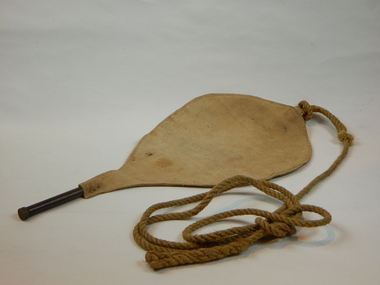
Tool - Oil bag, empty
... The bag has a light line attached to it to secure to the lifeboat when in use (by casting the bag into the sea).. no markings. ...The bag has a light line attached to it to secure to the lifeboat when in use (by casting the bag into the sea).. no markings. ...Item acquired from Lakes Entrance boat builder/owner who sold it to the PFHLS in 2008. Oil bags were part of the lifeboat equipment. Only one other example known is at the Port Albert Maritime Museum The oil bag was used to put oil on the sea's surface, to inhibit spray, wave burst and fear for survivors transferring from the shipwreck to the lifeboat. This was essential, as the lifeboat would never come close to the wreck, to avoid the risk of being damaged itself. The item is rare, and a vital part of the lifeboat's rescue equipment. The technique probably generated the phrase "pour oil on troubled waters" textile (flax) bag, shaped like a tennis racquet cover, with a brass tube attached to bag. The tube has a series of very small circular holes (in lines) arranged along the length of the tube. These were to allow the light oil contained within the bag to be sucked from the bag by a venturi action. The bag has a light line attached to it to secure to the lifeboat when in use (by casting the bag into the sea).. no markings. Bag measures 50cms x 29 cm and is flat. The tube is 15cms long, and has a diameter of 15mm and the holes are o.5mm in diameter. There is a threaded cap at the end of the tube. no markingsoil bag, calm waters, venturi oil distribution, life boat, shipwreck -
 Melbourne Tram Museum
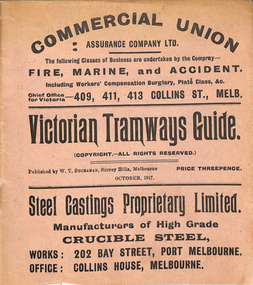
Ephemera, "Victorian Tramways Guide - October 1917", Oct. 1917
... line. Gives details of fares, routes, signs, first and last cars. Middle page - has a map and details of a Round trip and shows other lines and change points. Foldout map included on the inside rear cover, showing tramways, railways and rivers. Has many advertisements for the re-election of Sir Frank Madden (he was not re-elected - see http://www.parliament.vic.gov.au/re-member/details/569-madden-frank - accessed 30-12-2016). Polling day 15/11/1917. Has adverts for: Commercial Union Steel Castings...line. Gives details of fares, routes, signs, first and last cars. Middle page - has a map and details of a Round trip and shows other lines and change points. Foldout map included on the inside rear cover, showing tramways, railways and rivers. Has many advertisements for the re-election of Sir Frank Madden (he was not re-elected - see http://www.parliament.vic.gov.au/re-member/details/569-madden-frank - accessed 30-12-2016). Polling day 15/11/1917. Has adverts for: Commercial Union Steel Castings ...Timetable - 36 pages, printed on off-white paper, cover printed on pink paper, centre stapled titled "Victorian Tramways Guide" for October 1917. Details the timetables for the Tramway Board, Northcote Council, PMTT, NMETL, HTT, MBCTT and the VR Brighton line. Gives details of fares, routes, signs, first and last cars. Middle page - has a map and details of a Round trip and shows other lines and change points. Foldout map included on the inside rear cover, showing tramways, railways and rivers. Has many advertisements for the re-election of Sir Frank Madden (he was not re-elected - see http://www.parliament.vic.gov.au/re-member/details/569-madden-frank - accessed 30-12-2016). Polling day 15/11/1917. Has adverts for: Commercial Union Steel Castings Proprietary Limited Myer's Country of Bourke Permanent Building and Investment Society Prohibition - Canada, USA Royal Insurance Company Australian Ladies Commercial College Incley Frederick Collis Tramways Advertising Co. Stott's Business College Chambers and Seymour W. M Richards Huttons Ham Sterling Preparationstrams, tramways, timetables, melbourne, nmetl, vr, cable trams, htt, pmtt, map, advertising
