Ballarat Heritage Services
Photograph, Italian Holy Cards from the 1860s
... Caterina Lupis...A sacred image depicting the Virgin Mary, kept in the home of Caterina Lupis, was the scene of a miracle: tears of blood flowed from the painting. ...A sacred image depicting the Virgin Mary, kept in the home of Caterina Lupis, was the scene of a miracle: tears of blood flowed from the painting. ...
The Sanctuary of the Blessed Virgin of the Coast is located in the picturesque municipality of San Giovanni Bianco, is a fascinating example of a subsidiary church immersed in the greenery of the mountains. Its privileged location, at an altitude offering breathtaking views, has made this place an important point of reference for the local community since its founding. The church, characterized by a simple yet elegant architectural style, features a façade that exudes serenity and welcome, inviting visitors to discover its history and significance.
The feast of the Blessed Virgin of the Coast is celebrated every year on 15 August, becoming a moment of joy and sharing for the community.
True Image of the Blessed Virgin venerated in the Church of the Costa of St. Gall
One black and white holy card shows an artwork of the Blessed Virgin, St. Joseph, and the Magi and is venerated in the Church of the Costa of S. Gallo. The history of the sanctuary has its roots in an extraordinary event that occurred on 04 April 1492. A sacred image depicting the Virgin Mary, kept in the home of Caterina Lupis, was the scene of a miracle: tears of blood flowed from the painting. This event, interpreted as a divine sign, stirred great emotion and devotion in the local community.
After a series of miraculous events, the Madonna herself expressed the desire to build a sanctuary in her honor, in a specific place: the coast overlooking the town and the hamlets of San Giovanni. Construction of the sanctuary began in 1492, marking the beginning of a story of faith and devotion that continues to this day.
S. Antonio Abate, or St Anthony the Abbot Anthony the Abbot, Saint Anthony the Great, Saint Anthony of Egypt, Saint Anthony of the Fire, Saint Anthony of the Desert and Saint Anthony the Anchorite , ( Qumans , 12 January 251 – Thebaid Desert , 17 January 356 ) was an Egyptian abbot and hermit.
A contemporary of Paul of Thebes, he is considered the founder of Christian monasticism and the first of the abbots; he is responsible for the permanent establishment of families of monks who, under the guidance of a spiritual father, abba, consecrated themselves to the service of God. His life has been handed down by his disciple Athanasius of Alexandria. He is one of the four Fathers of the Eastern Church who bear the title of "Great" together with Athanasius himself, Basil and Photius of Constantinople. He is remembered in the Calendar of Saints of the Catholic Church and the Lutheran Church on January 17, but the Coptic Orthodox Church celebrates him on January 31, which corresponds, in its calendar, to the 22nd of the month of Tobit .
St Catherine of Alexandra was a martyr. T he emperor angrily ordered her to be executed on a breaking wheel. The breaking wheel is an ancient form of torture where a person's limbs are threaded among the spokes and their bones are shattered by an executioner with a heavy rod. It is a brutal punishment that results in a slow and painful death, normally reserved for the worst criminals. When Catherine was presented before the wheel, she touched it and a miracle occurred that caused the wheel to shatter. Unable to torture her to death, the emperor simply ordered her beheaded.
Around the year 800, a legend spread that her body has been found with her hair still growing and a constant stream of oil coming from her body. Nothing exists to this day of her remains, and her very existence has been called into question. Despite these questions, and the possibility that her story may be confused with that of one or more other saints, she is still venerated in the Eastern Orthodox Church as a Martyr. Many Roman Catholics also venerate her to this day as one of the great virgin saints of the early Church.
During the medieval period, St. Catherine was one of the most famous saints of the Church. She has was a popular subject in renaissance art and many paintings from the period are dedicated to her.
St. Henry, son of Henry, Duke of Bavaria, and of Gisella, daughter of Conrad, King of Burgundy, was born in 972. He received an excellent education under the care of St. Wolfgang, Bishop of Ratisbon. In 995, St. Henry succeeded his father as Duke of Bavaria, and in 1002, upon the death of his cousin, Otho III, he was elected emperor. Firmly anchored upon the great eternal truths, which the practice of meditation kept alive in his heart, he was not elated by this dignity and sought in all things, the greater glory of God. He was most watchful over the welfare of the Church and exerted his zeal for the maintenance of ecclesiastical discipline through the instrumentality of the Bishops. He gained several victories over his enemies, both at home and abroad, but he used these with great moderation and clemency. In 1014, he went to Rome and received the imperial crown at the hands of Pope Benedict VIII. On that occasion he confirmed the donation, made by his predecessors to the Pope, of the sovereignty of Rome and the exarchate of Ravenna. Circumstances several times drove the holy Emperor into war, from which he always came forth victorious. He led an army to the south of Italy against the Saracens and their allies, the Greeks, and drove them from the country. The humility and spirit of justice of the Saint were equal to his zeal for religion. He cast himself at the feet of Herebert, Bishop of Cologne, and begged his pardon for having treated him with coldness, on account of a misunderstanding. He wished to abdicate and retire into a monastery, but yielded to the advice of the Abbot of Verdun, and retained his dignity. Both he and his wife, St. Cunegundes, lived in perpetual chastity, to which they had bound themselves by vow. The Saint made numerous pious foundations, gave liberally to pious institutions and built the Cathedral of Bamberg. His holy death occurred at the castle of Grone, near Halberstad, in 1024. His feast day is July 13th. He is the patron saint of the childless, of Dukes, of the handicapped and those rejected by Religious Order.
What we know of St. Elizabeth comes from the Gospel, the book of Luke, in particular. In Luke, Elizabeth, a daughter of the line of Aaron, and the wife of Zechariah, was "righteous before God" and was "blameless" but childless. Elizabeth is also a cousin to the Virgin Mary.What we know of St. Elizabeth comes from the Gospel, the book of Luke, in particular. In Luke, Elizabeth, a daughter of the line of Aaron, and the wife of Zechariah, was "righteous before God" and was "blameless" but childless. Elizabeth is also a cousin to the Virgin Mary.
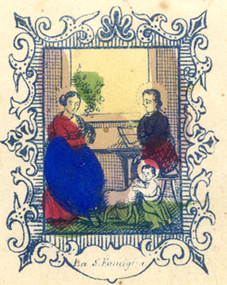
Five holy cards from San Gallo, Lombardy, Italy, carried by Luigi Gervasoni in a small prayer book that he carried to Australia. Two of the Holy Cards are hand coloured, and one mentions the Church were he was baptised, The Chiesa della Costa di S. Gallo. caterina lupis, san gallo, luigi gervasoni, italy, saint elizabeth, san giovanni bianco, chiesa di costa san giovanni bianco, holy family, saint anthony the abbot, st catherine