
Showing 20 items matching "catgut"
-
 Ambulance Victoria Museum
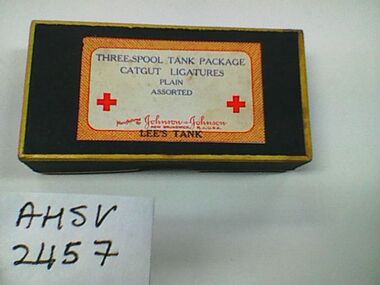
Box, ligatures, Catgut, Johnson & Johnson, UNKNOWN
... ...catgut...Rectangular, flat cardboard box with lid containing catgut ligatures for medical use. Made from black cardboard with yellow edging. ...Label on lid "Three-spool Tank Package - Catgut Ligatures" ...johnson & johnson, usa ligatures catgut Label on lid "Three-spool Tank Package - Catgut Ligatures" Rectangular, flat cardboard box with lid containing catgut ligatures for medical use. ...Rectangular, flat cardboard box with lid containing catgut ligatures for medical use. Made from black cardboard with yellow edging. The lid has a paper label adhered to surface printed in red, blue, and yellow. The underside of the box has a plain white label stuck over it.Label on lid "Three-spool Tank Package - Catgut Ligatures" johnson & johnson, usa, ligatures, catgut -
 Ballarat Base Hospital Trained Nurses League
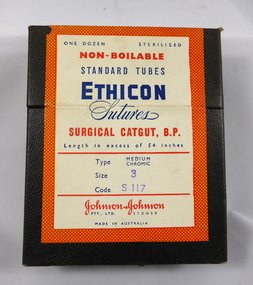
Surgical Catgut
... ...catgut...Surgical Catgut, sutures, standard tubes....surgical catgut Surgical Catgut, sutures, standard tubes. ...Surgical Catgut, sutures, standard tubes.surgical, catgut -
 Port Fairy Historical Society Museum and Archives
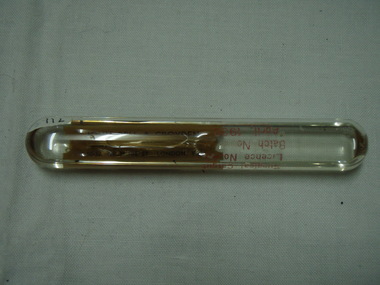
Functional object - First Aid Vial
... Doctor's sealed glass vial containing catgut thread and surgical needle suspended in a sterile liquid. ...Surgical Catgut Licence No 43 Batch No April 1939...medicine snake bite kit Surgical Catgut Licence No 43 Batch No April 1939 Doctor's sealed glass vial containing catgut thread and surgical needle suspended in a sterile liquid. ...Doctor's sealed glass vial containing catgut thread and surgical needle suspended in a sterile liquid. Thread is wrapped around a card labelled "Sterilised Surgical Ligature Thread No 0"Surgical Catgut Licence No 43 Batch No April 1939medicine, snake bite, kit -
 Royal Australian and New Zealand College of Obstetricians & Gynaecologists (RANZCOG)
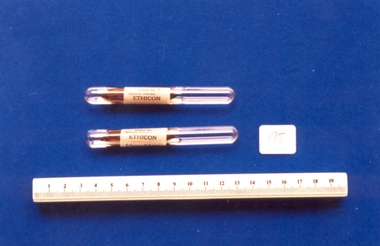
Two glass vials of 'Ethicon' catgut #3 used by Dr Mitchell Henry O'Sullivan, Ethicon
... Tanned or chronic catgut came from top quality catgut (fat free). ...Two glass vials [195.1,.3] with catgut number three "Ethicon" [195.2,.4] in sterile solution. ...Tanned or chronic catgut came from top quality catgut (fat free). ...Tanned or chronic catgut came from top quality catgut (fat free). A hardening process was then applied to the muscle durations. The process was introduced and perfected by the firm of Mersons of Edinburgh, makers of sterile surgical ligatures in the early 1930s. Once processed the catgut was preserved in an iod-asceptic preserving spirit and hermetically sealed in glass tubes. It was completely sterile and ready for immediate use. The length of the catgut in each tube was five feet, or 2.5m, and could be wound onto glass winders in assorted colours.Dr Mitchell Henry O'Sullivan worked in the Victorian country town of Casterton as a general practitioner from 1919 until his death in 1977. He also practiced obstetrics. His son, Dr David More O'Sullivan donated his obstetric bag and its contents to the College in 1999. The bag and contents are a unique time capsule of the type of instruments and pharmaceuticals used in the inter-war period.Two glass vials [195.1,.3] with catgut number three "Ethicon" [195.2,.4] in sterile solution. Vials are moulded and sealed at both ends.obstetric delivery -
 Ballarat Base Hospital Trained Nurses League
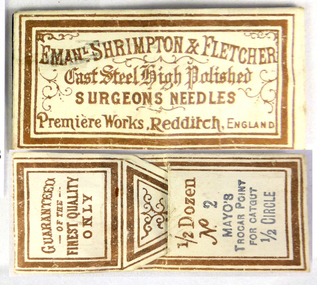
Emanl Shrimpton & Fletcher Surgical Needles
... Mayo's Trocar Point for Catgut, 1/2 Circle, Size No 2, 1/2 Doz....Emanl Shrimpton & Fletcher Surgical Needles Mayo's Trocar Point for Catgut, 1/2 Circle, Size No 2, 1/2 Doz. Emanl Shrimpton & Fletcher Surgical Needles ...Mayo's Trocar Point for Catgut, 1/2 Circle, Size No 2, 1/2 Doz.emanl shrimpton & fletcher surgical needles -
 Ballarat Base Hospital Trained Nurses League
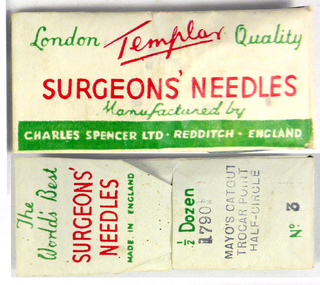
Templar Surgical Needles
... 1790 1/2 Mayo's Catgut Trocar Point, Half Circle, Size No 3, 1/2 Doz....Templar Surgical Needles 1790 1/2 Mayo's Catgut Trocar Point, Half Circle, Size No 3, 1/2 Doz. ...1790 1/2 Mayo's Catgut Trocar Point, Half Circle, Size No 3, 1/2 Doz.templar surgical needles -
 Ballarat Base Hospital Trained Nurses League
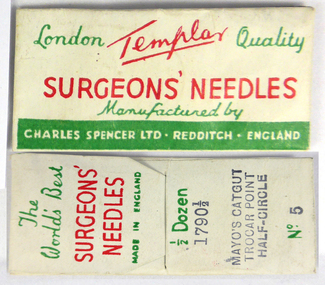
Templar Surgical Needles
... 1790 1/2 Mayo's Catgut Trocar Point, Half Circle, Size No 5, 1/2 Doz. ...1790 1/2 Mayo's Catgut Trocar Point, Half Circle, Size No 5, 1/2 Doz. ...1790 1/2 Mayo's Catgut Trocar Point, Half Circle, Size No 5, 1/2 Doz. -
 Kiewa Valley Historical Society
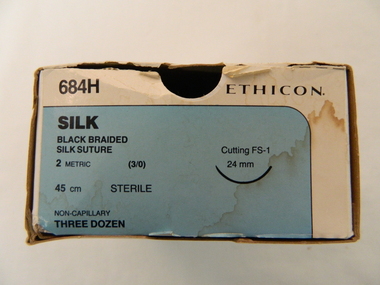
Silk Sutures
... x 15 packets/sachets of Black braided silk sutures and x 3 packets of Surgical Catgut in a cardboard box with a tray sliding out. ...Sachet yellow label: Plain 2/0 metric 3.5 / Ethicon / Surgical Catgut, B.P. / Sterile / Non- Boilable / Taper CT-1/ 36 mm / Length 75 cm / Ethnor Pty. ...Sachet yellow label: Plain 2/0 metric 3.5 / Ethicon / Surgical Catgut, B.P. / Sterile / Non- Boilable / Taper CT-1/ 36 mm / Length 75 cm / Ethnor Pty. ...This medical / hospital equipment was used in the Tawonga District General Hospital which was built in the 1950s, specifically for the increase in population due to the Kiewa Hydro Scheme.Historical: Shows the development of scientific hospital equipment. Provenance: Used in the Tawonga District General Hospital which was remote and therefore required good equipment.x 15 packets/sachets of Black braided silk sutures and x 3 packets of Surgical Catgut in a cardboard box with a tray sliding out. The box is labelled. The sachets are standing up in the tray. The packets are labelled and have foil at the back and clear plastic attached at the front. The suture is sterilised and possibly in a sachet of its own behind the label.Box and each sachet: Blue label at end of tray- 684H (top left) 2 metric (3/0) ETHICON / Silk / Black Braided /Silk Suture /45 cm Non-Capillary Sterile / Johnson & Johnson / medical Products Pty. Ltd. Sydney. (on right) Cutting FS-1 / 24mm. Sachet yellow label: Plain 2/0 metric 3.5 / Ethicon / Surgical Catgut, B.P. / Sterile / Non- Boilable / Taper CT-1/ 36 mm / Length 75 cm / Ethnor Pty. Ltd. Sydney. Across the sachet is a dotted line (for cutting?) then across the label Plain 2/0 / 843. Top of box - broken label. Made in Australia /Johnson&Johnson medical equipment. hospital equipment. tawonga. mt beauty. suture. -
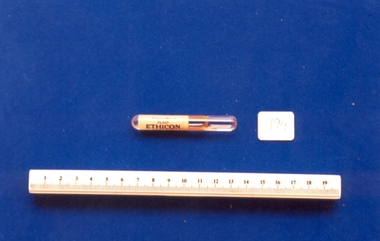 Royal Australian and New Zealand College of Obstetricians & Gynaecologists (RANZCOG)
'Ethicon' catgut #1 in glass vial used by Dr Mitchell Henry O'Sullivan, Ethicon
... Vial, glass [194.1] containing "Ethicon" catgut number one [194.2] in sterile solution. ...Obstetric delivery Vial, glass [194.1] containing "Ethicon" catgut number one [194.2] in sterile solution. ...Dr Mitchell Henry O'Sullivan worked in the Victorian country town of Casterton as a general practitioner from 1919 until his death in 1977. He also practiced obstetrics. The gladstone bag and contents are a unique time capsule of the type of instruments and pharmaceuticals used in the inter-war period. His son, Dr David More O'Sullivan donated the obstetric bag and its contents to the College in 1999.Vial, glass [194.1] containing "Ethicon" catgut number one [194.2] in sterile solution. Clear glass vial, moulded and sealed at both ends.obstetric delivery -
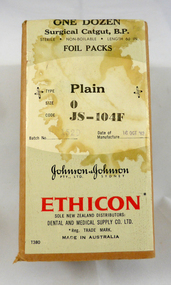 Ballarat Base Hospital Trained Nurses League
Surgical Catgut B.P. Foil Packs
... ...catgut...surgical catgut Foil Packs, 1 dozen. Surgical Catgut B.P. ...Foil Packs, 1 dozen.surgical, catgut -
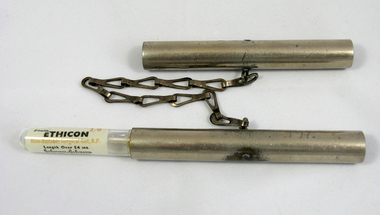 Ballarat Base Hospital Trained Nurses League
Catgut Breakers
... Catgut...Catgut Breakers Ballarat 2 metal cylinders with chain attached Catgut Breakers ...2 metal cylinders with chain attachedcatgut, breakers, ballarat -
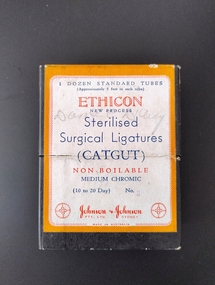 Royal Australian and New Zealand College of Obstetricians & Gynaecologists (RANZCOG)
Equipment - Box of Ethicon catgut vials associated with Dame Constance D'arcy, Johnson & Johnson
... Rectangular cardboard box containing twelve intact vials of catgut. Text on front of box reads '1 DOZEN STANDARD TUBES/(Approximately 5 feet in each tube)/ETHICON/NEW PROCESS/Sterilised/Surgical Ligatures/(CATGUT)/NON-BOILABLE/MEDIUM CHROMIC/ (10 to 20 Day) No. 3'. ...Equipment Box of Ethicon catgut vials associated with Dame Constance D'arcy Johnson & Johnson ...This item was donated to RANZCOG's historical collection by Dr Ian Cope. In 1958, Dr Cope moved into rooms at 233 Macquarie Street, Sydney, which had previously been occupied by Dr Dame Constance D'arcy. He subsequently donated much of the material which remained in those rooms to the College.Rectangular cardboard box containing twelve intact vials of catgut. Text on front of box reads '1 DOZEN STANDARD TUBES/(Approximately 5 feet in each tube)/ETHICON/NEW PROCESS/Sterilised/Surgical Ligatures/(CATGUT)/NON-BOILABLE/MEDIUM CHROMIC/ (10 to 20 Day) No. 3'. The name of the manufacturer is printed at the bottom of the front of the box, along with the text 'MADE IN AUSTRALIA'. Box and lid are joined at halfway height of the box. Box has an inner cardboard lining which separates and contains the individual vials.dame constance d'arcy, surgery -
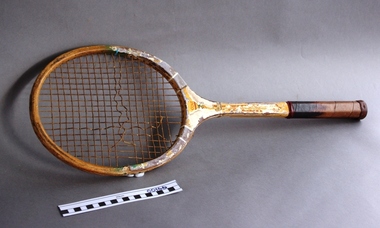 Upper Yarra Museum
Tennis Racket, Racquet, Brewers.Started manufacturing in 1928 in Newport and later in Mitcham
... The name neither implies nor derives from any association with cats. The word catgut may have been an abbreviation of the word "cattlegut". ...The name neither implies nor derives from any association with cats. The word catgut may have been an abbreviation of the word "cattlegut". ...File sizes Review ideal file sizes for photos http://www.tennishistory.com.au/equipment/vintage-racquets/racquet-retailing.html Extract - Born in Bendigo in 1905, Albert Brewer came to Melbourne in 1920 to commence work as a furniture factory machinist at Rojos Pty.Ltd. in Little Lonsdale Street Melbourne . http://en.wikipedia.org/wiki/Catgut Catgut is a type of cord[1] that is prepared from the natural fiber in the walls of animal intestines.[2] Usually sheep or goat intestines are used, but it is occasionally made from the intestines of a hog, horse, mule, pig or donkey. The name neither implies nor derives from any association with cats. The word catgut may have been an abbreviation of the word "cattlegut". Alternatively, it may have derived by folk etymology from kitgut or kitstring -- the word kit, meaning fiddle, having at some point been confused with the word kit for little cat. According to legend, string makers of the 17th century deliberately misled people to believe that the strings were made of cat intestines in order to protect their industry, as any association with cats was superstitiously believed to be extremely bad luck, and to be avoided at all costRacket or Racqet. A teardrop shaped wooden frame with tight interlaced network of strings. The strings are made of Cat-gut, several are broken. See narrative on Cat gut.The racket is branded Colt at the base of the tear drop and Designed for Young Players. Made by Brewer Australia. Maker of the Worlds famous style,is printed on the handle on both sides. The frame is made of laminated wood. The paint is in poor condition.The racket has a leather grip, the grip is is worn and stained. .Powerhouse Museum Collection Thesaurus Light bats consisting of a network of cord or nylon stretched in an elliptical frame, used chiefly in playing ball games like tennis, badminton, etc.Colt. Made by Brewers Australia. Maker of the Worlds Famous style leader. Designed for young playersball, sport, leather, game, racquet, racket, colt, cat gut, strings, young players, brewer, handle, grip -
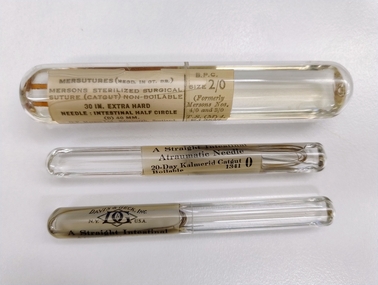 Royal Australian and New Zealand College of Obstetricians & Gynaecologists (RANZCOG)
Equipment - Vials of suture material with needles associated with Dame Constance D'arcy, Davis & Geck Inc
... The first vial is labelled 'MERSUTURES/MERSONS STERILIZED SURGICAL/SUTURE (CATGUT) NON-BOILABLE/30 IN. EXTRA HARD/NEEDLE: INTESTINAL HALF CIRCLE/(D) 40 MM....The first vial is labelled 'MERSUTURES/MERSONS STERILIZED SURGICAL/SUTURE (CATGUT) NON-BOILABLE/30 IN. EXTRA HARD/NEEDLE: INTESTINAL HALF CIRCLE/(D) 40 MM. ...This item was donated to RANZCOG's historical collection by Dr Ian Cope. In 1958, Dr Cope moved into rooms at 233 Macquarie Street, Sydney, which had previously been occupied by Dr Dame Constance D'arcy. He subsequently donated much of the material which remained in those rooms to the College.Three sealed glass vials, each containing suture material, a needle, and sterile liquid. The first vial is labelled 'MERSUTURES/MERSONS STERILIZED SURGICAL/SUTURE (CATGUT) NON-BOILABLE/30 IN. EXTRA HARD/NEEDLE: INTESTINAL HALF CIRCLE/(D) 40 MM./G.F. Merson Ltd., Edinburgh, Scotland/B.P.C./SIZE 2/0/(Formerly/Mersons Nos. "4/0 and 3/0"/T.S. (M) 4./EJ 3547'. Second and third vials carry the logo of Davis and Geck Inc. and are labelled with the text 'A Straight Intestinal/Atraumatic Needle/20-Day Kalmerid Catgut/Boilable/1341/0'dame constance d'arcy -
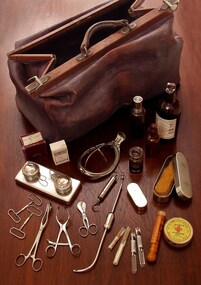 Royal Australian and New Zealand College of Obstetricians & Gynaecologists (RANZCOG)
Obstetrician's medical bag containing medical instruments and equipment of Dr
... An obstetrician's bag belonging to the late Dr Henry Mitchell O'Sullivan (1892-1972) containing various items such as obstetric forceps, destructive instruments, curette, pelvimeter, catheter, speculum, antiseptic, chloroform, iodine, catgut suture, surgical needles and twine for tying off umbilical cord after delivery. ...Consequently, this item is a unique time capsule of the type of instruments and pharmaceuticals usedby a Victorian country doctor in the inter-war period. dr henry mitchell o'sullivan casterton victoria dr david more o'sullivan inter-war period An obstetrician's bag belonging to the late Dr Henry Mitchell O'Sullivan (1892-1972) containing various items such as obstetric forceps, destructive instruments, curette, pelvimeter, catheter, speculum, antiseptic, chloroform, iodine, catgut suture, surgical needles and twine for tying off umbilical cord after delivery. ...Dr Henry Mitchell O'Sullivan was a medical doctor also practising obstetrics in the district of Casterton, Victoria from 1919 until his death in 1977.The Gladstone bag and contents were used in the inter-war period 1918-1945. His son, the late Dr David More O'Sullivan donated the obstetric bag and its contents to the RANZCOG Museum in 1999.The Gladstone bag was put aside and the contents have remained intact. Consequently, this item is a unique time capsule of the type of instruments and pharmaceuticals usedby a Victorian country doctor in the inter-war period.An obstetrician's bag belonging to the late Dr Henry Mitchell O'Sullivan (1892-1972) containing various items such as obstetric forceps, destructive instruments, curette, pelvimeter, catheter, speculum, antiseptic, chloroform, iodine, catgut suture, surgical needles and twine for tying off umbilical cord after delivery. dr henry mitchell o'sullivan, casterton victoria, dr david more o'sullivan, inter-war period -
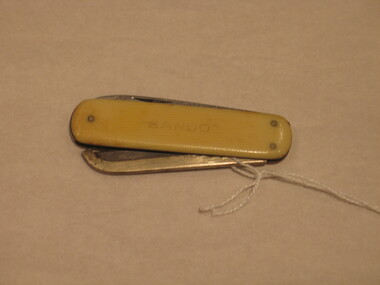 Royal Australian and New Zealand College of Obstetricians & Gynaecologists (RANZCOG)
Knife, pocket, c1982
... This pocket knife had an attached arm that was designed to break off the tops of glass vials containing catgut suture in solution.Sandoz manufactured the suture and provided the pocket knives with the vials of suture, according to Dr Ray Hyslop, the donor.....This pocket knife had an attached arm that was designed to break off the tops of glass vials containing catgut suture in solution.Sandoz manufactured the suture and provided the pocket knives with the vials of suture, according to Dr Ray Hyslop, the donor.. ...Pocket knife, metal with ivory hanlde inserts, manufacturer "Sandoz"inscribed on handle. This pocket knife had an attached arm that was designed to break off the tops of glass vials containing catgut suture in solution.Sandoz manufactured the suture and provided the pocket knives with the vials of suture, according to Dr Ray Hyslop, the donor..glass vial cutter -
 Royal Australian and New Zealand College of Obstetricians & Gynaecologists (RANZCOG)
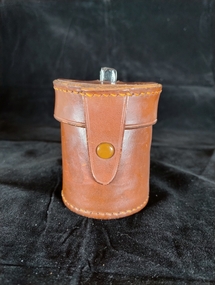
Glass jar containing roll of catgut, with protective case
... The jar appears to contain a roll of catgut, but the lid of the jar is jammed and the jar is jammed in the case so this is yet to be verified....Glass jar containing roll of catgut, with protective case ...Glass jar with lid in protective brown leather case. Jar and case are cylindrical. Case is made of brown leather with yellow stitching. Case has a folding lid, fastened by a stud button at the front. Glass jar consists of base and lid. Lid is topped by a rectangular glass handle at centre, which protrudes through the top of the protective case. The jar appears to contain a roll of catgut, but the lid of the jar is jammed and the jar is jammed in the case so this is yet to be verified. -
 Flagstaff Hill Maritime Museum and Village
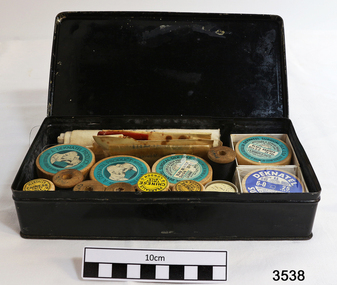
Equipment - Surgical silks and sutures, Teleflex (manufacturers of Deknatel), Early 1900s
... He first attempted sterilization with the 1860s "carbolic catgut," and chromic catgut followed two decades later. ...He first attempted sterilization with the 1860s "carbolic catgut," and chromic catgut followed two decades later. ...Through many millennia, various suture materials were used or proposed. Needles were made of bone or metals such as silver, copper, and aluminium bronze wire. Sutures were made of plant materials (flax, hemp and cotton) or animal material (hair, tendons, arteries, muscle strips and nerves, silk, and catgut).[citation needed] The earliest reports of surgical suture date to 3000 BC in ancient Egypt, and the oldest known suture is in a mummy from 1100 BC. A detailed description of a wound suture and the suture materials used in it is by the Indian sage and physician Sushruta, written in 500 BC. The Greek father of medicine, Hippocrates, described suture techniques, as did the later Roman Aulus Cornelius Celsus. The 2nd-century Roman physician Galen described sutures made of surgical gut or catgut. In the 10th century, the catgut suture along with the surgery needle were used in operations by Abulcasis. The gut suture was similar to that of strings for violins, guitars, and tennis racquets and it involved harvesting sheep or cow intestines. Catgut sometimes led to infection due to a lack of disinfection and sterilization of the material. Joseph Lister endorsed the routine sterilization of all suture threads. He first attempted sterilization with the 1860s "carbolic catgut," and chromic catgut followed two decades later. Sterile catgut was finally achieved in 1906 with iodine treatment. The next great leap came in the twentieth century. The chemical industry drove production of the first synthetic thread in the early 1930s, which exploded into production of numerous absorbable and non-absorbable synthetics. The first synthetic absorbable was based on polyvinyl alcohol in 1931. Polyesters were developed in the 1950s, and later the process of radiation sterilization was established for catgut and polyester. Polyglycolic acid was discovered in the 1960s and implemented in the 1970s. Today, most sutures are made of synthetic polymer fibers. Silk and, rarely, gut sutures are the only materials still in use from ancient times. In fact, gut sutures have been banned in Europe and Japan owing to concerns regarding bovine spongiform encephalopathy. Silk suture is still used today, mainly to secure surgical drains. https://en.wikipedia.org/wiki/Surgical_suture#:~:text=Sutures%20were%20made%20of%20plant,a%20mummy%20from%201100%20BC. This tin contains a variety of surgical threads and accessories that were used by Dr W.R.Angus. It was donated to Flagstaff Hill Maritime Village by the family of Doctor William Roy Angus, Surgeon and Oculist. It is part of the “W.R. Angus Collection” that includes historical medical equipment, surgical instruments and material once belonging to Dr Edward Ryan and Dr Thomas Francis Ryan, (both of Nhill, Victoria) as well as Dr Angus’ own belongings. The Collection’s history spans the medical practices of the two Doctors Ryan, from 1885-1926 plus that of Dr Angus, up until 1969. ABOUT THE “W.R.ANGUS COLLECTION” Doctor William Roy Angus M.B., B.S., Adel., 1923, F.R.C.S. Edin.,1928 (also known as Dr Roy Angus) was born in Murrumbeena, Victoria in 1901 and lived until 1970. He qualified as a doctor in 1923 at University of Adelaide, was Resident Medical Officer at the Royal Adelaide Hospital in 1924 and for a period was house surgeon to Sir (then Mr.) Henry Simpson Newland. Dr Angus was briefly an Assistant to Dr Riddell of Kapunda, then commenced private practice at Curramulka, Yorke Peninsula, SA, where he was physician, surgeon and chemist. In 1926, he was appointed as new Medical Assistant to Dr Thomas Francis Ryan (T.F. Ryan, or Tom), in Nhill, Victoria, where his experiences included radiology and pharmacy. In 1927 he was Acting House Surgeon in Dr Tom Ryan’s absence. Dr Angus had become engaged to Gladys Forsyth and they decided he would take time to further his studies overseas in the UK in 1927. He studied at London University College Hospital and at Edinburgh Royal Infirmary and in 1928, was awarded FRCS (Fellow from the Royal College of Surgeons), Edinburgh. He worked his passage back to Australia as a Ship’s Surgeon on the on the Australian Commonwealth Line’s SS Largs Bay. Dr Angus married Gladys in 1929, in Ballarat. (They went on to have one son (Graham 1932, born in SA) and two daughters (Helen (died 12/07/1996) and Berenice (Berry), both born at Mira, Nhill ) Dr Angus was a ‘flying doctor’ for the A.I.M. (Australian Inland Ministry) Aerial Medical Service in 1928 . The organisation began in South Australia through the Presbyterian Church in that year, with its first station being in the remote town of Oodnadatta, where Dr Angus was stationed. He was locum tenens there on North-South Railway at 21 Mile Camp. He took up this ‘flying doctor’ position in response to a call from Dr John Flynn; the organisation was later known as the Flying Doctor Service, then the Royal Flying Doctor Service. A lot of his work during this time involved dental surgery also. Between 1928-1932 he was surgeon at the Curramulka Hospital, Yorke Peninsula, South Australia. In 1933 Dr Angus returned to Nhill where he’d previously worked as Medical Assistant and purchased a share of the Nelson Street practice and Mira hospital from Dr Les Middleton one of the Middleton Brothers, the current owners of what was once Dr Tom Ryan’s practice. Dr L Middleton was House Surgeon to the Nhill Hospital 1926-1933, when he resigned. [Dr Tom Ryan’s practice had originally belonged to his older brother Dr Edward Ryan, who came to Nhill in 1885. Dr Edward saw patients at his rooms, firstly in Victoria Street and in 1886 in Nelson Street, until 1901. The Nelson Street practice also had a 2 bed ward, called Mira Private Hospital ). Dr Edward Ryan was House Surgeon at the Nhill Hospital 1884-1902 . He also had occasions where he successfully performed veterinary surgery for the local farmers too. Dr Tom Ryan then purchased the practice from his brother in 1901. Both Dr Edward and Dr Tom Ryan work as surgeons included eye surgery. Dr Tom Ryan performed many of his operations in the Mira private hospital on his premises. He too was House Surgeon at the Nhill Hospital 1902-1926. Dr Tom Ryan had one of the only two pieces of radiology equipment in Victoria during his practicing years – The Royal Melbourne Hospital had the other one. Over the years Dr Tom Ryan gradually set up what was effectively a training school for country general-practitioner-surgeons. Each patient was carefully examined, including using the X-ray machine, and any surgery was discussed and planned with Dr Ryan’s assistants several days in advance. Dr Angus gained experience in using the X-ray machine there during his time as assistant to Dr Ryan. Dr Tom Ryan moved from Nhill in 1926. He became a Fellow of the Royal Australasian College of Surgeons in 1927, soon after its formation, a rare accolade for a doctor outside any of the major cities. He remained a bachelor and died suddenly on 7th Dec 1955, aged 91, at his home in Ararat. Scholarships and prizes are still awarded to medical students in the honour of Dr T.F. Ryan and his father, Dr Michael Ryan, and brother, John Patrick Ryan. ] When Dr Angus bought into the Nelson Street premises in Nhill he was also appointed as the Nhill Hospital’s Honorary House Surgeon 1933-1938. His practitioner’s plate from his Nhill surgery states “HOURS Daily, except Tuesdays, Fridays and Saturday afternoons, 9-10am, 2-4pm, 7-8pm. Sundays by appointment”. This plate is now mounted on the doorway to the Port Medical Office at Flagstaff Hill Maritime Village, Warrnambool. Dr Edward Ryan and Dr Tom Ryan had an extensive collection of historical medical equipment and materials spanning 1884-1926 and when Dr Angus took up practice in their old premises he obtained this collection, a large part of which is now on display at the Port Medical Office at Flagstaff Hill Maritime Village in Warrnambool. During his time in Nhill Dr Angus was involved in the merging of the Mira Hospital and Nhill Public Hospital into one public hospital and the property titles passed on to Nhill Hospital in 1939. In 1939 Dr Angus and his family moved to Warrnambool where he purchased “Birchwood,” the 1852 home and medical practice of Dr John Hunter Henderson, at 214 Koroit Street. (This property was sold in1965 to the State Government and is now the site of the Warrnambool Police Station. ). The Angus family was able to afford gardeners, cooks and maids; their home was a popular place for visiting dignitaries to stay whilst visiting Warrnambool. Dr Angus had his own silk worm farm at home in a Mulberry tree. His young daughter used his centrifuge for spinning the silk. Dr Angus was appointed on a part-time basis as Port Medical Officer (Health Officer) in Warrnambool and held this position until the 1940’s when the government no longer required the service of a Port Medical Officer in Warrnambool; he was thus Warrnambool’s last serving Port Medical Officer. (The duties of a Port Medical Officer were outlined by the Colonial Secretary on 21st June, 1839 under the terms of the Quarantine Act. Masters of immigrant ships arriving in port reported incidents of diseases, illness and death and the Port Medical Officer made a decision on whether the ship required Quarantine and for how long, in this way preventing contagious illness from spreading from new immigrants to the residents already in the colony.) Dr Angus was a member of the Australian Medical Association, for 35 years and surgeon at the Warrnambool Base Hospital 1939-1942, He served as a Surgeon Captain during WWII1942-45, in Ballarat, Victoria, and in Bonegilla, N.S.W., completing his service just before the end of the war due to suffering from a heart attack. During his convalescence he carved an intricate and ‘most artistic’ chess set from the material that dentures were made from. He then studied ophthalmology at the Royal Melbourne Eye and Ear Hospital and created cosmetically superior artificial eyes by pioneering using the intrascleral cartilage. Angus received accolades from the Ophthalmological Society of Australasia for this work. He returned to Warrnambool to commence practice as an ophthalmologist, pioneering in artificial eye improvements. He was Honorary Consultant Ophthalmologist to Warrnambool Base Hospital for 31 years. He made monthly visits to Portland as a visiting surgeon, to perform eye surgery. He represented the Victorian South-West subdivision of the Australian Medical Association as its secretary between 1949 and 1956 and as chairman from 1956 to 1958. In 1968 Dr Angus was elected member of Spain’s Barraquer Institute of Barcelona after his research work in Intrasclearal cartilage grafting, becoming one of the few Australian ophthalmologists to receive this honour, and in the following year presented his final paper on Living Intrasclearal Cartilage Implants at the Inaugural Meeting of the Australian College of Ophthalmologists in Melbourne In his personal life Dr Angus was a Presbyterian and treated Sunday as a Sabbath, a day of rest. He would visit 3 or 4 country patients on a Sunday, taking his children along ‘for the ride’ and to visit with him. Sunday evenings he would play the pianola and sing Scottish songs to his family. One of Dr Angus’ patients was Margaret MacKenzie, author of a book on local shipwrecks that she’d seen as an eye witness from the late 1880’s in Peterborough, Victoria. In the early 1950’s Dr Angus, painted a picture of a shipwreck for the cover jacket of Margaret’s book, Shipwrecks and More Shipwrecks. She was blind in later life and her daughter wrote the actual book for her. Dr Angus and his wife Gladys were very involved in Warrnambool’s society with a strong interest in civic affairs. Their interests included organisations such as Red Cross, Rostrum, Warrnambool and District Historical Society (founding members), Wine and Food Society, Steering Committee for Tertiary Education in Warrnambool, Local National Trust, Good Neighbour Council, Housing Commission Advisory Board, United Services Institute, Legion of Ex-Servicemen, Olympic Pool Committee, Food for Britain Organisation, Warrnambool Hospital, Anti-Cancer Council, Boys’ Club, Charitable Council, National Fitness Council and Air Raid Precautions Group. He was also a member of the Steam Preservation Society and derived much pleasure from a steam traction engine on his farm. He had an interest in people and the community He and his wife Gladys were both involved in the creation of Flagstaff Hill, including the layout of the gardens. After his death (28th March 1970) his family requested his practitioner’s plate, medical instruments and some personal belongings be displayed in the Port Medical Office surgery at Flagstaff Hill Maritime Village, and be called the “W. R. Angus Collection”. The repair of open wounds is essential to prevent infection and death. The W.R. Angus Collection is significant for still being located at the site it is connected with, Doctor Angus being the last Port Medical Officer in Warrnambool. The collection of medical instruments and other equipment is culturally significant, being an historical example of medicine from late 19th to mid-20th century. Dr Angus assisted Dr Tom Ryan, a pioneer in the use of X-rays and in ocular surgery. Black tin with hinged lid, containing reels and packets of surgical silk, gut and metal suture threads, scalpel blades, chamois and metal blade holder with tensioned chamois piece across top. (W.R. Angus Collection)‘MEDRAFIL, Dr MULLER- MEERNACH, Nr O, MADE IN GERMANY.’ printed on one of the paper bags in the box containing a suture bobbin. 'PEARSALL'S LONDON' printed on some bobbins. 'J A DEKNATEL & SON INC, QUEENS VILLAGE, LONG ISLAND NEW YORK' printed on others.flagstaff hill, warrnambool, shipwrecked-coast, flagstaff-hill, flagstaff-hill-maritime-museum, maritime-museum, shipwreck-coast, flagstaff-hill-maritime-village, surgical silks and sutures, dr w r angus, medical equipment, surgical instrument, dr ryan, ophthalmology, s.s. largs bay, warrnambool base hospital, nhill base hospital, flying doctor, medical history, medical treatment, mira hospital, medical education, sutures, surgical silk -
 Ballarat Base Hospital Trained Nurses League
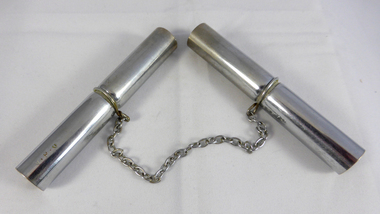
Catgut Breakers
... catgut breakers Catgut Breakers ...catgut breakers -
 Ballarat Base Hospital Trained Nurses League
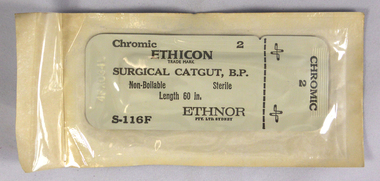
Surgical Catgut - Ethicon, Chromic 2
... Surgical Catgut - Ethicon, Chromic 2 Surgical Catgut - Ethicon, Chromic 2 ...surgical catgut - ethicon, chromic 2
