
Showing 79 items matching "catheter"
-
 Flagstaff Hill Maritime Museum and Village
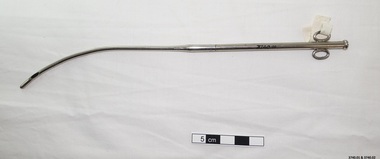
Equipment - Catheter, 20th century
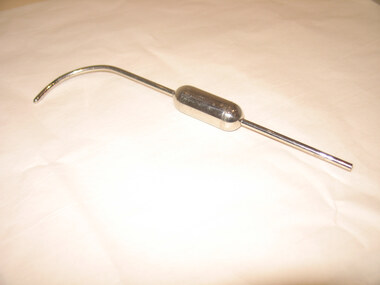
... Catheter......catheter...The word “catheter” comes from Greek, meaning “to let or send down.” ...Stainless steel catheter with hollow tip from W.R. Angus Collection. ...The word “catheter” comes from Greek, meaning “to let or send down.” ...The word “catheter” comes from Greek, meaning “to let or send down.” Catheters were used as early as 3,000 B.C. to relieve painful urinary retention. In those times, many materials were used to form a hollow catheter shape, including straw, rolled up palm leaves, hollow tops of onions, as well as, gold, silver, copper, brass, and lead. Malleable catheters were developed in the 11th century. In time, silver was used as the basis of catheters as it could be bent to any desired shape and was felt to have an antiseptic function. Benjamin Franklin, the inventor and colonial statesman, fashioned silver catheters for use by his older brother John. John suffered from kidney stones and needed to undergo a daily ritual of placing a bulky metal catheter into his bladder. To make these daily requirements on his brother less painful, Franklin worked with his local silversmith on his design for a flexible catheter. "It is as flexible as would be expected in a thing of the kind, and I imagine will readily comply with the turns of the passage," he wrote to John. Holes were bored into the sides of the catheter to allow for drainage. Coudé tip catheters were developed in the 18th and 19th centuries to facilitate male catheterization and continue to be used for this purpose in current medical practice. Catheters made from rubber were developed in the 18th century but were weak at body temperature, leaving debris in the bladder. The advent of rubber vulcanization, by Goodyear in 1844, improved the firmness and durability of the catheter, and allowed for mass production. Latex rubber became available in the 1930s. Dr. Frederic E.B. Foley (a St. Paul urologist) introduced the latex balloon catheter at a urologic meeting in 1935. Though he lost a legal battle with Davol for the patent, this catheter has since been known as the “Foley.” The earliest self-retaining catheters had wing tips (called Malecot) or flexible shoulders (called Pezzer), and were tied to the male penis or sutured to the female labia. Charriere’s French scale was used to describe the external diameter of a catheter. Thus the term “French (Fr)” size was coined. Joseph-Frederic-Benoit Charriere was a 19th century Parisian maker of surgical instruments. A 12 French catheter is approximately 4 mm in external diameter (0.33 mm = 1 French [Fr]). In French-speaking countries, these catheters may be referred to as the Charriere or abbreviated Ch. Catheterization of the bladder was felt to be fairly safe because of the antiseptic principles of Lister (1867). But many physicians continued to be concerned about catheter-related infections as patients were still developing “catheter fever” (systemic infection) despite antiseptic principles. After World War II, Sir Ludwig Guttman introduced the concept of sterile intermittent catheterization in patients with spinal cord injury. For many years, sterile technique was used for catheterization. In 1971, Dr. Jack Lapides of the University of Michigan at Ann Arbor introduced the clean intermittent catheterization (CIC) technique. Dr. Lapides’ theory was that bacteria weren’t the only cause of infection. He believed that chronic stagnant urine residuals and overstretching of the bladder were also responsible. But the fact that CIC was not performed in totally sterile conditions, Dr. Lapides still felt it was superior to indwelling catheters. Initially, Lapides was scorned in the urology world. Three decades after this debate, clean intermittent catheterization remains the preferred method to treat chronic urine retention and neurogenic bladder. Recent regulatory changes have recommended against the reuse of catheters for CIC in an attempt to further reduce the risk of catheter-associated urinary tract infections. https://www.urotoday.com/urinary-catheters-home/history-of-urinary-catheters.html This catheter was donated to Flagstaff Hill Maritime Village by the family of Doctor William Roy Angus, Surgeon and Oculist. It is part of the “W.R. Angus Collection” that includes historical medical equipment, surgical instruments and material once belonging to Dr Edward Ryan and Dr Thomas Francis Ryan, (both of Nhill, Victoria) as well as Dr Angus’ own belongings. The Collection’s history spans the medical practices of the two Doctors Ryan, from 1885-1926 plus that of Dr Angus, up until 1969. ABOUT THE “W.R.ANGUS COLLECTION” Doctor William Roy Angus M.B., B.S., Adel., 1923, F.R.C.S. Edin.,1928 (also known as Dr Roy Angus) was born in Murrumbeena, Victoria in 1901 and lived until 1970. He qualified as a doctor in 1923 at University of Adelaide, was Resident Medical Officer at the Royal Adelaide Hospital in 1924 and for a period was house surgeon to Sir (then Mr.) Henry Simpson Newland. Dr Angus was briefly an Assistant to Dr Riddell of Kapunda, then commenced private practice at Curramulka, Yorke Peninsula, SA, where he was physician, surgeon and chemist. In 1926, he was appointed as new Medical Assistant to Dr Thomas Francis Ryan (T.F. Ryan, or Tom), in Nhill, Victoria, where his experiences included radiology and pharmacy. In 1927 he was Acting House Surgeon in Dr Tom Ryan’s absence. Dr Angus had become engaged to Gladys Forsyth and they decided he further his studies overseas in the UK in 1927. He studied at London University College Hospital and at Edinburgh Royal Infirmary and in 1928, was awarded FRCS (Fellow from the Royal College of Surgeons), Edinburgh. He worked his passage back to Australia as a Ship’s Surgeon on the on the Australian Commonwealth Line’s T.S.S. Largs Bay. Dr Angus married Gladys in 1929, in Ballarat. (They went on to have one son (Graham 1932, born in SA) and two daughters (Helen (died 12/07/1996) and Berenice (Berry), both born at Mira, Nhill According to Berry, her mother Gladys made a lot of their clothes. She was very talented and did some lovely embroidery including lingerie for her trousseau and beautifully handmade baby clothes. Dr Angus was a ‘flying doctor’ for the A.I.M. (Australian Inland Ministry) Aerial Medical Service in 1928. Its first station was in the remote town of Oodnadatta, where Dr Angus was stationed. He was locum tenens there on North-South Railway at 21 Mile Camp. He took up this ‘flying doctor’ position in response to a call from Dr John Flynn; the organisation was later known as the Flying Doctor Service, then the Royal Flying Doctor Service. A lot of his work during this time involved dental surgery also. Between 1928-1932 he was surgeon at the Curramulka Hospital, Yorke Peninsula, South Australia. In 1933 Dr Angus returned to Nhill and purchased a share of the Nelson Street practice and Mira hospital (a 2 bed ward at the Nelson Street Practice) from Dr Les Middleton one of the Middleton Brothers, the current owners of what previously once Dr Tom Ryan’s practice. Dr Tom and his brother had worked as surgeons included eye surgery. Dr Tom Ryan performed many of his operations in the Mira private hospital on his premises. He had been House Surgeon at the Nhill Hospital 1902-1926. Dr Tom Ryan had one of the only two pieces of radiology equipment in Victoria during his practicing years – The Royal Melbourne Hospital had the other one. Over the years Dr Tom Ryan had gradually set up what was effectively a training school for country general-practitioner-surgeons. Each patient was carefully examined, including using the X-ray machine, and any surgery was discussed and planned with Dr Ryan’s assistants several days in advance. Dr Angus gained experience in using the X-ray machine there during his time as assistant to Dr Ryan. When Dr Angus bought into the Nelson Street premises in Nhill he was also appointed as the Nhill Hospital’s Honorary House Surgeon 1933-1938. His practitioner’s plate from his Nhill surgery is now mounted on the doorway to the Port Medical Office at Flagstaff Hill Maritime Village, Warrnambool. When Dr Angus took up practice in the Dr Edward and Dr Tom Ryan’s old premises he obtained their extensive collection of historical medical equipment and materials spanning 1884-1926. A large part of this collection is now on display at the Port Medical Office at Flagstaff Hill Maritime Village in Warrnambool. In 1939 Dr Angus and his family moved to Warrnambool where he purchased “Birchwood,” the 1852 home and medical practice of Dr John Hunter Henderson, at 214 Koroit Street. (This property was sold in1965 to the State Government and is now the site of the Warrnambool Police Station and an ALDI sore is on the land that was once their tennis court). The Angus family was able to afford gardeners, cooks and maids; their home was a popular place for visiting dignitaries to stay whilst visiting Warrnambool. Dr Angus had his own silk worm farm at home in a Mulberry tree. His young daughter used his centrifuge for spinning the silk. Dr Angus was appointed on a part-time basis as Port Medical Officer (Health Officer) in Warrnambool and held this position until the 1940’s when the government no longer required the service of a Port Medical Officer in Warrnambool; he was thus Warrnambool’s last serving Port Medical Officer. (Masters of immigrant ships arriving in port reported incidents of diseases, illness and death and the Port Medical Officer made a decision on whether the ship required Quarantine and for how long, in this way preventing contagious illness from spreading from new immigrants to the residents already in the colony.) Dr Angus was a member of the Australian Medical Association, for 35 years and surgeon at the Warrnambool Base Hospital 1939-1942, He served with the Australian Department of Defence as a Surgeon Captain during WWII 1942-45, in Ballarat, Victoria, and in Bonegilla, N.S.W., completing his service just before the end of the war due to suffering from a heart attack. During his convalescence he carved an intricate and ‘most artistic’ chess set from the material that dentures were made from. He then studied ophthalmology at the Royal Melbourne Eye and Ear Hospital and created cosmetically superior artificial eyes by pioneering using the intrascleral cartilage. Angus received accolades from the Ophthalmological Society of Australasia for this work. He returned to Warrnambool to commence practice as an ophthalmologist, pioneering in artificial eye improvements. He was Honorary Consultant Ophthalmologist to Warrnambool Base Hospital for 31 years. He made monthly visits to Portland as a visiting surgeon, to perform eye surgery. He represented the Victorian South-West subdivision of the Australian Medical Association as its secretary between 1949 and 1956 and as chairman from 1956 to 1958. In 1968 Dr Angus was elected member of Spain’s Barraquer Institute of Barcelona after his research work in Intrasclearal cartilage grafting, becoming one of the few Australian ophthalmologists to receive this honour, and in the following year presented his final paper on Living Intrasclearal Cartilage Implants at the Inaugural Meeting of the Australian College of Ophthalmologists in Melbourne In his personal life Dr Angus was a Presbyterian and treated Sunday as a Sabbath, a day of rest. He would visit 3 or 4 country patients on a Sunday, taking his children along ‘for the ride’ and to visit with him. Sunday evenings he would play the pianola and sing Scottish songs to his family. One of Dr Angus’ patients was Margaret MacKenzie, author of a book on local shipwrecks that she’d seen as an eye witness from the late 1880’s in Peterborough, Victoria. In the early 1950’s Dr Angus, painted a picture of a shipwreck for the cover jacket of Margaret’s book, Shipwrecks and More Shipwrecks. She was blind in later life and her daughter wrote the actual book for her. Dr Angus and his wife Gladys were very involved in Warrnambool’s society with a strong interest in civic affairs. He had an interest in people and the community. They were both involved in the creation of Flagstaff Hill, including the layout of the gardens. After his death (28th March 1970) his family requested his practitioner’s plate, medical instruments and some personal belongings be displayed in the Port Medical Office surgery at Flagstaff Hill Maritime Village, and be called the “W. R. Angus Collection”. The W.R. Angus Collection is significant for still being located at the site it is connected with, Doctor Angus being the last Port Medical Officer in Warrnambool. The collection of medical instruments and other equipment is culturally significant, being an historical example of medicine, administration, household equipment and clothing from late 19th to mid-20th century. Dr Angus assisted Dr Tom Ryan, a pioneer in the use of X-rays and in ocular surgery. Stainless steel catheter with hollow tip from W.R. Angus Collection. Top and end of this instrument screw together. flagstaff hill, warrnambool, shipwrecked coast, flagstaff hill maritime museum, maritime museum, shipwreck coast, flagstaff hill maritime village, great ocean road, dr w r angus, dr ryan, surgical instrument, t.s.s. largs bay, warrnambool base hospital, nhill base hospital, mira hospital, flying doctor, department of defence australia, australian army, army uniform, medical treatment, medical history, medical education, catheter -
 Kiewa Valley Historical Society
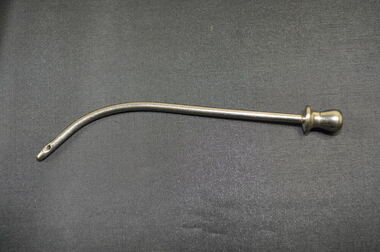
Catheter
... Catheter...Metal catheter has a knob at one end and is slightly curved at the other...Provenance: Used in the Tawonga District General Hospital which was remote and therefore required good equipment. hospital equipment. medical equipment. doctor. catheter. tawonga. mt beauty. Metal catheter has a knob at one end and is slightly curved at the other Catheter ...This medical / hospital instrument was used in the Tawonga District General Hospital which was built in the 1950s specifically for the increase in population due to the Kiewa Hydro Scheme.Historical: Shows the development of scientific hospital equipment. Provenance: Used in the Tawonga District General Hospital which was remote and therefore required good equipment.Metal catheter has a knob at one end and is slightly curved at the otherhospital equipment. medical equipment. doctor. catheter. tawonga. mt beauty. -
 Flagstaff Hill Maritime Museum and Village
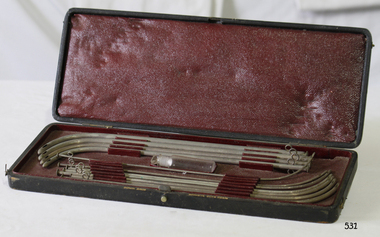
Catheter Set
... This urethral catheter set once belonged to Doctor John Henderson, who lived in "Birchwood" Warrnambool from 1852....Complete Catheter Set, laid out in a fitted box. Catheters are urethral catheters. ...Catheters are urethral catheters. They once belonged to Dr. ...This urethral catheter set once belonged to Doctor John Henderson, who lived in "Birchwood" Warrnambool from 1852.Complete Catheter Set, laid out in a fitted box. Catheters are urethral catheters. They once belonged to Dr. John Henderson of Warrnambool.flagstaff hill, warrnambool, shipwrecked-coast, flagstaff-hill, flagstaff-hill-maritime-museum, maritime-museum, shipwreck-coast, flagstaff-hill-maritime-village, medical instruments, urethral catherter set, urethral surgery, medical equipment, surgical equipment, dr john henderson, warrnambool doctor pre 1960s -
 Ballarat Base Hospital Trained Nurses League
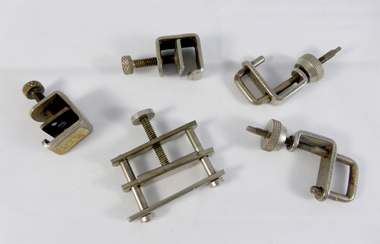
Catheter Clamps
... catheter...Catheter Clamps x 5...catheter clamps Catheter Clamps x 5 Catheter Clamps ...Catheter Clamps x 5catheter, clamps -
 Orbost & District Historical Society
catheter, c. mid 20th century
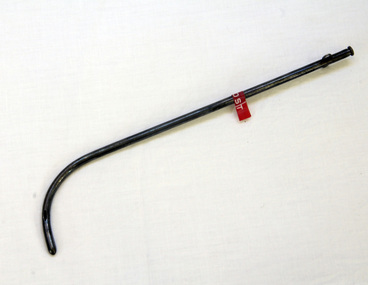
... catheter...A long metal catheter with a curved end, made of metal, possibly stainless steel. ...It has a red tag ORBOST. catheter ...Used at Orbost & District Hospital c. mid 20th century for urinary problems.This item is associated with Orbost Hospital and is an example of an early medical tool.A long metal catheter with a curved end, made of metal, possibly stainless steel. It has a small eyelet hole near the curved end. Inside is a fine metal tube. It has a red tag ORBOST. medical-instrument catheter -
 Kiewa Valley Historical Society
Catheter - Medical
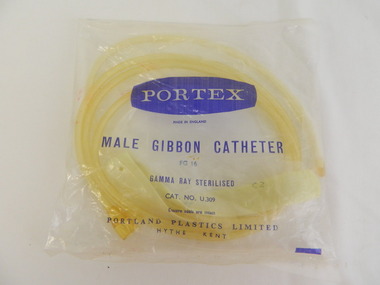
... catheter...Bag: Portex / Made in England / Male Gibbon Catheter / FG 16 / Gamma Ray Sterilised...Catheter - Medical ...This medical / hospital equipment was used in the Tawonga District General Hospital which was built in the 1950's specifically for the increase in population due to the Kiewa Hydro Scheme.Historical: Shows the development of scientific hospital equipment including sterilisation. Provenance: Used in the Tawonga District General Hospital which was remote and therefore required good equipment. good condition and good interpretation capacity.Plastic opaque yellowish tube in clear plastic sterilised bag with blue writing on it.Bag: Portex / Made in England / Male Gibbon Catheter / FG 16 / Gamma Ray Sterilisedcatheter, medical, hospital, portex, sterilisation -
 Ballarat Base Hospital Trained Nurses League
Tudor Edwards Catheter Carrier
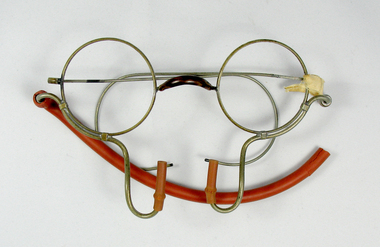
... ...Catheter...Tudor Edwards Catheter Carrier...Tudor Edwards Catheter Carrier Tudor Edwards Catheter Carrier Ballarat Metal spectacles with rubber tubes Tudor Edwards Catheter Carrier ...Tudor Edwards Catheter CarrierMetal spectacles with rubber tubestudor, edwards, catheter, carrier, ballarat -
 Orbost & District Historical Society
catheter, Mayer & Co, early 20th century
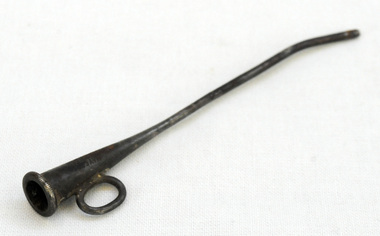
... catheter...It has a loop handle at the funnel end and is bent towards the end for insertion. catheter Mayer & Co. ...This veterinaary item as found in an old walk-through dairy on Wombat Track, Orbost.These items are representative of items used in Orbost on dairy farms in the first half of 20th century.A very small trumpet-shaped funnel made of silver/brass(?). It has a loop handle at the funnel end and is bent towards the end for insertion.MAYER & Co LONDON SILVERcatheter veterinary-instrument dairy farming -
 Royal Australian and New Zealand College of Obstetricians & Gynaecologists (RANZCOG)
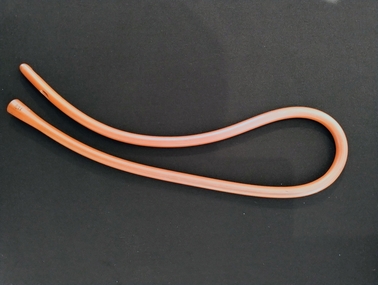
Rubber catheter, 11mm
... Red rubber catheter consisting of a length of red rubber tubing. ...Red rubber catheter consisting of a length of red rubber tubing. ...Red rubber catheter consisting of a length of red rubber tubing. One end of catheter is open and flared. This end of the catheter is printed with the text '6W' and '11 m/m' adjacent to the opening. Catheter ends in a rounded point at the other end. There are two staggered eyelets on alternate sides of the catheter at the closed end. -
 Ballarat Base Hospital Trained Nurses League
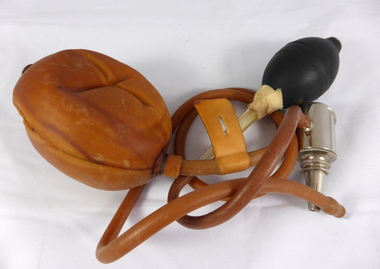
Politzer Bag, Mark Hovell's, Aural Instrument
... With catheter connecting nozzle....politzer bag mark hovell's aural instrument With catheter connecting nozzle. Politzer Bag, Mark Hovell's, Aural Instrument ...With catheter connecting nozzle.politzer bag, mark hovell's, aural, instrument -
 Royal Australian and New Zealand College of Obstetricians & Gynaecologists (RANZCOG)
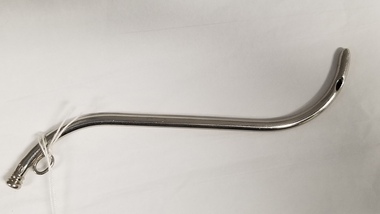
Tool - Uterine catheter used by Dr Fritz Duras and Dr Michael Kloss
... Metal uterine catheter. Catheter is in a vague 's' shape, with a rounded tip at one end and a hole in the catheter just above the tip. ...Obstetrics 'Kloss' Metal uterine catheter. Catheter is in a vague 's' shape, with a rounded tip at one end and a hole in the catheter just above the tip. ...This instrument was used by Dr Fritz Duras (1896-1965), who moved to Australia from Germany in 1937. As his father was Jewish, Duras was forced to leave Germany, and came to Australia to take up a post as director of physical education at Melbourne University. This instrument was part of a collection of instruments given to his son-in-law, Dr Michael Kloss, who was an obstetrician. Dr Kloss subsequently had it engraved and used it in his own practice, before donating the item to the College. Metal uterine catheter. Catheter is in a vague 's' shape, with a rounded tip at one end and a hole in the catheter just above the tip. There is a small oval shaped attachment at the proximal end of the device for grip. One side of the instrument is engraved with the word 'Kloss'. The number '10' is engraved at the proximal end of the catheter. Internal wire section may be missing from this catheter.'Kloss'obstetrics -
 Ballarat Base Hospital Trained Nurses League
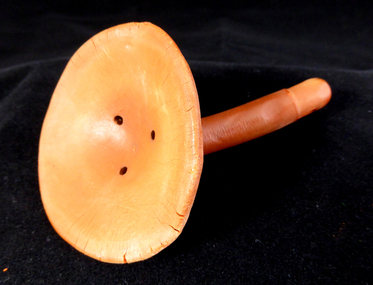
Gastrostomy Plug
... English catheter size - brown rubber....gastrostomy plug English catheter size - brown rubber. Gastrostomy Plug ...English catheter size - brown rubber.gastrostomy plug -
 Royal Australian and New Zealand College of Obstetricians & Gynaecologists (RANZCOG)
Instrument - Red Rubber Catheter
... Old red rubber catheter connected to rubber tubing ...Old red rubber catheter connected to rubber tubing Instrument Red Rubber Catheter ...Old red rubber catheter connected to rubber tubing -
Royal Australian and New Zealand College of Obstetricians & Gynaecologists (RANZCOG)
Instrument - De Lee Tracheal Catheter, De Lee
... De Lee Tracheal Catheter used for the resuscitation of newborn infants ...De Lee Tracheal Catheter used for the resuscitation of newborn infants Instrument De Lee Tracheal Catheter De Lee ...De Lee Tracheal Catheter used for the resuscitation of newborn infants -
 Geoffrey Kaye Museum of Anaesthetic History
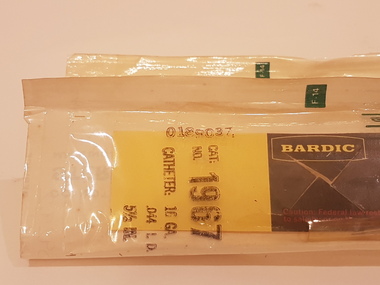
Equipment - Cannula placement set, Bardic, c. 1980
... Stamped in black ink on 3929.1: CAT: / NO. 1966 / CATHETER: 14 GA. / .058 I.D. / 5 1/2 IN. / 0182037 Stamped in black ink on 3929.2: CAT: / NO. 1967 / CATHETER: 16 GA. .044 I.D. / 5 1/2 IN. / 0189037...Intravenous Cannula Fluid therapy William O'Shaughnessy Thomas Latta Stamped in black ink on 3929.1: CAT: / NO. 1966 / CATHETER: 14 GA. / .058 I.D. / 5 1/2 IN. / 0182037 Stamped in black ink on 3929.2: CAT: / NO. 1967 / CATHETER: 16 GA. .044 I.D. / 5 1/2 IN. / 0189037 Clear plastic strip adhered to white paper backing, forming a sealed packet containing a cardboard backing board, with a cannula attached. ...Cholera swept a deadly path through Europe in 1832. Irish physician, William O’Shaughnessy, proposed treating patients with saline infusions and Dr Thomas Latta of Leith, successfully applied the treatment. The intravenous route is the fastest way to deliver fluids and medications through the body. Today, fluid therapy is one of the most widespread interventions in acute medicine. Clear plastic strip adhered to white paper backing, forming a sealed packet containing a cardboard backing board, with a cannula attached.Stamped in black ink on 3929.1: CAT: / NO. 1966 / CATHETER: 14 GA. / .058 I.D. / 5 1/2 IN. / 0182037 Stamped in black ink on 3929.2: CAT: / NO. 1967 / CATHETER: 16 GA. .044 I.D. / 5 1/2 IN. / 0189037intravenous, cannula, fluid therapy, william o'shaughnessy, thomas latta -
 Royal Australian and New Zealand College of Obstetricians & Gynaecologists (RANZCOG)
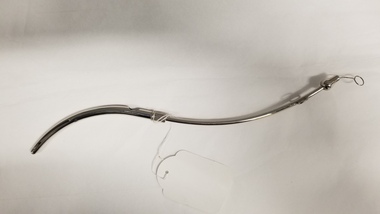
Tool - Uterine catheter used by Dr Fritz Duras
... Metal catheter with internal wire. Catheter is in a vague 's' shape, with a thinner and thicker section. ...Obstetrics Metal catheter with internal wire. Catheter is in a vague 's' shape, with a thinner and thicker section. ...This instrument was used by Dr Fritz Duras (1896-1965), who moved to Australia from Germany in 1937. As his father was Jewish, Duras was forced to leave Germany , and came to Australia to take up a post as director of physical education at Melbourne University. Metal catheter with internal wire. Catheter is in a vague 's' shape, with a thinner and thicker section. A loop at one end is attached to a wire which can be slid in and out of the device. There are two small round attachments at the thinner end of the device which function as grips. obstetrics -
 Royal Australian and New Zealand College of Obstetricians & Gynaecologists (RANZCOG)
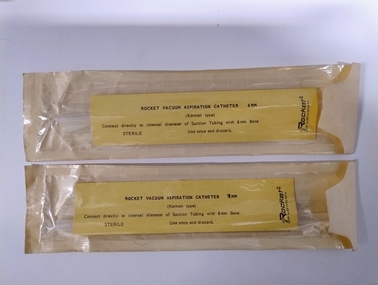
Instrument - Unused Rocket vacuum aspiration catheters, Karman type, Rocket & Co, London
... Two unused catheters in original packaging. One is 6mm width, the other is 8mm. ...Gynaecology Two unused catheters in original packaging. One is 6mm width, the other is 8mm. ...Two unused catheters in original packaging. One is 6mm width, the other is 8mm. Each catheter is a plastic tube, resembling a straw, open at one end and narrowing to a rounded point at the other. There are two openings in the tube just prior to the rounded point, staggered adjacently on either side of the tube, with a small overhanging notch at the top of each opening. Each catheter is sealed in sterile packaging, along with a note printed on yellow paper explaining their use. gynaecology -
 National Vietnam Veterans Museum (NVVM)
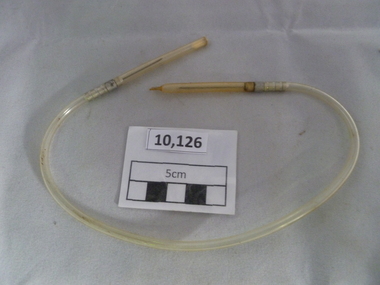
Functional Object, Plastic tubing
... Catheter...Catheter Plastic tubing with stainless steel fitting Plastic tubing Functional Object Functional Object ...Plastic tubing with stainless steel fittingcatheter -
 Royal Australian and New Zealand College of Obstetricians & Gynaecologists (RANZCOG)
Mucus catheter associated with Professor Bruce Mayes, c1932
... Mucus catheter, similar to Carton's [see 3448, page 355, Allen & Hanburys catalogue]. ...Stamp of manufacturer, "Holborn Co". Mucus catheter associated with Professor Bruce Mayes ...Items orginally belonged to Professor Bruce Mayes, University of Sydney c1950-65. According to Professor Warren Jones the items had been in a back room of the medical facility and Professor Mayes gave them to Warren Jones, otherwise they may have been thrown out. Warren Jones took them with him to Adelaide where he practiced from 1975.Mucus catheter, similar to Carton's [see 3448, page 355, Allen & Hanburys catalogue]. Stamp of manufacturer, "Holborn Co". -
 Geoffrey Kaye Museum of Anaesthetic History
Photograph
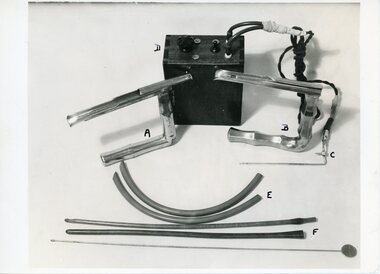
... At the bottom of the photograph are two Magill's rubber catheters and two different types of gum-elastic catheters....Laryngoscope Jackson's Laryngoscope Lamp carrier Dry cell battery Magill rubber catheters gum elastic catheter Handwritten in blue ink on reverse and underlined: Fig 39 Black and white photograph displaying different anaesthetic equipment. ...Black and white photograph displaying different anaesthetic equipment. At the top of the photograph is a dry-cell battery, two Jackon's laryngoscopes, one of which has been modified, and a lamp carrier which has been withdrawn from a laryngoscope. At the bottom of the photograph are two Magill's rubber catheters and two different types of gum-elastic catheters.Handwritten in blue ink on reverse and underlined: Fig 39laryngoscope, jackson's laryngoscope, lamp carrier, dry cell battery, magill rubber catheters, gum elastic catheter -
 Royal Australian and New Zealand College of Obstetricians & Gynaecologists (RANZCOG)
Tool - Uterine catheter used by Dr Fritz Duras
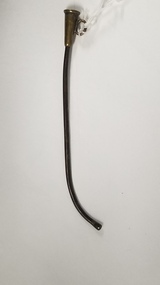
... Small metal uterine catheter. Thin, curved instrument with a brass coloured, bell shaped attachment at one end, curving to a hollow tip at the other end. ...There is a oval shaped fitting attached to the side of the bell attachment. Tool Uterine catheter used by Dr Fritz Duras ...This instrument was used by Dr Fritz Duras (1896-1965), who moved to Australia from Germany in 1937. As his father was Jewish, Duras was forced to leave Germany, and came to Australia to take up a post as director of physical education at Melbourne University. This instrument was part of a collection of instruments given to his son-in-law, Dr Michael Kloss, who was an obstetrician. Dr Kloss subsequently donated this item to the College. Small metal uterine catheter. Thin, curved instrument with a brass coloured, bell shaped attachment at one end, curving to a hollow tip at the other end. There is a oval shaped fitting attached to the side of the bell attachment.obstetrics -
 Royal Australian and New Zealand College of Obstetricians & Gynaecologists (RANZCOG)
Tool - Uterine catheter used by Dr Fritz Duras and Dr Michael Kloss
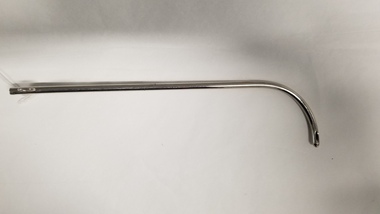
... Metal uterine catheter. Thin, curved instrument with two oval shaped fittings attached to the sides of the instrument at the proximal end for grip. ...One side of the instrument is engraved with the word 'Kloss'. Tool Uterine catheter used by Dr Fritz Duras and Dr Michael Kloss ...This instrument was used by Dr Fritz Duras (1896-1965), who moved to Australia from Germany in 1937. As his father was Jewish, Duras was forced to leave Germany, and came to Australia to take up a post as director of physical education at Melbourne University. This instrument was part of a collection of instruments given to his son-in-law, Dr Michael Kloss, who was an obstetrician. Dr Kloss subsequently had it engraved and used it in his own practice, before donating the item to the College. Metal uterine catheter. Thin, curved instrument with two oval shaped fittings attached to the sides of the instrument at the proximal end for grip. There is a seam roughly halfway down the instrument indicating that the halves of the instrument can be separated. One side of the instrument is engraved with the word 'Kloss'.'Kloss'obstetrics -
 Royal Australian and New Zealand College of Obstetricians & Gynaecologists (RANZCOG)
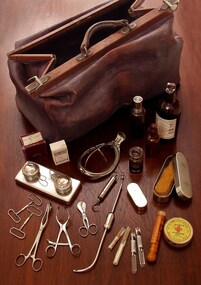
Obstetrician's medical bag containing medical instruments and equipment of Dr
... An obstetrician's bag belonging to the late Dr Henry Mitchell O'Sullivan (1892-1972) containing various items such as obstetric forceps, destructive instruments, curette, pelvimeter, catheter, speculum, antiseptic, chloroform, iodine, catgut suture, surgical needles and twine for tying off umbilical cord after delivery. ...Consequently, this item is a unique time capsule of the type of instruments and pharmaceuticals usedby a Victorian country doctor in the inter-war period. dr henry mitchell o'sullivan casterton victoria dr david more o'sullivan inter-war period An obstetrician's bag belonging to the late Dr Henry Mitchell O'Sullivan (1892-1972) containing various items such as obstetric forceps, destructive instruments, curette, pelvimeter, catheter, speculum, antiseptic, chloroform, iodine, catgut suture, surgical needles and twine for tying off umbilical cord after delivery. ...Dr Henry Mitchell O'Sullivan was a medical doctor also practising obstetrics in the district of Casterton, Victoria from 1919 until his death in 1977.The Gladstone bag and contents were used in the inter-war period 1918-1945. His son, the late Dr David More O'Sullivan donated the obstetric bag and its contents to the RANZCOG Museum in 1999.The Gladstone bag was put aside and the contents have remained intact. Consequently, this item is a unique time capsule of the type of instruments and pharmaceuticals usedby a Victorian country doctor in the inter-war period.An obstetrician's bag belonging to the late Dr Henry Mitchell O'Sullivan (1892-1972) containing various items such as obstetric forceps, destructive instruments, curette, pelvimeter, catheter, speculum, antiseptic, chloroform, iodine, catgut suture, surgical needles and twine for tying off umbilical cord after delivery. dr henry mitchell o'sullivan, casterton victoria, dr david more o'sullivan, inter-war period -
 Royal Australian and New Zealand College of Obstetricians & Gynaecologists (RANZCOG)
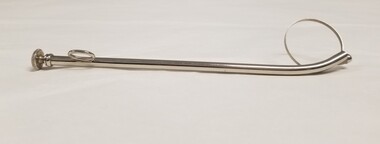
Tool - Urinary catheter used by Dr Michael Kloss
... Metal uterine catheter. Thin, small, curved instrument in the shape of a narrow tube. ...Obstetrics Metal uterine catheter. Thin, small, curved instrument in the shape of a narrow tube. ...This instrument was part of a collection of instruments used by Dr Michael Kloss in his medical practice. Dr Kloss subsequently donated this collection to the College.Metal uterine catheter. Thin, small, curved instrument in the shape of a narrow tube. There is a circular fitting at one end of the tube, and the tube curves as it reaches a rounded, hollow tip at the other end. A strip of metal topped by a rounded fitting extends from the hollow end of the tube, forming a circular loop.obstetrics -
 Royal Australian and New Zealand College of Obstetricians & Gynaecologists (RANZCOG)
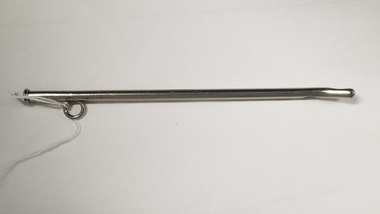
Tool - Uterine catheter used by Dr Fritz Duras and Dr Michael Kloss
... Metal uterine catheter. Thin, small, curved instrument in the shape of a narrow tube. ...Obstetrics Metal uterine catheter. Thin, small, curved instrument in the shape of a narrow tube. ...This instrument was used by Dr Fritz Duras (1896-1965), who moved to Australia from Germany in 1937. As his father was Jewish, Duras was forced to leave Germany, and came to Australia to take up a post as director of physical education at Melbourne University. This instrument was part of a collection of instruments given to his son-in-law, Dr Michael Kloss, who was an obstetrician. Dr Kloss subsequently donated the collection to the College, after using many of the instruments in his own practice. Metal uterine catheter. Thin, small, curved instrument in the shape of a narrow tube. There is a lip at one end of the tube, which curves as it reaches a rounded tip at the other end. There are holes in either side of the tube just below the tip. A circular fitting is attached to one side of the instrument for grip, a little below the lip.obstetrics -
 Geoffrey Kaye Museum of Anaesthetic History
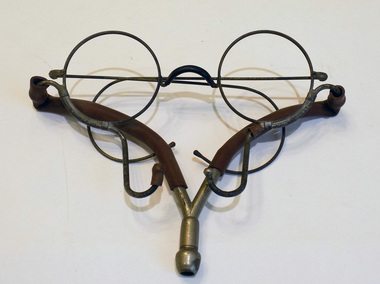
Equipment - Mask, Spectacle frame, c. 1930
... The use of a catheter for oxygen therapy was introduced by Arbuthnot Lane in 1907. ...The use of a catheter for oxygen therapy was introduced by Arbuthnot Lane in 1907. ...The use of a catheter for oxygen therapy was introduced by Arbuthnot Lane in 1907. However, its true value can be seen in its use during WWI. Masks were cumbersome and uncomfortable for the wounded and nasal delivery of oxygen was received more easily. The Tudor Edwards' Spectacle-frame was manufactured in London during the 1930s. Dr Penn recorded that it was an inefficient means of oxygen therapy because of the smallness of the nasal tubes.Metal mask resembling spectacles with round frames and rounded ends of the arms to secure around the ear. There is a tube coming from each round eye frame to end in a curve that sits in the nostril. The other end of this tube has a rubber tube attached which meets in the middle via a metal connector.oxygen therapy, intra-nasal -
 Royal Australian and New Zealand College of Obstetricians & Gynaecologists (RANZCOG)
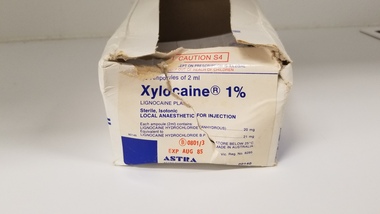
Equipment - Box of Astra Xylocaine 1% ampoules associated with Dr Lachlan Hardy-Wilson, Astra, c. 1985
... Lidocaine (or lignocaine) is a local anaesthetic (numbing medication) that is used to numb an area of your body to help reduce pain or discomfort caused by invasive medical procedures such as surgery, needle punctures, or insertion of a catheter or breathing tube. It is also sometimes used to treat irregular heart rhythms that may signal a possible heart attack, and can be given in an epidural (spinal block) to reduce the discomfort of contractions during labour....Lidocaine (or lignocaine) is a local anaesthetic (numbing medication) that is used to numb an area of your body to help reduce pain or discomfort caused by invasive medical procedures such as surgery, needle punctures, or insertion of a catheter or breathing tube. It is also sometimes used to treat irregular heart rhythms that may signal a possible heart attack, and can be given in an epidural (spinal block) to reduce the discomfort of contractions during labour. ...Lidocaine (or lignocaine) is a local anaesthetic (numbing medication) that is used to numb an area of your body to help reduce pain or discomfort caused by invasive medical procedures such as surgery, needle punctures, or insertion of a catheter or breathing tube. It is also sometimes used to treat irregular heart rhythms that may signal a possible heart attack, and can be given in an epidural (spinal block) to reduce the discomfort of contractions during labour.This is one of a collection of items received from the practice of Dr Lachlan Hardy-Wilson, FRCOG, Launceston, Tasmania.Cardboard box containing 19 ampoules of Xylocaine 1%. The ampoules are in three strips of five, and one strip of four. Expiry date noted on the box for this medication is August 1985.surgery -
 Royal District Nursing Service (now known as Bolton Clarke)
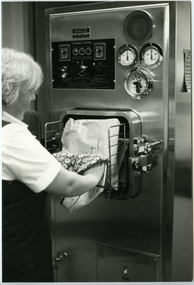
Photograph - Photograph, black and white, c.1975
... The Royal District Nursing Service (RDNS), Sister has sterilized an autoclave pack for use by the RDNS Sisters when attending their patients in their homes who are requiring specific treatments for e.g. catheterization. This photograph is taken in the sterilizing room at a RDNS Centre. ...The Royal District Nursing Service (RDNS), Sister has sterilized an autoclave pack for use by the RDNS Sisters when attending their patients in their homes who are requiring specific treatments for e.g. catheterization. This photograph is taken in the sterilizing room at a RDNS Centre. ...The Royal District Nursing Service (RDNS), Sister has sterilized an autoclave pack for use by the RDNS Sisters when attending their patients in their homes who are requiring specific treatments for e.g. catheterization. This photograph is taken in the sterilizing room at a RDNS Centre. The Sister is wearing the RDNS Summer uniform of a short sleeve white blouse under a royal blue V neck tunic style frock with the RDNS logo on its upper left.Royal District Nursing Service (RDNS) supplied sterilized equipment, such as ready set up catheter trays and dressing trays, as well as dressing packs for their Sisters to take to the home when attending to specific patient care. Patients bought their own future dressings, if these had not been given to them when discharged from Hospital. Following their day in the community the Sisters returned to the RDNS Centre and washed and set up the trays again ready for re-sterilization. Black and white photograph showing a Royal District Nursing Service, (RDNS), Sister who has blonde short hair; is wearing a short sleeved white blouse and dark tunic style frock, standing in the Autoclave room in an RDNS centre. She is emptying the Autoclave chamber after sterilizing a wrapped, 'gown and towel', which is written on the wrapping. Her right arm is extended with her hand on the metal wire basket which has a protective floral cloth covering the edge of the basket. The photograph shows a tall vertical Autoclave, which is made of metal. To the left above the chamber is a dark rectangular section with several switches, and to right of it are three white faced dials. royal district nursing service, rdns, rdns equipment, sterilizing -
Alfred Hospital Nurses League - Nursing History Collection
Functional object - Boxed Nasogastric Oesophageal Tubing Adult and Intermediate sizes, DAVOL INC, Nasogastric Oesophageal Tubing
... Red rubber tubing catheter 1000 mm in length with two balloons one 35mm and one 40mm around tubing/proximal end bullet shaped/ drainage holes on tubing up to balloon/distal end has two spigoted balloon inflation portals and one gastric aspiration outlet. ...Haemorrhage Gastric Oesophagus Sengstaken-Blakemore tube Balloon Tamponade Tubing marked at 50mm intervals for 250 mm Red rubber tubing catheter 1000 mm in length with two balloons one 35mm and one 40mm around tubing/proximal end bullet shaped/ drainage holes on tubing up to balloon/distal end has two spigoted balloon inflation portals and one gastric aspiration outlet. ...Used to lavage the stomach and oesophagus and apply pressure by inflating the balloons to bleeding oesophageal varices. The technique used to place the tube is called Balloon Tamponade.Historically used in an emergency situation to control bleeding of oesophageal and gastric varices.Red rubber tubing catheter 1000 mm in length with two balloons one 35mm and one 40mm around tubing/proximal end bullet shaped/ drainage holes on tubing up to balloon/distal end has two spigoted balloon inflation portals and one gastric aspiration outlet. Both contained in original cardboard box with pink leaflets instructions for use.Tubing marked at 50mm intervals for 250 mmhaemorrhage, gastric, oesophagus, sengstaken-blakemore tube, balloon tamponade -
 Royal Australian and New Zealand College of Obstetricians & Gynaecologists (RANZCOG)
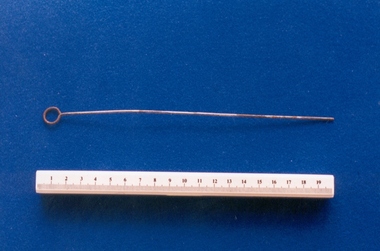
Introducer associated with midwife Mary Howlett, c. 1866 to 1920, c1880s
... This item can be used for cleaning rubber tubing or to assist with the introduction of rubber catheters and tubing. Mary Howlett (1840-1922) began practising as a country midwife in 1866 in the western district of Victoria. ...This item can be used for cleaning rubber tubing or to assist with the introduction of rubber catheters and tubing. Mary Howlett (1840-1922) began practising as a country midwife in 1866 in the western district of Victoria. ...This item can be used for cleaning rubber tubing or to assist with the introduction of rubber catheters and tubing. Mary Howlett (1840-1922) began practising as a country midwife in 1866 in the western district of Victoria. She qualified as a 'ladies monthly nurse' in 1887 and continued to practise as a nurse and midwife until 1920.She began her six months training at the Melbourne Lying-In Hospital. She was known by many as 'Auntie', and her career spanned more than 50 years. Mrs Howlett's midwifery box and contents were given to Dr Frank Forster, and he donated them to the museum collection in 1993.Device made of metal wire with a rounded point at one end and an eye hook the other end.surgery, midwifery
