
Showing 114 items matching "cattle stations"
-
 National Wool Museum
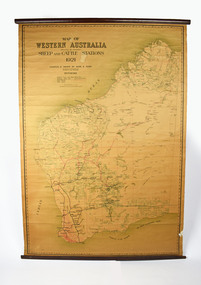
Map, Map of Western Australia Showing the Principal Sheep and Cattle Stations, 1921
... Map of Western Australia Showing the Principal Sheep and Cattle Stations, 1921...Map showing the principal sheep and cattle stations of Western Australia as of 1921....MAP OF / WESTERN AUSTRALIA / Showing the Principal / SHEEP AND CATTLE STATIONS / 1921 / COMPILED & DRAWN BY HOPE & KLEM / Surveyors & Draughtsmen / 23 Barrack St, Perth, WA...Map showing the principal sheep and cattle stations of Western Australia as of 1921. sheep stations MAP OF / WESTERN AUSTRALIA / Showing the Principal / SHEEP AND CATTLE STATIONS / 1921 / COMPILED & DRAWN BY HOPE & KLEM / Surveyors & Draughtsmen / 23 Barrack St, Perth, WA Map of Western Australia Showing the Principal Sheep and Cattle Stations, 1921 Map Map ...Map showing the principal sheep and cattle stations of Western Australia as of 1921.MAP OF / WESTERN AUSTRALIA / Showing the Principal / SHEEP AND CATTLE STATIONS / 1921 / COMPILED & DRAWN BY HOPE & KLEM / Surveyors & Draughtsmen / 23 Barrack St, Perth, WAsheep stations -
 Robin Boyd Foundation
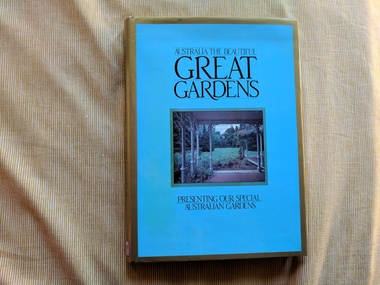
Book, Ed Kerrie E. Andrews, Australia The Beautiful: Great Gardens, 1983
... Indigenous colonial history, cattle station life, white-aboriginal relations, Australian fiction...Gardening Walsh St library Indigenous colonial history, cattle station life, white-aboriginal relations, Australian fiction Hardcover Australia The Beautiful: Great Gardens Book Ed Kerrie E. ...HardcoverIndigenous colonial history, cattle station life, white-aboriginal relations, Australian fictiongardening, walsh st library -
 Hymettus Cottage & Garden Ballarat
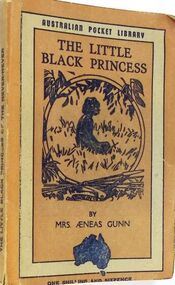
Work on paper - Book, The Little Black Princess
... ...Elsie Station...Cattle...First Nations Jeanie Gunn Novel Literature Elsie Station Cattle stations Australian Classics Aboriginal Juvenalia This is the story of Bett-Bett, an Aboriginal girl who was the servant & companion to the author, Mrs Gunn on Elsey Station in the Northern Territory in the first decade of the twentieth century. ...This is the story of Bett-Bett, an Aboriginal girl who was the servant & companion to the author, Mrs Gunn on Elsey Station in the Northern Territory in the first decade of the twentieth century.fictionThis is the story of Bett-Bett, an Aboriginal girl who was the servant & companion to the author, Mrs Gunn on Elsey Station in the Northern Territory in the first decade of the twentieth century.first nations, jeanie gunn, novel, literature, elsie station, cattle stations, australian classics, aboriginal, juvenalia -
 Federation University Historical Collection
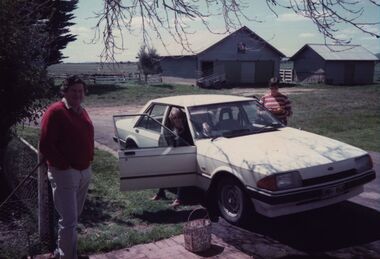
Photograph - Photograph - Colour, Visiting "Launchley", c1970s
... Elizabeth Chatham (nee Holmes) standing with family friends at “ Launchley” looking North East over the shearing shed and dairy towards Cattle Station Hill. ...Taken from the back door at "Launchley", Ascot chatham-holmes collection holmes elizabeth chatham launchley Elizabeth Chatham (nee Holmes) standing with family friends at “ Launchley” looking North East over the shearing shed and dairy towards Cattle Station Hill. Visiting "Launchley" Photograph Photograph - Colour Australia Victoria Ascot ...Elizabeth Chatham with her brother and sister-in-law. Taken from the back door at "Launchley", AscotElizabeth Chatham (nee Holmes) standing with family friends at “ Launchley” looking North East over the shearing shed and dairy towards Cattle Station Hill. chatham-holmes collection, holmes, elizabeth chatham, launchley -
 Kiewa Valley Historical Society
Shoes Horse Stock and Draft, early 1900's
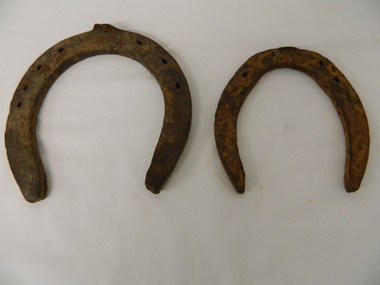
... Larger properties eg.large Northern territory cattle stations use helicopters for "cattle control"....Larger properties eg.large Northern territory cattle stations use helicopters for "cattle control". ...These horse shoes (one a stock horse and one a draft horse) were probably used in the mid 1900's. They have been roughly made suggesting that a professional blacksmith was not instrumental in their manufacture. On smaller or remote cattle stations either the lead stock man or owner would "fire up" the kiln to provide the adjustments required to the horse shoe to ensure a "tight" fit. The larger cattle stations had a "professional" blacksmith to cover all their "working" horses. Larger properties eg.large Northern territory cattle stations use helicopters for "cattle control".These horse shoes are very significant to the Kiewa Valley because of the early introduction of cattle stations in what initially was regarded as a semi remote location. The maintenance of horses hooves is an important requirement, especially during the period when cattle were grazed on the Bogong High Plains. The mustering and and moving cattle from the valley pastures to the high country was a demanding and dangerous exercise requiring "sure footed" stock horses. A scientific study started in 1947 to study the impact of grazing cattle on the natural Alpine and sub Alpine vegetation found grazing cattle had an adverse affect on the natural Alpine and sub alpine vegetation, and grazing on the plains was stopped by the Victorian Government in 2005.This "camp draft" in the High Plains could take up to six weeks.Both these horse shoes have been "roughly" made but are specifically made for the type of horse which wore them. The smaller of the two is for the stock horse/riding horse and the lager one is for the larger draft horse. Each horse type has a specific role to play in the the type of activity it was used for. The small horse shoe has six "nail" holes for attachment to the horse hoof by special nails. The larger shoe has seven "nail" holes. Both have the three quarter moon shape which fits the curvature of the horses hooves. working horses, bogong high plains camp draft, grazing cattle bogong high plains -
 Tatura Irrigation & Wartime Camps Museum
Book, Beyond the Bitumen, 1971
... Description of life on country properties in Victoria and cattle stations in Queensland....cattle scene. Title in red. Authors name in black. Photography dust cover illustration - Bronco branding at Rocklands Station by Sir Daryl Lindsay...Description of life on country properties in Victoria and cattle stations in Queensland. beyond the bitumen winter-irving family bradbury t rocklands station evans w Grey dust jacket. ...Story of Winter-Irving family. Description of life on country properties in Victoria and cattle stations in Queensland.Grey dust jacket. Stockmen and cattle scene. Title in red. Authors name in black. Photography dust cover illustration - Bronco branding at Rocklands Station by Sir Daryl Lindsaybeyond the bitumen, winter-irving family, bradbury t, rocklands station, evans w -
 Bendigo Historical Society Inc.
Book - ALEC H CHISHOLM COLLECTION: BOOK ''LARAPINTA'' BY R.B.PLOWMAN
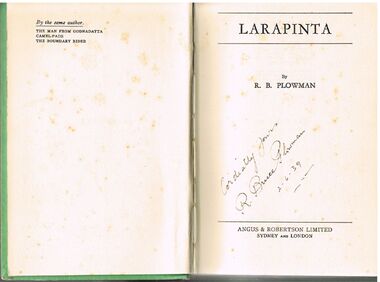
... A 294 page pale green cover hardback novel set on a cattle station around Alice Springs. Published in1939 by Angus & Robertson Ltd., Sydney and printed by Halstead Press Ltd., Sydney. ...A 294 page pale green cover hardback novel set on a cattle station around Alice Springs. Published in1939 by Angus & Robertson Ltd., Sydney and printed by Halstead Press Ltd., Sydney. ...Book. ALEC H CHISHOLM COLLECTION. A 294 page pale green cover hardback novel set on a cattle station around Alice Springs. Published in1939 by Angus & Robertson Ltd., Sydney and printed by Halstead Press Ltd., Sydney. Catalogue sticker ''2212 PLO'' on spine. Handwritten in ink on title page ''Cordially yours, R. Bruce Plowman 2-6-39 ''R. Bruce Plowmanbooks, collections, fiction, alec h chisholm collection, r. bruce plowman, novel, fiction, australiana -
Unions Ballarat
Mantle of safety : the Flying Doctor Service, Harley, Jane F, 1963
... During a stay at Dunbar, one of Australia's largest cattle stations, the author was faced with the problem of getting a badly injured man to hospital, it was the wet season, but the Royal flying doctor service came to the rescue. ...During a stay at Dunbar, one of Australia's largest cattle stations, the author was faced with the problem of getting a badly injured man to hospital, it was the wet season, but the Royal flying doctor service came to the rescue. ...During a stay at Dunbar, one of Australia's largest cattle stations, the author was faced with the problem of getting a badly injured man to hospital, it was the wet season, but the Royal flying doctor service came to the rescue. The author was later a nurse in a bush hospital and worked in close cooperation with the flying doctor service before writing "Mantle of Safety".Autobiographical and relevant to the history of the Australian flying doctor service.Paper; book.Cover: author's name and title.btlc, ballarat trades and labour council, ballarat trades hall, hospital, royal flying doctor service, bush hospitals, autobiography, medicine -
Glenelg Shire Council Cultural Collection
Administrative record - Police Report - Criminal Offence Cattle Stealing Dartmoor, Victoria, n.d
... Hand written supplementary Police Report of Criminal Offence cattle stealing, Dartmoor police station...Hand written supplementary Police Report of Criminal Offence cattle stealing, Dartmoor police station Administrative record Police Report - Criminal Offence Cattle Stealing Dartmoor, Victoria ...Hand written supplementary Police Report of Criminal Offence cattle stealing, Dartmoor police station -
Glenelg Shire Council Cultural Collection
Administrative record - Police Report - Criminal Offence Cattle Stealing Heywood, Victoria, 28/03/1915
... Hand written supplementary Police Report of Criminal Offence - cattle stealing, Heywood police station...Hand written supplementary Police Report of Criminal Offence - cattle stealing, Heywood police station Administrative record Police Report - Criminal Offence Cattle Stealing Heywood, Victoria ...Hand written supplementary Police Report of Criminal Offence - cattle stealing, Heywood police station -
Glenelg Shire Council Cultural Collection
Administrative record - Police Report - Criminal Offence Cattle Stealing Branxholme, Victoria, 15/05/1912
... Hand written supplementary Police Report of Criminal Offence - cattle stealing, Branxholme police station...Hand written supplementary Police Report of Criminal Offence - cattle stealing, Branxholme police station Administrative record Police Report - Criminal Offence Cattle Stealing Branxholme, Victoria ...Hand written supplementary Police Report of Criminal Offence - cattle stealing, Branxholme police station -
Glenelg Shire Council Cultural Collection
Administrative record - Police Report - Criminal Offence Cattle Stealing, Macarthur, Victoria, 18/02/1915
... Hand written supplementary Police Report of Criminal Offence - cattle stealing, Macarthur police station...Hand written supplementary Police Report of Criminal Offence - cattle stealing, Macarthur police station Administrative record Police Report - Criminal Offence Cattle Stealing, Macarthur, Victoria ...Hand written supplementary Police Report of Criminal Offence - cattle stealing, Macarthur police station -
 Wonga Park Community Cottage History Group
Newspaper - Copy of a newspaper cutting fromThe Australasian (Melbourne) Saturday 14/12/1907 on page 36, “A Cup Winner’s Stable” on the property of Mr. Stock of Wonga Park
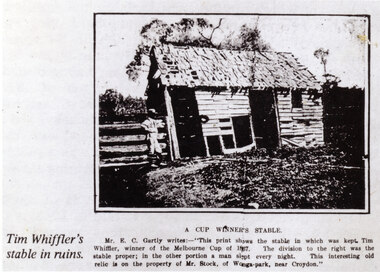
... In fact, this Tim Whiffler did not win the Melbourne Cup of 1867 and was stabled at Bully Brown’s Wonga Park Cattle Station from the early 1870s to about 1879. ...In fact, this Tim Whiffler did not win the Melbourne Cup of 1867 and was stabled at Bully Brown’s Wonga Park Cattle Station from the early 1870s to about 1879. ...“A Cup Winner’s Stable” appeared in The Australasian (Melbourne) Saturday 14/12/1907 on page 36 on the property of Mr. Stock of Wonga Park. In fact, this Tim Whiffler did not win the Melbourne Cup of 1867 and was stabled at Bully Brown’s Wonga Park Cattle Station from the early 1870s to about 1879. Although, itself not a Melbourne Cup winner it was a stud horse and was the ancestor of more than one Melbourne Cup winner.On the first page it is inscribed with the name "Robyn Smiley" and the school "Wonga Park" -
Glenelg Shire Council Cultural Collection
Administrative record - Police Report of Criminal Offence - Cattle Stealing Dartmoor Police Station 1915, 03/01/1915
... Police Report of Criminal Offence - Cattle Stealing Dartmoor Police Station 1915...Hand written , supplementary Police Criminal Offence report - cattle stealing, Dartmoor Police Station 3rd January 1915...Station historical records. Hand written , supplementary Police Criminal Offence report - cattle stealing, Dartmoor Police Station 3rd January 1915 Administrative record Police Report of Criminal Offence - Cattle Stealing Dartmoor Police Station 1915 ...Dartmoor Police Station historical records.Hand written , supplementary Police Criminal Offence report - cattle stealing, Dartmoor Police Station 3rd January 1915 -
Glenelg Shire Council Cultural Collection
Administrative record - Police Report - Criminal Offence Cattle Stealing Macarthur Victoria 1915, 19/03/1915
... Hand written supplementary Police Report of Criminal Offence - cattle stealing, Macarthur police station, 19th Mar 1915...Hand written supplementary Police Report of Criminal Offence - cattle stealing, Macarthur police station, 19th Mar 1915 Administrative record Police Report - Criminal Offence Cattle Stealing Macarthur Victoria 1915 ...Hand written supplementary Police Report of Criminal Offence - cattle stealing, Macarthur police station, 19th Mar 1915 -
Glenelg Shire Council Cultural Collection
Administrative record - supplementary Police Report of Criminal Offence - Cattle stealing 1915, 01/04/1915
... Hand written supplementary Police Report of Criminal Offence - Cattle stealing, Heywood Police Station, 1st April 1915....Station records. Hand written supplementary Police Report of Criminal Offence - Cattle stealing, Heywood Police Station, 1st April 1915. ...Heywood Police Station records.Hand written supplementary Police Report of Criminal Offence - Cattle stealing, Heywood Police Station, 1st April 1915. -
 Kiewa Valley Historical Society
Stocks for Riding Boots, Late 1800's to early 1900's
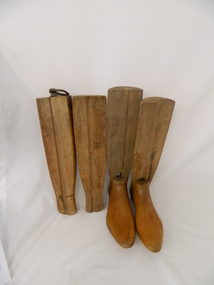
... This form of maintaining the tall riding boot structure was maintained in Australia by the rural "elite" both on cattle properties and smaller cattle stations in the early 1900's. Good riding boots were a status symbol in rural and outback Australia. ...This form of maintaining the tall riding boot structure was maintained in Australia by the rural "elite" both on cattle properties and smaller cattle stations in the early 1900's. Good riding boots were a status symbol in rural and outback Australia. ...These wooden trees for riding stocks are a concept that was brought to early colonial days from "mother" England. Gentle folk of wealth and status used these trees from early 1800's to keep and maintain their riding boots in their correct form. This form of maintaining the tall riding boot structure was maintained in Australia by the rural "elite" both on cattle properties and smaller cattle stations in the early 1900's. Good riding boots were a status symbol in rural and outback Australia. The riding stocks "wooden trees" are very significant in the Kiewa Valley because they were used by members of some of the original grazing cattle families to settle there. Both cattle and sheep properties occupied large areas of the Kiewa Valley and they also herded their flock and herd on the Bogong High Plains region. These stocks and boots were worn by Fred Roper whose great grand daughter donated them to KVHS. Therefore these boots and stocks would date from 1880's to 1920's and are a good representation of the style of boots worn during this period. This pair of wooden stocks for riding boots trees has been manufactured to a very high standard. Each of the four boot tree parts fit snugly together and maintain their form, and that of the boot that they occupy. The groove channels and foot forms (tongue and groove) are exact and once snapped together become very solid. There is a brass ring, attached by a small brass "peg" on each of the thin "sliding" middle uprights. See KVHS 0177 - Riding boots.On top "L" (for left boot), "R" (for right boot)horse. country. leather. gaiters. high plains. grazing. cattlemen. laces. studs. stocks. roper family. bogong high plains. -
 Orbost & District Historical Society
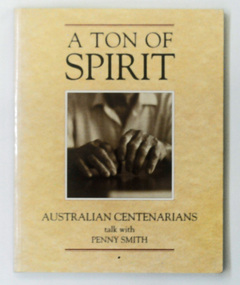
book, Kim Hup Lee Printing, A Ton of Spirit, 1990
... It includes reminiscences of Judy Bagu, Jimmy Bird, Paddy Djiaween and Walter Smith; brief accounts of bush foods, medicines, uses of plants, birth and mortuary rituals; working lives on cattle stations, missions, prospecting, dingo trapping, camel working, pearling, shire council; Kunmunyah, Beagle Bay Mission, Broome....It includes reminiscences of Judy Bagu, Jimmy Bird, Paddy Djiaween and Walter Smith; brief accounts of bush foods, medicines, uses of plants, birth and mortuary rituals; working lives on cattle stations, missions, prospecting, dingo trapping, camel working, pearling, shire council; Kunmunyah, Beagle Bay Mission, Broome. ...This book contains interviews with 48 of the 300 centenarians listed by the Australian Bicentennial Authority, whose long lives together form an oral social history of the development of Australia over the past one hundred years. It includes reminiscences of Judy Bagu, Jimmy Bird, Paddy Djiaween and Walter Smith; brief accounts of bush foods, medicines, uses of plants, birth and mortuary rituals; working lives on cattle stations, missions, prospecting, dingo trapping, camel working, pearling, shire council; Kunmunyah, Beagle Bay Mission, Broome.This compilation of stories from centenarians is a contemporary social record of one hundred years of living through two world wars and the Great Depression in Australia. A 183 pp book with a light brown cover, darker spine. On the front cover is a photograph of a pair of hands. Print is black "A Ton of Spirit Australian Centenarians talk with Penny Smith".book-a-ton-of-spirit-penny-smith social-records-early-australia -
 Kiewa Valley Historical Society
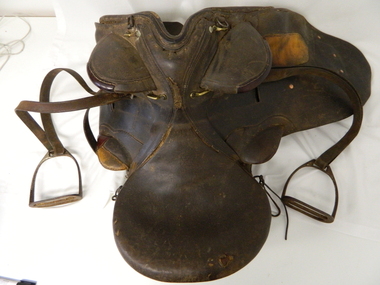
Saddle Horse Stock, Circa 1950
... Northern territory cattle stations in the late 1900's started to use helicopters for "cattle control". ...Northern territory cattle stations in the late 1900's started to use helicopters for "cattle control". ...This stock horse saddle was probably used in the mid 1900's. This was the period when cattle mustering was at its prime. The movement of cattle was by mounted stock horse only and not by other methods. Northern territory cattle stations in the late 1900's started to use helicopters for "cattle control". In the KIEWA Valley/Bogong High Plains and other rural cattle producing areas required well trained stock horses and stockmen for cattle control. It is only in the later 1900's that motor bikes and four wheeled quad-bikes have taken over, in part, from the mounted stockman.This horse saddle is very significant to the Kiewa Valley because of the early introduction of cattle stations in what initially was regarded as a semi remote location. The maintenance of cattle in the Kiewa Valley is and was an important requirement. A good stock horse saddle as and is important, especially during the period when cattle were grazed on the Bogong High Plains. The mustering and and moving cattle from the valley pastures to the high country was a demanding and dangerous exercise requiring "sure footed" stock horses.The "good" saddle was a vital part of this cattle mustering. A scientific study started in 1947 to study the impact of grazing cattle on the natural Alpine and sub Alpine vegetation found grazing cattle had an adverse affect on the natural Alpine and sub alpine vegetation, and grazing on the plains was stopped by the Victorian Government in 2005.This "camp draft" in the High Plains could take up to six weeks.This all leather "stock horse" saddle shows plenty of wear. It is in "full harness" configaration with stirrups and leg protectors horse, country, leather, gaiters, high, grazing, cattlemen, laces, studs -
 Kiewa Valley Historical Society
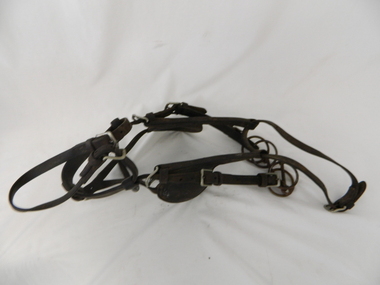
Bridle Horse, circa mid to late 1900's
... Northern territory cattle stations in the late 1900's started to use helicopters for "cattle control". ...Northern territory cattle stations in the late 1900's started to use helicopters for "cattle control". ...This stock horse bridle was probably used in the mid 1900's. This was the period when cattle and sheep mustering was at its prime. The movement of cattle and sheep was by mounted stock horse only and not by other methods. Northern territory cattle stations in the late 1900's started to use helicopters for "cattle control". In the KIEWA Valley/Bogong High Plains and other rural cattle/sheep producing areas required well trained stock horses and stockmen for cattle/sheep control. It is only in the later 1900's that motor bikes and four wheeled quad-bikes have taken over, in part, from the mounted stockman.This horse bridle is very significant to the Kiewa Valley because of the early introduction of cattle and sheep stations in what initially was regarded as a semi remote valley location. The maintenance of cattle and sheep in the Kiewa Valley was, and still is an important requirement of livestock management. A good stock horse bridle is important, especially during the period when cattle and sheep were grazed on the Bogong High Plains. The mustering and and moving cattle/sheep from the valley pastures to the high country was a demanding and dangerous exercise requiring "sure footed" stock horses.The "good specialised" bridle was a vital part of this cattle/sheep mustering. A scientific study started in 1947 to study the impact of grazing cattle/sheep on the natural Alpine and sub Alpine vegetation found grazing cattle had an adverse affect on the natural Alpine and sub alpine vegetation, and grazing on the plains was stopped by the Victorian Government in 2005.This "camp draft" on the Bogong High Plains could take up to six weeks.This harness bridle includes "blinders, winklers or blinkers" and would therefore be used on a pack or "working" horse. This bridle has rings on each end of the browband. The bridle is one used by a horse working in a team configuration pulling a heavy cart or wagon. The bridle has ten adjustable straps to allow it to accommodate a variety of horse sizes. See KVHS 0495 for a stock horse saddle.horse, country, leather bridle, gaiters, high country grazing, cattlemen, laces, studs -
Clunes Museum
Document - GLENGOWER/GLENDONALD POST OFFICE
... IT WAS SITED AT THE FOOT OF CATTLE STATION HILL. BETWEEN 1874 AND 1885 THE POST OFFICE WAS CONDUCTED BY THE CATTLE STATION STATE SCHOOL HEADMASTER POST OFFICERS AT GLENDONALD WERE: WILLIAM B. ...IT WAS SITED AT THE FOOT OF CATTLE STATION HILL. BETWEEN 1874 AND 1885 THE POST OFFICE WAS CONDUCTED BY THE CATTLE STATION STATE SCHOOL HEADMASTER POST OFFICERS AT GLENDONALD WERE: WILLIAM B. ....1 PHOTOCOPY OF HISTORY OF GLENDONALD POST OFFICE GLENDONALD POST OFFICE WAS OPENED ON 15 JANUARY 1868, AND WAS MADE A RECEIVING OFFICE ON 19 AUGUST 1894. IT WAS CLOSED ON 1 JULY 1917. IT USED BARRED NUMERAL CANCEL 639. GLENDONALD WAS A SMALL RURAL SETTLEMENT LOCATED ON THE INTERSECTION OF TH CRESWICK-CLUNES ROAD AND MINER'S REST-CASTLEMAINE ROAD BETWEEN CLUNES AND CRESWICK. IT WAS SITED AT THE FOOT OF CATTLE STATION HILL. BETWEEN 1874 AND 1885 THE POST OFFICE WAS CONDUCTED BY THE CATTLE STATION STATE SCHOOL HEADMASTER POST OFFICERS AT GLENDONALD WERE: WILLIAM B. LANGDON 1868 E S LANGDON 1868 - 1870 ELISABETH GOOD 1870-1874 ALEXANDER GILLIAN 1874-1885 ARTHUR W BEAN 1885 CHARLOTTE VALINS 1885 THOMAS DUNSTON 1885-1894 ELIZABETH PEARCY 1894-1901 EDWARD PEARCY 1901-1913 NOT KNOWN 1913-1917 .2PHOTOCOPY OF HISTORY OF GLENGOWER/MIDDLE CREEK POST OFFICE GLENGOWER POST OFFICE OPENED ON 13 JANUARY 1868 AS MIDDLE CREEK. ITS NAME WAS CHANGED ON 1 JUNE 1881, WHEN IT BECAME A RECEIVING OFFICE. A MIDDLE CREEK POST OFFICE WAS OPENED NEAR ARARAT IN 1881 AND THE POSTMASTER GENERAL HAD A POLICY OF NOT HAVING POST OFFICES HAVING THE SAME NAME. GLENGOWER WAS UPGRADED TO POST OFFICE ON 1 JULY 1927, IT CLOSED ON 30 JUNE 1952 BARRED NUMERAL CANCEL 632 WAS USED AT GLENGOWER POST OFFICERS AT GLENGOWER WERE: S IRWIN 1868-1869 DONALD FRASER 1869-1871 JOHN KEMP 1871-1873 JOHN NEWTON 1873-1876 W POTTER 1876-1887 ANNIE MCIVOR 1887-1892 JESSIE MCIVOR 1892-?? UNKNOWSN ????-1927 DJ FRASER 1927-1939 JAMES CAMPBELL 1939-1952middle creek post office, glengower post office, glendonald post office -
 City of Kingston
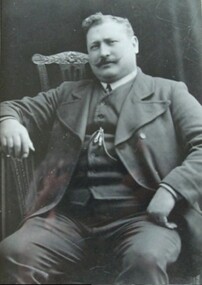
Photograph - Digital image, c.1918
... Born at Balnarring in 1869, Mills earned the title of Saltbush Bill whilst working on a cattle station in Queensland. On these long droving trips, he learnt the art of cracking stock whips of many different lengths and sizes, a skill that earnt him £100 after a Melbourne saddler, J.K. ...Born at Balnarring in 1869, Mills earned the title of Saltbush Bill whilst working on a cattle station in Queensland. On these long droving trips, he learnt the art of cracking stock whips of many different lengths and sizes, a skill that earnt him £100 after a Melbourne saddler, J.K. ...Roderick William Mills, known as Saltbush Bill, was the inspiration for several poems by A.B. Paterson. Born at Balnarring in 1869, Mills earned the title of Saltbush Bill whilst working on a cattle station in Queensland. On these long droving trips, he learnt the art of cracking stock whips of many different lengths and sizes, a skill that earnt him £100 after a Melbourne saddler, J.K. Jennings, suggested that no man could crack a 65-foot stock whip in three tries. Saltbush Bill succeeded on his first attempt and decided to make a career in entertainment with his skill. Over his career he performed for royalty, travelled and performed extensively overseas and lent his skill to fundraising efforts, particularly during the war. His last concert was given in the Boomerang Hall in Dandenong in 1926.A local resident of the City of Moorabbin, Saltbush Bill was an ambassador for Australia and a literary inspiration to A.B. (Banjo) Paterson. Saltbush Bill, his wife Hannah Louise Porter and their 11 children lived in Old Dandenong Road, Heatherton, where Saltbush Bill and Hannah conducted a market garden for many years. Saltbush Bill is buried in Cheltenham's Pioneer Cemetery.Black and white digital imageheatherton, banjo paterson, saltbush bill, stock whip, entertainment -
 Melbourne Royal
Award - Trophy, E. IRVING CO, The Borthwick Trophy, 1953
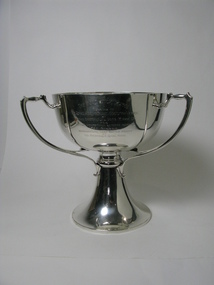
... Borthwick was a major meat exporter and ran freezing works as well as having its own cattle stations in Australia. From the early 19th century, Borthwick encouraged the production of quality beef by awarding prizes at agricultural shows throughout Australia. ...Borthwick was a major meat exporter and ran freezing works as well as having its own cattle stations in Australia. From the early 19th century, Borthwick encouraged the production of quality beef by awarding prizes at agricultural shows throughout Australia. ...Improving meat production In 1905, the English firm Thomas Borthwick & Son set up operations in Australia. Borthwick was a major meat exporter and ran freezing works as well as having its own cattle stations in Australia. From the early 19th century, Borthwick encouraged the production of quality beef by awarding prizes at agricultural shows throughout Australia. In the early 1950s the Australian Meat Board and The Royal Agricultural Society of Victoria (RASV) also took steps to encourage beef producers. Perpetual Trophy For the Coronation Show in 1953, Borthwick introduced a perpetual trophy. The Borthwick Trophy was awarded to the Fat Cattle Champion with the winner being judged from the best team of three steers under three years old. The winning team was the one that gained the highest aggregate score from both the live and carcase judging. Initially, the relevant winning Breed Society retained the trophy for a year and returned it for the following Royal Melbourne Show but the Borthwick Trophy is now displayed at the Melbourne Royal offices on the Melbourne Showgrounds. (Mandy Bede) The competition is now known as the competition between teams of three purebred steers in the Beef Carcase competition. There can be one team per beef cattle breed in the competition.Large silver cup with three handles, each flat at the top and then curving around the outside of the cup and rejoining before the cup's stem.THE BORTHWICK TROPHY. / PRESENTED TO / THE ROYAL AGRICULTURAL SOCIETY OF VICTORIA / BY / THOMAS BORTHWICK & SONS (A/ASIA) LTD, / FOR / ANNUAL COMPETITION BETWEEN TEAMS OF / FAT STEERS, / REPRESETNING BEEF CATTLE BREEDS / AT / THE MELBOURNE ROYAL SHOW / [various winning breeds]cattle, beef carcase, melbourne royal beef carcase competition, beef, perpetual, perpetual trophy, borthwick, prize, blue ribbon competition -
 City of Kingston
Photograph - Black and white, c.1917
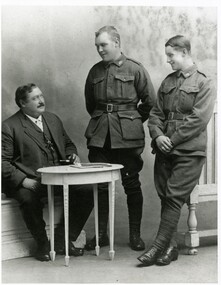
... Born at Balnarring in 1869, Mills earned the title of Saltbush Bill whilst working on a cattle station in Queensland. On these long droving trips, he learnt the art of cracking stock whips of many different lengths and sizes, a skill that earnt him £100 after a Melbourne saddler, J.K. ...Born at Balnarring in 1869, Mills earned the title of Saltbush Bill whilst working on a cattle station in Queensland. On these long droving trips, he learnt the art of cracking stock whips of many different lengths and sizes, a skill that earnt him £100 after a Melbourne saddler, J.K. ...Roderick William Mills, known as Saltbush Bill (left) with his sons, James Charles Mills (centre) and John James Mills (right), in London. In 1917 Saltbush Bill travelled from America to London after giving shows in various cities of the US, to spend time with his sons. James and John Mills were serving with the AIF and on leave from the French front in London. Saltbush Bill remained in London for the rest of the war as he was unable to return to Australia. Saltbush Bill, was the inspiration for several poems by A.B. Paterson. Born at Balnarring in 1869, Mills earned the title of Saltbush Bill whilst working on a cattle station in Queensland. On these long droving trips, he learnt the art of cracking stock whips of many different lengths and sizes, a skill that earnt him £100 after a Melbourne saddler, J.K. Jennings, suggested that no man could crack a 65-foot stock whip in three tries. Saltbush Bill succeeded on his first attempt and decided to make a career in entertainment with his skill. Over his career he performed for royalty, travelled and performed extensively overseas and lent his skill to fundraising efforts, particularly during the war. His last concert was given in the Boomerang Hall in Dandenong in 1926.A local resident of the City of Moorabbin, Saltbush Bill was an ambassador for Australia and a literary inspiration to A.B. (Banjo) Paterson. Saltbush Bill, his wife Hannah Louise Porter and their 11 children lived in Old Dandenong Road, Heatherton, where Saltbush Bill and Hannah conducted a market garden for many years. Saltbush Bill is buried in Cheltenham's Pioneer Cemetery.Black and white photograph of three men, one seated behind a table and two standing. The two standing are in military uniformsHandwritten in blue ink: K000733saltbush bill, stock whip, entertainment, heatherton -
 Port Fairy Historical Society Museum and Archives
Photograph, Cr William Boyd Shire of Belfast President 1891-92 95-96
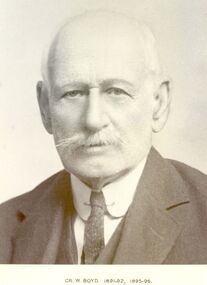
... William managed the station grazing cattle and sheep. The area was later to become part of the Soldier Settlement land after the Second World War....William managed the station grazing cattle and sheep. The area was later to become part of the Soldier Settlement land after the Second World War. belfast president government portrait shire council municipal local-government Tarrone Black and white portrait Cr William Boyd Shire of Belfast President 1891-92 95-96 Photograph Photograph ...Councillor William Boyd was the son of Alexander Boyd who emigrated from Scotland and purchased the property known as Tarrone station in 1884. William managed the station grazing cattle and sheep. The area was later to become part of the Soldier Settlement land after the Second World War.Black and white portraitbelfast, president, government, portrait, shire, council, municipal, local-government, tarrone -
 Eltham District Historical Society Inc
Negative - Photograph, Harry Gilham, Grave of Richard George, Emily Ann (nee Davis) and Edith Jane Kaylock, Eltham Cemetery, Victoria, Sep 2009
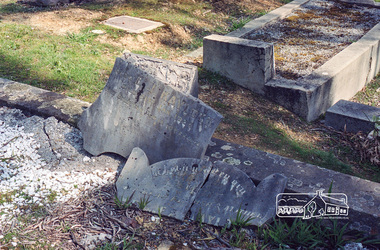
... In his early adult life, Richard Kaylock worked as a whaler (visiting California and New Zealand) and later as a drover on a large cattle station in New South Wales. In 1848 he came to Melbourne, working as a slaughterman, then settled in Eltham in 1854, his occupation thereafter being variously recorded as butcher or orchardist. ...In his early adult life, Richard Kaylock worked as a whaler (visiting California and New Zealand) and later as a drover on a large cattle station in New South Wales. In 1848 he came to Melbourne, working as a slaughterman, then settled in Eltham in 1854, his occupation thereafter being variously recorded as butcher or orchardist. ...In his early adult life, Richard Kaylock worked as a whaler (visiting California and New Zealand) and later as a drover on a large cattle station in New South Wales. In 1848 he came to Melbourne, working as a slaughterman, then settled in Eltham in 1854, his occupation thereafter being variously recorded as butcher or orchardist. He also had some experiences at Ballarat during the Eureka Rebellion. He died in 1910 at the age of 84. His obituary described him as a "striking personality" who was "brusque to a fault" and "strictly upright, expecting others to be the same". It seems from his will that he was illiterate. He is buried in Eltham Cemetery with his wife Emily. His property was in Wellington Street (now Brougham Street) and apparently extended across the Diamond Creek. The land on the western side of the creek was farmed, the house being on the eastern side. For many years the Brougham Street bridge was generally known as "Kaylock's Bridge". It formed part of the original coach road to Eltham and in 1922 was described as an "old rustic bridge". Its low level and insubstantial construction made it susceptible to flood damage, necessitating frequent closures until repairs could be carried out. The original bridge was demolished in 1923 and replaced by a "new up-to-date" one. When a lack of finances delayed repairs to the Bridge Street bridge in 1931, traffic had to detour via Brougham Street for some time. Local residents feared that the Bridge Street bridge might never reopen. In Loving Memory Of Our Dear Father & Mother R.G. and E.A. Kaylock Also E.J. Kaylock Died 21st Jan. 1927 The Eternal God Is My PledgeRoll of 35mm colour negative film, 6 stripsKodak GC 400-9eltham cemetery, gravestones, edith jane kaylock, emily ann kaylock (nee davis), richard george kaylock, brougham street bridge, kaylocks bridge -
 Eltham District Historical Society Inc
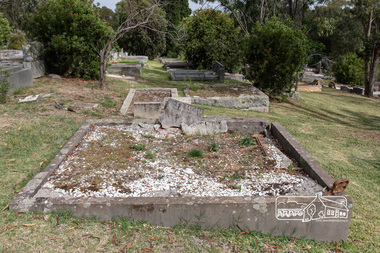
Photograph, Peter Pidgeon, Grave of Richard George, Emily Ann (nee Davis) and Edith Jane Kaylock, Eltham Cemetery, Victoria, 5 April 2021
... In his early adult life, Richard Kaylock worked as a whaler (visiting California and New Zealand) and later as a drover on a large cattle station in New South Wales. In 1848 he came to Melbourne, working as a slaughterman, then settled in Eltham in 1854, his occupation thereafter being variously recorded as butcher or orchardist. ...In his early adult life, Richard Kaylock worked as a whaler (visiting California and New Zealand) and later as a drover on a large cattle station in New South Wales. In 1848 he came to Melbourne, working as a slaughterman, then settled in Eltham in 1854, his occupation thereafter being variously recorded as butcher or orchardist. ...In his early adult life, Richard Kaylock worked as a whaler (visiting California and New Zealand) and later as a drover on a large cattle station in New South Wales. In 1848 he came to Melbourne, working as a slaughterman, then settled in Eltham in 1854, his occupation thereafter being variously recorded as butcher or orchardist. He also had some experiences at Ballarat during the Eureka Rebellion. He died in 1910 at the age of 84. His obituary described him as a "striking personality" who was "brusque to a fault" and "strictly upright, expecting others to be the same". It seems from his will that he was illiterate. He is buried in Eltham Cemetery with his wife Emily. His property was in Wellington Street (now Brougham Street) and apparently extended across the Diamond Creek. The land on the western side of the creek was farmed, the house being on the eastern side. For many years the Brougham Street bridge was generally known as "Kaylock's Bridge". It formed part of the original coach road to Eltham and in 1922 was described as an "old rustic bridge". Its low level and insubstantial construction made it susceptible to flood damage, necessitating frequent closures until repairs could be carried out. The original bridge was demolished in 1923 and replaced by a "new up-to-date" one. When a lack of finances delayed repairs to the Bridge Street bridge in 1931, traffic had to detour via Brougham Street for some time. Local residents feared that the Bridge Street bridge might never reopen. In Loving Memory Of Our Dear Father & Mother R.G. and E.A. Kaylock Also E.J. Kaylock Died 21st Jan. 1927 The Eternal God Is My PledgeBorn Digitaleltham cemetery, gravestones, brougham street bridge, edith jane kaylock, emily ann kaylock (nee davis), kaylocks bridge, richard george kaylock -
 Bendigo Historical Society Inc.
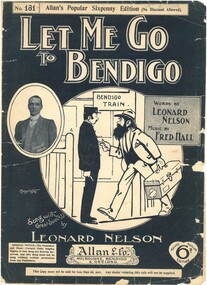
Document - Let Me Go to Bendigo (No. 181 Allan's Popular Sixpenny Edition), 1908
... Nelson had a varied resume including Cattle station work, song writing and public speaking. ...Nelson had a varied resume including Cattle station work, song writing and public speaking. ...Frederick "Fred" Fifield Hall was born in Carlton, Victoria in 1878. Son of Frederick Hall and Jessie Wallace Hall (nee Lloyd), Fred would marry Elsa May Daegner in 1899 with whom he had a son named Anthony. Hall died on 27th September 1956 in Mont Albert, Victoria and was buried at the Box Hill Cemetery. Hall was known as a solo pianist and the first conductor of the Station Orchestra at 3LO (ABC Radio Station). He was also a notable music editor at Allan & Co. Earning early recognition at 16 years of age when he conducted the Sydney Orchestra, Hall was a versatile composer having written in a variety of styles including solos for the piano, violin and cello, operas, foxtrots and orchestral suites. Publications indicate that between 300 and 400 of his compositions were published. The most famous of which was "Goodbye Melbourne Town" which he wrote with Lyricist Leonard Nelson. "Let Me Go to Bendigo" was another of their joint compositions. Leonard Nelson Snell, professionally known as Leonard Nelson, was born c. 1874 in Melbourne and grew up in Kew (he was 76 in 1950). Nelson married Lily Maud Haight in Victoria in 1897 and had six children named Roy, Dorothy, Leonard, Lionel, Austin and Marie. Nelson died on the 13 August 1962 in Blackheath, NSW and was buried at the local cemetery. Nelson had a varied resume including Cattle station work, song writing and public speaking. Nelson was known for his enjoyment of Australian poetry having known many of the greats personally and could recite works from memory. In his later life, Nelson worked as an entertainer for hire at banquets and other social gatherings. No. 181 Allan's popular sixpenny edition "Sung with great success by Leonard Nelson" Allan & Co. Pty Ltd. Melbourne, Bendigo & Geelong 1 score A B4 size document containing sheet music titled "Let Me Go to Bendigo". The document has a black and white cover with bold lettering and a cartoon of a man boarding the Bendigo Train. The music was written by Fred Hall and the lyrics were written and sung by Leonard Nelson who is pictured on the cover. The music covers 3 pages (1 double sided page and 1 single side) making up this 3-page document including the cover.The front cover contains a handwritten name in the top right-hand corner "Mrs Sinclair"sheet music, leonard nelson, fred hall, allan's popular sixpenny edition, bendigo, piano, songs and music, frederick fifield hall -
 Eltham District Historical Society Inc
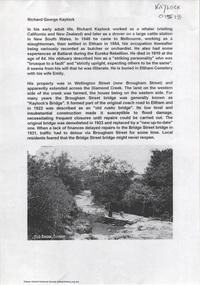
Folder, Kaylock Family, 1860s
... Grave of Richard George, Emily Ann (nee Davis) and Edith Jane Kaylock In his early adult life, Richard Kaylock worked as a whaler (visiting California and New Zealand) and later as a drover on a large cattle station in New South Wales. In 1848 he came to Melbourne, working as a slaughterman, then settled in Eltham in 1854, his occupation thereafter being variously recorded as butcher or orchardist. ...Grave of Richard George, Emily Ann (nee Davis) and Edith Jane Kaylock In his early adult life, Richard Kaylock worked as a whaler (visiting California and New Zealand) and later as a drover on a large cattle station in New South Wales. In 1848 he came to Melbourne, working as a slaughterman, then settled in Eltham in 1854, his occupation thereafter being variously recorded as butcher or orchardist. ...Contents: 1. Brief biography of Richard George Kaylock 2. Record of correspondence between Janet Keylock and her aunt Val Leggett with the Socoiety 3. Photocopy of photo of Old Bridge, Eltham and Brougham Street Bridge c.1960s and notes of burials at Eltham Cemetery of Charles (1867), Elizabeth Ann (1870), Roy (1905), Richard George (1910), Emily (1912), Amy (1933) 4. Photocopy of Baptism; 15 Jan 1834, Emily Ann (born 30 Nov 1833), daughter of William and Ann Davies (different spelling); Launceston, Tasmania; also Death Certificate; Emily Ann Kaylock, 3 Dec 1912, Brougham Street, Eltham, Vic. daughter of William and Ann Davis 5. Photocopy Certificate of Marriage; 18 Sep 1848, Richard George Keylock and Emily Ann Davis 6. Photocopy Birth Certificate; 21 Aug 1862, Elizabeth Jane, Eltham, Vic., daughter of Richard George Kaylock and Emily Ann Kalock (nee Davis) 7. Photocopy Birth Certificate; 10 Dec 1880, Ada, Eltham, Vic., daughter of Edith Jane Kaylock 8. Photocopy Certificate of Marriage; 17 Oct 1906, Frederick Samuel Webb and Ada Kaylock, Eltham, Vic. 9. Photocopy of Death Certificate; 7 May 1910, Richard George Kaylock, Eltham, Vic. 10. Photocopy of Death Certificate; 21 Jan 1927, Edith Jane Kaylock, Alphington, Vic. Grave of Richard George, Emily Ann (nee Davis) and Edith Jane Kaylock In his early adult life, Richard Kaylock worked as a whaler (visiting California and New Zealand) and later as a drover on a large cattle station in New South Wales. In 1848 he came to Melbourne, working as a slaughterman, then settled in Eltham in 1854, his occupation thereafter being variously recorded as butcher or orchardist. He also had some experiences at Ballarat during the Eureka Rebellion. He died in 1910 at the age of 84. His obituary described him as a "striking personality" who was "brusque to a fault" and "strictly upright, expecting others to be the same". It seems from his will that he was illiterate. He is buried in Eltham Cemetery with his wife Emily. His property was in Wellington Street (now Brougham Street) and apparently extended across the Diamond Creek. The land on the western side of the creek was farmed, the house being on the eastern side. For many years the Brougham Street bridge was generally known as "Kaylock's Bridge". It formed part of the original coach road to Eltham and in 1922 was described as an "old rustic bridge". Its low level and insubstantial construction made it susceptible to flood damage, necessitating frequent closures until repairs could be carried out. The original bridge was demolished in 1923 and replaced by a "new up-to-date" one. When a lack of finances delayed repairs to the Bridge Street bridge in 1931, traffic had to detour via Brougham Street for some time. Local residents feared that the Bridge Street bridge might never reopen. Buried in Eltham Cemetery In Loving Memory Of Our Dear Father & Mother R.G. and E.A. Kaylock Also E.J. Kaylock Died 21st Jan. 1927 The Eternal God Is My Pledge Folder of information on Kaylock family Eltham 1860skaylock family -
 Eltham District Historical Society Inc
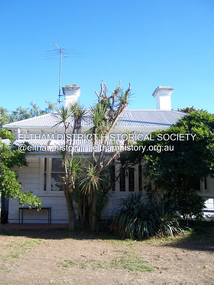
Photograph - Digital Photograph, Alan King, Allwood House, Hurstbridge, 16 April 2008
... They bought Haley’s cattle station and built the present Allwood House, using the original home as an orchard packing shed. ...They bought Haley’s cattle station and built the present Allwood House, using the original home as an orchard packing shed. ...Allwood - built in 1894 by Henry Hurst’s relatives, stands near the site of his house, which was demolisherd in the 1940s. Until 1924 Hurstbridge was known as Allwood. The building, one of the district's oldest is situated back from the corner of Arthurs Creek Road and Main Road. Covered under Heritage Overlay, Nillumbik Planning Scheme Published: Nillumbik Now and Then / Marguerite Marshall 2008; photographs Alan King with Marguerite Marshall.; p17 Hurst, who was a surveyor, came to Melbourne in 1852 by default, as on the way to Sydney he contracted typhoid and was off-loaded in Melbourne. Deciding to settle near Melbourne, he selected some land near the present Eltham railway station and was one of the first to grow crops there.2 But disaster struck again, when his shack was looted and burned, while he was carting goods for sale to nearby goldfields. It was then that Hurstbridge’s first settler, Cornelius Haley, asked Hurst to manage his 160 acres (65ha) grazing property and 9000 acres (3443ha) of leased land where the present Hurstbridge stands. Hurst proved equal to the tough conditions and he and his brother, Fred, cut a track with a bullock team from the property to Romsey, where Haley had selected some land. Hurst also put up a bridge across the creek near his house, after which Hurstbridge was named. He ran the property helped by two ticket-of-leave men and others, several of whom were sailors who had abandoned ship in search of gold, and were working there temporarily. In 1866, only 14 years after coming to Australia, Hurst met an early tragic death. One day a bushranger named Burke came to the house and demanded a horse. Hurst thought the bushranger might be an officer in search of runaway sailors3 and anyway, did not like the look of him, so he refused. A tussle followed and apparently Hurst shot first.4 He was shot and died five hours later from loss of blood. Later, troopers found Burke, who was subsequently hanged. The event is recorded in the Old Melbourne Gaol. The government offered the family £500 but the family refused it as ‘blood money’. Hurst’s father, Robert, even signed a petition against the bushranger’s death, claiming one life did not replace another. Hurst’s family continued to live in the district and saw a rise in their fortunes. They bought Haley’s cattle station and built the present Allwood House, using the original home as an orchard packing shed. The present Victorian style timber house had several outbuildings including a blacksmith’s shop. The property passed on to William Gray, an orchardist and nurseryman, who married Hurst’s grandniece, Frances. The business boomed from the early 1900s when it supplied most of the orchards in the area. Gray was Eltham Shire’s President for two terms and was asked to stand for parliament, but his wife’s illness and other family commitments prevented him from doing so. Then several calamities drove the family to bankruptcy. During World War One, Gray lost more than one million pounds on trees shipped overseas, which the Lloyd’s company had refused to insure. Other factors, including the Great Depression, ruined the family’s fortunes. The land was reduced from more than 640 acres (256ha) to 50 acres (20ha) and the older members married and left. After Mr Gray died, the house was leased, until his daughter Sheila Ferguson and her husband Gordon settled there in 1951, after buying it from other family members. However in 1975 the Shire designated the property as a passive recreation reserve. The Ferguson family sold most of the land, leaving the house on 0.6 hectares.This collection of almost 130 photos about places and people within the Shire of Nillumbik, an urban and rural municipality in Melbourne's north, contributes to an understanding of the history of the Shire. Published in 2008 immediately prior to the Black Saturday bushfires of February 7, 2009, it documents sites that were impacted, and in some cases destroyed by the fires. It includes photographs taken especially for the publication, creating a unique time capsule representing the Shire in the early 21st century. It remains the most recent comprehenesive publication devoted to the Shire's history connecting local residents to the past. nillumbik now and then (marshall-king) collection, hurstbridge, henry hurst, allwood house
