
Showing 5 items matching "chain. migration"
-
 Ithacan Historical Society
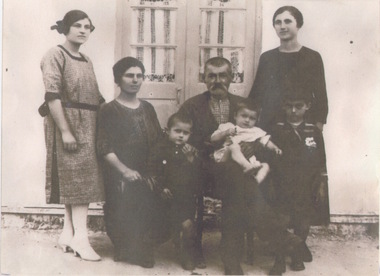
Photograph, Vlassopoulos family, Lahos Ithaca, c1922
... chain. migration...Generally it followed a pattern of chain migration with family members following one another. ...The photograph features Anastasios Vlassopoulos (Kioukiouris) with his three daughters-in-law, Ekaterini, Korina and Elena, and three little grandsons. They are from L-R: Ekaterina (nee Paxinos), Korina (nee Raftopoulos), John, Anastasios, baby Aleko held by his grandfather Anastasios, Elena (nee Raftopoulos) and Peter. The photograph was taken in the village of Lahos shortly before Ekaterina and son Peter emigrated to Australia to be reunited with her husband, John. Elena remained in Ithaca, as did Korina whose son Aleko Vlassopoulos migrated to Australia following World War 2. Ithacan migration to Australia before World War 2 was unassisted. Generally it followed a pattern of chain migration with family members following one another. The men arrived first with the intention of either returning or saving enough money to bring their wives and families out when they had become financially established. Most men did not return. Some families were reunited while some wives and children never saw their husbands and fathers again.A black and white photograph of a family group of seven people - an elderly man, three young women, two little boys and and a baby.chain. migration -
 Ithacan Historical Society
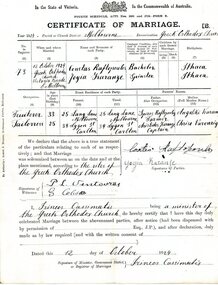
Document, Certificate of Marriage, Constas & Joyia Raftopoulos, 12 October 1924
... During the years between the two world wars chain migration saw many Ithacans sponsored by family members to come to Melbourne. ...A copy of the marriage certificate of Constas (Costas) and Joyia Raftopoulos nee Karanze, who were married at the Greek Orthodox Church 'Evangelismos' in East Melbourne on 12 October 1924. The priest who conducted the service was Father Irineos Cassimatis. Costas was a fruiterer and Joyia was a 'tailoress'.Constas Raftopoulos and Joyia Grarange both migrated to Australia from Ithaca in the 1920s and like many other Ithacans settled in Melbourne where they eventually married. During the years between the two world wars chain migration saw many Ithacans sponsored by family members to come to Melbourne.A photograph of a marriage certificate. -
 Ithacan Historical Society
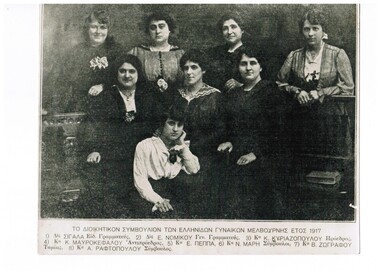
Photograph, Governing Council of Greek Women, Melbourne 1917, 1917
... During the early 1900s and emergence of chain migration, Ithacan women began to come to Melbourne. ...The photograph is of members of the Governing Council of Greek Women in Melbourne in 1917. A number of the women were from Ithaca. The organisation was created to offer social interaction for Greek women who had settled in Australia in the early years of the twentieth century and was part of the Greek Orthodox Community of Melbourne and Victoria. Back row L-R: Mrs. A Raftopoulou, Miss Sigala, Mrs. E. Peppa. Middle row L-R: Miss E. Nomikou, Mrs. K. Kyriazopoulou, (President), Mrs. K Mavrokefalou (Vice-president), Mrs. N. Mari. Front: Mrs. B. Zografou. A black and white portrait style photograph of eight young women. The translated caption is printed below the photograph in Greek: THE GOVERNING COUNCIL OF GREEK WOMEN, MELBOURNE 1917 gocv, committee, auxilliary -
 Ithacan Historical Society
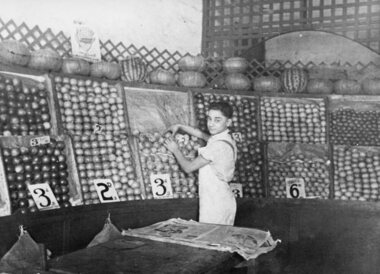
Photograph, Nakis Raftopoulos in the fruit shop, 1937
... The ownership of businesses by Ithacans assisted the development of chain migration with Ithacan business owners providing employment to relatives who wished to emigrate to Melbourne. ...In the photograph a young Nakis Raftopoulos is arranging the fruit display in his father's (Spiro Raftopoulos) shop which was at 250 Johnson Street in Abbotsford. Many Ithacan Greeks who settled in Melbourne opened businesses as it was difficult for non-British immigrants to secure employment in the early years when Ithacans first started arrive. The business were mostly associated with food vending, either cafes, restaurants, oyster bars and sea food shops, or fruit shops, stalls or barrows. They ventured into the food vending business because it was an area the had skills in. Also some of these business didn't require enormous initial capital outlay and provided a springboard for entrepreneurial Ithacans to progress to larger scale businesses. The ownership of businesses by Ithacans assisted the development of chain migration with Ithacan business owners providing employment to relatives who wished to emigrate to Melbourne. A black and white photograph of a young man in a fruit shop. he is arranging apples in a display behind a counter. The photograph has been reproduced and is mounted on board. -
 Friends of Westgarthtown
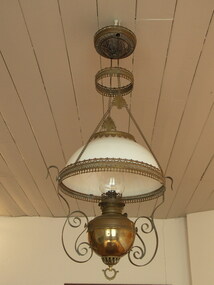
Domestic object - Lamp, Miller, Miller, c. 1890s
... chain-operated raising and lowering system. The inscriptions “B&H Valpirfor” and patent dates 1894-1895 confirm its authenticity as an American-made B&H Rayo lamp. This lamp was likely purchased in Mecklenburg, Germany, reflecting the export of modern lighting technologies into rural German households in the late 19th century. The lamp’s significance is further enhanced by its believed association with the Ziebell family. It is understood that a family member brought the lamp to Melbourne on a subsequent return journey to Germany after the family had established themselves at Westgarthtown. As a result, the lamp embodies themes of migration ...Purchased by Christian Ziebell on one of his two visits back to Germany.This object is of primary significance. Christian Ziebell brought it back from Germany on his return visit to Germany in 1856. It always hung where it is now and it is retractable to different heights. It hung on the lowest chain length over the table and was only raised when the family had festive events such as dances when Dorothea would accompany them on the piano. Great care had to be exercised when the lamp was raised because if it went up too high, and therefore became too close to the wooden ceiling, it could cause a fire. Francis Adams – son of Sylvia Adams (Ziebell) restored the lamp in the 1990’s. This Miller-style hanging oil lamp is a rare and culturally layered object that connects American industrial manufacture with German domestic life and early migrant history in Victoria. Produced by Bradley & Hubbard (B&H) in the United States in the 1890s, the lamp displays characteristic features of the firm’s Rayo line, including a brass body, opaque white glass shade, quality burner mechanism, and a chain-operated raising and lowering system. The inscriptions “B&H Valpirfor” and patent dates 1894-1895 confirm its authenticity as an American-made B&H Rayo lamp. This lamp was likely purchased in Mecklenburg, Germany, reflecting the export of modern lighting technologies into rural German households in the late 19th century. The lamp’s significance is further enhanced by its believed association with the Ziebell family. It is understood that a family member brought the lamp to Melbourne on a subsequent return journey to Germany after the family had established themselves at Westgarthtown. As a result, the lamp embodies themes of migration, technological adaptation, and the lived domestic environment of the Ziebell family across two continents. Its high level of intactness, combined provenance and dual- history contribute to its importance as a culturally rich artefact within the Ziebell’s Farmhouse collection. Original Miller hanging lamp, made of brass and opaque white glass. Lamp has chain-operated raising and lowering mechanism. Decorative brass trimming around widest edge of glass lampshade. Contains tubular wick.B & H Valpirfor written on lowering mechanism on top of the lamp. Rayo 24.98, PAT'D. NOV. 20.94, FEB 28.95, written on top of oil compartment.lighting, kerosene & oil, oil lamp, hanging lamp, original.
