
Showing 13 items matching "chapel lane"
-
 Eltham District Historical Society Inc
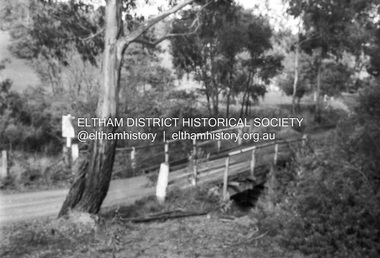
Negative - Photograph, Russell Yeoman, Bridge over Arthurs Creek, Chapel Lane, Nutfield, c.1970
... Bridge over Arthurs Creek, Chapel Lane, Nutfield...chapel lane...chapel lane arthurs creek nutfield Bridge Ilford HP4 Roll of 35mm black and white negative film, 4 of 7 strips and corresponding B&W print Bridge over Arthurs Creek, Chapel Lane, Nutfield Negative Photograph Russell Yeoman ...Roll of 35mm black and white negative film, 4 of 7 strips and corresponding B&W printIlford HP4chapel lane, arthurs creek, nutfield, bridge -
 Eltham District Historical Society Inc
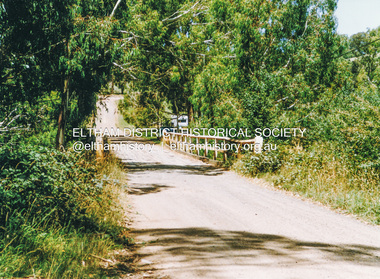
Photograph, Doug Orford, Bridge across Arthurs Creek, Chapel Lane, Nutfield, 1991, 1991
... Bridge across Arthurs Creek, Chapel Lane, Nutfield, 1991......chapel lane...From a collection of 35 photos taken by Doug Orford at 35 specific locations along the exact boundary of the then Shire of Eltham. bridges arthurs creek chapel lane nutfield Colour photograph Bridge across Arthurs Creek, Chapel Lane, Nutfield, 1991 Photograph Photograph Doug Orford ...From a collection of 35 photos taken by Doug Orford at 35 specific locations along the exact boundary of the then Shire of Eltham.Colour photographbridges, arthurs creek, chapel lane, nutfield -
 City of Moorabbin Historical Society (Operating the Box Cottage Museum)
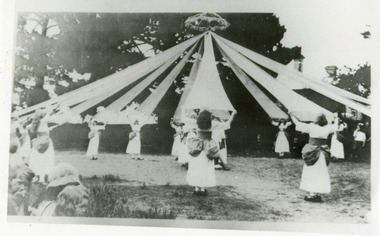
Photograph, Black & White x4 Maypole Dance Moorabbin State School 1922, 1922
... In order for this school to open, School No 442, a Wesleyan School, on the corner of Wickham Road and Chapel Lane, had to agree to close to meet pupil number requirements. ...In order for this school to open, School No 442, a Wesleyan School, on the corner of Wickham Road and Chapel Lane, had to agree to close to meet pupil number requirements. ...In October 1872, State School 1111 Box Rise opened on the corner of Worthing Road and Dane Road. In order for this school to open, School No 442, a Wesleyan School, on the corner of Wickham Road and Chapel Lane, had to agree to close to meet pupil number requirements. Charles Sadgrove was head teacher of the new State School when it opened on October 1st 1872 and he remained until 1878. The school was renamed South Brighton in 1887 to accord with the nearby railway station which opened around that time. The main part of the present building dates from 1890. By the early 1900s the school had been extended to the north. . The school contains a plaque for Harry G Hawker, one of the pioneers of aviation, who attended the school in the closing years of the nineteenth century. The school was renamed Moorabbin in 1909.During the 1940s and 1950s population in the area surged and school enrolments peaked to over 800 under head teacher CS Lansell. Enrollments decreased to 470 in 1969. By the 1990s however, enrollments began to increase again. ( G Whitehead KCC Historian) Since 1890 Moorabbin Primary School No.1111 has been socially significant at a local level providing education for the families of the early settlers in Moorabbin ( South Brighton) Black & White photographs x 4 of pupils at Moorabbin State School Maypole Dancing c1922keys robert, marriott charles, gregg barriecity of moorabbin, county of bourke, moorabbin roads board, parish of moorabbin, shire of moorabbin, henry dendy's special survey 1841, were j.b.; bent thomas, o'shannassy john, king richard, charman stephen, highett william, ormond francis, maynard dennis, methodist church wickham road, box rise state school no.1111, methodist chapel cheltenham, education, early settlers -
 Eltham District Historical Society Inc
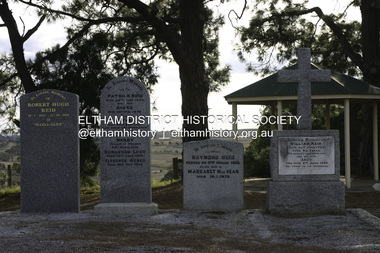
Photograph - Digital Photograph, Alan King, Reid family graves, Arthurs Creek Cemetery, 30 March 2008
... The Hazel Glen State School No 945, before it was moved to its present site, stood on land to the south of Chapel Lane, which had been donated by Hazel Glen owner, William Reid. ...The Hazel Glen State School No 945, before it was moved to its present site, stood on land to the south of Chapel Lane, which had been donated by Hazel Glen owner, William Reid. ...The Arthurs Creek Cemetery was originally the private cemetery of pioneers Agnes and Patrick Reid. Published: Nillumbik Now and Then / Marguerite Marshall 2008; photographs Alan King with Marguerite Marshall.; p11 The Hazel Glen property, at Middle Hut Road, Arthurs Creek, which includes one of Victoria’s earliest pioneer buildings, was the forerunner to the Arthurs Creek and Doreen townships. At one time the Doreen Post Office and school were called Hazel Glen. The Hazel Glen State School No 945, before it was moved to its present site, stood on land to the south of Chapel Lane, which had been donated by Hazel Glen owner, William Reid. In May 1895 the post office was renamed Doreen to avoid confusion with the Reid’s address. The Arthurs Creek Cemetery was originally the private cemetery of Hazel Glen pioneers Agnes and Patrick Reid. The Reids with their eight children, arrived in Melbourne in April 1839. In 1844 Patrick Reid took over the licence to the Stewart Ponds run of 5120 acres (2072ha). Reid renamed it Hazel Glen, after Hazelden, the name of the Reid estate at Mearns in Renfrewshire, Scotland. Reid built a small cottage from local stone and hand-made bricks, with walls one yard (91 cm) thick, a flagstone floor and a shingle roof. Today two rooms and a store room survive as part of a larger house. Agnes died in 1847 aged 49, and was buried on a hill overlooking Hazel Glen, where it is said she had asked to be buried as it had been a favourite picnic spot.2 In 1858 Patrick died aged 74, and was buried near her. Their son William was to become Whittlesea Shire’s first president. From 1868 he was a Whittlesea Roads Board member, then a shire councillor until shortly before his death in 1923 aged 88. In 1865 the Reid’s burial area was no longer on their property, so it was declared a cemetery site. In 1867 it became the Linton Public Cemetery, being in the Linton Parish. However, to avoid confusion with Linton near Ballarat, the cemetery was renamed the Arthurs Creek Public Cemetery in 1926. Arthurs Creek was named after Henry Arthur, a pastoralist and public servant, who ran 1000 sheep lower down the Creek, from 1836 to 1841. It is believed he built his home at the end of today’s Challenger Street in Diamond Creek.This collection of almost 130 photos about places and people within the Shire of Nillumbik, an urban and rural municipality in Melbourne's north, contributes to an understanding of the history of the Shire. Published in 2008 immediately prior to the Black Saturday bushfires of February 7, 2009, it documents sites that were impacted, and in some cases destroyed by the fires. It includes photographs taken especially for the publication, creating a unique time capsule representing the Shire in the early 21st century. It remains the most recent comprehenesive publication devoted to the Shire's history connecting local residents to the past. agnes reid, arthurs creek cemetery, nillumbik now and then (marshall-king) collection, patrick reid, reid family -
 Mission to Seafarers Victoria
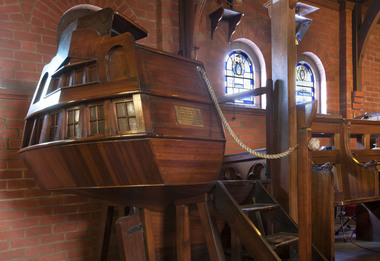
Furniture - Pulpit, Rodney Howard Alsop, 1909
... chapel...saint peter...pulpit...australian timber...stern...walter richmond butler...australian maritime history...reverend w.f. haire...rodney howard alsop (1881-1932)...wright's lane...He died in February 1918 in a railway accident. mission seafarers melbourne victoria chapel saint peter pulpit australian timber stern walter richmond butler australian maritime history reverend w.f. haire rodney howard alsop (1881-1932) wright's lane william john dalziel gifts-1917 heritage listed Inside the pulpit (right) is the cardboard label with the maker details: " On an attached plaque see 0678 To the greater glory of God and in ever loving memory of Jane King Haire. ...In 1909, assistant Chaplain Rev. Haire presented the Mission with an 'uncommonly artistic pulpit' in memory of his mother. A plaque in memory of Jane King Haire can be found on the side next to the steps. The dedication was performed by the Archbishop of Melbourne on the 26th January (date engraves on the plaque) This pulpit was designed by Melbourne architect Rodney Howard Alsop (1881-1932) and manufactured by William John Dalziel (furniture manufacturer). It was initially used in the first Mission in Central Melbourne, Siddeley St. It is located in the Chapel of Saint Peter of the Mission to Seafarers 717 Flinders St. complex since 1917 (State Heritage listed (H1496). This complex was designed by Walter Richmond Butler in 1916, and officially opened on 11 September 1917, a day '...of unusually kind weather', by the Governor of Victoria, the Honourable Sir Arthur Stanley. According to a later article published in 1950: The pulpit is a model, built to scale, of the stern of an old ship of the line in Lord Nelson's day. This pulpit is significant as it is housed in The Memorial Chapel of Saint Peter forming part of the State Heritage listed Mission to Seafarers Victoria complex. It was built in Melbourne of Australian timbers, and is one of only two known maritime inspired pulpits, both associated with Missions to Seamen of the early 20th C. the other is held in the ANMM Collection see link. Their statement of significance is worth quoting in part as it applies equally to this pulpit "...an extremely rare and unique example of such pulpits. It is highly significant as a wonderfully preserved example of a time when religion was preached to sailors for their spiritual guidance and temperance..." Rodney Howard Alsop was an important Melbourne architect of the Arts and Crafts movement. John William Dalziel had sailed from Liverpool to Melbourne in 1862. Seventeen years later Penman and Dalziel founded the business in Lonsdale Street West, and won recognition at the Indian and Colonial Exhibition in London in 1886. Penman and Dalziel were identified in 1937 as one of Melbourne’s early ‘skilled craftsmen’ and ‘leading names’ in the manufacture of fine furniture. He died in February 1918 in a railway accident.Timber pulpit built in the form of a ship's stern including a timber step ladder for access, a timber keel and rudder, a rope fixed from the pulpit to a post mounted to the floor, and a dedication plaque on the side of the pulpit. The pulpit sits on timber legs. It's likely to be the original rope: traditionally made coir rope with twisted fibres, covered with canvas supported by a thread. At lower end the rope is secured by a monkey fist know and at the top by a turk head knot.Inside the pulpit (right) is the cardboard label with the maker details: " On an attached plaque see 0678 To the greater glory of God and in ever loving memory of Jane King Haire. This pulpit is erected by her son. Blessed are the pure in heart. For they shall see God. St. Matt. V.8. 26.1.09mission, seafarers, melbourne, victoria, chapel, saint peter, pulpit, australian timber, stern, walter richmond butler, australian maritime history, reverend w.f. haire, rodney howard alsop (1881-1932), wright's lane, william john dalziel, gifts-1917, heritage listed -
 Ringwood and District Historical Society
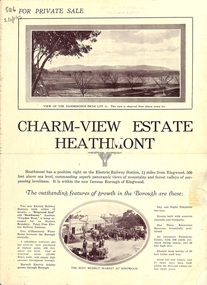
Flyer, Land Sale Brochure, Charm-View Estate, Heathmont, Vic. - c1926
... Burkitt & Co., Phone Ringwood 157, Overton & Co., 390 Chapel Street South Yarra, Phone Windsor 542. Solicitor A.V. Wischer, 443 Chancery Lane, Melbourne....Burkitt & Co., Phone Ringwood 157, Overton & Co., 390 Chapel Street South Yarra, Phone Windsor 542. Solicitor A.V. Wischer, 443 Chancery Lane, Melbourne. ...Double sided folded page advertisement highlighting local facilities, services and layout of blocks for sale in Charm-View Estate.Subdivision includes Heathmont Road, Orchid Street, Bennett Avenue, Dickasons Road and Canterbury Road. (Agents) T. Burkitt & Co., Phone Ringwood 157, Overton & Co., 390 Chapel Street South Yarra, Phone Windsor 542. Solicitor A.V. Wischer, 443 Chancery Lane, Melbourne. -
 Bendigo Historical Society Inc.
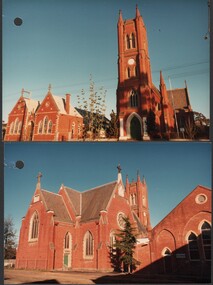
Photograph - National Trust Collection: St Paul's Church of England, Bendigo, 23/06/2025
... It has associations with individuals important to the history of the Anglican church in Bendigo including John Christian MacCullagh, the first Dean of Bendigo, after whom the MacCullagh Chapel was named, and Canon David Anthony, a former rector of the church. https://vhd.heritagecouncil.vic.gov.au/places/3695 St Paul's Church of England National Trust Collection: St Paul's Church of England, Bendigo Church constructed of red brick with contrasting brick features. Church entry/ bell tower is a feature of Bendigo skyline. 3084.102A frontage of the Church and Church Hall onto Myers Street, Bendigo 3084.102B St Paul's C of E, rear of Church and Church Hall facing Bush's Lane, Bendigo Photograph National Trust Collection: St Paul's Church of England, Bendigo ...Victorian Heritage Database: St Paul's Cathedral, Bendigo was built in stages. The nave was built in 1868, the tower in 1872-73 and the transepts and sanctuary in 1926-27. Robert Love was the architect, although the final stage was supervised by architects Gawler and Drummond. Cathedral status was transferred from the original cathedral All Saints to St Paul's in 1981. The Gothic style cathedral is constructed of red brick with stone dressings. It has a simple cruciform plan comprising a six bay nave, transepts and sanctuary. A tall tower centrally located at the west end dominates the exterior. The peal of eight bells was cast by Meares and Co of London and installed in 1873. The interior features elaborately cusped roof principals; an organ by Alfred Fuller built in 1883 with a console and pipes added later from St Andrew's Cathedral, Sydney; and notable stained glass by Ferguson, Urie and Lyon. St Paul's Rectory was built in 1885 to a design by the architect WC Vahland. The Parish Office and Hall was built as a Sunday School in 1898 to a design by FW Lehmann. St Paul's Cathedral is of architectural, aesthetic and historical significance to the state of Victoria. The cathedral is a significant example of the Early English Gothic style. The tower, with its distinctively detailed pinnacles, its spiral staircase and carillon of eight bells, is a notable feature and a town landmark. The interior is aesthetically important for its decorative detail. The roof structure, rising some 18.3 metres from the 11 metre walls in suspended semi-circles from the pillarless nave, is highly significant for both its considerable technical achievement and its aesthetic appeal. The interior features fine examples of carved timber fixtures and fittings. The interior is also noteworthy for the high quality of its stained glass, especially the twelve apostle windows by Ferguson, Urie and Lyon. The cathedral also features a number of important movable objects such as the finely carved eagle lectern in oak, the ornately carved timber chair in the sanctuary, the two baptismal fonts, the ornately carved canons' stalls with eagle motifs in the sanctuary and the two large candle holders. Important works of art include the opus sectile reredos in mosaic; the sculpture of Madonna and Child in Queensland birch by sculptress Leopoldine Mimovich; and the carved figures of St Peter and St Paul at the high altar by the sculptress Ola Cohn. St Paul's Cathedral complex has historical associations with the Anglican church in Bendigo, particularly the rivalry between St Paul's and the original cathedral, All Saints, and the long and controversial debate about 'High Church versus Low Church'. It has associations with individuals important to the history of the Anglican church in Bendigo including John Christian MacCullagh, the first Dean of Bendigo, after whom the MacCullagh Chapel was named, and Canon David Anthony, a former rector of the church. https://vhd.heritagecouncil.vic.gov.au/places/3695National Trust Collection: St Paul's Church of England, Bendigo Church constructed of red brick with contrasting brick features. Church entry/ bell tower is a feature of Bendigo skyline. 3084.102A frontage of the Church and Church Hall onto Myers Street, Bendigo 3084.102B St Paul's C of E, rear of Church and Church Hall facing Bush's Lane, Bendigost paul's church of england -
 Sunshine and District Historical Society Incorporated
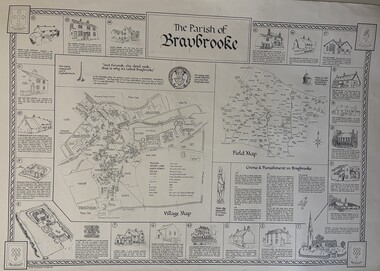
Map - The Parish of Braybrooke Map
... The Parish of Braybrooke|Church|Wantage Farm|The Old Sun Inn|The Bridge & Bridge House|Baptist Chapel & Bowden Bridge|Castle Farm|Braybrooke Castle|Probable Site of Braybrooke Orange|Workhouse Row and Jubilee Tree|The Old Post Office|Green Lane Cottage|Old Parish Houses|Bleak House|Old Village Store and Club House|Jim Robinson's Cottage|The Old School|The Swan Inn|Mrs Underwood's House|The Old Rectory|Village Hall|Braybrooke Primary School...Braybrook Map The Parish of Braybrooke|Church|Wantage Farm|The Old Sun Inn|The Bridge & Bridge House|Baptist Chapel & Bowden Bridge|Castle Farm|Braybrooke Castle|Probable Site of Braybrooke Orange|Workhouse Row and Jubilee Tree|The Old Post Office|Green Lane Cottage|Old Parish Houses|Bleak House|Old Village Store and Club House|Jim Robinson's Cottage|The Old School|The Swan Inn|Mrs Underwood's House|The Old Rectory|Village Hall|Braybrooke Primary School Large white map that lists the locations of multiple buildings within the Parish of Braybrooke Map The Parish of Braybrooke Map ...The Parish of Braybrooke|Church|Wantage Farm|The Old Sun Inn|The Bridge & Bridge House|Baptist Chapel & Bowden Bridge|Castle Farm|Braybrooke Castle|Probable Site of Braybrooke Orange|Workhouse Row and Jubilee Tree|The Old Post Office|Green Lane Cottage|Old Parish Houses|Bleak House|Old Village Store and Club House|Jim Robinson's Cottage|The Old School|The Swan Inn|Mrs Underwood's House|The Old Rectory|Village Hall|Braybrooke Primary Schoolbraybrook, map -
 Queen's College
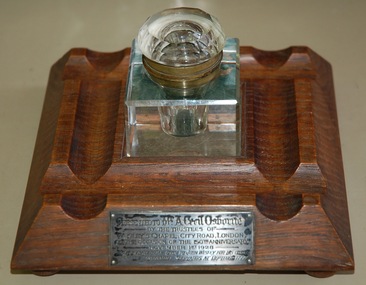
Inkwell and stand, 1928
... Made from old oak given to John Wesley for his chapel from the government shipyards at Deptford 1777" Plaque 2: Presented by Mrs Osborne of Hammers Lane, Mill Hill, London, To the Mont Albert Methodist Church In appreciation of gifts received from the Mont Albert Congregation, November 1947....Made from old oak given to John Wesley for his chapel from the government shipyards at Deptford 1777" Plaque 2: Presented by Mrs Osborne of Hammers Lane, Mill Hill, London, To the Mont Albert Methodist Church In appreciation of gifts received from the Mont Albert Congregation, November 1947. ...Glass inkwell and timber stand. The wooden inkstand has 2 small brass plaques attached to it.Plaque 1: "Presented to Mr A Cecil Osborne by the Trustees of Wesley's Chapel, City Road London on the occasion of the 150th anniversary November 1st 1928. Made from old oak given to John Wesley for his chapel from the government shipyards at Deptford 1777" Plaque 2: Presented by Mrs Osborne of Hammers Lane, Mill Hill, London, To the Mont Albert Methodist Church In appreciation of gifts received from the Mont Albert Congregation, November 1947.john wesley, inkwell, deptford shipyards, mont albert -
 Whitehorse Historical Society Inc.
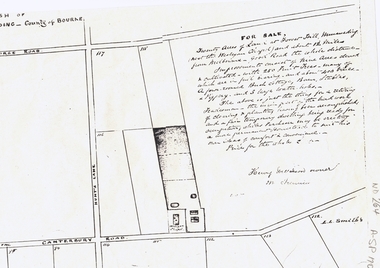
Document, Land Sale Forest Hill
... chapel...willson...henry...hunt's lane...wesleyan chapel willson henry hunt's lane forest hill mount pleasant methodist church 20 acres of land at Forest Hill 20 acres of land at Forest Hill Nunawading on Canterbury Road next to Wesleyan Chapel. ...20 acres of land at Forest Hill20 acres of land at Forest Hill Nunawading on Canterbury Road next to Wesleyan Chapel.20 acres of land at Forest Hillwesleyan chapel, willson, henry, hunt's lane, forest hill, mount pleasant methodist church -
 St Patrick's Old Collegians Association (SPOCA)
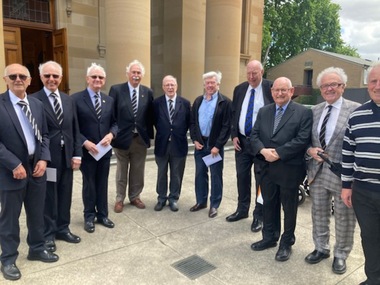
Photograph - Alumni, General
... Chapel on 24 Oct 2024. Group from left is M. Cavanagh, J. Curry, G. Wayland, J. Smith, T. Gaynor, P. McColl, G. Healy SJ, L. Burn, T. Cavanagh, B. Lane...Chapel on 24 Oct 2024. Group from left is M. Cavanagh, J. Curry, G. Wayland, J. Smith, T. Gaynor, P. McColl, G. Healy SJ, L. Burn, T. Cavanagh, B. Lane ... -
 St Patrick's Old Collegians Association (SPOCA)
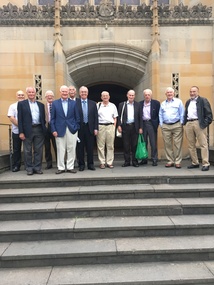
Photograph - SPOCA, Communion Breakfast, 2018
... Heading from Newman College chapel steps to breakfast and 2018 AGM are SPJC Alumni: Michael Nolan, Bob Solly, Kevin Lane, Peter Harford, Jim Smith, Murray Cullinan, speaker Kevin Brophy, Fr Michael Head SJ, Michael Curtain, tba and Paul Buttigieg...Heading from Newman College chapel steps to breakfast and 2018 AGM are SPJC Alumni: Michael Nolan, Bob Solly, Kevin Lane, Peter Harford, Jim Smith, Murray Cullinan, speaker Kevin Brophy, Fr Michael Head SJ, Michael Curtain, tba and Paul Buttigieg Photograph SPOCA, Communion Breakfast, 2018 ... -
 City of Melbourne Libraries
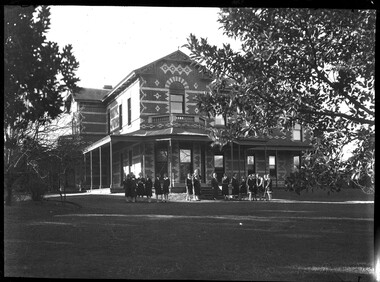
Photograph, Bull, Hugh Jones, 1897-1993, Ruyton Girls School 1933
... Lane and Market Street in 1857-58, in an elaborately detailed Renaissance Revival style. His churches were mostly Gothic Revival, built for the Anglican Church, along with some parsonages, while most of the bank buildings were Renaissance Revival designs for the Bank of Australasia. He also designed city buildings in the 1860s and 70s, such as the Mutual Insurance Co, Northern Insurance Co, and the first premises for George & George, destroyed by fire in 1889. One of his most outstanding designs is St George's Presbyterian Church in Chapel...Lane and Market Street in 1857-58, in an elaborately detailed Renaissance Revival style. His churches were mostly Gothic Revival, built for the Anglican Church, along with some parsonages, while most of the bank buildings were Renaissance Revival designs for the Bank of Australasia. He also designed city buildings in the 1860s and 70s, such as the Mutual Insurance Co, Northern Insurance Co, and the first premises for George & George, destroyed by fire in 1889. One of his most outstanding designs is St George's Presbyterian Church in Chapel ...Published: Age (Melbourne, Vic.: 1854- ), 4 August 1933, page 3 Published title: GIRLS’ SCHOOLS – MODEL YACHTING - FOOTBALL Published caption: The headmistress, Miss H. Daniell, and girls at Ruyton, Selbourne Road, Kew, snapped after school hours. Trove article identifier: http://nla.gov.au/nla.news-article204381763 Research by Project Volunteer, Louise McKenzie: Rather than the people, this charming building takes the eye! Originally named “Tarring”, it was built in 1872 by Mr Henry Henty and his wife Mrs Marion Anne Henty (nee McKellar) for their family. Located at 82 Selbourne Road, Kew, it is described by Melbourne’s Open House organisation as “… a two-storey, polychrome brick mansion built for them by prominent Melbourne architect Albert Purchas. The house and nearly four acres of grounds served as their family home until the death of Marian Henty in 1919. “ (See below for further information on Albert Purchas.) In 1920 it was sold to Ruyton Girls School. Ruyton was established in 1878 by its first principal, Charlotte Anderson (1838-1906), who named it in honour of the parish in Shropshire, England, Ruyton-XI-Towns, where her great-great-grandfather David Evans had been vicar. Its motto is Recte et Fideliter, meaning "Upright and Faithful", which is also the name of the school song. The original school, one of Victoria’s oldest independent schools for girls, was located at the home of Mrs Anderson at 63 High Street South, Kew. In 1882 she moved the school to Edgecombe in Studley Park Road. Mrs Anderson retired due to ill health and sold the school to her friend Miss Eliza Bromby. One of Ruyton's four Houses, Anderson, is named for Charlotte Anderson. When Ruyton Girls School was moved to the site in 1920 it established the building as a Boarding House, and renamed the building “Henty House” in honour of its original owners. Today the school remains an all girls’ school, and pays tribute to its founder and the historic significance of Henty House and its magnificent Moreton Bay Fig tree, which still stands today. The building retains many original, Victorian-era features, while also showing the layers of change, made over the decades in order to meet the evolving needs of one of Melbourne’s leading schools. The headmistress mentioned in the caption for MCK016 is Miss Hilda Daniell, shown standing in front of Henty House in the midst of a group of Ruyton girls in their school uniforms, some holding hockey sticks. Miss Daniell was the longest serving Principal of Ruyton 1913-1952. She was originally a student in 1893, then joined the teaching staff in 1898. It was under her leadership that the School purchased and moved to “Tarring”. The boarding house included a flat for Hilda to live onsite. An article in the Ruyton Heritage Collection – Bedford Series, dated 21 May 2021 cites that Miss Daniell “was affectionately known as “Dream” by Ruytonians of her era” apparently due to a tendency to quiet reflection. The article continues, “After her retirement in 1952 Miss Daniell was awarded an Order of the British Empire for her many services to education, an award she received from the hands of the Queen during the 1954 Royal Tour. Also in 1952, the Kew Council honoured her by renaming Brougham Place as ‘Daniell Place’.” Arthur Purchas, architect: The architect responsible for the design of “Tarring”. Arthur Purchas, was extremely active and highly regarded at this time. Born in Wales in 1825, he emigrated to Melbourne in 1851 and soon established a private practice as a surveyor and architect, with offices variously in Little Collins, Queen Street, Chancery Lane, and finally 462 Little Collins Street. Wikipedia notes in an early reference to Purchas that “An early story is that one of his first jobs, when he would have been about 25 years old, was a position under Surveyor-General Robert Hoddle, and disagreeing with him over the line for St Kilda Road, appealed to Governor La Trobe, and successfully got the road diverted around the hill which eventually became the site of the Shrine of Remembrance. There may not be much truth to this, since by 1851 St Kilda Road was already a well worn track running around the hill, the top of which La Trobe had reserved for a Government House in 1840.” The timing of Purchas’s arrival in Melbourne was perfect. The Victorian gold rush of the 1850’s generated enormous wealth in Melbourne, and a building boom followed. The Wikipedia entry continues … that alone, or with his brother in law Charles R Swyer, “Purchas is said to have designed over 140 houses, offices, churches, banks and cemetery buildings in Victoria in his long career. Berkely Hall, St Kilda dating from 1854 is one of his first buildings, and still exists, though the original house is obscured by an early C20th verandah. Another notable early design was the head office of the Melbourne Savings Bank, built on the corner Flinders Lane and Market Street in 1857-58, in an elaborately detailed Renaissance Revival style. His churches were mostly Gothic Revival, built for the Anglican Church, along with some parsonages, while most of the bank buildings were Renaissance Revival designs for the Bank of Australasia. He also designed city buildings in the 1860s and 70s, such as the Mutual Insurance Co, Northern Insurance Co, and the first premises for George & George, destroyed by fire in 1889. One of his most outstanding designs is St George's Presbyterian Church in Chapel Street, St Kilda (1877–80), in a striking polychrome brick Gothic Revival style, unusually carried on through to the interior. Purchas produced one of the few published maps and compilations of the early pastoral settlers runs in Victoria in 1853. In the same year he designed the layout of the Melbourne General Cemetery, the first 'garden' cemetery in Victoria, a curvilinear layout with extensive plantings, as well as the gate lodge and gates (the gates lodge were demolished and the gates relocated to their present position in the 1930s). He was a long time member of the Cemetery Trust, serving as secretary from 1876-1886. He was also Chairman of the Boroondara General Cemetery Board of Trustees 1867 to 1909, and designed many aspects of the cemetery, including the landscape, the cast iron entrance gates (1889), the rotunda (1890) and the surrounding brick wall (1895–6). Purchas was a keen inventor having applied for a patent for an invention for lighting a railway carriage with gas in 1861, and won a competition for a model farm complex, in 1862. This unusual design had the dairy either underground or half underground, to keep it cool, with a 'dry lining' around the outside of the sunken portions. In 1883, with fellow architect Alfred Smith, he took out a patent for fire-proof floors, arches, staircases and other parts of buildings.” Purchas died in his home in Kew in 1909 and, not surprisingly, was buried at Boroondara Cemetery. Henty family history in Australia: Henry Henty (b.1833-d.1912) was a successful businessman, and briefly a MLA for the seat of Grenville, Victoria in 1866. He was one of three sons of James Henty, and nephew of Edward Henty who is considered to be the first permanent European colonist to take up residence in Victoria. The Australian Dictionary of Biography provides a riveting overview of the complex and enthusiastic activities of the Henty family, and its entanglement in the development of mercantile life in WA, Tasmania, SA and Victoria from 1828 onwards. The family had a focussed commitment to creating thriving businesses in Australia, despite being regularly thwarted by legislative pushbacks and law changes, instigated in Britain as the Australian colony developed. Areas of greatest influence were merino sheep, beef and horse breeding, whaling, farm establishment, membership of the legal and political fraternities, sporting prowess, and board directorships in banking and railways. The Dictionary of Biography summarises: “As settlers the Henty men were notable not merely for being the first to settle in Victoria but also for their number and quality: a father and seven educated sons experienced in farming and trading, occupations of prime importance to a new colony, and importers of unusually substantial capital in money, skilled workers and thoroughbred stock.” As well as Tarring, the Henty family Melbourne residences included Findon (in Kew, overlooking Studley Park), Offington (St Kilda Road overlooking Albert Park) and Field Place (Henty Court, Kew), and descriptions of the houses in Wikipedia –Melbourne Architecture 1870s - reflect the development of Melbourne society. References RUYTON (1934, December 15). The Argus (Melbourne, Vic. : 1848 - 1957), p. 18. Retrieved March 12, 2025, from http://nla.gov.au/nla.news-article11001092 https://en.wikipedia.org/wiki/Ruyton_Girls%27_School#:~:text=Ruyton%20Girls'%20School%2C%20commonly%20referred,of%20Melbourne%2C%20Victoria%2C%20Australia. https://www.ruyton.vic.edu.au/our-school#:~:text=With%20an%20international%20reputation%20as,opportunity%20and%20challenge%20for%20girls. https://victoriancollections.net.au/items/5bea06b121ea690bf4eb08ed https://www.ruyton.vic.edu.au/our-school/campus-and-facilities Biography of Edward Henty and family: https://adb.anu.edu.au/biography/henty-edward-2247 Article on Offington House: http://nla.gov.au/nla.news-article196554993 Article on Field Place House : https://vhd.heritagecouncil.vic.gov.au/places/64881 Article on Findon: https://www.facebook.com/KewHistoryGroup/posts/in-the-book-jubilee-history-of-kew-1803-1910-by-fga-barnard-there-is-a-photo-of-/4389837914376555/ Charlotte Anderson/Ruyton: https://victoriancollections.net.au/items/5be4b8c821ea6a039c7a13e3 https://victoriancollections.net.au/items/6179e90da912eb195970bdf8 https://victoriancollections.net.au/items/5bea06b121ea690bf4eb08ed https://victoriancollections.net.au/items/65d3e05c5b5e5c61346420a2 Photo of Charlotte Anderson: https://viewer.slv.vic.gov.au/?entity=IE1515776&mode=browse Photo of Charlotte Anderson: https://victoriancollections.net.au/items/6179e90da912eb195970bdf8 https://victoriancollections.net.au/items/5be4b8c821ea6a039c7a13e3 Wikipedia: Architecture of Melbourne: https://en.wikipedia.org/wiki/Architecture_of_Melbourne Open House Melbourne: Henty House: https://www.universe.com/events/henty-house-ruyton-girls-school-tickets-Z45LYH Albert Purchas: https://en.wikipedia.org/wiki/Albert_Purchas Leader (Melbourne, Vic. : 1862 - 1918, 1935), Saturday 3 June 1876, page 9 – Article on Offington http://www.ohta.org.au/organs/organs/BoxHillUC.html Melb Architecture 1870s - Wikipedia Victorian Collections: Letters of Hilda Daniell https://victoriancollections.net.au/items/65d3e05c5b5e5c61346420a2 Photographer notations on slide: "Ruyton Girls School 1933".schools, 1930-1939, architecture, victorian architecture, trees, architects
