
Showing 4 items matching "charles james griffith 1808-1863"
-
![Diary, [Digital file].1840-1841. Charles Griffith](/media/collectors/5e461d8021ea67224c82f2a1/items/67a209aff435c92f9910fa93/item-media/67a20ae0f435c92f9910fc3e/item-fit-380x285.jpg?cb=6) Bacchus Marsh & District Historical Society
Bacchus Marsh & District Historical SocietyDiary, [Digital file].1840-1841. Charles Griffith
... Charles James Griffith 1808-1863...The final part of the diary includes a glossary of Aboriginal words Griffith was familiar with. Charles James Griffith 1808-1863 Diaries Bacchus Marsh Glenmore Station Wadawurrung People Aboriginal Australians Bacchus Marsh Region History Digital file. ...Charles Griffith was born in Kildare, Ireland in 1808. He studied at Trinity College, Dublin acquiring a B.A. in 1829 and an M.A. in 1832 before being admitted to practice as barister. In 1840 he emigrated to Australia arriving in the Port Phillip District in November 1840. Soon after arriving he and his friend James Moore formed a business partnership and acquired land in the Parwan Valley near Bacchus Marsh. This land had been in the possession of a Mr. McKenzie who agreed to sell his land and sheep to Griffith and Moore. The property they acquired came to be known as Glenmore. The partnership with James Moore lasted until 1848. In 1846, whilst in Ireland, Griffith married Miss Jane Catherine Magee, then returned to Glenmore and later took his nephew, Molesworth Richard Greene, into partnership, which arrangement proved to be long and prosperous. In 1857, they bought runs at Mount Hope and Mount Pyramid, which they kept until the days of free selection. Griffith led an active and successful public life. He was a member of the new Victorian Legislative Council in 1851, and was later an elected representative of the Legislative Assembly 1853-1859. He occupied many important public positions, including that of magistrate for Bacchus Marsh. Griffith was a devout Anglican and hosted Bishop Charles Perry at his station near Bacchus Marsh in 1849. He died in 1863 at his home in South Yarra. The diary is a detailed account of Griffith's voyage from Ireland to Australia and of his early months in Melbourne. After this it covers his early months establishing himself on his property, Glenmore, near Bacchus Marsh. The timeline of the diary stretches across 1840 and 1841. Griffith was an educated gentleman who made detailed observations about the environment he found himself in. The diary is particularly notable for Griffith's commentary about his interactions with people from first nations, and reveals some of his thinking about Colonial policies directed at first nations people. The diary also includes some sketches of individual first nations people along with some sketches of flora and fauna. The final part of the diary includes a glossary of Aboriginal words Griffith was familiar with. Digital file. PDF format. Digitised by State Library Victoria from photocopied pages of a hand-written transcription of the original diaries written by Charles J. (James) Griffith in 1840 and 1841.charles james griffith 1808-1863, diaries bacchus marsh, glenmore station, wadawurrung people, aboriginal australians bacchus marsh region history -
 Bacchus Marsh & District Historical Society
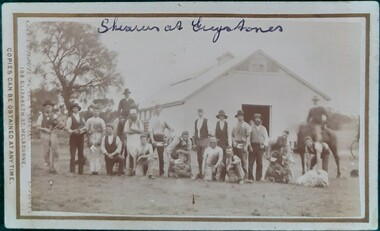
Photograph, Shearers and Overseers at Greystones Station 1883
... ...Charles James Griffith 1808-1863...Charles Griffith. The property had 11,000 sheep and was renowned for its high quality wool. In November 2023, the property of 4033 hectares was sold to overseas investors. The wool industry was a major industry in the development of the Australian economy from pre-colonial times. It gave rise to the saying that Australia 'rode on the sheep's back.' Stevenson and McNicoll 1883 Photographs of Bacchus Marsh and District Shearers Greystones Estate Bacchus Marsh Glenmore Run Wool Industry Charles James Griffith 1808-1863 ...Greystones station was originally part of the Glenmore run, established in 1840 by Charles Griffith. Originally a run of 55,00 acres, Glenmore was subdivided in the 1870s to form the Greystones property, owned and managed by Molesworth Greene, the nephew of Charles Griffith. The property had 11,000 sheep and was renowned for its high quality wool. In November 2023, the property of 4033 hectares was sold to overseas investors. The wool industry was a major industry in the development of the Australian economy from pre-colonial times. It gave rise to the saying that Australia 'rode on the sheep's back.'Small black and white 'carte de visite' style unframed photograph on card with gold border framing photograph. One of a set of photographs of Bacchus Marsh and District taken in 1883 by the photographers Stevenson and McNicoll. The photo shows a group of sixteen men standing or kneeling outside a large shearing shed at Greystones, Rowsley. Behind them are two mounted men, probably overseers or managers. The standing group includes a man with a fiddle and one with a concertina. The cook, wearing a white apron and hat can also be identified. Six men have hand-held shears, three in poses of shearing a sheep. Printed On the front: Stevenson & McNicoll. Photo. 108 Elizabeth St. Melbourne. COPIES CAN BE OBTAINED AT ANY TIME. On the back: LIGHT & TRUTH inscribed on a banner surmounted by a representation of the rising sun. Copies of this Portrait can be had at any time by sending the Name and Post Office Money Order or Stamps for the amount of order to STEVENSON & McNICOLL LATE BENSON & STEVENSON, Photographers. 108 Elizabeth Street, MELBOURNE. Handwritten in biro along the top: Shearers at Greystones. stevenson and mcnicoll 1883 photographs of bacchus marsh and district, shearers, greystones estate bacchus marsh, glenmore run, wool industry, charles james griffith 1808-1863, molesworth r. green 1827-1916 -
 Bacchus Marsh & District Historical Society
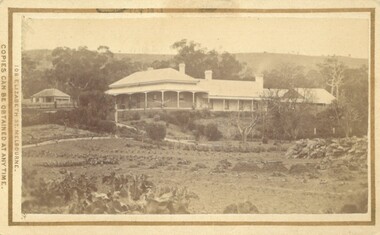
Photograph, Glenmore Homestead 1883
... ...Charles James Griffith 1808-1863...Griffith was a devout Anglican and hosted Bishop Charles Perry at his station near Bacchus Marsh in 1849. He died in 1863 at his home in South Yarra. Stevenson and McNicoll 1883 Photographs of Bacchus Marsh and District Farms Bacchus Marsh Charles James Griffith 1808-1863 Glenmore Station On the front: Stevenson & McNicoll. ...This homestead was built by Charles Griffith on a 55,000 acre Run. It replaced an earlier dwelling which was a slab hut with a bark roof. Charles Griffith, an Irish barrister, with his friend, James Moore, settled on Glenmore Station in the Parwan Valley in 1840. Their partnership lasted until 1848. In 1846, whilst in Ireland, Griffith married Miss Jane Catherine Magee, then returned to Glenmore and later took his nephew, Molesworth Richard Greene, into partnership, which arrangement proved to be long and prosperous. In 1857, they bought runs at Mount Hope and Mount Pyramid, which they kept until the days of free selection. Griffith led an active and successful public life.He was a member of the new Victorian Legislative Council in 1851, and was later an elected representative of the Legislative Assembly 1853-1859. He occupied many important public positions, including that of magistrate for Bacchus Marsh. Griffith was a devout Anglican and hosted Bishop Charles Perry at his station near Bacchus Marsh in 1849. He died in 1863 at his home in South Yarra.Small sepia unframed photograph on card with gold border framing photograph. Housed in the album, 'Photographs of Bacchus Marsh and District in 1883 by Stevenson and McNicoll'. The photograph shows a view of an extensive single-storey homestead consisting of three adjoining buildings, with a further building on the left of the main property. The series of three buildings is built in an elevated position, with pathways leading through a garden. At the front there is a vegetable garden which seems to be still in a state of development. The main house, possibly of brick, is set at an angle to the other two in this complex. It has a hip roof with a concave verandah on two sides with arched barge boards and simple unadorned pillars. There appears to be a hammock slung between two pillars. Two chimneys can be seen on this dwelling.The adjoining building is of a simpler design, with a lower roof line and a verandah running along the front. Two chimneys can be seen, one emitting smoke. This middle building may be a kitchen and rooms for day-to-day use. The third building is also of a simpler design, with a gable above a verandah. The purpose of this building is less clear. The different styles of construction suggest that these buildings were built separately at different times for different purposes. To the left of the main group of buildings is another cottage, smaller and of a simpler design. A fence runs along the front, clearly separating this building from the others, suggesting it may have been the dwelling of an overseer.On the front: Stevenson & McNicoll. Photo. 108 Elizabeth St. Melbourne. COPIES CAN BE OBTAINED AT ANY TIME. On the back: LIGHT & TRUTH inscribed on a banner surmounted by a representation of the rising sun. Copies of this Portrait can be had at any time by sending the Name and Post Office Money Order or Stamps for the amount of order to STEVENSON & McNICOLL LATE BENSON & STEVENSON, Photographers. 108 Elizabeth Street, MELBOURNE. stevenson and mcnicoll 1883 photographs of bacchus marsh and district, farms bacchus marsh, charles james griffith 1808-1863, glenmore station -
 Bacchus Marsh & District Historical Society
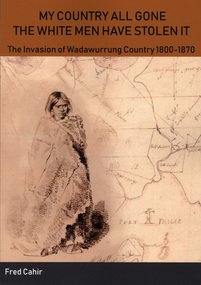
Book, "My country all gone the white men have stolen it" : the invasion of Wadawurrung Country 1800-1870
... ...Charles James Griffith 1808-1863...Aboriginal Australians Bacchus Marsh Region History Wadawurrung People Charles James Griffith 1808-1863 Aboriginal Australians Colonisation Description from publication blurb The Wadawurrung are the Aboriginal people whose Country includes the cities now known as Ballarat and Geelong. ...Description from publication blurb The Wadawurrung are the Aboriginal people whose Country includes the cities now known as Ballarat and Geelong. Fred Cahir examines the contact history in the period 1800 – 1870 of the Wadawurrung and the ngamadjidj (generally translated as white stranger belonging to the sea). Divided into chronological and thematic sections, the book chronicles three waves of invasion: the early invasion period incorporating trespassers predominately from the sea, the sheepherders or squatters who followed in their wake and usurped the Wadawurrung of all their Country for sheep runs, and the third wave of invadors – the gold seekers. This historical study is transformative as it presents a compelling argument of how the Wadawurrung were active agents of change and sought cultural enrichment in the midst of the frontier war on the Country." Significant sections of this book look at the interactions between the Wadawurrung people in locations within the Bacchus Marsh district. The private diary and published works of prominent pastoralist Charles Griffith of Glenmore Station are among the records used to examine this history.Printed book. Softcover. 348 pages, with illustrations. Citation: My country all gone the white men have stolen it" : the invasion of Wadawurrung Country 1800-1870 by Fred Cahir. Published by Australian History Matters, Ballarat, Vic., 2019. BMDHS Location: AR/SU4non-fictionDescription from publication blurb The Wadawurrung are the Aboriginal people whose Country includes the cities now known as Ballarat and Geelong. Fred Cahir examines the contact history in the period 1800 – 1870 of the Wadawurrung and the ngamadjidj (generally translated as white stranger belonging to the sea). Divided into chronological and thematic sections, the book chronicles three waves of invasion: the early invasion period incorporating trespassers predominately from the sea, the sheepherders or squatters who followed in their wake and usurped the Wadawurrung of all their Country for sheep runs, and the third wave of invadors – the gold seekers. This historical study is transformative as it presents a compelling argument of how the Wadawurrung were active agents of change and sought cultural enrichment in the midst of the frontier war on the Country." Significant sections of this book look at the interactions between the Wadawurrung people in locations within the Bacchus Marsh district. The private diary and published works of prominent pastoralist Charles Griffith of Glenmore Station are among the records used to examine this history. aboriginal australians bacchus marsh region history, wadawurrung people, charles james griffith 1808-1863, aboriginal australians colonisation
