
Showing 5 items matching "chemotherapy"
-
 Warrnambool and District Historical Society Inc.
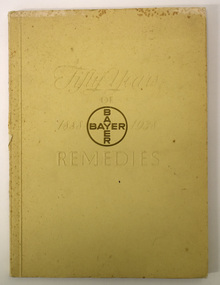
Book, Fifty Years of Remedies Bayer 1888-1938, 1938
... Chapter headings include - Chemotherapy, Narcotics and Anaesthetics, Amoebic Dysentery and Vitamins. ...Chapter headings include - Chemotherapy, Narcotics and Anaesthetics, Amoebic Dysentery and Vitamins. ...Remedies available from Bayer PharmaceuticalsThis is a book of 90 pages, The cover is beige with embossed white and gold printing. The spine is somewhat worn. The pages contain printed text and black and white photographs and illustrationsnon-fictionRemedies available from Bayer Pharmaceuticalsbayer company of germany, pharmaceuticals -
 Geoffrey Kaye Museum of Anaesthetic History
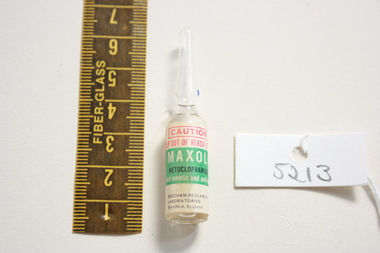
Container - Metaclopramide (Maxolon), 1972
... It is still used to treat nausea and vomiting that occurs post-operatively or from chemotherapy but there are more effective agents now....It is still used to treat nausea and vomiting that occurs post-operatively or from chemotherapy but there are more effective agents now. ...Metoclopramide blocks dopamine receptors in the brain in the areas responsible for the vomiting reflex. It is still used to treat nausea and vomiting that occurs post-operatively or from chemotherapy but there are more effective agents now.Clear glass ampoule with adhered green and white manufacturer's label containing Maxolon.anti-emetic, anti-nauseant -
 Peter MacCallum Cancer Centre
Book, The Peter Mac A Personal Reminiscence
... ...chemotherapy...staff Medicine Radiation Therapy nursing construction chemotherapy A personal history of Peter Maccallum Cancer Centre written by Dr TF Sandeman who worked at Peter Mac from 1959 - 1996. ...A personal history of Peter Maccallum Cancer Centre written by Dr TF Sandeman who worked at Peter Mac from 1959 - 1996. It includes a variety of subjects, from development and infrastructure to staff and departments a well as prominent figures and the evolution of care.non-fictionA personal history of Peter Maccallum Cancer Centre written by Dr TF Sandeman who worked at Peter Mac from 1959 - 1996. It includes a variety of subjects, from development and infrastructure to staff and departments a well as prominent figures and the evolution of care.staff, medicine, radiation therapy, nursing, construction, chemotherapy -
Northern District School of Nursing. Managed by Bendigo Historical Society Inc.
Tool - Northern District School of Nursing Graduates Association - Combistik Urine Test strips, 1950s
... Useful for diagnosing and managing urinary tract infections, metabolic conditions, and monitoring therapy (e.g., sulphonamide therapy, chemotherapy for genito-urinary infections). ...Useful for diagnosing and managing urinary tract infections, metabolic conditions, and monitoring therapy (e.g., sulphonamide therapy, chemotherapy for genito-urinary infections). ...The Northern District School of Nursing in Victoria, Australia Graduates Association: History of the School Managed by a committee including hospital administrators, medical professionals, and nursing leaders from several regional hospitals. Associated with major hospitals in the Northern District, including Bendigo Base, Mildura Base, Castlemaine, Echuca, Swan Hill, St. Arnaud, and Kyneton District Hospitals. Provide high-quality theoretical and practical nursing training. Raise the standard of nursing education in the region. Maintain the highest principles of nursing practice. Applicants must be at least 17 years old and hold a Proficiency Certificate or higher educational qualification. Application involves submitting forms, certificates, an interview, an aptitude test, and a medical examination. A three-month probationary period follows initial acceptance. Preliminary Training School: Four-week introductory course covering basic nursing, anatomy, hygiene, and practical skills. Practical experience in various hospital departments, guided by senior staff. Study Block Plan: Includes several blocks of theoretical and practical instruction throughout the three-year program. Regular school exams and two state exams (First Professional and Final State) are required for progression and graduation. Nurses work a 40-hour week with at least one or two days off per week and three weeks of annual leave. Accommodation is provided in comfortable hostels with good facilities. Uniforms are supplied free; nurses provide their own shoes and stockings. Salaries and allowances are regulated, with deductions for board and free medical care. Additional Information Post-Graduate Opportunities. Senior positions require further experience and additional certificates (e.g., Midwifery, Infant Welfare).Diploma courses available in administration, teaching, and specialized nursing fields. Bursaries are available for advanced study.Career Prospects: Graduates can pursue roles in administration, teaching, ward and departmental leadership, district and visiting nursing, industrial and school nursing, and more. Opportunities existed both within hospitals and in community or specialized settings.FAQs and Practical Details. Minimal training costs (mainly exam fees and personal items).Living out allowances and travel expenses are covered. Four training intakes per year; waiting periods are short if qualifications are met.Northern District School of Nursing Graduates Association - Combistik Urine Test strips - instruction booklet - 4 pages by the Ames Compant 65 Queens Road Melbourne This item contains the following document: 3792.11a Northern District School of Nursing Graduates Association - Combistik Urine Test strips - coloured instruction booklet Here are the key points from the document on Combistix urine test strips: Clinical Importance of UrinalysisUrinalysis is often underestimated but provides valuable diagnostic information.Simple to perform, yet highly informative for detecting urinary and metabolic conditions.Combistix is a combination test strip that rapidly screens for glucose, protein, and pH in urine. The test requires only one dip and 10 seconds to deliver three results, with no need for urine pre-treatment. Suitable for routine hospital urinalysis and large-scale screening, even by non-specialists due to its simplicity. Helps optimize laboratory workflow by allowing ancillary staff to perform basic tests, freeing technologists for more complex tasks. Useful for diagnosing and managing urinary tract infections, metabolic conditions, and monitoring therapy (e.g., sulphonamide therapy, chemotherapy for genito-urinary infections). Glucose: Essential for diabetes screening and management; Combistix is specific for glucose and does not react to lactose, making it reliable during pregnancy. Proteinuria is a key indicator of renal abnormalities, vascular disease, or pre-eclampsia. Its absence is reassuring. The test is sensitive and can be performed accurately by inexperienced users. The strip has three color-coded, reagent-impregnated areas separated by barriers for clear results.Simple procedure: dip, wait 10 seconds, and compare colors to a chart. Packaged in air-tight bottles of 100 strips, available through standard medical supply channels. Combistix offers a fast, reliable, and easy-to-use method for routine urine screening, supporting both clinical diagnosis and efficient laboratory operations.nurse training, lister house, ames company, combistix -
Northern District School of Nursing. Managed by Bendigo Historical Society Inc.
Administrative record - Northern District School of Nursing Graduates Association - Newsletter, 1990
... Ongoing efforts to document the history of nursing in the region, including books and seminars.Contributions are sought for histories of Lister House, B.B.H., and Mildura Hospital.Hospital and Regional Changes Updates on hospital amalgamations, renovations, and new departments (e.g., chemotherapy, physiotherapy, CAT scan). Hospitals are reorganizing wards for efficiency and facing financial pressures. ...Ongoing efforts to document the history of nursing in the region, including books and seminars.Contributions are sought for histories of Lister House, B.B.H., and Mildura Hospital.Hospital and Regional Changes Updates on hospital amalgamations, renovations, and new departments (e.g., chemotherapy, physiotherapy, CAT scan). Hospitals are reorganizing wards for efficiency and facing financial pressures. ...The Northern District School of Nursing in Victoria, Australia Graduates Association: History of the School Managed by a committee including hospital administrators, medical professionals, and nursing leaders from several regional hospitals. Associated with major hospitals in the Northern District, including Bendigo Base, Mildura Base, Castlemaine, Echuca, Swan Hill, St. Arnaud, and Kyneton District Hospitals. Provide high-quality theoretical and practical nursing training. Raise the standard of nursing education in the region. Maintain the highest principles of nursing practice. Applicants must be at least 17 years old and hold a Proficiency Certificate or higher educational qualification. Application involves submitting forms, certificates, an interview, an aptitude test, and a medical examination. A three-month probationary period follows initial acceptance. Preliminary Training School: Four-week introductory course covering basic nursing, anatomy, hygiene, and practical skills. Practical experience in various hospital departments, guided by senior staff. Study Block Plan: Includes several blocks of theoretical and practical instruction throughout the three-year program. Regular school exams and two state exams (First Professional and Final State) are required for progression and graduation. Nurses work a 40-hour week with at least one or two days off per week and three weeks of annual leave. Accommodation is provided in comfortable hostels with good facilities. Uniforms are supplied free; nurses provide their own shoes and stockings. Salaries and allowances are regulated, with deductions for board and free medical care. Additional Information Post-Graduate Opportunities. Senior positions require further experience and additional certificates (e.g., Midwifery, Infant Welfare).Diploma courses available in administration, teaching, and specialized nursing fields. Bursaries are available for advanced study.Career Prospects: Graduates can pursue roles in administration, teaching, ward and departmental leadership, district and visiting nursing, industrial and school nursing, and more. Opportunities existed both within hospitals and in community or specialized settings.FAQs and Practical Details. Minimal training costs (mainly exam fees and personal items).Living out allowances and travel expenses are covered. Four training intakes per year; waiting periods are short if qualifications are met.Northern District School of Nursing Graduates Association - Newsletter 1990, 11 pages This item contains the following documents: 3793.14a Newsletter 1990, 11 pages This newsletter provides an overview of significant changes and updates related to nursing education and associations in the Bendigo region: The traditional hospital-based nurse training at Lister House has ended with the graduation of School 108. The building is now used by the Health Department as offices. The Bendigo College of Advanced Education (B.C.A.E.) has produced its first nursing graduates, marking a shift to college-based training. Efforts have been made to retain equipment and records from Lister House for a future museum. Records are now stored at B.C.A.E.; transcripts can be requested via training hospitals or the Registrar. School photos and memorabilia will be relocated to the Health Science Department at the College. Academic and practical excellence prizes were awarded to Kelly-Ann Stancombe and Lisa Kuhn, respectively, by the Graduates Association and Zonta Club International. Flowers were placed at the Cenotaph on Remembrance and Anzac Days to honor nurses lost in wars. Regular reunions are held every five years; the next is in 1995.Membership is $10 for five years; non-members are encouraged to join to stay informed. Several upcoming reunions and anniversary events are listed for various schools and hospitals. Ongoing efforts to document the history of nursing in the region, including books and seminars.Contributions are sought for histories of Lister House, B.B.H., and Mildura Hospital.Hospital and Regional Changes Updates on hospital amalgamations, renovations, and new departments (e.g., chemotherapy, physiotherapy, CAT scan). Hospitals are reorganizing wards for efficiency and facing financial pressures. Discussion on whether to admit B.C.A.E. graduates and non-completers as members. Survey results: 40% support B.C.A.E. graduate membership, 58% support associate membership for non-completers. Suggestions for changing the Association's name to reflect broader membership.Committee and Administration Lists current committee members and contact details for the N.D.S.N. Graduates Association. This summary captures the document's focus on the end of an era in nurse training, preservation of nursing heritage, ongoing community and alumni engagement, and adaptation to changes in the healthcare landscape.nurse training, lister house, newsletter
