
Showing 4 items matching "chicago flexible shaft company"
-
 Emerald Museum & Nobelius Heritage Park
Equipment - Horse coat Trimmer, Chicago Flexible Shaft Company, 1900s
... Chicago Flexible Shaft Co...Chicago Flexible Shaft Company...The Chicago Flexible Shaft Company was established in Chicago, Illinois, in 1893. ...Chicago Flexible Shaft Company...The Chicago Flexible Shaft Company was established in Chicago, Illinois, in 1893. ...The Chicago Flexible Shaft Company was established in Chicago, Illinois, in 1893. Horses were integral to both the agricultural and transport sectors at the time so hand-cranked clippers that reduced the time to remove the excess winter coat of working horses and other large animals (including sheep) that previously needed to be trimmed with hand shears to a job that could be completed in less than twenty minutes was a considerable advancement. This model, the Number 1, was actually the second iteration of the company's hand-cranked devices; it was smaller and lighter to transport and cheaper for farmers to purchase and therefore had a bigger impact on overall agricultural practices than the company's first, pioneering, 'Chicago Clipper'. This item is the stand and power-generation unit of the machine. An attachment on the left-hand side of the item shows where a long, flexible 'shaft' ending in sharp clippers could be attached to the crank unit and powered by manually turning the crank handle. The clippers could then be used to easily remove long hair from animals such as horses, whose winter coats could interfere with their ability to wear a harness or hold sweat which would be uncomfortable for the horse when it dried. The inventors who founded the Chicago Flexible Shaft Company, John K. Stewart (born Terrence O'Brien Junior) and Thomas J. Clark (born Thomas Conlon), went on to design the speedometer used in the Ford Model T car. After Stewart sold his shares in the Chicago Flexible Shaft Company to focus on developing the speedometer concept, the company changed direction to focus on domestic appliances - including clippers for human hair - and rebranded as Sunbeam, a brand still in use today.This item is significant as an example of agricultural technology in use in the Emerald area in the early Twentieth Century. The particular make and model of clipper represented a considerable technological advance as it was significantly smaller in size and easier to operate than previous models from the same company. This smaller size meant it had a much bigger impact on farming processes internationally as it was easier to transport and more affordable for farmers to purchase. It is not known which farm in the Emerald area purchased and used the machine.The item consists of a small metal case, which may house a ball bearing mechanism, powered by a wooden handled metal crank to the right side of the case. A metal handle is provided at the rear. An outlet for a cord is present on the left hand side of the unit. The unit stands on an attached tripod to raise it to working height. The item is the brown of rusted metal all over, though it can be seen that the rear handle was originally red and the wooden handle black, in distinction to the possible original chrome colour of the unit overall.Top: THE / STEWART / CHICAGO / BALL BEARING / No. 1 / CLIPPER / MADE BY / CHICAGO / FLEXIBLE / SHAFT CO / CHICAGO USA / PATENTED BY / U.S.A., ENGLAND / AUSTRALIA / NEW ZEALAND / CANADA / CUBA / ETC Right side: STEWART / CLIPPER / MADE / BY / CHICAGO FLEXIBLE SHAFT CO /1890s, 1900s, 1910s, chicago flexible shaft co, chicago flexible shaft company, agricultural equipment, farm and equipment, farm tools, horses, john k stewart, terrence o'brien junior, thomas j clark, thomas conlon, ford motor company, ford model t, speedometer, sunbeam -
 National Wool Museum
Tool - Grinder, 1960-69
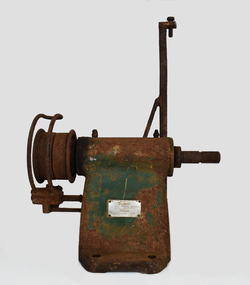
... US company Cooper, which had been founded in 1843 as a maker of sheep dip, began selling Wolseley equipment in the USA in 1895. The Chicago Flexible Shaft Company successfully entered the power-shearing market a few years later and entered a joint venture with Cooper. ...US company Cooper, which had been founded in 1843 as a maker of sheep dip, began selling Wolseley equipment in the USA in 1895. The Chicago Flexible Shaft Company successfully entered the power-shearing market a few years later and entered a joint venture with Cooper. ...Cooper S.E. Ball Bearing Grinder made and guaranteed by Sunbeam Corporation Limited. Grinders like this example have been made the same since the early 1900s, with this grinder thought to have been produced in the 1960s. It is belt driven, with the other end of the belt being attached to an engine; the same engine that would have powered the overhead shearing equipment in shearing sheds. It was common for shearing teams to bring their own equipment, especially pre-1960 as most shearing sheds were not connected to power, and shearers preferred to work with their own equipment. The engines that powered the shears and grinder were typically fuelled with kerosene or petrol. The large circular disks are attached to the bolt that protrudes from the grinder and fastened tightly with a nut. An example of seeing a similar grinder in action can be found on the following link - https://www.youtube.com/watch?v=O7eimI_Gm9o. Inventor Frederick Wolseley made the world's first commercially successful power-shearing system in Australia in 1888. US company Cooper, which had been founded in 1843 as a maker of sheep dip, began selling Wolseley equipment in the USA in 1895. The Chicago Flexible Shaft Company successfully entered the power-shearing market a few years later and entered a joint venture with Cooper. It set up a branch in Sydney and sold shearing sets, and engines to power them, into the Australian market. In 1921 the US parent company, realising it needed to make products whose sales were not as seasonal as those of shearing equipment, made its first household appliances and branded them Sunbeam. In 1933, changes in exchange rates and taxes led the company to manufacture engines and shearing equipment in Australia via subsidiary Cooper Engineering, which changed its name to Sunbeam in 1946. Although most Australians know of this company as a major manufacturer of household appliances, its rural division flourished and retained the Sunbeam name for shearing equipment even after it was taken over by New Zealand company Tru-Test in 2001. The grinder is formed from a central arch shaped block of green painted metal. Much of this paint has been lost to age, leaving the grinder in a ‘farm used’ condition with much surface oxidation present. On the front of the arch is a specification plate, reading “Cooper S.E. ball bearing grinder. Made and guaranteed by Sunbeam”. At the foot of the arch, three bolt holes are found for securing the grinder to the base of a solid wooden surface. Two of the bolt holes are found on the front of the grinder, with another found on the rear. From the central arch, a bolt protrudes to the right of the grinder. This large bolt is for securing a grinding plate to the grinder. Above the central arch is a pendulum which holds the comb / cutter that is being sharpened. From the pendulum, a large arm extends down (not pictured) to meet and strike the plate spinning at a rapid speed. On the left-hand side of the central arch of the grinder, a wheel is found which a belt is attached to for power. This belt is then attached to a separate engine, spinning the wheel and hence powering the grinder. The wheel is partially covered with a section of protective bent tube, designed to provide protection from the rapidly spinning wheel. Below this wheel is the belt shifter. It is designed to move the protective bent tube from one side of the grinder to the other, to accommodate the grinder in the setup of different shearing sheds. The two separate grinding plates are identical. They have a slight slope for sharpening the comb and cutters in the correct method, with a slight bias towards the base, or “tooth”, of the equipment. The disks have a large central bolt for attaching to the grinder. They have tags on the horizontal axis of the grinding plates, for securing the plates in transportation, and to help with initial alignment when setting up the grinder. The reverse of these grinding plates has the same green painted metal finish found on the grinder. This paint is also in a ‘farm used’ condition, with surface oxidation present. The grinder would be provided from the factory with a comb holder, shifter for securing the grinding plates, emery cloth and emery glue. The emery cloth is what does the actual grinding and is applied to the grinding disks, replacing once well worn. These items can be seen in the final images in the multimedia section, showcasing advertising for this grinder. Plate. Inscribed. “Cooper / S.E. BALL BEARING GRINDER / MADE AND GUARANTEED BY / Sunbeam / CORPORATION LIMITED / SYDNEY MELBOURNE / ADELAIDE BRISBANE ”sheep shearing, shearing equipment, sunbeam, grinder -
 National Wool Museum
Machine - Shearing Motor, Sunbeam, 1960-69
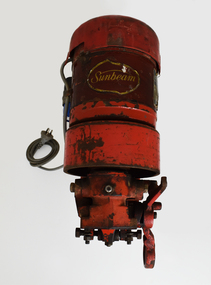
... US company Cooper, which had been founded in 1843 as a maker of sheep dip, began selling Wolseley equipment in the USA in 1895. The Chicago Flexible Shaft Company successfully entered the power-shearing market a few years later and entered into a joint venture with Cooper. ...US company Cooper, which had been founded in 1843 as a maker of sheep dip, began selling Wolseley equipment in the USA in 1895. The Chicago Flexible Shaft Company successfully entered the power-shearing market a few years later and entered into a joint venture with Cooper. ...With more and more woolsheds being connected to power lines, the need for electric shearing gear markedly increased from the 1960s onwards. The greater economy made electric gear an attractive proposition to many graziers. Requiring only an electric shearing motor, for small and medium scale operations, electric shearing motors were a more economical way of shearing a wool clip. The other option for graziers was Overhead shearing gear, which also required an Engine to provide shared power to a row of shearing stations. Still working, this Sunbeam Electric Shearing Motor – Heavy Duty Model, features a slow speed motor totally enclosed for protection against dust and insects. The full bearing down tube is easily removed and stored to be out of the way when not in use (not pictured). Providing 0.5 hp, which is twice the power ever needed for shearing sheep, this buffer allows for fluctuations in voltages that can occur in rural districts. Inventor Frederick Wolseley made the world's first commercially successful power-shearing system in Australia in 1888. US company Cooper, which had been founded in 1843 as a maker of sheep dip, began selling Wolseley equipment in the USA in 1895. The Chicago Flexible Shaft Company successfully entered the power-shearing market a few years later and entered into a joint venture with Cooper. It set up a branch in Sydney and sold shearing sets, and engines to power them, into the Australian market. In 1921 the US parent company, realising it needed to make products whose sales were not as seasonal as those of shearing equipment, made its first household appliances and branded them Sunbeam. In 1933, changes in exchange rates and taxes led the company to manufacture engines and shearing equipment in Australia via subsidiary Cooper Engineering, which changed its name to Sunbeam in 1946. Although most Australians know of this company as a major manufacturer of household appliances, its rural division flourished and retained the Sunbeam name for shearing equipment even after it was taken over by New Zealand company Tru-Test in 2001. This 0.5 horsepower vertical brushed motor air-cooled engine was designed to drive a single shearing plant. From the central cylinder which features a yellow “Sunbeam” sticker, a grey 240v power lead can be found on the left-hand side. A blue capacitor is located next to this power lead. Below, two legs extend and meet to form a foot which is fastened to a wall. On the right-hand side of the engine, a specification plate is located on the central cylinder. A yellow directional arrow sticker is located on the rotating section of the engine below the specification plate (location for photography, this section is designed to rotate and hence this sticker is not fixed in this location). At the rear of the cylinder, a plastic cap with small air cut outs protects the air-cooled engine from contaminants. At the front of the engine, the location for securing the bearing down tube is located. On the right-hand side of the lock for the bearing down tube is the handle, to which a string is often attached for switching the motor on and off by a shearer bent at the waist (not pictured). Sticker. Gold writing. Front of shearing motor “Sunbeam” Plate. Inscribed. Side of shearing motor. “Sunbeam / SHEARING MOTOR / MADE IN AUSTRALIA / 0.5 H.P. / 220/240 V / 1 PHASE A.C. / 4.0 AMPS / 50 C/S. / CONT. RTG. / 1425 R.P.M. / CLASS A INSUL / NO. J244560 / TYPE: NSB5C2/49." sheep sheering, shearing equipment, sunbeam, electric shearing motor -
 Wodonga & District Historical Society Inc
Domestic object - Lady Sunbeam Home Hair Dryer, Sunbeam Corporation Australia, c1960
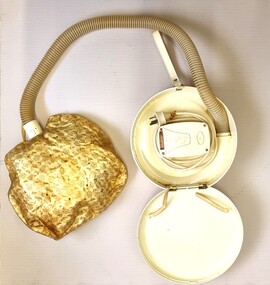
... Sunbeam History The Sunbeam Corporation began in Australia in 1902 as a small branch of the American group, Chicago Flexible Shaft Company.In 1946, this company changed its name to Sunbeam Corporation and developed the slogan "Best Electric Appliances Made". ...Sunbeam History The Sunbeam Corporation began in Australia in 1902 as a small branch of the American group, Chicago Flexible Shaft Company.In 1946, this company changed its name to Sunbeam Corporation and developed the slogan "Best Electric Appliances Made". ...Sunbeam produced a wide range of hair dryers in a variety of sizes and shapes throughout the 1960s. Lady Sunbeam was promoted as providing unequalled efficiency as well as extra convenience and comfort. Whilst you dried your hair, you were able to sit and relax, read a book, write letters, knit or apply your nail enamel. The added convenient shoulder strap enabled you to complete other small household chores such as ironing - as long as they could be carried out within the distance of the power cord. Sunbeam History The Sunbeam Corporation began in Australia in 1902 as a small branch of the American group, Chicago Flexible Shaft Company.In 1946, this company changed its name to Sunbeam Corporation and developed the slogan "Best Electric Appliances Made". The company became publicly traded in 1952 and came into Australian ownership in 1987. In 1948 the company launched the Sunbeam Mixmaster®, the first small electrical appliance to be manufactured in Australia. In 2020, the company changed its name to Newell Australia.This item is representative of a range of domestic appliances used across Australia in the 1960s to make home life simpler and more convenient.Hair dryer in portable round plastic hinged case with motor fitted within the base. Plastic wire coiled hose is attached to the motor. A plastic hood edged with elastic and lace adjustment is fitted to the end of the hose. The hood has a pattern of gold embossed flowers. The motor has settings off, cool, warm, med, hot. An electric cord and plug are attached to the motor. The lid closes with a sprung knob and has a plastic carry handle. The "Lady Sunbeam" Logo is embossed on the lid.On lid: Lady Sunbeam / HAIR DRYER Underneath unit: MODEL AHD-7 220-250V 50CYC 300W.AC. ONLY/ PATENT PENDING RD.NO.42.338 MADE IN AUSTRALIA / Sunbeam CORPORATION LIMITEDsunbeam australia, domestic appliances, hair dryers
