
Showing 12 items matching "child’s christening gown"
-
 Flagstaff Hill Maritime Museum and Village
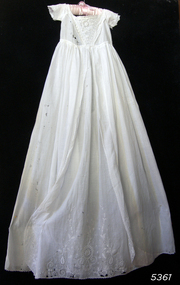
Clothing - Christening Gown, 1860's
... ...child’s christening gown...Flagstaff Hill Warrnambool Shipwreck Coast Maritime Museum Maritime Village Flagstaff Hill Maritime Museum and Village christening gown christening dress baptism gown baptism dress religious ceremony nightwear sleepwear clothing fashion 19th century child’s christening gown handmade clothing Long white christening gown with short sleeves and Broderie Anglaise yoke, circa 1860's Clothing Christening Gown ...Long white christening gown with short sleeves and Broderie Anglaise yoke, circa 1860'sflagstaff hill, warrnambool, shipwreck coast, maritime museum, maritime village, flagstaff hill maritime museum and village, christening gown, christening dress, baptism gown, baptism dress, religious ceremony, nightwear, sleepwear, clothing, fashion, 19th century, child’s christening gown, handmade clothing -
 Flagstaff Hill Maritime Museum and Village
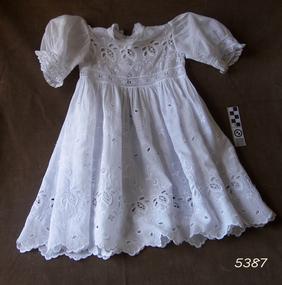
Clothing - Christening Gown, c. 1911
... This child's white broderie anglaise christening gown was worn by Robert Barnard, son of Mrs W N Barnard of Portland, when he was a young child, circa 1911....Child's white broderie anglaise christening gown, hand sewn, three button closure, short sleeves, c. ...This child's white broderie anglaise christening gown was worn by Robert Barnard, son of Mrs W N Barnard of Portland, when he was a young child, circa 1911. ...This child's white broderie anglaise christening gown was worn by Robert Barnard, son of Mrs W N Barnard of Portland, when he was a young child, circa 1911.This item is representative of christening gowns in the early 1910s. Child's white broderie anglaise christening gown, hand sewn, three button closure, short sleeves, c. Circa 1911. Worn by Robert Barnard son of Mrs W N Barnard of Portland.flagstaff hill, warrnambool, shipwrecked coast, flagstaff hill maritime museum, maritime museum, shipwreck coast, flagstaff hill maritime village, great ocean road, mrs w.n. barnard, w.n. barnard of portland victoria, robert barnard, child’s clothing c 1911, broderie anglaise, christening gown, ceremonial gown, ceremonial clothing, religious clothing -
 Flagstaff Hill Maritime Museum and Village
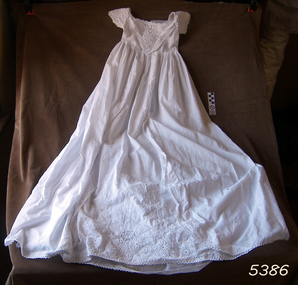
Clothing - Christening Gown, c. 1850's
... Child's long, white christening gown, capped sleeves. Hand sewn, inserted panel in bodice and skirt, embroidered and eyelets. ...christening gown was possibly worn by the donor, Mrs. W.N. Barnard. This 18500s christening gown is representative of gowns worn for this ceremony in the 1850s. flagstaff hill warrnambool shipwrecked coast flagstaff hill maritime museum maritime museum shipwreck coast flagstaff hill maritime village great ocean road Mrs W N Barnard of Portland Victoria Robert Barnard son of W N Barnard christening gown 1850's christening gown religious apparel W N Barnard Child's long, white christening gown, capped sleeves. ...This white christening gown was possibly worn by the donor, Mrs. W.N. Barnard.This 18500s christening gown is representative of gowns worn for this ceremony in the 1850s.Child's long, white christening gown, capped sleeves. Hand sewn, inserted panel in bodice and skirt, embroidered and eyelets. Circa 1850's. Possibly worn by Mrs W.N. Barnard when she was christened.flagstaff hill, warrnambool, shipwrecked coast, flagstaff hill maritime museum, maritime museum, shipwreck coast, flagstaff hill maritime village, great ocean road, mrs w n barnard of portland victoria, robert barnard son of w n barnard, christening gown, 1850's christening gown, religious apparel, w n barnard -
 Flagstaff Hill Maritime Museum and Village
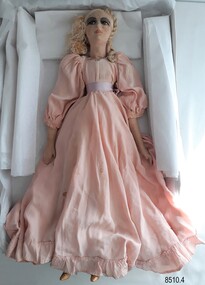
Leisure object - Boudoir Doll, c. early 1900s
... This doll appears to date at about the early part of the 20th century, but the petticoats are much older - possibly from a child's christening gown. At the time that the donor received the doll, it had a coloured lace over-gown that was badly torn so her mother removed it to replace with more lace but this never eventuated. ...This doll appears to date at about the early part of the 20th century, but the petticoats are much older - possibly from a child's christening gown. At the time that the donor received the doll, it had a coloured lace over-gown that was badly torn so her mother removed it to replace with more lace but this never eventuated. ...The donor was given this doll about 50 years ago by her grandfather (in the late 1960s). He used to be a handyman at a high rise building in St Kilda, Melbourne. He had been doing some work for one of the old ladies and she gave him the doll to give to his granddaughter, who collected dolls. The doll has spent a few years at the Nagambie museum until it closed down and returned to the donor The origins or age of the doll are unknown. Originally it was thought to be a Fashion Doll dating from around the 1880s but the painted face together with the bisque legs and gold painted shoes are similar to those found on Boudoir Dolls (also known as Bed Dolls, Sofa Dolls, Flapper Dolls and French Dolls) of the early 20th century. Fashion dolls were sent from fashion houses to advertise the latest styles, fabrics, trims, hairstyles and accessories. Dressmakers would show these dolls to their customers. Ladies would then place their order and the dressmakers would make the dress to their size. The dressmakers would learn the construction techniques from examining the dolls. Boudoir Dolls dolls usually had no maker's marks and were primarily used as bedroom decorations for ladies rather than as children's toys. This doll appears to date at about the early part of the 20th century, but the petticoats are much older - possibly from a child's christening gown. At the time that the donor received the doll, it had a coloured lace over-gown that was badly torn so her mother removed it to replace with more lace but this never eventuated. The pink silk dress also appears to have been remodelled into a 19th century style with gathered sleeves and a gathered skirt. This fashion or boudoir doll is significant for being a rare example of a doll made in the late 19th or early 20th centuries. The doll is wearing clothing representing the fashion for young girls in that era. The doll is also significant as an item possibly used by fashion houses and dressmakers to advertise the latest fashions in clothing, trims, accessories and hairstyles. A doll such as this may have been found in a Victorian dressmaker's premises for use as a pattern and technique template and for a display to customers. It may also have been used as a decorative item in a lady's bedroom.Female boudoir doll with silk face and body, and porcelain lower arms and legs. She has plaited blonde silk hair. Her painted face has brown eyes and her shoes are painted gold. The doll is dressed in a long pink puffed-sleeve dress with a gathered waist and a ruffle at the hem. A pink ribbon around her waist is tied at the back. There are small silver balls hand-stitched around the neckline. She has a white, hand-embroidered lace petticoat and bloomers.warrnambool, flagstaff hill maritime museum, shipwreck coast, flagstaff hill maritime village, great ocean road, doll, boudoir doll, female doll, dressmaker's doll, display doll, late 1800s doll, fashion doll, antique doll, 19th century doll, children's fashion, girl's fashion, late 1800s children's fashion, early 20th century doll, composite doll, french doll -
 Orbost & District Historical Society
cloth, first half 20th century
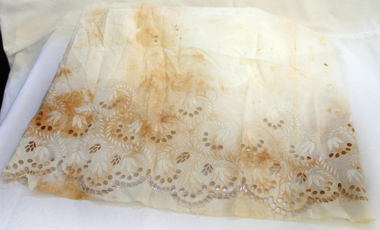
... child's christening robe. was donated by Mrs Jo Hermann ( Elsie Winchester). Jo Hermann was an Orbost resident -blacksmith, painter and signwriter. Baptism through the ages has held great importance in celebrating a new life for social and religious beliefs and to announce another generation. Christening gowns ...Was left over from material used for child's christening robe. was donated by Mrs Jo Hermann ( Elsie Winchester). Jo Hermann was an Orbost resident -blacksmith, painter and signwriter. Baptism through the ages has held great importance in celebrating a new life for social and religious beliefs and to announce another generation. Christening gowns, dresses or robes became special for these occasions and followed fashion as life changed. this cloth is an example of the needlework skills of women in the early 20th century.A cloth of handmade broderie anglaise on white fine linen with white thread.cloth handcraft needlework -
 Flagstaff Hill Maritime Museum and Village
Clothing - Christening Gown, Sarah Lees, c. 1860's
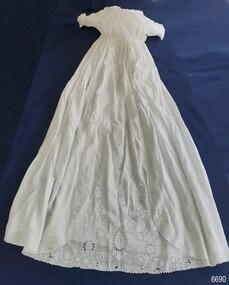
... child, Anne, taken in 1868, depicts her wearing a dress and pantaloons sewn by her mother. Sarah also crocheted lace curtains for her home in addition to large tablecloths and other articles. According to family legend, the skirt of this christening gown...child, Anne, taken in 1868, depicts her wearing a dress and pantaloons sewn by her mother. Sarah also crocheted lace curtains for her home in addition to large tablecloths and other articles. According to family legend, the skirt of this christening gown ...In the words of the donor, Betty Stone, "This gown was originally made by my great grandmother Sarah Ellis (nee Chamberlain) Lees of Wangoom, Warrnambool. Later, the gown was altered by her daughter Ann (nee Lees) Dale who also used it for the christenings of her five children in the 1890's, and later still, for some of her grandchildren. Sarah Ellis Chamberlain, born in Thriplow, Cambridgeshire, England on 31 July 1844, sixth child of Joshua and Susan Chamberlain, was ten years old when she arrived in Australia with her parents and siblings in January 1855. Ten years later, in 1864, Sarah Chamberlain married Lees Lees, a skilled stonemason who had migrated from Saddleworth, Yorkshire. Lees Lees purchased land in McGregors Road, Wangoom, Warrnambool where he operated a successful stonemasonry, contracting business until his death in 1912. The Lees farm, which eventually consisted of about fifty acres, was situated adjacent to both the Chamberlain and Dale farms. Sarah Lees was a meticulous homemaker who also fashioned and sewed clothes for her seven children. A photograph of the eldest child, Anne, taken in 1868, depicts her wearing a dress and pantaloons sewn by her mother. Sarah also crocheted lace curtains for her home in addition to large tablecloths and other articles. According to family legend, the skirt of this christening gown was part of the original gown hand-sewn by Sarah (nee Chamberlain) Lees which was used for the christening of her children. The gown was later passed on to her daughter Anne (nee Lees) Dale who, also an expert needlewoman, replaced the bodice and used it for the christening of her five children born between the years 1890 and 1899. Still, later, at least two children of the third generation (Sarah Lees' great-grandchildren) also wore this gown when christened at Christ Church Warrnambool. Sarah (nee Chamberlain) Lees died in 1932, aged 87 years, at her daughter Anne Dale's home in Latrigg. Anne (nee Lees) Dale died in 1948 aged 83 years, at her home in Latrigg." (Note: For additional information please refer to Betty Stone’s book “Pioneers and Places - A History of three Warrnambool Pioneering Families” ie. Chamberlain, Dale and Lees Families)This item is associated with the families of Chamberlain, Dale and Lees. These families are listed in the "Pioneers' Register" for Warrnambool Township and Shire, 1835-1900, published by A.I.G.S. Warrnambool Branch. The item is a fine example of late-19th-century needlework and handmade domestic items.Christening gown made by Sarah Ellis. White with unusual Broderie Anglaise yoke. The long-sleeved garment has a gathered waist and a long skirt. The front centre of the skirt has a floral Broderie Anglaise and cut work panel insert.Circa 1860's. From the 'Chamberlain Dale Lees Collection’, donated by Betty Stoneflagstaff hill, warrnambool, shipwrecked coast, flagstaff hill maritime museum, maritime museum, shipwreck coast, flagstaff hill maritime village, great ocean road, chamberlain, dale, lees, stone, betty stone, warrnambool pioneers, sarah ellis, hand sewn, christening gown, baby wear, clothing, 19th century -
 Bendigo Historical Society Inc.
Clothing - MERLE HOULDEN COLLECTION: CHRISTENING DRESS AND PETTICOAT, 1960's
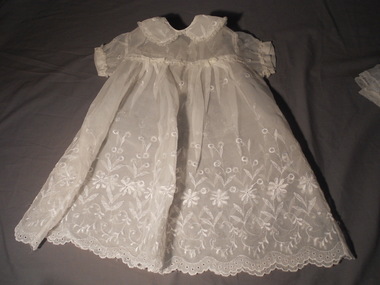
... christening dress White embroidered nylon. Tiny yoke topped with a Peter Pan collar, edged with gathered fine lace. Puff sleeves - pleated at shoulder, and gathered into a 1.75cm band, edged with fine, gathered lace. Gathered lace and two white ribbon( .5cm wide) bows define the yoke.Skirt 40 cm long, edged with embroidery and scalloped hemline. Two pearl buttons fasten the back of the yoke. Dress has been made to take advantage of the embroidered fabric of the train of Merle's own wedding gown.Merle Houlden made this gown for her first child ...White embroidered nylon. Tiny yoke topped with a Peter Pan collar, edged with gathered fine lace. Puff sleeves - pleated at shoulder, and gathered into a 1.75cm band, edged with fine, gathered lace. Gathered lace and two white ribbon( .5cm wide) bows define the yoke.Skirt 40 cm long, edged with embroidery and scalloped hemline. Two pearl buttons fasten the back of the yoke. Dress has been made to take advantage of the embroidered fabric of the train of Merle's own wedding gown.Merle Houlden made this gown for her first child, Bronwyn, using fabric from the lower tier of the train of her own wedding gown. Bri-nylon sleeveless, and embroidered nylon skirt, edged with fine lace (on the frill of the skirt). Skirt has an 8 cm frill, attached with an embroidered band of ribbon insertion. The ribbon insert is finished with two small .5cm ribbon bows. Both dress and petticoat have been made to take advantage of the embroidered fabric of Merle's own wedding dress train.costume, children's, christening dress -
 Bendigo Historical Society Inc.
Clothing - MERLE HOULDEN COLLECTION: FABRIC FROM WEDDING DRESS TRAIN, Wedding Dress Train, 05-06-1960
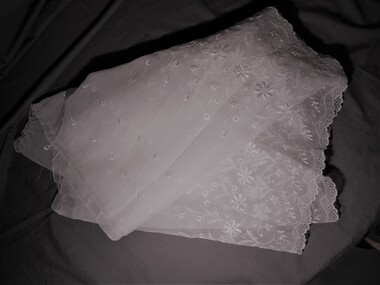
... The original train on the wedding dress was a feature of the wedding gown, falling in tiers as a "waterfall" effect. One tier was later used by Merle to make a christening dress for her first child, Bronwyn. ...The original train on the wedding dress was a feature of the wedding gown, falling in tiers as a "waterfall" effect. One tier was later used by Merle to make a christening dress for her first child, Bronwyn. ...Sheer embroidered nylon. Silk thread embroidery in a floral pattern. Scalloped edge finishes the lace panel. The original train on the wedding dress was a feature of the wedding gown, falling in tiers as a "waterfall" effect. One tier was later used by Merle to make a christening dress for her first child, Bronwyn. Evidence is still visible of the gathering thread at the top of this panel.costume accessories, female, wedding dress train fabric -
 Tatura Irrigation & Wartime Camps Museum
Clothing - Dress, Christening Gown
... Cotton white gown made for a christening of a child in camp. Made by unknown person...Cotton white gown made for a christening of a child in camp. Made by unknown person White cotton dress with round next, short sleeved. ...Cotton white gown made for a christening of a child in camp. Made by unknown personWhite cotton dress with round next, short sleeved. Bottom of from has many folds, and flower pattern with holes. -
 Whitehorse Historical Society Inc.
Clothing - Christening gown and petticoat, 1881/1882
... Brian Millane's grandmother made gown and petticoat in 1881/1882. Used in 1967 at christening of Brian and Michelle's first child. ...Brian Millane's grandmother made gown and petticoat in 1881/1882. Used in 1967 at christening of Brian and Michelle's first child. ...Brian Millane's grandmother made gown and petticoat in 1881/1882. Used in 1967 at christening of Brian and Michelle's first child. Was worn by many generations of the Millane's family.Long cotton christening gown with handmade eyelet/broderie anglais on skirt and bodice. Four tucks on each side of broderie anglais on bodice. Sleeves and neckline edged with lace. Opening at back pearl button and tie at waist. Pin-tucks in skirt layered between broderie anglais lace. Petticoat is sleeveless with lace and tucks at hemline. Opening at back of bodice with ties.millane family, st john's church mitcham -
 Kew Historical Society Inc
Clothing - Child's Dress, 1899-1910
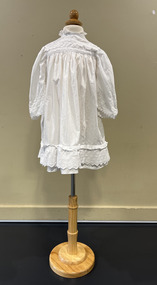
... It is the only child's dress in this collection which is otherwise comprised of christening or infant's gowns. ...It is the only child's dress in this collection which is otherwise comprised of christening or infant's gowns. ...In the early 19th century, infant gowns were modelled on dresses worn by adult women. Gowns were typically made of fine white linen or cotton, and often trimmed with tucks, lace, whitework embroidery, and other handwork. The Kew Historical Society's collection includes over twenty-five gowns dating from the 19th and 20th centuries. This child's dress was worn by one or more of the Weir children.This is one of ten items of clothing, worn by infants in the Weir family of Broken Hill between 1899 and 1910. They are part of the larger Weir Family collection of clothing, documents and photographs gifted to the Kew Historical Society by their descendants. Due to their known provenence, the gowns are historically and aesthetically significant in that they can be accurately dated to an 11-year-period, allowing other comparable items of infant's and children's clothing to be dated to an earlier, silmilar or later period. They also exemplify the styles and decorative techniques used for christening gowns, infant's and children's clothing of the period.Short, white cotton child's dress. This high-necked dress with long sleeves, compared to other infant's clothing in the Weir Family Collection, is quite ornate, indicating that it was designed to be a piece of 'best' clothing. It is the only child's dress in this collection which is otherwise comprised of christening or infant's gowns. The dress is a one-piecer. It has wide sleeves with scalloped cuffs, designed to allow for movement. What was the waist in the infant's gowns has moved higher towards the neck, but still maintains the decorative eleent of ruching below it. The dress includes extensive use of scalloped lace in the lower portion of the outfit.Nilchildren's wear -
 Linton and District Historical Society Inc
Petticoat, Child's petticoat, Early 1900s
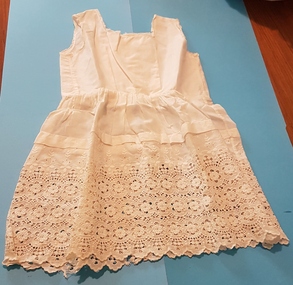
... Thought to have been adapted from the Christening dress of Henry Bolte, who was afterwards Premier of Victoria. Shortened for later use as a child's petticoat. Henry Bolte Christening gowns ...Thought to have been adapted from the Christening dress of Henry Bolte, who was afterwards Premier of Victoria. Shortened for later use as a child's petticoat.White lawn undergarment with thin lace around square neckline and armholes. Gathered skirt 220 mm of lace shortened skirt with 40 mm tuck 3 press stud fasteners.henry bolte, christening gowns, petticoats, textiles, children's clothing
