
Showing 262 items matching "china tea"
-
 Bendigo Historical Society Inc.
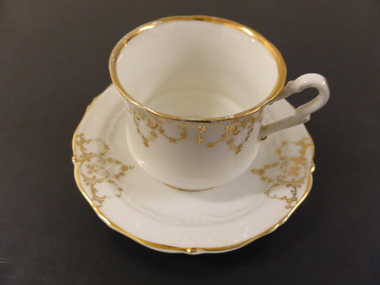
Domestic Object - CHINA TEA CUP & SAUCER
... CHINA TEA CUP & SAUCER...White china tea cup with saucer and decorated with gold....Domestic Object CHINA TEA CUP & SAUCER ...White china tea cup with saucer and decorated with gold.domestic equipment, food consumption, kitchen -
 Bendigo Historical Society Inc.
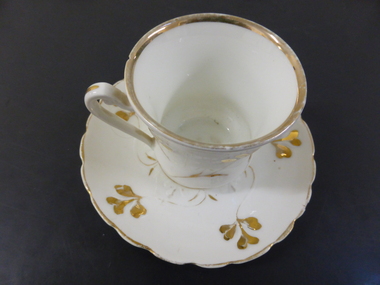
Domestic Object - WHITE CHINA TEA CUP & SAUCER
... WHITE CHINA TEA CUP & SAUCER...White china tea cup with saucer decorated with gold shamrocks....Domestic Object WHITE CHINA TEA CUP & SAUCER ...White china tea cup with saucer decorated with gold shamrocks.domestic equipment, food consumption, kitchen -
 Bendigo Historical Society Inc.
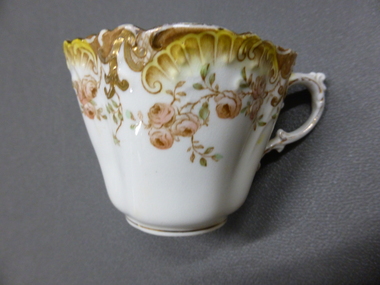
Domestic Object - CHINA TEA CUP
... CHINA TEA CUP...English china tea cup by Aynsley with frilled top and decorated with flowers coloured in tones of pink, lemon and brown with gilding....Domestic Object CHINA TEA CUP ...English china tea cup by Aynsley with frilled top and decorated with flowers coloured in tones of pink, lemon and brown with gilding.11557 a crown above Aynsley Englanddomestic equipment, table setting, cups -
 Glenelg Shire Council Cultural Collection
Souvenir - China Tea Bag Holder, n.d
... China Tea Bag Holder...White Westminster china tea bag holder, in shape of teapot. Gold edging, coloured decal of Whalers Bluff and grain terminal....Souvenir China Tea Bag Holder Westminster, Australia ...White Westminster china tea bag holder, in shape of teapot. Gold edging, coloured decal of Whalers Bluff and grain terminal.Front: 'PORTLAND VIC WHALERS BLUFF AND GRAIN TERMINAL BEYOND' Back: Makers black stamp 'Fine China WESTMINSTER AUSTRALIA'souvenir of portland, portland harbour, whalers bluff, domestic object -
 Bendigo Historical Society Inc.
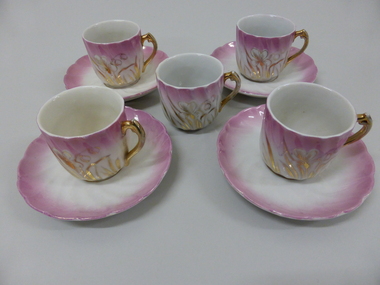
Domestic Object - CHINA TEA SET
... CHINA TEA SET...China tea set consisting of 5 cups, 4 saucers, white and pink with gilding and floral decoration, number 84 impressed on bottom of cups....Domestic Object CHINA TEA SET ...China tea set consisting of 5 cups, 4 saucers, white and pink with gilding and floral decoration, number 84 impressed on bottom of cups.domestic equipment, table setting, cups -
 Bendigo Historical Society Inc.
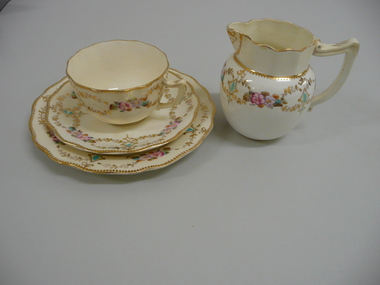
Domestic Object - CHINA TEA SET
... CHINA TEA SET...Part china tea set, off white with floral design in shades of pink, mauve, green with scalloped edging and gilt decoration. ...Domestic Object CHINA TEA SET ...Part china tea set, off white with floral design in shades of pink, mauve, green with scalloped edging and gilt decoration. Consisting of 5 side plates, 3 saucers, 5 cups and a milk jug.domestic equipment, food consumption, kitchen -
 Ballarat Clarendon College
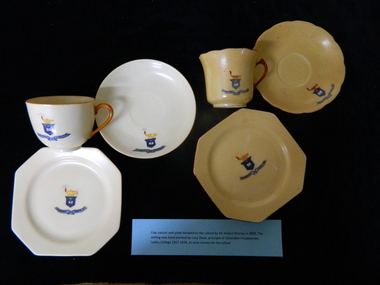
China tea setting
... China tea setting.... / 1934 Cup, saucer and plate with Clarendon PLC crest hand-painted on face; fawn coloured china with tan edge to plates and handle of cup; second cup, saucer and plate with off-white china and light brown edge to plates and handle of cup. China tea setting ...Fawn-coloured setting was donated to the school by Mr Robert Murray in 2005. The setting was hand painted by Lucy Shaw, (principal of Clarendon PLC 1927-1934) in 1934. The sets were sold to raise money for the school. Cup, saucer and plate with Clarendon PLC crest hand-painted on face; fawn coloured china with tan edge to plates and handle of cup; second cup, saucer and plate with off-white china and light brown edge to plates and handle of cup.On base of cup: L. SHAW On base of saucer: L SHAW / 1934 On base of plate: L. S. / 1934lucy-shaw, hand-painted-china -
 Bendigo Historical Society Inc.
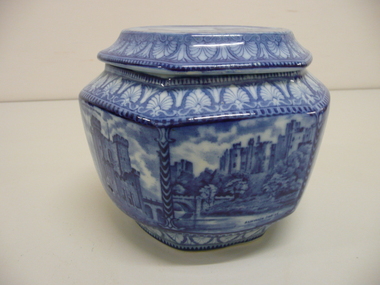
Domestic Object - BLUE CHINA TEA CADDY
... BLUE CHINA TEA CADDY...Blue and white hexagonal shaped china jar with lid, various castles depicted around sides and Windsor Castle on lid. Made by Maling Ware for Ringtons tea offices and warehouse Newcastle Upon Tyne illustrated on base...Made by Maling Ware for Ringtons tea offices and warehouse Newcastle Upon Tyne illustrated on base Domestic Object BLUE CHINA TEA CADDY ...Blue and white hexagonal shaped china jar with lid, various castles depicted around sides and Windsor Castle on lid. Made by Maling Ware for Ringtons tea offices and warehouse Newcastle Upon Tyne illustrated on baseMaling Ware England, Ringtons Tea emblem inside lid.domestic equipment, food storage & preservation, tea caddy, dr334.1 -
 Bendigo Historical Society Inc.
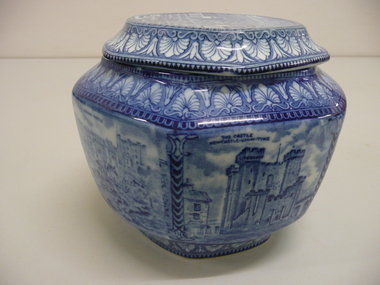
Domestic Object - BLUE CHINA TEA CADDY, 1929
... BLUE CHINA TEA CADDY...Blue and white hexagonal shaped china jar with lid, various castles depicted around sides and on lid. Made by Maling Ware for Ringtons Tea Offices & warehouse Newcastle Upon Tyne illustrated on base. ...Domestic Object BLUE CHINA TEA CADDY ...Blue and white hexagonal shaped china jar with lid, various castles depicted around sides and on lid. Made by Maling Ware for Ringtons Tea Offices & warehouse Newcastle Upon Tyne illustrated on base. Inside lid North East Coast Industries Exhibition Newcastle On Tyne 1929 Reg No's 745884 745865 plus coat of arms.Maling Ware England reg No's 745864-5domestic equipment, food storage & preservation, tea caddy, dr 334.2 -
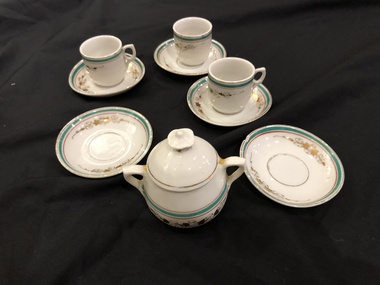 Mont De Lancey
China Tea Set
... China Tea Set...Sugar bowl with 2 lids, 5 saucers, 3 cups. China Tea Set ...Used in 1890, from Freida Striezel11 piece Children's Tea Set, white with green ring around rims, and gold leaf patterned. Sugar bowl with 2 lids, 5 saucers, 3 cups.toy dinnerware, toy cups, toy bowls, toy coffee services -
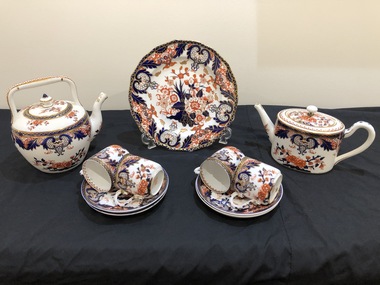 Mont De Lancey
China Tea Set, Staffordshire
... China Tea Set...All pieces are numbered on the base. China Tea Set Staffordshire ...From Robyn Johnston12 piece blue and orange floral Royal Staffordshire tea set with gold trim. Pieces included - four teacups, four saucers, one round lidded teapot, one hanging plate one oval lidded water kettle. All pieces are numbered on the base. Gold painted crown with Staffordshire name below. All pieces have 7500 number on base.tea sets -
Emerald Museum & Nobelius Heritage Park
Domestic object - China Tea Set
... China Tea Set...Domestic object China Tea Set ...China Teapot,Milk Jug, cup, saucer and plate. White, with green edges and flower garlands.Festoon (on plate only)emerald, victoria, australia, china -
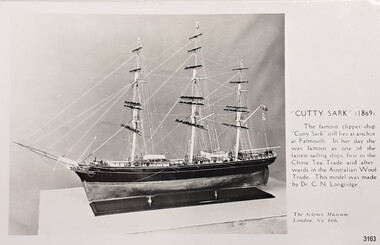 Flagstaff Hill Maritime Museum and Village
Postcard - Vessel, Sailing Ship, B Matthews (photo printer), Cutty Sark, 20t century
... ...China tea...At first, it carried tea from China. Later, it was used to transport wool from Australia. ...In her day, she was famous as one of the fastest sailing ships, first in the China Tea Trade, and afterwards in the Australian Wool Trade. ...In her day, she was famous as one of the fastest sailing ships, first in the China Tea Trade, and afterwards in the Australian Wool Trade. ...The maker of the ship model on the postcard was Dr C Nelson Longridge (1876–1952), an English surgeon, maritime author, and builder of detailed ship models. Other models include the SS Marioness and the steam yacht Asia. He also wrote the books 'Cutty Sark' and 'The Anatomy of Nelson's Ships'. The postcard was printed by B Matthews, Bradford, England, incorporated in 1970 as B. Matthews (Photo Printers) Limited. Collections of B Matthews' photo prints of famous painted portraits are held at The National Portrait Gallery of London. Copies of B Matthews postcards are today sought after by collectors. THE CUTTY SARK: - The Cutty Sark was built in Britain in 1869 and was one of the last great sailing ships. At first, it carried tea from China. Later, it was used to transport wool from Australia. It became famous for its speed and held the record for the fastest voyage from Australia to Britain for ten years. Later, a Portuguese company bought the ship and renamed it Ferreira. After that, a retired sea captain purchased it to use as a training ship in Cornwall. When the captain died, the ship was given to a training college in Greenwich in 1938. In 1954, it was placed in dry dock at Greenwich, where it remains on display. This postcard features a photograph of a model of the sailing ship Cutty Sark, making it significant because of its connection to this well-known vessel. The famous tea clipper transported wool from Australia to markets around the world. Models such as this one help us understand what sea travel was like before steam-powered ships became widespread, while also illustrating how trade, travel and migration developed over time. Cutty Sark was also celebrated for its speed. It broke records on the voyage from Australia to Britain and held this distinction for ten years. Its importance is still recognised today, as the ship has been carefully preserved and is now displayed at the British Maritime Museum in Greenwich. Its remarkable history has also made it a popular subject for model ship enthusiasts. The postcard is also valuable because it shows a model of Cutty Sark built by the renowned C. N. Longridge, who was not only a respected surgeon but also a skilled model maker and author of detailed maritime works. A further connection is found in the printer, B Matthews, who photographed and printed collections featuring famous people, model ships and maritime scenes, adding another layer of historical interest to the postcard. Postcard, black and white, showing a model of the sailing ship Cutty Sark. Printed details are provided on both the front and back of the postcard. Inscriptions include a brief description of the Cutty Sark, the location and maker of the model, and the printer's contact information. The postcard was printed in Great Britain.FRONT: " "CUTTY SARK" (1869) The famous clipper ship "Cutty Sark" still lies at anchor at Falmouth. In her day, she was famous as one of the fastest sailing ships, first in the China Tea Trade, and afterwards in the Australian Wool Trade. This model was made by Dr C.N. Longridge." "The Science Museum, London. No. 166." REVERSE: "POSTCARD" "COMMUNICATION" "ADDRESS" "Printed by B Matthews, Bradford, England"flagstaff hill, warrnambool, flagstaff hill maritime museum, shipwreck coast, flagstaff hill maritime village, maritime museum, great ocean road, cutty sark, historic sailing ship, tea clipper, sail training vessel, cadet training ship, commercial trading vessel, cargo sail vessel, clipper races, scott and linton of dunbarton scottland, race record, ferreria, 1869, tea cargo, tea trade, china tea, wool export, australian export, australian wool export, china tea trade, cornwall, training ship, greenwich, british museum, ship model, craft, hobby, ship model cutty sark, model making, postcard, c nelson longridge, charles nelson longridge, b matthews, photo printer, b matthews bradford england, b matthews (photo printer ) ltd. -
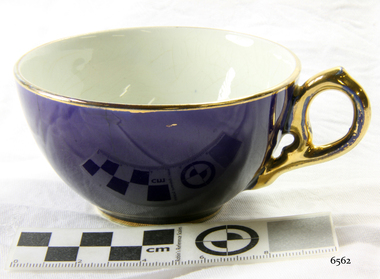 Flagstaff Hill Maritime Museum and Village
Ceramic - Teacup, 1920s
... ...china tea set...The teacup is part of a china tea set place setting, which comprises the teacup, a saucer and two plates of slightly different sizes. ...Flagstaff hill Warrnambool Flagstaff Hill Maritime Museum and Village Shipwreck Coast Great Ocean Road china tea set tea set royal blue china Tom Pearce Eva Carmichael Jane Shields Glenample Loch Ard place setting teacup The teacup is part of a china tea set place setting, which comprises the teacup, a saucer and two plates of slightly different sizes. ...This teacup is part of a four-piece place setting, comprising a teacup, saucer and plates, from a tea set. The tea set was given by Eva Carmichael, a survivor of the ship Loch Ard which was wrecked near Port Campbell in 1878, to Jane Shields, the young woman who supported Eva during her recovery from the ordeal. Ms Shields was Eva’s close companion while she was convalescing at Glenample Homestead. The friendship between the two women continued after Eva Carmichael returned to her home in Britain, became Mrs Townsend, and had three sons. Jane Shields also married, becoming Mrs John Osborne and bearing four daughters and two sons. In 1926-27, almost forty-eight years after the shipwreck, one of Jane’s daughters (Ella Marie Schulby nee Osborne) visited Eva in England. Eva gave her the tea set to take back home to her mother. Jane died in 1932 and her tea set was inherited by her daughters, who divided it between themselves, a four-piece place setting for each of them. A brief history of the Loch Ard: - The Loch Ard was named after a Scottish lake. It was one of the famous Loch Line of ships that sailed the long voyage from England to Australia. Barclay, Curdle and Co. built the three-masted iron ship in Glasgow in 1873. It had sailed three trips to Australia and one trip to Calcutta before its fateful voyage. Loch Ard left England on March 2, 1878, under the command of recently married, 29-year-old Captain Gibbs, bound for Melbourne with a crew of 37, plus 17 passengers. The general cargo reflected the affluence of Melbourne at the time. Onboard were straw hats, umbrellas, perfumes, clay pipes, pianos, clocks, confectionery, linen and candles, and a heavier load of railway irons, cement, lead and copper. Other cargo included items intended for display in the Melbourne International Exhibition of 1880. The Loch Ard had been sailing for three months and was close to its destination. At 3 am on June 1, 1878, Captain Gibbs expected to see land, but the Loch Ard ran into a fog that greatly reduced visibility. Captain Gibbs became anxious as there was no sign of land or the Cape Otway lighthouse. The fog lifted at 4 am. A lookout announced that he could see breakers. The sheer cliffs of Victoria's west coast came into view; the ship was much closer to them than Captain Gibbs expected. It was not long before the Loch Ard's bow swung towards land. Although the Captain tried to manage the vessel, his attempts didn’t work and the ship struck a reef at the base of Mutton Bird Island, near Port Campbell. The top deck became loosened from the hull, and the masts and rigging crashed down, knocking passengers and crew overboard. The lifeboat was launched by Tom Pearce but crashed into the side of Loch Ard and capsized. Tom Pearce managed to cling to the lifeboat’s overturned hull and shelter beneath it. He drifted out to sea and the tide brought him back to what is now called Loch Ard Gorge. He swam to shore and found a cave for shelter. A passenger, Eva Carmichael, had raced onto the deck to find out what was happening and was confronted by towering cliffs above the ship. She was soon swept off the ship by a huge wave. Eva saw Tom Pearce on a small rocky beach and yelled to attract his attention. He swam to the exhausted woman and dragged her to shore and to the shelter of the cave. He revived Eva with a bottle of brandy from a case that had washed up on the beach. Tom scaled a cliff in search of help and followed some horse hoof prints. He came from two men from Glenample Station, three and a half miles away. He told the men of the tragedy and then returned to the gorge while the two men rode back to the station to get help. They reached Loch Ard Gorge and took the two shipwreck survivors to Glenample Station to recover. Eva stayed at the station for six weeks before returning to Ireland by steamship. In Melbourne, Tom Pearce received a hero's welcome and was presented with a medal and some money. Of the 54 crew members and passengers on board, only two survived: the apprentice, Tom Pearce and the young woman passenger, Eva Carmichael, who lost her family in the tragedy.This blue china tea set, comprising a teacup, saucer and two plates, is of high significance as it is closely connected to the wreck of the Loch Ard, and to one of only two survivors, Eva Carmichael. Memorabilia connected to Eva Carmichael are precious and rare. The Loch Ard shipwreck is significant for Victoria and is registered on the Victorian Heritage Register (S 417). Flagstaff Hill has a varied collection of artefacts from Loch Ard and its collection is significant for being one of the largest accumulations of artefacts from this notable Victorian shipwreck. The group gives a snapshot of history, enabling us to interpret the story of this tragic event and the lives of the people involved. The collection is also archaeologically significant as it represents aspects of Victoria's shipping history that allow us to interpret Victoria's social and historical themes of the time. The collection's historical significance is that it is associated unfortunately with the worst and best-known shipwreck in Victoria's history.The teacup is part of a china tea set place setting, which comprises the teacup, a saucer and two plates of slightly different sizes. The cup is a royal blue outer, white inside with gold lip, a gold ring around the base and a gold handle. flagstaff hill, warrnambool, flagstaff hill maritime museum and village, shipwreck coast, great ocean road, china tea set, tea set, royal blue china, tom pearce, eva carmichael, jane shields, glenample, loch ard, place setting, teacup -
 Flagstaff Hill Maritime Museum and Village
Photograph - Vessel, Sailing Ship, Cutty Sark, Between c.1869-1895
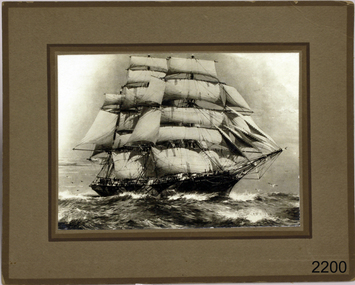
... ...China tea...THE CUTTY SARK: The ship Cutty Sark was built expressly for the China Tea Trade and was involved in the famous tea clipper races between 1859 and 1872. ...THE CUTTY SARK: The ship Cutty Sark was built expressly for the China Tea Trade and was involved in the famous tea clipper races between 1859 and 1872. ...THE CUTTY SARK: The ship Cutty Sark was built expressly for the China Tea Trade and was involved in the famous tea clipper races between 1859 and 1872. It was designed and built by Scott and Linton of Dunbarton, Scotland. Cutty Sark holds the record with 363 knots done more than once. On one occasion, it managed speeds of 362 and 363 knots on two consecutive days. In 1872, it had the misfortune of losing its rudder while racing the "Thermopylae" but was able to continue the race after repairs.The photograph of the Cutty Sark is significant for showing a special ship which carried wool from Australia to other parts of the world. The photograph helps us imagine what sea travel was like before steam-powered ships were common, and they show us how trade, travel and migration changed over time. The Cutty Sark is famous for being very fast. It set a record for the journey from Australia to Britain and kept that title for ten years. Today, people still recognise its importance because it has been carefully preserved and is on display at the British Maritime Museum in Greenwich. Photograph framed black and white photograph behind glass, depicting the tall ship "Cutty Sark" in full rig. Figures are on deck. flagstaff hill, warrnambool, flagstaff hill maritime museum, shipwreck coast, flagstaff hill maritime village, maritime museum, great ocean road, cutty sark, historic sailing ship, tea clipper, sail training vessel, cadet training ship, commercial trading vessel, cargo sail vessel, clipper races, scott and linton of dunbarton scottland, race record, ferreria, 1869, tea cargo, tea trade, china tea, wool export, australian export, australian wool export, china tea trade, thermopylae -
 Flagstaff Hill Maritime Museum and Village
Postcard - Vessel, Sailing Ship, Jack Spurling (John Robert Charles Spurling), marine artist, circa 19th century
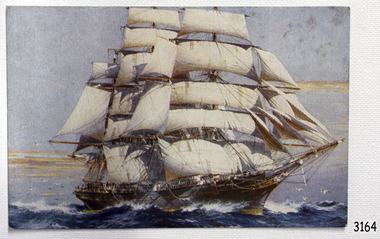
... ...China tea...At first, it carried tea from China. Later, it was used to transport wool from Australia. ...At first, it carried tea from China. Later, it was used to transport wool from Australia. ...The postcard is a copy of a painting by the renowned British maritime artist Jack Spurling (John (Jack) Robert Charles Spurling 1870-1933). Spurling's love for the sea was fulfilled as a teenager when he worked as an apprentice, eventually gaining a Second Mate certificate and going on to join the Blue Anchor Line as a junior officer. His love for the sea shows in his detailed paintings of ship portraits. THE CUTTY SARK: - The Cutty Sark was built in Britain in 1869 and was one of the last great sailing ships. At first, it carried tea from China. Later, it was used to transport wool from Australia. It became famous for its speed and held the record for the fastest voyage from Australia to Britain for ten years. Later, a Portuguese company bought the ship and renamed it Ferreira. After that, a retired sea captain purchased it to use as a training ship in Cornwall. When the captain died, the ship was given to a training college in Greenwich in 1938. In 1954, it was placed in dry dock at Greenwich, where it remains on display. The postcard depicts the clipper, Cutty Sark, which was a special ship because it carried wool from Australia to other parts of the world. Postcards like this one help us imagine what sea travel was like before steam-powered ships became common, and they show us how trade, travel, and migration evolved. The Cutty Sark is also famous for its speed. It set a record for the journey from Australia to Britain and kept that title for ten years. Today, people still recognise its importance because it has been carefully preserved and is on display at the British Maritime Museum in Greenwich. Its story has also made it a favourite subject for people who enjoy building ship models. The picture is a copy of a painting by renowned maritime artist Jack Spurling, who was famous for his ship portraits.Coloured postcard of the Cutty Sark. Photograph of a painting by J Spurling. flagstaff hill, warrnambool, flagstaff hill maritime museum, shipwreck coast, flagstaff hill maritime village, maritime museum, great ocean road, cutty sark, historic sailing ship, tea clipper, sail training vessel, cadet training ship, commercial trading vessel, cargo sail vessel, clipper races, scott and linton of dunbarton scottland, race record, ferreria, 1869, tea cargo, tea trade, china tea, wool export, australian export, australian wool export, china tea trade, cornwall, training ship, greenwich, british museum, postcard, coloured postcard, postcard of a painting, jack spurling, british maritime artist, ship portraits, john 'jack' robert charles spurling -
 Flagstaff Hill Maritime Museum and Village
Photograph - Vessel, Sailing Ship, Jack Spurling (John Robert Charles Spurling), marine artist, circa 19th century
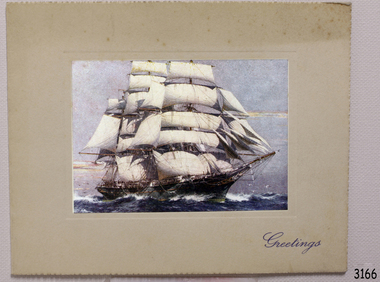
... ...China tea...At first, it carried tea from China. Later, it was used to transport wool from Australia. ...At first, it carried tea from China. Later, it was used to transport wool from Australia. ...The card is a copy of a painting by the renowned British maritime artist Jack Spurling (John (Jack) Robert Charles Spurling 1870-1933). Spurling's love for the sea was fulfilled as a teenager when he worked as an apprentice, eventually gaining a Second Mate certificate and going on to join the Blue Anchor Line as a junior officer. His love for the sea shows in his detailed paintings of ship portraits. THE CUTTY SARK: - The Cutty Sark was built in Britain in 1869 and was one of the last great sailing ships. At first, it carried tea from China. Later, it was used to transport wool from Australia. It became famous for its speed and held the record for the fastest voyage from Australia to Britain for ten years. Later, a Portuguese company bought the ship and renamed it Ferreira. After that, a retired sea captain purchased it to use as a training ship in Cornwall. When the captain died, the ship was given to a training college in Greenwich in 1938. In 1954, it was placed in dry dock at Greenwich, where it remains on display.The card depicts the clipper, Cutty Sark, which was a special ship because it carried wool from Australia to other parts of the world. Cards like this one help us imagine what sea travel was like before steam-powered ships became common, and they show us how trade, travel, and migration evolved. The Cutty Sark is also famous for its speed. It set a record for the journey from Australia to Britain and kept that title for ten years. Today, people still recognise its importance because it has been carefully preserved and is on display at the British Maritime Museum in Greenwich. The picture is a copy of a painting by renowned maritime artist Jack Spurling, who was famous for his ship portraits.Photograph: coloured image of the sailing ship Cutty Sark by artist J Spurling. The image is mounted on a card used as a greeting card. It has a printed inscription. "Greetings"flagstaff hill, warrnambool, flagstaff hill maritime museum, shipwreck coast, flagstaff hill maritime village, maritime museum, great ocean road, cutty sark, historic sailing ship, tea clipper, sail training vessel, cadet training ship, commercial trading vessel, cargo sail vessel, clipper races, scott and linton of dunbarton scottland, race record, ferreria, 1869, tea cargo, tea trade, china tea, wool export, australian export, australian wool export, china tea trade, cornwall, training ship, greenwich, british museum, postcard, coloured postcard, postcard of a painting, jack spurling, british maritime artist, ship portraits, john 'jack' robert charles spurling -
 Flagstaff Hill Maritime Museum and Village
Postcard - Vessel, Sailing Ship, Cutty Sark in Sydney Harbour, After August 1891
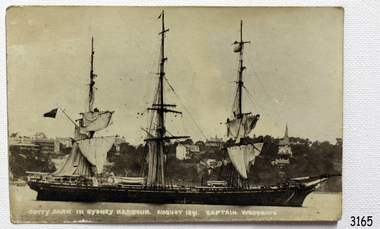
... ...China tea...At first, it carried tea from China. Later, it was used to transport wool from Australia. ...At first, it carried tea from China. Later, it was used to transport wool from Australia. ...Captain Richard Woodget (1845-1928) was renowned for his successful command of the Cutty Sark. He began his maritime career in 1861 as an apprentice seaman at almost 15 years old and received his Master Certificate in 1871. In 1881, aged 35, he took his first command on the vessel Coldstream. His sailing skill and careful financial management earned him the command of the Cutty Sark for ten of its voyages. For another year, he commanded the Coldingham, then retired from life as a mariner in 1896. The Cutty Sark was built in Britain in 1869 and was one of the last great sailing ships. At first, it carried tea from China. Later, it was used to transport wool from Australia. It became famous for its speed and held the record for the fastest voyage from Australia to Britain for ten years. Later, a Portuguese company bought the ship and renamed it Ferreira. After that, a retired sea captain purchased it to use as a training ship in Cornwall. When the captain died, the ship was given to a training college in Greenwich in 1938. In 1954, it was placed in dry dock at Greenwich, where it remains on display. The postcard is important for is connection with the vessel, Cutty Sark, a special ship because it carried wool from Australia to other parts of the world. Postcards like this one help us imagine what sea travel was like before steam-powered ships were common, and they show us how trade, travel and migration changed over time. The Cutty Sark is also famous for being very fast. It set a record for the journey from Australia to Britain and kept that title for ten years. Today, people still recognise its importance because it has been carefully preserved and is on display at the British Maritime Museum in Greenwich. Its story has also made it a favourite subject for people who enjoy building ship models. The postcard is important to Australian history, as it shows the Cutty Sark at Sydney on one of its voyages, in the command of Captain Richard Woodget, a respected mariner and master of sailing ships.Postcard: Black and white postcard of a photographed image of a 3-masted sailing ship, sails half-lowered. Behind the vessel is a hill with buildings on it. A white handwritten inscription is along the base of the postcard. The vessel is the Cutty Sark in Sydney Harbour in August 1891. Its master was Captain Woodget."CUTTY SARK IN SYDNEY HARBOUR. AUGUST 1891. CAPTAIN WOODGATE."flagstaff hill, warrnambool, flagstaff hill maritime museum, shipwreck coast, flagstaff hill maritime village, maritime museum, great ocean road, cutty sark, historic sailing ship, tea clipper, sail training vessel, cadet training ship, commercial trading vessel, cargo sail vessel, clipper races, scott and linton of dunbarton scottland, race record, transportation, ferreria, 1869, tea cargo, tea trade, china tea, wool export, australian export, australian wool export, china tea trade, cornwall, training ship, greenwich, british museum, captain richard woodget, captain woodget -
Glenelg Shire Council Cultural Collection
Leisure object - Doll's Teacup, n.d
... China tea cup - toy...Part of Graham Collection, donated by the family of Misses Mary and Edith Maude Graham, of 4 Blair St Portland toys tea cup tea set doll China tea cup - toy Leisure object Doll's Teacup ...Part of Graham Collection, donated by the family of Misses Mary and Edith Maude Graham, of 4 Blair St PortlandChina tea cup - toytoys, tea cup, tea set, doll -
 Marysville & District Historical Society
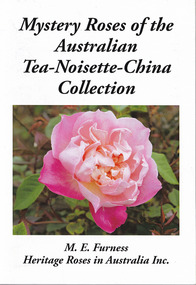
Booklet - Paperback booklet, Margaret Furness, Mystery Roses of the Australian Tea-Noisette-China Collection, 2022
... Mystery Roses of the Australian Tea-Noisette-China Collection...Mystery Roses of the Australian Tea-Noisette-China Collection Booklet Paperback booklet Margaret Furness Heritage Roses in Australia Inc Reid Print ...A booklet containing descriptions and photographs of tea roses found in Australia.Front cover has a photograph of a pink rose. The title of the book is in black lettering across the upper edge with the author's name along the lower edge. Reverse of book has a photograph of a cream rose with the blurb regarding the book above the photograph.non-fictionA booklet containing descriptions and photographs of tea roses found in Australia.tea roses, australia, heritage roses in australia inc -
 Flagstaff Hill Maritime Museum and Village
Craft - Ship Model, Cutty Sark
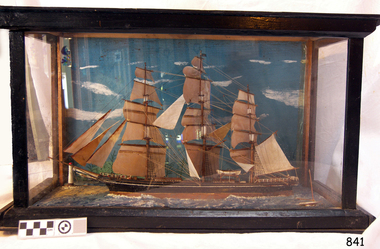
... ...China tea...At first, it carried tea from China. Later, it was used to transport wool from Australia. ...At first, it carried tea from China. Later, it was used to transport wool from Australia. ...THE CUTTY SARK: - The Cutty Sark was built in Britain in 1869 and was one of the last great sailing ships. At first, it carried tea from China. Later, it was used to transport wool from Australia. It became famous for its speed and held the record for the fastest voyage from Australia to Britain for ten years. Later, a Portuguese company bought the ship and renamed it Ferreira. After that, a retired sea captain purchased it to use as a training ship in Cornwall. When the captain died, the ship was given to a training college in Greenwich in 1938. In 1954, it was placed in dry dock at Greenwich, where it remains on display. The Cutty Sark is a special ship because it carried wool from Australia to other parts of the world. Models like this one help us imagine what sea travel was like before steam-powered ships were common, and they show us how trade, travel and migration changed over time. The Cutty Sark is also famous for being very fast. It set a record for the journey from Australia to Britain and kept that title for ten years. Today, people still recognise its importance because it has been carefully preserved and is on display at the British Maritime Museum in Greenwich. Its story has also made it a favorite subject for people who enjoy building ship models. Ship model: the clipper ship Cutty Sark in full ship rig with raised poop deck, deck house, three boats on deck (one has fallen). It has a two-toned black and tan hull and three jibs. The model is set in a diorama of a blue sea, a lighthouse and another small yacht. It is housed in a glass-sided case with a dark grey painted structure. The bow has an inscription."Cutty Sark"flagstaff hill, warrnambool, flagstaff hill maritime museum, shipwreck coast, flagstaff hill maritime village, maritime museum, great ocean road, cutty sark, historic sailing ship, tea clipper, sail training vessel, cadet training ship, commercial trading vessel, cargo sail vessel, ferreria, 1869, tea cargo, tea trade, china tea, wool export, australian export, australian wool export, cornwall, training ship, greenwich, british museum, ship model, craft, hobby, ship model cutty sark, model making -
 Flagstaff Hill Maritime Museum and Village
Photograph - Set of Photographs, John Chance, late 1960s to early 1970s
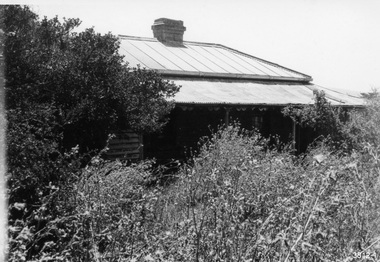
... ...blue china tea set...Eva handed her a blue china tea set to pass onto her mother as a gift. ...Eva handed her a blue china tea set to pass onto her mother as a gift. ...This set of glossy black and white photographs is a set of images of Glenample Homestead circa late 1960s to early 1970s. They were taken by John Chance and are part of the John Chance Collection. The Colonial Georgian style Glenample Homestead was built from 1866 to 1869 from locally quarried sandstone. In is built on the top of a hill amongst trees. There are paddocks below and around the building. The building is basically a rectangular shape with a recessed room on the right side of the front. The pitched roof is covered in corrugated iron. The veranda, added in 1886, also has a corrugated iron room and is supported by square posts with decorative tops. It shelters three sides of the building. The edge of the veranda is decorated with scalloped shapes along the front and left side of the building. On the right is a brick wall incorporating a chimney. Another chimney on the left is contained within the building. The four-panelled outside doors are visible in some of the photos, as are the 12-paned glass windows, which are framed in contrasting stone. The veranda is trimmed with scalloped metal work on two sides and had some enclosed corners. There appears to be a cubical water tank on the roof line. Out-buildings include a toilet built against the house's brick wall. Another building appears to have two rooms with outside doors, perhaps for workers. There is the remains of a two-wheeled cart under a shelter. GLENAMPLE & the LOCH ARD Glenample Homestead became famous after the disastrous wreck of the sailing ship Loch Ard on June 1, 1878. The owners, Hugh Hamilton Gibson and Peter McArthur, were involved in the rescue and recovery of the only two survivors, as well as overseeing the salvage of items from the shipwreck and the burial of those who lost their lives. Glenample Homestead is on the Great Ocean Road at Princetown. Originally the land was part of Kennan’s Station lease, one of the district’s early settlements, circa 1847. James Murray bought Kerman’s land in 1856-57, combined it with nearby land, and named it Glenample Homestead. The ruins of huts Murray built on the property were still there until recently. Glenample was sold in 1866 to the partnership of Gibson and McArthur, who built a Georgian style house there using local sandstone, completing it by 1869. On 1st June 1878 the Loch Ard was wrecked at what is now called Loch Ard Gorge. Apprentice crewman Tom Pearce and eighteen year old passenger Eva Carmichael were the only survivors. Pearce had brought Eva ashore and sheltered her in a cave, reviving her with whiskey found amongst items washed up from the wreck. He climbed the cliffs and came across two riders from Glenample. No other survivors were found and sadly, Eva’s family members were amongst those who drowned. Hugh and Lavinia Gibson cared for Pearce and Eva at Glenample and extended their hospitality to Eva, who stayed on for about six weeks as she recovered from the ordeal physically and emotionally. Mrs Gibson introduced Eva to Jane Shields and the young ladies became lifelong friends. Years after Eva had returned to England, Jane’s daughter visited her. Eva handed her a blue china tea set to pass onto her mother as a gift. A descendant of Jane’s donated part of the tea set to Flagstaff Hill Maritime Village while another descendant donated her inherited share of the tea set to the Warrnambool and District Historical Society. In 1886 Glenample Homestead was updated to include a veranda on three sides. In 1887 Gibson sold his share to partner Peter McArthur. McArthur’s son Ernest inherited the property in 1897. Ernest established the Glenample Cheese Factory in around 1911. It was closed due to the World War and reopened in 1929 by McArthur’s sons, Robert and Colin, when they took control. In 1945 they sold Glenample and several owners followed but it was left unoccupied and became dilapidated. It was during this time that John Chance visited the property and photographed the buildings. In the 1980s the National Parks Service acquired the Glenample Homestead and began a restoration program. Work began in 1989 by Cathedral Stone, which was established in 1989 by James Charlwood, a specialist stonemason and son of maritime author Don Charlwood. This set of photographs are significant as a record of Glenample Homestead as it was from around the late 1860s to the late 1960s. The photographs are also significant as they were taken by John Chance, a diver from the wreck of the Loch Ard in the 1960s-70s. Items that come from several wrecks along Victoria's coast have since been donated to the Flagstaff Hill Maritime Village’s museum collection by his family, illustrating this item’s level of historical value. The photographs are significant as a link between Glenample, the vessel Loch Ard, and the only survivors of the Loch Ard. Glenample Homestead is of historical, social and architectural significance to the State of Victoria and is listed on the Victorian Heritage Register (VHR H0392). It is a historical example of early settlement and development of a run in the coastal land of South West Victoria, and it is constructed from locally quarried sandstone but doesn’t take away from its Georgian design. Glenample Homestead is of State significance through its unique connection with the wreck of the ship Loch Ard and the connection to its owners, Hugh and Lavinia Gibson and Peter McArthur, played a historically and socially significant role in the rescue and care of the survivors, the salvage of goods and the burial of those who lost their lives. The shipwreck of the Loch Ard itself is of significance for Victoria and is registered on the Victorian Heritage Register (S417). The set of ten rectangular black and white photographs of the Glenample Homestead, taken in the late 1960s or early 1970s, give san overview of the Glenample property. The views include the front, back and one side of the building, three outbuildings, and the situation of the homestead on the property. The details on the photographs show the materials used and the Colonial Georgian style. The photographs are also a record of the deterioration of the property over the years it was unoccupied.flagstaff hill, warrnambool, flagstaff hill maritime museum, maritime museum, shipwreck coast, flagstaff hill maritime village, great ocean road, kennans station, glenample homestead, georgian homestead, loch ard, princetown, victoria, james murray, hugh hamilton gibson, lavinia gibson, jane shields, eva carmichael, tom pearce, blue china tea set, peter mcarthur, ernest mcarthur, robert mcarthur, colin mcarthur, glenample cheese factory, cathedral stone, don charlwood, james charlwood, antique door key, glenample photographs, john chance, victorian heritage database 392 -
 Whitehorse Historical Society Inc.
Domestic object - Tea Pot
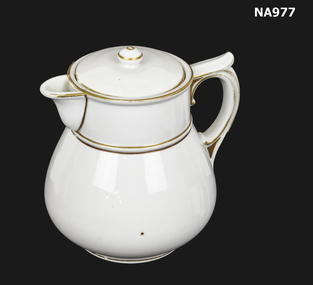
... Large white china tea pot with gold trim...domestic items crockery Large white china tea pot with gold trim Domestic object Tea Pot ...Large white china tea pot with gold trimdomestic items, crockery -
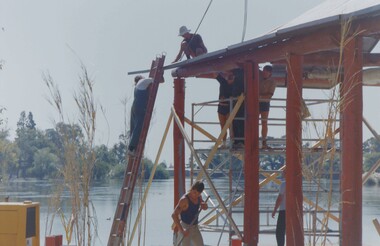 Bendigo Historical Society Inc.
Negative - BENDIGO CHINESE TEA HOUSE
... Construction of the Bendigo Chinese Tea House, Nolan Street, Bendigo....BUILDINGS Commercial tea house Construction of the Bendigo Chinese Tea House, Nolan Street, Bendigo. Negative BENDIGO CHINESE TEA HOUSE ...Construction of the Bendigo Chinese Tea House, Nolan Street, Bendigo.buildings, commercial, tea house -
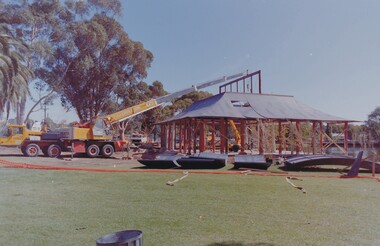 Bendigo Historical Society Inc.
Negative - BENDIGO CHINESE TEA HOUSE
... Construction of the Bendigo Chinese Tea House, Nolan Street, Bendigo....BUILDINGS Commercial tea house Construction of the Bendigo Chinese Tea House, Nolan Street, Bendigo. Negative BENDIGO CHINESE TEA HOUSE ...Construction of the Bendigo Chinese Tea House, Nolan Street, Bendigo.buildings, commercial, tea house -
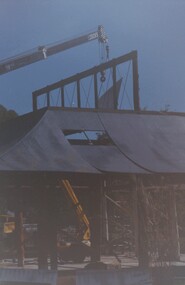 Bendigo Historical Society Inc.
Negative - BENDIGO CHINESE TEA HOUSE
... Construction of the Bendigo Chinese Tea House, Nolan Street, Bendigo....BUILDINGS Commercial tea house Construction of the Bendigo Chinese Tea House, Nolan Street, Bendigo. Negative BENDIGO CHINESE TEA HOUSE ...Construction of the Bendigo Chinese Tea House, Nolan Street, Bendigo.buildings, commercial, tea house -
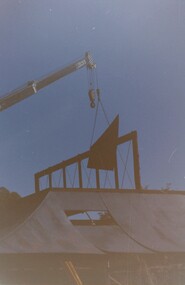 Bendigo Historical Society Inc.
Negative - BENDIGO CHINESE TEA HOUSE
... Construction of the Bendigo Chinese Tea House, Nolan Steet, Bendigo....BUILDINGS Commercial tea house Construction of the Bendigo Chinese Tea House, Nolan Steet, Bendigo. Negative BENDIGO CHINESE TEA HOUSE ...Construction of the Bendigo Chinese Tea House, Nolan Steet, Bendigo.buildings, commercial, tea house -
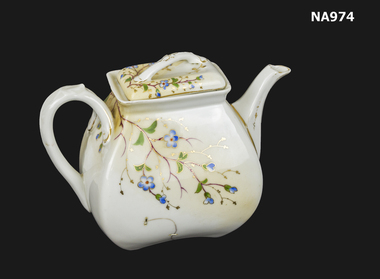 Whitehorse Historical Society Inc.
Domestic object - Tea Pot
... Large white china tea pot with blue flowers and gold trim...domestic items crockery Large white china tea pot with blue flowers and gold trim Domestic object Tea Pot ...Large white china tea pot with blue flowers and gold trimdomestic items, crockery -
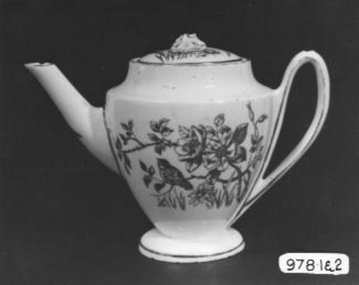 Whitehorse Historical Society Inc.
Domestic object - Tea Pot
... White china tea pot with red flowered decoration and gold trim...domestic items crockery White china tea pot with red flowered decoration and gold trim Domestic object Tea Pot ...White china tea pot with red flowered decoration and gold trimdomestic items, crockery -
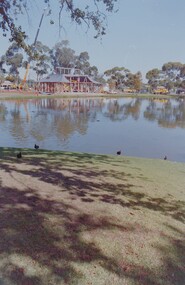 Bendigo Historical Society Inc.
Negative - BENDIGO CHINESE TEA HOUSE
... Construction of Chinese Tea House, Nolan Street, Bendigo. Beside Lake Weeroona...BUILDINGS Commercial tea house Construction of Chinese Tea House, Nolan Street, Bendigo. Beside Lake Weeroona Negative BENDIGO CHINESE TEA HOUSE ...Construction of Chinese Tea House, Nolan Street, Bendigo. Beside Lake Weeroonabuildings, commercial, tea house
