
Showing 121 items matching "chinese food"
-
 Bendigo Historical Society Inc.
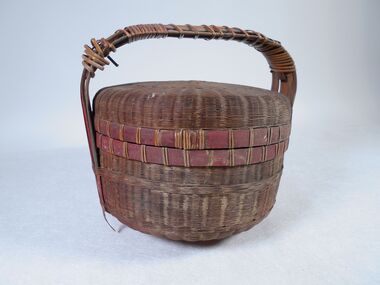
Container - CHINESE FOOD BASKET, 1890s
... CHINESE FOOD BASKET...Large round rattan Chinese food basket with lid and handle (6.5 cm).Double layer of woven can and bamboo, inner section in herringbone pattern and outer layer in horizontal pattern. ...Red and green decoration around the basket and on the handle. Container CHINESE FOOD BASKET ...Large round rattan Chinese food basket with lid and handle (6.5 cm).Double layer of woven can and bamboo, inner section in herringbone pattern and outer layer in horizontal pattern. Red and green decoration around the basket and on the handle.domestic equipment, food storage & preservation, chinese -
 Bright & District Historical Society operating the Bright Museum
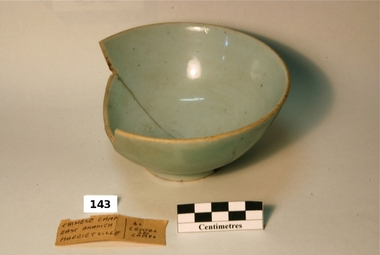
Bowl
... Chinese food bowl, porcelain, celadon...This object is part of one of the largest collections of Chinese ware found in the Upper Ovens area and the only one recording the location where found. chinese bowl porcelain celadon Blue Chinese writing or maker's stamp on base Chinese food bowl, porcelain, celadon Bowl ...Brought to the Ovens Goldfields by Chinese men working in the area in the 19th century. Most likely made in China.Aldo Gios recorded the location of where most pieces in his collection were found. Some maps drawn by Aldo Gios, also give more detail. This detail is rare as most pieces of broken crockery were discarded and complete items were usually collected with no thought to recording the location where they were found. This object is part of one of the largest collections of Chinese ware found in the Upper Ovens area and the only one recording the location where found.Chinese food bowl, porcelain, celadonBlue Chinese writing or maker's stamp on basechinese, bowl, porcelain, celadon -
 Clunes Museum
Domestic object - FOOD MOULD
... CHINA FOOD MOULD, CREAM COLOURED WITH RIDGES ON THE OUTSIDE....FOOD MOULD DOMESTIC OBJECT CHINA FOOD MOULD, CREAM COLOURED WITH RIDGES ON THE OUTSIDE. ...CHINA FOOD MOULD, CREAM COLOURED WITH RIDGES ON THE OUTSIDE.food mould, domestic object -
 Bright & District Historical Society operating the Bright Museum
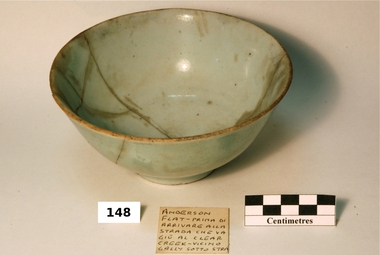
Bowl
... Chinese porcelain food bowl, celadon....This object is part of one of the largest collections of Chinese ware found in the Upper Ovens area and the only one recording the location where found. chinese bowl tableware porcelain buckland celadon Blue Chinese writing or maker’s stamp on base. Chinese porcelain food bowl, celadon. Bowl ...Brought to the Ovens Goldfields by Chinese men working in the area in the 19th century. Most likely made in China.Aldo Gios recorded the location of where most pieces in his collection were found. Some maps drawn by Aldo Gios, also give more detail. This detail is rare as most pieces of broken crockery were discarded and complete items were usually collected with no thought to recording the location where they were found. This object is part of one of the largest collections of Chinese ware found in the Upper Ovens area and the only one recording the location where found.Chinese porcelain food bowl, celadon.Blue Chinese writing or maker’s stamp on base.chinese, bowl, tableware, porcelain, buckland, celadon -
 Bright & District Historical Society operating the Bright Museum
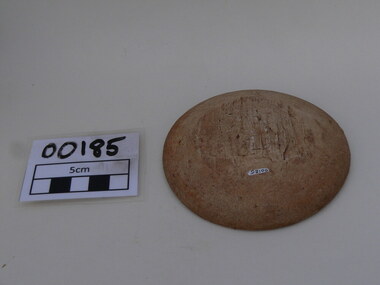
Dish
... Chinese earthenware food dish, unglazed...Part of one of the largest collections of Chinese ware found in the Upper Ovens area and the only one recording the location where found. chinese goldfields gios tableware dish earthenware harrietville Chinese earthenware food dish, unglazed Dish ...Brought to the Ovens Goldfields by Chinese men working in the area in the 19th century. Most likely made in China.Aldo Gios recorded the location of where most of the pieces in this collection were found. Some maps drawn by Aldo Gios also give more detail. This detail is rare, as most pieces of broken crockery were discarded and complete items were usually collected with no thought to recording the location they came from. Part of one of the largest collections of Chinese ware found in the Upper Ovens area and the only one recording the location where found.Chinese earthenware food dish, unglazedchinese, goldfields, gios, tableware, dish, earthenware, harrietville -
 Bright & District Historical Society operating the Bright Museum
Jar
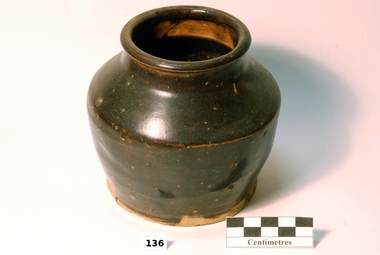
... chinese...food...This object is part of one of the largest collections of Chinese ware found in the Upper Ovens area and the only one recording the location where found. chinese food jar goldfields glaze stoneware Stoneware food jar, glazed except base. ...Brought to the Ovens Goldfields by Chinese men working in the area in the 19th century. Most likely made in China.Aldo Gios recorded the location of where most pieces in his collection were found. Some maps drawn by Aldo Gios, also give more detail. This detail is rare as most pieces of broken crockery were discarded and complete items were usually collected with no thought to recording the location where they were found. This object is part of one of the largest collections of Chinese ware found in the Upper Ovens area and the only one recording the location where found.Stoneware food jar, glazed except base. Dark brown.chinese, food, jar, goldfields, glaze, stoneware -
Bialik College
Photograph (Item) - Photographs, excursions and school camps, no dates
... ...Chinese Food...For inquiries or access contact [email protected] Excursion Camp Hiking Adventure Chinese Food ChinaTown School Jewish School Bialik College Photographs Photographs in colour, glossy and matte, 4x6 Photograph Photographs, excursions and school camps, no dates. ...Photographs, excursions and school camps, no dates. Shows students partaking in various aspects of day excursions or school camps. For instance, one camp appears to be at Wilson's Prom, an outdoor adventure circuit, a bus trip, hiking. Excursions appear to be to a Chinese restaurant and the China Town Melbourne museum, white water rafting with older students. For inquiries or access contact [email protected], camp, hiking, adventure, chinese food, chinatown, school, jewish school, bialik college, photographs -
 Bright & District Historical Society operating the Bright Museum
Bowl
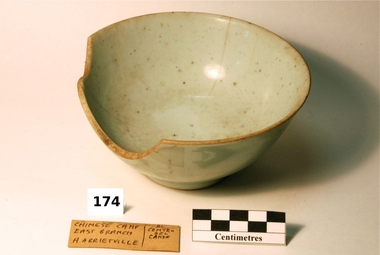
... Chinese porcelain food bowl, celadon glaze....Part of one of the largest collections of Chinese ware found in the Upper Ovens area and the only one recording the location where found. chinese bowl goldfields gios tableware glaze porcelain harrietville celadon Blue Chinese writing or maker’s stamp on base. Chinese porcelain food bowl, celadon glaze. Bowl ...Brought to the Ovens Goldfields by Chinese men working in the area in the 19th century. Most likely made in China.Aldo Gios recorded the location of where most of the pieces in this collection were found. Some maps drawn by Aldo Gios also give more detail. This detail is rare, as most pieces of broken crockery were discarded and complete items were usually collected with no thought to recording the location they came from. Part of one of the largest collections of Chinese ware found in the Upper Ovens area and the only one recording the location where found.Chinese porcelain food bowl, celadon glaze.Blue Chinese writing or maker’s stamp on base.chinese, bowl, goldfields, gios, tableware, glaze, porcelain, harrietville, celadon -
 Bright & District Historical Society operating the Bright Museum
Bowl
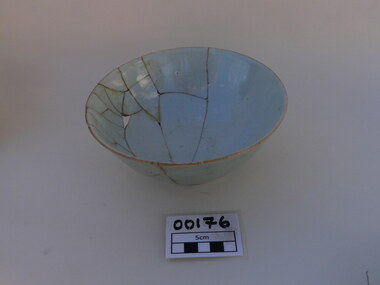
... Chinese porcelain food bowl, celadon glaze....Part of one of the largest collections of Chinese ware found in the Upper Ovens area and the only one recording the location where found. chinese bowl goldfields gios tableware glaze porcelain harrietville celadon Blue Chinese writing or maker’s stamp on base. Chinese porcelain food bowl, celadon glaze. Bowl ...Brought to the Ovens Goldfields by Chinese men working in the area in the 19th century. Most likely made in China.Aldo Gios recorded the location of where most of the pieces in this collection were found. Some maps drawn by Aldo Gios also give more detail. This detail is rare, as most pieces of broken crockery were discarded and complete items were usually collected with no thought to recording the location they came from. Part of one of the largest collections of Chinese ware found in the Upper Ovens area and the only one recording the location where found.Chinese porcelain food bowl, celadon glaze.Blue Chinese writing or maker’s stamp on base. chinese, bowl, goldfields, gios, tableware, glaze, porcelain, harrietville, celadon -
Bright & District Historical Society operating the Bright Museum
Bowl
... Chinese earthenware food bowl. Part glazed....earthenware bowl chinese tableware goldfields buckland valley Aldo Gios Chinese earthenware food bowl. Part glazed. Bowl ...Chinese earthenware food bowl. Part glazed.earthenware, bowl, chinese, tableware, goldfields, buckland valley, aldo gios -
 Bendigo Historical Society Inc.
Container - CHINESE SEWING BASKET, 1900-1940
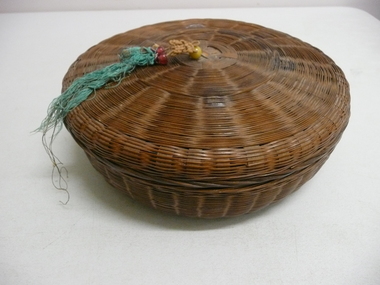
... Small round woven rattan Chinese food container with lid, brown tones, handle of 3 glass beads, pink & Yellow joined by knotted cotton plus unravelled silk tassel....DOMESTIC EQUIPMENT Food storage & preservation chinese Small round woven rattan Chinese food container with lid, brown tones, handle of 3 glass beads, pink & Yellow joined by knotted cotton plus unravelled silk tassel. ...Small round woven rattan Chinese food container with lid, brown tones, handle of 3 glass beads, pink & Yellow joined by knotted cotton plus unravelled silk tassel.domestic equipment, food storage & preservation, chinese -
 Bright & District Historical Society operating the Bright Museum
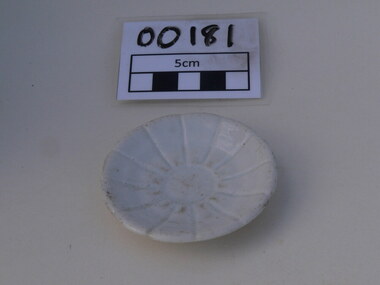
Dish
... Chinese porcelain food dish, glazed. White colour with flower pattern....Part of one of the largest collections of Chinese ware found in the Upper Ovens area and the only one recording the location where found. chinese goldfields gios tableware glaze porcelain dish harrietville Chinese porcelain food dish, glazed. White colour with flower pattern. ...Brought to the Ovens Goldfields by Chinese men working in the area in the 19th century. Most likely made in China.Aldo Gios recorded the location of where most of the pieces in this collection were found. Some maps drawn by Aldo Gios also give more detail. This detail is rare, as most pieces of broken crockery were discarded and complete items were usually collected with no thought to recording the location they came from. Part of one of the largest collections of Chinese ware found in the Upper Ovens area and the only one recording the location where found.Chinese porcelain food dish, glazed. White colour with flower pattern.chinese, goldfields, gios, tableware, glaze, porcelain, dish, harrietville -
Bright & District Historical Society operating the Bright Museum
Dish
... Chinese porcelain food dish, celadon glaze. Blue pattern on outside, swirls and lines....Dish porcelain chinese glaze tableware goldfields Aldo Gios Chinese porcelain food dish, celadon glaze. Blue pattern on outside, swirls and lines. ...Chinese porcelain food dish, celadon glaze. Blue pattern on outside, swirls and lines.dish, porcelain, chinese, glaze, tableware, goldfields, aldo gios -
 Bright & District Historical Society operating the Bright Museum
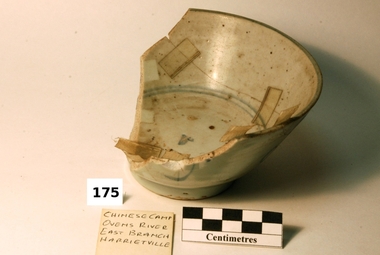
Bowl
... Chinese porcelain food bowl, celadon glaze. Decorations in blue colour on outer surface. ...Part of one of the largest collections of Chinese ware found in the Upper Ovens area and the only one recording the location where found. chinese goldfields gios tableware glaze harrietville celadon handpainted porcelain bowl Blue Chinese writing or maker’s stamp on base. Chinese porcelain food bowl, celadon glaze. Decorations in blue colour on outer surface. ...Brought to the Ovens Goldfields by Chinese men working in the area in the 19th century. Most likely made in China.Aldo Gios recorded the location of where most of the pieces in this collection were found. Some maps drawn by Aldo Gios also give more detail. This detail is rare, as most pieces of broken crockery were discarded and complete items were usually collected with no thought to recording the location they came from. Part of one of the largest collections of Chinese ware found in the Upper Ovens area and the only one recording the location where found.Chinese porcelain food bowl, celadon glaze. Decorations in blue colour on outer surface. Blue lines circling the inside, handpainted.Blue Chinese writing or maker’s stamp on base.chinese, goldfields, gios, tableware, glaze, harrietville, celadon, handpainted, porcelain bowl -
 Kilmore Historical Society
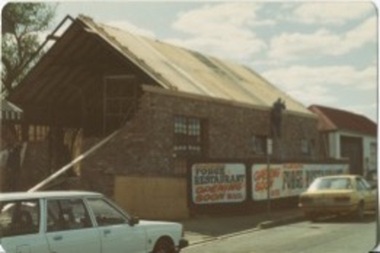
Photograph, 69 Sydney Street, 1982
... Now is the site of the Kilmore Palace Chinese Food....Now is the site of the Kilmore Palace Chinese Food. 69 Sydney Street Photograph Photograph ...13cm x 9cm coloured photograph of the construction site where the old forge was at 69 Sydney Street. The brickwork is almost complete and the so is the roofing. There are fences around the construction site advertising "Forge Restaurant Coming Soon B.Y.O" and "Coming Soon Forge Restaurant B.Y.O". Now is the site of the Kilmore Palace Chinese Food.restaurants, construction sites, construction -
 Bright & District Historical Society operating the Bright Museum
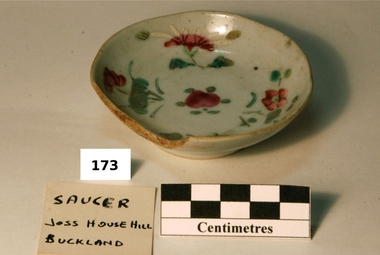
Saucer
... Chinese porcelain food dish, glazed with floral decoration. ...Part of one of the largest collections of Chinese ware found in the Upper Ovens area and the only one recording the location where found. chinese gold floral goldfields gios tableware glaze porcelain dish buckland celadon handpainted Chinese writing or maker’s stamp on base in orange ink / dye. Chinese porcelain food dish, glazed with floral decoration. ...Brought to the Ovens Goldfields by Chinese men working in the area in the 19th century. Most likely made in China.Aldo Gios recorded the location of where most of the pieces in this collection were found. Some maps drawn by Aldo Gios also give more detail. This detail is rare, as most pieces of broken crockery were discarded and complete items were usually collected with no thought to recording the location they came from. Part of one of the largest collections of Chinese ware found in the Upper Ovens area and the only one recording the location where found.Chinese porcelain food dish, glazed with floral decoration. Handpainted on inside surface. Celadon background with floral design in colours, pink, green, white and brown with gold frosting on leaves.Chinese writing or maker’s stamp on base in orange ink / dye.chinese, gold, floral, goldfields, gios, tableware, glaze, porcelain, dish, buckland, celadon, handpainted -
Bright & District Historical Society operating the Bright Museum
Bowl
... Chinese porcelain food bowl, celadon glaze, blue floral design on outer surface. ...porcelain chinese tableware bowl celadon glaze buckland valley goldfields aldo gios "Tick" on bottom of the bowl. Chinese porcelain food bowl, celadon glaze, blue floral design on outer surface. ...Chinese porcelain food bowl, celadon glaze, blue floral design on outer surface. Blue lines around inside of bowl. Eight pieces reassembled. Has a base rim."Tick" on bottom of the bowl.porcelain, chinese, tableware, bowl, celadon, glaze, buckland valley, goldfields, aldo gios -
 Bright & District Historical Society operating the Bright Museum
Bowl
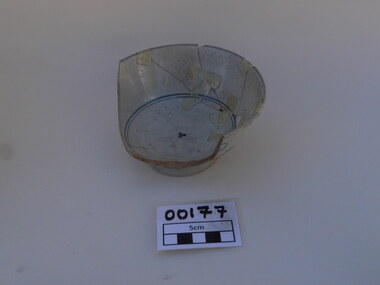
... Chinese porcelain food bowl, glazed. Chinese design on outer surface in blue colour. ...Part of one of the largest collections of Chinese ware found in the Upper Ovens area and the only one recording the location where found. chinese bowl goldfields gios tableware glaze porcelain buckland handpainted Chinese porcelain food bowl, glazed. Chinese design on outer surface in blue colour. ...Brought to the Ovens Goldfields by Chinese men working in the area in the 19th century. Most likely made in China.Aldo Gios recorded the location of where most of the pieces in this collection were found. Some maps drawn by Aldo Gios also give more detail. This detail is rare, as most pieces of broken crockery were discarded and complete items were usually collected with no thought to recording the location they came from. Part of one of the largest collections of Chinese ware found in the Upper Ovens area and the only one recording the location where found.Chinese porcelain food bowl, glazed. Chinese design on outer surface in blue colour. Two blue lines circling inside of bowl. One blue line circling top of rim.chinese, bowl, goldfields, gios, tableware, glaze, porcelain, buckland, handpainted -
 Melbourne Tram Museum
Ephemera - Ticket/s, The Met, Set of five Metcard tickets, featuring Melbourne food, 1999 - 2000
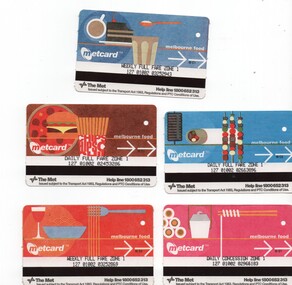
... All used during 2000 unless noted and details of ticket type printed on the front of them. .1 - red colour - takeaway Chinese food - daily concession zone 1 - used 1999 and 2000 - two copies. .2 - red colour - pasta with wine - short trip 10 full fare, 2 hour full fare and weekly full fare - three copies. .3 - blue colour - grilled kebab - daily full fare - 1 copy. .4 - brown colour - chips and hamburgers - daily full fare - 1 copy. .5 - blue colour - coffee and cake - monthly concession, weekly full fare and one without the type allowed for - three copies....All used during 2000 unless noted and details of ticket type printed on the front of them. .1 - red colour - takeaway Chinese food - daily concession zone 1 - used 1999 and 2000 - two copies. .2 - red colour - pasta with wine - short trip 10 full fare, 2 hour full fare and weekly full fare - three copies. .3 - blue colour - grilled kebab - daily full fare - 1 copy. .4 - brown colour - chips and hamburgers - daily full fare - 1 copy. .5 - blue colour - coffee and cake - monthly concession, weekly full fare and one without the type allowed for - three copies. ...Set of five Metcard tickets, featuring Melbourne food. All have the Metcard and The Met logos, with ticket numbers etc. All used during 2000 unless noted and details of ticket type printed on the front of them. .1 - red colour - takeaway Chinese food - daily concession zone 1 - used 1999 and 2000 - two copies. .2 - red colour - pasta with wine - short trip 10 full fare, 2 hour full fare and weekly full fare - three copies. .3 - blue colour - grilled kebab - daily full fare - 1 copy. .4 - brown colour - chips and hamburgers - daily full fare - 1 copy. .5 - blue colour - coffee and cake - monthly concession, weekly full fare and one without the type allowed for - three copies.trams, tramways, tickets, metlink, metcard -
 Ballarat Tramway Museum
Slide - 35mm slide/s, Keith Caldwell, 12/03/1962 12:00:00 AM
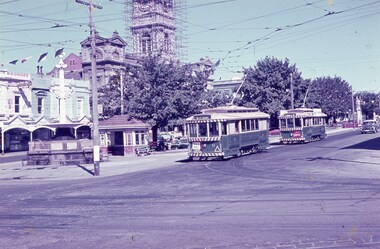
... In the background is the Burke and Wills Fountain, shelter, Golden Star Chinese Cafe, Georges Sea Food shop and the Town Hall with the clock tower having scaffolding around it....In the background is the Burke and Wills Fountain, shelter, Golden Star Chinese Cafe, Georges Sea Food shop and the Town Hall with the clock tower having scaffolding around it. ...Yields information about the nature of tram services at the city terminus at Sturt and Lydiard St and the street scene at the time.Agfa colour slide, white cardboard mount, photo by Keith Caldwell on 12/3/1962 of: Trams 11 and 27 arriving at the "Tramway Centre" the city terminus. Tram 11 has the destination of Mt Pleasant and has a The Age dash canopy advertisement. No. 27 showing Victoria St and has a Briquettes dash panel advertisement. In the background is the Burke and Wills Fountain, shelter, Golden Star Chinese Cafe, Georges Sea Food shop and the Town Hall with the clock tower having scaffolding around it.In ink "Ballarat 12.3.62"tramways, trams, shelters, sturt st, lydiard st north, fountains, tram 11, tram 27 -
 Flagstaff Hill Maritime Museum and Village
Furniture - Table
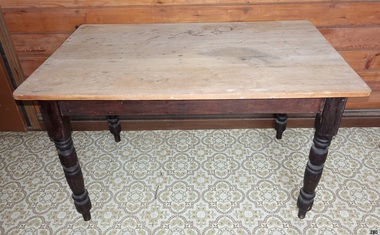
... Food and drinks were usually put on large plates deposed on a pedestal for eating. The Egyptians made use of various small tables and elevated playing boards. The Chinese...Food and drinks were usually put on large plates deposed on a pedestal for eating. The Egyptians made use of various small tables and elevated playing boards. The Chinese ...Some very early tables were made and used by the Ancient Egyptians around 2500 BC, using wood and alabaster. They were often little more than stone platforms used to keep objects off the floor, though a few examples of wooden tables have been found in tombs. Food and drinks were usually put on large plates deposed on a pedestal for eating. The Egyptians made use of various small tables and elevated playing boards. The Chinese also created very early tables in order to pursue the arts of writing and painting, as did people in Mesopotamia, where various metals were used. The Greeks and Romans made more frequent use of tables, notably for eating, although Greek tables were pushed under a bed after use. The Greeks invented a piece of furniture very similar to the guéridon. Tables were made of marble or wood and metal (typically bronze or silver alloys), sometimes with richly ornate legs. Later, the larger rectangular tables were made of separate platforms and pillars. The Romans also introduced a large, semicircular table to Italy, the mensa lunata. Plutarch mentions use of "tables" by Persians. Furniture during the Middle Ages is not as well known as that of earlier or later periods, and most sources show the types used by the nobility. In the Eastern Roman Empire, tables were made of metal or wood, usually with four feet and frequently linked by x-shaped stretchers. Tables for eating were large and often round or semicircular. A combination of a small round table and a lectern seemed very popular as a writing table. In western Europe, the invasions and internecine wars caused most of the knowledge inherited from the classical era to be lost. As a result of the necessary movability, most tables were simple trestle tables, although small round tables made from joinery reappeared during the 15th century and onward. In the Gothic era, the chest became widespread and was often used as a table. Refectory tables first appeared at least as early as the 17th century, as an advancement of the trestle table; these tables were typically quite long and wide and capable of supporting a sizeable banquet in the great hall or other reception room of a castle. https://en.wikipedia.org/wiki/Table_(furniture)The table is one of the most important items of furniture used in the home, including the kitchen.Table wooden with 4 wooden turned legs and unvarnished raw wood topNone flagstaff hill, warrnambool, shipwrecked-coast, flagstaff-hill, flagstaff-hill-maritime-museum, maritime-museum, shipwreck-coast, flagstaff-hill-maritime-village, table, kitchen furniture -
 Flagstaff Hill Maritime Museum and Village
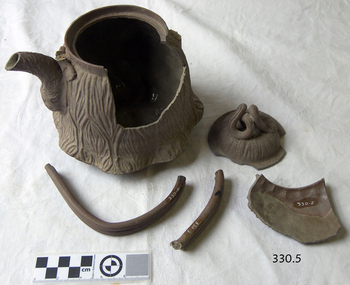
Domestic object - Teapot, 1857
... Flagstaff Hill Flagstaff Hill Maritime Museum and Village Warrnambool Maritime Museum Maritime Village Great Ocean Road Shipwreck Coast teapot Chinese teapot clay teapot handmade teapot food and beverage tea On lid "L26" Chinese teapot, brown clay, with vertical wavey line design. ...This is a mid-19th century handmade Chinese clay teapot. It has a pattern around the body and interesting tubular handle and knob. This teapot is significant as an example of an item from the mid-19th century. It is also significant as the only example of a Chinese teapot in Flagstaff Hill Maritime Museum and Village's collection.Chinese teapot, brown clay, with vertical wavey line design. The spout is gracefully curved. The lid has decorative tubes as a handle. The handle, now dethatched, is also a tube shape. It is dated 1857. The inside is partially glazed. There is an inscription on the lid. The pot is broken and in five pieces.On lid "L26"flagstaff hill, flagstaff hill maritime museum and village, warrnambool, maritime museum, maritime village, great ocean road, shipwreck coast, teapot, chinese teapot, clay teapot, handmade teapot, food and beverage, tea -
 Flagstaff Hill Maritime Museum and Village
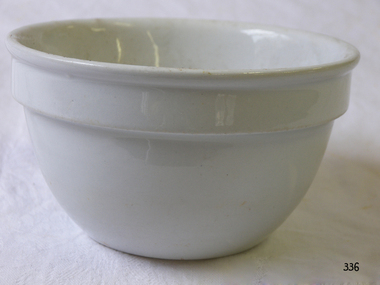
Domestic object - Bowl, J & G Meakin, Late 19th or early 20th Century
... Flagstaff Hill Flagstaff Hill Maritime Museum and Village Warrnambool Maritime Museum Maritime Village Great Ocean Road Shipwreck Coast mixing bowl food preparation J & G Meakin pottery Stoke-on-Trent kitchen equipment Ceramic On base, 'Ironstone China Reg SOL 391413' with symbol Bowl; white ceramic, round and tapering inwards towards base. ...The Process of Making Pottery Decorating, Firing, Glazing, Making, Technical There is a rhythm and flow to clay. It can’t be done all at once! Even the making process! It can take weeks to get everything done, especially if you can only work on your pottery once a week! Even though we have three hour classes, it’s often just not enough time! Here is an overview of some of the processes so you have a bit more grasp on some of the technical stuff! Step One – Design There are SO many ideas out there for making stuff in clay! From delicate porcelain jewellery, through to heavy sculptural work and everything in between. Deciding your direction is sometimes not that easy – when you first start, try everything, you will naturally gravitate to the style that you enjoy! The options and variations are endless and can get a wee bit overwhelming too! Check in with me before you start to ensure your ideas will work, what order you might do things, how you could achieve the look you are seeking and any other technical data required! Step Two – Making Clay is thixotropic. This means that as you work with it, the clay first gets sloppier and wetter, before is begins to dry in the atmosphere. For most things, you simply can’t do all parts of the project at once. An example of work order might look like: Get last weeks work out from the shelves Prepare clay for today’s work – roll your clay, prepare balls for throwing, make the first stage of a pinch pot) Clean up last week’s work and put it on the shelf for bisque firing Check that you have any glazing to do – and do enough of it that you will have time to finish your main project Do the next step of your next project – there might be a further step that can’t be complete immediately, in that case, wrap your work well and put onto the shelves. Letting your work rest for a while can really help keep your work clean and professional looking. Many things require bagging under plastic to keep it ready for work the next week – put your name on the outside of the bag so you can find your work easily. We have stickers and markers. Consider how you want to decorate your work – coloured slip can be applied at a fairly wet stage (remembering that it will make your work even wetter!). Trying to apply slip to dry clay won’t work! If you want to do sgraffito – you will need to keep the work leather hard (a state of dryness where you can still work the clay with a little effort and a little water and care). Step Three – Drying Most of the time your work can go into the rack uncovered to let it dry out for the following week. If you want to continue forming or shaping you will need to double bag your work – put your work on a suitable sized bat and put the bat in a bag so the base of the bag is under the bat, then put another bag over the top of the work and tuck the top of the bag under the bat. If you want to trim (or turn) your thrown work the following week, it should also be double bagged. If your work is large, delicate, or of uneven thicknesses, you should lightly cover your work for drying. When considering the drying process, bare in mind the weather, humidity and wind! The hotter and dryer, the faster things dry and work can dry unevenly in the shelves – this can lead to cracking – another time to lightly cover your work for drying. Step Four – Trimming and Cleaning Up Your work is dry! It is called greenware now and it is at it’s most fragile! Handle everything with two hands. I often refer to soft hands – keep everything gentle and with your fingers spread as much as possible. Try to not pick up things like plates too much, and always with both hands! Before your work can be bisque fired it should be “cleaned up”. You work won’t go into the kiln if it has sharp edges – when glazed, sharp edges turn into razor blades! Use a piece of fly wire to rub the work all over – this will scratch a little so be light handed. Use a knife or metal kidney to scrape any areas that require a bit more dynamic treatment than the fly wire offers! Finally, a very light wipe over with a slightly damp sponge can help soften and soothe all of your edges and dags! Trimming thrown work: If you are planning to trim (or turn) your thrown work (and you should be), make sure you bag it well – your work should be leather hard to almost dry for easiest trimming. Use this step to finish the work completely – use a metal kidney to polish the surface, or a slightly damp sponge to give a freshly thrown look. Wipe the sponge around the rim after trimming, and check the inside of the pot for dags! Trimming slip cast work: Usually I will trim the rims of your work on the wheel the following day to make that stage easier, however you will still need to check your work for lumps and bumps. Last but not least – check that your name is still clearly on the bottom of your work. Step Five – Bisque Firing When the work is completely dry it can go into the bisque kiln. The bisque kiln is fired to 1000°C. This process burns off the water in the clay as well as some of the chemically bound water. The structure of the clay is not altered that much at this temperature. Inside the bisque kiln, the work is stacked a little, small bowl inside a larger bowl and onto a heavy plate. Smaller items like decorations or drink coasters might get stacked several high. Consideration is paid to the weight of the stack and shape of the work. A bisque kiln can fire about one and a half times the amount of work that the glaze kiln can fire. The firing takes about 10 hours to complete the cycle and about two days to cool down. Once it has been emptied the work is placed in the glaze room ready for you to decorate! Step Six – Glazing Decorating your work with colour can be a lot of fun – and time consuming! There are three main options for surface treatment at this stage: Oxide Washes Underglazes Glazes Washes and underglazes do not “glaze” the work – It will still need a layer of glaze to fully seal the clay (washes don’t need glaze on surfaces not designed for food or liquid as they can gloss up a little on their own). Underglazes are stable colourants that turn out pretty much how they look in the jar. They can be mixed with each other to form other colours and can be used like water colours to paint onto your work. Mostly they should have a clear glaze on top to seal them. Oxides are a different species – the pink oxide (cobalt) wash turns out bright blue for instance. They don’t always need a glaze on top, and some glazes can change the colour of the wash! The glazes need no other “glaze” on top! Be careful of unknown glaze interactions – you can put any combination of glaze in a bowl or on a plate, but only a single glaze on the outside of any vertical surface! Glazes are a chemical reaction under heat. We don’t know the exact chemicals in the Mayco glazes we use. I can guess by the way they interact with each other, however, on the whole, you need to test every idea you have, and not run the test on a vertical surface! Simply put, glaze is a layer of glass like substance that bonds with the clay underneath. Clay is made of silica, alumina and water. Glaze is made of mostly silica. Silica has a melting point of 1700°C and we fire to 1240°C. The silica requires a “flux” to help it melt at the lower temperature. Fluxes can be all sorts of chemicals – a common one is calcium – calcium has a melting point of 2500°C, however, together they both melt at a much lower temperature! Colourants are metal oxides like cobalt (blue), chrome (green through black), copper (green, blue, even red!), manganese (black, purple and pink) iron (red brown), etc. Different chemicals in the glaze can have dramatic effects. for example, barium carbonate (which we don’t use) turns manganese bright pink! Other elements can turn manganese dioxide brown, blue, purple and reddish brown. Manganese dioxide is a flux in and of itself as well. So, glazes that get their black and purple colours, often interact with other glazes and RUN! Our mirror black is a good example – it mixes really well with many glazes because it fluxes them – causes them to melt faster. It will also bring out many beautiful colours in the glazes because it’s black colouring most definitely comes from manganese dioxide! Glaze chemistry is a whole subject on it’s own! We use commercial Mayco glazes on purpose – for their huge range of colour possibilities, stability, cool interactions, artistic freedom with the ability to easily brush the glazes on and ease of use. We currently have almost 50 glazes on hand! A major project is to test the interactions of all glazes with each other. That is 2,500 test tiles!!!! I’m going to make the wall behind the wheels the feature wall of pretty colours! Step Seven – Glaze (Gloss or sometimes called “Glost”) Firing Most of the time this is the final stage of making your creation (but not always!) The glaze kiln goes to 1240°C. This is called cone 6, or midrange. It is the low end of stoneware temperatures. Stoneware clays and glazes are typically fired at cone 8 – 10, that is 1260 – 1290°C. The energy requirement to go from 1240°C to 1280°C is almost a 30% more! Our clay is formulated to vitrify (mature, turn “glass-like”) at 1240°, as are our glazes. A glaze kiln take around 12 hours to reach temperature and two to three days to cool down. Sometimes a third firing process is required – this is for decoration that is added to work after the glaze firing. For example – adding precious metals and lustres. this firing temperature is usually around 600 – 800°C depending upon the techniques being used. There are many students interested in gold and silver trims – we will be doing this third type of firing soon! After firing your work will be in the student finished work shelves. Remember to pay for it before you head out the door! There is a small extra charge for using porcelain clay (it’s more than twice the price of regular clay), and for any third firing process! Once your work has been fired it can not turn back into clay for millennia – so don’t fire it if you don’t like it! Put it in the bucket for recycling. https://firebirdstudios.com.au/the-process-of-making-pottery/This bowl was made by renowned pottery company J & G Meakin of England. The firm was established in the mid-1800's. The bowl is an example of kitchenware used in the 19th century and still in use today.Bowl; white ceramic, round and tapering inwards towards base. Made by J and G Meakin England.On base, 'Ironstone China Reg SOL 391413' with symbolflagstaff hill, flagstaff hill maritime museum and village, warrnambool, maritime museum, maritime village, great ocean road, shipwreck coast, mixing bowl, food preparation, j & g meakin, pottery, stoke-on-trent, kitchen equipment, ceramic -
 Flagstaff Hill Maritime Museum and Village
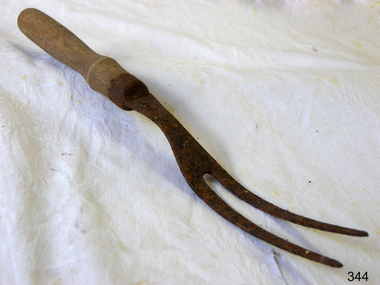
Domestic object - Fork
... Source: Wikipedia/Public Domain Some of the earliest known uses of forks with food occurred in Ancient Egypt, where large forks were used as cooking utensils. Bone forks had been found on the burial site of the Bronze Age Qijia culture (2400–1900 BC) as well as later Chinese dynasties’ tombs.The Ancient Greeks used the fork as a serving utensil. ...Source: Wikipedia/Public Domain Some of the earliest known uses of forks with food occurred in Ancient Egypt, where large forks were used as cooking utensils. Bone forks had been found on the burial site of the Bronze Age Qijia culture (2400–1900 BC) as well as later Chinese dynasties’ tombs.The Ancient Greeks used the fork as a serving utensil. ...Naturally, we tend to take commonplace objects for granted, because they have always been there. Yet how many of you actually have thought “hey, where do forks come from?” Well, it takes one trip to China and a 3-year-old laughing at your face because of your desperate attempt to eat with chopsticks to finally appreciate something so ordinary such as a fork. So, where do forks come from? The early history of the fork is obscure. As a kitchen and dining utensil, it is believed to have originated in the Roman Empire, as proved by archaeological evidence. The personal table fork most likely originated in the Eastern Roman (or Byzantine) Empire. Its use spread to what is now the Middle East during the first millennium AD and then spread into Southern Europe during the second millennium. It did not become common in northern Europe until the 18th century and was not common in North America until the 19th century. Carving fork from 1640. Source: Wikipedia/Public Domain Carving Fork from 1640. Source: Wikipedia/Public Domain Some of the earliest known uses of forks with food occurred in Ancient Egypt, where large forks were used as cooking utensils. Bone forks had been found on the burial site of the Bronze Age Qijia culture (2400–1900 BC) as well as later Chinese dynasties’ tombs.The Ancient Greeks used the fork as a serving utensil. Read also: Steven Spielberg to Remake the Classic Musical ‘West Side Story’ In the Roman Empire, bronze and silver forks were used. The use varied according to local customs, social class and the nature of food, but forks of the earlier periods were mostly used as cooking and serving utensils. The personal table fork was most likely invented in the Eastern Roman (Byzantine) Empire, where they were in everyday use by the 4th century (its origin may even go back to Ancient Greece, before the Roman period). Records show that by the 9th century a similar utensil known as a barjyn was in limited use in Persia within some elite circles. By the 10th century, the table fork was in common use throughout the Middle East. Bronze forks made in Persia during the 8th or 9th century.Source: Wikipedia/Public Domain Bronze forks made in Persia during the 8th or 9th century.Source: Wikipedia/Public Domain The first recorded introduction of the fork to Western Europe, as recorded by the theologian and Cardinal Peter Damian, was by Theophano Sklereina the Byzantine wife of Holy Roman Emperor Otto II, who nonchalantly wielded one at an Imperial banquet in 972, astonishing her Western hosts.By the 11th century, the table fork had become increasingly prevalent in the Italian peninsula. It gained a following in Italy before any other Western European region because of historical ties with Byzantium and continued to get popularity due to the increasing presence of pasta in the Italian diet. At first, pasta was consumed using a long wooden spike, but this eventually evolved into three spikes, design better suited to gathering the noodles. In Italy, it became commonplace by the 14th century and was almost universally used by the merchant and upper classes by 1600. It was proper for a guest to arrive with his fork and spoon enclosed in a box called a cadena; this usage was introduced to the French court with Catherine de’ Medici’s entourage. In Portugal, forks were first used at the time of Infanta Beatrice, Duchess of Viseu, King Manuel I of Portugal’s mother around 1450. However, forks were not commonly used in Western Europe until the 16th century when they became part of Italian etiquette. The utensil had also gained some currency in Spain by this time, and its use gradually spread to France. Nevertheless, most of Europe did not adopt the use of the fork until the 18th century. Read also: The 8 Most Famous ‘Functioning Alcoholics’ in History Long after the personal table fork had become commonplace in France, at the supper celebrating the marriage of the Duc de Chartres to Louis XIV’s natural daughter in 1692, the seating was described in the court memoirs of Saint-Simon: “King James having his Queen on his right hand and the King on his left, and each with their cadenas.” In Perrault’s contemporaneous fairy tale of La Belle au bois dormant (1697), each of the fairies invited for the christening is presented with a splendid “fork holder”. The fork’s adoption in northern Europe was slower. Its use was first described in English by Thomas Coryat in a volume of writings on his Italian travels (1611), but for many years it was viewed as an unmanly Italian affectation. Some writers of the Roman Catholic Church expressly disapproved of its use, St. Peter Damian seeing it as “excessive delicacy.” It was not until the 18th century that the fork became commonly used in Great Britain, although some sources say that forks were common in France, England, and Sweden already by the early 17th century. Spaghetti fork By Lady alys - Own work, CC BY-SA 3.0, https://commons.wikimedia.org/w/index.php?curid=6414948 Spaghetti Fork By Lady alys – Own work, CC BY-SA 3.0, The fork did not become popular in North America until near the time of the American Revolution. The curved fork used in most parts of the world today was developed in Germany in the mid 18th century while the standard four-tine design became current in the early 19th century. The fork was important in Germany because they believed that eating with the fingers was rude and disrespectful. The fork led to family dinners and sit-down meals, which are important features of German culture. https://www.thevintagenews.com/2016/08/31/priority-fork-came-italy-european-country-pasta/?chrome=1Serving fork, two prongs, with a shaped wooden handle. Badly rusted.None.flagstaff hill, warrnambool, shipwrecked-coast, flagstaff-hill, flagstaff-hill-maritime-museum, maritime-museum, shipwreck-coast, flagstaff-hill-maritime-village, food, meat, carving -
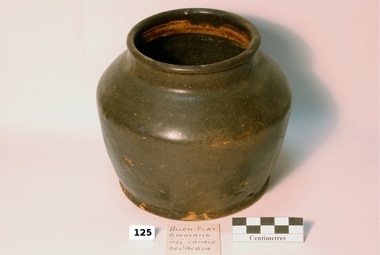 Bright & District Historical Society operating the Bright Museum
Jar
... This object is part of one of the largest collections of Chinese ware found in the Upper Ovens area and the only one recording the location where found. chinese jar glaze stoneware Squat, shouldered, food jar. Dark brown Jar ...Brought to the Ovens Goldfields by Chinese men working in the area in the 19th century. Most likely made in China.Aldo Gios recorded the location of where most pieces in his collection were found. Some maps drawn by Aldo Gios, also give more detail. This detail is rare as most pieces of broken crockery were discarded and complete items were usually collected with no thought to recording the location where they were found. This object is part of one of the largest collections of Chinese ware found in the Upper Ovens area and the only one recording the location where found.Squat, shouldered, food jar. Dark brownchinese, jar, glaze, stoneware -
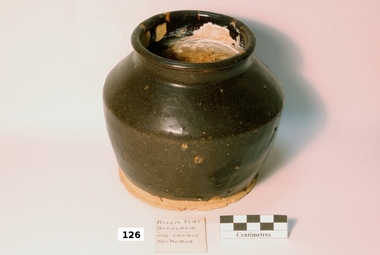 Bright & District Historical Society operating the Bright Museum
Jar
... This object is part of one of the largest collections of Chinese ware found in the Upper Ovens area and the only one recording the location where found. chinese jar glaze stoneware Squat, shouldered, food jar. Dark brown Jar ...Brought to the Ovens Goldfields by Chinese men working in the area in the 19th century. Most likely made in China.Aldo Gios recorded the location of where most pieces in his collection were found. Some maps drawn by Aldo Gios, also give more detail. This detail is rare as most pieces of broken crockery were discarded and complete items were usually collected with no thought to recording the location where they were found. This object is part of one of the largest collections of Chinese ware found in the Upper Ovens area and the only one recording the location where found.Squat, shouldered, food jar. Dark brownchinese, jar, glaze, stoneware -
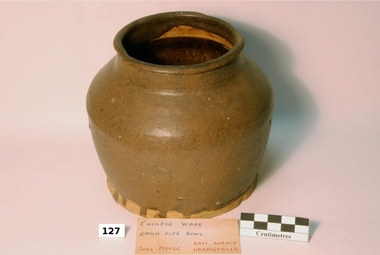 Bright & District Historical Society operating the Bright Museum
Jar
... This object is part of one of the largest collections of Chinese ware found in the Upper Ovens area and the only one recording the location where found. chinese jar glaze stoneware Squat, shouldered, food jar. Light brown Jar ...Brought to the Ovens Goldfields by Chinese men working in the area in the 19th century. Most likely made in China.Aldo Gios recorded the location of where most pieces in his collection were found. Some maps drawn by Aldo Gios, also give more detail. This detail is rare as most pieces of broken crockery were discarded and complete items were usually collected with no thought to recording the location where they were found. This object is part of one of the largest collections of Chinese ware found in the Upper Ovens area and the only one recording the location where found.Squat, shouldered, food jar. Light brownchinese, jar, glaze, stoneware -
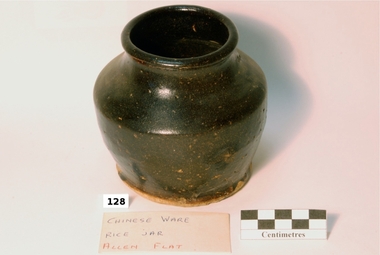 Bright & District Historical Society operating the Bright Museum
Jar
... This object is part of one of the largest collections of Chinese ware found in the Upper Ovens area and the only one recording the location where found. chinese jar glaze stoneware Squat, shouldered, food jar. Dark brown Jar ...Brought to the Ovens Goldfields by Chinese men working in the area in the 19th century. Most likely made in China.Aldo Gios recorded the location of where most pieces in his collection were found. Some maps drawn by Aldo Gios, also give more detail. This detail is rare as most pieces of broken crockery were discarded and complete items were usually collected with no thought to recording the location where they were found. This object is part of one of the largest collections of Chinese ware found in the Upper Ovens area and the only one recording the location where found.Squat, shouldered, food jar. Dark brownchinese, jar, glaze, stoneware -
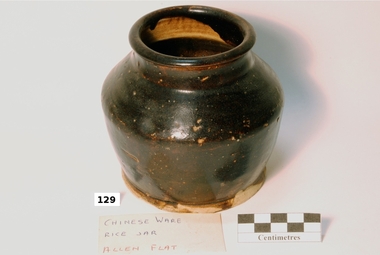 Bright & District Historical Society operating the Bright Museum
Jar
... This object is part of one of the largest collections of Chinese ware found in the Upper Ovens area and the only one recording the location where found. chinese jar glaze stoneware Squat, shouldered, food jar. Dark brown Jar ...Brought to the Ovens Goldfields by Chinese men working in the area in the 19th century. Most likely made in China.Aldo Gios recorded the location of where most pieces in his collection were found. Some maps drawn by Aldo Gios, also give more detail. This detail is rare as most pieces of broken crockery were discarded and complete items were usually collected with no thought to recording the location where they were found. This object is part of one of the largest collections of Chinese ware found in the Upper Ovens area and the only one recording the location where found.Squat, shouldered, food jar. Dark brownchinese, jar, glaze, stoneware -
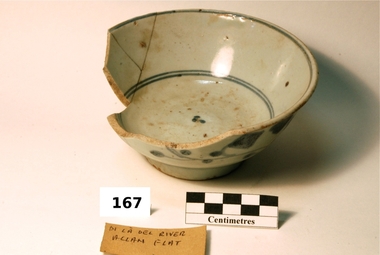 Bright & District Historical Society operating the Bright Museum
Bowl
... Porcelain food bowl, celadon glaze, Chinese. Blue floral design on outer surface, blue lines inside....Part of one of the largest collections of Chinese ware found in the Upper Ovens area and the only one recording the location where found. chinese bowl goldfields gios tableware glaze porcelain buckland celadon Porcelain food bowl, celadon glaze, Chinese. ...Brought to the Ovens Goldfields by Chinese men working in the area in the 19th century. Most likely made in China.Aldo Gios recorded the location of where most of the pieces in this collection were found. Some maps drawn by Aldo Gios also give more detail. This detail is rare, as most pieces of broken crockery were discarded and complete items were usually collected with no thought to recording the location they came from. Part of one of the largest collections of Chinese ware found in the Upper Ovens area and the only one recording the location where found.Porcelain food bowl, celadon glaze, Chinese. Blue floral design on outer surface, blue lines inside.chinese, bowl, goldfields, gios, tableware, glaze, porcelain, buckland, celadon
