
Showing 4 items matching "chinese naval service"
-
 Flagstaff Hill Maritime Museum and Village
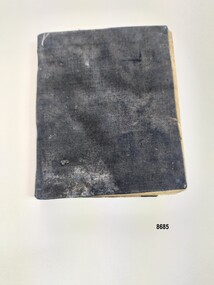
Book - Mariner's Pocket Book, Captain John Budge Murray, circa 1881 - 1887
... ...Chinese Naval Service...During the course of his career, he was a merchant marine employed by the Peninsula and Oriental Steam Navigation Company (better known as P&O) and also became a master mariner and Captain serving in the Chinese Naval Service. When he married in 1888, his marriage certificate listed his occupation as "Captain in the Chinese Naval Service". ...During the course of his career, he was a merchant marine employed by the Peninsula and Oriental Steam Navigation Company (better known as P&O) and also became a master mariner and Captain serving in the Chinese Naval Service. When he married in 1888, his marriage certificate listed his occupation as "Captain in the Chinese Naval Service". ...This is a small pocketbook owned by Master Mariner John Budge Murray. It is 119 pages long and contains a mix of detailed navigational calculations and lessons, diary entries, drill commands for soldiers "On Parade" and personal jottings. The dates in the notebook span the years from 1881 to 1887 and mention trips from Hong Kong to Singapore, Galle, Colombo, the Suez Canal, Aden, Port Said, Malta, Gibraltar and London. Two of the ships mentioned include the S. S. Bangalore and the S. S. Assam - both belonged to the "Peninsula and Oriental Steam Navigation Company" (later known as the P&O Line). John Budge Murray was born in 1847 at Olrig, Caithness in Scotland. During the course of his career, he was a merchant marine employed by the Peninsula and Oriental Steam Navigation Company (better known as P&O) and also became a master mariner and Captain serving in the Chinese Naval Service. When he married in 1888, his marriage certificate listed his occupation as "Captain in the Chinese Naval Service". Family records show his sister describing him as "commanding three frigates in the South China Sea - allegedly chasing pirates!" His obituary in the "John O'Groat Journal" in 1910 said he was "one of the original contingent of Britons who served as officers in the Chinese Fleet ...it was they who cleared the Chinese seas of the pirates who infected them." It went on to say "Captain Murray was brave even to the most reckless exposure of his life and ... the Chinese crews had explicit faith in him." John Murray and his wife Jessie had four children and by 1901 were living on a farm at Aucorn in Caithness. One of his sons (also called John Budge Murray) immigrated to Australia and joined the 8th Battalion, AIF (Australia Imperial Force) in 1915 and was killed in France in August 1918. Captain Murray died at Olrig in 1910. In 1840 the Peninsula Steam Navigation Company won a contract for the mail service between the U.K. and Egypt. They expanded their operations to include mail contracts to Alexandria, from Suez to Ceylon, Madras and Calcutta and in 1845 further expanded their operations to Shanghai. Steam communication with Australia was inaugurated in 1852 and in 1854 the Bombay Mail Service passed from the East India Company to P&O. By 1884 P&O's fleet contained fifty ships including the S.S. Assam and S.S. Bangalore - both are mentioned in Captain Murray's pocketbook. In 1882 the S.S. Bangalore was operating in the Bombay / Far East mail service and had made several trips in 1876 between Bombay and Melbourne. In 1875, the Qing Dynasty began to establish a modern Imperial Navy. They ordered a series of warships from Britain and Germany. Two of these ships (the Chaoyong and the Yangwoi) were built at the Tyne shipyards and sailed to China in 1881. They also needed to improve the skills of their naval personnel, and some skilled officers were recruited from Britain. This pocketbook is a significant example of a Master Mariner's everyday working pocketbook. It is also an important object as it belonged to a Scottish Master Mariner who held the unusual position as an officer in the Chinese Naval Fleet.A Master Mariner's small pocket-sized notebook. It has a black cover, 119 pages and contains a mix of navigational records, personal addresses, diary type entries and personal jottings in ink and pencil.First page - "John Budge Murray/Aucorn /Bower/ J. B. Murray/John B/ John B Murray/ Aucorn"flagstaff hill maritime museum and village, great ocean road, captain john budge murray, captain murray, master mariner, navigational calculations, ships log, pocketbook, peninsula and oriental steam navigation company, p&o, s.s. bangalore, s.s. assam, drill commands, chinese naval service, qing dynasty, south china sea -
 Bendigo Military Museum
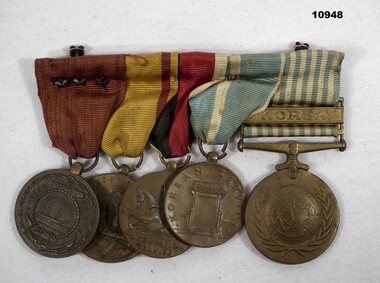
Award - MEDAL SET, KOREA, Unknown
... Navy good conduct - awarded for 3 years consecutive service in the Navy plus a star for each additional 3 years. 2. China Service Medal for Naval & Coastguard who served in Chinese Waters prior & Post WW2 up to 1957. 3. ...Navy good conduct - awarded for 3 years consecutive service in the Navy plus a star for each additional 3 years. 2. China Service Medal for Naval & Coastguard who served in Chinese Waters prior & Post WW2 up to 1957. 3. ...1. Navy good conduct - awarded for 3 years consecutive service in the Navy plus a star for each additional 3 years. 2. China Service Medal for Naval & Coastguard who served in Chinese Waters prior & Post WW2 up to 1957. 3. Occupation medal - awarded for Post WW2 Occupation in specific regions. 4. US Korea Service - for personnel who served in Korean War from 27Jun 1950 to 27 July 1954. 5. UN Medal - Korea - with bar - International Military Decoration who served with Multi-National Defence Forces in Korean War.Set of 5 medals all mounted with ribbons. 1. Navy Good conduct with 3 re-enlistment stars. 2. China Service Medal - Navy. 3. Occupation Medal. 4. US Korea Service with one battle star. 5. UN Medal with bar - Korea. No name inscriptions.ron mills collection, medals, korea -
 Bendigo Military Museum
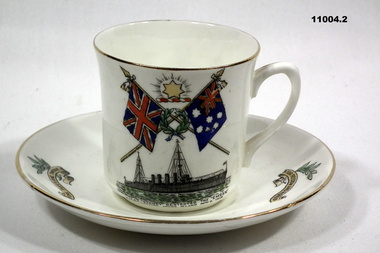
Souvenir - CUP & SAUCER
... service listed as New Guinea 30.7.1943 - 5.4.1944, 5.11.1944 - 8.10.1945. Discharged 4/2/1946 with the Rank of Captain in 2/14th Australian Infantry Battalion. Collections Bone China 1. & 2. Manufacturer's stamp on base of cup and saucer - green ibnk "RADFORDS/ KINGS CROWN SYMBOL/ CROWN CHINA/ ENGLAND". 1. 2. Cup with handle and saucer made from bone china, white coloured with coloured transfers applied. Gold coloured rim on cup and saucer. 1. Cup - transfers - Crossed flags with star and laurel wreath above a naval ...Cup and saucer owned by - JACK ADAMS FINLAY Chaplain VX133078. (Born Wandong, Victoria, enlisted Puckapunyal) initially in the CMF No V146772 on 11.2.1942, transfer to the AIF No VX133018 on 19/12/1942. Overseas service listed as New Guinea 30.7.1943 - 5.4.1944, 5.11.1944 - 8.10.1945. Discharged 4/2/1946 with the Rank of Captain in 2/14th Australian Infantry Battalion.1. 2. Cup with handle and saucer made from bone china, white coloured with coloured transfers applied. Gold coloured rim on cup and saucer. 1. Cup - transfers - Crossed flags with star and laurel wreath above a naval ship. Wording below "H.M.A.S. SYDNEY DESTROYED THE EMDEN/ AT KEELING COCOS ISLAND NO. 9. 1914". Reverse side - COAT OF ARMS of AUSTRALIA with Kangaroo, shield and emu. Wording below 'ADVANCE AUSTRALIA/ COMMOBNWEALTH OF AUSTRALIA" 2. Saucer - four transfers - 1. Crossed flags with star and laurel wreath, 2. Naval ship (description as above). 3. Banner with words "FOR FREEDOM AND HONOUR". 4. Banner with words "ONE FLEET, ONE THRONE".1. & 2. Manufacturer's stamp on base of cup and saucer - green ibnk "RADFORDS/ KINGS CROWN SYMBOL/ CROWN CHINA/ ENGLAND".collections, bone china -
 Dandenong/Cranbourne RSL Sub Branch
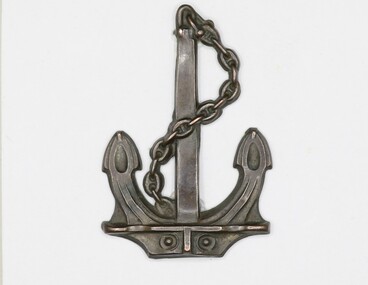
Badge - RAN Bridging Train Collar Badge, Circa 1914/15
... Naval Reserve for whom there were no available billets in seagoing RAN ships. Many of the sailors serving in the 1st RANBT were rated ‘drivers’, and again, this refers to wagon drivers as opposed to motor vehicle drivers. Other seamen were rated as ‘artificers’ or ‘sappers’, the latter being a military term traditionally used to describe army engineers. Appointed in command of the 1st RANBT was Lieutenant Commander Leighton Seymour Bracegirdle, RAN. Bracegirdle was ideally suited to command the unit, having seen active service with the NSW Naval Brigade during the Boxer Rebellion in China ...The 1st Royal Australian Naval Bridging Train (1st RANBT) was formed in Melbourne on 28 February 1915 and was intended to be a horse drawn engineering unit attached to the Royal Naval Division (RND), then serving as infantry on the Western Front. The term ‘train’, in its title, was a direct reference to the horse drawn wagons that would, in theory, form and move ‘in train’ to carry the unit’s heavy lumber, building materials and engineering equipment to the front. The unit was manned by members of the Royal Australian Naval Reserve for whom there were no available billets in seagoing RAN ships. Many of the sailors serving in the 1st RANBT were rated ‘drivers’, and again, this refers to wagon drivers as opposed to motor vehicle drivers. Other seamen were rated as ‘artificers’ or ‘sappers’, the latter being a military term traditionally used to describe army engineers. Appointed in command of the 1st RANBT was Lieutenant Commander Leighton Seymour Bracegirdle, RAN. Bracegirdle was ideally suited to command the unit, having seen active service with the NSW Naval Brigade during the Boxer Rebellion in China as well as serving as a military officer in the South African Irregular Horse during the Boer War in 1901. He had also recently returned from German New Guinea where he had served as a staff officer in the joint Australian Naval and Military Expeditionary Force (ANMEF) responsible for the capture of the German colonies in the Pacific in September 1914. Three hundred naval reservists, including 50 men who had recently served in New Guinea, were selected for the 1st RANBT and they began their training in horsemanship, engineering and pontoon bridging at the Domain in Melbourne. By late May 1915 a decision was made to send the unit to Britain to complete its training and then to join the RND on the Western Front. The plan, however, never eventuated. The complaints about the non-combatant work being done by the men had been raised in Federal Parliament and following consultation with the senior Australian officer in the Middle East, Lieutenant General Sir Harry Chauvel, a recommendation was made that the unit be disbanded and its men used as reinforcements for the AIF. Consequently, Lieutenant Commander Bracegirdle was advised that his unit was to be dispersed; its men transferring to the AIF or being returned to Australia for discharge. On 27 March 1917 the 1st RANBT was officially disbanded.Oxidised brass anchor shaped collar badge.ww1, world war 1, first world war, ranbt, ran bridging train, royal australian navy bridging train, collar badge
