
Showing 6 items matching "chinese restriction act"
-
 Bendigo Historical Society Inc.
Document - Bendigo Chinese Presentation - Author unknown, abt 1990s
... ...chinese restriction act...An A4 sheet with details of the Chinese community in Bendigo; details of the 1855 Victorian Government Chinese Restriction Act - Source: Australian Law through 200 years - Vijaya Nagarajan 1989. ...Both Loong and Sun Loong are on permanent display at the Golden Dragon Museum in Bendigo. history bendigo chinese sun loong chinese restriction act Bendigo Chinese Presentation - Author unknown. ...Sun Loong (simplified Chinese: traditional Chinese:) derived from the Cantonese pronunciation of "New Dragon", is an imperial parade dragon that was used in the Bendigo Easter parade from 1970 through 2019. It was believed to be the longest imperial parade dragon in the world, measuring approximately 100 metres (330 ft) long. Sun Loong was used in the traditional Chinese dragon dance and superseded Bendigo's earlier Loong in 1970; Loong is heritage listed as it is believed to be the oldest complete imperial parade dragon in the world. On 21 April 2019, a new dragon named Dai Gum Loong made its debut at the Bendigo parade and took over the title of longest dragon at 125 m (410 ft). Both Loong and Sun Loong are on permanent display at the Golden Dragon Museum in Bendigo.Bendigo Chinese Presentation - Author unknown. An A4 sheet with details of the Chinese community in Bendigo; details of the 1855 Victorian Government Chinese Restriction Act - Source: Australian Law through 200 years - Vijaya Nagarajan 1989. Also a photo clipping of the Chinese Dragon Sun Loong with the curator of the Bendigo Chinese Museum, Ralph Beh.history, bendigo, chinese, sun loong, chinese restriction act -
 Bendigo Historical Society Inc.
Slide - DIGGERS & MINING. THE CHINESE ON THE GOLD FIELDS, c1850s
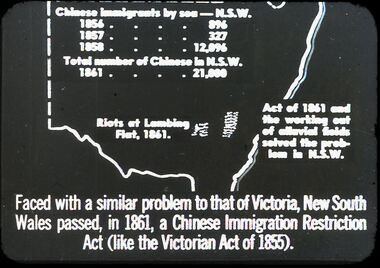
... Chinese in N.S.W. 1861 - 21,000. Riots of Lambing Flat, 1861. Act of 1861 the working out of alluvial fields solved the problem in N.S.W. Faced with a similar problem to that of Victoria, New South Wales passed, in 1861, a Chinese Immigration Restriction Act (like the Victorian Act of 1855). ...Chinese in N.S.W. 1861 - 21,000. Riots of Lambing Flat, 1861. Act of 1861 the working out of alluvial fields solved the problem in N.S.W. Faced with a similar problem to that of Victoria, New South Wales passed, in 1861, a Chinese Immigration Restriction Act (like the Victorian Act of 1855). ...Diggers & Mining. The Chinese on the Gold Fields. Slide: Map of New South Wales. Chinese immigration by sea - N.S.W. 1856 - 896, 1857 - 327, 1858 - 12,096. Total number of Chinese in N.S.W. 1861 - 21,000. Riots of Lambing Flat, 1861. Act of 1861 the working out of alluvial fields solved the problem in N.S.W. Faced with a similar problem to that of Victoria, New South Wales passed, in 1861, a Chinese Immigration Restriction Act (like the Victorian Act of 1855). Markings: 10 994:LIF I. Used as a teaching aid.hanimounteducation, tertiary, goldfields -
 Bendigo Historical Society Inc.
Slide - DIGGERS & MINING. THE CHINESE ON THE GOLD FIELDS, c1877
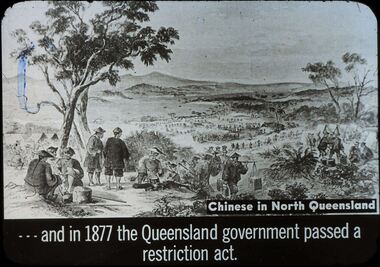
... Chinese on the Gold Fields. Slide:Chinese in North Queensland . . . . And in 1877 the Queensland government passed a restriction act. ...Chinese on the Gold Fields. Slide:Chinese in North Queensland . . . . And in 1877 the Queensland government passed a restriction act. ...Diggers & Mining. The Chinese on the Gold Fields. Slide:Chinese in North Queensland . . . . And in 1877 the Queensland government passed a restriction act. Chinese on the long journey to their destination, a camp site on the right, on the left they take shelter under a tree. Markings: 5, blue ink smuge on left of slide in tree. Used as a teaching aid.hanimounteducation, tertiary, goldfields -
 Flagstaff Hill Maritime Museum and Village
Memorabilia - Horseshoe Case, 1906 – 1907
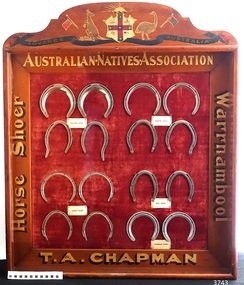
... Chinese legislation and were an ardent believer of colonial unification. Its mission and efforts are largely credited for the successful referendums that resulted in Federation of the six Australian colonies into a new nation, the association’s most important legacy. The ANA was also a supporter of trade protection, and were a staunch advocate of the first act of Australia's new parliament, the Immigration Restriction...Chinese legislation and were an ardent believer of colonial unification. Its mission and efforts are largely credited for the successful referendums that resulted in Federation of the six Australian colonies into a new nation, the association’s most important legacy. The ANA was also a supporter of trade protection, and were a staunch advocate of the first act of Australia's new parliament, the Immigration Restriction ...The horseshoes in this purpose-built display case were made by Thomas Alfred Chapman in 1906-1907. Chapman operated a blacksmith’s shop in Mortlake Rd, Purnim, about 15 mins drive from Warrnambool. Chapman made this horseshoe case especially for the 3rd Exhibition of Australian Manufacturers and Products, held in the Exhibition Building in Melbourne, which was organised and promoted by the Australian Natives Association (ANA). Reference is made to the horseshoe case in the Exhibition’s Souvenir Catalogue of 1907 on page 85, under the heading 'In the Machinery Section the following exhibits are also shown … 'CHAPMAN, T.A. , Woolsthorpe, via Warrnambool, Case of Horseshoes'. The Australian Natives’ Association (ANA) were a non-partisan and non-sectarian, friendly society founded in Melbourne, Australia in April 1871. It was set-up for the benefit of Australian-born white men, and membership was restricted exclusively to that group. Men of other races including the Chinese and Indigenous people were not allowed to join. The ANA had relatively progressive views on women (for the time) and attracted suffragists seeking support for their cause, and in 1894, the ANA advocated for women’s enfranchisement. Although, white women were only admitted as members from 1964. The organisation was most prominent in Victoria and sought to shape Australia’s national identity and was a training ground for businessmen, trade unionists and politicians including many of Australia’s early prime ministers such as Edmund Barton, Alfred Deakin, James Scullin and Francis Forde, and the first Australian-born governor-general, Isaac Isaacs, was a member. By 1910 it had developed into a nationwide association with real political and social influence, and members would participate in many activities. The ANA lobbied strongly for anti-Chinese legislation and were an ardent believer of colonial unification. Its mission and efforts are largely credited for the successful referendums that resulted in Federation of the six Australian colonies into a new nation, the association’s most important legacy. The ANA was also a supporter of trade protection, and were a staunch advocate of the first act of Australia's new parliament, the Immigration Restriction Act 1901 (cth) or commonly known as the White Australia Policy, which became one of the central pillars of Australian nationalism in the 20th-century. The ANA campaigned against the Australian Federal Government's new immigration policy after the Second World War (non-British immigration from southern and central Europe) in order to maintain a 'white Australia', and resisted changes when the Labor government during the 1970s fully dismantled and abandoned the White Australia Policy. The ANA merged with Manchester Unity Independent Order of Oddfellows, in 1993 to become Australian Unity Ltd. The display case of horseshoes changed hands several times, going from its maker Thomas Chapman to his mother then various other members of his family. The case was also displayed at the Lee Family’s butcher shop at 188 Liebig St Warrnambool, and in the Purnim Hotel during the Warrnambool May Races. In the late 1950s the horseshoe case went to Thomas’s son, Brian. He was a Master Farrier and completed his apprenticeship at Flemington Racecourse, and in Warrnambool he owned a blacksmith business at the Warrnambool Racecourse Grounds. Brian later operated a blacksmith’s at Flagstaff Hill, where his customers would bring their horses to be shod. Brian passed away in August 2017. The horseshoe case is significant as an example of trades in the early 20th century in Western Victoria, Australia. It is also significant as an example of horseshoes from the early 20th century. The horseshoe display case is also significant for its association with the Australian Exhibition of 1907, showcasing Australian produce and manufacturing to the world. The horseshoe display case is locally significant for its association with local families, essential businesses and community events. Display case of homemade horseshoes. Wooden case with glass front containing 16 horse shoes grouped in sets, each set with a label: Made 1906-1907 for Australian Exhibition of 1907 by Thomas Alfred Chapman of Warrnambool. The case contains (a) complete chrome set each of Trotting Shoes, Hunting Shoes and Racing Plates, and (b) one pair of Hind Polo Shoes and one pair of Front Aluminium Shoes. The wooden frame has gold lettering on each side proclaiming “Australian Natives Association, T.A. Chapman, horse shoer, Warrnambool” and is topped by a painted Australian coat of arms. Gold lettering on frame, in the order of top/bottom/ left/right “AUSTRALIAN.NATIVES.ASSOCIATION / T.A. CHAPMAN / Horse Shoer / Warrnambool”flagstaff hill, warrnambool, shipwrecked coast, maritime museum, shipwreck coast, horseshoe display case 1906-1907, chromed set of trotting shoes 1906-1907, chrome set of hunting shoes 1906-1907, chrome set of racing plates 1906-1907, pair of hind polo shoes 1906-1907, pair of front aluminium shoes 1906-1907, australian exhibition 1907, australian natives association (ana), t.a. chapman horse shoer warrnambool, thomas alfred chapman, brian chapman, brian “snacks” chapman, blacksmith warrnambool, warrnambool may races, warrnambool racecourse, purnim hotel, lee family’s butcher shop warrnambool -
 Bendigo Historical Society Inc.
Slide - DIGGERS & MINING. THE CHINESE ON THE GOLD FIELDS, c1850s
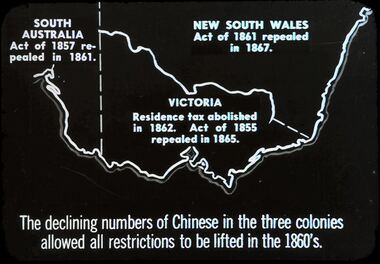
... Chinese on the Gold Fields. Slide: Shows map of Victoria and part of South Australia and New South Wales. South Australia Act. Of 1857 repealed I 1861. New South Wales Act. Of 1861 repealed I 1867. Victoria Residence tax abolished in 1862. Act. Of 1855 repealed in 1865. The declining numbers of Chinese in the three colonies allowed all restrictions...Chinese on the Gold Fields. Slide: Shows map of Victoria and part of South Australia and New South Wales. South Australia Act. Of 1857 repealed I 1861. New South Wales Act. Of 1861 repealed I 1867. Victoria Residence tax abolished in 1862. Act. Of 1855 repealed in 1865. The declining numbers of Chinese in the three colonies allowed all restrictions ...Diggers & Mining. The Chinese on the Gold Fields. Slide: Shows map of Victoria and part of South Australia and New South Wales. South Australia Act. Of 1857 repealed I 1861. New South Wales Act. Of 1861 repealed I 1867. Victoria Residence tax abolished in 1862. Act. Of 1855 repealed in 1865. The declining numbers of Chinese in the three colonies allowed all restrictions to be lifted in the 1860's. Markings: 2 2. Used as a teaching aid.hanimounteducation, tertiary, goldfields -
 Bendigo Historical Society Inc.
Slide - DIGGERS & MINING. THE CHINESE ON THE GOLD FIELDS, c1857
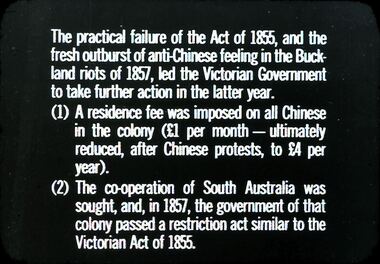
... Chinese on the Gold Fields. Slide: The practical failure of the Act of 1856, and the fresh outburst of anti-Chinese feeling in the Buckland riots of 1857, led to Victorian Government to take further action in the latter year. (1) A residence fee was imposed on all Chinese in the colony (one pound per month - ultimately reduced, after Chinese protests, to four pound per year). (2) The co-operation of South Australia was sought, and , in 1857, the government of that colony passed a restriction...Chinese on the Gold Fields. Slide: The practical failure of the Act of 1856, and the fresh outburst of anti-Chinese feeling in the Buckland riots of 1857, led to Victorian Government to take further action in the latter year. (1) A residence fee was imposed on all Chinese in the colony (one pound per month - ultimately reduced, after Chinese protests, to four pound per year). (2) The co-operation of South Australia was sought, and , in 1857, the government of that colony passed a restriction act similar to the Victorian Act of 1855. ...Diggers & Mining. The Chinese on the Gold Fields. Slide: The practical failure of the Act of 1856, and the fresh outburst of anti-Chinese feeling in the Buckland riots of 1857, led to Victorian Government to take further action in the latter year. (1) A residence fee was imposed on all Chinese in the colony (one pound per month - ultimately reduced, after Chinese protests, to four pound per year). (2) The co-operation of South Australia was sought, and , in 1857, the government of that colony passed a restriction act similar to the Victorian Act of 1855. Markings: 21. Used as a teaching aid.hanimounteducation, tertiary, goldfields
