
Showing 11 items matching "chinese yuan"
-
 Dandenong/Cranbourne RSL Sub Branch
Currency - Chinese Yuan, Thomas De La Rue & Company, 1941
... Chinese Yuan...chinese yuan...Five Yuan note from the Central Bank of China. On one side there are several Chinese inscriptions and the effigy of a man with a moustache. ...There are also a number of handwritten inscriptions in English on both sides in black ink. Currency Chinese Yuan Thomas De La Rue & Company ...This note has the names of British/Australian soldiers who served in WWII written in English on both sides. Five Yuan note from the Central Bank of China. On one side there are several Chinese inscriptions and the effigy of a man with a moustache. One the other, a central image of a tree-lined avenue and the number 5, as well as English text. There are also a number of handwritten inscriptions in English on both sides in black ink.Handwritten English inscriptions of the names and service numbers of British soldiers. Not all are legible. chinese yuan -
 Running Rabbits Military Museum operated by the Upwey Belgrave RSL Sub Branch
Currency
... Collection of Chinese currency notes(1 yuan, 2 er yuan, 10 fen, 50 fen, 1 yi jiao)...Ephemera General Collection of Chinese currency notes(1 yuan, 2 er yuan, 10 fen, 50 fen, 1 yi jiao) Currency ...Collection of Chinese currency notes(1 yuan, 2 er yuan, 10 fen, 50 fen, 1 yi jiao)ephemera, general -
 Bendigo Military Museum
Currency - CURRENCY, ASSORTED, estimated date 1939 to 1945
... Bank notes from Asian Countries .1) 10 Yen, blue/green colour. .2) One Yen, yellowish, red. .3) One Yuan China, reddish colour. .4) One pound, Japanese Govt., bluish colour. .5) Ten dollars Blueish colour. ...Currency notes japanese chinese Bank notes from Asian Countries .1) 10 Yen, blue/green colour. .2) One Yen, yellowish, red. .3) One Yuan China, reddish colour. .4) One pound, Japanese Govt., bluish colour. .5) Ten dollars Blueish colour. ...In the collection belonging to H.J.B.Burrell BEM MM VX 59659. Refer Cat No 298.4 for his service details.Bank notes from Asian Countries .1) 10 Yen, blue/green colour. .2) One Yen, yellowish, red. .3) One Yuan China, reddish colour. .4) One pound, Japanese Govt., bluish colour. .5) Ten dollars Blueish colour. currency, notes, japanese, chinese -
 Flagstaff Hill Maritime Museum and Village
Equipment - Wicker Basket
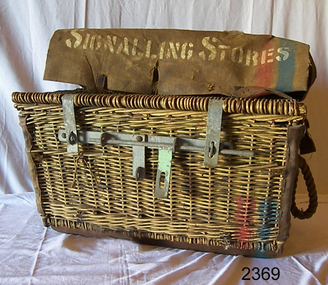
... The earliest recorded use of gunpowder for signalling purposes was the 'signal bomb' used by the Chinese Song Dynasty as the Mongol-led Yuan Dynasty besieged Yangzhou in 1276. ...The earliest recorded use of gunpowder for signalling purposes was the 'signal bomb' used by the Chinese Song Dynasty as the Mongol-led Yuan Dynasty besieged Yangzhou in 1276. ...A flare, also sometimes called a fusee, is a type of pyrotechnic that produces a bright light or intense heat without an explosion. Flares are used for distress signalling, illumination, communication or defensive countermeasures in civilian and military applications. Flares may be ground pyrotechnics, projectile pyrotechnics, or parachute-suspended to provide maximum illumination time over a large area. Projectile pyrotechnics may be dropped from aircraft, fired from rocket or artillery, or deployed by flare guns or hand held percussive tubes. Signalling flares have been in use by all branches of the military services since the 1920s also by the maritime services to signal other ships or for distress purposes. The earliest recorded use of gunpowder for signalling purposes was the 'signal bomb' used by the Chinese Song Dynasty as the Mongol-led Yuan Dynasty besieged Yangzhou in 1276. These soft-shelled bombs, timed to explode in mid-air, were used to send messages to a detachment of troops far in the distance. Another mention of the signal bomb appears in a text dating from 1293 requesting their collection from those still stored in Zhejiang. A signal gun appears in Korea by 1600. The (Wu I Thu Phu Thung Chih or Illustrated Military Encyclopedia) written in 1791 depicts a signal gun in an illustration. The item was used to carry and store flares for signalling use as the inscription on the canvas cover suggests. Given the method of storing flares is in a wicker basket that is non conducting of an electrical charge that may accidentally set of explosive materials. The writer assumes the basket was used from the early 20th century and most likely by maritime or military services to store it's flares.Basket cane square with metal locks & rope handles each end. Canvas reinforced on vertical sides with a canvas cover on top. Canvas cover has leather straps. Stencilled on canvas in white paint "SIGNALLING STORES" flagstaff hill, warrnambool, shipwrecked-coast, flagstaff-hill, flagstaff-hill-maritime-museum, maritime-museum, shipwreck-coast, flagstaff-hill-maritime-village, basket, cane basket, signalling stores -
 Ringwood and District Historical Society
Document, Ringwood High School - Form IV - 1967 - History of Australia and the Pacific Assignment- China 1900-1927
... This paper consists of several parts - Introduction , Spheres of Influence, The Boxer Rising, China begins to modernize, Dr. Sun Yat Sen and the Overthrow of the Manchus, Yuan Shih-Kai, China under the Warlords 1916-1927, The rise of the Kuomintang....This paper consists of several parts - Introduction , Spheres of Influence, The Boxer Rising, China begins to modernize, Dr. Sun Yat Sen and the Overthrow of the Manchus, Yuan Shih-Kai, China under the Warlords 1916-1927, The rise of the Kuomintang. ...One single sided foolscap sheet This paper consists of several parts - Introduction , Spheres of Influence, The Boxer Rising, China begins to modernize, Dr. Sun Yat Sen and the Overthrow of the Manchus, Yuan Shih-Kai, China under the Warlords 1916-1927, The rise of the Kuomintang. -
 Bendigo Historical Society Inc.
Book - CHINESE VILLAGE TOURIST PROJECT, 1974
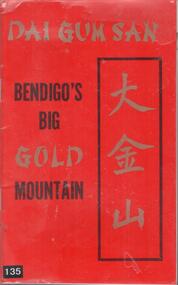
... Land for the Bendigo Chinese precinct was set aside by an Act of parliament' Bendigo (Dai Gum San Village) Land Act 1975' to be administered by the Bendigo Trust. The cultural precinct includes the Golden Dragon Museum, Yi Yuan Gardens and the Kuan Yin Temple....Land for the Bendigo Chinese precinct was set aside by an Act of parliament' Bendigo (Dai Gum San Village) Land Act 1975' to be administered by the Bendigo Trust. The cultural precinct includes the Golden Dragon Museum, Yi Yuan Gardens and the Kuan Yin Temple. ...Land for the Bendigo Chinese precinct was set aside by an Act of parliament' Bendigo (Dai Gum San Village) Land Act 1975' to be administered by the Bendigo Trust. The cultural precinct includes the Golden Dragon Museum, Yi Yuan Gardens and the Kuan Yin Temple.DAI GUM SAN BENDIGO'S BIG GOLD MOUNTAIN - CHINESE VILLAGE TOURIST PROJECT Softcover booklet with red cover and black and silver printing. Booklet contains 31 pages with description of the project to be built and outlining the benefits to the community. Also contains colour photographs.The Bendigo Trustchinese -
 City of Ballarat
Artwork, other - Public Artwork, Open Monument by John Young, 2015
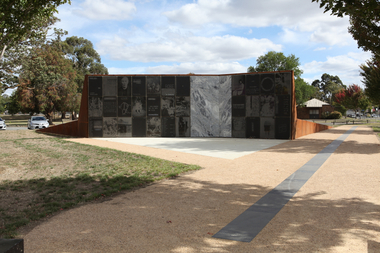
... Leong Mr Vi Minh Tran JP Mr Frank Cheng Mr David Cheng Mr William Thai Mr Lizhen Lin Mr Phillip Richard Thai Mr Hoan Ping Kow Mrs Xao Nhu Kow Mr Huy Thai Mr Yun Kuen Lo Mr Chiu Yip & Mrs Yuan Han Cho Mrs Jacqueline Louise Thai Greenwood Mr Joe Hap Chi Chao & Mrs Rosana Wei Ning Chao Charity & Multi Art Association of Victoria Inc. Mr Billy Cai Miss Nikki Cai Miss Su-Ling & Miss Lily Mays-Doon Mr Anthony Doon Mr H J Moy & Family Chinese Australian Cultural Society Ballarat Inc ...Leong Mr Vi Minh Tran JP Mr Frank Cheng Mr David Cheng Mr William Thai Mr Lizhen Lin Mr Phillip Richard Thai Mr Hoan Ping Kow Mrs Xao Nhu Kow Mr Huy Thai Mr Yun Kuen Lo Mr Chiu Yip & Mrs Yuan Han Cho Mrs Jacqueline Louise Thai Greenwood Mr Joe Hap Chi Chao & Mrs Rosana Wei Ning Chao Charity & Multi Art Association of Victoria Inc. Mr Billy Cai Miss Nikki Cai Miss Su-Ling & Miss Lily Mays-Doon Mr Anthony Doon Mr H J Moy & Family Chinese Australian Cultural Society Ballarat Inc Architectural artwork consisting of large marble panels on a corten steel frame imbedded into a grassed mount. ...Open Monument is a contemporary artwork acknowledging the history of Chinese people in Ballarat. The Chinese diaspora was global and many Chinese people came to Ballarat and the Victorian Goldfields. The work details some of the personal Chinese family memories of Ballarat from the goldrush forward. The 33 marble laser-etched panels include found images and texts mounted on a modernist metal architectural feature holding back a grassed hill landscape. Within the side walkway of gravel and composite stone is an etched of local activities relating to the Chinese community achievements that can be added to by the community.Open Monument is of aesthetic and historical significance to the people of BallaratArchitectural artwork consisting of large marble panels on a corten steel frame imbedded into a grassed mount.Inscription on plaque: Open Monument 無極紀念碑 / Artist: John Young / Officially Launched by Mr Yumin Song / Chinese Consul-General to Victoria / 6th September 2015 / Open Monument unearths stories of the Chinese diaspora in Ballarat, a name which means/ “resting place” to the traditional custodians - the Wadawurrung and Dja Dja Wurrung people./ The monument comprises of two artworks: Transculture, a granite-panelled work, evoking stories of alternative worldviews, / modernity, leisure and toil. Whilst Timeline traces the major contributions of the Chinese community in Ballarat, every decade / from the 1850s until the present. The timeline then folds out to 2170, anticipating imaginary future contributions. / The monument is open to future interpretations of this history. / I thank you for visiting and acknowledging the contributions and memories that meant so much to / those who have gone before us./ - John Young Zerunge / Patron: Mr Henry Thai OAM JP / President of Ballarat Chinese / Community Association Inc / The following generous donors to this project are acknowledged with gratitude/ City of Ballarat Sovereign Hill Museum Association Inc. Ballarat Chinese Community Association Inc. Mr Henry Thai OAM JP & Mrs Sandra Thai Mrs Shirley Doon & Family in memory of Harry Doon Chinese Masonic Association Inc. Mr Mean Te and Mrs Meng Khun Mr Jack Nguyen MA JP & Mrs My Tang Mr Tony and Mrs Elise Yu Mr Chang Zhen Zhen & Family Australian Lian Jiang Association The Federation of Chinese Associations Vic The Leesoon Family Mr Stephen K.F Ng OAM JP Dr Che Sam Lo MD phD JP OAM Elderly Chinese Home Inc. The Federation of Chinese Org from VN Cambodian and Lao Association of Vic. Inc. Bright Moon Buddhist Society Nam Pon Soon Club House See-Yup Society Mr Peter Chong Wai Lo Mr Qing Song Lin Mr Binh Quoc Mao & Mrs Thuy Cam Thai Mr Alexander Mao Mr Yuet Lung Kwok JP Mr Tai The Tran Mr Phillip K. L. Tran Mr William K. L. Tran Mr Quang Khon Tran JP Mr Kouy Taing Mrs Kieng Hor Lou Mr Bill Chang Piu Au Mr Maurice Kwok Leong Mrs Eunice J. Leong Mr Vi Minh Tran JP Mr Frank Cheng Mr David Cheng Mr William Thai Mr Lizhen Lin Mr Phillip Richard Thai Mr Hoan Ping Kow Mrs Xao Nhu Kow Mr Huy Thai Mr Yun Kuen Lo Mr Chiu Yip & Mrs Yuan Han Cho Mrs Jacqueline Louise Thai Greenwood Mr Joe Hap Chi Chao & Mrs Rosana Wei Ning Chao Charity & Multi Art Association of Victoria Inc. Mr Billy Cai Miss Nikki Cai Miss Su-Ling & Miss Lily Mays-Doon Mr Anthony Doon Mr H J Moy & Family Chinese Australian Cultural Society Ballarat Inc open monument chinese, chinese history ballarat goldfields, china, ballarat, goldfields, john young, chinese, mining, multicultural, immigration, tong way, goon, joss house, embroidery, billy butterfly, chinese market gardens, red lion hotel, ah soon, mayor of main road, chinese herbalist, yee lee, james hong, cheok cheong hong, john ah loo, wathawurrung, robe, lowe kong meng, louis ah mouy, tongway, gallipoli, william lung -
 City of Greater Bendigo - Civic Collection
Plaque, Dai Gum San, Dai Gum San Precinct Development, 2010
... Today Dai Gum San is a rich Chinese Cultural Centre and Chinese precinct in the centre of Bendigo which links the Golden Dragon Museum with the Yi Yuan Gardens and Kuan Yin Temple. ...Today Dai Gum San is a rich Chinese Cultural Centre and Chinese precinct in the centre of Bendigo which links the Golden Dragon Museum with the Yi Yuan Gardens and Kuan Yin Temple. ...The chinese called the rich goldfields in the heart of Victoria Dai Gum San, Big Gold Mountain. A place of untold wealth and promise. Today Dai Gum San is a rich Chinese Cultural Centre and Chinese precinct in the centre of Bendigo which links the Golden Dragon Museum with the Yi Yuan Gardens and Kuan Yin Temple. The gardens are a place of peace and beauty and the Kuan Yin Temple is a stunning home for the goddess of compassion.Squarish piece of quartz with printed plaque attached to front face. Dai gum san / In appreciation of your contribution / to the development of the / Bendigo Chinese Precinct / August 2010dai gum san, bendigo chinese dragon, golden dragon museum, city of greater bendigo heritage attractions -
 City of Melbourne Libraries
Photograph (item), Bull, Hugh Jones, 1897-1993, Unloading timber at Victoria Dock, 1933
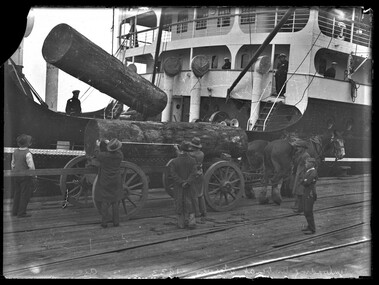
... in the East China Sea near the Zhoushan Archipelago. The Chien Yuan was also operating in darkness. ... in the East China Sea near the Zhoushan Archipelago. The Chien Yuan was also operating in darkness. ...Photographer notations on slide: "Unloading Timber at Wharves 1933 Age B5" Published: Age (Melbourne, Vic.: 1854- ), Tuesday 15 August 1933 MAHOGANY FROM MANILA. (1933, August 15). The Age (Melbourne, Vic. : 1854 - 1954), p. 11. Retrieved January 16, 2026, from http://nla.gov.au/nla.news-article204377024 Published title: MAHOGANY FROM MANILA Published Caption: Age Tue 15 Aug 1933 Caption: Unloading Mahogany Logs brought from Manila, Philippine Islands, by the steamer Taiping, which berthed yesterday at Victoria Dock. The vessel discharged twenty logs, each weighing three tons, the first shipment of this type of timber landed in Melbourne. Research by Project Volunteer, Louise McKenzie: This photograph in many ways epitomises Melbourne in the 1930s. It is a time of enormous growth, development and change. But before delving into that, the photo itself is very powerful. The huge mahogany logs being unloaded appear to be so heavy that the ship itself seems to list to port as they are craned over the side. They are being levered into a cart to which two large and sturdy Clydesdale horses are hitched. In contrast to the traditional horses, the wharf is crisscrossed with modern railway tracks. Unloading is both mechanical and manual, and the scene is one of intense interest to a young boy bystander. The ship appears to be squat and solid, but the whole image also gives a feeling of movement and intensity. The mahogany being delivered to Melbourne would be intended for high quality furniture. In the 1930s Australia actually had a growing timber industry, but much of the eucalyptus wood was being utilised for mass produced furniture, and much of this furniture would then have had a veneer applied to it. The fact that it was economic to import this timber from the “Philippine Islands” – not a traditional trading market for Australia – reflects a Victorian economy that was strong enough to support a growing demand for good quality furniture Mahogany was described as a classic, strong hardwood, often used for dark opulent furniture. In the 1930s the importation of timber from Manila (Philippines) to Australia was a notable trade, particularly in Philippine Lauan (often referred to as Philippine Mahogany), which was used as a cheaper alternative to other hardwoods. 1930s furniture, dominated by the art deco style, used a mix of luxurious exotic woods like mahogany, macassar and ebony for high-end pieces, often veneered over less expensive woods such as walnut, birch and poplar, and with plywood, chrome and lacquer also popular for more practical, streamlined designs during the Depression era. By the mid 1930s timber mills were being relocated away from the immediate dock area, but the fact that these logs were being transported by horse-drawn cart implies that the load would not have had to be taken too far for milling. 1885 the Melbourne Harbour Trust Commissioners had decided that land in or near the city was far too valuable to be used as timber yards. Furthermore, large stacks of timber posed a fire risk. The Trust asked the Victorian Government to reserve a site on the east side of the Yarra River opposite Yarraville and Spotswood. Here, in 1889, the Trust began building six jetties and a wharf specifically for the landing of timber. Clydesdale horses were initially brought to Victoria from Tasmania in the 1830s, and with the 1850s gold rush they were imported direct from Scotland. Melbourne was from its earliest years an important centre of horse-breeding from both imported and colonial-bred stock, providing the well-built draught horse for pulling heavily loaded wagons, the harness horse for delivery work and drawing coaches, and the saddle-horse used for riding. Stud breeding facilities were advertised from the early 1840s. By the 1870s the horse export trade was thriving, and the Port of Melbourne was the country's busiest exporter of horses to Indian, Asian and New Zealand markets. Kirk's Melbourne Horse and Carriage Bazaar in Bourke Street first advertised for business in 1840, and by the 1850s Bourke Street West was famed for its horse bazaars and saleyards. The Victorian Clydesdale Horse Society reports that Clydesdale working horses were a vital part of Melbourne's infrastructure and agricultural industry in the 1930s, when they reached the peak of their popularity despite the increasing competition from mechanization. Their main roles and usage at this time were: • City Delivery: Clydesdales were a common sight for metropolitan deliveries, particularly for breweries (such as Carlton & United Breweries), milk runs, and bread deliveries. • Industrial Work: They were heavily used for hauling cargo at the docks, in construction, and at specialized sites like the Truganina Explosives Reserve, where they pulled wagons. • Agriculture: In surrounding rural areas, they were the primary power source for ploughing and agricultural machinery. • Specialization: By the 1930s, the Clydesdale was smaller and more compact than the Shire or Percheron breeds, making them ideal for navigation in urban environments. After the 1930s their numbers decreased due to the onset of WWI and mechanisation. Wartime petrol rationing led to a brief revival for the working horse, as suburban tradesmen, now used to motor delivery, took their old jinkers out of mothballs. By 1947, however, only 1.5% of city traffic was horse-drawn. In 1952 the large horse cartage company A. Kellet Pty Ltd sold its 250 horses and converted its Richmond stables to storage. In the 1950s at Station and Princes piers, wharf labourers refused to work with the six draught horses still being used to haul trolleys and which were soon superseded by the fork lift, semi-trailer and mobile crane. Where carefully trained horses had once shunted trains in city goods yards, a few hundred a week were now being killed at the abattoirs for pet and human consumption. The last MCC dray horse was withdrawn from service in 1958, but some of the few remaining working animals are used by the mounted police for crowd control at demonstrations and football games. The death knell had also sounded for the associated trades of farrier, saddler and blacksmith. Our photo, therefore, showing the wharf with both the haulage Clydesdales and the rail lines, is a strong visual summary of the social and economic changes experienced in Victoria in the 1930s and on towards the 1950s. Our photo is located at Victoria Dock (also known as Victoria Harbour) which is still an active component of Melbourne’s port system. In 1892 the West Melbourne Dock (later Victoria Dock) was opened, downstream and immediately west of the Spencer Street railway shunting yards. It contained a swing basin for ships, replacing the one which had been provided on the south side of the river, later to be the Duke and Orr dry dock, west of the Charles Grimes Bridge. Further west was the South Wharf along the river bank. The history of Victoria Dock is extremely well described by Ashley Smith in his 2 March 2022 article in Docklands News, and its accompanying aerial photo of the Dock taken in 1934. He writes: "In the early 1930s Victoria Dock was one of the biggest sites for trade and export in Melbourne. A constant queue of ships sailed in, unloaded their cargo, recharged and reloaded, then left for the next port. Around the time this photo was taken (found in a 1934 photo book), the trapezium-shaped basin had been through some changes since its construction in the 1890s. The 497-metre-long Central Pier, finished in 1919, now featured six sheds to house the ever-increasing volume of cargo. The entrance had also been widened in the 1920s to allow better access. Some of the berths featured three-ton jib electric cranes to help with loading cargo and a rail network connected to the State Railway service. By the time construction was completed, the dock was 39 hectares and hailed as the second-largest dock in the world (behind Cavendish Dock, Barrow-in-Furness). To further save costs, excavations were dug to a more reasonable seven metres below low water, instead of British engineer Sir John Coode’s recommended 8.3 metres. Even then, the costs were still around £900,000. It was envisaged, with the extra wharfage, that around thirty 90-metre ships could berth inside. On March 22, 1892, Victoria Dock was opened by Victoria’s Governor, the Earl of Hopetoun (later Australia’s first Governor-General) who opened the sluice to let the Yarra in. It took six days to fill the basin with The Leader newspaper estimating that it would take another six months to completely fill (March 26, 1892). In the end, it took nearly a year before the first ship was allowed to enter on February 20, 1893, when the steamer Hubbuck sailed in to unload 1200 tonnes of cargo in 15 hours. The Argus (February 23, 1893) reported that the ship’s captain, J. R. Brodie, called the Yarra “better than the Thames”, and compared Victoria Dock favourably to the Albert Dock (Liverpool)." This would be a good time to move our focus on to the Taiping, which is the transporter of these giant mahogany logs. The Taiping was a steel-hulled, single-screw passenger-cargo Chinese steamer, which today has the dubious legacy of being involved in a collision headlined as “The Chinese Titanic”. It was constructed by the Hong Kong and Shampoa Dock Company at its facility in Hong Kong, with completion in 1926 for service under the Australia Oriental Line. Her gross register tonnage measured 4,324 tons, reflecting her design for inter-island and coastal trade routes, accommodating both passengers and freight. She operated routes connecting Australian ports with East Asian destinations. As World War II approached, Taiping continued predominantly working the trade routes between China and Australia, until December 1941, when she evacuated women and children from Hong Kong to Manila just before Japanese forces overran the region. She then safely reached Australia despite enemy air raids. Taiping was then requisitioned by the Royal Navy and repurposed as a victualling stores issuing ship for the Eastern Fleet, supporting logistical needs in the Pacific and Indian oceans. Returned to the Australian Oriental Line in 1947, she underwent refitting and by mid-1948 was chartered to the Shanghai Shipping Company, and modified for greater passenger accommodation – approximately 500 passengers. In 1948/49 the Chinese Civil War took place. The Taiping departed Shanghai on 26 January 1949 as one of the final vessels evacuating civilians from to Keelung Harbour in Taiwan. Reports indicate that the Taiping carried double the rated capacity of passengers i.e. 1000. The ship carried families, military personnel, civilians, carrying personal belongings, gold and valuables in hope of resettlement in Nationalist Taiwan. It also held heavy cargo in the form of silver and gold bullion loaded by the Central Bank of China. Because of the risk of patrols, and to conserve fuel, the Captain took the ship away from the usual open-sea passage, and instead navigated along the coast. He also extinguished navigation lights to avoid detection. Shortly after midnight on 27 January 1949 the Taiping collided with the smaller cargo steamer Chien Yuan in the East China Sea near the Zhoushan Archipelago. The Chien Yuan was also operating in darkness. The subsequent collision was catastrophic. The Chien Yuan sank with in 5 minutes, with the loss of 72 of its 74 crew. The Taiping sustained severe structural compromise from the broadside strike and initially remained afloat, then made a swift descent into the freezing water, with no attempt at an organised evacuation. No formal recovery process was instigated, however a distress signal went out. 32 survivors were picked up by the Australian destroyer HMAS Warramunga (on patrol nearby), a passing US vessel found 2 more, and local Zhoushan fishermen retrieved others. In the end, only 37 people survived. The event is remembered as a poignant moment in the mass migration to Taiwan, with families tragically separated. A memorial to the disaster exists at the Keelung Harbour naval base on Taiwan. With its total of over 1,500 deaths, it constituted one of the worst peacetime maritime losses. It is sometimes referred to as the “Oriental Titanic” because of the similarly large loss of life and speed of demise with the RMS Titanic in 1912. A fictional depiction of this event appears in the John Woo movies “The Crossing (Part 1) (2014), and The Crossing II (2015), known in Chinese as “Taiping Wheel”. The narrative weaves a story around pre-disaster romances and wartime turmoil among passengers, culminating in the ship’s rapid sinking. “The production, a high-budget Sino-Taiwanese-Hong Kong co-effort, portrays the event as a microcosm of the 1940s Sino-Japanese and civil war legacies, though critics noted the melodramatic style prioritizing spectacle over historical precision.” In conclusion, it is nice to return to our photo, and observe the people involved in this moment. The dockworkers are, so typical of the 1930s, dressed in what looks to us like formal clothing – dark suits or coats, white shirts, and black hats. I am particularly drawn to the young boy, bare-headed, arms crossed, and so intent on the unloading process. He too is wearing a white shirt, black trousers and jacket, and black shoes. This is 1933 Melbourne – but the haircut he is sporting is now very “hipster” and modern in 2026 Melbourne. References: MAHOGANY FROM MANILA. (1933, August 15). The Age (Melbourne, Vic. : 1854 - 1954), p. 11. Retrieved January 30, 2026, from http://nla.gov.au/nla.news-article204377024 Wikipedia, Taiping steamer, https://en.wikipedia.org/wiki/Taiping_(steamer) Wikipedia, Victoria Dock, https://en.wikipedia.org/wiki/Victoria_Dock_(Melbourne) Docklands News, Ashley Smith, 2 Mar 2022, https://www.docklandsnews.com.au/victoria-dock/ Living Histories: Heritage Council of Victoria, Jill Barnard, 2008, Jetties and Piers, https://livinghistories.net.au/wp-content/uploads/2015/11/Jetties-ONL-intro_Part-1.pdf eMelbourne, Wharves and Docks, https://www.emelbourne.net.au/biogs/EM01612b.htm Australian Academy of Technological Sciences – Harvesting Wood, https://www.austehc.unimelb.edu.au/tia/225.html Old Treasury Building, On the Water – The Docks, https://tinyurl.com/3wkbk66m Old Treasury Building, On The Road, https://tinyurl.com/dw44yr3t Port of Melbourne, Victorian Places, https://www.victorianplaces.com.au/port-of-melbourne Docklands Heritage Study - Environmental History, https://mvga-prod-files.s3.ap-southeast-4.amazonaws.com/public/2024-05/docklands-heritage-review-thematic-environmental-history-1991.pdf eMelbourne, Horses, https://www.emelbourne.net.au/biogs/EM00723b.htm Victorian Clydesdale Horse Society, https://www.clydesdalesvic.org.au/history The Crossing, https://letterboxd.com/film/the-crossing-i/Photographer notations on slide: "Unloading Timber at Wharves 1933 Age B5"ships, shipping, timber industry, shipwrecks, horses, docks, wharves, 1930-1939, wars, docklands -
 Embroiderers Guild, Victoria
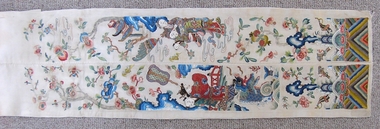
Accessory - Pair of Chinese Embroidered Sleeve Bands, 19 th C
... Yuan conferred' and 'carp jumping over the dragon gate'. In feudal society, examiners for the official positions had to go through three different levels of examinations. Bats - the work for bat is 'fu' and is a visual pun for the word happiness 'fu'. Rhino horn - wealth and good fortune. The ruyi sceptre - is a curved decorative Chinese...Yuan conferred' and 'carp jumping over the dragon gate'. In feudal society, examiners for the official positions had to go through three different levels of examinations. Bats - the work for bat is 'fu' and is a visual pun for the word happiness 'fu'. Rhino horn - wealth and good fortune. The ruyi sceptre - is a curved decorative Chinese ...Chinese sleeve embroidery bands, or wanxiu became popular in the late 19th century during the Qing Dynasty, evolving from the traditional Han cuff embroidery and Manchu styles. These detachable, decorated bands were added to women's informal jackets and robes, often featuring symbolic motifs like landscapes, flowers, and auspicious symbols. They served both a decorative function, displaying artistic skill and personal wishes, and a practical one by covering the sleeves when hands were folded at the waist. History and evolution: Origins: The practice of embroidering cuffs on robes existed during the previous Ming Dynasty for Han women, and this was adopted by the Manchu rulers who founded the Qing Dynasty. Qing Dynasty (1644-1911): The practice was popularized and elaborated upon during this era, with detachable bands becoming a fashionable element for informal wear. Symbolism: The embroidery included a complex visual vocabulary of wishes for a long life, many offspring, and a happy marriage, derived from nature, mythology, and classical literature. Functionality: Women would fold their arms, often with their hands inside the sleeves, so the embroidered bands, which were sewn to hang down the back of the jacket, would be displayed prominently down the front. 19th century peak: The late 19th century was the peak of their popularity, with intricate designs becoming fashionable and even influenced by court tastes, such as those favoured by the Empress Dowager Cixi. Later developments: The late 19th century saw the introduction of chemical 'aniline' dyes from Europe, leading to brighter, bolder colours in embroidery. Motifs and their Meanings: Auspicious symbols: Designs often included symbols for good fortune, wealth, and longevity. Natural imagery: Birds, flowers, and landscapes were common motifs that could represent natural beauty or convey specific symbolic meanings. Figurative scenes: Bands could also feature narrative scenes from classical stories or legends. The choice of motifs allowed women to express personal desires, cultural values, and aesthetic preferences, reflecting a more personal and informal style than official court attire. Symbolism: Mountains and sea, clouds and waves - Good luck. Dragon/fish tail/flaming pearl = Good fortune. This refers to the legend 'liyutiaolongmen' - a carp rising from the waves with the head already changed into a dragon implies the wish for success in the civil service examination. It is an allegory for the persistent effort needed to overcome obstacles. Male with black hat - Zhuang Yuan conferred. Among patterns with implied meanings , patterns related to the pursuits of scholarly honour and official rand include mainly the 'three number ones'. 'Zheng Yuan conferred' and 'carp jumping over the dragon gate'. In feudal society, examiners for the official positions had to go through three different levels of examinations. Bats - the work for bat is 'fu' and is a visual pun for the word happiness 'fu'. Rhino horn - wealth and good fortune. The ruyi sceptre - is a curved decorative Chinese object that symbolizes power, good fortune, and the wish that “things go as you desire.” The head of the sceptre resembles the 'lingzhi' of the 'longevity fungus'. Pomegranate - fertility ie; offspring, a virtue in China. Boy holding the flowering branch in the arms of the woman - in the selection of officials through imperial examinations in feudal society, the winner of an official position is described as ' having picked the crown'. 'Gui' (sweet scented osmanthus) and 'gui' (high rank or official) are very close in sound Chinese. In this design the boy in the woman's arms is seen waving a sweet scented osmanthus, thus an auspicious message is delivered. Information from Dr Rachel Silberstein, visiting Associate Professor at Rhode Island School of Design. "This pair of sleeve bands are two halves of a scene known as "tian xian song zi" or "Heavenly immortals deliver a son". The historical origins of this saying is a story from 'The History of the Wei Imperial records', involving the Emperor Sheng and an immortal maiden who presents him with a son. After this, the expression "tian xian song zi" came to be used as good wishes for marriage, closely associated with 'qilin song zi' (the qilin delivers a son), another popular topic in nianhua popular prints". Both cuffs show figures in an outdoor setting, done in colourful silk thread on a ivory satin. Reading from the bottom to the top of the cuff both have pointed mountains, clouds and sea with a rhino horn and a 'rui' coming out of the waves. Left cuff: above the sea there are a fish/dragon and a flaming pearl. Next two male figures standing on a bridge. One holds a fan and the other is wearing a black hat. More flowers, peonies and blossoms are above the figures. Right cuff: Above the water and mountains is a bat, peonies and pomegranates. Above these are three figures and another bat. The figure in there rear holds a feathered fan, while the front figure holds a child, who is holding a flowering branch. Above the trio is a low pagoda and blossoms. Silk satin stitch, Pekin knots and couched gold metal thread.embroidery, garments, silk embroidery, china, landscape, garden, figures -
 Embroiderers Guild, Victoria
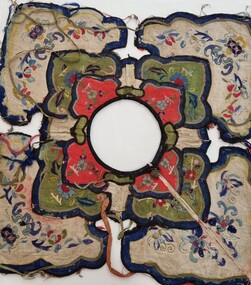
Clothing - Chinese Silk Embroidery Cloud Collar, 19 th C
... Chinese detachable cape-like or shawl-like accessory worn over the shoulders. Shape & Design: Typically structured with four or eight lobed panels that drape over the shoulders like floating clouds, symbolizing the vault of heaven and the connection between man and nature. Historically hand-embroidered with silk and metallic threads, often featuring auspicious motifs such as peonies, lotuses, butterflies, phoenixes, and lucky clouds, and edged with beads or tassels. Traced back centuries through Dunhuang cave murals and Tang/Yuan...Chinese detachable cape-like or shawl-like accessory worn over the shoulders. Shape & Design: Typically structured with four or eight lobed panels that drape over the shoulders like floating clouds, symbolizing the vault of heaven and the connection between man and nature. Historically hand-embroidered with silk and metallic threads, often featuring auspicious motifs such as peonies, lotuses, butterflies, phoenixes, and lucky clouds, and edged with beads or tassels. Traced back centuries through Dunhuang cave murals and Tang/Yuan ...Late 19th century cloud shaped collar, A Yunjian (云肩), or "cloud collar," is a traditional Chinese detachable cape-like or shawl-like accessory worn over the shoulders. Shape & Design: Typically structured with four or eight lobed panels that drape over the shoulders like floating clouds, symbolizing the vault of heaven and the connection between man and nature. Historically hand-embroidered with silk and metallic threads, often featuring auspicious motifs such as peonies, lotuses, butterflies, phoenixes, and lucky clouds, and edged with beads or tassels. Traced back centuries through Dunhuang cave murals and Tang/Yuan official wear, it became an elaborate element of women's fashion and traditional bridal attire during the Ming and Qing dynasties.Yunjian cloud collar. Four lobed collar in red, green and cream silk embroidered in fine gold metal thread. Floral and bat motifs. Secured by anornate brass button.floral, bat, china, collar
