
Showing 9 items matching "chopping board"
-
 Greensborough Historical Society
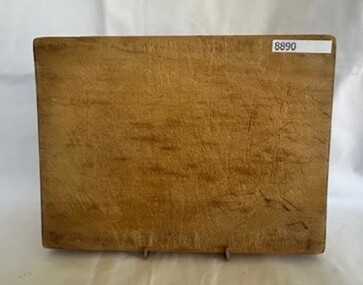
Domestic object - Chopping Board, Wooden cutting board, 1900s
... Chopping Board...Chopping board...Worn (concave in centre) Wooden cutting board Domestic object Chopping Board ...Board owned and used by Norma and Jim Petts, long standing residents of Greenhill Road, Greensborough 1951-2000.Small wooden rectangular board. Worn (concave in centre)chopping board, petts family, kitchen equipment -
 Friends of Westgarthtown
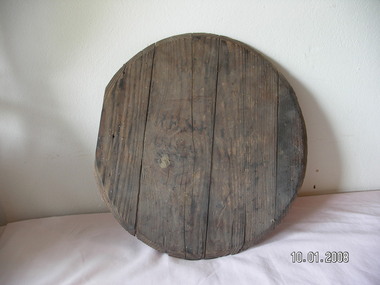
Functional object - Barrel lid
... ...chopping board...Round wooden chopping board made up of four individual planks of wood. ...Round wooden chopping board made up of four individual planks of wood. ...Round wooden chopping board made up of four individual planks of wood. Wood has possibly been reused for this purpose.Reser (?) (…) printed on wood. Ink has worn away and difficult to decipher.domestic items, food preparation, reser, chopping board, round, wooden -
 Flagstaff Hill Maritime Museum and Village
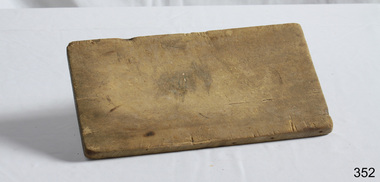
Domestic object - Wooden Bread Board, Not known
... ...Chopping Board...https://www.woodcuttingboards.com/news/quick-history-of-the-cutting-board-47.aspx The use of the wooden chopping board over time. Flagstaff Hill Warrnambool Shipwrecked-coast Flagstaff-Hill Flagstaff-Hill-Maritime-Museum Maritime-Museum Shipwreck-coast Flagstaff-Hill-Maritime-Village Chopping Board Cooking None. ...In the high tech, fast paced society that we live in, it’s easy to take some things for granted. Case in point: the wood cutting board on which you’ll probably be preparing the evening’s dinner. Have you ever taken the time to think about the history of the cutting board? Where did it come from, and what did ancient civilizations use to cut their meats, fruits and vegetables? Wood throughout the ages Since the dawn of time, wood has been one of the most available materials used by mankind to build tools and lodgings, so it’s not really surprising to know that wood has been used in the preparation of food since the prehistoric ages. Of course, back then, cavemen probably used an unpolished slab of tree trunk to cut the kill of the day on and they probably didn’t think twice about saving it once the meal was over. Chances are they probably threw it in the fire with the rest of the wood needed to kindle it. Advances in technology Throughout the centuries, mankind evolved and started creating machines from steam, electricity and metal. When the circular saw was invented, nicer, cleaner slabs of wood were cut and used as cutting boards. Since soft wood was the most available type of wood at the time, it was the material of choice for to be used for cutting boards. Boards were made smaller since the slab of wood could now be cut to any desired size. Since they were made smaller, they were also used to eat off of and some people referred to them as trenchers. Trenchers were originally pieces of stale hard bread that were used as substitute plates. Wood trenchers quickly became the replacements of the eatable dinnerware. The butcher block: the cutting board’s larger cousin In the industrial ages, many industries rapidly developed, and the butchery industry followed this trend as well. Before the invention of the cutting board, butchers used tree rounds to carve their meat on. The rounds were often too soft and they rapidly became unsanitary. Hard maple wood butcher blocks were the preferred choice of the industry. They were made to be extremely thick and durable, so durable in fact, that a butcher could use the same block for almost his entire career. Cutting boards around the world As cutting boards began to be more and more used in kitchens around North America, the rest of the world crafted such boards from different materials. The East used thick bamboo as their material of choice. Despite its frail appearance, bamboo is quite strong and made durable cutting boards and butcher blocks. Europe used maple in the crafting of their cutting boards while Persia used flat pieces of polished wood in their kitchens. The world then saw cutting boards that were being made from other materials like plastic and they came in all shapes and sizes, but they always served the same purpose, to provide a household with a safe, clean surface on which to prepare meals for their friends and family members. https://www.woodcuttingboards.com/news/quick-history-of-the-cutting-board-47.aspxThe use of the wooden chopping board over time. Wooden Rectangular Bread board . Worn (concave in centre). Raw wood.None.flagstaff hill, warrnambool, shipwrecked-coast, flagstaff-hill, flagstaff-hill-maritime-museum, maritime-museum, shipwreck-coast, flagstaff-hill-maritime-village, chopping board, cooking -
 Flagstaff Hill Maritime Museum and Village
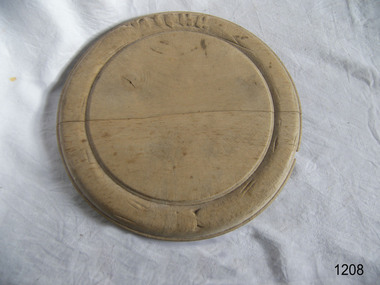
Domestic object - Bread Board
... ...Chopping Board...Flagstaff Hill Warrnambool Shipwrecked-coast Flagstaff-Hill Flagstaff-Hill-Maritime-Museum Maritime-Museum Shipwreck-coast Flagstaff-Hill-Maritime-Village Chopping Board Cooking Kitchen Equipment None. Bread board wooden round with carved inner circle and carving an outer rim in old English lettering "Bread" Domestic object Bread Board ...In the high tech, fast paced society that we live in, it’s easy to take some things for granted. Case in point: the wood cutting board on which you’ll probably be preparing the evening’s dinner. Have you ever taken the time to think about the history of the cutting board? Where did it come from, and what did ancient civilizations use to cut their meats, fruits and vegetables? Wood throughout the ages Since the dawn of time, wood has been one of the most available materials used by mankind to build tools and lodgings, so it’s not really surprising to know that wood has been used in the preparation of food since the prehistoric ages. Of course, back then, cavemen probably used an unpolished slab of tree trunk to cut the kill of the day on and they probably didn’t think twice about saving it once the meal was over. Chances are they probably threw it in the fire with the rest of the wood needed to kindle it. Advances in technology Throughout the centuries, mankind evolved and started creating machines from steam, electricity and metal. When the circular saw was invented, nicer, cleaner slabs of wood were cut and used as cutting boards. Since soft wood was the most available type of wood at the time, it was the material of choice for to be used for cutting boards. Boards were made smaller since the slab of wood could now be cut to any desired size. Since they were made smaller, they were also used to eat off of and some people referred to them as trenchers. Trenchers were originally pieces of stale hard bread that were used as substitute plates. Wood trenchers quickly became the replacements of the eatable dinnerware. The butcher block: the cutting board’s larger cousin In the industrial ages, many industries rapidly developed, and the butchery industry followed this trend as well. Before the invention of the cutting board, butchers used tree rounds to carve their meat on. The rounds were often too soft and they rapidly became unsanitary. Hard maple wood butcher blocks were the preferred choice of the industry. They were made to be extremely thick and durable, so durable in fact, that a butcher could use the same block for almost his entire career. Cutting boards around the world As cutting boards began to be more and more used in kitchens around North America, the rest of the world crafted such boards from different materials. The East used thick bamboo as their material of choice. Despite its frail appearance, bamboo is quite strong and made durable cutting boards and butcher blocks. Europe used maple in the crafting of their cutting boards while Persia used flat pieces of polished wood in their kitchens. The world then saw cutting boards that were being made from other materials like plastic and they came in all shapes and sizes, but they always served the same purpose, to provide a household with a safe, clean surface on which to prepare meals for their friends and family members. https://www.woodcuttingboards.com/news/quick-history-of-the-cutting-board-47.aspxThe bread board is an example of kitchen equipment used during Victorian times and similar to those used today.Bread board wooden round with carved inner circle and carving an outer rim in old English lettering "Bread"None.flagstaff hill, warrnambool, shipwrecked-coast, flagstaff-hill, flagstaff-hill-maritime-museum, maritime-museum, shipwreck-coast, flagstaff-hill-maritime-village, chopping board, cooking, kitchen equipment -
 Musculoskeletal Health Australia (now held by the Glen Eira Historical Society)
Photograph - Solo photo, 1998
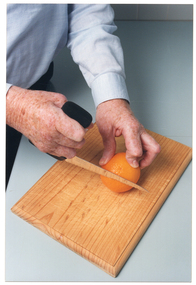
... He is cutting an orange on a wooden chopping board....He is cutting an orange on a wooden chopping board. Photograph Solo photo ...Through its quarterly newsletters, the Arthritis Foundation of Victoria (AFV) was able to inform its members about arthritis-friendly kitchen and household aids, and how to use them. In this photo, Arthritis Victoria member and volunteer, Bill O'Connor, demonstrates the use of a knife with a specially designed handle. The handle design facilitates the grasping of the knife for ease of cutting. A similar photo appears as part of a photo collage on the cover of the 1998 Annual Report.COL close up photo of a man's hands using a knife with a specially-designed handle. He is cutting an orange on a wooden chopping board.arthritis foundation of victoria, afv, arthritic aids, kitchen aids, kitchen gadgets, arthritis knife, adaptive knife, kitchen utensils, living with arthritis, pain management, annual report, 1998 -
 Musculoskeletal Health Australia (now held by the Glen Eira Historical Society)
Photograph - Solo photo, Circa November 1989
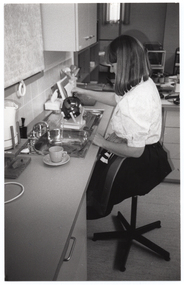
... In the published photo, the woman is depicted sitting on the sit-stand chair, about to cut an apple on a small chopping board. The photo accompanies an article titled, 'Living with Arthritis', with the subtitle 'Independent Living Centre', 'A service of the Yooralla Society of Victoria'. ...In the published photo, the woman is depicted sitting on the sit-stand chair, about to cut an apple on a small chopping board. The photo accompanies an article titled, 'Living with Arthritis', with the subtitle 'Independent Living Centre', 'A service of the Yooralla Society of Victoria'. ...Through its quarterly newsletters, the Arthritis Foundation of Victoria (AFV), formerly the Rheumatism and Arthritis Association of Victoria (RAAV), was able to inform its members about the latest arthritis-friendly kitchen appliances and aids, and how to use them. In this photo, a woman demonstrates how to use a kettle pourer. She is sitting on a swivel chair on castors, at the kitchen sink. A similar photo appears in the Vol 3 No 1, Autumn 1990 issue of the Arthritis Foundation of Victoria's quarterly magazine, Arthritis Update. The photo in the magazine is captioned: " 'Sit-Stand Chair' in use at a pull-out workbench. It's [sic] adjustable height makes it a useful piece of household equipment." In the published photo, the woman is depicted sitting on the sit-stand chair, about to cut an apple on a small chopping board. The photo accompanies an article titled, 'Living with Arthritis', with the subtitle 'Independent Living Centre', 'A service of the Yooralla Society of Victoria'. According to an earlier article appearing on page 3 of the No 33, August 1984 edition of RAAV's quarterly newsletter, News Review, the Independent Living Centre was the venue for the launch of Arthritis Week in May 1984.B&W photo of a woman sitting on a swivel chair on castors, at a kitchen sink. She is pouring water from a kettle into the sink. The kettle is sitting on a device which enables her to pour from the kettle without having to lift it. The sink is recessed into an L-shaped kitchen bench, upon which a cup and saucer can be seen sitting near the edge of the sink. There are several miscellaneous kitchen appliances on the bench. There are cupboards and drawers beneath the bench, and one set of cupboards above the sink.[On a yellow sticky note, in blue ink] November - December, 1989 Independent Living Centre?arthritis foundation of victoria, afv, rheumatism and arthritis association of victoria, raav, independent living centre, demonstration kitchen, arthritic aids, kitchen aids, kitchen gadgets, kitchen appliances, kitchen sink, kettle pourer, tea, coffee, hot drinks, swivel chair, sit-stand chair, pull-out workbench, retractable bench top, sliding bench top, adaptive kitchens, accessible kitchens, disability-friendly kitchens, modified kitchens, yooralla society of victoria, living with arthritis, pain management, 1989, arthritis update, 1990, news review, 1984 -
 Greensborough Historical Society
Photograph - Digital image, Trevor Partington Perpetual Trophy, 2000c
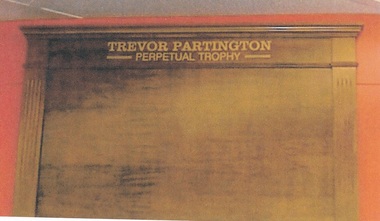
... board to honour Trevor Partington. Trevor was a keen sportsman, playing over 300 games of football for Greensborough, cricket, athletics, wood chopping and bowling....board to honour Trevor Partington. Trevor was a keen sportsman, playing over 300 games of football for Greensborough, cricket, athletics, wood chopping and bowling. trevor partington trevor partington perpetual trophy Digital copy of colour photograph. ...Perpetual Trophy board to honour Trevor Partington. Trevor was a keen sportsman, playing over 300 games of football for Greensborough, cricket, athletics, wood chopping and bowling.Digital copy of colour photograph.trevor partington, trevor partington perpetual trophy -
 Emerald Museum & Nobelius Heritage Park
Photograph - Framed Photograph of Emerald Primary School Picnic, 1930
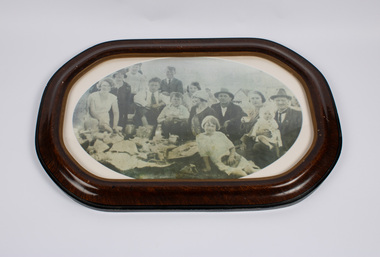
... board in a mahogany timber style hanging frame. At some point the photo has been touched up with a painted tree in the left-hand side foreground of the picture, partially covering the identity of one of the group of picnickers. More information about the people in the group has been detailed on the back of the photo frame. The photo frame chops...board in a mahogany timber style hanging frame. At some point the photo has been touched up with a painted tree in the left-hand side foreground of the picture, partially covering the identity of one of the group of picnickers. More information about the people in the group has been detailed on the back of the photo frame. The photo frame chops ...This framed portrait is of a family group picnicking and is titled Emerald School Picnic, Mordialloc, Victoria which was taken in 1930. The group are mainly family members of the Hirst Family, as described on the reverse of the photograph.An oval timber framed black and white sepia toned photograph of Emerald Primary School Picnic held at Mordialloc, Victoria in approximately 1930. The photo is a landscape orientation photograph and is mounted with an oval, white mat board in a mahogany timber style hanging frame. At some point the photo has been touched up with a painted tree in the left-hand side foreground of the picture, partially covering the identity of one of the group of picnickers. More information about the people in the group has been detailed on the back of the photo frame. The photo frame chops into part of the photo which is also slightly less sharp and blurry compared to the original one printed on cabinet card.On back of photograph: "Alice Richardson first grandchild for Granny & Grandad Hirst. A School Picnic held at Mordialloc - Victoria. approx - year of 1930 They are listed from left to right from back row; Tom Legett and Joe Hirst. Second row consists of Maud Nobelius (now Hirst), Jack Hirst, Kath Hirst (now Fitton). Third row consists of Kath Hirst (now Fitton), Charlie Leggett, Granny Hirst (Alice) (hat on), Harry Leggett, Dolly Richardson (Alice) (now Hirst), Grandad Hirst, nursing Alice Richardson (now Newcombe). Front row is a set of legs (unknown) and Lana Hirst (now Tardrew). At Emerald Primary School Picnic held at Mordialloc approx 1930 Harry Leggett father of Tom & Charlie Leggett also father of Bonnie Butterworth (Leggett) Not in photo. Another daughter Dorothy Leggett died (aged 13years) after an accident falling from a milk cart when the horse bolted at Emerald. Drinking fountain in Emerald School a memorial to her."hirst family, 1930, photograph, mordialloc, emerald primary school -
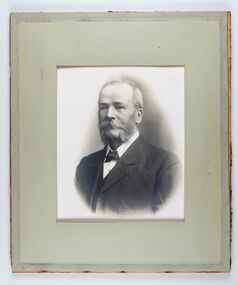 City of Greater Bendigo - Civic Collection
Photograph - Portrait of Councillor Long, Talma & Co
... board which has photograph attached; Talma & Co. / 119 Swanston St., / Melbourne Framed black and white head and shoulder portrait of Councillor Long. Profile to left with walrus moustache and mutton chops ...The district of Strathfieldsaye was proclaimed in 1861 and named a Shire on the 17th September in 1866. It remained a shire until amalgamation in 1994 when it became part of the City of Greater Bendigo. The shire was located 8 km to the south- east of Bendigo and covered an area of 601 square kilometres and extended from the Calder Highway to the Coliban and Campaspe Rivers. The shire's administration centre was in Strathfieldsaye until 1972 when new offices were opened in Kennington.Framed black and white head and shoulder portrait of Councillor Long. Profile to left with walrus moustache and mutton chops. Cut olive retangle mount. Verso; Long. On under board which has photograph attached; Talma & Co. / 119 Swanston St., / Melbournestrathfieldsaye shire council, councillor long
