
Showing 51 items matching "christening dress"
-
 Ringwood and District Historical Society
Clothing - Christening dress, Christening Dress Ringwood 1927
... Christening dress...Christening Dress Ringwood 1927...Worn by June Jones for her Christening (dob 21-May 1927 The dress was made by her Grandmother Catherine Webber. ...White lawn Christening dress with lace collar and lace edging on sleeves and hemline.Two rows of lace inserts on bodice. ...Christening Dress Ringwood 1927 Clothing Christening dress ...Worn by June Jones for her Christening (dob 21-May 1927 The dress was made by her Grandmother Catherine Webber. The Webber family lived in Ringwood Street Ringwood .and later daughters Ruth and Alice lived at North Ringwood.White lawn Christening dress with lace collar and lace edging on sleeves and hemline.Two rows of lace inserts on bodice. -
 City of Moorabbin Historical Society (Operating the Box Cottage Museum)
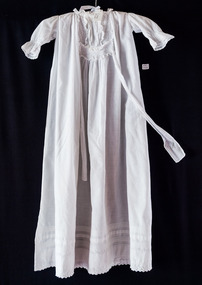
Clothing - Clothing, baby's pintucked christening dress, c1900
... Clothing, baby's pintucked christening dress...This long, white fine lawn cotton pin-tucked baby's christening dress is an example of the dressmaking skills of the women of the families of the pioneer settlers and market gardeners of the Moorabbin Shire. ...A white, fine lawn cotton, pin-tucked, baby's long christening dress...This long, white fine lawn cotton pin-tucked baby's christening dress is an example of the dressmaking skills of the women of the families of the pioneer settlers and market gardeners of the Moorabbin Shire. ...This long, white fine lawn cotton pin-tucked baby's christening dress is an example of the dressmaking skills of the women of the families of the pioneer settlers and market gardeners of the Moorabbin Shire. The pioneer settlers and market gardeners of Moorabbin Shire had to be self reliant and made their own clothing and utensils. This is one of many items that exhibit the skill and craftsmanship of the women in these families.A white, fine lawn cotton, pin-tucked, baby's long christening dressclothing, brighton, moorabbin, pioneers, dressmaking, dendy henry, market gardeners, craft work -
 Bendigo Historical Society Inc.
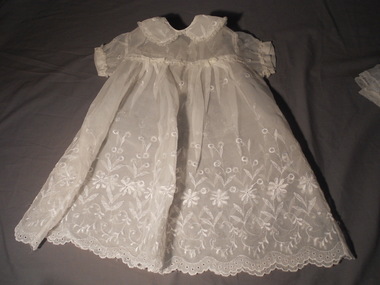
Clothing - MERLE HOULDEN COLLECTION: CHRISTENING DRESS AND PETTICOAT, 1960's
... MERLE HOULDEN COLLECTION: CHRISTENING DRESS AND PETTICOAT......christening dress...COSTUME Children's christening dress White embroidered nylon. Tiny yoke topped with a Peter Pan collar, edged with gathered fine lace. ...White embroidered nylon. Tiny yoke topped with a Peter Pan collar, edged with gathered fine lace. Puff sleeves - pleated at shoulder, and gathered into a 1.75cm band, edged with fine, gathered lace. Gathered lace and two white ribbon( .5cm wide) bows define the yoke.Skirt 40 cm long, edged with embroidery and scalloped hemline. Two pearl buttons fasten the back of the yoke. Dress has been made to take advantage of the embroidered fabric of the train of Merle's own wedding gown.Merle Houlden made this gown for her first child, Bronwyn, using fabric from the lower tier of the train of her own wedding gown. Bri-nylon sleeveless, and embroidered nylon skirt, edged with fine lace (on the frill of the skirt). Skirt has an 8 cm frill, attached with an embroidered band of ribbon insertion. The ribbon insert is finished with two small .5cm ribbon bows. Both dress and petticoat have been made to take advantage of the embroidered fabric of Merle's own wedding dress train.costume, children's, christening dress -
 Kilmore Historical Society
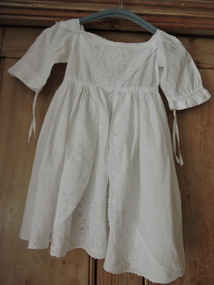
Textile - Childs christening dress, Unknown
... Childs christening dress...Christening dress donated by Kilmore family...Textile Childs christening dress ...Christening dress donated by Kilmore familyWhite cotton, short sleeves with drawstrings, gathered waist, broderie anglaise triangular shaped bodice detail, broderie anglaise trim to skirt. Excellent conditition.child, christening -
Stawell Historical Society Inc
Textile - Dress, Christening Dress 1921
... Christening Dress 1921...Christening Dress 1921 Textile Dress ...Christening in Northcote Church of England 1921. Story of Thelma in Storage Box.Cream Crochet Dress, neck has tie and ribbon around waistline. -
Dunkeld Museum Inc.
Clothing - Dress, Christening, Approximately 1870
... Dress, Christening...christening...infant...dress...christening gown. Hand made. Bodice has hand worked cotton lace across the front with three rows of pin tucks between the lace. Two frills are placed either side of the embroidered panel. The neck has a draw string which ties at the back below a row of picot lace. There is also a drawstring at the waist of the dress...The skirt is tightly gathered at the waist. Clothing Dress, Christening Jacobina McNab (nee Murdoch) ...This dress was made by Jacobina McNab for her sons in the 1870's. It was later worn by Jack and Elizabeth Templeton's family.This was owned and worn by a number of the earliest families in Dunkeld for the christening of their children.Infant's cotton christening gown. Hand made. Bodice has hand worked cotton lace across the front with three rows of pin tucks between the lace. Two frills are placed either side of the embroidered panel. The neck has a draw string which ties at the back below a row of picot lace. There is also a drawstring at the waist of the dress. Short raglan sleeves also have the two frills and a row of lace on the sleeve and the edge is finished with the same picot lace as the neckline. The skirt is very long with a panel down the centre which becomes wider as it goes down. This panel has a single frill either side of the panel. The panel is decorated with alternate self fabric frills and narrow tucks. The bottom of the dress is finished with a self fabric frill and two narrow tucks around the dress except for the area of the front panel. The skirt is tightly gathered at the waist.christening, infant, dress, baby, baptism, needlework -
 Flagstaff Hill Maritime Museum and Village
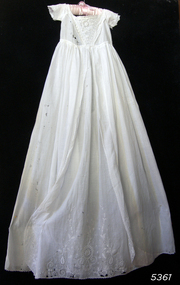
Clothing - Christening Gown, 1860's
... ...christening dress...Flagstaff Hill Warrnambool Shipwreck Coast Maritime Museum Maritime Village Flagstaff Hill Maritime Museum and Village christening gown christening dress baptism gown baptism dress religious ceremony nightwear sleepwear clothing fashion 19th century child’s christening gown handmade clothing Long white christening gown with short sleeves and Broderie Anglaise yoke, circa 1860's Clothing Christening Gown ...Long white christening gown with short sleeves and Broderie Anglaise yoke, circa 1860'sflagstaff hill, warrnambool, shipwreck coast, maritime museum, maritime village, flagstaff hill maritime museum and village, christening gown, christening dress, baptism gown, baptism dress, religious ceremony, nightwear, sleepwear, clothing, fashion, 19th century, child’s christening gown, handmade clothing -
 Bendigo Historical Society Inc.
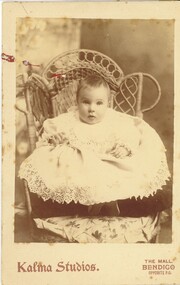
Photograph - HARRIS COLLECTION: BABY PHOTO, Twentieth Century
... Black & White studio photograph baby in christening dress seated in cane chair. Printed Front. ...The Mall Bendigo Black & White studio photograph baby in christening dress seated in cane chair. Printed Front. ...Black & White studio photograph baby in christening dress seated in cane chair. Printed Front. Kalma Studios The Mall Bendigo opposite P OKalma Studio. The Mall Bendigophotograph, person, baby -
 Kilmore Historical Society
Clothing - Christening Clothes, c1928
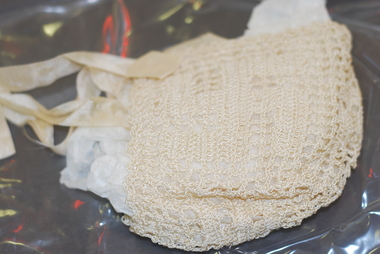
... Child's christening dress, coat & Bonnet, silk, embroidered. ...Child christening Turner Collection Child's christening dress, coat & Bonnet, silk, embroidered. ...Child's christening ensemble worn by Philip ('Pip') Smith at his christening. Grandson of Stephen Robinson & Elizabeth Jane Hartnell of 'The Dene' & 'Overdale', Kilmore East. Three daughters - Elsie, Esme & Monica. Their daughter Monica Fleck Turner (1899-1990) m. Albert Smith (1890- 1951) in 1926. Phillip born 1928, d. 2006 at Seymour. Buried Fawkner Cemetery. Clothing from early Kilmore families.Child's christening dress, coat & Bonnet, silk, embroidered. All in very good condition, despite yellowing. TEX-51.1 Dress TEX-51.2 Coat TEX-51.3 Bonnetchild, christening, turner collection -
 Kiewa Valley Historical Society
Dress Child
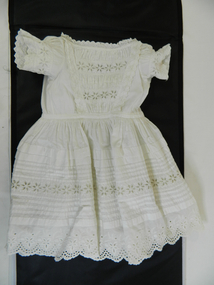
... dress...cotton...christening...These style Christening dresses were often worn buy several children of the one family , both boys and girls. ...Girl's white dress (christening event), fine cotton with lace border "broderie anglaise" with a row of lace flowers mid skirt "battenberg".This lace is also inserted in centre front panel and sleeves. ...These style Christening dresses were often worn buy several children of the one family , both boys and girls. ...The dress was probably worn at a christening in one of the Kiewa Valley churches (denomination unknown). The importance of the event to family and friends is shown by the quality of the garment. These style Christening dresses were often worn buy several children of the one family , both boys and girls. Other items such as hand made bonnet may have been part of this out fit. "KVHS 0123" The quality of the garment and the fashion style it represents is both historical, not only the time of its manufacture but also of the fashion in that era. It has christian religious implications and values of the time frame of regional life in the early1900s. Girl's white dress (christening event), fine cotton with lace border "broderie anglaise" with a row of lace flowers mid skirt "battenberg".This lace is also inserted in centre front panel and sleeves. Scolloped cotton is also on sleeves, neck and front. Pin tucked skirt. Opening back with drawstring fastening at neck and waist. Short sleeves and machine stitched children clothing, lace-battenberg and broderie anglaise, female clothing, dress, cotton, christening, dressmaking -
 Linton and District Historical Society Inc
Petticoat, Child's petticoat, Early 1900s
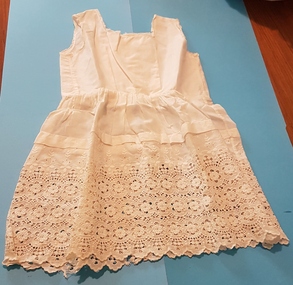
... Thought to have been adapted from the Christening dress of Henry Bolte, who was afterwards Premier of Victoria. ...Thought to have been adapted from the Christening dress of Henry Bolte, who was afterwards Premier of Victoria. ...Thought to have been adapted from the Christening dress of Henry Bolte, who was afterwards Premier of Victoria. Shortened for later use as a child's petticoat.White lawn undergarment with thin lace around square neckline and armholes. Gathered skirt 220 mm of lace shortened skirt with 40 mm tuck 3 press stud fasteners.henry bolte, christening gowns, petticoats, textiles, children's clothing -
 Mont De Lancey
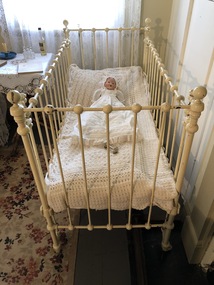
Furniture - Cot
... A baby doll dressed in a christening dress and bonnet is sleeping on it with a silver rattle resting at the end....A baby doll dressed in a christening dress and bonnet is sleeping on it with a silver rattle resting at the end. ...A white painted iron cot with drop down sides on castors. It has round knobs on the tops of the bars. The paint is peeling. It is fully made up with cot sheets and a crocheted rug on top. A baby doll dressed in a christening dress and bonnet is sleeping on it with a silver rattle resting at the end.cots, nursery furniture, beds -
 Emerald Museum & Nobelius Heritage Park
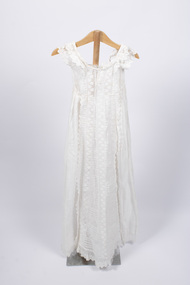
Clothing - Christening Gown, c. 1891
... This white lawn cotton christening dress is a long line gown with a simple bodice. ...Clothing Nobelius Family This white lawn cotton christening dress is a long line gown with a simple bodice. ...This christening gown belonged to Frances Nobelius (1920-2015) and is believed to have been given to her by her mother Nina Ayers (nee Casement, 1891-1872). It was likely passed to Nina by her own mother, Mary Frances Balharry (1869-1898), and reused by the family over multiple generations of christenings. At the time it was made - before Nina's christening in 1891 - christening gowns usually featured a very long skirt decorated with extensive embroidery - often modelled on contemporary women's fashion. They were long-lasting family heirlooms, typically passed from mother to daughter.This gown was passed through several generations living in the local area, including members of the Nobelius family. It is an example of an element of late 19th century christening practices, and shows the reuse of christening gowns through decades and generations.This white lawn cotton christening dress is a long line gown with a simple bodice. It is almost sleeveless with a lace trim. It has a lace trimmed neckline, and a back opening with ribbon ties at the neckline and waistline. The skirt is gathered with a broderie anglais panel of lace on the front, extending from the neckline to the hemline.clothing, nobelius family -
 Bendigo Historical Society Inc.
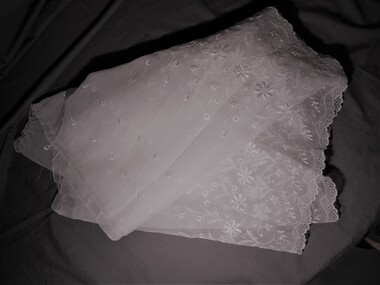
Clothing - MERLE HOULDEN COLLECTION: FABRIC FROM WEDDING DRESS TRAIN, Wedding Dress Train, 05-06-1960
... One tier was later used by Merle to make a christening dress for her first child, Bronwyn. Evidence is still visible of the gathering thread at the top of this panel....One tier was later used by Merle to make a christening dress for her first child, Bronwyn. Evidence is still visible of the gathering thread at the top of this panel. ...Sheer embroidered nylon. Silk thread embroidery in a floral pattern. Scalloped edge finishes the lace panel. The original train on the wedding dress was a feature of the wedding gown, falling in tiers as a "waterfall" effect. One tier was later used by Merle to make a christening dress for her first child, Bronwyn. Evidence is still visible of the gathering thread at the top of this panel.costume accessories, female, wedding dress train fabric -
 Mont De Lancey
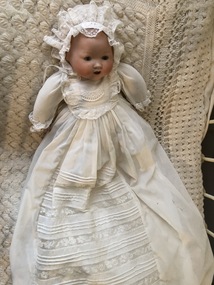
Leisure object - Doll
... Wearing a long sleeved white lace and embroidered christening style dress with a matching bonnet, a ribbon bow is on the bodice of the dress, and two white buttons on the back of the dress. ...Wearing a long sleeved white lace and embroidered christening style dress with a matching bonnet, a ribbon bow is on the bodice of the dress, and two white buttons on the back of the dress. ...Modern porcelain or ceramic doll, belonging to 6th generation of Henry and Martha Sebire. Emma & Karlee Jennings.Porcelain or ceramic doll with blue eyes and red lips. Wearing a long sleeved white lace and embroidered christening style dress with a matching bonnet, a ribbon bow is on the bodice of the dress, and two white buttons on the back of the dress. Towelling type cotton body with panties.dolls, baby dolls, toys, leisure objects -
 Embroiderers Guild, Victoria
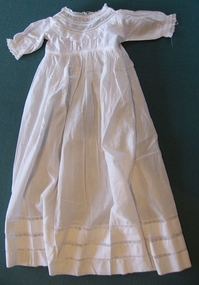
Clothing - Baby's Muslin Christening Gown
... White muslin Christening Robe. Typical long dress with machine made lace and pin tucks. ...Embroidery White muslin Christening Robe. Typical long dress with machine made lace and pin tucks. ...White muslin Christening Robe. Typical long dress with machine made lace and pin tucks. It has a pretty round yoke with lace and insertions. Machine lace & pin tucksembroidery -
 City of Moorabbin Historical Society (Operating the Box Cottage Museum)
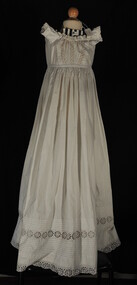
Clothing - Clothing, christening gown, c1900
... A long white cotton infant's Christening or 'walking-out' dress. The neckline and short sleeves have broderie anglais trim. ...This is one of many items that exhibit the skill and craftsmanship of the women in these families. clothing brighton moorabbin pioneers dendy henry market gardeners baptism dressmakers craft work maggs nance A long white cotton infant's Christening or 'walking-out' dress. The neckline and short sleeves have broderie anglais trim. ...This cotton baby's nightgown is an example of the dressmaking skills of the women of the families of the pioneer settlers and market gardeners of the Moorabbin Shire.The Maggs family were early settlers in the Moorabbin Shire. The pioneer settlers and market gardeners of Moorabbin Shire had to be self reliant and made their own clothing and utensils. This is one of many items that exhibit the skill and craftsmanship of the women in these families. A long white cotton infant's Christening or 'walking-out' dress. The neckline and short sleeves have broderie anglais trim. Bodice has extensive cut-work and hand embroidered feather-stitching. There is further hand-embroidered feather-stitching around the waist band. The skirt of the garment has pin-tucking and lower borders of further cut-work The garment is in good condition.clothing, brighton, moorabbin, pioneers, dendy henry, market gardeners, baptism, dressmakers, craft work, maggs nance -
 Flagstaff Hill Maritime Museum and Village
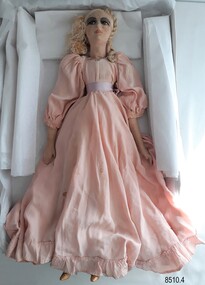
Leisure object - Boudoir Doll, c. early 1900s
... dress to their size. The dressmakers would learn the construction techniques from examining the dolls. Boudoir Dolls dolls usually had no maker's marks and were primarily used as bedroom decorations for ladies rather than as children's toys. This doll appears to date at about the early part of the 20th century, but the petticoats are much older - possibly from a child's christening...dress to their size. The dressmakers would learn the construction techniques from examining the dolls. Boudoir Dolls dolls usually had no maker's marks and were primarily used as bedroom decorations for ladies rather than as children's toys. This doll appears to date at about the early part of the 20th century, but the petticoats are much older - possibly from a child's christening ...The donor was given this doll about 50 years ago by her grandfather (in the late 1960s). He used to be a handyman at a high rise building in St Kilda, Melbourne. He had been doing some work for one of the old ladies and she gave him the doll to give to his granddaughter, who collected dolls. The doll has spent a few years at the Nagambie museum until it closed down and returned to the donor The origins or age of the doll are unknown. Originally it was thought to be a Fashion Doll dating from around the 1880s but the painted face together with the bisque legs and gold painted shoes are similar to those found on Boudoir Dolls (also known as Bed Dolls, Sofa Dolls, Flapper Dolls and French Dolls) of the early 20th century. Fashion dolls were sent from fashion houses to advertise the latest styles, fabrics, trims, hairstyles and accessories. Dressmakers would show these dolls to their customers. Ladies would then place their order and the dressmakers would make the dress to their size. The dressmakers would learn the construction techniques from examining the dolls. Boudoir Dolls dolls usually had no maker's marks and were primarily used as bedroom decorations for ladies rather than as children's toys. This doll appears to date at about the early part of the 20th century, but the petticoats are much older - possibly from a child's christening gown. At the time that the donor received the doll, it had a coloured lace over-gown that was badly torn so her mother removed it to replace with more lace but this never eventuated. The pink silk dress also appears to have been remodelled into a 19th century style with gathered sleeves and a gathered skirt. This fashion or boudoir doll is significant for being a rare example of a doll made in the late 19th or early 20th centuries. The doll is wearing clothing representing the fashion for young girls in that era. The doll is also significant as an item possibly used by fashion houses and dressmakers to advertise the latest fashions in clothing, trims, accessories and hairstyles. A doll such as this may have been found in a Victorian dressmaker's premises for use as a pattern and technique template and for a display to customers. It may also have been used as a decorative item in a lady's bedroom.Female boudoir doll with silk face and body, and porcelain lower arms and legs. She has plaited blonde silk hair. Her painted face has brown eyes and her shoes are painted gold. The doll is dressed in a long pink puffed-sleeve dress with a gathered waist and a ruffle at the hem. A pink ribbon around her waist is tied at the back. There are small silver balls hand-stitched around the neckline. She has a white, hand-embroidered lace petticoat and bloomers.warrnambool, flagstaff hill maritime museum, shipwreck coast, flagstaff hill maritime village, great ocean road, doll, boudoir doll, female doll, dressmaker's doll, display doll, late 1800s doll, fashion doll, antique doll, 19th century doll, children's fashion, girl's fashion, late 1800s children's fashion, early 20th century doll, composite doll, french doll -
 Orbost & District Historical Society
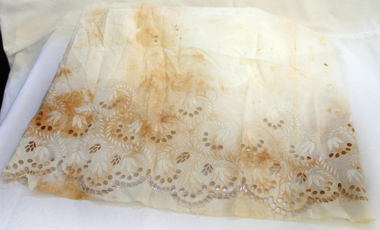
cloth, first half 20th century
... Baptism through the ages has held great importance in celebrating a new life for social and religious beliefs and to announce another generation. Christening gowns, dresses or robes became special for these occasions and followed fashion as life changed. this cloth is an example of the needlework skills of women in the early 20th century. cloth handcraft needlework A cloth of handmade broderie anglaise on white fine linen with white thread. cloth ...Was left over from material used for child's christening robe. was donated by Mrs Jo Hermann ( Elsie Winchester). Jo Hermann was an Orbost resident -blacksmith, painter and signwriter. Baptism through the ages has held great importance in celebrating a new life for social and religious beliefs and to announce another generation. Christening gowns, dresses or robes became special for these occasions and followed fashion as life changed. this cloth is an example of the needlework skills of women in the early 20th century.A cloth of handmade broderie anglaise on white fine linen with white thread.cloth handcraft needlework -
 Flagstaff Hill Maritime Museum and Village
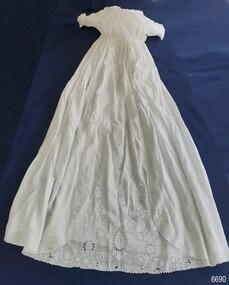
Clothing - Christening Gown, Sarah Lees, c. 1860's
... dress and pantaloons sewn by her mother. Sarah also crocheted lace curtains for her home in addition to large tablecloths and other articles. According to family legend, the skirt of this christening...dress and pantaloons sewn by her mother. Sarah also crocheted lace curtains for her home in addition to large tablecloths and other articles. According to family legend, the skirt of this christening ...In the words of the donor, Betty Stone, "This gown was originally made by my great grandmother Sarah Ellis (nee Chamberlain) Lees of Wangoom, Warrnambool. Later, the gown was altered by her daughter Ann (nee Lees) Dale who also used it for the christenings of her five children in the 1890's, and later still, for some of her grandchildren. Sarah Ellis Chamberlain, born in Thriplow, Cambridgeshire, England on 31 July 1844, sixth child of Joshua and Susan Chamberlain, was ten years old when she arrived in Australia with her parents and siblings in January 1855. Ten years later, in 1864, Sarah Chamberlain married Lees Lees, a skilled stonemason who had migrated from Saddleworth, Yorkshire. Lees Lees purchased land in McGregors Road, Wangoom, Warrnambool where he operated a successful stonemasonry, contracting business until his death in 1912. The Lees farm, which eventually consisted of about fifty acres, was situated adjacent to both the Chamberlain and Dale farms. Sarah Lees was a meticulous homemaker who also fashioned and sewed clothes for her seven children. A photograph of the eldest child, Anne, taken in 1868, depicts her wearing a dress and pantaloons sewn by her mother. Sarah also crocheted lace curtains for her home in addition to large tablecloths and other articles. According to family legend, the skirt of this christening gown was part of the original gown hand-sewn by Sarah (nee Chamberlain) Lees which was used for the christening of her children. The gown was later passed on to her daughter Anne (nee Lees) Dale who, also an expert needlewoman, replaced the bodice and used it for the christening of her five children born between the years 1890 and 1899. Still, later, at least two children of the third generation (Sarah Lees' great-grandchildren) also wore this gown when christened at Christ Church Warrnambool. Sarah (nee Chamberlain) Lees died in 1932, aged 87 years, at her daughter Anne Dale's home in Latrigg. Anne (nee Lees) Dale died in 1948 aged 83 years, at her home in Latrigg." (Note: For additional information please refer to Betty Stone’s book “Pioneers and Places - A History of three Warrnambool Pioneering Families” ie. Chamberlain, Dale and Lees Families)This item is associated with the families of Chamberlain, Dale and Lees. These families are listed in the "Pioneers' Register" for Warrnambool Township and Shire, 1835-1900, published by A.I.G.S. Warrnambool Branch. The item is a fine example of late-19th-century needlework and handmade domestic items.Christening gown made by Sarah Ellis. White with unusual Broderie Anglaise yoke. The long-sleeved garment has a gathered waist and a long skirt. The front centre of the skirt has a floral Broderie Anglaise and cut work panel insert.Circa 1860's. From the 'Chamberlain Dale Lees Collection’, donated by Betty Stoneflagstaff hill, warrnambool, shipwrecked coast, flagstaff hill maritime museum, maritime museum, shipwreck coast, flagstaff hill maritime village, great ocean road, chamberlain, dale, lees, stone, betty stone, warrnambool pioneers, sarah ellis, hand sewn, christening gown, baby wear, clothing, 19th century -
Warrnambool and District Historical Society Inc.
Photograph - Wangoom Methodist Church members, 1888
... Christening Dixon Baby. This is a faded photograph mounted on a piece of cardboard. It depicts gentlemen, ladies and children standing and sitting in front of a building. The ladies and children are wearing hats and the gentlemen are dressed ...This is a photograph of those attending the Wangoom Methodist church picnic and christening in 1888. The Wangoom Methodist church was established in 1859 on the Wangoom Road. It was a weather board building seating 100 people. The Gothic windows and the pulpit came from the first Warrnambool Wesleyan chapel (1850) The church closed in 1963. The Christening was of a Dixon child and the Dixon family were early members of the Wangoom church congregation. This photograph is of considerable significance as it documents some of the congregation of the Wangoom Methodist church in 1888 and the clothing worn at the time. This is a faded photograph mounted on a piece of cardboard. It depicts gentlemen, ladies and children standing and sitting in front of a building. The ladies and children are wearing hats and the gentlemen are dressed in suits.Two ladies are holding babies. A separate item is a piece of brown paper with blue ink hand writing. WANGOOM OCT. 18 1888 Wangoom Methodist Picnic and Christening Dixon Baby.wangoom methodist church, warrnambool methodism, dixon, wangom -
 Bendigo Historical Society Inc.
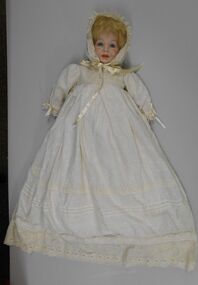
Leisure object - DOLL COLLECTION: KAMMER AND REINHARDT PORCELAIN DOLL, 1910-1914
... She is dressed in a long sleeved, extended christening like robe of cream broderie anglaise. ...She is dressed in a long sleeved, extended christening like robe of cream broderie anglaise. ...Doll maker Kammer and Reinhard bisque doll heads and bodies were designed by them, but most heads were manufactured by Simon & Halbig which is why heads bear both marks.Kammer and Reinhardt porcelain and cloth baby doll mould number 116A circa 1912. She has a porcelain head, forearms and lower legs and feet. The rest of her body is a stuffed material calico. Her legs are jointed at the knees. She is dressed in a long sleeved, extended christening like robe of cream broderie anglaise. The robe has decorative pintucking and lace on the bodice, sleeves, cuffs and skirt with a contrasting broderie anglaise hem. Part of a lace insert has become unstitched at the front. Underneath is a full petticoat of white cotton with pintucking and lace with a white broderie anglaise hem. Another full length petticoat of cream linen trimmed with lace is also underneath. She has a cream knitted singlet and knickers with cream knitted bootees. She has short blonde matted hair and wears a lace trimmed broderie anglaise bonnet with satin ribbons to match her robe.Initials K and R either side of a Star of David and the words Simon and Halbig below with the mould no 116/Atoys, dolls, porcelain -
 Warrnambool and District Historical Society Inc.
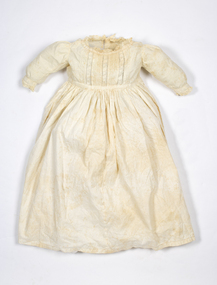
Clothing - Baby's Christening Gown, 1890
... This Christening gown belonged to William Edward Housden who was born in Castlemaine in 1890 and died in Warrnambool in 1972. He served in World War One and married Lucy Knowles in 1921. It was on occasions, and still is, a common practice to make a special dress...This Christening gown belonged to William Edward Housden who was born in Castlemaine in 1890 and died in Warrnambool in 1972. He served in World War One and married Lucy Knowles in 1921. It was on occasions, and still is, a common practice to make a special dress ...This Christening gown belonged to William Edward Housden who was born in Castlemaine in 1890 and died in Warrnambool in 1972. He served in World War One and married Lucy Knowles in 1921. It was on occasions, and still is, a common practice to make a special dress for a baby's Christening or to use a gown that has been handed down over the generations. This is a fine example of a Christening gown made for a baby 130 years ago.This is a Christening gown made of cream cotton. It is high waisted with a gathered skirt and a pintucked bodice with hand embroidered leaves and fine drawn thread work. The draw string waist opens at the back. It has long sleeves with lace and embroidered cuffs. There is lace and draw string tape around the neck. The seams have been machined.william edward housden, christening gowns -
 Embroiderers Guild, Victoria
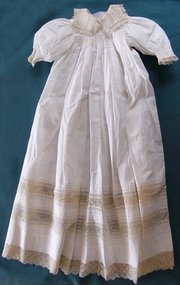
Clothing - Christening Robe, Mrs Charlotte Sarah Webb, Before 1907
... Christening Robe Petticoats Embroidery Heirloom sewing Australia 1900-20 Lace White cotton, dress has a fine self stripe, gathered bodice and squared collar of torchon lace and insertion, gathered sleeves, and pintucks, insertion and lace at skirt edge. ...Part of a complete layette made by donor's maternal grandmother Mrs Charlotte Sarah Webb (nee Richardson) before 1907 (1865-51). The layette won equal second prize at the First Australia Exhibition of Women's Work 1907. Part of a complete layette, which won equal second prize at the first Australian Exhibition of Women's Work 1907. White cotton, dress has a fine self stripe, gathered bodice and squared collar of torchon lace and insertion, gathered sleeves, and pintucks, insertion and lace at skirt edge. christening robe, petticoats, embroidery, heirloom sewing, australia, 1900-20, lace -
Tatura Irrigation & Wartime Camps Museum
Clothing - Dress, Christening Gown
... Bottom of from has many folds, and flower pattern with holes. Christening Gown Clothing Dress ...Cotton white gown made for a christening of a child in camp. Made by unknown personWhite cotton dress with round next, short sleeved. Bottom of from has many folds, and flower pattern with holes. -
 Whitehorse Historical Society Inc.
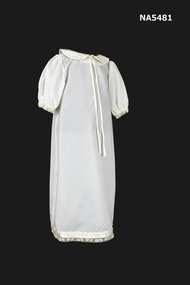
Clothing - Dress, Christening Gown, c 1990
... It closes at the back with a false button and press stud fastening. Christening Gown Clothing Dress GLENN, Valerie Rose ...Handmade by the donor, using fabric from the donor's wedding dressc1990Handmade cream nylon christening gown with applied lace, satin ribbon and embroidery. It closes at the back with a false button and press stud fastening.Nilbaby clothing, christening gown, handmade -
 Whitehorse Historical Society Inc.
Book - Hatches, Matches and Dispatches, 1987
... Christening, Bridal and Mourning Fashions from 16th century to present day Clothing and Dress 121p A4 Christening , Bridal and Mourning Fashions From16th Century to present day Book Hatches, Matches and Dispatches Clark, Rowena ...Christening, Bridal and Mourning Fashions from 16th century to present day121p A4 Christening , Bridal and Mourning Fashions From16th Century to present dayclothing and dress -
 Kew Historical Society Inc
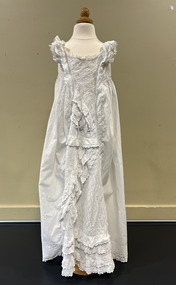
Clothing - Christening Gown, 1899-1910
... dresses worn by adult women. Gowns were typically made of fine white linen or cotton, and often trimmed with tucks, lace, whitework embroidery, and other handwork. The Kew Historical Society's collection includes over twenty-five gowns dating from the 19th and 20th centuries. This christening...dresses worn by adult women. Gowns were typically made of fine white linen or cotton, and often trimmed with tucks, lace, whitework embroidery, and other handwork. The Kew Historical Society's collection includes over twenty-five gowns dating from the 19th and 20th centuries. This christening ...In the early 19th century, infant gowns were modelled on dresses worn by adult women. Gowns were typically made of fine white linen or cotton, and often trimmed with tucks, lace, whitework embroidery, and other handwork. The Kew Historical Society's collection includes over twenty-five gowns dating from the 19th and 20th centuries. This christening gown was worn by one or more of the Weir children.This is one of ten items of clothing, worn by infants in the Weir family of Broken Hill between 1899 and 1910. They are part of the larger Weir Family collection of clothing, documents and photographs gifted to the Kew Historical Society by their descendants. Due to their known provenence, the gowns are historically and aesthetically significant in that they can be accurately dated to an 11-year-period, allowing other comparable items of infant's and children's clothing to be dated to an earlier, silmilar or later period. They also exemplify the styles and decorative techniques used for christening gowns, infant's and children's clothing of the period.Long, white cotton christening gown. The high-necked, short-sleeved bodice has a number of decorative elements. This includes an extesive use of lace in diagonal panels at the front above four horizontal layers of the same lace. There are two layers of lace forming the sleeves. Nilchristening gowns, ceremonial clothing, children's wear, baptismal clothing, victorian historical themes — 8.6 marking the phases of life -
 Kew Historical Society Inc
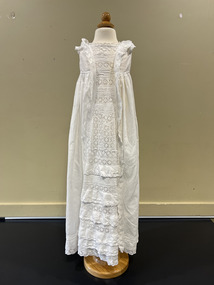
Clothing - Christening Gown, 1891-1910
... dresses worn by adult women. Gowns were typically made of fine white linen or cotton, and often trimmed with tucks, lace, whitework embroidery, and other handwork. The Kew Historical Society's collection includes over twenty-five gowns dating from the 19th and 20th centuries. This christening...dresses worn by adult women. Gowns were typically made of fine white linen or cotton, and often trimmed with tucks, lace, whitework embroidery, and other handwork. The Kew Historical Society's collection includes over twenty-five gowns dating from the 19th and 20th centuries. This christening ...In the early 19th century, infant gowns were modelled on dresses worn by adult women. Gowns were typically made of fine white linen or cotton, and often trimmed with tucks, lace, whitework embroidery, and other handwork. The Kew Historical Society's collection includes over twenty-five gowns dating from the 19th and 20th centuries. This christening gown was worn by one or more of the Weir children.This is one of ten items of clothing, worn by infants in the Weir family of Broken Hill between 1899 and 1910. They are part of the larger Weir Family collection of clothing, documents and photographs gifted to the Kew Historical Society by their descendants. Due to their known provenence, the gowns are historically and aesthetically significant in that they can be accurately dated to an 11-year-period, allowing other comparable items of infant's and children's clothing to be dated to an earlier, silmilar or later period. They also exemplify the styles and decorative techniques used for christening gowns, infant's and children's clothing of the period.Long, white cotton christening gown. The high-necked, short-sleeved bodice has a number of decorative elements. These include an extesive use of lace in horizontal and triangular panels of various styles at the front. Two long bands of lace frame this central panel.Nilchristening gowns, ceremonial clothing, children's wear, baptismal clothing, victorian historical themes — 8.6 marking the phases of life -
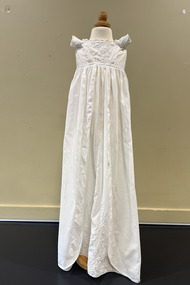 Kew Historical Society Inc
Clothing - Christening Gown, 1891-1910
... dresses worn by adult women. Gowns were typically made of fine white linen or cotton, and often trimmed with tucks, lace, whitework embroidery, and other handwork. The Kew Historical Society's collection includes over twenty-five gowns dating from the 19th and 20th centuries. This christening...dresses worn by adult women. Gowns were typically made of fine white linen or cotton, and often trimmed with tucks, lace, whitework embroidery, and other handwork. The Kew Historical Society's collection includes over twenty-five gowns dating from the 19th and 20th centuries. This christening ...In the early 19th century, infant gowns were modelled on dresses worn by adult women. Gowns were typically made of fine white linen or cotton, and often trimmed with tucks, lace, whitework embroidery, and other handwork. The Kew Historical Society's collection includes over twenty-five gowns dating from the 19th and 20th centuries. This christening gown was worn by one or more of the Weir children.This is one of ten items of clothing, worn by infants in the Weir family of Broken Hill between 1891 and 1910. They are part of the larger Weir Family collection of clothing, documents and photographs gifted to the Kew Historical Society by their descendants. Due to their known provenence, the gowns are historically and aesthetically significant in that they can be accurately dated to an 19-year-period, allowing other comparable items of infant's and children's clothing to be dated to an earlier, silmilar or later period. They also exemplify the styles and decorative techniques used for christening gowns, infant's and children's clothing of the period.Long, fine white cotton christening gown. The high-necked, short-sleeved bodice has a number of decorative elements. These include an extesive use of white work on the sleeves, bodice and gown. Tight ruching at the waist allows a central panel of white work to be framed by the larger panel which acts as a polonnaise. This contains the finest workmanship of the christening gowns and infants clothing in the Weir Collection and may date to 1891.Nilceremonial clothing, children's wear, baptismal clothing, victorian historical themes — 8.6 marking the phases of life, christening gown
