
Showing 15 items matching "christmas pudding"
-
 Tatura Irrigation & Wartime Camps Museum
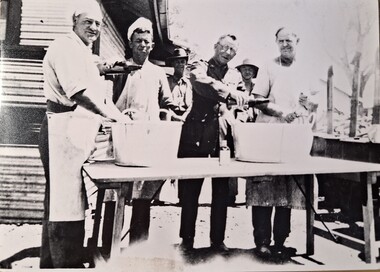
Photograph, Christmas Pudding
... Christmas Pudding...Christmas pudding...Making of the Christmas pudding at Camp 4. Captain Scates in the middle. ...They are pouring liquid into two big tubs, making Christmas pudding....Making of the Christmas pudding at Camp 4. Captain Scates in the middle. ...Making of the Christmas pudding at Camp 4. Captain Scates in the middle. Black and white photograph of 6 men, 4 in front and 2 behind. 3 of the 4 men in front in white aprons the other in uniform. The two men in background are in uniform. They are pouring liquid into two big tubs, making Christmas pudding.christmas pudding, camp 4 kitchen staff, captain scates -
 Whitehorse Historical Society Inc.
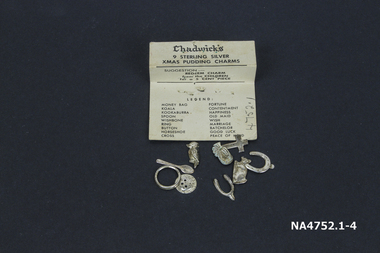
Domestic object - Christmas Pudding Charms
... Christmas Pudding Charms...From the kitchen of Abigail Schwerkolt and used in the Christmas puddings or her grandchildren. This must have been after 1966, because of decimal currency. ...Six Sterling silver Christmas Pudding Charms....Donor found these when cleaning out the house in 1994. domestic items food storage & preservation metalcraft sterling silver Chardwicks Six Sterling silver Christmas Pudding Charms. Domestic object Christmas Pudding Charms ...From the kitchen of Abigail Schwerkolt and used in the Christmas puddings or her grandchildren. This must have been after 1966, because of decimal currency. Donor found these when cleaning out the house in 1994.Six Sterling silver Christmas Pudding Charms.Chardwicksdomestic items, food storage & preservation, metalcraft, sterling silver -
 Ringwood RSL Sub-Branch
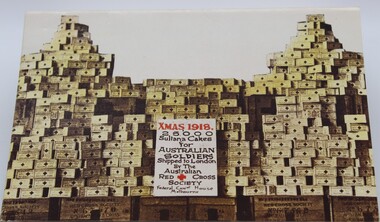
Postcard - Photo, Army WW2, Christmas card
... WW2 Making Christmas Puddings, Christmas Fare....WW2 Making Christmas Puddings, Christmas Fare. Christmas Cards Reproductions 2 x WW1 2 X WW2 Christmas card Postcard Photo, Army WW2 ...Christmas Cards Reproductions 2 x WW1 2 X WW2WW1 Cakes being sent to Australian Troops serving in France. WW2 Making Christmas Puddings, Christmas Fare. -
 Merbein District Historical Society
Journal - Quarterly, Merbein Historian - Quarterly Journal of MDHS - No 38 (2 copies), Dec.2009
... Curtis - Hilda Christmas Pudding...Christmas Merbein 1929 Curtis - Hilda Christmas Pudding Jenny Hawkes Alison Whiting Centenary Celebrations Pictorial Raylee Schultz Bill Bennett Let the Wedding Bells Ring Rhonda Murray Tony McKenzie Val Golding Palms Historic plaque Centenary Room Cowanna Bend Picnic 1912 - 1916 Fred Curtis Betty Henderson Jill Thomson Bernadette Wells Kevin Forbes Vernon (Cr) Knight Laurie Henderson Alf Henderson Annie Henderson Walter Humphrey Henry Curtis Maria Treadwell Vincent Treadwell Myrtle & Thomas McMillan Maggie & Jim McMillan Florence Treadwell Hilda Curtis Eva Bush Nell Treadwell William & Muriel Lindenberg Leigh Treadwell John Arnold Merbein Historian - Quarterly Journal of MDHS - No 38 (2 copies) Journal Quarterly ...christmas merbein 1929, curtis - hilda christmas pudding, jenny hawkes, alison whiting, centenary celebrations pictorial, raylee schultz, bill bennett, let the wedding bells ring, rhonda murray, tony mckenzie, val golding, palms historic plaque, centenary room, cowanna bend picnic 1912 - 1916, fred curtis, betty henderson, jill thomson, bernadette wells, kevin forbes, vernon (cr) knight, laurie henderson, alf henderson, annie henderson, walter humphrey, henry curtis, maria treadwell, vincent treadwell, myrtle & thomas mcmillan, maggie & jim mcmillan, florence treadwell, hilda curtis, eva bush, nell treadwell, william & muriel lindenberg, leigh treadwell, john arnold -
 Melbourne Legacy
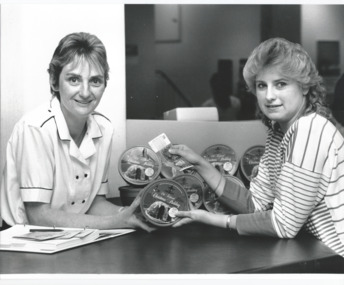
Photograph - Photo, Fundraising, Legacy Christmas Puddings
... Legacy raised funds from the sale of Christmas puddings for a few years. Cost of the puddings were $3.50. ...Legacy raised funds from the sale of Christmas puddings for a few years. Cost of the puddings were $3.50. ...Legacy raised funds from the sale of Christmas puddings for a few years. Cost of the puddings were $3.50. Large corporations like banks agreed to sell the puddings on Legacy's behalf. The photo was featured in a the President's highlights report.A record that corporations helped sell puddings for Legacy as part of their fundraising.Black and white photo x 2 of a bank teller selling Legacy puddings and associated order forms and promotional brochure.christmas, fundraising -
 Melbourne Legacy
Photograph - Photo, Widows Club, 30/10/1991
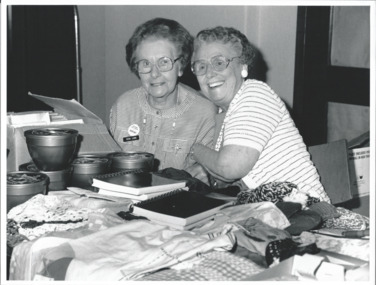
... The items include Christmas puddings. The Widow clubs often ran trading stalls of goods and handcrafts. ...The items include Christmas puddings. The Widow clubs often ran trading stalls of goods and handcrafts. ...Widow club secretary Vera Lang and another lady at a trading table. The items include Christmas puddings. The Widow clubs often ran trading stalls of goods and handcrafts. Keesing Photographers took a series of photos on the same day of various ladies. It is assumed that the date was 1991 due to the reference number from the photographic studio 911030C-15 could mean 30 October 1991, along with 00645, 00646, 00647, 00648, 00649, 00651, 00661 to 00666.Photos of the committee members of Widows clubs were taken by a professional photographer.Black and white photo of 2 Legacy widows at a trading table and a proof sheet.Label on the back from Keesing Photographic with Reference No: 911030C-30A and 6 in pencil.widows, widows club -
 Seaworks Maritime Museum
Menu
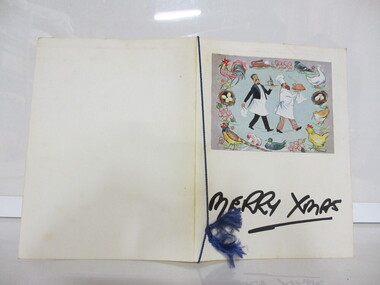
... ./ At Sydney/ XMAS DINNER/ Grapefruit Maraschine/ Chilled Orange Juice/ Consomme Royale/ Cream of Tomato/ Seafood Cocktail Darn of Salmon Holondaise/ Chicken Vol au Vente/ Roast Norfolk Turkey Chipolata/ Cranberry Sauce/ POTATOES/ Straw Roast Parsley/ Green Peas Brussel Sprouts Mixed Vegetables/ COLD BUFFET/ Pale Ham Roast Beef Corned Beef/ SALADS/ Asparagus Vinnaigrette Fresh Beetroot & Onion/ SWEETS/ Christmas Pudding and Rum Sauce/ Strawberries & Ice Cream Bartlett Pears and Cream/ Assorted Nuts/ Fresh Fruits/ Assorted Cheeses/ Coffee Biscuits"..../ At Sydney/ XMAS DINNER/ Grapefruit Maraschine/ Chilled Orange Juice/ Consomme Royale/ Cream of Tomato/ Seafood Cocktail Darn of Salmon Holondaise/ Chicken Vol au Vente/ Roast Norfolk Turkey Chipolata/ Cranberry Sauce/ POTATOES/ Straw Roast Parsley/ Green Peas Brussel Sprouts Mixed Vegetables/ COLD BUFFET/ Pale Ham Roast Beef Corned Beef/ SALADS/ Asparagus Vinnaigrette Fresh Beetroot & Onion/ SWEETS/ Christmas Pudding and Rum Sauce/ Strawberries & Ice Cream Bartlett Pears and Cream/ Assorted Nuts/ Fresh Fruits/ Assorted Cheeses/ Coffee Biscuits" Card menu with paper insert. ...Card menu with paper insert. Front has image of a chef and a waiter surrounded by birds. Has a blue string around the middle.Front: "MERRY XMAS" Inside: "We wish you a very merry Xmas/ m.v Halifax Star/ 25th December 1965./ At Sydney/ XMAS DINNER/ Grapefruit Maraschine/ Chilled Orange Juice/ Consomme Royale/ Cream of Tomato/ Seafood Cocktail Darn of Salmon Holondaise/ Chicken Vol au Vente/ Roast Norfolk Turkey Chipolata/ Cranberry Sauce/ POTATOES/ Straw Roast Parsley/ Green Peas Brussel Sprouts Mixed Vegetables/ COLD BUFFET/ Pale Ham Roast Beef Corned Beef/ SALADS/ Asparagus Vinnaigrette Fresh Beetroot & Onion/ SWEETS/ Christmas Pudding and Rum Sauce/ Strawberries & Ice Cream Bartlett Pears and Cream/ Assorted Nuts/ Fresh Fruits/ Assorted Cheeses/ Coffee Biscuits" -
 Melbourne Legacy
Photograph, JL artwork on Christmas cards, 1989
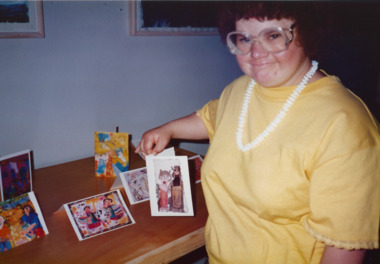
... Also a photo of a girl in a motorised wheel chair selling the Christmas cards and Legacy puddings in a street. Photos were taken by Susie Howard who was publicity officer for Legacy at the time. ...Also a photo of a girl in a motorised wheel chair selling the Christmas cards and Legacy puddings in a street. Photos were taken by Susie Howard who was publicity officer for Legacy at the time. ...Legacy raised funds from the sale of Christmas cards for many years. In 1989 they chose artwork by a Junior Legatee (name not known at the moment) to feature on the cards. Also a photo of a girl in a motorised wheel chair selling the Christmas cards and Legacy puddings in a street. Photos were taken by Susie Howard who was publicity officer for Legacy at the time. Was in a scrapbook of photos spanning 1987 to 1991.A record that Legacy valued the artwork of a junior legatee and used it for fundraising Christmas cards.Colour photo x 5 of a Junior Legatee who had her artwork reprinted as Legacy Christmas cards in 1989.christmas, fundraising, junior legatee, painting -
 Wangaratta RSL Sub Branch
Mixed media - Framed photograph and objects, Pte Sidney Spencer Plum
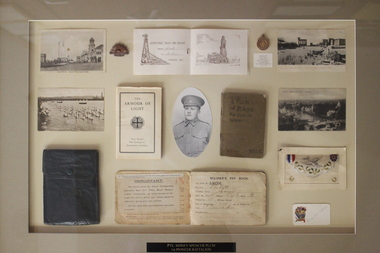
... The Captain of our company gave me a Christmas pudding. All the same I wished I were back in Australia again. ...The Captain of our company gave me a Christmas pudding. All the same I wished I were back in Australia again. ...Collection of personal effects that belonged to Private SIdney Spencer Plum, 3431 1st Pioneer Battalion. SIdney was born on 3/1/1894 at Dockers Plains via Wangaratta. He attended both North Wangaratta and Dockers Plains schools. He was a Blacksmith aged 21 years when he enlisted on 12/6/1915 and embarked on 11/10/1915 on board HMAT Nestor. He was wounded three times and was discharged from the AIF on 16/3/1919. Items include oval photo of Sidney Plum in the centre surrounded by four post cards, one embroidered post card of a dove with an envelope in it's beak with the Union Jack and French flag, a Greetings From The Front" booklet, "The Armour of Light" bible, "A Form of Prayer for open air services" book, Soldier's Pay Book, a "To my dear Mother" card, a black leather pouch, a rising sun badge, round gold medallion. A framed montage of personal items belonging to Private Sydney Spencer PLUM compiled by his family to honour his memory and service. In addition to general military issue the remaining items were most likely purchased whilst on leave in France and England during the first world war. Postcards particularly embroidered postcards were sent home to loved ones and friends.Framed Collection of personal effects - Private Sidney Spencer Plum, 1st Pioneer Battalion. Includes oval photo of Sidney Plum in the centre surrounded by four post cards, one embroidered post card of a dove with an envelope in it's beak with the Union Jack and French flag, a Greetings From The Front" booklet, "The Armour of Light" bible, "A Form of Prayer for open air services" book, Soldier's Pay Book, a "To my dear Mother" card, a black leather pouch, a risen sun badge, round gold coloured medalion. Frame has a donation plaque.Front: Pte Sidney Spencer Plum, 1st Pioneer Battalion. Donated by Max & Hilary (Plum) Ryan and Sylvia Reed (Plum) of Wangarattaa Back: Wangaratta Picture Framers 9 Oct 2003. Also has messages from front postcards; Dear Mother, Just a few lines to let you know that I am alright hoping that you and all the rest is well too. We have had three fogs over here and it is very cold at night. I was picked in Cairo and they had some Turkey Officers an a German spy in gaol there. I wrote to Aunt Nelline. I got two letters from Alf. Maude Saxby hasnt wrote to me since I was up there on final leave. I get the letters quicker. I got Alf photos all right. I will be having Christmas in London. Well I think this is all this. I remain you son Sid. Tell Alf to send me over the Age so I can see how the war is going. I suppose Dad and the rest is busy harvesting now. Glad to hear that you got the photos all right. I think this is all this time from Sid same address as before. Dear Mother, Just a few lines to let you know that I am keeping well hoping that you and every body is the same. We have some great fogs over here, it rained all one night. We had a very good Christmas we got a billy issued to us and it had every thing in it. The Captain of our company gave me a Christmas pudding. All the same I wished I were back in Australia again. I think this is all this time. Yours truely son Sid, 25/12/15plum, sidney, world war 1, postcards, embroidered postcard, soldier's pay book, leather pouch, bible, prayer book, sydney -
 Flagstaff Hill Maritime Museum and Village
Article - Ointment, Bates & Co. (William Usher), 1851 - mid-1900s
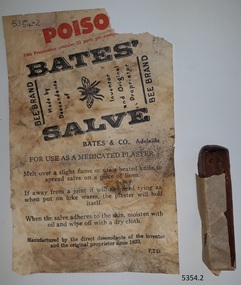
... The contents included Christmas puddings and tobacco. The huge project was coordinated by a local Committee and involved generous businesses and hundreds of kind-hearted community members, with recognition sown by naming many of those involved in an article in the Warrnambool Standard. ...The contents included Christmas puddings and tobacco. The huge project was coordinated by a local Committee and involved generous businesses and hundreds of kind-hearted community members, with recognition sown by naming many of those involved in an article in the Warrnambool Standard. ...Bates' Salve has been used as a home remedy for the treatment of boils, skin infections, splinters, pimples and insect bites for decades, from the mid-1800s to the mid-1900s. It is a drawing application for bringing out foreign bodies and pusses from a wound. There are still many families who remember using it and others who have been using it and are down to their last ‘inch’. One comment from a reader from Queensland tells how his Dad was a sleeper cutter in the 1950s and on school holidays his brother and he used to help their Dad. When doing this task after a wet season they would be confronted with spear grass about a metre high. Sometimes the spears would enter their skin, and when the spears were wet they would screw like a corkscrew into their flesh. If they left them for too long it was impossible to dig them out with a needle. That's when the Bates Salve was put into action to draw the spearhead out. "It worked wonders. It was a marvellous invention." Many people say that they would love to be able to purchase more of it today and hope that someone will produce a ‘safe’ version of it. There are several versions of a recipe for the salve available online. It appears that the salve is named after Daisy Bates, wife of the Bates’ Salve proprietor, William Usher. William’s son Victor continued making Bates’ Salve well into the mid-1900s, with the business being carried on by Victor’s only son, Alan. There are still descendants in the family home in Norwood, Adelaide. William’s great-grandchild has stated that, despite being subject to the salve during childhood, there have been no noticeable ill effects. A small notice in the Adelaide Advertiser in 1915 made a suggestion “It is said that Bates’ Salve is the popular line with OUR BOYS in Gallipoli. They recently sent to the Adelaide Red Cross for a supply, so it would be a good line to put in soldiers’ Christmas Billies.“ Over 700 ‘Christmas Billies’ were sent from generous Warrnambool citizens to our soldiers in the trenches in Gallipoli. The average cost of filling a billy with gifts was Ten Shillings, calculated at about Fifty-four Dollars in 2021. The contents included Christmas puddings and tobacco. The huge project was coordinated by a local Committee and involved generous businesses and hundreds of kind-hearted community members, with recognition sown by naming many of those involved in an article in the Warrnambool Standard. The project’s idea was initiated by Australia’s Department of Defence and all states were involved in supporting the soldiers in this way. Mr Bates (Theopholis) of Hull, England, was the original owner of the Bates’ Salve recipe. When he died he left his business to William Usher, his son-in-law. William arrived in South Australia in 1851 after he had sold his recipe to an English firm, giving them the rights to make and sell it all over the world, except in Australia. Bates then became the registered proprietor of Bates’ Salve for the Commonwealth and still had a large market for his product. William Usher made the salve at his Norwood home, in a wood-fired copper in the garden within a three-sided enclosure. The ointment was then taken to a room in the house where it was divided, labelled and packaged. It was then sent to Faulding’s Wholesale Chemist for distribution. William and his wife May (or Mary) had three children; Jack, Victor and Ivy. When May died, William married Mary Williams (May’s maid, from Tasmania, twenty years younger than William) and had seven more children. The treatment’s packaging labels it as a POISON. It seems that its active ingredient was lead oxide (22 per cent), which is no longer considered unsafe. A member of the public mentioned that in 2016 they found some Bates’ Salve in an old family medicine chest. Its label stated that the product “contains a minimum of 25.8 per cent of red lead oxide”. That particular sample was made at 470 Wallon Road, West Molesey, Surrey, England. Some people would love to be able to use the product still and even take the risk of poisoning. Instructions for its use are included on the wrapper. Here is a transcription - "Bates' Salve. Bee Brand. POISON. This Preparation contains 22 parts per centum [lead oxide]… Made by Descendants of the Inventor and Original Proprietor. For use as a medicated plaster. Melt over a slight flame or use a heated knife to spread the salve on a piece of linen. If away from a joint it will not need tying as, when put on lukewarm, the plaster will hold itself. When the salve adheres to the skin moisten it with oil and wipe it off with a dry cloth. Manufactured by the direct descendants of the inventor and the original proprietor since 1833."This package of Bates' Salve has been used as a home remedy since the mod-1800s and even up to now in 2019 by those who consider themselves lucky to still have some at home. It was promoted as a 'cure all' treatment and kept handy for use at home and away. It represents our early industry and health management when medical treatment was often difficult to access. The product is the part of many childhood memories of those alive today.Bates’ Salve ointment; oblong stick of firm, brown waxy substance wrapped in waxed paper, with an outer printed wrapper. Text on wrapper warns that it is POISON and includes instructions for use as a medicated plaster, to be heated and spread onto linen then applied to the injury. Made by Bates & Co., Adelaide. The wrapper shows an emblem of a bee. The formula has been used since 1833.Text on wrapper includes "POISO[N]", "BATES' SALVE", "BEE BRAND", "BATES & CO., ADELAIDE". "This Preparation contains 22 parts per centum [lead oxide]" There is an emblem of a bee with wings outstretched.flagstaff hill, warrnambool, shipwrecked-coast, flagstaff-hill, flagstaff-hill-maritime-museum, maritime-museum, shipwreck-coast, flagstaff-hill-maritime-village, bates’ salve, bates’ salve medicated plaster, bates and co adelaide, bee brand, medicated plaster, medical treatment, remedy, drawing treatment for infection, medicine cabinet, home remedy, pharmacy treatment, mid 1800s – mid 1900s remedy, topical application, treatment for boils, bites, splinters and infections, poison, preparation for treatment, ointment -
 Mission to Seafarers Victoria
Photograph - Cyanotype, The Missions to Seamen, Melbourne - Ladies Harbour Light Guild - 21st Birthday Cake Present by Captain C.A.M. Derham 1928, 1928
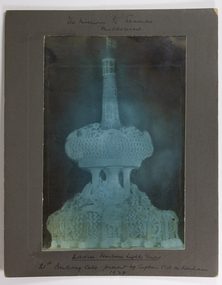
... They also supplied the mission with plum puddings on every Christmas events. Captain C.A.M Derham enlisted in 1915 and was discharged in 1919. ...The party was organised on the Saturday 8 December 1928, 3pm. Captain Charles Alfred Melbourne Derham, son of Frederick Thomas Derham, partner and managing director of Swallow & Ariell Pty Ltd (biscuit company in 1854 in Port Melbourne). The Derham family had been involved with the Port Melbourne mission since the beginning as the factory was producing "ship biscuits". The company was renowned for its patriotic fundraising campaigns during both world wars. They also supplied the mission with plum puddings on every Christmas events. Captain C.A.M Derham enlisted in 1915 and was discharged in 1919. The same year he married Eileen Cuscaden sister of Beatrice Cuscaden (Honorary Secretary of the South Yarra branch of the LHLG), and daughter of Dr George Cuscaden, previously ship surgeon, honorary surgeon of the Women's Hospital and director of Swallow & Ariell. The photograph was published in the 1928 Annual Report. The print shows the curtain background.Photograph of the cake presented to the LHLG in 1928: on top of the cake a lighthouse.Ladies Harbour Light Guild - 21st Birthday Cake Present by Captain C.A.M. Derham 1928charles alfred melbourne derham, swallow and ariell, frederick thomas derham, cyanotyp, eileen cuscaden, beatrice cuscaden, dr george cuscaden, lhlg, anniversary, lighthouse, flag -
 Marysville & District Historical Society
Postcard (Item) - Colour postcard, Nucolorvue Productions, Autumn Tints in Main Street, Marysville, c1940s
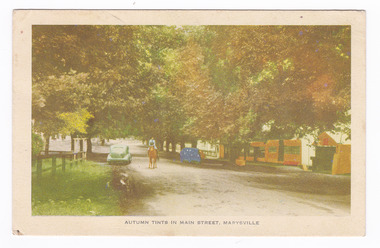
... ./ We had a lovely Christmas/ dinner of turkey and plum pudding. We had a/ dance Christmas night st the house and it was/ very enjoyable. ..../ We had a lovely Christmas/ dinner of turkey and plum pudding. We had a/ dance Christmas night st the house and it was/ very enjoyable. ...A colour photograph of Murchison Street in Marysville in Victoria during Autumn.A colour photograph of the main street in Marysville in Victoria during Autumn. This street is now known as Murchison Street. This postcard was produced by Nucolorvue Productions as a souvenir of Marysville.POST CARD NUCOLORVUE PRODUCTIONS, ELWOOD, VICTORIA "Roseleigh"/ 27/12/47 My Dear Shirlie,/ Just a few lines to let you know we/ are having a lovely time at Marysville./ We had a lovely Christmas/ dinner of turkey and plum pudding. We had a/ dance Christmas night st the house and it was/ very enjoyable. There are lovely kind friendly/ people here, and everything is very pleasant./ We went for a lovely walk to the/ wishing well and the Taggerty river yesterday/ morning. Yesterday afternoon we went in for/ a swim in the swimming pool and it/ was lovely. Last night we had a bit of a talent/ quest and I won the ladies section and a man/ won the mens. So I was very pleased! Well/ think I will say cheerio for the moment, with/ lots of love from Dot xxxxxx/ P.S. Please give my very kind regards to/ Ivan. murchison street, marysville, victoria, nucolorvue productions, postcard, souvenir -
 Embroiderers Guild, Victoria
Decorative Object - Christmas Decorations (1273 A - G), Amanda (Mandy) Ginsberg, Christmas Decorations, 2003
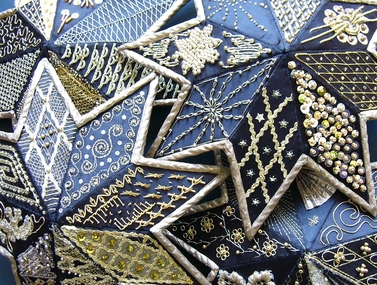
... Christmas stocking. Embroidered - Jan Green, Quilted - Margaret Jessel, constructed - Bev Lane 1273c & d. Summer puddings...Christmas stocking. Embroidered - Jan Green, Quilted - Margaret Jessel, constructed - Bev Lane 1273c & d. Summer puddings ...In November 2003 the Guild decorated part of the Johnson Collection (in East Melbourne) for Christmas. The exhibition was so successful that it was extended to March 2004. This is a representative sample of the pieces made by members during 2003."1273a. Ribbon/cord which decorated the Christmas trees. (Mandy Ginsberg, Dorothy Morgan, Kate Dungan, Ailsa Hailes, Melanie Hill. 1273b. Christmas stocking. Embroidered - Jan Green, Quilted - Margaret Jessel, constructed - Bev Lane 1273c & d. Summer puddings. Rachel Haskell, Yvonne Walton, Anita Fregon, Dorothy Morgan 1273e & f. Stars - many members co-ordinated by Yvonne Walton 1273g. Strawberries (13) many members, co-ordinated by Bev Lane." strawberries, Summer Pudding, rope, Stars christmas decorations, embroidery, mixed media, australia, 2000-20 -
 Ballarat Heritage Services
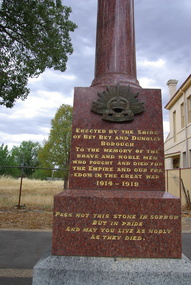
Photograph - War Memorial, Lisa Gervasoni, Dunolly War Memorial, 2025, 1921
... He referred to their Dtsojourns at Lemoos Island, where Christmas was spent, and where the billies and puddings assisted much in their enjoyment. ...He referred to their Dtsojourns at Lemoos Island, where Christmas was spent, and where the billies and puddings assisted much in their enjoyment. ...The Dunolly World War One Memorial Pillar, located in front of the Town Hall on Broadway Street, and was unveiled on November 18th 1921. The pillar is topped by an urn and rests on a square concrete plinth, which lists the names ninety-four locals who died serving during the First World War. On Friday afternoon the Premier, accompanied by Messrs. Pennington and Groves, M's.L.A., visited Dunolly, and unveiled a soldiers' memorial — a polished granite column on a square base, erected by the residents at a cost of £300. It bears the names of 94 district soldiers who were killed in action. The Premier, who is a native of Dunolly, referred to his early associations with the town and district. Speaking of the valiant service rendered by the Australian soldiers in the great war, he paid a tribute to those who enlisted from the country districts. He was not one of those who would withhold national memorials to the fallen because provision had not been made for all who had returned. It was right and proper to have these memorials as silent reminders of the great sacrifice made by the many as a lasting tribute to their memory. Messrs. Groves and Pennington and local clergymen also spoke. The school children sang O God, Our Help in Ages Past, and a bugler sounded the Last Post after the unveiling. The shire president entertained the visitors and committee at dinner. The Age (Melbourne), 19 November 1921. Colour photograph of the Dunolly War Memorial. Front Inscription "Erected by the Shire of Bet Bet and Dunolly Borough To the memory of the brave and noble men who fought and died for the Empire and our freedom in the Great War 1914 - 1918. Pass not this stone in sorrow but in pride, and may you live as nobly as they died." "Private L. Polinelli has written several letters to his mother at Dunolly, dated from from Tel el Kebir from January 13th till the 22nd. He had written every day or two, and this example, is a very fine one. He explains why there was an interval some weeks during which he sent no letters. This was just before the evacuation of Gallipoli, and no-one was permitted to send letters at such a critical time, as there were fears that carefully arranged plans might leak out in some way. Gallipoli had been evacuated on the 19th December, which happened to be Private Polinelli's 24th birthday, and he has cause, he says, to remember that birthday particularly, when this important movement, in which he participated, was so success-fully carried out. He was in the best of health. They had been on Lemnos Island for two weeks after leaving Galilipoli, and while there they got billeted and numerous gifts from Australia, which gave great delight. He (Private Polinelli) had got a big mail - 35 letters and a number of parcels. Both Norman Watson and himself were feeling well, although they had a pretty rough time at the front, but they were feeling better every day. Further letters speak of the arrival in Egypt and the Australian being encamped at Tel el Kebir, 40 miles from Cairo. He states that W. Lyndon had returned from England and was with them. He (W. Lyndon) looks splendid and had had a splendid time in England and Scotland. He saw Jack Lewis in England, and thinks he was to return to Australia. Reference is made to the Rev. Father Goidanich who was with their brigade, and who had been wounded at the front, but was all right again. Father Goidanich is well-known in this district. The letters were written in good spirits and many references were made to friends in Dunolly and district. A friend in Dunolly has received a letter from Private L. Polinelli, which is dated February 3rd, and written 'from the Arabian Desert.' This covers a vast extent of country, so that there is no use in speculating as to the locality, and portions of the letter which possibly would have given some indication have bean 'censored.' Private Polinelli wrote that Norman Watson and Himself were in the best of health and have stook the life well. They are right out of civilisation at time of writing. He referred to their Dtsojourns at Lemoos Island, where Christmas was spent, and where the billies and puddings assisted much in their enjoyment. But they were glad to leave Lemnos Island. After being in camp at Tel el E-bir for two weeks they were sent to where they were at the time of writing, all being in good xxxx and the open country suiting them well. He speaks with admiration of the desert work done by the camels so very largely used. The censoring was very strict so that he could not give much news. After alluding to the return to splendid health of W. Lyndon from England, he says he saw a lot of others from round Dunolly on returning to Egypt, including Tom Fishlock, R. Johnson, and J. Taylor, and some others from Betley, and all looked well. He had also seen Erie Williamson a few times, and he looked splendid. He concludes with remembrances to friends, and from himself and Norman Watson to the Loyal Prince Alfred Lodge." (Dunolly and Betbetshire Express and County of Gladstone Advertiser, Tue 14 Mar 1916) "SOLDIER'S LETTERS PRIVATE L. POLINELLI A friend in Dunolly has received another interesting letter from Private L Polinelli, son of Mrs J Davis, South Dunolly. It is from "Somewhere in France," and is dated July 23rd. He remarks with regret that a good deal of the soldiers' mail from Australia went down in the Arabia, and then goes on to say:- "Norman is back here with us again now and looking well. He had a splendid time over in England after he was able to get out of bed. It was two years on the 18th of this month (January) since Norman and I enlisted, and we celebrated the occasion by having a bit of an evening out. I am very pleased that he is back; we spend most of our time together. We are at present out of the line having a spell in a village, so we are not having a bad time just now but we will soon be going into the trenches again. I met Wally Bell a few days ago; they were going into the line to relieve our brigade. We did not have time to have a long talk. He looks rather thin, but he was always that way. He is feeling well, and wishes to be remembered to his friends in Dunolly. I also met C. Game the same day; he looked well but, as he was also going into the line, we could not have much of a talk J. Hughes and C. Atherton are also over here now; I often see them. W. Lyndon and T. Miles are well ; I was speaking to them yesterday. We are having very bad weather over here now ; it is either raining or snowing every day. The snow was about a fool deep a few days ago. When the rain comes after it, it makes things muddy, The mud is very bad over here; it takes us all our time to struggle through it in places. We will all be very glad when the winter is over. I was over in England on furlough last month, and had a splendid time. The people over there do all they can to give us a good time. I had several invitations to visit different people, and those that we did visit gave us a splendid time. At the place where I was staying they always had a guide waiting of a morning to show us any place of interest that we wanted to see. There was also always a supply of free tickets to the different theatres if we wanted them ; so you see that they go to some expense to give ns a good time. When they know yon are from France you are sure of a hearty welcome. was up in Scotland, and spent five days in Edinburgh. It is a very pretty place, especially when it is seen from Edinburgh Castle, which is on a high bill overlooking the place. We veil through the Castle; also Holyrood Palace. There are a lot of interesting things to be seen in the two places connected with the history of Scotland. It was snowing very heavily while v« were in Scotland, and we bad some fine snowballing with the Scotch people. I greatly enjoyed the trip to Scotland. It would take a very long time to see all round London. I saw a lot of the old historical places there, which were very interesting. The fogs are very bad in London. I had an experience of a London fog one day; it was the heaviest they experienced for a number of years. We could only see a few yards ahead of us. Nearly everyone carried torches; it looked very funny. . . . There are nearly always as many women drinking in the bars as men; it struck me as being very strange, a bit different to what we are used to in Australia, a trip through some parts of London is a real eye-opener to us. It is interesting to watch the traffic in some of the business parts of London it moves along in one big mass. It is a wonder that a lot more accidents do not happen. I saw Australia House, where the High Commissioner has his office, in the Strand. It is not yet finished. It looks a very fine place, and when completed will be 'some' place. Both Norman and I are well, and send remembrances to friends." (Since this letter was written we have had the sad news of the death from wounds of Privates Atherton and Hughes, and that Sergeant Miles and Corporal Norman Watson have been wounded.) (Dunolly and Betbetshire Express and County of Gladstone Advertiser , Friday 13 April 1917, page 2) "Private L Polinelli, from some of whose previous letters we have published interesting extracts, has written to a friend in Dunolly, the letter being from France, and dated April 28th. Private Polinelli says among other things, "I am pleased to say that, Norman (Watson), Les (Anderson) and myself are in the best of health. We now have been in France some time. It is a terrible place for rain ; It has been raining all the time we have been here. It has also been very cold, snowing at times, but it is starting to "fine up" now, and the last few days have been splendid. I hope it keeps like that for a while, as it makes things very miserable in the trenches when it is so wet. We get a few days spell out of the trenches every now and again; so things are not as bad here as they were at Gallipoli. It is not so lively here so far as it was over there either. I am sorry to say that Jack Sanderson, who had been Will Lyndon's mate since they joined the forces, got killed during a bombardment last night. He was terribly knocked about with a shell. I saw W. Lyndon to-day and he was telling me all about it. He seemed terribly cut up over it, and so am I, as I was with Jack a lot over at Gallipoli after Will got sent away sick. He was always bright and cheerful, always had a smile up whenever I met him. I feel very sad about it. We will do all we can to make the Germans pay for it. You will most likely know him, as be used to live in Dunolly before going to Bendigo. Will Lyndon had a narrow escape also, as he was not very far from where the shell burst. He escaped with a bit of a shock, otherwise he is in the best of health. We have a good time among the French people when we are out of the trenches. They do all they can to make us feel at home. I am getting quite expert at speaking French. They smile at us a treat trying to speak French, but we generally make ourselves understood and have a good time among them. It is very rarely we see a young Frenchman, they being all away fighting. The women do all the work on the farms themselves, and deserve every credit for it. . . . I was sorry to hear about the death of Nurse M'Mahon; she was a grand old nurse. I heard that her daughter Nelly was nurse in a hospital on Lemnos Island, and when we were there I went to two of the hospitals to try to see her, but she did not happen to be at either, and I had no time to visit any of the others, so I did not see her. I was also sorry to hear about Mrs Rokahr, as she has left so many little ones behind. (Reference is made to other happenings in Dunolly.) So far I am pleased to say Norman and I have had the luck not to have had a day's illness; I think we are very fortunate, as such a lot get sent to the hospital ill. We are also lucky to have escaped the bullets and shells so far. I hope that luck sticks to us. I am sorry that, owing to the censorship, I cannot give you any interesting news of our trip over to France and the places we have seen. I will have to keep that till I get back to Dunolly again. . . . I have just heard that the battalion that Teddy Game is in has arrived, so I am going to look him up first chance I get." (The letter concludes with remembrances to members of the Lodge and other friends.) (Dunolly and Betbetshire Express and County of Gladstone Advertiser, Tuesday 13 June 1916, page 3) "PRIVATE L POLINELLI Another very interesting letter has been received by a friend in Dunolly from Private L. Polinelli, from France dated May 4th, 1916- Private Polinelli says-" I was glad that you got the letter I wrote from the Arabian Desert. The Censor must have crossed a good deal of it out. They seem to cross out a lot more than is really necessary. We left out there all of a sudden, and in a very short while found ourselves over here. It does not take them very long to make a move. I was saying in the last letter that I was going to try and find " Teddy " Game. I met him a few days ago and had a good yarn with him; he looks real well. I also met S. Prew, and "Ted" Smyth and his son Ernie. They all looked splendid, and are in the same battalion. "Ted" Smyth sticks to it well, and looks better than he ever looked. They will be under fire for the first time in a few days. S. Prew was hit in the landing at Gallipoli, but be is quite well now. W. Smythe, who is in our brigade is well ; I see him very often. " Les " Peart is not with us now; he has joined a Pioneer battalion, and I have not seen him since he joined it. I gave all the Dunolly boys your best wishes and they all wish to be remembered to you— also the same remembrance from Dave Millar, who used to play football for Dunolly from Moliagul. He is in our battalion, having come over with reinforcements. I see him every day and he wished to be remembered to you. A brother of Mr A. J. Williamson, manager of the Bank of Victoria, Dunolly, is also in this battalion. He is a great friend of mine ; we often have a talk about Dunolly. He was not well a little while ago, having to go into a hospital, but is all right again and is back with me. Eric Williamson, son of Mr A. J. Williamson is over here ; Norman (Watson) saw him a few days ago and said he looked well. Norman has been a corporal for some time. I was also offered stripes lately, but preferred to remain a private. There is a lot of worry and running about when you are an N.C.O., so I think I will remain as I am. ... So football is about done this season. I don't think they should cut it right out. I suppose some of them have to stay at home, so they ought to have some amusement. I would very much like to have a game, but I think I would just about forget how to play now. It is very amusing for us to read some of the soldiers letters in the Australian papers. . . l told you in the last letter about xxx young "Jack "Sanderson ; I was terribly sorry about him." Private Polinelli mentions in a letter to his sister in Dunolly that he happened to be beach at Gallipoli where the late Lord Kitchener was xxxxx addressed the' soldiers and' xxxxxx to them the message from the King. Private Polinelli states that he was very proud to have been one of those addressed by the great man. He and Norman Watson have never been a day out of the lines since arriving first in Egypt. It is intended to grant special leave to all those who have been kept so close to their posts xxx three months, and they are looking forward to this relaxation with keen anticipation, hoping to visit England and Scotland. (Dunolly and Betbetshire Express and County of Gladstone Advertiser, Tue 27 Jun 1916) "SOLDIER'S LETTERS. CORPORAL L. POLINELLI. Two letters have been received by Mrs J. Davis, South Dunolly, from her son, Corporal L. Polinelli, both written subsequent to the time when he was wounded, as reported when word was received at the time. Corporal Polinelli writes from No. 12 General Hospital, Rouen, France, and his first letter is dated 7th May. He stated that he was in hospital, he having been wounded in the arm and shoulder on 3rd May. He continued— " It is not a bad wound, and will not take long to heal up, as it is a clean wound. I was very lucky to get out of the fight alive, as I was buried by a shell explosion about an hour before I was wounded. It was very rough, and the noise of all the shells was terrible. Four men were killed by the same shell that wounded me, so I was fortunate. I am feeling a bit " shook up," and my head is aching from the concussion of the shells, but after a few days' spell in bed here I will be feeling just the thing again. So you need not worry about me ; a week or two will see me quite right again. We are having very nice warm weather just now-pleasant change after all the bad weather we have had." The second letter is dated May 12, Corporal Polinelli saying— "I am getting along splendidly ; the wound is healing up fast, so it will not be very long before I am quite right. The doc-tor, the other day said it would be better not to take the piece of shell out of my shoulder yet, and that it would not interfere with me in any way ; so perhaps l will always carry it about with me. He feared lest taking it out at that time would interfere with an artery. Rouen, where the hospital is, is a very pretty city. They give us leave to visit all the places when we are well enough. It is a nice spell here, away from the firing line. We have nothing to trouble us at all, so I will soon be just the thing again. When I got buried by a shell it shook me up a good deal. I felt it far more than the wound I got after; but it has not done me any harm, as I feel hardly any effects now. My good luck sticks to me in getting out of it so lightly. I hope you are not worrying at all about me, as I am all right. We are having beautiful weather over here— sunny days just like the Australian spring. . . . The sisters in the hospital are very nice, and treat us well. They have a lot of work to do, as a good few men have been wounded lately. I would have liked to have been sent over to England, but they are not sending many over there now. They treat as many as they can in France on account of attacks on hospital ships. I would have been able to have a good time with Norman (Watson) had l got over. He was just about all right when I heard from him last." Corporal Polinelli sends kind remembrances to friends." (Dunolly and Betbetshire Express and County of Gladstone Advertiser, Friday 6 July 1917, page 2) "SOLDIERS' LETTERS. CORPORAL L. POLINELLI. The following letter, dated from London on December 27; has been received by a friend in Dunolly from Corporal L. Polinelli (son of Mrs J. Davis, South Donolly), who, at the time of writing, after long and hard service at the front, was on furlough in England. After an introduction he says:— I am having a very good time. I went over to Ireland for five days, spending the most of the time in Dublin. I like the place very much. War appearances are not so conspicuous in Ireland as in England. The hotels are open all day, and a good meal can be obtained anywhere, which is more than can be got in England. The war seems to be making things very bad in England. It is very hard to get a good meal in London ; everything is so restricted. The only way to get a good meal is to go into two places. The people have to line up outside the shops for hours to get sugar, tea, and butter, and then they sometimes fail to get any. So many of our boats getting sunk is the cause of it. If things continue to go on in this way I am afraid that there is a very hard time in store for the people in England. Several people that I have spoken to say that they are just beginning to feel the pinch now. I was in London while an air raid was on a few days ago; it caused a lot of excitement among the people. Ten were killed and 70 wounded in the raid. I was about half a mile from where the bombs fell, so I was pretty right. I thought I had left the war behind in France, but it seems to be on over here at times also. I spent Christmas day with a family at Grantham, a town between London and Newcastle; they were very nice people. I had a very enjoyable time with them. I went to a dance in the evening and enjoyed it very much. It was a bit strange for a start, as it is the first dance I have been to since Norman and I had the send off at Dunolly in January, 1915. They do the dances a bit different over here to what they are done in Australia, and that made it worse still. I went through Guinness's Brewery while I was in Dublin. It is a wonderful place, and covers 55 acres of ground. I got a great surprise when I was starting on my leave in France. We were taken to the station we had to start from in a motor lorry, and who should the driver of the lorry be but Syd. Richards (son of Mr W. Richards, South Dunolly), who used to work at the Post Office in Dunolly. I rode on the front with him, so we had a good yarn. I did not know that be had joined, so was surprised to see him. He has grown a lot since I saw him last, and is looking well. Norman and Bill Lyndon were both well when I left France. We had been having a good spell near Messines, in Flanders, but they will be in the trenches by now. We have been round about Ypres for this last four months, and had some pretty rough times there. dunolly, dunolly war memorial, l. polinelli, bet bet, world war one, world war two, j. deledio, b. battilana, c. fitzgerald, f.s. kendall, j.h. hogan, p. zampatti, louisa davis, louisa gervasoni, bill lyndon, norman lyndon, sydney lindsay -
Port Melbourne Historical & Preservation Society
Photograph - Christmas stockings, WWI donations for the Australian Navy, Swallow & Ariell Busy Bee, 1914 - 1920
... Stockings contained Xmas cake; Xmas pudding; shortbread; wafers; butter scotch; cigarettes; pipe; raisins; chewing gum; handkerchiefs and games. For the Australian Navy. Photograph Christmas ...One of 44 black and white photos recording the work and contribution by Swallow & Ariell's "Busy Bee" for the First World War in Europe .19 - Donations from "Busy Bees" and the Qamby Club Melbourne. Xmas stockings for 1915. Stockings contained Xmas cake; Xmas pudding; shortbread; wafers; butter scotch; cigarettes; pipe; raisins; chewing gum; handkerchiefs and games. For the Australian Navy.business and traders, war - world war i, social activities, busy bee, swallow & ariell ltd, red cross, built environment - industrial
