
Showing 7 items matching "city of knox victoria australia"
-
 Emerald Museum & Nobelius Heritage Park
Book - History Book, Jones, Michael George et al, Prolific in God's gifts: A social history of Knox and the Dandenongs, 1983
... City of Knox Victoria Australia...A community history of the City of Knox City of Knox Victoria Australia Dandenong Ranges Victoria Australia Shire of Ferntree Gully Victoria Australia Emerald Victoria Australia gold mining Michael Jones George Hodges Knox Gus (living history) from Peter Whitehead, Boronia Community Centre 328p.: ill., maps, ports.; 23cm. ...A community history of the City of Knox328p.: ill., maps, ports.; 23cm. ISBN 086861 326 6 (pbk). Bibliography. Includes index.Gus (living history) from Peter Whitehead, Boronia Community Centrecity of knox victoria australia, dandenong ranges, victoria, australia, shire of ferntree gully victoria australia, emerald, victoria, australia, gold mining, michael jones, george hodges knox -
Emerald Museum & Nobelius Heritage Park
Book - History Book, Fennessy, Kathleen et al, Exploring the History of the City of Knox, 1984
... ...City of Knox Victoria Australia...A catalogue of source material related to the history of the City of Knox prepared by Kathleen Fennessy, Frances O'Neill and Ruth Leveson local history City of Knox Victoria Australia 67 pages. 30cm. ...A catalogue of source material related to the history of the City of Knox prepared by Kathleen Fennessy, Frances O'Neill and Ruth Leveson67 pages. 30cm. Indexes. A history of governmental and private collections, relating the history of the City of Knox. ISBN 0959089918. DDC994.0016Paperlocal history, city of knox victoria australia -
Emerald Museum & Nobelius Heritage Park
Pamphlet - History Pamphlet, City of Knox not indicated, 1980s?
... Victoria... Australia...City of Knox...Emerald Victoria Australia City of Knox Victoria Australia Historic Sites City of Knox Knox A Brief History' - Eight page pamphlet giving brief history of suburbs comprising City of Knox, red and white cover with coat of arms of City of Knox.Paper Pamphlet History Pamphlet City of Knox not indicated ...Knox A Brief History' - Eight page pamphlet giving brief history of suburbs comprising City of Knox, red and white cover with coat of arms of City of Knox.Paperemerald, victoria, australia, city of knox victoria australia, historic sites, city of knox -
 Glen Eira Historical Society
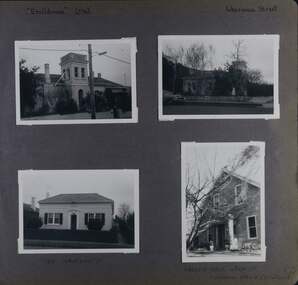
Album - Album page, Ercildoune (576), Inkerman Street, Circa 1972
... Australia (Victoria) and Caulfield City Council to identify historic buildings within the City of Caulfield that warranted the protection of a National Trust Classification. Principal photographer thought to be Trevor Hart, member of Caulfield Historical Society. Most photographs were taken between 1966-1972 with a small number of photographs being older and from unknown sources. All photographs are black and white except where stated, with 386 photographs over 198 pages. Vol 1 Caulfield's Building Heritage by Dr Geulah Solomon states that Ercildoune was the home of Sir Samuel Wilson and later, Arthur Knox...Australia (Victoria) and Caulfield City Council to identify historic buildings within the City of Caulfield that warranted the protection of a National Trust Classification. Principal photographer thought to be Trevor Hart, member of Caulfield Historical Society. Most photographs were taken between 1966-1972 with a small number of photographs being older and from unknown sources. All photographs are black and white except where stated, with 386 photographs over 198 pages. Vol 1 Caulfield's Building Heritage by Dr Geulah Solomon states that Ercildoune was the home of Sir Samuel Wilson and later, Arthur Knox ...This photograph is part of the Caulfield Historical Album 1972. This album was created in approximately 1972 as part of a project by the Caulfield Historical Society to assist in identifying buildings worthy of preservation. The album is related to a Survey the Caulfield Historical Society developed in collaboration with the National Trust of Australia (Victoria) and Caulfield City Council to identify historic buildings within the City of Caulfield that warranted the protection of a National Trust Classification. Principal photographer thought to be Trevor Hart, member of Caulfield Historical Society. Most photographs were taken between 1966-1972 with a small number of photographs being older and from unknown sources. All photographs are black and white except where stated, with 386 photographs over 198 pages. Vol 1 Caulfield's Building Heritage by Dr Geulah Solomon states that Ercildoune was the home of Sir Samuel Wilson and later, Arthur Knox. Knox is likely the person who subdivided the land, creating Ercildoune Street.Page 100 of Photograph Album with two photographs (landscape) of Ercildoune and two photographs (one landscape and one portrait) of two other houses on Inkerman Street.Handwritten: "Ercildoune" (576) [top left] / Inkerman Street [top right] / 138 INKERMAN ST [under bottom left photo] / LABASSA GROVE CORNER OF INKERMAN OPPOSITE ERCILDOUNE [under bottom right photo] / 100 [bottom right]trevor hart, east st kilda, ercildoune, mansions, towers, gardens, bloomsbury, inkerman road, labassa grove, attic houses, porches, inkerman street, caulfield north, st kilda east, sir samuel wilson, arthur knox, ercildoune street, house names -
 Eltham District Historical Society Inc
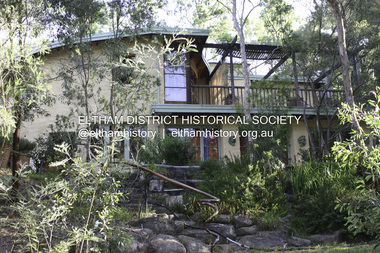
Photograph - Digital Photograph, Alan King, Busst House, cnr Silver Street and Kerrie Crescent, Eltham, 2 February 2008
... Knox caught one of the three morning trains to the city in those days and bought several copies of the pamphlet to give to each councillor. On his return he found the councillors standing on the steps of the shire offices after lunch at the local hotel. He heard that earth building had been discussed before lunch and that they were not in favor of it. Knox gave each councillor a pamphlet. They passed that plan and by doing so, opened the door for all future earth building in Victoria and by default, in Australia...Knox caught one of the three morning trains to the city in those days and bought several copies of the pamphlet to give to each councillor. On his return he found the councillors standing on the steps of the shire offices after lunch at the local hotel. He heard that earth building had been discussed before lunch and that they were not in favor of it. Knox gave each councillor a pamphlet. They passed that plan and by doing so, opened the door for all future earth building in Victoria and by default, in Australia ...Considered the best of the early mud-brick houses built by Alistair Knox. Covered under Heritage Overlay, Nillumbik Planning Scheme. Published: Nillumbik Now and Then / Marguerite Marshall 2008; photographs Alan King with Marguerite Marshall.; p143 The Busst house hidden by trees at the corner of Silver Street and Kerrie Crescent is considered the best of the early mud-brick houses built by Eltham architect, Alistair Knox. Knox himself said, that the Busst house was the most mature mud-brick house designed at that period. ‘It related with true understanding to its steep site and expressed the flexibility of earth building ………to develop a new sense of flowing form and shape’. Built in 1948 for artist Phyl Busst, a former art student at Montsalvat, the house helped usher in Eltham Shire’s distinctive mud-brick residential character. Knox was the pivotal figure of the style developed from the 1950s to the 1970s. Scarcity of building materials after World War Two encouraged mud-brick building because earth was a cheap and plentiful building medium. But when Knox began building in mud-brick in 1947, no council in Victoria knew anything of this ancient art and he needed a permit. Fortunately the Commonwealth Experimental Building Station at Ryde in NSW, had been experimenting with earth construction to help overcome the shortages of that time. They published a pamphlet that became available in Melbourne on the same day the Eltham Council was to consider whether the earth building should be allowed. Knox caught one of the three morning trains to the city in those days and bought several copies of the pamphlet to give to each councillor. On his return he found the councillors standing on the steps of the shire offices after lunch at the local hotel. He heard that earth building had been discussed before lunch and that they were not in favor of it. Knox gave each councillor a pamphlet. They passed that plan and by doing so, opened the door for all future earth building in Victoria and by default, in Australia. Mud-brick houses attracted artists to Eltham, for their aesthetic appeal and because they were cheap. Those who built their own houses, included film maker Tim Burstall, artists Peter Glass, Clifton Pugh, Matcham Skipper, Sonia Skipper and husband Jo Hannan. For Knox, mud-brick building was more than just a cheap building medium. He saw it as harmonising with the surrounding bush and as a way of counteracting the growing materialism of the age. He wrote of its impact on ‘ 20th century man. It should counteract the confusion that the perpetual flow of high technology products have upon him ..’ Building the Busst house on a steep site was difficult because most earth-moving equipment was then in its infancy. For instance drilling for explosives was done by hand, which was a slow and painful process. Knox, assisted by his foreman Horrie Judd and Gordon Ford (who was to become a famous landscape designer), built two large main rooms - a living room/ kitchen downstairs - and upstairs, a studio/bedroom. The studio/bedroom opens onto the balcony, which covers the living area. The bath made of solid concrete by stonemason Jack Fabro, is particularly deep. Sunshine pours through the three French windows of the north-east facing kitchen/living area, which is lined with timber. The large hearth can fit a family around the fire while the timber floors and solomite (compressed straw) ceilings add to the cosy atmosphere. The garden is thick with trees, and in the late 1990s, Ford put in a pool near the original dry wall he had built as a young man.This collection of almost 130 photos about places and people within the Shire of Nillumbik, an urban and rural municipality in Melbourne's north, contributes to an understanding of the history of the Shire. Published in 2008 immediately prior to the Black Saturday bushfires of February 7, 2009, it documents sites that were impacted, and in some cases destroyed by the fires. It includes photographs taken especially for the publication, creating a unique time capsule representing the Shire in the early 21st century. It remains the most recent comprehenesive publication devoted to the Shire's history connecting local residents to the past. nillumbik now and then (marshall-king) collection, alistair knox, alistair knox design, busst house, kerrie crescent, mudbrick construction, mudbrick houses, silver street -
 Mt Dandenong & District Historical Society Inc.
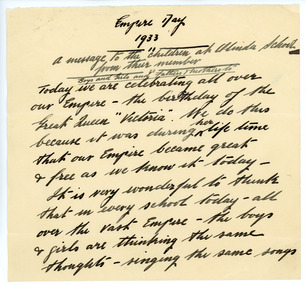
Document - Speech, Empire Day 1933
... Victoria's birthday on May 24 was renamed Empire Day in 1903 after her death in 1901. Empire Day was observed in state schools from 1905 with a program of addresses, pageants and patriotic songs, with children swearing allegiance to King and Empire with a loyal declaration. The last celebration of Empire Day in Australia took place in 1958. olinda school sir george hodges knox empire day speech city ...This document is a speech titled "Empire Day 1933. A message to the children at Olinda School from their member". It is signed G H Knox. It was written by Sir George Hodges Knox and read to the children at Olinda School as part of the Empire Day celebrations in 1933. Sir George Hodges Knox (1885-1960) was a veteran of WW1 and was elected to the Ferntree Gully Shire Council in 1922. He held this post until 1927.The City Of Knox is named after him. He won the Victorian Legislative Assembly seat for Upper Yarra in 1927 for the Nationalist Party. He became Speaker for the Victorian Parliament in 1942 and remained there until 1947. Between 1945 and his death in 1960 he held the seat of Scoresby. He was knighted in 1945. The celebration of Queen Victoria's birthday on May 24 was renamed Empire Day in 1903 after her death in 1901. Empire Day was observed in state schools from 1905 with a program of addresses, pageants and patriotic songs, with children swearing allegiance to King and Empire with a loyal declaration. The last celebration of Empire Day in Australia took place in 1958. Five sheets of unlined paper that appear to have been torn from a writing pad with a speech handwritten in thick, black fountain pen commemorating Empire Day.olinda school, sir george hodges knox, empire day, speech, city of knox, knox, olinda, school, celebration -
Emerald Museum & Nobelius Heritage Park
Newspaper - Ash Wednesday Newspapers, The Bulletin, 1983
... Special editions of local newspapers published following Ash Wednesday bushfires in 1983 bushfires Dandenong Ranges Victoria Australia Cockatoo Victoria Australia Ash Wednesday 1983 Berwick-Pakenham Times Pakenham Gazette and Berwick City News The Leader ' Newspapers. 1. Berwick-Pakenham Times 21 February 1983| 2. The Pakenham Gazette and Berwick City News| 3. Leader: Emergency Issue of Free Press, Lillydale Express, Knox ...Special editions of local newspapers published following Ash Wednesday bushfires in 1983Newspapers. 1. Berwick-Pakenham Times 21 February 1983| 2. The Pakenham Gazette and Berwick City News| 3. Leader: Emergency Issue of Free Press, Lillydale Express, Knox-Sherbrooke News, Ringwood-Croydon Mail 17 February 19831. 44-page newspaper|2. 52-page newspaper|3. single sheet newsprint with photograqphs folded to 4 pages'bushfires, dandenong ranges, victoria, australia, cockatoo victoria australia, ash wednesday 1983, berwick-pakenham times, pakenham gazette and berwick city news, the leader
