
Showing 25 items matching "civic administration"
-
 Broadmeadows Historical Society & Museum
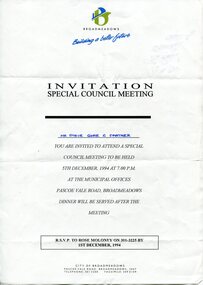
Document - Invitation, City of Broadmeadows Council, Invitation – Special Council Meeting, 1994
... ...Civic administration...Relates to governance and civic administration of the former City of Broadmeadows prior to municipal amalgamations in Victoria (mid 1990s). ...Relates to governance and civic administration of the former City of Broadmeadows prior to municipal amalgamations in Victoria (mid 1990s). ...Relates to governance and civic administration of the former City of Broadmeadows prior to municipal amalgamations in Victoria (mid 1990s). Invitations such as this document formal council proceedings and reflect local government practices of the period.This item provides direct evidence of municipal operations and communication practices of the City of Broadmeadows shortly before council amalgamations. It demonstrates formal invitation formats, organisational branding (“Building a better future”), and named civic participants.Single A4 sheet, printed on white paper; black printed text with blue logo and handwritten blue ink annotation. Paper shows fold lines (horizontal and vertical), creasing, and light handling wear.Recto (front): “MR STEVE GORE & PARTNER” (handwritten in blue ink) Printed text includes: “INVITATION / SPECIAL COUNCIL MEETING … 5TH DECEMBER, 1994 AT 7.00 P.M. … PASCOE VALE ROAD, BROADMEADOWS … R.S.V.P. TO ROSE MOLONEY…” Verso (back): “WI 0994” (printed label) Handwritten blue ink note (partially legible): appears to reference “16/7/06 … copy … kept …”local government, city of broadmeadows, council meetings, civic administration, 1990s broadmeadows, council amalgamations 1994 -
 Broadmeadows Historical Society & Museum
Document (collection) - Council Record, City of Broadmeadows, Agenda and Minutes for the Special Meeting of the Council of the City of Broadmeadows, 5 December 1994, 5 December 1994
... ...civic administration...City of Broadmeadows local government municipal amalgamation council meetings special council meeting council minutes civic administration mayoral address local history Victorian municipalities dissolution of council governance records community acknowledgements public administration historical documentation Agenda and Minutes for the Special Meeting of the Council of the City of Broadmeadows, 5 December 1994 Document Council Record City of Broadmeadows ...Created by the City of Broadmeadows Council in the course of its statutory governance and administrative functions.Records created to document the official proceedings of a Special Council Meeting held to formally mark the dissolution of the City of Broadmeadows prior to municipal amalgamation.Original Order maintainedAgenda and signed minutes of the Special Meeting of Council held on Monday, 5 December 1994.city of broadmeadows, local government, municipal amalgamation, council meetings, special council meeting, council minutes, civic administration, mayoral address, local history, victorian municipalities, dissolution of council, governance records, community acknowledgements, public administration, historical documentationcity of broadmeadows, local government, municipal amalgamation, council meetings, special council meeting, council minutes, civic administration, mayoral address, local history, victorian municipalities, dissolution of council, governance records, community acknowledgements, public administration, historical documentation -
Broadmeadows Historical Society & Museum
Document, City of Broadmeadows Council, Meeting of Council to be held on 3rd May 1982 at 7.30p.m, 1982
... ...civic administration...Local government municipal administration council meetings council agendas notice papers civic administration local governance public administration municipal decision making councils and councillors community governance twentieth century local history Broadmeadows (Vic.) ...This item forms part of the documentary record preserved by the Broadmeadows Historical Society, contributing to the understanding of local history, social activity, and institutional development in Broadmeadows and surrounding regions.Of historic and research significance as part of the archival record relating to Broadmeadows. While individually modest, its value derives from its role within a broader documentary context, contributing to the evidentiary base used to interpret local history.Paper-based item setting out the agenda and business to be considered at a council meeting. Text is typewritten and arranged in a formal notice format.RECTO: Typed text including meeting details and date. VERSO: yellow catalogue adhesive label affixed above other labels: WI-3073 : white catalogue adhesive label affixed above other labels: WI-0584 (struck through) local government, municipal administration, council meetings, council agendas, notice papers, civic administration, local governance, public administration, municipal decision making, councils and councillors, community governance, twentieth century local history, broadmeadows (vic.), victoria local government, administrative documents -
Broadmeadows Historical Society & Museum
Document - Ward List, City of Broadmeadows Ward Councillors 1992/93, 1992
... ...Civic administration...Local government Municipal councillors City of Broadmeadows Civic administration 1992/1993 (printed, recto): CITY OF BROADMEADOWS/WARD COUNCILLORS/1992/93 (handwritten notes, including telephone numbers for each councillor, and in the top left corner, in pencil, is the handwritten notation "ISLE OFMAN") (verso): (yellow label) WI-3760 (handwritten in pencil): Peter Anderson One printed paper sheet, black text on white paper. ...The document reflects the structure and elected representation of the City of Broadmeadows immediately prior to local government amalgamations in Victoria during the mid-1990s.This item provides documentary evidence of local governance, elected representatives, and ward boundaries in Broadmeadows in the early 1990s.One printed paper sheet, black text on white paper. Recto printed, verso contains minimal unrelated markings.(printed, recto): CITY OF BROADMEADOWS/WARD COUNCILLORS/1992/93 (handwritten notes, including telephone numbers for each councillor, and in the top left corner, in pencil, is the handwritten notation "ISLE OFMAN") (verso): (yellow label) WI-3760 (handwritten in pencil): Peter Andersonlocal government, municipal councillors, city of broadmeadows, civic administration, 1992/1993 -
Broadmeadows Historical Society & Museum
Document - Council memorandum, Wayne Harvey, City Development Memo – Notes from Councillors’ Presentation, 12 December 1994
... ...civic administration...City of Broadmeadows local government municipal council councillors city development council memorandum civic administration urban development governance councillor profiles 1990s Broadmeadows municipal history internal council records community leadership Victorian local government “TO: CITY DEVELOPMENT MEMO / All Councillors / FROM: Director City Development / SUBJECT: Notes – Councillors’ Presentation – 5 December / DATE: 12 December, 1994” (front page) There are no handwritten notes throughout the document. ...Documents the functioning of the City of Broadmeadows council during the mid 1990s, providing insight into councillor profiles, local governance priorities, and urban development issues of the period.This document holds local historical significance as a firsthand record of municipal governance, councillor representation, and administrative practices in Broadmeadows during the 1990s.Multi page document comprising typed text, reproduced images, and photocopied pages; black text on white paper.“TO: CITY DEVELOPMENT MEMO / All Councillors / FROM: Director City Development / SUBJECT: Notes – Councillors’ Presentation – 5 December / DATE: 12 December, 1994” (front page) There are no handwritten notes throughout the document.city of broadmeadows, local government, municipal council, councillors, city development, council memorandum, civic administration, urban development, governance, councillor profiles, 1990s broadmeadows, municipal history, internal council records, community leadership, victorian local government -
 Broadmeadows Historical Society & Museum
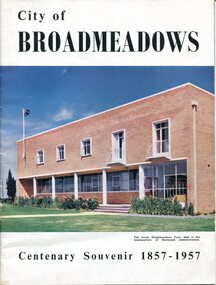
Booklet - Centenary Souvenir, City of Broadmeadows Council, City of Broadmeadows: Centenary Souvenir 1857-1957, 1957
... ...Civic Administration...Broadmeadows City of Broadmeadows Local Government Municipal History Centenary Celebrations Community History Urban Development Early Settlement John Pascoe Fawkner Duncan Cameron Victoria Historical Publications Civic Administration Municipal Officers Roads Transport Campbellfield Pascoe Vale Glenroy Heritage This commemorative souvenir booklet was produced by the City of Broadmeadows to mark one hundred years of municipal government from 1857 to 1957. ...This commemorative souvenir booklet was produced by the City of Broadmeadows to mark one hundred years of municipal government from 1857 to 1957. It presents an overview of the municipality's history, including early European settlement, pastoral occupation, local government formation, infrastructure development and civic achievements. Historical photographs and reproduced archival documents provide visual and documentary evidence of Broadmeadows' transformation from a rural district to an expanding metropolitan municipality. The publication was intended to celebrate community achievements while promoting civic pride and preserving local history.A 36-page illustrated stapled booklet published by the City of Broadmeadows to commemorate the centenary of local government in the municipality, 1857-1957. Contains historical text, reproductions of government records, municipal information, and black-and-white photographs.non-fictionThis commemorative souvenir booklet was produced by the City of Broadmeadows to mark one hundred years of municipal government from 1857 to 1957. It presents an overview of the municipality's history, including early European settlement, pastoral occupation, local government formation, infrastructure development and civic achievements. Historical photographs and reproduced archival documents provide visual and documentary evidence of Broadmeadows' transformation from a rural district to an expanding metropolitan municipality. The publication was intended to celebrate community achievements while promoting civic pride and preserving local history.broadmeadows, city of broadmeadows, local government, municipal history, centenary celebrations, community history, urban development, early settlement, john pascoe fawkner, duncan cameron, victoria, historical publications, civic administration, municipal officers, roads, transport, campbellfield, pascoe vale, glenroy, heritage -
 Broadmeadows Historical Society & Museum
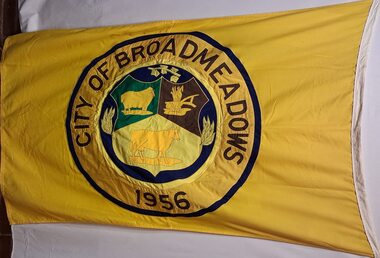
Flag - Municipal Flag, City of Broadmeadows Flag
... Administration...Municipal Symbols...Broadmeadows...Hume Region...Flags...Civic...The item represents civic identity, local government administration, and municipal symbolism within Broadmeadows. ...The item represents civic identity, local government administration, and municipal symbolism within Broadmeadows. ...This flag is associated with the former City of Broadmeadows, a municipal authority that administered a large proportion of the area now incorporated within the City of Hume. The item represents civic identity, local government administration, and municipal symbolism within Broadmeadows. The former catalogue worksheet identifies the item as a "City of Broadmeadows Flag 1956".The City of Broadmeadows Flag is historically significant as a surviving municipal emblem of the former City of Broadmeadows. It demonstrates how the municipality represented itself through official civic symbols and contributes to the interpretation of local government history within Broadmeadows and the wider Hume district. The survival of a complete municipal flag enhances its research and interpretive value and provides tangible evidence of community identity and municipal heritage.Yellow oblong municipal flag manufactured from cotton. The flag bears the City of Broadmeadows civic logo on both faces and retains attachments along the hoist edge for display or flying. The flag is complete and substantially intact.No inscriptions or markings recorded. The flag incorporates the official City of Broadmeadows municipal logo on both faces.city of broadmeadows, local government, municipal administration, municipal symbols, broadmeadows, hume region, flags, civic identity -
 Flagstaff Hill Maritime Museum and Village
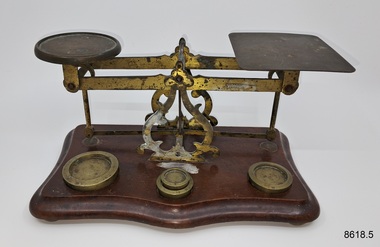
Equipment - Postal Scales, Unknown
... civic affairs. He had an interest in people and the community They were both involved in the creation of Flagstaff Hill, including the layout of the gardens. After his death (28th March 1970) his family requested his practitioner’s plate, medical instruments and some personal belongings be displayed in the Port Medical Office surgery at Flagstaff Hill Maritime Village, and be called the “W. R. Angus Collection”. At about the same time that the adhesive postage stamps and envelopes made their appearance, postal administrations...civic affairs. He had an interest in people and the community They were both involved in the creation of Flagstaff Hill, including the layout of the gardens. After his death (28th March 1970) his family requested his practitioner’s plate, medical instruments and some personal belongings be displayed in the Port Medical Office surgery at Flagstaff Hill Maritime Village, and be called the “W. R. Angus Collection”. At about the same time that the adhesive postage stamps and envelopes made their appearance, postal administrations ...Before 1851, letters sent through the mail were charged by the number of sheets it contained and the distance it travelled. For example, a letter consisting of one sheet of paper was charged the single rate; a double letter, that is two sheets, was charged double the single rate, a treble letter, was charged three times the single rate, and so on. In other words, each additional sheet of paper increased the charge by one rate. In Great Britain. Sealing a letter in an envelope effectively put an end to postal clerks' ability to count the number of sheets in a letter and an alternative method of determining the postage had to be found. Overweight mailings had previously required the items to be weighed but with the introduction of the Uniform Penny Postage act of 1839, the public could mail a letter not exceeding a half-ounce in weight within the United Kingdom for one penny if prepaid, or two pence if paid on delivery. These postal scales belonged to Dr.William Roy Angus, Surgeon and Oculist. They were donated to Flagstaff Hill Maritime Village by his daughter, Bernice McDade. They are part of the “W.R. Angus Collection” that includes historical medical equipment, surgical instruments and material once belonging to Dr Edward Ryan and Dr Thomas Francis Ryan, (both of Nhill, Victoria) as well as Dr Angus’ own belongings. The Collection’s history spans the medical practices of the two Doctors Ryan, from 1885-1926 plus that of Dr Angus, up until 1969. ABOUT THE “W.R.ANGUS COLLECTION” Doctor William Roy Angus M.B., B.S., Adel., 1923, F.R.C.S. Edin.,1928 (also known as Dr Roy Angus) was born in Murrumbeena, Victoria in 1901 and lived until 1970. He qualified as a doctor in 1923 at University of Adelaide, was Resident Medical Officer at the Royal Adelaide Hospital in 1924 and for a period was house surgeon to Sir (then Mr.) Henry Simpson Newland. Dr Angus was briefly an Assistant to Dr Riddell of Kapunda, then commenced private practice at Curramulka, Yorke Peninsula, SA, where he was physician, surgeon and chemist. In 1926, he was appointed as new Medical Assistant to Dr Thomas Francis Ryan (T.F. Ryan, or Tom), in Nhill, Victoria, where his experiences included radiology and pharmacy. In 1927 he was Acting House Surgeon in Dr Tom Ryan’s absence. Dr Angus had become engaged to Gladys Forsyth and they decided he further his studies overseas in the UK in 1927. He studied at London University College Hospital and at Edinburgh Royal Infirmary and in 1928, was awarded FRCS (Fellow from the Royal College of Surgeons), Edinburgh. He worked his passage back to Australia as a Ship’s Surgeon on the on the Australian Commonwealth Line’s T.S.S. Largs Bay. Dr Angus married Gladys in 1929, in Ballarat. (They went on to have one son (Graham 1932, born in SA) and two daughters (Helen (died 12/07/1996) and Berenice (Berry), both born at Mira, Nhill ) According to Berry, her mother Gladys made a lot of their clothes. She was very talented and did some lovely embroidery including lingerie for her trousseau and beautifully handmade baby clothes. Dr Angus was a ‘flying doctor’ for the A.I.M. (Australian Inland Ministry) Aerial Medical Service in 1928 . Its first station was in the remote town of Oodnadatta, where Dr Angus was stationed. He was locum tenens there on North-South Railway at 21 Mile Camp. He took up this ‘flying doctor’ position in response to a call from Dr John Flynn; the organisation was later known as the Flying Doctor Service, then the Royal Flying Doctor Service. A lot of his work during this time involved dental surgery also. Between 1928-1932 he was surgeon at the Curramulka Hospital, Yorke Peninsula, South Australia. In 1933 Dr Angus returned to Nhill and purchased a share of the Nelson Street practice and Mira hospital (a 2 bed ward at the Nelson Street Practice) from Dr Les Middleton one of the Middleton Brothers, the current owners of what previously once Dr Tom Ryan’s practice. Dr Tom and his brother had worked as surgeons included eye surgery. Dr Tom Ryan performed many of his operations in the Mira private hospital on his premises. He had been House Surgeon at the Nhill Hospital 1902-1926. Dr Tom Ryan had one of the only two pieces of radiology equipment in Victoria during his practicing years – The Royal Melbourne Hospital had the other one. Over the years Dr Tom Ryan had gradually set up what was effectively a training school for country general-practitioner-surgeons. Each patient was carefully examined, including using the X-ray machine, and any surgery was discussed and planned with Dr Ryan’s assistants several days in advance. Dr Angus gained experience in using the X-ray machine there during his time as assistant to Dr Ryan. When Dr Angus bought into the Nelson Street premises in Nhill he was also appointed as the Nhill Hospital’s Honorary House Surgeon 1933-1938. His practitioner’s plate from his Nhill surgery is now mounted on the doorway to the Port Medical Office at Flagstaff Hill Maritime Village, Warrnambool. When Dr Angus took up practice in the Dr Edward and Dr Tom Ryan’s old premises he obtained their extensive collection of historical medical equipment and materials spanning 1884-1926. A large part of this collection is now on display at the Port Medical Office at Flagstaff Hill Maritime Village in Warrnambool. In 1939 Dr Angus and his family moved to Warrnambool where he purchased “Birchwood,” the 1852 home and medical practice of Dr John Hunter Henderson, at 214 Koroit Street. (This property was sold in1965 to the State Government and is now the site of the Warrnambool Police Station. and an ALDI sore is on the land that was once their tennis court). The Angus family was able to afford gardeners, cooks and maids; their home was a popular place for visiting dignitaries to stay whilst visiting Warrnambool. Dr Angus had his own silk worm farm at home in a Mulberry tree. His young daughter used his centrifuge for spinning the silk. Dr Angus was appointed on a part-time basis as Port Medical Officer (Health Officer) in Warrnambool and held this position until the 1940’s when the government no longer required the service of a Port Medical Officer in Warrnambool; he was thus Warrnambool’s last serving Port Medical Officer. (Masters of immigrant ships arriving in port reported incidents of diseases, illness and death and the Port Medical Officer made a decision on whether the ship required Quarantine and for how long, in this way preventing contagious illness from spreading from new immigrants to the residents already in the colony.) Dr Angus was a member of the Australian Medical Association, for 35 years and surgeon at the Warrnambool Base Hospital 1939-1942, He served as a Surgeon Captain during WWII1942-45, in Ballarat, Victoria, and in Bonegilla, N.S.W., completing his service just before the end of the war due to suffering from a heart attack. During his convalescence he carved an intricate and ‘most artistic’ chess set from the material that dentures were made from. He then studied ophthalmology at the Royal Melbourne Eye and Ear Hospital and created cosmetically superior artificial eyes by pioneering using the intrascleral cartilage. Angus received accolades from the Ophthalmological Society of Australasia for this work. He returned to Warrnambool to commence practice as an ophthalmologist, pioneering in artificial eye improvements. He was Honorary Consultant Ophthalmologist to Warrnambool Base Hospital for 31 years. He made monthly visits to Portland as a visiting surgeon, to perform eye surgery. He represented the Victorian South-West subdivision of the Australian Medical Association as its secretary between 1949 and 1956 and as chairman from 1956 to 1958. In 1968 Dr Angus was elected member of Spain’s Barraquer Institute of Barcelona after his research work in Intrasclearal cartilage grafting, becoming one of the few Australian ophthalmologists to receive this honour, and in the following year presented his final paper on Living Intrasclearal Cartilage Implants at the Inaugural Meeting of the Australian College of Ophthalmologists in Melbourne In his personal life Dr Angus was a Presbyterian and treated Sunday as a Sabbath, a day of rest. He would visit 3 or 4 country patients on a Sunday, taking his children along ‘for the ride’ and to visit with him. Sunday evenings he would play the pianola and sing Scottish songs to his family. One of Dr Angus’ patients was Margaret MacKenzie, author of a book on local shipwrecks that she’d seen as an eye witness from the late 1880’s in Peterborough, Victoria. In the early 1950’s Dr Angus, painted a picture of a shipwreck for the cover jacket of Margaret’s book, Shipwrecks and More Shipwrecks. She was blind in later life and her daughter wrote the actual book for her. Dr Angus and his wife Gladys were very involved in Warrnambool’s society with a strong interest in civic affairs. He had an interest in people and the community They were both involved in the creation of Flagstaff Hill, including the layout of the gardens. After his death (28th March 1970) his family requested his practitioner’s plate, medical instruments and some personal belongings be displayed in the Port Medical Office surgery at Flagstaff Hill Maritime Village, and be called the “W. R. Angus Collection”. At about the same time that the adhesive postage stamps and envelopes made their appearance, postal administrations began to experiment with strategically placed street letter boxes, known as pillar boxes because of their round, pillar-like shape, that permitted the public to mail letters from a place other than from a post office. For all these reasons, the use of postal scales became the nucleus of every post office. Scales had been in use since ancient Egyptian times so their use for everyday commerce was not unusual in the 1800s. What was new in 1840 was their ubiquitous use throughout the postal system. No post office could function effectively without one. Although the earliest scales used in post offices did not differ markedly from the ones in general use as time went on they were adapted specifically for postal use. For example, a paper sleeve, also known as a weight sticker, was attached that showed the applicable rate of postage for any given weight. This innovation was quite a time saver as postal clerks no longer needed to weigh the item first and then refer to a separate chart to determine the required postage for that particular weight.The W.R. Angus Collection is significant for still being located at the site it is connected with, Doctor Angus being the last Port Medical Officer in Warrnambool. The collection of medical instruments and other items and equipment is culturally significant, being an historical example of medicine from late 19th to mid-20th century. Dr Angus assisted Dr Tom Ryan, a pioneer in the use of X-rays and in ocular surgery.Postal scales with weights,. Balance scale has brass fittings and is mounted on a rectangular wooden stand, with depressions for brass weights. Weights measure 1oz, 2oz, 4oz and 8oz.'Warranteed Accurate'flagstaff hill maritime museum and village, great ocean road, shipwreck coast, scales, post -
 Greensborough Historical Society
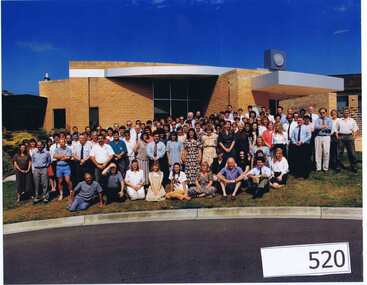
Photograph, Shire of Diamond Valley, Shire of Diamond Valley Staff: Last day 1992, 1992_12
... Photograph of administration or "indoor" staff, Shire of Diamond Valley, on their last day at work for the Shire.The Shire of Diamond Valley was a Local Government Area located about 20 kilometres northeast of Melbourne. The Shire covered an area of 74.38 square kilometres and existed from 30/09/1964 until 14/12/1994. The staff are standing in front of the Civic...Photograph of administration or "indoor" staff, Shire of Diamond Valley, on their last day at work for the Shire.The Shire of Diamond Valley was a Local Government Area located about 20 kilometres northeast of Melbourne. The Shire covered an area of 74.38 square kilometres and existed from 30/09/1964 until 14/12/1994. The staff are standing in front of the Civic ...Photograph of administration or "indoor" staff, Shire of Diamond Valley, on their last day at work for the Shire.The Shire of Diamond Valley was a Local Government Area located about 20 kilometres northeast of Melbourne. The Shire covered an area of 74.38 square kilometres and existed from 30/09/1964 until 14/12/1994. The staff are standing in front of the Civic Centre offices. Following the merger of councils in 1994, some staff moved to Banyule or Nillumbik Council, some were made redundant. Colour photograph of large groupshire of diamond valley, shire of diamond valley staff -
 Glenelg Shire Council Cultural Collection
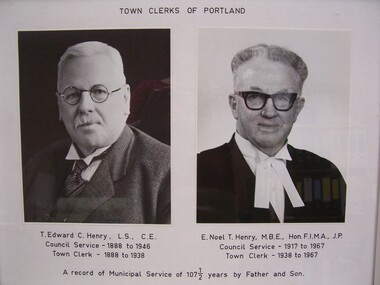
Photograph - Photograph - Town Clerks of Portland: T.E.C. Henry & E.N.T. Henry, 1960s
... administration... local government... official portrait photography...civic...Portland Town Council Portland Town Council administration local government official portrait photography civic photography Front: Top centre: Town Clerks of Portland Bottom left: T. ...Portland Town CouncilTwo framed black and white photographs. Left: T. Edward C. Henry Right: E. Noel T. Henry Head and shoulders wearing tweed suit, Wearing official looking robes, striped tie, round-rimmed glasses, dark-rimmed glasses. moustache.Front: Top centre: Town Clerks of Portland Bottom left: T. Edward C. Henry, LS, CE, Council Service - 1888 to 1946 Town Clerk - 1888 to 1938 Bottom right: E. Noel T. Henry, MBE, Hon F.I.M.A., JP, Council Service - 1917 to 1967 Town Clerk - 1938 to 1967 Bottom: A record of Municipal Service of 107½ years by father and son. Back: Yellow sticker, numbered 3004.portland town council, administration, local government, official portrait photography, civic photography -
 Warrnambool and District Historical Society Inc.
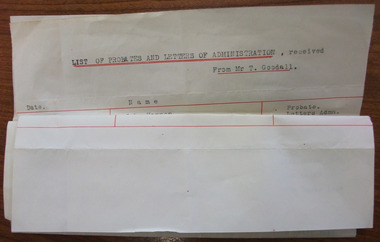
Document, List and index of legal papers
... Administration documents and the lists to George Sutherland Mackay at some unknown date (pre 1917). George Mackay (1850-1926) began a legal practice in Warrnambool in the 1890s and was established at 131 Kepler Street when he took J. McD. Taylor as a partner. George Mackay was a prominent Warrnambool resident, involved in civic...Administration documents and the lists to George Sutherland Mackay at some unknown date (pre 1917). George Mackay (1850-1926) began a legal practice in Warrnambool in the 1890s and was established at 131 Kepler Street when he took J. McD. Taylor as a partner. George Mackay was a prominent Warrnambool resident, involved in civic ...William and Ellen Goodall were pioneer settlers in Warrnambool, with one of the sons, Thomas (1852-1917), becoming a law clerk and accountant. It is not known for which legal firm Thomas Goodall worked but he handed in these Probate and Letters of Administration documents and the lists to George Sutherland Mackay at some unknown date (pre 1917). George Mackay (1850-1926) began a legal practice in Warrnambool in the 1890s and was established at 131 Kepler Street when he took J. McD. Taylor as a partner. George Mackay was a prominent Warrnambool resident, involved in civic affairs and the Presbyterian Church. The firm of Mackay, Taylor and Co. was a dominant one in Warrnambool until the 1990s. The list of Probate and Letters of Administration documents is of some minor importance as it provides an historical context for the location of the documents themselves, prior to acquisition by the Warrnambool and District Historical SocietyThese are two typed quarto-sized sheets of paper (typed on both sides) with lists of Probates and Letters of Administration from 1874 to 1909 handed to George S. Mackay, Warrnambool lawyer, from Thomas Goodall, Legal Clerk. Three on the lists are handwritten in red ink and one page is ruled with red lines. There are 65 items on the lists.william and ellen goodall, warrnambool -
Port Melbourne Historical & Preservation Society
Plaque, Port Melbourne Administration building, Parks and Gardens depot
... Civic "City of Port Melbourne Parks and Gardens depot. This admonistration and amenity building was officially opened on Monday 28th July 1986 by the Mayor Councillor Perce White JP. Councillors: T T Buckingham; P White JP; B J Mitchell; R F Julier; F R Winduss; N Tsilfoglou; Town Clerk F C Jackson City Engineer W A Thackray Bronze or brass plaque installed on the City of Port Melbourne Parks and Gardens depot administration building when the building was officially opened on 28th July 1986 Parks and Gardens depot Plaque, Port Melbourne Administration building ...Plaque removed from building upon its demolition in 2018Bronze or brass plaque installed on the City of Port Melbourne Parks and Gardens depot administration building when the building was officially opened on 28th July 1986"City of Port Melbourne Parks and Gardens depot. This admonistration and amenity building was officially opened on Monday 28th July 1986 by the Mayor Councillor Perce White JP. Councillors: T T Buckingham; P White JP; B J Mitchell; R F Julier; F R Winduss; N Tsilfoglou; Town Clerk F C Jackson City Engineer W A Thackraytown clerks, city engineers, barry 'bomber' mitchell, nick tsilfoglou, parks and gardens, frederick charles jackson, raymond frank julier, frederick robert winduss, theodore thomas (tom) buckingham, bill thackray, perce mcguire white, perce white, built environment - civic -
 Sunshine and District Historical Society Incorporated
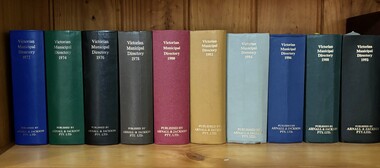
Book - Victorian Municipal Directory Collection, Arnall & Jackson Pty Ltd, Victorian Municipal Directory
... They were the backbone of civic administration research before digitisation. 1/ Victorian Municipal Directory 1972 - State Guide and Water supply Record Incorporating Part of Southern N.S.W. 2/ Victorian Municipal Directory 1974 - State Guide and Water supply Record Incorporating Part of Southern N.S.W. 3/ Victorian Municipal Directory 1976 - State Guide and Water supply Record 4/ Victorian Municipal Directory 1978 - State Guide and Water supply Record 5/ Victorian Municipal Directory 1980 - State Guide and Water supply Record 6/ Victorian Municipal Directory 1982 - State Guide and Water supply Record 7/ Victorian Municipal Directory 1984 - State Guide and Water supply Record 8/ Victorian Municipal Directory 1986 - State Guide and Water supply Record 9/ Victorian Municipal Directory 1988 - State Guide and Water supply Record 10/ Victorian Municipal Directory 1990 - State Guide and Water supply Record Collection of 10 Victorian Municipal Directories Hard Covered Books Victorian Municipal Directory Book Victorian Municipal Directory Collection Arnall & Jackson Pty Ltd ...The Victorian Municipal Directories were annual (or near‑annual) reference books published from the late 19th century through much of the 20th century that listed every municipality in Victoria, along with detailed information about councils, officers, rates, boundaries, services, infrastructure, and local institutions. They were the backbone of civic administration research before digitisation.Collection of 10 Victorian Municipal Directories Hard Covered Booksnon-fictionThe Victorian Municipal Directories were annual (or near‑annual) reference books published from the late 19th century through much of the 20th century that listed every municipality in Victoria, along with detailed information about councils, officers, rates, boundaries, services, infrastructure, and local institutions. They were the backbone of civic administration research before digitisation.directory, victoria, thomas william "bill" deutschmann, city of sunshine -
![W. D. Birrell, Town Clerk [Kew] 1936 -](/media/collectors/550653872162f11fb04854aa/items/5922c01dd0cde9131c35460b/item-media/5c22673821ea6713f45cc993/item-fit-380x285.jpg?cb=6) Kew Historical Society Inc
Kew Historical Society IncPhotograph, Stuart Tompkins Studios, W. D. Birrell, Town Clerk [Kew] 1936, c.1938
... Civic Century (1960), Cr. W.D. Vaughan described William Dickie Birrell M.B.E. (1899-1974) as follows: “Mr. W. D. Birrell, who had been on the staff of the Country Roads Board after his return from active service with the First A.I.F., was appointed assistant town clerk on February 15, 1921. On Mr. Harrison’s retirement he was appointed town clerk and city treasurer, and has given outstanding service. His knowledge of municipal administration...Civic Century (1960), Cr. W.D. Vaughan described William Dickie Birrell M.B.E. (1899-1974) as follows: “Mr. W. D. Birrell, who had been on the staff of the Country Roads Board after his return from active service with the First A.I.F., was appointed assistant town clerk on February 15, 1921. On Mr. Harrison’s retirement he was appointed town clerk and city treasurer, and has given outstanding service. His knowledge of municipal administration ...In Kew’s Civic Century (1960), Cr. W.D. Vaughan described William Dickie Birrell M.B.E. (1899-1974) as follows: “Mr. W. D. Birrell, who had been on the staff of the Country Roads Board after his return from active service with the First A.I.F., was appointed assistant town clerk on February 15, 1921. On Mr. Harrison’s retirement he was appointed town clerk and city treasurer, and has given outstanding service. His knowledge of municipal administration has been acknowledged by the Government calling on his services to advise on amendments to the Local Government Act. He is a past president of the Town Clerks Institute, and on the nomination of that body was honoured by Her Majesty the Queen in 1958 with the award of the M.B.E. He still occupies the position and is held in the highest esteem not only by the Kew Council, but also by local government administrators throughout the metropolitan area.” (page 132) He died on 7 May 1974, and his ashes were interred at the Boroondara General Cemetery. This portrait is one of a series of mounted and framed photographic portraits of Mayors and Town Clerks of the former Borough, Town and City of Kew, for the period 1863 to 1969. The portraits were transferred by the City of Kew to the Kew Historical Society in March 1989. A Significance Assessment in 2018, funded by the National Library of Australia confirmed the historic, and often artistic significance of the series. Framed portrait of W. D. Birrell - Town Clerk of the City of Kew from 1936 -. The mounting and framing of the photograph follows a typical layout or style in that it each is framed in dark wood, glazed, and laid down on an inscribed board. The inscription identifies the name of the town clerk and the year/s that he served.W.D. BIRRELL / TOWN CLERK 1938-town clerks - kew (vic), w.d. birrell, photographers - stuart tompkins studios - camberwell (vic), kew (vic.) — municipal collection -
 Mont De Lancey
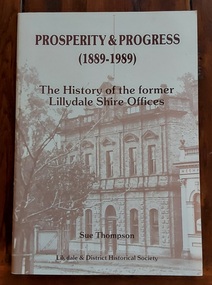
Book, Sue Thompson, Prosperity and Progress (1889-1989): The History of the former Lillydale Shire offices, 1989
... administration as Lilydale transitioned from a remote settlement to a booming agricultural and suburban hub. Lillydale - history Lillydale - shire offices Victoria - Lillydale This book refers to the historical publication by Sue Thompson detailing the legacy and evolution of the former Shire of Lillydale Offices in Victoria, Australia. Published by the Lilydale & District Historical Society, the book covers a century of civic ...This book refers to the historical publication by Sue Thompson detailing the legacy and evolution of the former Shire of Lillydale Offices in Victoria, Australia. Published by the Lilydale & District Historical Society, the book covers a century of civic leadership, infrastructural growth, and local governance.A white book with a large sepia coloured photograph on the front of The Lillydale Shire Offices opened on November 14,1889. The front cover lettering is brown. The title page has publishing details with further information on the back of it. There are Contents, Foreword and Introduction pages. The publication highlights the development of shire staff, selected historical issues through the years, and a complete listing of local councillors who steered the region’s growth. Pp. 48non-fictionThis book refers to the historical publication by Sue Thompson detailing the legacy and evolution of the former Shire of Lillydale Offices in Victoria, Australia. Published by the Lilydale & District Historical Society, the book covers a century of civic leadership, infrastructural growth, and local governance.lillydale - history, lillydale - shire offices, victoria - lillydale -
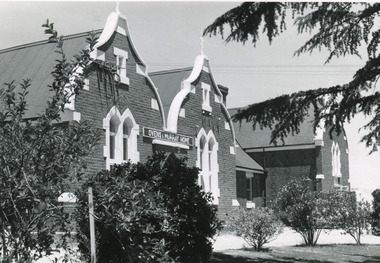 The Beechworth Burke Museum
Photograph, J. Collins, c.1940-1950s
... This building is important for research into the civic development of Beechworth as an early Gold Rush town located in Victoria's North-East. During this period, Beechworth was developing as the main center of administration in this region which made it a very influential and quickly developed town. ...This photograph was captured sometime between an estimated 1940s-1950s. It depicts the Beechworth Benevolent Asylum (later the Ovens and Murray Hospital for the Aged) which was built in 1862. It is located on an elevated site in Beechworth, Victoria because it was believed the height was beneficial to the health of the patients at the Benevolent. Later wings were added to the original building between 1867 and 1890. The building was constructed in an unusual Flemish Gothic Revival style which contrasts with the classical style of the Mayday Hills Hospital in close proximity to the Benevolent. The Hospital was designed in Italianate Revival architecture. The appearance of buildings like the Mayday Hills Hospital and the Ovens Benevolent Asylum are representative of the importance of Beechworth as a town shortly after the goldrush. During the 1850s and 1860s, administration buildings were erected alongside churches, shops and structures of justice. This marks a movement away from the "chaotic" structure of life on the goldfields and towards a more civilised and cultural lifestyle. This social phenomenon is also witnessed in Melbourne with the creation of buildings like the State Library and the University of Melbourne. The Beechworth Benevolent Asylum was renamed the Ovens Benevolent Home in 1935. The Asylum had been set up to provide accommodation and care for permanently injured gold miners, and for women and children who were penniless, homeless, or whose parents were guests of the state. In 1954 it was renamed as The Ovens and Murray Home (as pictured in this photograph). The purpose of this building was to provide a refuge for the poor and destitute, homeless older men, deserted women and children along with providing care for the mentally ill. These buildings were built at the government's expense and are of great historical and architectural significance.This photograph depicts the Ovens and Murray Home (previously the Ovens Benevolent Home) during the 1940s or 1950s. Since this building is of great historic and architectural significance, photographs like this are especially valuable in reconstructing the use history and any changes/additions to the building over a period of time. This building is important for what it can reveal about society in Beechworth and also architectural styles. This building is made in the Flemish Gothic Revival style which is quite unusual for the 1860s. It is important as an early example of a building constructed for a specific purpose, in the case of this particular building: caring for the aged/destitute. This building is important for research into the civic development of Beechworth as an early Gold Rush town located in Victoria's North-East. During this period, Beechworth was developing as the main center of administration in this region which made it a very influential and quickly developed town. Photographs like this one which depict a building during one period in history can reveal important information for the use and alterations of a building and for preferences in architectural style. It can also be studied for what it reveals about society in Beechworth and compared and contrasted to similar institutions across Australia and with additional photographs in the Burke Museum collection.Black and white rectangular photograph printed on gloss photographic paperObverse: OVENS & MURRAY HOME / Reverse: KODAK PAPER / 727 / J. Collins BMM 8689.1 /mayday hills, beechworth benevolent asylum, ovens benevolent home, asylum, refuge, poor and destitute, goldrush, flemish gothic revival, architecture -
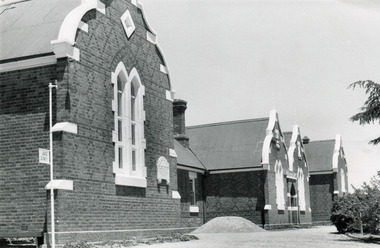 The Beechworth Burke Museum
Photograph, J. Collins
... This building is important for research into the civic development of Beechworth as an early Gold Rush town located in Victoria's North-East. During this period, Beechworth was developing as the main center of administration in this region which made it a very influential and quickly developed town. ...This photograph was captured sometime between an estimated 1940s-1950s. It depicts the Beechworth Benevolent Asylum (later the Ovens and Murray Hospital for the Aged) which was built in 1862. It is located on an elevated site in Beechworth, Victoria because it was believed the height was beneficial to the health of the patients at the Benevolent. Later wings were added to the original building between 1867 and 1890. The building was constructed in an unusual Flemish Gothic Revival style which contrasts with the classical style of the Mayday Hills Hospital in close proximity to the Benevolent. The Hospital was designed in Italianate Revival architecture. The appearance of buildings like the Mayday Hills Hospital and the Ovens Benevolent Asylum are representative of the importance of Beechworth as a town shortly after the goldrush. During the 1850s and 1860s, administration buildings were erected alongside churches, shops and structures of justice. This marks a movement away from the "chaotic" structure of life on the goldfields and towards a more civilised and cultural lifestyle. This social phenomenon is also witnessed in Melbourne with the creation of buildings like the State Library and the University of Melbourne. The Beechworth Benevolent Asylum was renamed the Ovens Benevolent Home in 1935. The Asylum had been set up to provide accommodation and care for permanently injured gold miners, and for women and children who were penniless, homeless, or whose parents were guests of the state. In 1954 it was renamed as The Ovens and Murray Home (as pictured in this photograph). The purpose of this building was to provide a refuge for the poor and destitute, homeless older men, deserted women and children along with providing care for the mentally ill. These buildings were built at the government's expense and are of great historical and architectural significance.This photograph depicts the Ovens and Murray Home (previously the Ovens Benevolent Home) during the 1940s or 1950s. Since this building is of great historic and architectural significance, photographs like this are especially valuable in reconstructing the use history and any changes/additions to the building over a period of time. This building is important for what it can reveal about society in Beechworth and also architectural styles. This building is made in the Flemish Gothic Revival style which is quite unusual for the 1860s. It is important as an early example of a building constructed for a specific purpose, in the case of this particular building: caring for the aged/destitute. This building is important for research into the civic development of Beechworth as an early Gold Rush town located in Victoria's North-East. During this period, Beechworth was developing as the main center of administration in this region which made it a very influential and quickly developed town. Photographs like this one which depict a building during one period in history can reveal important information for the use and alterations of a building and for preferences in architectural style. It can also be studied for what it reveals about society in Beechworth and compared and contrasted to similar institutions across Australia and with additional photographs in the Burke Museum collection.Black and white rectangular photograph printed on gloss photographic paperBack of photograph. Handwriting: "For John Beckingsale"mayday hills, beechworth benevolent asylum, ovens benevolent home, destitute, gold town, beechworth, victoria, north-east vic -
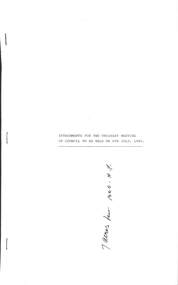 Sunshine and District Historical Society Incorporated
Administrative record - City of Sunshine - Commissioner Mr Alexander Alex George Gillon Collection 1976 - 1982 - Attachments for the ordinary meeting 8th July 1980, City of Sunshine, 8th July 1980
... Attachments for the Ordinary Meeting 8th July 1980 The Institute of Municipal Administration Letter Dated 16th June 1980 Short Course Powers & Duties of the Municipal Returning Officer Civic Centre Essendon 10th July 1980 The Institute of Municipal Administration Letter Dated 18th June 1980 Office Administration Seminar 17th & 18th July 1980 Sunshine Swimming Pool and Deer Park Swimming Pool Annual Reports City of Coburg Letter Dated 12th June 1980 Victorian Post Education Commission on Advance Education in Victoria Report Department of Administrative Services Letter Land Sale to Council Randall Street Maribyrnong for Elderly Citizens' Club...Sunshine Swimming Pool Kennedy Street Sunshine Deer Park Swimming Pool Sassella Park Station Road Deer Park Randall Street Maribyrnong Maribyrnong Elderly Citizens' Club Attachments for the Ordinary Meeting 8th July 1980 The Institute of Municipal Administration Letter Dated 16th June 1980 Short Course Powers & Duties of the Municipal Returning Officer Civic Centre Essendon 10th July 1980 The Institute of Municipal Administration Letter Dated 18th June 1980 Office Administration Seminar 17th & 18th July 1980 Sunshine Swimming Pool and Deer Park Swimming Pool Annual Reports City of Coburg Letter Dated 12th June 1980 Victorian Post Education Commission on Advance Education in Victoria Report Department of Administrative Services Letter Land Sale to Council Randall Street Maribyrnong for Elderly Citizens' Club Foolscap sized document. ...Attachments for the Ordinary Meeting 8th July 1980 The Institute of Municipal Administration Letter Dated 16th June 1980 Short Course Powers & Duties of the Municipal Returning Officer Civic Centre Essendon 10th July 1980 The Institute of Municipal Administration Letter Dated 18th June 1980 Office Administration Seminar 17th & 18th July 1980 Sunshine Swimming Pool and Deer Park Swimming Pool Annual Reports City of Coburg Letter Dated 12th June 1980 Victorian Post Education Commission on Advance Education in Victoria Report Department of Administrative Services Letter Land Sale to Council Randall Street Maribyrnong for Elderly Citizens' Clubsunshine swimming pool, kennedy street, sunshine, deer park swimming pool, sassella park, station road, deer park, randall street, maribyrnong, maribyrnong elderly citizens' club -
 Broadmeadows Historical Society & Museum
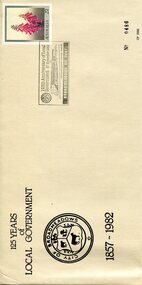
Ephemera - Commemorative Cover, Australia Post, 125 Years of Local Government 1857-1982, 1982
... Administration...Municipal History...Civic...civic commemoration, municipal identity, and the use of official symbols during the late twentieth century. The inclusion of a special Broadmeadows cancellation links the item directly to a local event, while the numbered limited edition enhances its documentary value. The cover contributes to understanding how local government milestones were publicly celebrated and represented within the municipality. City of Broadmeadows Local Government Municipal Administration ...This commemorative envelope was produced to mark the 125th anniversary of local government in Victoria, calculated from the establishment of the colony's municipal system in 1857. The envelope specifically commemorates local celebrations held in Broadmeadows on 27 November 1982. The item reflects civic identity and municipal pride during the City of Broadmeadows era and incorporates the municipal seal used by the municipality. The special cancellation references the Broadmeadows Leisure Centre, indicating its role in anniversary activities.This commemorative cover is historically significant for its association with the 125th anniversary of local government in Victoria and the City of Broadmeadows' participation in those celebrations. It provides evidence of civic commemoration, municipal identity, and the use of official symbols during the late twentieth century. The inclusion of a special Broadmeadows cancellation links the item directly to a local event, while the numbered limited edition enhances its documentary value. The cover contributes to understanding how local government milestones were publicly celebrated and represented within the municipality.Rectangular commercially produced paper envelope with gummed flap. Printed in black ink on cream stock. Front bears municipal insignia of the City of Broadmeadows, commemorative text, Australia Post pre-stamped floral indicium, and special pictorial cancellation. Reverse contains explanatory Australia Post text and postal markings. Limited edition numbered 0486 of 2000.city of broadmeadows, local government, municipal administration, municipal history, civic identity, municipal symbols, postal history, commemorative covers, australia post, broadmeadows leisure centre, anniversary celebrations, philately, community events, victoria. -
Broadmeadows Historical Society & Museum
Booklet - Council Booklet, Broadmeadows City Council, Future Directions, 1994
... The booklet provides valuable evidence of civic administration, municipal planning and community aspirations within Broadmeadows immediately before local government restructuring. ...This booklet was produced during 1993–1994 and communicates the priorities and direction of Broadmeadows City Council. Topics include organisational restructuring, occupational health and safety improvements, debt refinancing, changes to the municipal rating system, community consultation, service delivery and economic development. It provides evidence of local government administration and policy immediately prior to the Victorian municipal amalgamations of the mid-1990s.This publication is historically significant as a record of Broadmeadows City Council's policies, priorities and public communications during the early 1990s. It documents management reforms, financial strategies, community engagement initiatives and economic development objectives at a time of significant change in Victorian local government. The booklet provides valuable evidence of civic administration, municipal planning and community aspirations within Broadmeadows immediately before local government restructuring.Monochrome illustrated stapled booklet issued by Broadmeadows City Council. The publication outlines council management reforms, financial management initiatives, debt refinancing, waste collection services, capital works projects, community consultation programs, kindergarten services and economic development strategies. Approximately eight pages with photographic illustrations and council branding throughout. broadmeadows city council, local government, municipal administration, community planning, economic development, public finance, municipal services, broadmeadows (vic.), urban development, local history -
Broadmeadows Historical Society & Museum
Administrative record (sub-series) - Notice Paper, Notice papers and Agenda for meetings of the City of Broadmeadows, 1960
... Documents reflect systems of municipal governance, public works administration, and institutional ideology during a period of urban development and civic regulation. ...Documents reflect systems of municipal governance, public works administration, and institutional ideology during a period of urban development and civic regulation. ...Created and accumulated by Broadmeadows Historical Society (Broadmeadows Museum). Maintained as working records and reference materials.Created to document, support, and justify administrative governance, institutional ideology, and the planning, approval, and execution of municipal works and civic infrastructure.Documents appear to have been kept in subject based groupings, combining technical records with ideological or interpretive material. Original order largely maintained, reflecting creator usage rather than chronological sequencing. Arranged in chronological order.Sub series comprises: • Administrative memoranda and ideological statements. • Municipal engineering and public works reports. • Construction, street, drainage, and infrastructure documentation. • Approval notes, official reports, and technical appendices. • Mixed manuscript and typescript material with annotations. local government, municipal administration, public works, infrastructure development, bureaucracy, governance and authority, urban historylocal government, municipal administration, public works, infrastructure development, bureaucracy, governance and authority, urban history -
 Broadmeadows Historical Society & Museum
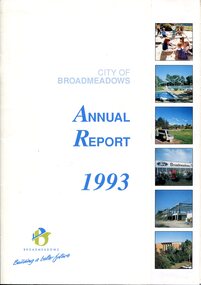
Book - Annual Report, Alex Simic et al, City of Broadmeadows Annual Report 1993, 1993
... Administration...Annual Reports...Civic...The publication documents the functions, priorities, achievements and financial position of the City of Broadmeadows during its final years of existence and provides valuable evidence of civic administration, urban development and community services in the municipality. ...The annual report presents an overview of municipal operations and achievements for 1993. Content typically includes reports from the Mayor and Chief Executive Officer, financial statements, departmental reports, community services, engineering and works programs, planning activities, recreation services, economic development initiatives, staffing information and statistical data relating to municipal governance and service delivery.28 pages including covers; colour printed publication with card cover and stapled binding. Front cover features the title City of Broadmeadows Annual Report 1993, municipal logo and slogan "Building a Better Future", and a series of colour photographs depicting community facilities, recreation spaces, commercial development and civic infrastructure.non-fictionThe annual report presents an overview of municipal operations and achievements for 1993. Content typically includes reports from the Mayor and Chief Executive Officer, financial statements, departmental reports, community services, engineering and works programs, planning activities, recreation services, economic development initiatives, staffing information and statistical data relating to municipal governance and service delivery.city of broadmeadows, local government, municipal administration, annual reports, civic governance, community services, urban development, municipal finance, recreation facilities, infrastructure, broadmeadows, hume region, victoria, local history, municipal reform. -
 Broadmeadows Historical Society & Museum
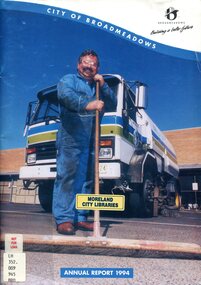
Administrative record - Annual Report, Phillip Shannihan, City of Broadmeadows Annual Report 1994, 1994
... administration, urban development, municipal infrastructure and community services in Broadmeadows during 1994. The item retains provenance evidence through former Moreland City Libraries ownership markings and remains a complete example of a municipal annual report. It possesses strong interpretive value for understanding civic ...Official annual report of the City of Broadmeadows for 1994. Includes reports on council operations, administration, finance, infrastructure, community services, planning activities and municipal achievements. The publication serves as a primary source documenting local government functions and community development within Broadmeadows during 1994.Printed annual report comprising paper text pages with colour printed paper cover. The front cover depicts a municipal street-sweeping vehicle and a municipal works employee standing with a long-handled broom. The title "CITY OF BROADMEADOWS" appears at the top of the cover, with the municipal logo and slogan "Building a better future". The publication bears evidence of former ownership by Moreland City Libraries, including labels and classification markings. Softcover publication; paper and paperboard construction.non-fictionOfficial annual report of the City of Broadmeadows for 1994. Includes reports on council operations, administration, finance, infrastructure, community services, planning activities and municipal achievements. The publication serves as a primary source documenting local government functions and community development within Broadmeadows during 1994.city of broadmeadows, local government, municipal administration, annual reports, community services, infrastructure, urban development, council governance, broadmeadows history, hume region. -
 Flagstaff Hill Maritime Museum and Village
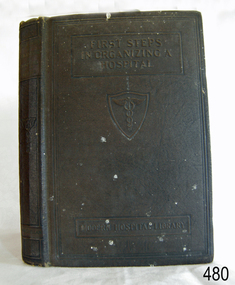
Book - Reference Book Hospital Management, Joseph J Weber, First Steps in Organizing a Hospital, 1924
... administration and healthcare planning. Written during a period when modern hospital design and governance were undergoing rapid professionalisation, the book serves as a practical, step-by-step guide for local committee members, civic leaders, and medical professionals planning to establish a new hospital. ...First Steps in Organising a Hospital is a 1924 foundational manual on hospital administration and healthcare planning. Written during a period when modern hospital design and governance were undergoing rapid professionalisation, the book serves as a practical, step-by-step guide for local committee members, civic leaders, and medical professionals planning to establish a new hospital. Its primary focus is on community needs assessments through preliminary surveys to determine whether a community actually requires a hospital and at what capacity, as well as the governance and board structures required. This volume outlines the roles, legal duties, and recruitment of hospital trustees and board members. Additional subjects covered include financial planning, outlining methods for fundraising, capital campaigns, budgeting, and long-term operating costs. Building design and layout are also addressed, explaining how to coordinate with architects to create functional, hygienic, and efficient clinical spaces, alongside guidance for staffing and overall administration.First Steps in Organizing a Hospital Author: Joseph J Weber Publisher: The Macmillan Company Date: 1924 Further Information: Hardcover, textured brown, embossed title and details in black embossed lettering.non-fictionFirst Steps in Organising a Hospital is a 1924 foundational manual on hospital administration and healthcare planning. Written during a period when modern hospital design and governance were undergoing rapid professionalisation, the book serves as a practical, step-by-step guide for local committee members, civic leaders, and medical professionals planning to establish a new hospital. Its primary focus is on community needs assessments through preliminary surveys to determine whether a community actually requires a hospital and at what capacity, as well as the governance and board structures required. This volume outlines the roles, legal duties, and recruitment of hospital trustees and board members. Additional subjects covered include financial planning, outlining methods for fundraising, capital campaigns, budgeting, and long-term operating costs. Building design and layout are also addressed, explaining how to coordinate with architects to create functional, hygienic, and efficient clinical spaces, alongside guidance for staffing and overall administration.flagstaff hill, warrnambool, shipwrecked-coast, flagstaff-hill, flagstaff-hill-maritime-museum, maritime-museum, shipwreck-coast, flagstaff-hill-maritime-village, first steps in organizing a hospital, book, joseph j weber, w. r. angus -
 Broadmeadows Historical Society & Museum
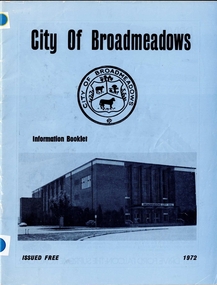
Booklet - Information Booklet, City of Broadmeadows Council, City of Broadmeadows Information Booklet 1972, 1972
... Administration...Community Services...Urban Development...Civic...The publication offers valuable insight into local government administration, community facilities, urban planning and civic identity in Melbourne's northern suburbs. ...An official municipal information booklet issued free by the City of Broadmeadows in 1972. It provides residents with an overview of council operations, elected representatives, municipal facilities, services, infrastructure, planning initiatives and community resources. The publication serves as a contemporary record of the municipality during a significant period of population growth and urban development.34-page stapled paper booklet with printed colour cover and black-and-white internal pages. Front cover features the City of Broadmeadows municipal seal, a photograph of Broadmeadows City Hall, the words “Information Booklet”, and the date 1972. Booklet contains information relating to municipal administration, services, facilities, development, and local government activities within the City of Broadmeadows. non-fictionAn official municipal information booklet issued free by the City of Broadmeadows in 1972. It provides residents with an overview of council operations, elected representatives, municipal facilities, services, infrastructure, planning initiatives and community resources. The publication serves as a contemporary record of the municipality during a significant period of population growth and urban development.city of broadmeadows, local government, municipal administration, community services, urban development, civic infrastructure, broadmeadows city hall, municipal history, melbourne northern suburbs, public information publications, victoria, 1972.
