
Showing 6 items matching "civic showcase"
-
 Whitehorse Historical Society Inc.
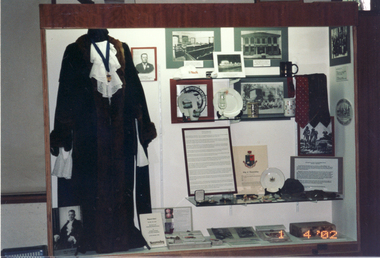
Photograph, Civic Showcase, 1/04/2002 12:00:00 AM
... Civic Showcase...civic showcase...Coloured photograph of Civic Showcase in Museum - opened for refurbishment....civic showcase museum Coloured photograph of Civic Showcase in Museum - opened for refurbishment. ...Coloured photograph of Civic Showcase in Museum - opened for refurbishment.civic showcase, museum -
 Eltham District Historical Society Inc
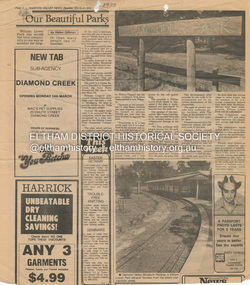
Document - Property Binder, Eltham Lower Park, Main Road, Eltham
... Newspaper article: New BBQ at Eltham Park, The Advertiser, 9 July 1996, about a joint project between Nillumbik Council and Eltham Rotary (On same page an article about the showcasing of indigineous plants around Nillumbik Shire offices at Civic Drive and on p4 an article about redevelopment works at Elis Cottage)....Newspaper article: New BBQ at Eltham Park, The Advertiser, 9 July 1996, about a joint project between Nillumbik Council and Eltham Rotary (On same page an article about the showcasing of indigineous plants around Nillumbik Shire offices at Civic Drive and on p4 an article about redevelopment works at Elis Cottage). ...Newspaper article: Our Beautiful Parks, Diamond Valley News, 8 March 1983, describing Eltham Lower Park and Diamond Valley Miniature Railway. Newspaper article: Diamond Valley News, 8 March 1983, Election of the ALP, Peter Stables member for Diamond Valley. Flier for Diamond Valley Miniature Railway with photograph and map. Photographs of Miniature Railway at former location at Chelsworth Park Ivanhoe. Newspaper article: New BBQ at Eltham Park, The Advertiser, 9 July 1996, about a joint project between Nillumbik Council and Eltham Rotary (On same page an article about the showcasing of indigineous plants around Nillumbik Shire offices at Civic Drive and on p4 an article about redevelopment works at Elis Cottage).main road, parks, miniature railway, chelsworth park ivanhoe, bbq facilities, civic drive, eltham lower park, eltham rotary, landscape, nillumbik shire council, ellis cottage, eltham (vic), chelsworth park, ivanhoe, diamond valley railway -
 Bendigo Military Museum
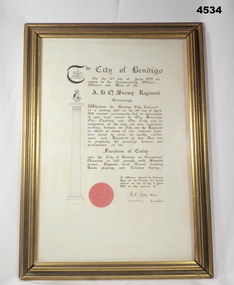
Certificate - FREEDOM OF ENTRY, FRAMED
... civic honor a city can confer on a military unit. It strengthens the bond between the military and the local community, acknowledging the unit's historical ties and contributions. Events celebrating Freedom of Entry often draw large crowds, showcasing...civic honor a city can confer on a military unit. It strengthens the bond between the military and the local community, acknowledging the unit's historical ties and contributions. Events celebrating Freedom of Entry often draw large crowds, showcasing ...Freedom of Entry is a ceremonial privilege granted to military units, allowing them to march through a city or town with full military honors, symbolizing trust and community ties. Freedom of Entry has its roots in military traditions dating back to ancient Rome, where soldiers were not allowed to enter the city without permission due to concerns about maintaining order. This practice evolved over centuries, particularly after the English Civil War, when loyal military units were granted the right to enter cities as a mark of honor and trust. In contemporary times, Freedom of Entry is a formal honor bestowed by local governments on military units, allowing them to march through the streets with swords drawn, drums beating, and colors flying. This event typically includes a ceremonial parade, where the unit is challenged by local authorities, symbolizing the community's recognition of the military's service and commitment. The granting of Freedom of Entry represents the highest civic honor a city can confer on a military unit. It strengthens the bond between the military and the local community, acknowledging the unit's historical ties and contributions. Events celebrating Freedom of Entry often draw large crowds, showcasing community support for the armed forces. The Certificate of Freedom of Entry to Bendigo was granted to A.H.Q Survey Regt in 1970. Signed by JCH Jeffrey, Mayor. This was a great honor to be granted to the unitCertificate and frame. Frame - gold tinted wooden frame, rectangular, glass. Certificate - Parchment, white, printing possibly old gothic style, black ink. City of Bendigo seal is red and embossed. Survey Regiment crest and City of Bendigo crest. freedom, royal australian survey corps, rasvy, fortuna, army survey regiment, army svy regt, asr -
 Bendigo Military Museum
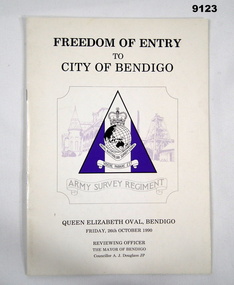
Booklet - Army Survey Regiment - Freedom of Entry to City of Bendigo 1990, Army Survey Regiment, Oct 1990
... civic honor a city can confer on a military unit. It strengthens the bond between the military and the local community, acknowledging the unit's historical ties and contributions. Events celebrating Freedom of Entry often draw large crowds, showcasing...civic honor a city can confer on a military unit. It strengthens the bond between the military and the local community, acknowledging the unit's historical ties and contributions. Events celebrating Freedom of Entry often draw large crowds, showcasing ...Freedom of Entry is a ceremonial privilege granted to military units, allowing them to march through a city or town with full military honors, symbolizing trust and community ties. Freedom of Entry has its roots in military traditions dating back to ancient Rome, where soldiers were not allowed to enter the city without permission due to concerns about maintaining order. This practice evolved over centuries, particularly after the English Civil War, when loyal military units were granted the right to enter cities as a mark of honor and trust. In contemporary times, Freedom of Entry is a formal honor bestowed by local governments on military units, allowing them to march through the streets with swords drawn, drums beating, and colors flying. This event typically includes a ceremonial parade, where the unit is challenged by local authorities, symbolizing the community's recognition of the military's service and commitment. The granting of Freedom of Entry represents the highest civic honor a city can confer on a military unit. It strengthens the bond between the military and the local community, acknowledging the unit's historical ties and contributions. Events celebrating Freedom of Entry often draw large crowds, showcasing community support for the armed forces. The Certificate of Freedom of Entry to Bendigo was granted to A.H.Q Survey Regt in 1970. Signed by JCH Jeffrey, Mayor. This was a great honor to be granted to the unit and this booklet records the exercising of that privilege on 26 October 1990. This booklet records the senior Officers of the Royal Australian Survey Corps and their appointments and dates of service as well as the unit members participating in the Freedom of Entry Parade that was held on the Queen Elizabeth Oval, Bendigo. The Reviewing Officer was Cr AJ Douglass JP the Mayor of the City of Greater Bendigo. The Army Survey Regiment exercised its Freedom of Entry with ceremonial parades in 1970, 1977, 1980, 1985, 1990, 1995 and finally in 1996 when the Unit was disbanded. Because of the importance and amount of information, the entire booklet has been scanned at 200dpi and then made into a 3.54 Mb video that runs for about 4 minutes. Pause the video if you wish to read the entire contents of a single page.Laminated cardboard cover, black & white print. On front cover at R top corner RASvy emblem in colour. 20 pages, coloured photo of the Director of Military Survey Colonel DG Swiney MBE on p2. Coloured photo of CO Lt Col Rene Van den Tol on p4, coloured photo of Mayor of the City of Greater Bendigo Cr AJ Douglas JP on p6. Contents cover the history of dignitaries, the Freedom of Entry Certificate & program of service followed by a list of Senior Survey Corps Officers and the dates that they served followed by a nominal roll of the Unit parade attendees. Held at Queen Elizabeth Oval on Friday 26 October 1990. The entire booklet has been scanned at 200dpi and then made into a 3.54 Mb video that runs for about 4 minutes. Pause the video if you wish to read the entire contents of a single page.books-military, civic mementoes-presentations, military history-army, royal australian survey corps, rasvy, fortuna, army survey regiment, army svy regt -
 Broadmeadows Historical Society & Museum
Photograph - Group Photo, Classic Studios Victoria, Jacana Primary School - Students and Staff Photograph, 2006, 2006
... showcasing the unity and shared purpose of its students and staff. It highlights the school’s role not only as a place of learning but also as a centre for community building, civic engagement, and social support. ...showcasing the unity and shared purpose of its students and staff. It highlights the school’s role not only as a place of learning but also as a centre for community building, civic engagement, and social support. ...Jacana Primary School was established in 1959 during a period of rapid suburban expansion in Melbourne’s northern corridor. Situated in the suburb of Jacana, the school was part of a broader post-war initiative aimed at delivering accessible public education to communities shaped by migration, industrial growth, and government housing programs. Over the decades, Jacana Primary evolved alongside its community, reflecting the changing social and cultural landscape of the area. By the 1990s and early 2000s, the school had become a vibrant and inclusive environment, welcoming students from a wide range of cultural and socio-economic backgrounds. This diversity was embraced through inclusive teaching practices, multicultural celebrations, and student leadership initiatives such as the junior student council. The 2006 photograph captures a moment near the end of the school’s operation, showcasing the unity and shared purpose of its students and staff. It highlights the school’s role not only as a place of learning but also as a centre for community building, civic engagement, and social support. Although Jacana Primary School closed in the early 2000s, its legacy endures through archival materials like this photograph. These records offer valuable insights into the role of public education in shaping community identity and fostering social cohesion during a transformative period in Melbourne’s suburban history. The 2006 Students and Staff photograph from Jacana Primary School is a historically significant visual record that captures the final chapter of a school deeply embedded in Melbourne’s northern suburban landscape. Established in 1959 during a wave of post-war development, Jacana Primary was part of a broader initiative to provide accessible public education to communities shaped by migration, industrial growth, and housing expansion. This photograph reflects the school’s enduring commitment to inclusion, diversity, and community engagement. By the early 2000s, Jacana Primary had become a vibrant educational environment, welcoming students and staff from a wide range of cultural and socio-economic backgrounds. The image documents the collaborative spirit and shared purpose that defined the school’s ethos, highlighting its role as both a learning institution and a centre of social cohesion. As one of the final visual records before the school’s closure, the photograph holds particular significance. It offers insight into the lived experiences of students and educators during a transformative period in Melbourne’s suburban history and stands as a testament to the lasting impact of public education in fostering community identity and resilience.A colour photograph mounted on matte Paper with a purple border(Blue Label) PH - 5383 Classic Studios VIC order: p337249 / Frame x Jacana whole school item 4 Kodak Professional / Endura Paper. papier. papel / Professional images are/ copyright protected / Dutch copyright Gerschütz jacana primary school, education, photograph, group photograph, 2006, students and staff, jacana -
 Broadmeadows Historical Society & Museum
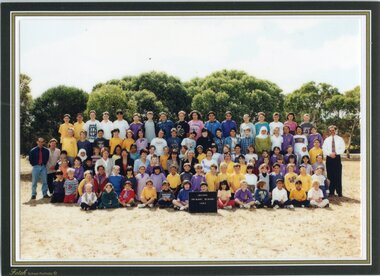
Photograph - Group Photo, Fotek School Portraits, Jacana Primary School 1997 Students and Staff Photograph, 1997
... The 1997 photograph captures a moment in this dynamic environment, showcasing both staff and students engaged in a shared educational mission. It represents a time when schools were not only places of learning but also key sites of community building, civic engagement, and social support. ...The 1997 photograph captures a moment in this dynamic environment, showcasing both staff and students engaged in a shared educational mission. It represents a time when schools were not only places of learning but also key sites of community building, civic engagement, and social support. ...Jacana Primary School was established in 1959 during a period of rapid suburban expansion in Melbourne’s northern corridor. Located in the suburb of Jacana, the school was part of a broader post-war effort to provide accessible public education to growing communities shaped by migration, industrial development, and housing initiatives. Throughout its operation, Jacana Primary reflected the evolving social fabric of the area. By the 1990s, the school had become a microcosm of Melbourne’s increasing cultural diversity, welcoming students from a wide range of ethnic and socio-economic backgrounds. This diversity was not only embraced but actively celebrated through inclusive teaching practices, multicultural events, and student leadership programs such as the junior student council. The 1997 photograph captures a moment in this dynamic environment, showcasing both staff and students engaged in a shared educational mission. It represents a time when schools were not only places of learning but also key sites of community building, civic engagement, and social support. Jacana Primary closed in the early 2000s as part of broader changes in educational policy and demographic shifts. However, its legacy lives on through archival materials like this photograph, which offer valuable insights into the role of public schools in shaping community identity and fostering social cohesion during a transformative period in Melbourne’s suburban history. This 1997 photograph of staff and students at Jacana Primary School marks a poignant moment in the history of a community-centred educational institution that served Melbourne’s northern suburbs from 1959 until its closure in the early 2000s. More than a conventional group portrait, the image stands as a historical artifact that encapsulates the spirit and values of a school deeply embedded in its local community. Jacana Primary School was distinguished by its commitment to educational equity, inclusivity, and a strong sense of belonging—principles that were actively lived and practiced within its classrooms and broader school culture. The photograph offers insight into the educational ethos and staff dynamics of the time, while also reflecting the broader social and cultural shifts occurring in suburban Melbourne at the close of the 20th century. As part of the school’s visual archive, this image contributes to a richer understanding of how public education shaped community identity, supported diverse student populations, and left a lasting legacy in the lives of generations of children and families.A colour photograph mounted on white card with a black border, is laminated. Back: (Blue Label Top) (Right Corner): PH -2157, Front: (Bottom Left Corner): Fotek School Portraitsjacana primary school, education, photograph, group photograph, 1997
