
Showing 5 items matching "civic welcome events"
-
 Bendigo Military Museum
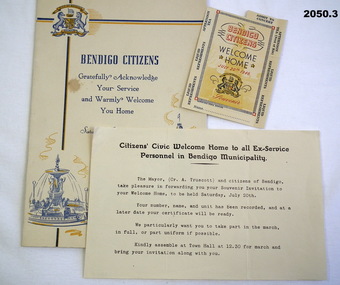
document - DOCUMENTS, CIVILIAN, 20/07/1946
... civic welcome events...Refer Cat No 215.9 for service details. civic welcome events bendigo documents - events/address Documents pertaining to welcome home ceremonies for returning troops; concert, sports, presentations document DOCUMENTS, CIVILIAN ...Items saved by Maurice Anthony BYRNE RAAF. Refer Cat No 215.9 for service details.Documents pertaining to welcome home ceremonies for returning troops; concert, sports, presentationscivic welcome events, bendigo, documents - events/address -
 St Kilda Historical Society
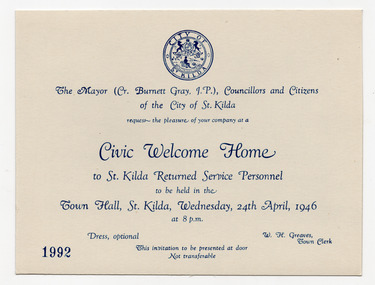
Ephemera - Invitation, Civic Welcome Home, 1946
... Invitation to a civic welcome home event for returned service personnel from St Kilda, held by the City of St Kilda at St Kilda Town Hall on 24 April 1946...Invitation to a civic welcome home event for returned service personnel from St Kilda, held by the City of St Kilda at St Kilda Town Hall on 24 April 1946 City of St Kilda WWII recognition of service Stamped 1992 and 2000 Cream card, discoloured with age, printed on one side in blue - 2 copies. ...Invitation to a civic welcome home event for returned service personnel from St Kilda, held by the City of St Kilda at St Kilda Town Hall on 24 April 1946Cream card, discoloured with age, printed on one side in blue - 2 copies.Stamped 1992 and 2000city of st kilda, wwii recognition of service -
 Bendigo Historical Society Inc.
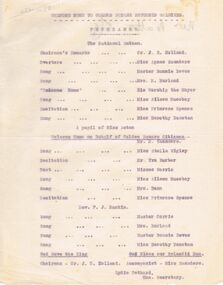
Document - LYDIA CHANCELLOR COLLECTION; WELCOME HOME TO GOLDEN SQUARE RETURNED SOLDIERS PROGRAMME
... EVENT Official civic Lydia Chancellor collection war WW II soldiers event music ceremony Two carbon copies of 'Welcome Home to Golden Square Returned Soldiers' programme. ...Two carbon copies of 'Welcome Home to Golden Square Returned Soldiers' programme. The programme includes speeches, songs, recitations and the National Anthem. The Chairman was Cr. J.E. Holland. Accompanist Miss Saunders and Lydia Pethard, the Hon. Secretary. One sheet. c1945.event, official, civic, lydia chancellor, collection, war, ww ii, soldiers, event, music, ceremony -
 Sunshine and District Historical Society Incorporated
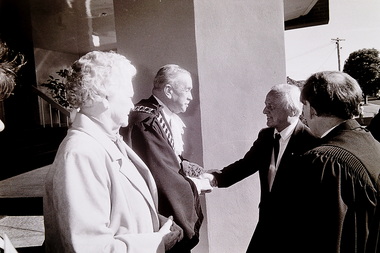
Photograph - Lieutenant Governor Of Victoria Samuel McCaughey Visit To Sunshine 1990 Photographs, Adam Ellwood, 29th June 1990
... Ceremonial duties include attending civic events, visiting suburbs, towns, schools, and community organisations, opening public buildings and infrastructure, presenting awards and honours, supporting charities and volunteer groups. These photographs taken by The Advocate in 1990, when Governor McCaughey and his wife made an official visit to Sunshine. They were welcomed...Ceremonial duties include attending civic events, visiting suburbs, towns, schools, and community organisations, opening public buildings and infrastructure, presenting awards and honours, supporting charities and volunteer groups. These photographs taken by The Advocate in 1990, when Governor McCaughey and his wife made an official visit to Sunshine. They were welcomed ...Sir Samuel McCaughey was a state officeholder, specifically the Lieutenant‑Governor of Victoria. The Governor of Victoria is the Queen / King’s representative in the State of Victoria and is a state level constitutional and ceremonial role. Constitutional duties include giving Royal Assent to Victorian laws, appointing the Premier and Ministers, opening and dissolving Parliament, acting on the advice of the Victorian Government, and ensuring stable, lawful government in the state. Ceremonial duties include attending civic events, visiting suburbs, towns, schools, and community organisations, opening public buildings and infrastructure, presenting awards and honours, supporting charities and volunteer groups. These photographs taken by The Advocate in 1990, when Governor McCaughey and his wife made an official visit to Sunshine. They were welcomed to Sunshine by the Mayor Cr. Don McKay and mayoress Mrs. Isobel McKay. Also at the reception was scouts and guides from Sunshine and Deer Park. The Sunshine North Secondary College Band played in the foyer to welcome the Governor and his wife. After the reception, the party was then taken to The Hunt Club, where the Governor laid the foundation brick for new pottery kiln. They then moved to the Albion Explosive Factory where the new project plans were explained to them. They then moved to Cranwell Park to lay a memorial plaque before travelling to Marie Mill Community Hall and the Living Museum of the West.Governor and Lieutenant‑Governor visits to suburbs like Albion, Braybrook, Maribyrnong, St. Albans and Sunshine were important civic events because they connected local communities to the highest levels of Victoria’s constitutional and ceremonial leadership.Governor McCaughey at Sunshine 321.2samuel mccaughey, sunshine, don mckay, isobel mckay, the hunt club and community arts centre, albion explosive factory, ballarat road, deer park, cranwell park, cranwell street, braybrook, marie mill community centre, randall street, living museum of the west, maribyrnong -
 Broadmeadows Historical Society & Museum
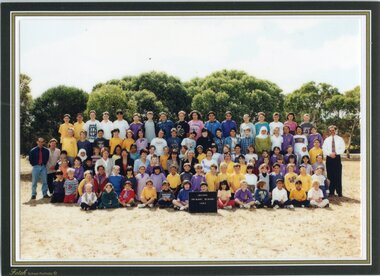
Photograph - Group Photo, Fotek School Portraits, Jacana Primary School 1997 Students and Staff Photograph, 1997
... welcoming students from a wide range of ethnic and socio-economic backgrounds. This diversity was not only embraced but actively celebrated through inclusive teaching practices, multicultural events, and student leadership programs such as the junior student council. The 1997 photograph captures a moment in this dynamic environment, showcasing both staff and students engaged in a shared educational mission. It represents a time when schools were not only places of learning but also key sites of community building, civic...welcoming students from a wide range of ethnic and socio-economic backgrounds. This diversity was not only embraced but actively celebrated through inclusive teaching practices, multicultural events, and student leadership programs such as the junior student council. The 1997 photograph captures a moment in this dynamic environment, showcasing both staff and students engaged in a shared educational mission. It represents a time when schools were not only places of learning but also key sites of community building, civic ...Jacana Primary School was established in 1959 during a period of rapid suburban expansion in Melbourne’s northern corridor. Located in the suburb of Jacana, the school was part of a broader post-war effort to provide accessible public education to growing communities shaped by migration, industrial development, and housing initiatives. Throughout its operation, Jacana Primary reflected the evolving social fabric of the area. By the 1990s, the school had become a microcosm of Melbourne’s increasing cultural diversity, welcoming students from a wide range of ethnic and socio-economic backgrounds. This diversity was not only embraced but actively celebrated through inclusive teaching practices, multicultural events, and student leadership programs such as the junior student council. The 1997 photograph captures a moment in this dynamic environment, showcasing both staff and students engaged in a shared educational mission. It represents a time when schools were not only places of learning but also key sites of community building, civic engagement, and social support. Jacana Primary closed in the early 2000s as part of broader changes in educational policy and demographic shifts. However, its legacy lives on through archival materials like this photograph, which offer valuable insights into the role of public schools in shaping community identity and fostering social cohesion during a transformative period in Melbourne’s suburban history. This 1997 photograph of staff and students at Jacana Primary School marks a poignant moment in the history of a community-centred educational institution that served Melbourne’s northern suburbs from 1959 until its closure in the early 2000s. More than a conventional group portrait, the image stands as a historical artifact that encapsulates the spirit and values of a school deeply embedded in its local community. Jacana Primary School was distinguished by its commitment to educational equity, inclusivity, and a strong sense of belonging—principles that were actively lived and practiced within its classrooms and broader school culture. The photograph offers insight into the educational ethos and staff dynamics of the time, while also reflecting the broader social and cultural shifts occurring in suburban Melbourne at the close of the 20th century. As part of the school’s visual archive, this image contributes to a richer understanding of how public education shaped community identity, supported diverse student populations, and left a lasting legacy in the lives of generations of children and families.A colour photograph mounted on white card with a black border, is laminated. Back: (Blue Label Top) (Right Corner): PH -2157, Front: (Bottom Left Corner): Fotek School Portraitsjacana primary school, education, photograph, group photograph, 1997
