
Showing 9 items matching "civilian doctors"
-
 National Vietnam Veterans Museum (NVVM)
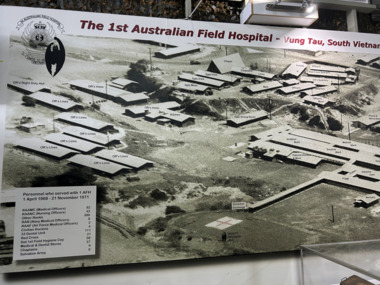
Photograph, The 1st Aust Field Hospital - Vung Tau, South Vietnam
... ...Civilian doctors...1st Australian Field Hospital RAAMC RAANC RAN RAAF Civilian doctors 33 Dental Unit Australian Red Cross Det 1st Field Hygiene Coy Chaplains Salvation Army Medical Officers Nurses 1 Australian Field Hospital Vung Tau South Vietnam Aerial photograph wall panel of 1st Australian Field Hospital, Vung Tau, South Vietnam which features layout and labelled building of hospital complex. ...Aerial photograph wall panel of 1st Australian Field Hospital, Vung Tau, South Vietnam which features layout and labelled building of hospital complex. Bottom left hand corner there is a section with the heading Personnel who served with 1 AFH 1 April 1968 - 21 November 1791. See medial for more information. 1 Australian Field Hospital Vung Tau South Vietnam 1st australian field hospital, raamc, raanc, ran, raaf, civilian doctors, 33 dental unit, australian red cross, det 1st field hygiene coy, chaplains, salvation army, medical officers, nurses -
 Bendigo Military Museum
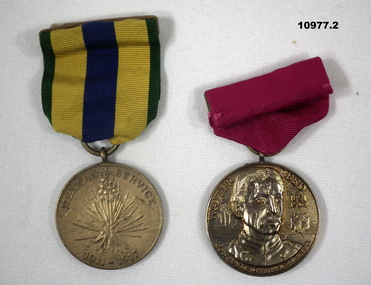
Award - MEDALS, U.S, Unknown
... Walter Reed Medal Military Decoration for US Army recognising accomplishments of US Civilian and Army Doctors who investigated cause and treatment of Yellow Fever in 1901 & 1902....Walter Reed Medal Military Decoration for US Army recognising accomplishments of US Civilian and Army Doctors who investigated cause and treatment of Yellow Fever in 1901 & 1902. ...1. US Border Service Medal 1911-17. Was issued for Action along Mexican Border against bandits between 12 April 1911 to 7 Feb 1917. 2. Walter Reed Medal Military Decoration for US Army recognising accomplishments of US Civilian and Army Doctors who investigated cause and treatment of Yellow Fever in 1901 & 1902. Two medals with ribbons - unmounted. 1. US 1911-17 Border Service Medal. 2. Walter Reed Panama Canal, Yellow Fever Medal with pin clip. 1. No name. Inscribed "FOR MEXICAN SERVIICE 1911-17". 2. No name. Inscribed "WALTER REED 1881-1902 - CONQUEROR OF YELLOW FEVER". ron mills collection, medals, us, pre ww1 -
 Geoffrey Kaye Museum of Anaesthetic History
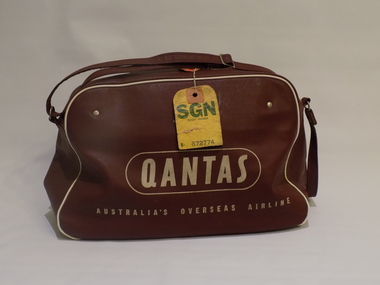
Container - Qantas bag
... civilian) during 1963. He used this bag for carry-on luggage. Despite assurances about the quality of resources available on arrival, he carried an essential part of the breathing circuit for an EMO vaporiser in his carry-on. The actual vaporiser was packed in his check-in luggage. In 1963 the Vietnamese government sought training in Australia in anaesthetics for several medical technicians. Australia was not able to meet the request as anaesthesia training in Australia is restricted to qualified doctors...civilian) during 1963. He used this bag for carry-on luggage. Despite assurances about the quality of resources available on arrival, he carried an essential part of the breathing circuit for an EMO vaporiser in his carry-on. The actual vaporiser was packed in his check-in luggage. In 1963 the Vietnamese government sought training in Australia in anaesthetics for several medical technicians. Australia was not able to meet the request as anaesthesia training in Australia is restricted to qualified doctors ...Dr James (Jim) Villiers went to Vietnam as an anaesthetist with the Australian Surgical Team (civilian) during 1963. He used this bag for carry-on luggage. Despite assurances about the quality of resources available on arrival, he carried an essential part of the breathing circuit for an EMO vaporiser in his carry-on. The actual vaporiser was packed in his check-in luggage. In 1963 the Vietnamese government sought training in Australia in anaesthetics for several medical technicians. Australia was not able to meet the request as anaesthesia training in Australia is restricted to qualified doctors. Instead, the Dean of the Faculty of Anaesthetists at RACS suggested sending a team of anaesthetists to Vietnam to conduct training for technicians there. However, they requested a preliminary survey be undertaken in order to determine the abilities of the prospective trainees and establish contacts with medical authorities in Vietnam. James (Jim) Villiers was one of the people who undertook the survey and made a report. Training of Vietnamese medical technicians was undertaken using the Epstein MacIntosh Oxford Anaesthetic Apparatus (EMO). This equipment was robust, portable and relatively cheap, there are few moving parts for servicing, it requires only ether and air for operation. Brick-red vinyl bag with white Qantas branding including the flying kangaroo printed on both sides. The bag has a zipper opening and contains an anaesthetic apparatus mounted on a piece of wooden particle board. There are two black hoses, a white hose, a black plastic connector, a metal t-bar connect, a green resuscitation bag and black face mask. james villiers, malignant hyperthermia, vietnam, qantas, australian surgical team, long xuyen, bien hoa, anaesthesia training -
 National Vietnam Veterans Museum (NVVM)
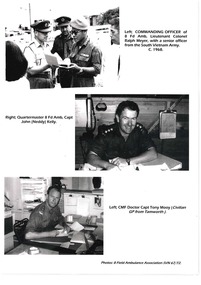
Poster - Information Board
... John (Neddy) Kelly and bottom images if of CMF Doctor Capt. Tony Mooy (Civilian GP from Tamworth) sitting as a desk. ...Civilian GP 8 Field Ambulance South Vietnam/1967-1972 Laminated poster with three images. Top image shows three senior officers. Middle image is of Quartermaster Capt. John (Neddy) Kelly and bottom images if of CMF Doctor ...This item contributes to an understanding of the impact that involvement in the war in Vietnam (1962–1972) had on Australian servicemen. Laminated poster with three images. Top image shows three senior officers. Middle image is of Quartermaster Capt. John (Neddy) Kelly and bottom images if of CMF Doctor Capt. Tony Mooy (Civilian GP from Tamworth) sitting as a desk. 8 Field Ambulance South Vietnam/1967-1972 8 field ambulance, vung tau, vietnam, hospital, commanding officer, quartmaster, civilian gp -
 Alfred Hospital Nurses League - Nursing History Collection
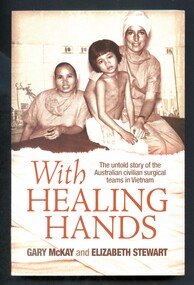
Book - Illustrated book, Gary McKay et al, With healing hands: the untold stories of the Australian civilian nursing teams in Vietnam, 2009
... Most of the country's doctors had been conscripted into the army and the civilian population was facing a medical crisis....Most of the country's doctors had been conscripted into the army and the civilian population was facing a medical crisis. ...From October 1964 until the end of 1972, over 450 surgeons, nurses and other medical specialists from Australian hospitals volunteered to work in South Vietnam. In the towns of Long Xuyen, Bien Hoa, Vung Tau and Ba Ria they brought expert medical and surgical care, comfort and support to a war-weary and traumatised civilian population. The extraordinary story of these Australian civilians at war is told here, based on interviews with many of those who served in the teams, The book includes two appendices: one lists the dates of service of the teams, the other lists the members of the teams.Illustrated book, Fronts cover has a photograph of two women in operating theatre dress with a young child (Vietnamese anaesthetic technician Tran Thi Dung, theatre nurse Cathy Blackmore and a young patient in an operating theatre at Bien Hoa Hospital, in early 1972). Below this on a background photo of bandages title and authors names are printed in shades of brown. Abbreviated title (light brown ink) and authors names (dark brown ink) are also printed on the spine along with the publisher's mark. A summary of the book, along with information about the authors, is [rinted on the back cover. non-fiction From October 1964 until the end of 1972, over 450 surgeons, nurses and other medical specialists from Australian hospitals volunteered to work in South Vietnam. In the towns of Long Xuyen, Bien Hoa, Vung Tau and Ba Ria they brought expert medical and surgical care, comfort and support to a war-weary and traumatised civilian population. The extraordinary story of these Australian civilians at war is told here, based on interviews with many of those who served in the teams, The book includes two appendices: one lists the dates of service of the teams, the other lists the members of the teams. vietnam war 1961-1975-medical care, vietnam war 1961-1975-participation-australia, vietnam war 1961-1975-personal narratives-australian, volunteer workers in medical car-vietnam-history, alfred hospital -
 Stawell Historical Society Inc
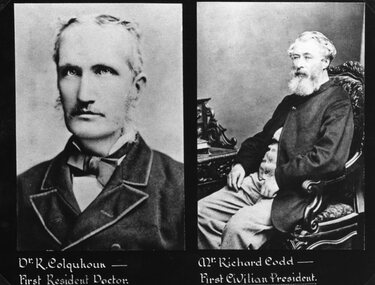
Photograph, Pleasant Creek -- Stawell Hospital with Dr R. Colquhoun as the first Resident Doctor & Mr Richard Codd as the first Civilian President -- Studio Portraits -- 2 Photos
... Colquhoun as the first Resident Doctor & Mr Richard Codd as the first Civilian President -- Studio Portraits -- 2 Photos...Colquhoun First Resident Doctor. Mr Richard Codd First Civilian President....Colquhoun First Resident Doctor. Mr Richard Codd First Civilian President. Stawell Hospital Medical Pleasant Creek -- Stawell Hospital with Dr R. ...Pleasant Creek. Stawell Hospital Portraits. Dr R. Colquhoun First Resident Doctor. Mr Richard Codd First Civilian President. stawell hospital medical -
 8th/13th Victorian Mounted Rifles Regimental Collection
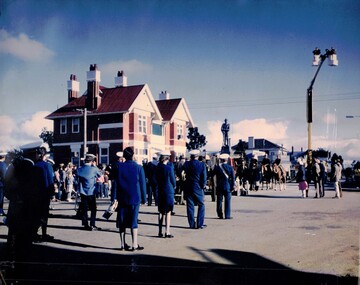
Photograph - Scene at Dimboola
... civilian members. Training and advice came from former light horsemen: Des Martin (8LH), Norm Whitehead (21LH), Bob Fyffe (20LH) and Fred Trickey (Riding Master RMC). This was an example of the troop engaging in a community activity. light horse dimboola television flying doctors Colour photograph of street scene in the Victorian town of Dimboola, June 1986. ...VMR Heritage Troop was a very public face of the regiment during the 1980s and early 1990s. It conducted one royal escort, several vice-regal escorts and numerous VIP escorts in the border, north-east and wider Victorian locations. The royal duty was at the opening of Hopkins Barracks, Puckapunyal by HRH Prince Charles accompanied by HRH Princess Diana, 31 October 1985. Major General Kevin Cooke GOC 3rd Division authorised the establishment of the troop in February 1980. Captain (later Major) Robert Morrison was the troop leader and the driving force behind the concept seeing potential where others did not. The troop was made up mainly by serving members of 8/13 but did include some civilian members. Training and advice came from former light horsemen: Des Martin (8LH), Norm Whitehead (21LH), Bob Fyffe (20LH) and Fred Trickey (Riding Master RMC). This was an example of the troop engaging in a community activity. Colour photograph of street scene in the Victorian town of Dimboola, June 1986. It was a set for shooting an episode of a TV series "Flying Doctors" and included a cameo appearance of a section of four light horsemen from the 8/13 Victorian Mounted Rifles Heritage Troop. Horsemen were Corporals S Walch, A Florent, N Morris and Trooper C Ellison. Photo is glued to a fluted plastic card. light horse, dimboola, television, flying doctors -
 Federation University Art Collection
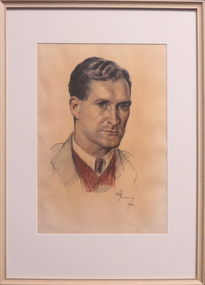
Drawing - Conte on paper, David Alexander, Portrait of David Alexander, 1947 by Geoffrey Mainwaring, 1947
... civilian basis until his paintings were completed in March 1948. In 1949 he was appointed Head of the Art School at the Ballarat School of Mines (now Federation University Australia). He continued to paint commissioned portraits for the Australian War Memorial until the late 1950s. Geoffrey Mainwaring died at Ballarat in April 2000. David Alexander was a medical doctor...civilian basis until his paintings were completed in March 1948. In 1949 he was appointed Head of the Art School at the Ballarat School of Mines (now Federation University Australia). He continued to paint commissioned portraits for the Australian War Memorial until the late 1950s. Geoffrey Mainwaring died at Ballarat in April 2000. David Alexander was a medical doctor ...Geoffrey MAINWARING (29 October 1912-13 April 2000) Born Adelaide, South Australia Geoffrey Mainwaring studied at the South Australian School of Arts and Crafts before becoming an art teacher at Thebarton Technical School (1928-36). Mainwaring was adept at depicting a variety of subjects, from landscapes to portraits, and was very competent using a variety of media, including pencil, oils, and watercolour. He was a confident draftsperson, and completed many sensitively rendered portraits that give an insight into the character of the sitter. In June 1941 Geoffrey Mainwaring (SX13471) joined the 2nd Australian Imperial Force, and after five months was transferred to the Engineers and employed as a Sergeant-Instructor, specialising in demolitions. In late 1942, he was sent to New Guinea as an Australian army artist on probation. On 27 May 1947, Mainwaring was discharged from the Army, having served for five and a half years. He was appointed as an artist on a civilian basis until his paintings were completed in March 1948. In 1949 he was appointed Head of the Art School at the Ballarat School of Mines (now Federation University Australia). He continued to paint commissioned portraits for the Australian War Memorial until the late 1950s. Geoffrey Mainwaring died at Ballarat in April 2000. David Alexander was a medical doctor in Ballarat for many years. Alongside his medical work he was a committed artist, producing a large body of work over his lifetime. He was an instigator of the Federation University Art Collection and was a great supporter of local artists. Geoff Mainwaring taught painiting at the Ballarat Technical Art School, a division of the Ballarat School of Mines. This item is part of the Federation University Art Collection. The Art Collection features over 1000 works and was listed as a 'Ballarat Treasure' in 2007. Framed portrait of Dr David Alexander by Geoffrey Mainwaring. Gift of David Alexander, 2014 art, artwork, david alexander, available, ballarat technical art school, portrait, geoff mainwaring, mainwaring, australian war artist -
 Alfred Hospital Nurses League - Nursing History Collection
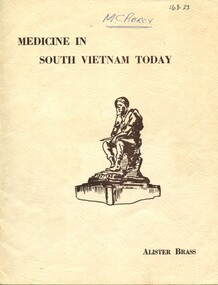
Book - Illustrated book, Alister Brass 1937-1986, Medicine in South Vietnam today, 1967
... Army medical establishments Vietnam The book details the devastating impact of the Vietnam war on the region's civilian healthcare system, highlighting critical doctor shortages and reliance on foreign medical teams. ...The book details the devastating impact of the Vietnam war on the region's civilian healthcare system, highlighting critical doctor shortages and reliance on foreign medical teams.Stapled illustrated book, cream cover with brown print. in the centre is an illustration of a seated soldier wearing a helmet with a rifle across his lamp. Title above this illustration and autho's name below. The book details the devastating impact of the Vietnam war on the region's civilian healthcare system, highlighting critical doctor shortages and reliance on foreign medical teams. vietnam war 1961-1975, south vietnam-medical care, australian civilian surgical teams-vietnam-1964-1973, u.s. army medical establishments vietnam
