
Showing 22 items matching "civilian identification"
-
 St Kilda Historical Society
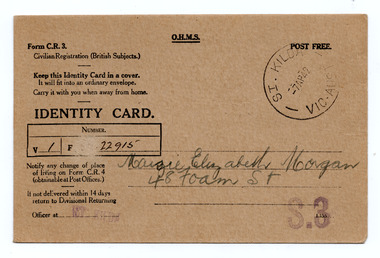
Administrative record - Identification card, Identity Card, 1942
... ...Civilian identification...WWII World War II Civilian identification ID cards Postmarked 7 April 1942 St Kilda. ...An identity card issued for civilian registration of British Subjects during World War II. This card was issued to Maisie Elizabeth Morgan of 48 Foam Street, Elwood.Brown card printed in black on both sidesPostmarked 7 April 1942 St Kilda. Card number 22915. Handwritten name, address and signatures of cardholder and witness. Handwritten additional reference numbers for official purposes.wwii, world war ii, civilian identification, id cards -
 St Kilda Historical Society
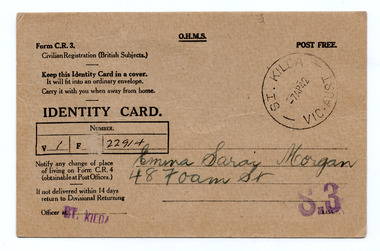
Administrative record - Identification card, Identity Card, 1942
... ...Civilian identification...WWII World War II Civilian identification ID cards Postmarked 7 April 1942 St Kilda. ...An identity card issued for civilian registration of British Subjects during World War II. This card was issued to Emma Sara Morgan of 48 Foam Street, Elwood.Brown card printed in black on both sidesPostmarked 7 April 1942 St Kilda. Card number 22914. Handwritten name, address and signatures of cardholder and witness. Handwritten additional reference numbers for official purposes.wwii, world war ii, civilian identification, id cards -
 St Kilda Historical Society
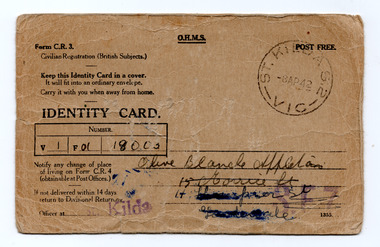
Administrative record - Identification card, Identity Card, 1942
... ...Civilian identification...WWII World War II Civilian identification ID cards Postmarked 8 April 1942 St Kilda. ...An identity card issued for civilian registration of British Subjects during World War II. This card was issued to Olive Blanche Appelton, 15 Morrie Street, Caulfield North.Brown card printed in black on both sidesPostmarked 8 April 1942 St Kilda. Card number 18003. Handwritten name, address and signatures of cardholder and witness. Handwritten additional reference numbers for official purposes.wwii, world war ii, civilian identification, id cards -
 Warrnambool RSL Sub Branch
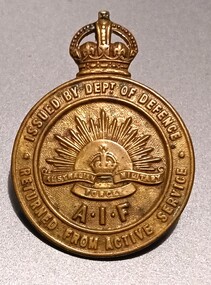
Badge - WW1 Returned from Active Service Lapel Badge
... Civilian life...Identification...Military history Civilian life Identification A crowned gilt bronze badge with two lugs on back. ...These badges (often called "Discharged Returned Soldier Badges") were issued by the Department of Defence between 1914 and 1919, to indicate a soldier had returned from active service and been honourably discharged. Wearing the badge helped returned soldiers avoid being wrongfully accused of showing disloyalty to their country because they were not seen wearing a military uniform. A specific number was stamped on the reverse of each badge and logged on the veteran's official service record. WW1 shows degree of animsity from some civiliand, and efforts of goverments to prevent it.A crowned gilt bronze badge with two lugs on back. The obverse has the rising sun behind a crown; below on ribbon, AUSTRALIAN MILITARY FORCES; below, A.I.F; around, ISSUED BY DEPT. OF DEFENCE . RETURNED FROM ACTIVE SERVICE. The reverse has been stamped, 76689. military history, civilian life, identification -
 Bendigo Military Museum
Administrative record - IDENTITY CARDS WW2, 2) 02.06.1944
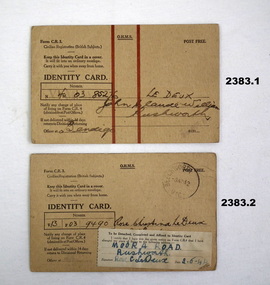
... military history - identification...Civilian...Bendigo Military Museum 37 - 39 Pall Mall Bendigo goldfields Items in the collection re J.C.W.LEDEUX, refer Cat No 2378 for his service details. documents - cards military history - identification Civilian .1) Written in front in ink: “LEDEUX / John Claude William / Rushworth” .2) “ Rose Christina Ledeux / Moora Road / Ruthworth” .2) Is endorsed: Ration Books for two children 2 Identity Cards issued to members of the LEDEUX Family. ...Items in the collection re J.C.W.LEDEUX, refer Cat No 2378 for his service details.2 Identity Cards issued to members of the LEDEUX Family. They are civilian registration cards for British Subjects, made of light brown card printed in black ink..1) Written in front in ink: “LEDEUX / John Claude William / Rushworth” .2) “ Rose Christina Ledeux / Moora Road / Ruthworth” .2) Is endorsed: Ration Books for two childrendocuments - cards, military history - identification, civilian -
 Bendigo Military Museum
Administrative record - I.D. CARD, Government Printer, 1945 - 1946
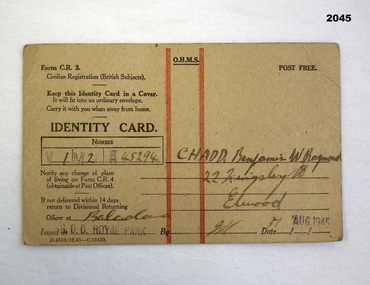
... military history - identification...Civilian...Refer Cat No 2039 for his service history. military history - identification Civilian “CARD NUMBER V/M2/A45294 ISSUED AT ROYAL PARK” Buff card with 2 vertical lines each side. ...the card was in the collection of Benjamin Thomas Roy Chadd No's 10594, VX20311, 1st and 2nd AIF. Refer Cat No 2039 for his service history.Buff card with 2 vertical lines each side. Handwritten in the name of Benjamin W. Raymond CHADD. Civilian Registration of British Subjects.“CARD NUMBER V/M2/A45294 ISSUED AT ROYAL PARK”military history - identification, civilian -
 Bendigo Military Museum
Photograph - RA Svy Project C4 Aerodist Operation, Eastern & Western Arnhem Land, NT, 1967, 1968
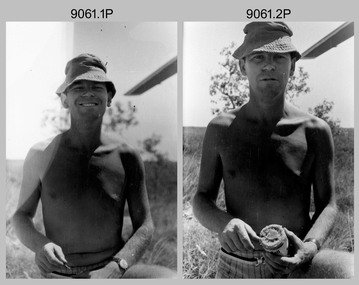
... They are part of the Army Survey Regiment’s Collection. .1) to .2) – Photo, black & white, 1968, unidentified soldier with an opened can of food, possibly bully beef. .3) – Photo, black & white, 15 Aug 1968, aerial view of terrain taken from a helicopter in vicinity of MILINGIMBI SIERRA. .4) – Photo, black & white, 1967, aerial view of an island taken from a helicopter. .5) & .6) – Photo, black & white, 1967, unidentified soldier driving a Haflinger 4x4 Light utility vehicle with trailer. .7) – Photo, black & white, 1967, unidentified surveyors taking vertical measurements with a leveling instrument and staff. .8) – Photo, black & white, 1967, Australian Army Sioux Light Observation Helicopter (LOH) with float removed. .9) to .11) – Photo, black & white, 1967, Australian Army Sioux Light Observation Helicopter (LOH) with floats. .12) – Photo, black & white, 1967, civilian Bell 47G-2 helicopter (Australian Army Sioux LOH equivalent) refuelled. .13) – Photo, black & white, 1967, survey station on coastline surrounded by white plastic aerial photographic identification panels lined with rocks. .14) & .15) – Photo, black & white, 1967, soldier (possibly a signaller from RA Sigs) operating a radio. .16) – Photo, black & white, 1967, Central Comd Fd Svy Unit Operations Section tent, Main Base Gove (Nhulunbuy) L to R: SPR Harry Dunn, WO1 Pat Wood BEM. .17) – Photo, black & white, 1967, Central Comd Fd Svy Unit Operations Section tent, Main Base Gove (Nhulunbuy) L to R: unidentified, WO1 Pat Wood BEM. .18) – Photo, black & white, 1967, Central Comd Fd Svy Unit Operations Section, Main Base Gove (Nhulunbuy), unidentified Australian Army Catering Corps cook preparing meals. .19) – Photo, black & white, 1967, Central Comd Fd Svy Unit Operations Section, Main Base Gove (Nhulunbuy) mess tent in readiness for meals. .20) – Photo, black & white, 1967, Bank of batteries in transit boxes undergoing recharging using generators. .21) – Photo, black & white, 1967, A topographic survey identification plaque set in a concrete block being weighed using a set of scales hanging from slaughtering gallows. .22) – Photo, black & white, 1967, CPL (Geoff or Gary) Larkin operating the remote Aerodist MRC2 ground instrument at Veronica Island, located north of Nhulunbuy. .23) – Photo, black & white, 1967, L to R: CPL (Geoff or Gary) Larkin with unidentified surveyor operate the remote Aerodist MRC2 ground instrument at Venica Island, located north of Nhulunbuy. .24) & .25 – Photo, black & white, 1967, The Aerodist MRC2 Remote antenna. .26) – Photo, black & white, 1967, The Aerodist MRC2 Remote antenna....They are part of the Army Survey Regiment’s Collection. .1) to .2) – Photo, black & white, 1968, unidentified soldier with an opened can of food, possibly bully beef. .3) – Photo, black & white, 15 Aug 1968, aerial view of terrain taken from a helicopter in vicinity of MILINGIMBI SIERRA. .4) – Photo, black & white, 1967, aerial view of an island taken from a helicopter. .5) & .6) – Photo, black & white, 1967, unidentified soldier driving a Haflinger 4x4 Light utility vehicle with trailer. .7) – Photo, black & white, 1967, unidentified surveyors taking vertical measurements with a leveling instrument and staff. .8) – Photo, black & white, 1967, Australian Army Sioux Light Observation Helicopter (LOH) with float removed. .9) to .11) – Photo, black & white, 1967, Australian Army Sioux Light Observation Helicopter (LOH) with floats. .12) – Photo, black & white, 1967, civilian Bell 47G-2 helicopter (Australian Army Sioux LOH equivalent) refuelled. .13) – Photo, black & white, 1967, survey station on coastline surrounded by white plastic aerial photographic identification panels lined with rocks. .14) & .15) – Photo, black & white, 1967, soldier (possibly a signaller from RA Sigs) operating a radio. .16) – Photo, black & white, 1967, Central Comd Fd Svy Unit Operations Section tent, Main Base Gove (Nhulunbuy) L to R: SPR Harry Dunn, WO1 Pat Wood BEM. .17) – Photo, black & white, 1967, Central Comd Fd Svy Unit Operations Section tent, Main Base Gove (Nhulunbuy) L to R: unidentified, WO1 Pat Wood BEM. .18) – Photo, black & white, 1967, Central Comd Fd Svy Unit Operations Section, Main Base Gove (Nhulunbuy), unidentified Australian Army Catering Corps cook preparing meals. .19) – Photo, black & white, 1967, Central Comd Fd Svy Unit Operations Section, Main Base Gove (Nhulunbuy) mess tent in readiness for meals. .20) – Photo, black & white, 1967, Bank of batteries in transit boxes undergoing recharging using generators. .21) – Photo, black & white, 1967, A topographic survey identification plaque set in a concrete block being weighed using a set of scales hanging from slaughtering gallows. .22) – Photo, black & white, 1967, CPL (Geoff or Gary) Larkin operating the remote Aerodist MRC2 ground instrument at Veronica Island, located north of Nhulunbuy. .23) – Photo, black & white, 1967, L to R: CPL (Geoff or Gary) Larkin with unidentified surveyor operate the remote Aerodist MRC2 ground instrument at Venica Island, located north of Nhulunbuy. .24) & .25 – Photo, black & white, 1967, The Aerodist MRC2 Remote antenna. .26) – Photo, black & white, 1967, The Aerodist MRC2 Remote antenna. ...This is a set of 26 photographs of Royal Australian Survey Corps (RA Svy) personnel from Central Comd Fd Svy Unit (Adelaide) on Aerodist survey operation - Project C4 in Eastern Arnhem Land, Northern Territory in 1967 (photos .4P to .26P) and in Western Arnhem Land, Northern Territory in 1968 (photos .1P to .3P). Photos of personnel were taken either at the operations base at Numbulwar or the main base at Gove (Nhulunbuy). RA Svy conducted nineteen Aerodist operations for 12 years from 1964 to 1975. Aerodist MRC2 was a tellurometer-based system adapted for aircraft to accurately measure distances between non-intervisible ground survey stations, using the aircraft as an intermediate station. Lower order geodetic results could be achieved by survey network trilateration. The measured distances between stations formed survey networks from which each station’s latitude and longitude was computed. Aerodist MRC2 was RA Svy’s major horizontal control survey tool for mainly medium scale topographic mapping (scale 1:100,000 Class A being spatially accurate to within 50 metres) in PNG, northern NT, north-west WA, Kalimantan Barat (West) Indonesia, Sumatra Indonesia, Gulf of Carpentaria and Cape York, QLD. In 1967, the Aerodist MRC2 Master equipment was installed in the aircraft featured in this set of photos, Executive Air Services’ (Essendon VIC) Grand Aero Commander VH-EXX. It was the same aircraft type and company contracted to Division of National Mapping for Aerodist MRC2 surveys. From July to October 1967 the aircraft was attached to Central Comd Fd Svy Unit (Adelaide - Major Don Ridge) on Project C4 eastern-Arnhem Land NT, where 317 Aerodist lines measuring 17,300 line miles were successfully completed. This was the most productive Aerodist project thus far. The most common helicopter used by RA Svy up to 1972 was the civilian Bell 47G-2 and the Sioux Light Observation Helicopters (LOH), the Australian Army’s equivalent featured in this photo set. These light observation helicopters had a limiting load carrying capacity of up to about 500 pounds. By comparison, one Aerodist team including two people weighed up to 1,500 pounds. In 1968, after completion of the Kimberley Aerodist Operation project, the Aerodist system in VH-EXX was immediately deployed to western-Arnhem Land NT for Central Comd Fd Svy Unit (Adelaide - Major Don Ridge) to complete the mapping control across northern NT from mid-July to October. The Aerodist MRC2 Remote antenna seen in Photos .24P to .26P is mounted on a 20 foot pole tower. The antenna direction was controlled by wires/ropes to the two arms under the dish at right angles. The antenna elevation could be changed to the vertical for aircraft height checks as seen in photo .25P. Source: Royal Australian Survey Corps – Aerodist Years 1964-1975 by Peter Jensen. Refer to Item 6449.30P for more photos taken during these Aerodist survey operations.This is a set of 26 photographs of Royal Australian Survey Corps (RA Svy) personnel on Aerodist survey operations in Eastern Arnhem Land, Northern Territory in 1967 and Western Arnhem Land, Northern Territory in 1968. The photographs are on 35mm negative film and scanned at 96 dpi. They are part of the Army Survey Regiment’s Collection. .1) to .2) – Photo, black & white, 1968, unidentified soldier with an opened can of food, possibly bully beef. .3) – Photo, black & white, 15 Aug 1968, aerial view of terrain taken from a helicopter in vicinity of MILINGIMBI SIERRA. .4) – Photo, black & white, 1967, aerial view of an island taken from a helicopter. .5) & .6) – Photo, black & white, 1967, unidentified soldier driving a Haflinger 4x4 Light utility vehicle with trailer. .7) – Photo, black & white, 1967, unidentified surveyors taking vertical measurements with a leveling instrument and staff. .8) – Photo, black & white, 1967, Australian Army Sioux Light Observation Helicopter (LOH) with float removed. .9) to .11) – Photo, black & white, 1967, Australian Army Sioux Light Observation Helicopter (LOH) with floats. .12) – Photo, black & white, 1967, civilian Bell 47G-2 helicopter (Australian Army Sioux LOH equivalent) refuelled. .13) – Photo, black & white, 1967, survey station on coastline surrounded by white plastic aerial photographic identification panels lined with rocks. .14) & .15) – Photo, black & white, 1967, soldier (possibly a signaller from RA Sigs) operating a radio. .16) – Photo, black & white, 1967, Central Comd Fd Svy Unit Operations Section tent, Main Base Gove (Nhulunbuy) L to R: SPR Harry Dunn, WO1 Pat Wood BEM. .17) – Photo, black & white, 1967, Central Comd Fd Svy Unit Operations Section tent, Main Base Gove (Nhulunbuy) L to R: unidentified, WO1 Pat Wood BEM. .18) – Photo, black & white, 1967, Central Comd Fd Svy Unit Operations Section, Main Base Gove (Nhulunbuy), unidentified Australian Army Catering Corps cook preparing meals. .19) – Photo, black & white, 1967, Central Comd Fd Svy Unit Operations Section, Main Base Gove (Nhulunbuy) mess tent in readiness for meals. .20) – Photo, black & white, 1967, Bank of batteries in transit boxes undergoing recharging using generators. .21) – Photo, black & white, 1967, A topographic survey identification plaque set in a concrete block being weighed using a set of scales hanging from slaughtering gallows. .22) – Photo, black & white, 1967, CPL (Geoff or Gary) Larkin operating the remote Aerodist MRC2 ground instrument at Veronica Island, located north of Nhulunbuy. .23) – Photo, black & white, 1967, L to R: CPL (Geoff or Gary) Larkin with unidentified surveyor operate the remote Aerodist MRC2 ground instrument at Venica Island, located north of Nhulunbuy. .24) & .25 – Photo, black & white, 1967, The Aerodist MRC2 Remote antenna. .26) – Photo, black & white, 1967, The Aerodist MRC2 Remote antenna.The following photos are annotated in black ink on edge of film negative: .3P – ’15 Aug ’68, 2000’, 1-C18 ’68 MILINGIMBI SIERRA’ .4P – ’U462’ .8P – ‘1-C3/67 Float Removed’ .13P – ‘U477 10-C3/67 .20P - ‘2-C3/67 Bank of Chargers’ .21P - ‘3-C3/67 Gallows & Scales’ .22P - ‘0462 VERONICA ISLAND NT, CPL Larkin’ .23P - ‘0462 VERONICA ISLAND NT’ .24P - ‘4-C3/67 20’ Aerodist Tower’ .25P - ‘5-C3/67 20’ Aerodist Tower’ .26P - ‘6-C3/67 20’ Aerodist Tower’royal australian survey corps, rasvy, army survey regiment, army svy regt, fortuna, asr, aerodist, surveying, central comd fd svy unit -
 Bendigo Military Museum
Model - AIRCRAFT RECOGNITION (WW2), C. WW2
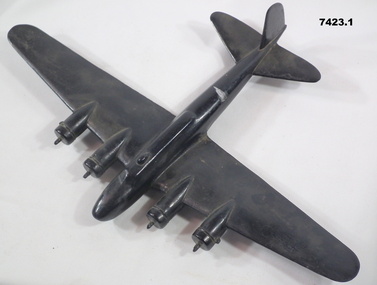
... civilians alike. MILITARY AIRCRAFT TRAINING WW2 Handwritten label with models - grey lead pencil. "Recognition Model used to train pilot and gunner in identification. ...Aircraft recognition models were produced and painted flat black and lacked any real surface detail or markings in order to simulate a silhouette. Training purposes for both military personnel and civilians alike.1. & 2. Model Aircraft x 2 made from timber and painted black. 1. Has four engines and appears to be a "Boeing B.17 Flying Fortress", an American heavy bomber WW2. 2. Has twin engines - a "Vickers Wellington", a British, long range medium bomber WW2.Handwritten label with models - grey lead pencil. "Recognition Model used to train pilot and gunner in identification. Top. Boe's B17. Bottom Vickers Wellington". 1. Label on bottom of model - "FORTRESS"military, aircraft, training, ww2 -
 Bendigo Military Museum
Accessory - PHOTOGRAPHS, 1942
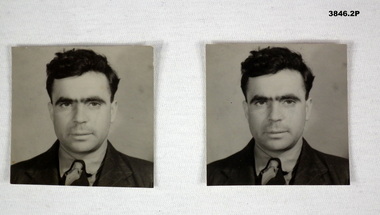
... Refer Reg No 3536P for his service details photography identification raaf .1) Handwritten on back in black ink: 1942 Escape photo for passport .1) & .2) Black / white passport sized head & shoulders photos of a man in civilian clothes. ...Passport photos of Frederick Gardner DAVEY to be used in a passport in case of escape from POW camp. Item re Frederick Gardner DAVEY DFC No 410533 RAAF. Refer Reg No 3536P for his service details.1) & .2) Black / white passport sized head & shoulders photos of a man in civilian clothes..1) Handwritten on back in black ink: 1942 Escape photo for passportphotography, identification raaf -
 Nhill Aviation Heritage Centre
Booklet - Aircraft recongnition booklets x2, Aeroplane Recognition Test, What is it?, c1930s
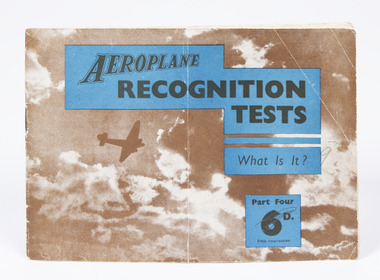
... identification of aircraft during WWII. Aircraft recognition was carried out by RAF crews, Anti Aircraft gun crews, Royal Observer Corps, Civilian Raid Spotters and Shipping. ...identification of aircraft during WWII. Aircraft recognition was carried out by RAF crews, Anti Aircraft gun crews, Royal Observer Corps, Civilian Raid Spotters and Shipping. ...The book was produced to compliment various publications to aid identification of aircraft during WWII. Aircraft recognition was carried out by RAF crews, Anti Aircraft gun crews, Royal Observer Corps, Civilian Raid Spotters and Shipping. Two books, paperback, 17 pages, black and white images, AEROPLANE Recongnition Tests, What is it? Part 3 images 81 to 116 and Part 4 images 117 to 152 Temple Press Ltd Bowling Green Lane, London -
 Bendigo Military Museum
Artwork, other - CARD AND PAMPHLET, 2) Sirichai Press, 1) est 1945, .2) post 1945
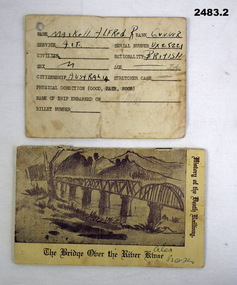
... Refer 2485 for medals and service history also 1076, 1100.2, 2489P. identification burma railway ww2 "Maskell Alfred R, Gunner AIF VX25221 British-M-Australia" .1) Card, printed in black with hand written details on one side, rear is lined. The card details name, rank, sex, civilian ....1) Possibly a ships boarding pass on return from Japan at wars end..2) 3 Pagodas was a place on the Burma Railway. Items belonged to Alfred Robert Maskell VX25221, 4th Anti Tank Regt 2nd AIF. Refer 2485 for medals and service history also 1076, 1100.2, 2489P. .1) Card, printed in black with hand written details on one side, rear is lined. The card details name, rank, sex, civilian, physical condition, name of ship embarked on, billet No. .2) Pamphlet, "The Bridge on the River Kwai, history of the Death Railway". Front has a drawing of the bridge, rear has depiction of the "3 Pagodas", 12 pages."Maskell Alfred R, Gunner AIF VX25221 British-M-Australia"identification, burma railway, ww2 -
 Bendigo Military Museum
Administrative record - CARD, IDENTIFICATION, 5 APR 1942
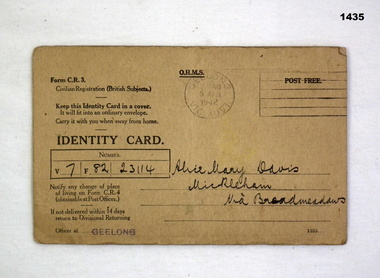
... Refer Cat No 1434 re Neil documents - certificates id cards Davis “V7, F82, 23114 Alice Mary Davis Mickleham via Broadmeadows” Civilian ID Card Registration Form C.R.3 for British Subjects, yellow card with “OHMS and stamped at P.O. Administrative record CARD, IDENTIFICATION ...Alice Mary Davis. Possibly a sister to Neil Walton Davis. Alice is not listed as NOK to Neil. Refer Cat No 1434 re NeilCivilian ID Card Registration Form C.R.3 for British Subjects, yellow card with “OHMS and stamped at P.O.“V7, F82, 23114 Alice Mary Davis Mickleham via Broadmeadows”documents - certificates, id cards, davis -
 Bendigo Military Museum
Card - MEDICAL CERTIFICATE AND ID CARD, 1942
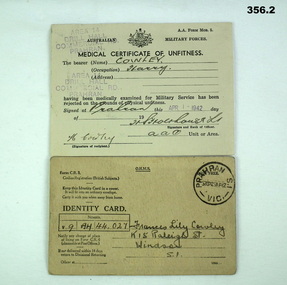
... Obviously he tried to enlist in WW2 but was rejected on medical grounds. documents Medical identification .1) For "Harry Cowley, Area 14 Drill Hall Prahran, Dated 1 Apr 1942" .2) For "Francis Lily Cowley, K15 Raleigh St Windsor S1" .1) Medical Certificate of Unfitness AA.Form MoB 5 .2) ID Card Civilian Registration ( British Subjects ) Number V9 F94 44,027 Stamped Prahran Vic 29 April 1942 Card MEDICAL CERTIFICATE AND ID CARD ...Items relating to Harry and Lily COWLEY. Refer 347.3. Refer 347.3 for Harry Cowley, WW1 service history. Obviously he tried to enlist in WW2 but was rejected on medical grounds..1) Medical Certificate of Unfitness AA.Form MoB 5 .2) ID Card Civilian Registration ( British Subjects ) Number V9 F94 44,027 Stamped Prahran Vic 29 April 1942.1) For "Harry Cowley, Area 14 Drill Hall Prahran, Dated 1 Apr 1942" .2) For "Francis Lily Cowley, K15 Raleigh St Windsor S1"documents, medical, identification -
 Eltham District Historical Society Inc
Photograph - Document, Identity Card: Ernest Thomas Orford, 1942
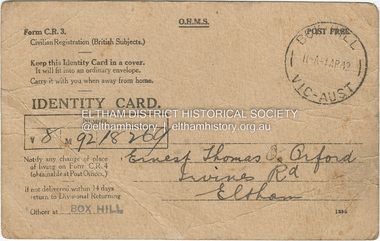
... civilians. During World War II everyone in Australia was issued with a personal identity card and was required to report changes of address to the government. These cards were particularly important in the identification...civilians. During World War II everyone in Australia was issued with a personal identity card and was required to report changes of address to the government. These cards were particularly important in the identification ...Civilian Registration Identity Card issued to Ernest Thomas Orford of Irvines Road, Eltham, farmer, signed by subject and witnessed by Elizabeth J. Cox of Eltham. This type of card was issued to British subjects who were civilians. During World War II everyone in Australia was issued with a personal identity card and was required to report changes of address to the government. These cards were particularly important in the identification and monitoring of Aliens (non-citizen residents) , particularly non-Europeans and Asian residents.1942, civilian registration (british subjects), elizabeth j. cox, eltham, ernest thomas orford, identity card, irvines road, second world war, ww2 -
 Eltham District Historical Society Inc
Photograph - Document, Identity Card: Douglas Frederick Orford, 1943
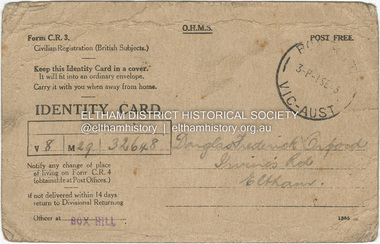
... civilians. During World War II everyone in Australia was issued with a personal identity card and was required to report changes of address to the government. These cards were particularly important in the identification...civilians. During World War II everyone in Australia was issued with a personal identity card and was required to report changes of address to the government. These cards were particularly important in the identification ...Civilian Registration Identity Card issued to Douglas Frederick Orford of Irvines Road, Eltham, a student of Eltham Higher Elementary School, signed by subject and witnessed by E.T. Orford, farmer of Eltham. This type of card was issued to British subjects who were civilians. During World War II everyone in Australia was issued with a personal identity card and was required to report changes of address to the government. These cards were particularly important in the identification and monitoring of Aliens (non-citizen residents) , particularly non-Europeans and Asian residents.civilian registration (british subjects), eltham, ernest thomas orford, identity card, irvines road, second world war, ww2, douglas frederick orford, eltham higher elementary school, 1943 -
 Bendigo Historical Society Inc.
Document - BASIL MILLER COLLECTION: IDENTITY CARD (WARTIME), 1942
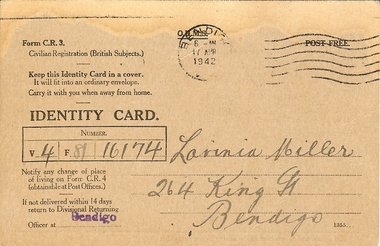
... Identification Card issued in the name of Lavinia Miller, 264 King Street, Bendigo Victoria. Number V4 F81 16174. For Civilian...Identification Card issued in the name of Lavinia Miller, 264 King Street, Bendigo Victoria. Number V4 F81 16174. For Civilian ...Identification Card issued in the name of Lavinia Miller, 264 King Street, Bendigo Victoria. Number V4 F81 16174. For Civilian Registration, (British Subjects). There are a number of inscriptions on the reverse side.Commonwealth of Australia.cottage, miners -
 The Beechworth Burke Museum
Photograph
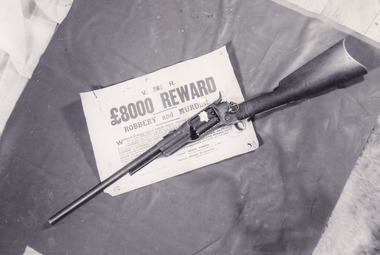
... civilian, to shoot a declared outlaw on sight. After the bank robberies, the Police force of NSW and Victoria increased the existing reward to this £8,000 amount. This photograph is significant for what it can potentially reveal about the Kelly Gang and firearms made in this period. The rifle in the image is a Colt Revolving Rifle which was known to have been used by the Victorian Police force from the early 1850s to the late 1880s. It is also known that the Kelly Gang stole police rifles which they used to practise with and so the identification ...In this image a Colt 1855 Revolving Rifle is placed upon a sign detailing an £8,000 reward for robbery and murder. Writing on the rear of the photograph identifies the rifle as having belonged to Joe Byrne. In colonial Victoria, the Colt brand firearm was highly popular. They began their popularity in the goldfields of the early 1850s. Individuals, particularly those coming to Victoria with prior experience in the goldfield, brought with them a means of self-defence because of the prevalence of assault and robbery on the goldfields. In the 1860s, the Colt firearm became popular among the Victorian Police force. It was decided in June 1864 by Chief Commissioner of Police, Frederick Standish that the Colt revolvers were far more practical, being of simpler construction and therefore, more easily cleaned and less dangerous than the revolvers used prior to this: the Adams and Kerr firearms. The Colt revolver remained in use in regional districts of Victoria as late as the early 1880 when they were used at the Kelly siege at Glenrowan. The £8,000 reward was issued in 1879 after the Kelly Gang committed numerous bank robberies at Euroa and Jerilderie. In the year prior, the Kelly Gang murdered three policemen at Stringybark Creek. This resulted in the creation of the “Felon’s Apprehension Act 1878” which enabled an individual, whether a part of the Police force or civilian, to shoot a declared outlaw on sight. After the bank robberies, the Police force of NSW and Victoria increased the existing reward to this £8,000 amount.This photograph is significant for what it can potentially reveal about the Kelly Gang and firearms made in this period. The rifle in the image is a Colt Revolving Rifle which was known to have been used by the Victorian Police force from the early 1850s to the late 1880s. It is also known that the Kelly Gang stole police rifles which they used to practise with and so the identification of the rifle as having belonged to Joe Byrne is of significant importance to researchers studying the firearms of the Kelly Gang. More research is needed to solidify the connection of this particular weapon to Byrne other than the handwritten note on the back of the photograph. The Burke Museum Beechworth is home to a significant collection of photographs connected to Ned Kelly and the Kelly Gang. Photographs like this one are valuable for what they can potentially reveal about the Kelly Gang and the Police force during this period. Alongside the study of the other images, photographs from this collection have the ability to further expand current knowledge on this period of Australian history. There is also the capability to provide an analysis of how these firearms and Kelly memorabilia have been received in the past. It could be beneficial to undertake a close study of the use history and reception of these artefacts within the museum context.Black and white rectangular reproduced photograph printed on matte photographic paperReverse: 10268 / Joe Byrne's / Riflekelly album, ned kelly, kelly gang, joe byrne, rewards, outlaw, criminals, bushrangers, colt, police, firearm, beechworth, reward, felon's apprehension act 1878, 1880, glenrowan, colt revolver, revolving rifle, 8000 pound reward, jerilderie, euroa, beechworth goldfield -
 Bendigo Historical Society Inc.
Document - RATION BOOK AND IDENTIFICATION CARD HOLDER E.J. ANDERSON, 17/04/1942
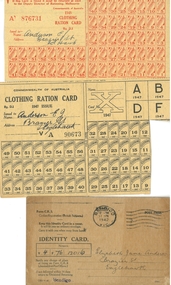
... Black leather Ration book and Identification card holder with ration and Identification cards / light brown Identification card for Elizabeth Jane Anderson, Brazier St Eaglehawk date stamped 17.4.1942 Bendigo / Form C.R.3. -Civilian...History House 11 Mackenzie Street Bendigo goldfields DOCUMENT Ration cards Identity card Black leather Ration book and Identification card holder with ration and Identification cards / light brown Identification card for Elizabeth Jane Anderson, Brazier St Eaglehawk date stamped 17.4.1942 Bendigo / Form C.R.3. -Civilian ...Black leather Ration book and Identification card holder with ration and Identification cards / light brown Identification card for Elizabeth Jane Anderson, Brazier St Eaglehawk date stamped 17.4.1942 Bendigo / Form C.R.3. -Civilian Registration (British Subjects) Identity Card Number v4, f76, 12016 - reverse of the card is signed by the holder with signatures of two witnesses / Cream coloured red ink printed Clothing Ration Card dated 1948 number A 876731 issued to E.J. Anderson /3x Cream coloured red ink printed meat Ration Cards dated 1948 number A 876730-32 for F, E.J and J.I. Anderson / 2x stained Cream coloured black ink printed meat Ration Cards dated 1947 for J.I. and F. Anderson number VA 90672 and VA 90674 reverse of the card states 'If this Ration Card is found it must be returned to The Deputy Director of Rationing Cavendish House, 159 Flinders Lane, Melbourne / 1x Cream coloured black ink printed meat Ration Card dated 1947 for E.J. Anderson number VA 90673 reverse of the card states 'If this Ration Card is found it must be returned to The Deputy Director of Rationing Cavendish House, 159 Flinders Lane, Melbourne /document, ration cards, identity card -
 City of Moorabbin Historical Society (Operating the Box Cottage Museum)
Document - Identity Card - Marriott family, World War 2, c 1942
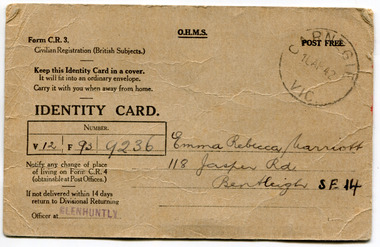
... civilians. During World War II everyone in Australia was issued with a personal identity card and was required to report changes of address to the government. These cards were particularly important in the identification...civilians. During World War II everyone in Australia was issued with a personal identity card and was required to report changes of address to the government. These cards were particularly important in the identification ...This type of card was issued to British subjects who were civilians. During World War II everyone in Australia was issued with a personal identity card and was required to report changes of address to the government. These cards were particularly important in the identification and monitoring of Aliens (non-citizen residents) , particularly non-Europeans and Asian residents.Emma Marriott was the daughter of a pioneer family of the City of Moorabbin. Her father was a Market Gardener.Brown card identified as an identity card, one side stamped Carnegie 1942 and addressed to Emma Rebecca Marriott; reverse side signed by E Marriott and witnessed by M Smith.world war ii, bentleigh, moorabbin, pioneer, identity card -
 Kew Historical Society Inc
Document - Identity Card, Commonwealth of Australia, Emily Elizabeth Foley, 89 Harp Road, East Kew, 1942, 1942
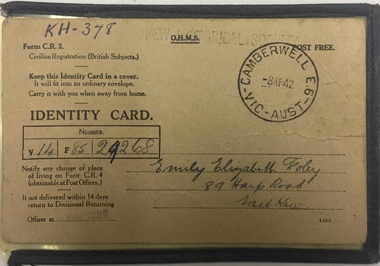
... civilians. During World War II everyone in Australia was issued with a personal identity card and was required to report changes of address to the government. These cards were particularly important in the identification...civilians. During World War II everyone in Australia was issued with a personal identity card and was required to report changes of address to the government. These cards were particularly important in the identification ...Identity card issued to Emily Foley in 1942. This type of card was issued to British subjects who were civilians. During World War II everyone in Australia was issued with a personal identity card and was required to report changes of address to the government. These cards were particularly important in the identification and monitoring of Aliens (non-citizen residents) , particularly non-Europeans and Asian residents. (Source: Museum Victoria)Local example of an identity card issued to a Kew resident.Identity card issued to Emily Elizabeth Foley of 89 Harp Road, East Kew. The card uses the for "C.R.3 - Civilian Registration British Subjects". it bears a Camberwell stamp on the front right corner. The Identity Card includes the following inscriptions: Front "V14 / F85 / 29268" Reverse Witness signature: "Ethel Foley" same address identity cards, world war 2 - ii, second world war 1939-1945, australia -
 Wodonga & District Historical Society Inc
Document - Citizen Identity Cards World War II, Australian Federal Government, 1940s
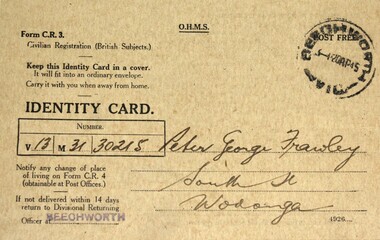
... civilians. This included all non-indigenous adults born in Australia. The concept of Australian citizenship was only introduced by the Nationality and Citizenship Act of 1948. All adults had personal identity cards and were required to report changes of address to the government. These cards were particularly important in the identification...civilians. This included all non-indigenous adults born in Australia. The concept of Australian citizenship was only introduced by the Nationality and Citizenship Act of 1948. All adults had personal identity cards and were required to report changes of address to the government. These cards were particularly important in the identification ...These cards were issued during World War 11 to British subjects who were civilians. This included all non-indigenous adults born in Australia. The concept of Australian citizenship was only introduced by the Nationality and Citizenship Act of 1948. All adults had personal identity cards and were required to report changes of address to the government. These cards were particularly important in the identification and monitoring of Aliens (non-citizen residents) , particularly non-Europeans and Asian residents.Peter Frawley was a long-time resident of Wodonga. He was a veteran of Gallipoli and Fromelles. For his actions at Fromelles, he was awarded the French Croix de Guerre. After the war Peter became a successful jockey and one of his greatest successes was winning the Australian Steeple Chase at Caulfield in 1922. He was an active member of the Wodonga Turf Club and Bonegilla Race Club and a founding member of the Wodonga Show Society. Peter’s wife Connie was an integral member of the Wodonga Hospital fundraising committee, being awarded a life membership. Nereida Pearl Goyne (nee Emery) lived most of her life in Wodonga. She was actively engaged in the community until 2007 when she moved to Rutherglen where she passed away in January 2009.3 fawn coloured cards with black text, all stamped with the Beechworth Post Office stamp. They are identified as Form C.R.3 Civilian Registration (British Subjects).Written on both sides in ink: Detailed explanation of government regulations. On Card 1 in ink;" V13, M 31 ,30215" Signed "Peter George Frawley, South St Wodonga" Reversed signed by card holder and witness" On Card 2 in ink;" V13, M 02 ,2494" Signed Constance Frawley, South St Wodonga" Reversed signed C Frawley and witnessed P Frawley" Note - Ration book for 3 children" On Card 3 in ink;" V13, M 10 ,12251" Signed "Nereida Pearl Goyne, Bank St Wodonga" Reversed signed by card holder and witnessed by L.C. McCullough" Note Ration book for 2 children"identity cards, civilian registration, world war 2, ww11 -
 Linton and District Historical Society Inc
Identity card, Lola Morgan, 1942
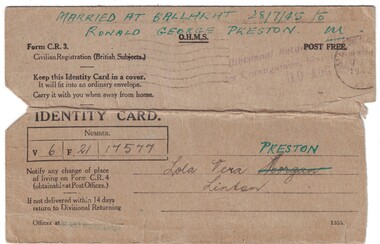
... identification number on it. They were required to carry it with them whenever they were away from their home, and were required to show it, at any time on demand, to any person authorized by law to see it. Compulsory registration of all civilian...identification number on it. They were required to carry it with them whenever they were away from their home, and were required to show it, at any time on demand, to any person authorized by law to see it. Compulsory registration of all civilian ...Identity cards were produced during World War II. Each person was issued with a card, which had their name, address and identification number on it. They were required to carry it with them whenever they were away from their home, and were required to show it, at any time on demand, to any person authorized by law to see it. Compulsory registration of all civilian British subjects in Australia over the age of 16 had to be completed by 25 March 1942. Those who did not do so faced prosecution or a penalty. Registration cards were posted out soon after registration.Rectangular brown cardboard card, printed on both sides. On face of card, the words "Form C.R.3 / Civilian Registration (British Subjects)" printed in top LH corner of card. The words "IDENTITY CARD" in capital letters at centre of card on left hand side. Beneath this, a box printed on the card has a number inscribed in handwriting. The name "Lola Vera Morgan", and the address "Linton" in handwriting in the lower RH section of the card. The name "Morgan" has been crossed out and replaced with the name "PRESTON", in green ink. At the top of the card "MARRIED AT BALLARAT 28/7/45 TO RONALD GEORGE PRESTON" is written in green ink. The card appears to have been posted to the holder. It is marked "OHMS" at the top, "Post Free" in the top RH corner, and it has a postmark with the date 7 APR 1942. On the back of the card are instructions for signing the card and notifying changes to address or loss of the card. The holder's signature and address ("L.T. Morgan / Linton") are on the RH side, and the signature and address of a witness ("R.H. Morgan / Linton") on the LH side. Various numerical codes are inscribed in handwriting in a section on the lower RH side.identification, identity cards, world war 1939-1945, lola morgan, lola preston
