
Showing 6 items matching "civilian relief"
-
 National Vietnam Veterans Museum (NVVM)
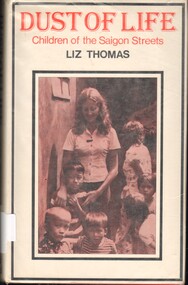
Book, Thomas, Liz, Dust of Life: children of Saigon Streets, 1977
... ... 1961-1975 - Civilian Relief...Vietnam War 1961-1975 - Children Vietnam War 1961-1975 - Civilian Relief This is a remarkable story of bravery and compassion. ...This is a remarkable story of bravery and compassion. Liz Thomas flew alone to Vietnam in 1972 having trained as a nurse. She was twenty years old and her one aim was to help and care for the suffering.This is a remarkable story of bravery and compassion. Liz Thomas flew alone to Vietnam in 1972 having trained as a nurse. She was twenty years old and her one aim was to help and care for the suffering.vietnam war, 1961-1975 - children, vietnam war, 1961-1975 - civilian relief -
 National Vietnam Veterans Museum (NVVM)
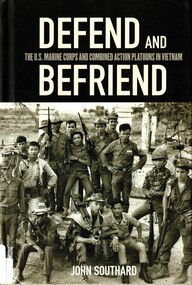
Book, Southard, John, Defend and Befriend: Tthe U.S. Marine Corps and Combined Action Platoons in Vietnam, 2014
... ... 1961-1975 - Civilian relief....Vietnam War 1961-1975 - Civilian relief. United States. Marine Corps - History - Vietnam War 1961 - 1975. ...A valuable and insightful study of the relationship and perception of Americans tasked with counterinsurgency and their Vietnamese counterparts.A valuable and insightful study of the relationship and perception of Americans tasked with counterinsurgency and their Vietnamese counterparts.vietnam war, 1961-1975 - civilian relief., united states. marine corps - history - vietnam war, 1961 - 1975., vietnamese -
 Mrs Aeneas Gunn Memorial Library
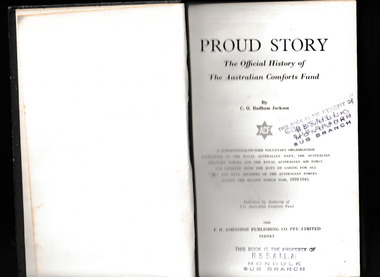
Book, C.O. Badham Jackson, Proud story : the official history of the Australian Comforts Fund, 1949
... World War 1939-1945 - Civilian relief...World War 1939-1945 - Civilian relief Australian Comforts Fund A history of the Australian Comforts Fund Ill, p.366. ...A history of the Australian Comforts FundIll, p.366.non-fictionA history of the Australian Comforts Fundworld war 1939-1945 - civilian relief, australian comforts fund -
 Returned Nurses RSL Sub-branch
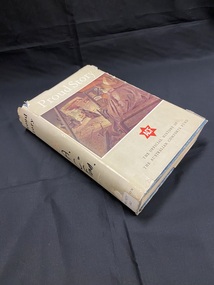
Book - Hardcover book, C.O.Badham Jackson et al, Proud Story: the official history of the Australian Comforst Fund, 1949
... ...Civilian relief...-from The Australian War Memorial WW2 WWII World War 1939-1945 Civilian relief Australian Comforts Fund ACF History of the Australian Comforts Fund (ACF). ...History of the Australian Comforts Fund (ACF). The fund was "a commonwealth-wide voluntary organisation accredited to the Royal Australian Navy, the Australian Military Forces and the Royal Australian Air Force and charged with the duty of caring for all fit and well members of the Australian Forces during the Second World War, 1939-1945" -taken from title page. This volume details the history from each individual state in Australia, as well as the service it provided overseas, and it's partnership with the Salvation Army, Y.M.C.A. and Y.W.C.A.Blue cloth-bound hardcover book with a worn cream coloured dust-jacket. The title is printed in white across the top, beneath which is an illustration of three jeeps driving in a row (from the perspective of someone sitting in the back seat of the third jeep). The bottom of the page displays black text with a red star above it with the letters ACF inside. The spine has the title printed in black across the top, a spine label taped to the bottom, and A.C.Fund handwritten in black marker in the middle.non-fictionHistory of the Australian Comforts Fund (ACF). The fund was "a commonwealth-wide voluntary organisation accredited to the Royal Australian Navy, the Australian Military Forces and the Royal Australian Air Force and charged with the duty of caring for all fit and well members of the Australian Forces during the Second World War, 1939-1945" -taken from title page. This volume details the history from each individual state in Australia, as well as the service it provided overseas, and it's partnership with the Salvation Army, Y.M.C.A. and Y.W.C.A.ww2, wwii, world war 1939-1945, civilian relief, australian comforts fund, acf -
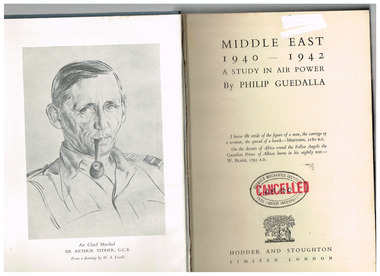 Monbulk RSL Sub Branch
Book, CO Badham Jackson, Proud story: The official history of the Australian comforts fund, 1949
... ...Civilian war relief...Australian comforts fund - History Civilian war relief ACF, a commonwealth-wide voluntary organisation accredited to the Royal Australian Navy, the Australian Military Forces and the Royal Australian Air Force and charged with the duty of caring for all fit and well members of the Australian Forces during the Second World War, 1939-1945 Ill, p.361. ...ACF, a commonwealth-wide voluntary organisation accredited to the Royal Australian Navy, the Australian Military Forces and the Royal Australian Air Force and charged with the duty of caring for all fit and well members of the Australian Forces during the Second World War, 1939-1945Ill, p.361.ACF, a commonwealth-wide voluntary organisation accredited to the Royal Australian Navy, the Australian Military Forces and the Royal Australian Air Force and charged with the duty of caring for all fit and well members of the Australian Forces during the Second World War, 1939-1945australian comforts fund - history, civilian war relief -
 Lara RSL Sub Branch
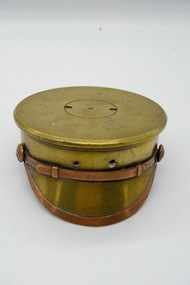
18 Pounder shell ashtray, Souvenir, 1927
... civilians alike to become personal souvenirs or to swap or sell. Spent artillery shells were crafted, often using a hammer and a bent nail. The crafting of trench art reflects the construction of an identity that offers momentary relief from the hell experienced in the trenches. ...Artillery shells were designed to be recycled and spent shells were returned to the munitions factory for re-filling, a mark engraved upon the head-stamp at each re-filling. Millions upon millions of shells were recycled and re-fired. Relationships with ‘objects’ were forged as recycled objects of conflict were welcomed into people’s homes. Such objects were embodied with personal experiences of war, later to become objects textured with memory, remembrance, and longing – attributes that clearly go beyond an object’s form and function. 18-Pounder Artillery Shells: The Great War Recycled and Re-Circulated Categories :Material Culture Machine Subscribe Share on facebook Share on twitter The intention of war is to kill, to maim and to destroy using, for example, the agency of 18-pounder artillery shells (so-called because they weighed 18 pounds). The shells were loaded in to the 18-pounder field guns used by the Royal Artillery and targeted to destroy German batteries and trenches as well as to shoot down aeroplanes. Horse-drawn field gun, Canal du Nord, France. Taken by First World War photographer David McLellan. Available via the National Library of Scotland as CC BY-NC-SA Horse-drawn field gun, Canal du Nord, France. Taken by First World War photographer David McLellan. Available via the National Library of Scotland as CC BY-NC-SA In Under Fire, Henri Barbusse recounts how the incessant and diabolical din of war constantly bombarded the soldier body with the unendurable noise of bursting shells that caused pain to the ears (Barbusse 2010 [1933]: 207). The noise was so ‘monstrously resounding’ that one felt ‘annihilated by the mere sound of the downpour of thunder’ (Barbusse 2010 [1933]: 206). Artillery shells were designed to be recycled and spent shells were returned to the munitions factory for re-filling, a mark engraved upon the head-stamp at each re-filling. Millions upon millions of shells were recycled and re-fired. A mound of spent shell cases, Nord, Nord-pas-de-Calais, France. Taken by war photographer, Tom Aitken, 1918. Available via the National Library of Scotland as CC BY-NC-SA. A mound of spent shell cases, Nord, Nord-pas-de-Calais, France. Taken by war photographer, Tom Aitken, 1918. Available via the National Library of Scotland as CC BY-NC-SA. People’s experience of the First World War did not end with the armistice. Whilst the noise of the artillery had ceased, the noise of war was remembered. Harry Patch on arriving home injured recalled being ‘jumpy for a while’ with the least noise prompting him to dive for cover (2009: 114). Something else materialised. Relationships with ‘objects’ were forged as recycled objects of conflict were welcomed into people’s homes. Such objects were embodied with personal experiences of war, later to become objects textured with memory, remembrance, and longing – attributes that clearly go beyond an object’s form and function. The head-stamp of these particular shells displays the British broad arrow and the initials ‘EOC’ indicates that they were made at the Elswick Ordnance Company, England; the initials ‘CF’ signal that the charge was loaded with cordite, a standard propellant. Spent shells were illicitly scavenged from massive mounds by both soldiers and civilians alike to become personal souvenirs or to swap or sell. Spent artillery shells were crafted, often using a hammer and a bent nail. The crafting of trench art reflects the construction of an identity that offers momentary relief from the hell experienced in the trenches. The lid of an 18Pounder shell which has been adapted for use as an ash tray.Lot 27 1927, 18Pr, III, EOC, C/F, Defence broad arrow,
