
Showing 2 items matching "ckm"
-
 Flagstaff Hill Maritime Museum and Village
Photograph - Vessel, Sail and Steam Ship, S.S. Warrnambool
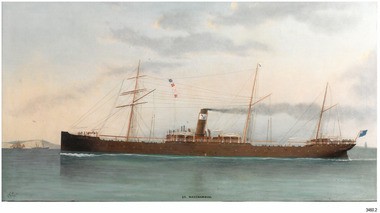
... ...CKM...Each photograph was accompanied by a letter, one written in 2001 and the other in 2003, confirming that the artist of the painting was by Charles Keith Miller, signed with his initials “CKM” and dated “1893”. The images show the ship’s home flag with a diagonal blue anchor flying from the masthead. ...The signature of the painting's artist, CKM (Charles Keith Miller), and a title on the lower edge of the photograph....House flag symbol, [diagonal blue anchor on white background] Text "CKM" and "1893" Text "S. S. WARRNAMBOOL."...Charles Keith Miller (CKM)...Warrnambool Photograph Vessel, Sail and Steam Ship Britain Charles Keith Miller (CKM) ...This photograph and a matching earlier photograph are images of a 1989 oil-on-canvas painting owned by the donor. They show the British sail and steam ship SS Warrnambool at Dover Strait in the English Channel. Each photograph was accompanied by a letter, one written in 2001 and the other in 2003, confirming that the artist of the painting was by Charles Keith Miller, signed with his initials “CKM” and dated “1893”. The images show the ship’s home flag with a diagonal blue anchor flying from the masthead. The same symbol is painted on the ship’s black funnel. The signal flags on the foremast display ‘M’ ‘R’ ‘V’ ‘B’, with each flag signalling a meaning in the International Code of Signals. While the SS Warrnambool was visiting Melbourne on its maiden voyage on December 1, 1892, a painting of that Lind Line ship by marine artist C.K. Miller was presented to the Town Council of Warrnambool by Mr. William Lund of London, owner of the Lind Line, or Blue Anchor Line. At that time, the Ladies of Warrnambool presented the ship with a ‘house’ flag bearing the Blue Anchor Line’s symbol, made by them especially for the occasion during the preceding moth. On December 6, the homeward bound ship anchored for a short time off the Port of Warrnambool, and a boat was launched from Lady Bay to take a group of friends to the ship with a delivery of gifts. After three cheers each for the ship and its Captain the SS Warrnambool continued its journey towards Britain via Adelaide. Although the painting was gifted in December 1892, it is post-dated “1893”. The reason for the discrepancy is unclear but whatever the reason, the provenance of the painting was confirmed at auctions of this painting and other works by the same artist. CHARLES KEITH MILLER 1836-1907:- Captain Charles Miller left his home in Scotland at the age of 15 years for a life at sea. He earned his Master’s Certificate ten years later. After being the captain of sailing ships, he moved to the steamships because they were faster. He married in 1866 and settled in Glasgow. Over the following eleven years, he and his wife had five children, then sadly, his wife passed away. Captain Miller returned to the sea for a while, but in 1888, he gave up his sea life to spend his time as a marine artist. His understanding of seafaring life and vessels, combined with his artistic skills, enabled him to produce fine art, and several galleries and museums have collections of his sought-after works. S.S. WARRNAMBOOL 1892-1925:- The sail and steamship SS Warrnambool was built in 1892 by the Sunderland Ship Building Company for the Lund Line of London, founded by William Lund in 1869, and registered in London. It efficiently carried passengers and cargo worldwide, including Australia, under its master, Captain Joshua Edward Ilbery, who had many years of experience with the Lund’s Blue Anchor Line, or BAL, which owned a fleet of sail and steamships. The funnels its steamships were painted black, with a white band around the top bearing a diagonal blue anchor and chain, also shown on the company’s house flag. The Lund Line ships were given Australian place names beginning with the letter “W”. Master Mariner, Captain Joshua Ilbery, was lost at sea without a trace in 1909, along with the ship SS Waratah. The ‘no frills’ service carried passengers and cargo to and from Europe around the Cape of Good Hope, stopping at various ports. The ship was involved in bringing home returned soldiers in 1895. At one time, it carried a doctor from Victoria, Australia, to assist at the war front in South Africa. The ship had a very good reputation for its cargo arriving almost always in excellent condition. Exported goods from Australia included iron safes, flour, wool, apples, frozen rabbits, butter, cheese, pork, cattle, poultry and sheep. One remarkable delivery contained Ostriches for Queen Victoria, and they survived the journey well. The SS Warrnambool was sold in 1900 to the British and South American Steam Navigation Co. Ltd of Liverpool and was renamed ‘Harmodius’. R.P. Houston & Company of London managed the company, and its Houston Line funnels were red with a black top. The Harmodius was sold in 1919 to K.S.S. Co. Ltd, managed by Kaye Son & Co. Ltd. of Liverpool, and was renamed ‘Kut’. The line had black funnels with a white ‘K’ in a diamond or between white stripes. In 1926, it was purchased by T.W. Ward Ltd. and broken up. NOTE- other vessels named “Warrnambool” Two other vessels carried the name “Warrnambool” (1)- HMAS Warrnambool J202 (1941-1947), a Bathurst-class corvette vessel owned by the Royal Australian Navy, was destroyed by a mine. (2)- HMAS Warrnambool FCPB204 (1980-2005), a Fremantle Class Patrol Boat of the RAN. The photograph is significant for its association with the painting "SS Warrnambool" by renowned marine artist Charles Keith Miller, whose paintings are well valued. The painting by C K Miller, the photograph, both bear the name Warrnambool, and the house flag of the Lind Line, are connected through the gifts exchanged between the ship company owner, the Town of Warrnambool and the Ladies of Warrnambool. The images connect the SS Warrnambool to the international trade of cargo and passengers. Coloured photograph of a painting depicting the Blue Anchor Line’s 1892 steamship S.S. Warrnambool. The three-masted ship in calm water. Its sails are lowered, and smoke is rising from its funnel. It displays four raised signal flags, a house flag and a blue ensign on the ship. The funnel also bears the house flag's symbol. There are figures on deck. The signature of the painting's artist, CKM (Charles Keith Miller), and a title on the lower edge of the photograph.House flag symbol, [diagonal blue anchor on white background] Text "CKM" and "1893" Text "S. S. WARRNAMBOOL."flagstaff hill, warrnambool, photograph, steam ship warrnambool, flagstaff hill maritime village, shipwreck coast, ss warrnambool, captain, charles keith miller, ckm, 1893, william lund, warrnambool town council, blue anchor line, lund line, ladies of warrnambool, house flag, diagonal blue anchor, captain miller, sunderland ship building company, migrant ship, 1892 ship, home flag, bal, australian export, s.s.warrnambool, dover strait, english chanel, port of warrnambool, lady bay, mrvb, captain charles miller, captain joshua edward iibery, ostriches, queen victoria, british and south american steam navigation co., harmodius, r.p. houston & company, houston line, k.s.s. co. ltd, kaye son & co. ltd, kut, t.w. ward ltd -
 Flagstaff Hill Maritime Museum and Village
Painting - Vessel, Sail and Steam Ship, C.K.M. (Charles Keigh Miller), artist, S.S. Warrnambool, 1882
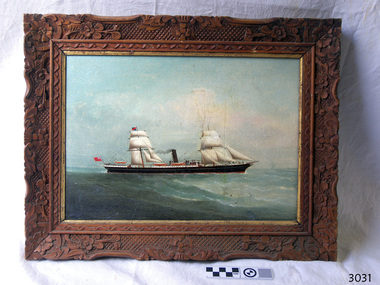
... ...CKM...On the backboard, written in the style used by the Warrnambool Museum and Art Gallery: - On white sticker, in pen “A-P31/1-74” - Pencil “A27/1883 / Artist CKM 1883 / Title SS Warrnambool / oil on board” Written in pen by the repairer: - “Repaired & re-drilled – cleaned etc. / David Heysen 11/66” Written by Flagstaff Hill’s Cataloguer in pencil: “3031” On a cardboard wrapper, in a marking pen: - “S.S. ...Miller ladies of Warrnambool home flag M.R.V.B. CKM On the backboard, written in the style used by the Warrnambool Museum and Art Gallery: - On white sticker, in pen “A-P31/1-74” - Pencil “A27/1883 / Artist CKM 1883 / Title SS Warrnambool / oil on board” Written in pen by the repairer: - “Repaired & re-drilled – cleaned etc. / David Heysen 11/66” Written by Flagstaff Hill’s Cataloguer in pencil: “3031” On a cardboard wrapper, in a marking pen: - “S.S. ...This oil painting, mounted in a handmade, carved frame, was originally held in the old Warrnambool Museum and Art Gallery, which was established in the 1880s. A note from the curator of the gallery accompanied the painting: The S.S. "Warrnambool”, 2833 tons. The oil painting by C.K. Miller of Glasgow of the above steamer named after this town was presented to the Town Council of Warrnambool by Mr William Lund Of London, the owner of the “Lund Line” of steam vessels, in recognition of the ladies of Warrnambool having presented the ship with a ‘home flag’ the pattern of which is seen upon the funnel in the painting as also upon the flag at the mast-head. The flags flying at the foremast are the ship’s “number” M.R.V.B. The presentation of the flag and album both took place in Melbourne on December 1st, 1982. On the 6th December, the “Warrnambool” lay-to off this port – on the homeward passage via Adelaide for a short time – see W.S. Dec 7th. The painting depicts the sail and steam-powered ship, S.S. Warrnambool, built in 1892, during the transition period when ship designs shifted from clipper ships with their billowing sails to steam-powered ships that moved at a greater pace. The flag flown from the stern signifies the British Merchant Navy that traded around the world to transport cargo, and later passengers, from one destination to another. During its lifetime, the S.S. Warrnambool underwent several modifications, upgrades and changes in its design. The painting was attributed to the ship portrait painter, the renowned C.K.M. - Charles Keith Miller. At some point, it was catalogued with the date 1883. However, the correct date is 1892. The artist's name and date are covered by the repaired frame, but are verified on the transfer document between the Warrnambool Art Gallery and Flagstaff Hill Maritime Museum and Village. In 1966, between the closure of the old Warrnambool Museum and Art Gallery and the distribution of the painting to Flagstaff Hill, this painting was repaired by David Heysen, son of the German-born artist Hans Heysen OBE. David was born in Hahndorf (called Ambleside for a short period), South Australia, married Lyly Refshauge from Melbourne, and they raised a family on their property in Kalangadoo, near Penola, in South Australia.The painting is of importance to the Warrnambool community, reflecting the excitement of having a ship named after the town. So much so that the ladies made a unique flag in its honour and presented it to the ship's owner when it docked in Membourne. The painting is significant for its handmade, ornately carved frame, joined by a craftsman. It is an example of craft and joinery created in the late 19th century. The artist has depicted the image of a historical sail-and-steam ship of the type in which cargo was traded across the world, including to and from Australia. It is a transitional time between sail and steam, helping to interpret the evolution of power used to move ships. Vessels such as this also brought migrants to Australia.Painting, oil on board, of the screw steamer SS Warrnambool, by artist C.K.M. dated 1892. The painting is mounted in a hand-carved wooden frame with a floral and geometric pattern, and the inner border is painted gold. It depicts a two-masted sail and steam ship, sails raised, and a black funnel emitting smoke. Hull is black with a white horizontal stripe and white trim around the sides of the deck. Three lifeboats are visible. The clipper shape bow appears to have a figurehead. A red ensign flag flies at the stern, and a blue and red flag is attached to the mainmast. The frame has been assembled using Mortice and Tenon joints, one of which is exposed on the back, lower right corner. A chandelier chain has been attached for hanging. The signature, date and title are no longer visible, perhaps due to the The backboard has empty holes around the edge and is held in place by staples. The visible surface has remnants of adhesive from two rectangular attachments. There are two small white stickers attached, one with a handwritten inscription. There are pencil and pen inscriptions. The painting is protected by cardboard with inscriptions made with a marking pen. (A note from the old Warrnambool Museum and Art Gallery accompanied the painting.)On the backboard, written in the style used by the Warrnambool Museum and Art Gallery: - On white sticker, in pen “A-P31/1-74” - Pencil “A27/1883 / Artist CKM 1883 / Title SS Warrnambool / oil on board” Written in pen by the repairer: - “Repaired & re-drilled – cleaned etc. / David Heysen 11/66” Written by Flagstaff Hill’s Cataloguer in pencil: “3031” On a cardboard wrapper, in a marking pen: - “S.S. Warrnambool / by / C.K.M. 1883” * - “A-P/31/1-74” - “3031” *[NOTE: The painting is actually dated "1892" but has been marked in error as "1883"] *[Accompanying note: "The S.S. ‘Warrnambool” 2833 tons. The oil painting by C.K. Miller of Glasgow of the above steamer named after this town was presented to the Town Council of Warrnambool by Mr William Lund Of London the owner of the “Lund Line” of steam vessels in recognition of the ladies of Warrnambool having presented the ship with a ‘home flag’ the pattern of which is seen upon the funnel in the painting as also upon the flag at the mast-head. The flags flying at the foremast are the ship’s “number” M.R.V.B. The presentation of the flag and album both took place in Melbourne, December 1st 1982. See the Warrnambool Standard, December 2nd 1892 On the 6th December the “Warrnambool” lay-to off this port – on the homeward passage via Adelaide for a short time – see W.S. Dec 7th [Warrnambool Standard]. Other notices relative to the ship owner in the first volume, “W.S.” for 1893. See also July 28th 1893.")flagstaff hill, warrnambool, shipwrecked coast, maritime museum, shipwreck coast, flagstaff hill maritime village, great ocean road, s s warrnambool, charles keith miller, charles miller, steam and sail ship, british merchant navy, slipper shaped bow, 19th century sea trade, warrnambool museum and art gallery, old warrnambool art gallery, hand carved picture frame, mortice and tennon picture frame, migrants, c.k.m., william lund, lund line, c.k. miller, ladies of warrnambool, home flag, m.r.v.b., ckm
