
Showing 10 items matching "clasp knives"
-
 Emerald Museum & Nobelius Heritage Park
Tool - Budding knives, Kaufmann
... ...Clasp knives...These knives were owned by Norman Nobelius and were used for taking cuttings and grafting - essential work for the Nobelius Nursery Knives Clasp knives Cutting tools pouch nobelius Emerald Victoria Australia Nobelius Nursery Collection Inscription on blade near hilt 'Kaufmann/ 55' 1. ...These knives were owned by Norman Nobelius and were used for taking cuttings and grafting - essential work for the Nobelius Nursery1. Metal and wood budding knife with movable blade, owned by Normal Nobelius, made by Kaufmann 55 2. Metal and wood budding knife with movable blade, owned by Normal Nobelius, made by Kaufmann 55 together with brown leather pouchInscription on blade near hilt 'Kaufmann/ 55'knives, clasp knives, cutting tools, pouch, nobelius, emerald, victoria, australia, nobelius nursery collection -
National Vietnam Veterans Museum (NVVM)
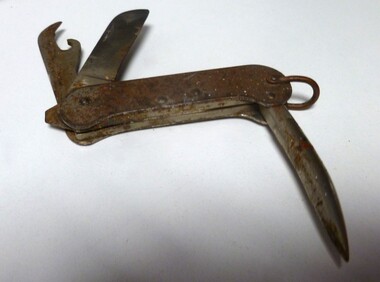
Equipment - Clasp knife, 1945
... This is a continuation of the standard pattern of clasp knives issued since before the Second World War....This is a continuation of the standard pattern of clasp knives issued since before the Second World War. ...Clasp knife issued to the Australian Army during the conflict in Vietnam. This is a continuation of the standard pattern of clasp knives issued since before the Second World War.Nickle plated steel. Equipped with a friction folding blade, marlinspike, can/bottle opener and screwdriver stub.Whittingslowe opener 15737, patented in Adelaideclasp knife, knife, pocket knife -
 National Vietnam Veterans Museum (NVVM)
Equipment - Clasp knife
... This is a continuation of the standard pattern of clasp knives issued since before the Second World War....This is a continuation of the standard pattern of clasp knives issued since before the Second World War. ...Clasp knife issued to the Australian Army during the conflict in Vietnam. This is a continuation of the standard pattern of clasp knives issued since before the Second World War.Stainless steel pocket-knife with blade, spike and can and bottle opener. There is a metal loop attached to the top of the pocket-knife. DAD Opener 15737pocket knife -
 Bendigo Military Museum
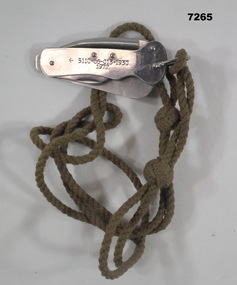
Equipment - KNIFE, CLASP, 1977
... Standard pattern of clasp knives issued since before the Second World War. ...Standard pattern of clasp knives issued since before the Second World War. ...Standard pattern of clasp knives issued since before the Second World War. Part of the Kevin John Herdman, No. 397661, Collection. See Catalogue No. 5942P for details of his service record.Stainless steel construction clasp knife consisting of a retractable blade, a can opener and spike. A screwdriver is attached to one end. The knife is attached to a khaki coloured lanyard.Stamped on one side of the knife: “(upwards arrow), 5110-66-013-1930, 1977”clasp knife, equipment, kevin john herdman -
 Bendigo Military Museum
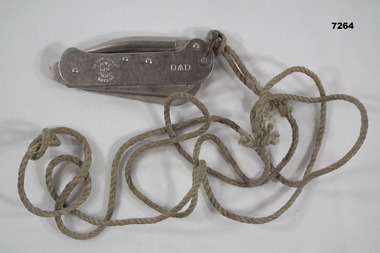
Equipment - KNIFE, CLASP
... Standard pattern of clasp knives issued since before the Second World War. ...Standard pattern of clasp knives issued since before the Second World War. ...Standard pattern of clasp knives issued since before the Second World War. Part of the Kevin John Herdman, No. 397661, Collection. See Catalogue No. 5942P for details of his service record.Stainless steel construction clasp knife consisting of a blade, a can opener, a screwdriver, and a spike. The knife is attached to a khaki coloured lanyard.Stamped on the side of the knife: “WHITTINGSLOWE OPENER, 15737, PAT. APPN., ADELAIDE, D (upwards arrow) D”clasp knife, equipment, kevin john herdman -
 Emerald Museum & Nobelius Heritage Park
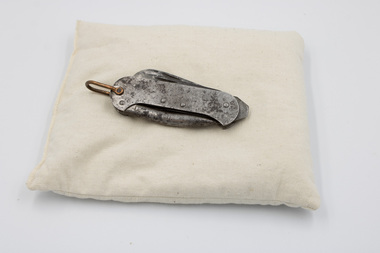
Tool - Carr Fast. Clasp Knife, Whittingslowe
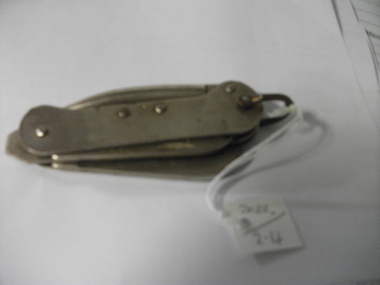
... Clasp knives were made for military use in the Australian army during World War 2. ...Clasp knives were made for military use in the Australian army during World War 2. ...Clasp knives were made for military use in the Australian army during World War 2. The 'CARR' symbol indicates that the knife was made by Carr Fasteners company in Whittingslowe factories. The 'arrowhead symbol' below the 'CARR' symbol indicates that the knife was produced for military use.This item is significant as it provides insight into the tools used by the Australian Military in World War 2. It also provides historic insight into the companies that produced and supplied the tools to the military.Metal handle. One blade folds out of the handle. One tin opener folds out of the handle adjacent to the blade. On the opposite end and side of the handle a marlin spike folds out. On the end of the handle is a ring.Right side of tin opener: "CARR / Arrowhead symbol"military, world war 2, knife -
 National Vietnam Veterans Museum (NVVM)
Equipment - Clasp knife
... An example of the standard pattern of clasp knives issued since before the Second World War....An example of the standard pattern of clasp knives issued since before the Second World War. knife pocket knife clasp knife whitehill ron whitehill Silver-grey multi-purpose pocket-knife, all stainless steel construction, with blade, spike and can and bottle opener. ...Standard issue army clasp knife as issued to Corporal R D Whitehill, who served in Vietnam in 1st Transport Platoon, Royal Australian Army Service Corps from 25 May 1966 until 20 Apr 1967. An example of the standard pattern of clasp knives issued since before the Second World War.Silver-grey multi-purpose pocket-knife, all stainless steel construction, with blade, spike and can and bottle opener. There is a metal loop attached to the top of the pocket-knife. knife, pocket knife, clasp knife, whitehill, ron whitehill -
 Montmorency–Eltham RSL Sub Branch
Knife, Clasp, with Marlin Spike and Tin Opener - Carr Fast second pattern, World War Two era
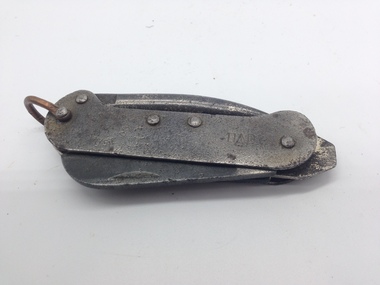
... Two patterns of clasp knife were supplied to the Australian Military Forces in the WW2 era by the Carr Fastener Company. These clasp knives were identical to those made by Whittingslowe Engineers that were made in the Whittingslowe factory under contract to Carr Fasteners. ...Two patterns of clasp knife were supplied to the Australian Military Forces in the WW2 era by the Carr Fastener Company. These clasp knives were identical to those made by Whittingslowe Engineers that were made in the Whittingslowe factory under contract to Carr Fasteners. ...Two patterns of clasp knife were supplied to the Australian Military Forces in the WW2 era by the Carr Fastener Company. These clasp knives were identical to those made by Whittingslowe Engineers that were made in the Whittingslowe factory under contract to Carr Fasteners. William Whittingslowe had a close association with Carr Fasteners prior to WW2 and had been Chairman of Carr Fasteners for some time.Smaller sized canoe shaped body military steel clasp knife. The clasp knife is the Carr Fast second pattern with the improved tin opener, manufactured in Australia in the World War Two era. The clasp knife has a blade, a tin/bottle opener, a marline spike as well as a screw driver and a copper wire shackle used to attach the knife to a lanyard or belt clip. The body of the knife is held together by steel rivets. Indentations to aid opening are located on the top RHS of the blade, and on the top LHS of the tin opener. The end of the tin opener is shaped to a point.CARR FAST CO AUST D (broad arrow pattern) Dclasp knife, world war two, australian military forces, steel -
 Wodonga & District Historical Society Inc
Functional object - Australian Army Issue Clasp Knife
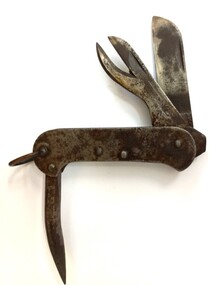
... Australian manufactured clasp knives were a standard issue to Australian Military Forces during World War 2. ...Australian manufactured clasp knives were a standard issue to Australian Military Forces during World War 2. ...Australian manufactured clasp knives were a standard issue to Australian Military Forces during World War 2. The most commonly encountered knife was an all metal model with a canoe shaped body. This knife was a Whittingslowe first pattern clasp knife which included a blade, a tin opener and a marline spike as well as screw driver and shackle to attach the knife to a lanyard or belt clip. These knives were given a dull Nickel plating to protect them. William Thomas Whittingslowe was born in Wales in 1888, he was educated in England and at 18 migrated to Canada and then to Australia, arriving in about 1912. After working in various states, he settled in South Australia and in the 1920s set up his own business, Whittingslowe Engineers Limited. He specialised in ironworking and knife manufacturing. His firm produced a large amount of blade ware during World War 2. He also designed and built manufacturing equipment for General Motors Holden. He died at Murray Bridge (SA) in 1956.This item is significance because it was donated by a member of the community of Wodonga which has a strong connection to Australian military history.A clasp knife made completely from metal with nickel plating. The accessories all fold into a canoe-shaped body. It included a knife, can opener and marlin spike.On knife blade: WE over a broad arrow/I\australian army equipment ww2, thomas whittingslowe, australian army -
 Bendigo Military Museum
Weapon - KNIFE, CLASP, 1960's
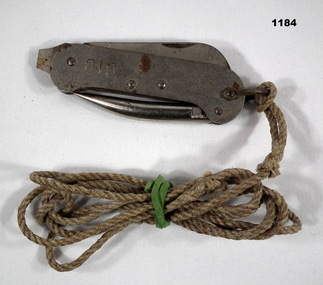
... knives...military history...Weapon...Clasp...Refer 638P for his service history. personal effects - pocket knives military history Weapon Clasp knife D^D"- Sterling, Made in Australia Metal Clasp knife with 2 blades and a pointed piece with a rope cord attached. ...Issued to Geoff Murray No 3411521, Vietnam 3 CAV Regt 27.11.67 to 22.10.68, Survey Corp 15.10.69 to 15.10.70. Refer 638P for his service history.Metal Clasp knife with 2 blades and a pointed piece with a rope cord attached.D^D"- Sterling, Made in Australiapersonal effects - pocket knives, military history, weapon, clasp knife
