
Showing 28 items matching "clay pits"
-
 Merri-bek City Council
Work on paper - letterpress print, Commoners Press, Clay Pits of Brunswick, 2022
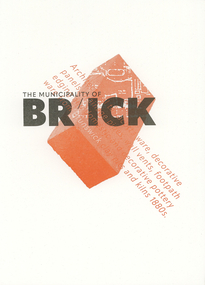
... Clay Pits of Brunswick ...Letterpress print Clay Pits of Brunswick Work on paper letterpress print Commoners Press Marius Foley ...When I visit Merri-bek I wonder, when I step on the tarmac of the Barkly Square carpark, what was here before? In fact, at this spot and across Brunswick there were clay pits, which would feed the pottery workshops in Brunswick that produced the pottery, gargoyles and decorative items for Marvellous Melbourne homes and suburbs. Marvellous for those who had profited from gold, property and finance, not so for those working in the clay pits. My print is a contemplation on what is beneath our feet and our relationship to the ground. I am a design academic working at RMIT University and began my print and design practice on a Golding foot-treadle Letterpress machine.10Press brings together a diverse group of creatives who were invited to make a new artwork inspired by the theme of ‘Moreland: its creative future, its past or other hidden stories’. Artists were invited to respond to the prompt ‘Moreland’, using only one or two colours. This body of work was created in 2022 during a significant time in local history, which saw Council’s name change from ‘Moreland’ to ‘Merri-bek’. The printed bellyband of the folio highlights this transition, with the word ‘Moreland’ crossed out and replaced with Woiwurrung language name ‘Merri-bek’. Commoners Press is a Coburg-based print studio that works with artists and designers in Australia and abroad on short run projects. Established by Jan Brueggemeier, Rob Eales and Neal Haslem in 2017, Commoners Press focus on projects that are community-centred, experimental and sustainable. Donated by Commoners Press Letterpress print -
 Box Hill Historical Society
Photograph - Brickworks
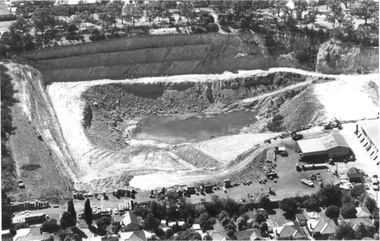
... ...Clay pits...Clay pit of Box Hill Brickworks, adjacent to Surrey Dive. ...Clay pit of Box Hill Brickworks, adjacent to Surrey Dive. ...Clay pit of Box Hill Brickworks, adjacent to Surrey Dive. Closed down in 1988B&w photobrickworks, clay pits, the days we remember -
 Federation University Historical Collection
Newsclippings, Ballarat Courier, Proposed Larter Street Clay Pit. 1964, 1964
... Proposed Larter Street Clay Pit. 1964...Larter Street Clay Pit...Four letters, articles, and editorials regarding the proposed Larter Street Clay Pit....Larter Street Clay Pit clay deposits Four letters, articles, and editorials regarding the proposed Larter Street Clay Pit. ...Four letters, articles, and editorials regarding the proposed Larter Street Clay Pit.larter street clay pit, clay deposits -
 Whitehorse Historical Society Inc.
Photograph - Aerial Photograph, Mitcham Reservoir
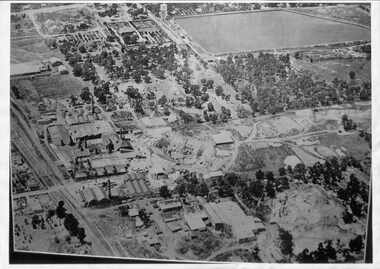
... Black and white aerial photograph of Mitcham showing the reservoir, Australian Tesselated Tiles with the clay pit at the rear, and Monarch Tiles (1914-16) in the foreground....Pty Ltd Monarch Terra Cotta Pty Ltd Black and white aerial photograph of Mitcham showing the reservoir, Australian Tesselated Tiles with the clay pit at the rear, and Monarch Tiles (1914-16) in the foreground. ...Most of the area is now Thornton Crescent, Mitcham, a factory area. When erecting the present 'buildings', which are all single level, certain strategies were employed to ensure safety.Black and white aerial photograph of Mitcham showing the reservoir, Australian Tesselated Tiles with the clay pit at the rear, and Monarch Tiles (1914-16) in the foreground.mitcham reservoir, australian tesselated tile co. pty ltd, monarch terra cotta pty ltd -
 Whitehorse Historical Society Inc.
Machine - Clay Skip
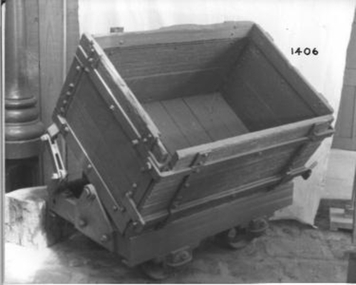
... Skip for moving clay in a clay pit. It has four rail track wheels - it can be tipped to remove clay and one side opens to facilitate this....It is understood that it was used in the pottery pit for many years. ceramics terracotta Skip for moving clay in a clay pit. ...It is understood that it was used in the pottery pit for many years.Skip for moving clay in a clay pit. It has four rail track wheels - it can be tipped to remove clay and one side opens to facilitate this.ceramics, terracotta -
 Bendigo Historical Society Inc.
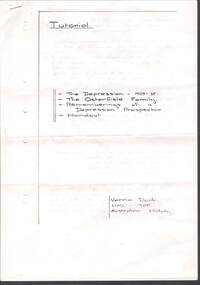
Document - HANDWRITTEN PAPER: OSTERFIELD FAMILY
... ... Clay Pit Axedale....Mention of successful clay pit at Axedale....Mention of successful clay pit at Axedale. Document HANDWRITTEN PAPER: OSTERFIELD FAMILY ...Handwritten paper re Osterfield family by Verna Doak '' the Depression 1929-35; The Osterfield Family and Remembering of a Depression Prospector''' Frederick Osterfield; Roderick Roy Osterfield. Mention of Dukes Flat and Burnt Gully (photographs) and details of primitive mining techniques. Mention of successful clay pit at Axedale.Verna Doakperson, individual, osterfield family, depression protector, dukes flat, burnt gully, clay pit axedale. -
 Box Hill Historical Society
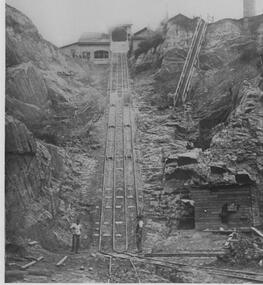
Photograph - Brickworks
... Brickworks at Standard Brick and Tile Company, showing rails for transporting clay from pit to factory. ...Brickworks at Standard Brick and Tile Company, showing rails for transporting clay from pit to factory. Brickworks Businesses Industries Building industry Railway lines Standard Brick and Tile Company "The Days Before Yesterday" Black & white photo Photograph Brickworks ...Brickworks at Standard Brick and Tile Company, showing rails for transporting clay from pit to factory. Black & white photobrickworks, businesses, industries, building industry, railway lines, standard brick and tile company, "the days before yesterday" -
 Orbost & District Historical Society
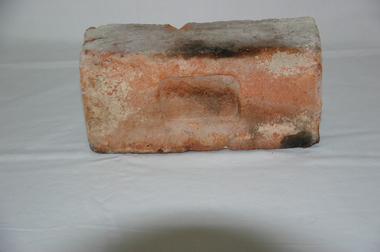
Functional object - brick with handprint, early 1900s
... The brick is almost certainly made from a local clay-pit at Orbost. At that time, the Orbost district was very isolated, with poor transport links to Melbourne. ...The brick is almost certainly made from a local clay-pit at Orbost. At that time, the Orbost district was very isolated, with poor transport links to Melbourne. ...This hand-made brick came from a fireplace which was being demolished in Orbost in 2023. The house is located cnr. Lyndall and Gladstone Streets, Orbost and was built c. early 1900s. The brick is almost certainly made from a local clay-pit at Orbost. At that time, the Orbost district was very isolated, with poor transport links to Melbourne. As a result, the town was very self-sufficient, and bricks were made locally. This item is significant because it indicates the self-sufficiency needed by Orbost in the early 1900s when it was very isolated with poor transport with the rest of Victoria. This is a building brick, brown colour. One side of the brick has an indent, and the other side has an imprint of a hand with fingers. brick, hand-made brick, orbost -
 Clunes Museum
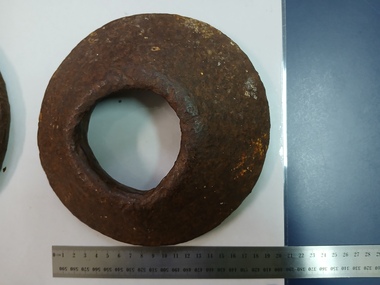
Leisure object - IRON QUOITS
... TWO IRON PEGS ABOUT 2'.6" LONG AND 1" IN DIAMETER. TWO CLAY PITS WERE DUG ABOUT 30' APART, 3' LONG AND ABOUT 2' 6" WIDE. ...TWO IRON PEGS ABOUT 2'.6" LONG AND 1" IN DIAMETER. TWO CLAY PITS WERE DUG ABOUT 30' APART, 3' LONG AND ABOUT 2' 6" WIDE. ...IRON QUOITS WEIGH ABOUT 9LBS. OR 4.1KG. TWO IRON PEGS ABOUT 2'.6" LONG AND 1" IN DIAMETER. TWO CLAY PITS WERE DUG ABOUT 30' APART, 3' LONG AND ABOUT 2' 6" WIDE. THESE PITS WERE FILLED WITH RED CLAY AND THE IRON PEGS PLACED UPRIGHT IN THE CENTRE. EACH PLAYER TAKING A TURN AT THROWING THE QUOIT TO FINISH CLOSEST TO THE PIN. SCORING WAS COUNTED OVER SEVERAL ENDS..1 BOOKLET WITH SET OF RULES. .2 HEAVY METAL CIRCULAR DISCS WITH CENTRE REMOVED TO FORM A RING TO BE THROWN IN PLAY TO ENCIRCLE A PEG OR FINISH AS NEAR TO THE PEG AS POSSIBLE. .3 STICK OR PEG TO BE PLACED IN THE GROUND local history, recreation, sport - quoits -
Federation University Art Collection
Artwork - Ceramics, Ceramic Forms by Elsa Adern
... Part of the clay for these came from the Staffords' clay-pits. Elsa Adern is known for her strong form of her pots, enhanced by her characteristically subtle wood-ash glazes. ...Part of the clay for these came from the Staffords' clay-pits. Elsa Adern is known for her strong form of her pots, enhanced by her characteristically subtle wood-ash glazes. ...Elsa ADERN (1918-2006) Born New Zealand Arrived Melbourne 1942 Elsa Ardern was living at Warrandyte in 1954 when she started studying pottery under John Bernard Knight at the Melbourne Technical College. In 1961 she was a founding member of Potters' Cottage at Warrandyte with friends Sylvia Halpern and Kate Janeba. She worked from a studio under the family home, exhibiting at the cottage and also through the Victorian Ceramic Group when it was set up in 1969. In 1980 she established a workshop at Tathra on the far south coast of NSW, sharing her time between Tathra and Warrandyte for the next 25 years. Amongst the work made at Tathra were some very large pieces which she fired in the Stafford Brothers' wood-fired brick-kiln at Kalaru. Part of the clay for these came from the Staffords' clay-pits. Elsa Adern is known for her strong form of her pots, enhanced by her characteristically subtle wood-ash glazes. Her works are signed with an incised 'Elsa Ardern' or 'EA'. (http://www.australianpotteryatbemboka.com.au/shop/index.php?manufacturers_id=32)available, elsa adern, available ceramics, ceramics -
Federation University Art Collection
Artwork - Ceramics, Ceramic Containers by Ailsa Adern, c1950
... Part of the clay for these came from the Staffords' clay-pits. With Sylvia Halpern and Gus McLaren Ailsa Asern celebrated her long association with the Potters' Cottage by exhibiting in its 45th anniversary exhibition in 2003. 2. ...Part of the clay for these came from the Staffords' clay-pits. With Sylvia Halpern and Gus McLaren Ailsa Asern celebrated her long association with the Potters' Cottage by exhibiting in its 45th anniversary exhibition in 2003. 2. ...Ailsa ADERN (1918-2006) Born New Zealand Arrived Melbourne 1942 Elsa Ardern arrived in Melbourne in 1942 to earn money for a trip to the United Kingdon. After marrying she settled at Warrandyte. In 1954, after her two children started school, Adern studied Pottery at Melbourne Technical College under John Bernard Knight. In 1961 she joined the Potters' Cottage at Warrandyte with friends Sylvia Halpern and Kate Janeba. She worked from a studio under the family home, exhibiting at the cottage and also through the Victorian Ceramic Group when it was set up in 1969. In 1980 she established a workshop at Tathra on the far south coast of NSW, sharing her time between Tathra and Warrandyte for the next 25 years. Amongst the work made at Tathra were some very large pieces which she fired in the Stafford Brothers' wood-fired brick-kiln at Kalaru. Part of the clay for these came from the Staffords' clay-pits. With Sylvia Halpern and Gus McLaren Ailsa Asern celebrated her long association with the Potters' Cottage by exhibiting in its 45th anniversary exhibition in 2003. 2. Her works are signed with an incised 'Elsa Ardern' or 'EA'.Two thrown and handworked 'bottles' featuring verticle ridges on the edge of each form. Her pots are valued for their strong form , ed by her characteristically subtle wood-ash glazes. ceramics, ailsa adern, pottery -
Tatura Irrigation & Wartime Camps Museum
Photograph, 19/12/1946
... Centre picture: Horse drawn scoops dig clay from the borrow pit, and the central horse-drawn cart moves under the bridge to collect clay through an opening in the roof for transport to the embankment....Centre picture: Horse drawn scoops dig clay from the borrow pit, and the central horse-drawn cart moves under the bridge to collect clay through an opening in the roof for transport to the embankment. ...Taken by photographer for State Rivers and Water Supply Commission.Medium sized black and white photograph. Centre picture: Horse drawn scoops dig clay from the borrow pit, and the central horse-drawn cart moves under the bridge to collect clay through an opening in the roof for transport to the embankment.goulburn weir, victorian state rivers and supply commission -
 Federation University Art Collection
Ceramic, 'Helmet Bowl & Vessel' by Neville French, 2003
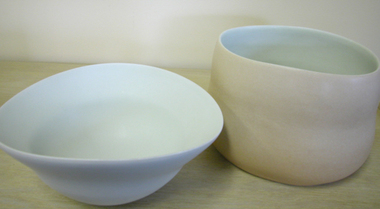
... During his time as a student at Ballarat Neville Bunning would collect clay from the Enfield clay pit. He described following white tyre tracks to find the location. ...During his time as a student at Ballarat Neville Bunning would collect clay from the Enfield clay pit. He described following white tyre tracks to find the location. ...Neville FRENCH (1955- ) Born Maryborough, Victoria In 1977 Neville French graduated from Ballarat College of Advanced Education after studying a Diploma in Fine Art (Ceramics) between 1974 and 1976, and was a tutor there for six months in 1978. He holds a Master of Arts, Research (Ceramics) from RMIT Universiy, and was awarded the Vitrify Alcorso National Ceramics Award in 2012. Neville has an international reputation as a ceramics artists and educator. From 1982 to 2012 Neville French was teach and coordinator of the Ceramics department at the Ballarat School of Mines and University of Ballarat (now Federation University). From 1982 to 2012 Neville French taught Ceramics at the Ballarat School of Mines TAFE, which later merged with the University of Ballarat (now Federation University Australia). He completed a Graduate Diploma of Education at Hawthorn State College in 1980, a Certificate of Stoneware Glazes from Brisbane College of Advanced Education in 1983 and a Master of Arts Fine Art (Ceramics) at RMIT University in 2000. Between 2010 and 2012 Neville French taught post graduate honours and masters Ceramics students. During his time as a student at Ballarat Neville Bunning would collect clay from the Enfield clay pit. He described following white tyre tracks to find the location. He described the clay as silky smooth and and fired to a beautiful grey colour at stoneware tempreture. When blended with terracotta clay from Nerrina or fireclay from Bacchus Marsh a wide range of different bodies could be created. This item is part of the Federation University Art Collection. The Art Collection features over 2000 works and was listed as a 'Ballarat Treasure' in 2007.Two vessels made as a sculptural pair. Statement: "My work involves an exploration of elemental vessels - extending porcelain to develop taut contours and spatial dynamics. I seek to distill an essence of purity to evoke notions of quietude and transendence through the expressive use of glaze and its relationship to form, tactility, weight and light. Forms are wheel-thrown, altered and slowly scraped to develip a soft line and solidity. Coloured matt glazes are layered and fused to the porcelain body through multiple firings to give expression and luminosity to the surface,. The iodosyncratice nature of glaze stimulates the imagination. It evokes associations with the natural environement and alludes to a meditative infinity."Signed on base 'f.'art, artwork, neville french, french, ceramics, porcelain, wheelthrown, thrown and altered, alumni -
 Bendigo Historical Society Inc.
Document - The Pitcher Dressers, W.G. O'Neill, Unknown
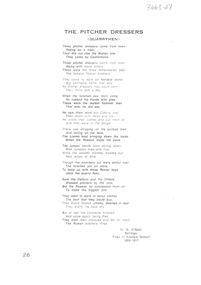
... There were a number of quarries and clay pits in Brunswick at this time and by July 9, 1861, Ingham was operating a quarry and contracting services to local councils and boroughs for road works, including Sydney Road. ...There were a number of quarries and clay pits in Brunswick at this time and by July 9, 1861, Ingham was operating a quarry and contracting services to local councils and boroughs for road works, including Sydney Road. ...Axedale is well known for its Bluestone. Early on the quarries employed a large number of people. In the 1860’s Napthali Ingham selected land in Axedale and opened a bluestone quarry beside the river later known as Ingham Hill. The quarry produced dressed curbing and pitchers for use in Bendigo and Melbourne. This bluestone can be seen throughout Axedale in the churches, the bridge over the Campaspe River and guttering in the township. The quarry also supplied bluestone products further afield, for example road metal. Napthali Ingham, the owner of one of the first quarries in Axedale, arrived in Victoria from Lancashire, England, some time before 1860, and settled in Brunswick, Victoria. He may have been building his home in Ewen[sic] Street in 1860, at approximately 31 years of age, when he placed two advertisements in The Argus, October 10. One called for tenders for carting "upwards of 100 perches of rubbish to Sandridge." The other calls for tenders to supply "800 bushels of Geelong Roche Lime." His address, given for the purpose of the advertisements, is Ewen Street, Brunswick. There were a number of quarries and clay pits in Brunswick at this time and by July 9, 1861, Ingham was operating a quarry and contracting services to local councils and boroughs for road works, including Sydney Road. He also operated the True Briton Hotel in Ewen Street. Ingham continued his quarry works and business dealings in the Brunswick area for a few years and, around 1872, was contracting for the City of Bendigo. He eventually moved to Axedale, between Bendigo and Heathcote, where he took up land and opened a bluestone quarry on the east bank of the Campaspe River. As he had difficulty transporting bluestone to Bendigo, he wrote a letter to The Bendigo Advertiser, suggesting a tramway be laid between Sandhurst (Bendigo) and Axedale. Over the next ten years or so, he modified this suggestion to a rail line connecting Sandhurst, Axedale and Heathcote to the North East line at Seymour. This suggestion did not materialise in its entirety, but it eventually resulted in what became the Wandong, Heathcote and Sandhurst Rail Line, the first sections, Bendigo-Heathcote and Wandong-Kilmore, opening October 1, 1888. In the 1870s, Ingham built the Quarry Hotel which is now the crumbling ruins adjoining Ingham Road on the east side of the Campaspe River.. Its condition is worsening as time passes. Ingham intended to have a tramline constructed from his Axedale bluestone quarry to the new rail line. This also did not happen but he was successful in getting a wood siding provided at the location that is today's Hanson's Quarry. Evidence of the rail siding are still evident at the site in 2025. Ingham's quarry is now owned by Hansen Quarries Ingham died in 1909 and the rail line that grew out of his suggestion lasted until 1958 when it was closed from Bendigo to Heathcote. The Heathcote Junction section was closed in 1968. Another quarry was owned and operated by Brasier, Riley and Nelson. 'This well known firm of contractors have a most extensive plant and all the latest improved machinery required for the supply of kerbstone, pitchers, monumental work and dressed bluestone metal for road making. ('Bendigo & District, 1902') 1. One page typed poem, written by W.G. O'Neill, titled 'The Pitcher Dressers, (Quarrymen). The poem tells the story of three Rowan brothers who came to the Axedale Quarry: 'They came to work on Axedale stone, Big contracts came that way, As pitcher dressers they could earn, Their thirty bob a day.' 2. Three copies of newspaper articles relating to quarry work and employees attached to poem: information regarding Brasier, Riley and Nelson, contractors (Bendigo and District 1902); 'The Stone Quarry Grievance' (Bendigo Advertiser, 15 June, 1959, p2); 'A Restriction Upon Industry' (Bendigo Advertiser, 2 June, 1859). Article 'A Restriction Upon Industry" details the anomalies that exist between working the quartz reefs for gold and quarrying for building stone. The cost of obtaining a license to 'quarry stone is 50 pounds sterling which must be paid down in order to merely prospect the ground. Some people who took out a lease to work a reef were actually 'looking for building stone'. On bottom of poem, W.G. O'Neill, Bendigo. Pupil of Axedale School, 1908-1917.axedale, quarry, napthali ingham, pitchers, pitcher dressers, bluestone, campaspe river, quarry hotel, rowan brothers -
 Flagstaff Hill Maritime Museum and Village
Domestic object - Dinner plate, circa 1878
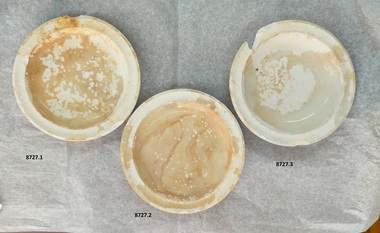
... As the initial glaze has disintegrated, the underlying clay base has become pitted. The ship Loch Ard was built on the River Clyde in Scotland in 1873 for the prestigious Loch Line of colonial clipper ships, designed for the Australian run. ...As the initial glaze has disintegrated, the underlying clay base has become pitted. The ship Loch Ard was built on the River Clyde in Scotland in 1873 for the prestigious Loch Line of colonial clipper ships, designed for the Australian run. ...These earthenware dinner plates were recovered from the wreck of the Loch Ard, on the southwest coast of Victoria and donated by a friend of the diver. They have had an initial glaze but have no transfer work or painted decoration and may have been imported by a firm who wished to add their own designs. As the initial glaze has disintegrated, the underlying clay base has become pitted. The ship Loch Ard was built on the River Clyde in Scotland in 1873 for the prestigious Loch Line of colonial clipper ships, designed for the Australian run. It sailed from England on 1st March 1878 carrying 37 crew, 17 passengers and a load of cargo. The general cargo reflected the affluence of Melbourne at the time. On board were straw hats, umbrellas, perfumes, clay pipes, pianos, clocks, confectionary, linen and candles, as well as a heavier load of railway irons, cement, lead and copper. There were items included that were intended for display in the Melbourne International Exhibition in 1880 - a diverse general cargo ranging from luxury items to bulk railway iron. On 1 June 1878, emerging from fog and hearing too late the sound of breakers against the tall limestone cliffs, the vessel struck the southern foot of Mutton Bird Island and sank in 23 metres of water. Of the fifty-four people on board only two survived, one young male crewman, Tom Pearce, and one young female passenger, Eva Carmichael. Ten days after the Loch Ard tragedy, salvage rights to the wreck were sold at auction for £2,120. Cargo valued at £3,000 was salvaged and placed on the beach, but most washed back into the sea when another storm developed. The wreck of Loch Ard still lies at the base of Mutton Bird Island. Much of the cargo has now been salvaged and some was washed up into what is now known as Loch Ard Gorge. Cargo and artefacts have also been illegally salvaged over many years before protective legislation was introduced. One of the most unlikely pieces of cargo to have survived the shipwreck was a Minton porcelain peacock - one of only seven in the world. The peacock was destined for the Melbourne International Exhibition in 1880. It had been well packed, which gave it adequate protection during the violent storm. Today, the Minton peacock can be seen at the Flagstaff Hill Maritime Museum in Warrnambool. From Australia's most dramatic shipwreck it has now become Australia's most valuable shipwreck artefact and is one of very few 'objects' on the Victorian State Heritage Register.Flagstaff Hill’s collection of artefacts from LOCH ARD is significant for being one of the largest collections of artefacts from this shipwreck in Victoria. It is significant for its association with the shipwreck, which is on the Victorian Heritage Register (VHR S417). The collection is significant because of the relationship between the objects, as together they have a high potential to interpret the story of the LOCH ARD. The LOCH ARD collection is archaeologically significant as the remains of a large international passenger and cargo ship. The LOCH ARD collection is historically significant for representing aspects of Victoria’s shipping history and its potential to interpret sub-theme 1.5 of Victoria’s Framework of Historical Themes (living with natural processes). The collection is also historically significant for its association with the LOCH ARD, which was one of the worst and best known shipwrecks in Victoria’s history.Three dinner plates with an initial glaze but no painted or transferware decoration. Plate 8727.1 has a blotchy cream surface with some of the initial glaze remaining. The surface of the underneath of the plate is very pitted and there are two chips in the rim. Plate 8727.2 is in better condition with much of the initial glaze remaining in the body of the plate (but not on the rim). The glaze has extensive "crazing". The maker's stamp on the bottom of the plate, is quite clear. Plate 8727.3 has a large chunk missing from the rim and a smaller chip, plus much of the glazing is missing from both sides leaving a chalky, pitted surface.The bottom of plate 8727.2 has a stamped design which appears to be an oval shape topped with a crown.flagstaff hill maritime museum and village, great ocean road, warrnambool, shipwreck coast, loch ard, wreck of the loch ard, plates, domestic plates, earthenware plates, salvage, dinner plates -
 Flagstaff Hill Maritime Museum and Village
Ceramic - Stoneware Container, 1900 to 1940
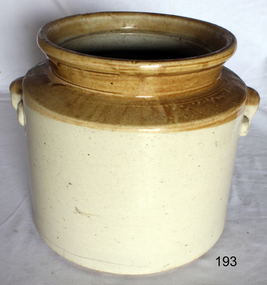
... Earthenware can be fired effectively as low as 600°C, achievable in primitive pit firing, but 800 °C was more typical. Stoneware also needs certain types of clays, more specific than those able to make earthenware, but can be made from a much wider range than porcelain. ...Earthenware can be fired effectively as low as 600°C, achievable in primitive pit firing, but 800 °C was more typical. Stoneware also needs certain types of clays, more specific than those able to make earthenware, but can be made from a much wider range than porcelain. ...Stoneware is a rather broad term for pottery or other ceramics that is fired at a relatively high temperature. A modern technical definition is a vitreous or semi-vitreous ceramic made primarily from stoneware clay or non-refractory fire clay. Whether vitrified or not, it is non-porous, it may or may not be glazed. Historically, across the world, it has been developed after earthenware and before porcelain and has often been used for high-quality as well as utilitarian wares. As a rough guide, modern earthen wares are normally fired in a kiln at temperatures in the range of about 1,000°C (1,830 °F) to 1,200 °C (2,190 °F); stoneware's at between about 1,100 °C (2,010 °F) to 1,300 °C (2,370 °F); and porcelains at between about 1,200 °C (2,190 °F) to 1,400 °C (2,550 °F). Historically, reaching high temperatures was a long-lasting challenge, and temperatures somewhat below these were used for a long time. Earthenware can be fired effectively as low as 600°C, achievable in primitive pit firing, but 800 °C was more typical. Stoneware also needs certain types of clays, more specific than those able to make earthenware, but can be made from a much wider range than porcelain. A domestic item used to store food products as glazing makes the container non-porous, often used for pickling. Or larger containers for kitchen flour. Items age is difficult to determine given the same techniques for making stoneware are in use today. Stoneware containers were made by many potteries in Australia and England. They were in common domestic use before plastics were invented around 1940 to store goods so this subject item is probably from around 1900 to the 1940s. Item's significance is difficult to determine given it is not associated with a place, person, historic event, or manufacturer. Its significance lies with its use as a domestic object giving today a view into our social past.Stoneware circular container with wide opening, brown top and off white base. Handholds moulded on each side glazed finish, cracks in base.Noneflagstaff hill, warrnambool, shipwrecked coast, flagstaff hill maritime museum, shipwreck coast, flagstaff hill maritime village, great ocean road, container, stoneware container, kitchen storage, kitchen ware -
Federation University Historical Collection
Book - Book - Scrapbook, Ballarat Institute of Advanced Education: Scrapbook of newspaper cutting, Book 5, August 1971 to December 1971
... ...clay pit plans...The cuttings cover the period from 19 August 1971 to 1 December 1971. ballarat institute of advanced education biae employment advertisements application for enrolment outline of courses smb finances concern mildura visitors testing new wind tunnel derek vine zig placina excellent year for association jack barker biae art show woman on a bike letters to the editor re art show 1500 trees planted biae students call strike new courses approved new physics equipment apartheid history explained derek viner talk student protest backed ballarat trades and labor council support prahran college of technology seeks supporters role of colleges threatened teacher training new regional office - education dept clay pit plans equipment for biae art display by smb students teachers to conduct assessment experiment undermining our sold foundation pioneer experiment at biae national diploma controls needed f r hornby colleges and students - 1972 helping hand for overseas students gordon smith teachers' colleges accommodation at technical schools victorian teachers' union concerns exceptions in an imperfect world student housing local degree courses on secondary studentships problem for school leavers $250000 for biae union building death of harry arblaster - former smb principal model of building project engineers' seminar at ballarat Book with orange cover, front. ...Newspaper cuttings relating to Ballarat Institute of Advanced Education. These are from various newspapers and include The Age, Ballarat Courier, The Australian, The Herald. The cuttings cover the period from 19 August 1971 to 1 December 1971. Book with orange cover, front. Spiral bound. Large tear back cover.ballarat institute of advanced education, biae, employment advertisements, application for enrolment, outline of courses, smb finances concern, mildura visitors, testing new wind tunnel, derek vine, zig placina, excellent year for association, jack barker, biae art show, woman on a bike, letters to the editor re art show, 1500 trees planted, biae students call strike, new courses approved, new physics equipment, apartheid history explained, derek viner talk, student protest backed, ballarat trades and labor council support, prahran college of technology seeks supporters, role of colleges threatened, teacher training, new regional office - education dept, clay pit plans, equipment for biae, art display by smb students, teachers to conduct assessment experiment, undermining our sold foundation, pioneer experiment at biae, national diploma controls needed, f r hornby, colleges and students - 1972, helping hand for overseas students, gordon smith, teachers' colleges, accommodation at technical schools, victorian teachers' union concerns, exceptions in an imperfect world, student housing, local degree courses on secondary studentships, problem for school leavers, $250000 for biae union building, death of harry arblaster - former smb principal, model of building project, engineers' seminar at ballarat -
Federation University Historical Collection
Book - Book - Scrapbook, Ballarat Institute of Advanced Education: Scrapbook of newspaper cutting, Book 6; December 1971 to May 1972
... decision on mt helen clay pit...The cuttings cover the period from 12 December 1971 to 1 May 1972. ballarat institute of advanced education biae employment advertisements application for enrolment outline of courses victorian institute of colleges staff association jack barker sees danger fourth university use up funds technical teachers at annual conference professor at seminar middle courses needed in engineering field 1973 for biae library student poster to sovereign hill john crebbin graeme trevena gary murphy group leadership is important mr kevin murray pollution threat to biae at mt helen $300000 for biae student housing academic registrar for institute decision on mt helen clay pit a l mckenzie president japanese exchange group in ballarat study grant for metallurgist planners agree on fourth uni pmg training at institute melbourne site recommended fourth uni should reach out leaders slate report pressure from country - fourth uni gates to be removed - former gaol 60 year old fleece found john sharrock youth is his thing industry shows lack of interest great blow to decentralisation develop flexibility advise to chemical society australian science education project fourth uni not wanted - councillor biae library taking shape $500 scholarship to anne mills bush their classroom smb cabaret ball greg govan - pottery student prize commemorates early industrialists e j tippett apprenticeship prize daryl eason athletics champion goon's giftthrough ballarat technical teachers at protest meeting stock exchange award to anne mills chamber of manufactures scholarship to david ward arblaster award for smb new course - bachelor of applied science in metallurgy Book with orange cover, front. ...Newspaper cuttings relating to Ballarat Institute of Advanced Education. These are from various newspapers and include The Age, Ballarat Courier, The Australian, The Herald. The cuttings cover the period from 12 December 1971 to 1 May 1972. Book with orange cover, front. Spiral bound.ballarat institute of advanced education, biae, employment advertisements, application for enrolment, outline of courses, victorian institute of colleges staff association, jack barker sees danger, fourth university use up funds, technical teachers at annual conference, professor at seminar, middle courses needed in engineering field, 1973 for biae library, student poster to sovereign hill, john crebbin, graeme trevena, gary murphy, group leadership is important, mr kevin murray, pollution threat to biae at mt helen, $300000 for biae student housing, academic registrar for institute, decision on mt helen clay pit, a l mckenzie president, japanese exchange group in ballarat, study grant for metallurgist, planners agree on fourth uni, pmg training at institute, melbourne site recommended, fourth uni should reach out, leaders slate report, pressure from country - fourth uni, gates to be removed - former gaol, 60 year old fleece found, john sharrock, youth is his thing, industry shows lack of interest, great blow to decentralisation, develop flexibility advise to chemical society, australian science education project, fourth uni not wanted - councillor, biae library taking shape, $500 scholarship to anne mills, bush their classroom, smb cabaret ball, greg govan - pottery student, prize commemorates early industrialists, e j tippett apprenticeship prize, daryl eason athletics champion, goon's giftthrough ballarat, technical teachers at protest meeting, stock exchange award to anne mills, chamber of manufactures scholarship to david ward, arblaster award for smb, new course - bachelor of applied science in metallurgy -
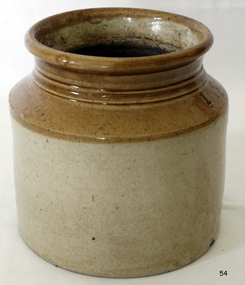 Flagstaff Hill Maritime Museum and Village
Ceramic - Stoneware Container, 1900 to 1940
... Earthenware can be fired effectively as low as 600°C, achievable in primitive pit firing, but 800 °C was more typical. Stoneware also needs certain types of clays, more specific than those able to make earthenware, but can be made from a much wider range than porcelain. ...Earthenware can be fired effectively as low as 600°C, achievable in primitive pit firing, but 800 °C was more typical. Stoneware also needs certain types of clays, more specific than those able to make earthenware, but can be made from a much wider range than porcelain. ...Stoneware is a rather broad term for pottery or other ceramics that is fired at a relatively high temperature. A modern technical definition is a vitreous or semi-vitreous ceramic made primarily from stoneware clay or non-refractory fire clay. Whether vitrified or not, it is non-porous, it may or may not be glazed. Historically, across the world, it has been developed after earthenware and before porcelain and has often been used for high-quality as well as utilitarian wares. As a rough guide, modern earthen wares are normally fired in a kiln at temperatures in the range of about 1,000°C (1,830 °F) to 1,200 °C (2,190 °F); stoneware's at between about 1,100 °C (2,010 °F) to 1,300 °C (2,370 °F); and porcelains at between about 1,200 °C (2,190 °F) to 1,400 °C (2,550 °F). Historically, reaching high temperatures was a long-lasting challenge, and temperatures somewhat below these were used for a long time. Earthenware can be fired effectively as low as 600°C, achievable in primitive pit firing, but 800 °C was more typical. Stoneware also needs certain types of clays, more specific than those able to make earthenware, but can be made from a much wider range than porcelain. A domestic item used to store food products as glazing makes the container non-porous, often used for pickling. Or larger containers for kitchen flour. Items age is difficult to determine given the same techniques for making stoneware are in use today. Stoneware containers were made by many potteries in Australia and England. They were in common domestic use before plastics were invented around 1940 to store goods so this subject item is probably from around 1900 to the 1940s. Item's significance is difficult to determine given it is not associated with a place, person, historic event, or manufacturer. Its significance lies with its use as a domestic object giving today a view into our social past.Stoneware circular container with wide opening, brown top and off white base glazed finish Marked "1" on brown glazed rimflagstaff hill, warrnambool, shipwrecked coast, flagstaff hill maritime museum, shipwreck coast, flagstaff hill maritime village, great ocean road, container, stoneware container, kitchen storage, kitchen ware -
Glenelg Shire Council Cultural Collection
Photograph - Photograph - Reconstructed Historic Sawpit, Mt Clay, n.d
... Front: Green label - Reconstructed historic Saw Pit Mt. Clay. Back: -...Mount Clay Front: Green label - Reconstructed historic Saw Pit Mt. Clay. Back: - Black and white photo mounted on strong cardboard. ...Black and white photo mounted on strong cardboard. Lots of trees. Car on left side. Log barriers. Large log over sawpit. Information area - roofed.Front: Green label - Reconstructed historic Saw Pit Mt. Clay. Back: -mount clay -
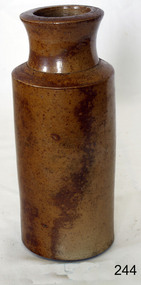 Flagstaff Hill Maritime Museum and Village
Ceramic - Stoneware Bottle, 1890-1940
... Earthenware can be fired effectively as low as 600°C, achievable in primitive pit firing, but 800 °C was more typical. Stoneware also needs certain types of clays, more specific than those able to make earthenware, but can be made from a much wider range than porcelain. ...Earthenware can be fired effectively as low as 600°C, achievable in primitive pit firing, but 800 °C was more typical. Stoneware also needs certain types of clays, more specific than those able to make earthenware, but can be made from a much wider range than porcelain. ...Stoneware is a rather broad term for pottery or other ceramics that is fired at a relatively high temperature. A modern technical definition is a vitreous or semi-vitreous ceramic made primarily from stoneware clay or non-refractory fire clay. Whether vitrified or not, it is non-porous, it may or may not be glazed. Historically, across the world, it has been developed after earthenware and before porcelain and has often been used for high-quality as well as utilitarian wares. As a rough guide, modern earthen wares are normally fired in a kiln at temperatures in the range of about 1,000°C (1,830 °F) to 1,200 °C (2,190 °F); stoneware's at between about 1,100 °C (2,010 °F) to 1,300 °C (2,370 °F); and porcelains at between about 1,200 °C (2,190 °F) to 1,400 °C (2,550 °F). Historically, reaching high temperatures was a long-lasting challenge, and temperatures somewhat below these were used for a long time. Earthenware can be fired effectively as low as 600°C, achievable in primitive pit firing, but 800 °C was more typical. Stoneware also needs certain types of clays, more specific than those able to make earthenware, but can be made from a much wider range than porcelain. A domestic item used to store food products as glazing makes the container non-porous, often used for pickling. Or larger containers for kitchen flour. Items age is difficult to determine given the same techniques for making stoneware are in use today. Stoneware containers were made by many potteries in Australia and England. They were in common domestic use before plastics were invented around 1940 to store goods so this subject item is probably from around 1900 to the 1940s.Item's significance is difficult to determine given it is not associated with a place, person, historic event, or manufacturer. Its significance lies with its use as a domestic object giving today a view into our social past.Brown salt glaze stoneware bottle None (possibly made by Royal Doulton UK)flagstaff hill, warrnambool, flagstaff hill maritime museum, maritime museum, flagstaff hill maritime village, great ocean road, bottle, stoneware bottle, storage, kitchen ware, salt glazed, stoneware, shipwreck coast -
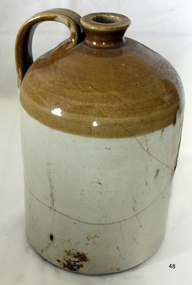 Flagstaff Hill Maritime Museum and Village
Ceramic - Jug, 1900 - 1940
... Earthenware can be fired effectively as low as 600°C, achievable in primitive pit firing, but 800 °C was more typical. Stoneware also needs certain types of clays, more specific than those able to make earthenware, but can be made from a much wider range than porcelain. ...Earthenware can be fired effectively as low as 600°C, achievable in primitive pit firing, but 800 °C was more typical. Stoneware also needs certain types of clays, more specific than those able to make earthenware, but can be made from a much wider range than porcelain. ...Stoneware is a rather broad term for pottery or other ceramics that is fired at a relatively high temperature. A modern technical definition is a vitreous or semi-vitreous ceramic made primarily from stoneware clay or non-refractory fire clay. Whether vitrified or not, it is non-porous, it may or may not be glazed. Historically, across the world, it has been developed after earthenware and before porcelain and has often been used for high-quality as well as utilitarian wares. As a rough guide, modern earthen wares are normally fired in a kiln at temperatures in the range of about 1,000°C (1,830 °F) to 1,200 °C (2,190 °F); stoneware's at between about 1,100 °C (2,010 °F) to 1,300 °C (2,370 °F); and porcelains at between about 1,200 °C (2,190 °F) to 1,400 °C (2,550 °F). Historically, reaching high temperatures was a long-lasting challenge, and temperatures somewhat below these were used for a long time. Earthenware can be fired effectively as low as 600°C, achievable in primitive pit firing, but 800 °C was more typical. Stoneware also needs certain types of clays, more specific than those able to make earthenware, but can be made from a much wider range than porcelain. A domestic item used to store food products as glazing makes the container non-porous, often used for pickling. Or larger containers for kitchen flour. Items age is difficult to determine given the same techniques for making stoneware are in use today. Stoneware containers were made by many potteries in Australia and England. They were in common domestic use before plastics were invented around 1940 to store goods so this subject item is probably from around 1900 to the 1940s.Item's significance and origin of manufacture is difficult to determine given it is not associated with a place, person, historic event, or manufacturer. Its significance lies with its use as a domestic object giving today a view into our social past. Stoneware jug badly cracked and repaired with handle and short neckNoneflagstaff hill, warrnambool, shipwrecked coast, flagstaff hill maritime museum, maritime museum, shipwreck coast, flagstaff hill maritime village, great ocean road, jug, stoneware jug, earthenware jug, kitchen storage -
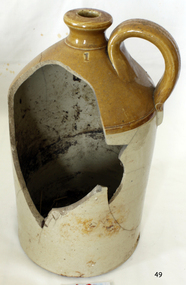 Flagstaff Hill Maritime Museum and Village
Ceramic - Jug, 1920-1940
... Earthenware can be fired effectively as low as 600°C, achievable in primitive pit firing, but 800 °C was more typical. Stoneware also needs certain types of clays, more specific than those able to make earthenware, but can be made from a much wider range than porcelain. ...Earthenware can be fired effectively as low as 600°C, achievable in primitive pit firing, but 800 °C was more typical. Stoneware also needs certain types of clays, more specific than those able to make earthenware, but can be made from a much wider range than porcelain. ...Stoneware is a rather broad term for pottery or other ceramics that is fired at a relatively high temperature. A modern technical definition is a vitreous or semi-vitreous ceramic made primarily from stoneware clay or non-refractory fire clay. Whether vitrified or not, it is non-porous, it may or may not be glazed. Historically, across the world, it has been developed after earthenware and before porcelain and has often been used for high-quality as well as utilitarian wares. As a rough guide, modern earthenwares are normally fired in a kiln at temperatures in the range of about 1,000°C (1,830 °F) to 1,200 °C (2,190 °F); stoneware's at between about 1,100 °C (2,010 °F) to 1,300 °C (2,370 °F); and porcelains at between about 1,200 °C (2,190 °F) to 1,400 °C (2,550 °F). Historically, reaching high temperatures was a long-lasting challenge, and temperatures somewhat below these were used for a long time. Earthenware can be fired effectively as low as 600°C, achievable in primitive pit firing, but 800 °C was more typical. Stoneware also needs certain types of clays, more specific than those able to make earthenware, but can be made from a much wider range than porcelain. A domestic item used to store food products as glazing makes the container non-porous, often used for pickling. Or larger containers for kitchen flour. Items age is difficult to determine given the same techniques for making stoneware are in use today. Stoneware containers were made by many potteries in Australia and England. They were in common domestic use before plastics were invented around 1940 to store goods so this subject item is probably from around 1900 to the 1940s. Item's significance is difficult to determine given it is not associated with a place, person, historic event, or manufacturer. Its significance lies with its use as a domestic object giving today a view into our social past.Brown Stoneware jug with short neckThe number "1" under neck flagstaff hill, warrnambool, shipwrecked coast, flagstaff hill maritime museum, shipwreck coast, flagstaff hill maritime village, great ocean road, jug, stoneware jug, salt glaze -
 Bendigo Historical Society Inc.
Photograph - RALPH BIRRELL COLLECTION: VIEW OF WHITE HILL
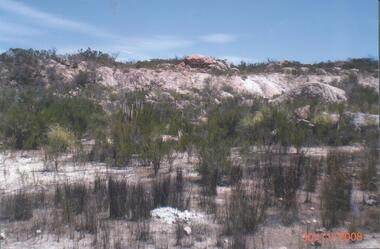
... Image shows white clay and gravel, low level bushes, possibly Chinese Scrub on site. 'The rim of the pit showing an exposed boulder in situ' ( in foreground of image ) (see Mosaic 4400.220 for detailed information regarding the White Hills, written by Dr. ...Image shows white clay and gravel, low level bushes, possibly Chinese Scrub on site. 'The rim of the pit showing an exposed boulder in situ' ( in foreground of image ) (see Mosaic 4400.220 for detailed information regarding the White Hills, written by Dr. ...Colour photograph of White Hill area - possibly at First White Hill. Image shows white clay and gravel, low level bushes, possibly Chinese Scrub on site. 'The rim of the pit showing an exposed boulder in situ' ( in foreground of image ) (see Mosaic 4400.220 for detailed information regarding the White Hills, written by Dr. Ralph Birrell)bendigo, mining, white hills -
 Bendigo Historical Society Inc.
Slide - DIGGERS & MINING. GETTING THE GOLD, c1850s
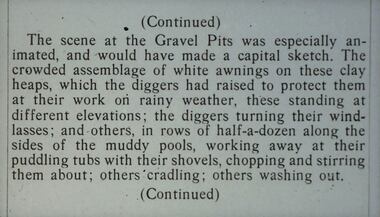
... Slide: (Continued) The scene at the Gravel Pits was especially animated, and would have made a capital sketch. The crowded assemblage of white awnings on these clay heaps, which the diggers had raised to protect them at their work on rainy weather, these standing at different elevations; the diggers turning their windlasses; and others, in rows of half-a-dozen along the sides of muddy pools, working away at their puddling tubs with their shovels, chopping and stirring them about; other cradling; others washing out. ...Slide: (Continued) The scene at the Gravel Pits was especially animated, and would have made a capital sketch. The crowded assemblage of white awnings on these clay heaps, which the diggers had raised to protect them at their work on rainy weather, these standing at different elevations; the diggers turning their windlasses; and others, in rows of half-a-dozen along the sides of muddy pools, working away at their puddling tubs with their shovels, chopping and stirring them about; other cradling; others washing out. ...Diggers & Mining. Getting the Gold. Slide: (Continued) The scene at the Gravel Pits was especially animated, and would have made a capital sketch. The crowded assemblage of white awnings on these clay heaps, which the diggers had raised to protect them at their work on rainy weather, these standing at different elevations; the diggers turning their windlasses; and others, in rows of half-a-dozen along the sides of muddy pools, working away at their puddling tubs with their shovels, chopping and stirring them about; other cradling; others washing out. (Continued) Markings: 34 994.LIF:4. Used as a teaching aid.hanimounteducation, tertiary, goldfields -
 Anglesea and District Historical Society
Stoneware Jar, Estimated 19th century
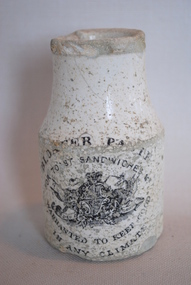
... White clay glazed stonewared jar. Baluster shape. Surface heavily pitted and rim chipped. ...White clay glazed stonewared jar. Baluster shape. Surface heavily pitted and rim chipped. ...White clay glazed stonewared jar. Baluster shape. Surface heavily pitted and rim chipped. Transfer printed on side in black with royal armorial in centre of design.BLOATER PASTE / FOR TOAST SANDWICHES / WARRANTED TO KEEP GOOD / IN ANY CLIMATE.bloater paste, stoneware jar -
 Kew Historical Society Inc
Plan, Melbourne & Metropolitan Board of Works : Borough of Kew : Detail Plan No.1296, 1904
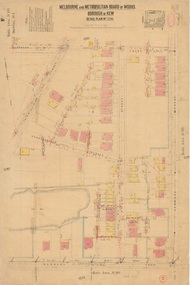
... clay hole’, on the site of the current Foley Reserve. It was used by Smart’s Brickyard from the 1880s until 1911, when the Council purchased it for a rubbish dump. It is notable as the site is one of the few industrial operations to have existed in Kew. By 1903, urban development was characterised by larger houses fronting Barkers Road and brick and weatherboard villas in Foley Street. Nearer the pit...clay hole’, on the site of the current Foley Reserve. It was used by Smart’s Brickyard from the 1880s until 1911, when the Council purchased it for a rubbish dump. It is notable as the site is one of the few industrial operations to have existed in Kew. By 1903, urban development was characterised by larger houses fronting Barkers Road and brick and weatherboard villas in Foley Street. Nearer the pit ...The Melbourne and Metropolitan Board of Works (MMBW) plans were produced from the 1890s to the 1950s. They were crucial to the design and development of Melbourne's sewerage and drainage system. The plans, at a scale of 40 feet to 1 inch (1:480), provide a detailed historical record of Melbourne streetscapes and environmental features. Each plan covers one or two street blocks (roughly six streets), showing details of buildings, including garden layouts and ownership boundaries, and features such as laneways, drains, bridges, parks, municipal boundaries and other prominent landmarks as they existed at the time each plan was produced. (Source: State Library of Victoria)This plan forms part of a large group of MMBW plans and maps that was donated to the Society by the Mr Poulter, City Engineer of the City of Kew in 1989. Within this collection, thirty-five hand-coloured plans, backed with linen, are of statewide significance as they include annotations that provide details of construction materials used in buildings in the first decade of the 20th century as well as additional information about land ownership and usage. The copies in the Public Record Office Victoria and the State Library of Victoria are monochrome versions which do not denote building materials so that the maps in this collection are invaluable and unique tools for researchers and heritage consultants. A number of the plans are not held in the collection of the State Library of Victoria so they have the additional attribute of rarity.Original survey plan, issued by the MMBW to a contractor with responsibility for constructing sewers in the area identified on the plan within the Borough of Kew. The plan was at some stage hand-coloured, possibly by the contractor, but more likely by officers working in the Engineering Department of the Borough and later Town, then City of Kew. The hand-coloured sections of buildings on the plan were used to denote masonry or brick constructions (pink), weatherboard constructions (yellow), and public buildings (grey). This area was once known as O’Shaughnessy’s Paddock. O’Shaughnessy was the licensee of the Kew Hotel. The ‘Paddock’ or farm was for many years the closest farm to Melbourne. By 1903, when this plan was surveyed and lithographed, little of the farm remained. The area is dominated by a ‘clay hole’, on the site of the current Foley Reserve. It was used by Smart’s Brickyard from the 1880s until 1911, when the Council purchased it for a rubbish dump. It is notable as the site is one of the few industrial operations to have existed in Kew. By 1903, urban development was characterised by larger houses fronting Barkers Road and brick and weatherboard villas in Foley Street. Nearer the pit, weatherboard houses predominated. Foley Street bisected the triangular block and continued right to Denmark Street. At this stage, a house impeded the through road, only allowing access via a right of way to High Street.melbourne and metropolitan board of works, detail plans, mmbw 1296, cartography -
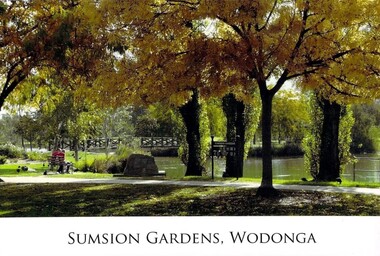 Wodonga & District Historical Society Inc
Photograph - Eric Sumsion Gardens
... Clay Bird Shooting Club. From the early 1900s football and cricket were played there, and some mining leases were also allowed. At one time there were open gravel pits...Clay Bird Shooting Club. From the early 1900s football and cricket were played there, and some mining leases were also allowed. At one time there were open gravel pits ...Mr Eric Sumsion was the gardening curator for Wodonga Shire in 1956. He had previously operated a bootmaker’s shop in High Street, Wodonga for many years. Eric saw the potential of the area in Wodonga now known as Belvoir Park and asked permission to work on part of the area. He eventually purchased a house adjoining the area giving him more time and easy access to work on it. The Lagoon, Lake Huon, Belvoir Lagoon, Belvoir Park and Sumsion Gardens are all names used over time for what is today one of Wodonga’s favourite recreation and picnic spots. In the 1800s river boats could enter Lake Huon from Wodonga Creek. There was a jetty south of where the water fountain is today. In later years, this jetty was used by the Clay Bird Shooting Club. From the early 1900s football and cricket were played there, and some mining leases were also allowed. At one time there were open gravel pits between House Creek and the main lagoon, and these were subsequently filled with town garbage collected by the Council. In the late 1940s, Wodonga Golf Club took over part of Belvoir Park for a 9-hole golf course with sand greens. The Golf Club House was built in 1946. The Club extended the course to 12-holes when the football ground moved to Martin Park and the course later extended to 18 holes. Under Eric Sumsion’s care the area became a magnificent area of parkland and curated gardens. After he had retired in 1961 his work was acknowledged by the Shire Engineer, Mr Bill Page, when the Sumsion Gardens were named in his honour. He was also responsible for the design and curating of many other gardens in Wodonga, including those at Sarah Coventry and Richardson Park. Eric Sumsion died in July 1988, aged 85.This item is significant because it acknowledges the dedication and commitment of Eric Sumsion to the Wodonga Community.A collection of photographic images and an advertisement related to the work of Eric Sumsion in Wodonga.eric sumsion, parks and gardens wodonga
