
Showing 21 items matching "climbing plants"
-
 University of Melbourne, Burnley Campus Archives
Negative - Colour negatives, Plant Materials, Unknown
... ...climbing plants..."Weeds, Australian Plants, Climbing Plants & Ground Covers, Early Spring Flowering Plants, Californian Plants & Others, Plants for De Oxygenated Soils, Aquatic Plants, Botanical Gardens (Rarer Plants)." ..."Weeds, Australian Plants, Climbing Plants & Ground Covers, Early Spring Flowering Plants, Californian Plants & Others, Plants for De Oxygenated Soils, Aquatic Plants, Botanical Gardens (Rarer Plants)." ...8 rolls colour negativesLabelled, "Diploma/Degree Semester 2 Weeks 6-13." "Weeds, Australian Plants, Climbing Plants & Ground Covers, Early Spring Flowering Plants, Californian Plants & Others, Plants for De Oxygenated Soils, Aquatic Plants, Botanical Gardens (Rarer Plants)." Not digitised.plant materials, weeds, australian plants, climbing plants, ground covers, early spring flowering plants, californian plants, deoxygenated soils, aquatic plants, botanical gardens, rare plants, degree, diploma, plant id -
 Bendigo Historical Society Inc.
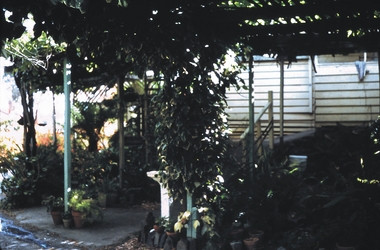
Slide - GARDEN-12 HOPE STREET, Jan 1963
... Garden-12 Hope Street. Climbing plants on trellis....Garden-12 Hope Street. Climbing plants on trellis. Slide GARDEN-12 HOPE STREET. ...Slide. Garden-12 Hope Street. Climbing plants on trellis.slide, bendigo, garden-12 hope street., garden-12 hope street. -
 Linton and District Historical Society Inc
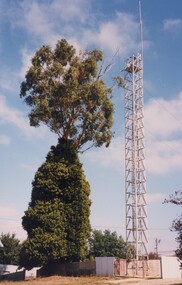
Photograph, CFA Radio Tower, Linton, 1988, 1988
... Colour photograph of Linton fire tower next to a tall landmark tree which has trunk covered with climbing plant....Linton fire tower Linton CFA Linton Fire Brigade Telecommunications towers Colour photograph of Linton fire tower next to a tall landmark tree which has trunk covered with climbing plant. CFA Radio Tower, Linton, 1988 Photograph ...Taken April 23-24 1988, during Heritage Week.Colour photograph of Linton fire tower next to a tall landmark tree which has trunk covered with climbing plant.linton fire tower, linton cfa, linton fire brigade, telecommunications towers -
 City of Greater Geelong
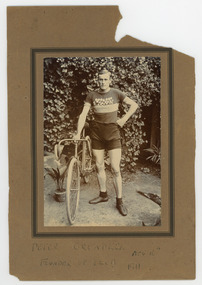
Photograph - Black and White Photograph, Cyclist, Peter Grundeel with many medals on shirt, 1911
... Man with many small medallions pinned to t-shirt standing next to bicycle with pot plant on opposite side in front of a large outdoor climbing plant....Man with many small medallions pinned to t-shirt standing next to bicycle with pot plant on opposite side in front of a large outdoor climbing plant. Photograph Black and White Photograph, Cyclist, Peter Grundeel with many medals on shirt, 1911 ...Geelong Amateur Cycling Club. Geelong West Cycling Club.Black and white photograph mounted on cardboard. Man with many small medallions pinned to t-shirt standing next to bicycle with pot plant on opposite side in front of a large outdoor climbing plant.Peter Grundeel Founder of Club Nov 16th 1911 -
 Bendigo Historical Society Inc.
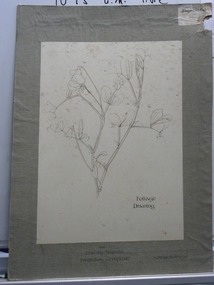
Artwork,other - NORMAN PENROSE COLLECTION: FOLIAGE DRAWING
... Norman Penrose collection: pen and ink drawing of a climbing plant like a Sweet Pea. Mounted on cardboard with a grey, green and reddish checked matt. ...Norman Penrose collection: pen and ink drawing of a climbing plant like a Sweet Pea. Mounted on cardboard with a grey, green and reddish checked matt. ...Artwork. Norman Penrose collection: pen and ink drawing of a climbing plant like a Sweet Pea. Mounted on cardboard with a grey, green and reddish checked matt. Foliage Drawing for Drawing Teachers Secondary Certificate. Norman W. PenroseN. Penrosedrawing, pencil, school of mines, norman penrose collection, artwork, foliage drawing -
 Linton and District Historical Society Inc
Photograph, Crosier Family Home at Happy Valley
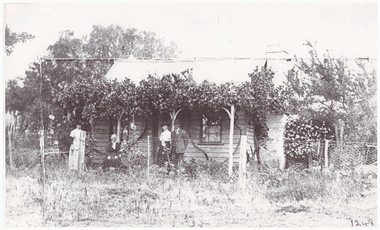
... Black and white copy of original photograph showing a small weatherboard house with climbing plants along the verandah. Standing in front of the house are two women, with an older lady sitting between them, and a gentleman standing on the right, next to one of the women....Crosier family home Miss Crosier Mrs Crosier Jack Crombie Maggie Crombie (nee Crosier) Happy Valley Black and white copy of original photograph showing a small weatherboard house with climbing plants along the verandah. Standing in front of the house are two women, with an older lady sitting between them, and a gentleman standing on the right, next to one of the women. ...This photograph is believed to have been taken in the 1890s at the Crosier property at Happy Valley (the Crosiers lived along the road leading to the Happy Valley School. Crosier descendants still live on this site). People in the photo are thought to be, L-R: Nell Crosier, Mary Crosier (née Hogan), Maggie Crombie (née Crosier), Jack Crombie. Mary Crosier was the second wife of Henry Crosier (1825-1901), a miner and farmer at Happy Valley. They had eight children. Their oldest daughter Maggie Crosier (1865-1932) married John Charles (Jack) Crombie in 1893. The Crombies farmed at Durham Lead.Black and white copy of original photograph showing a small weatherboard house with climbing plants along the verandah. Standing in front of the house are two women, with an older lady sitting between them, and a gentleman standing on the right, next to one of the women.crosier family home, miss crosier, mrs crosier, jack crombie, maggie crombie (nee crosier), happy valley -
Bendigo Historical Society Inc.
Photograph - PORTRAIT FAMILY
... All 4 standing outside a white 2 storey house, pillars on ground floor, a flowering climbing plant close to family. On back of photo, can partially read, 'This is just a snapshot taken (blank) our house in May 1918 (blank line). ...All 4 standing outside a white 2 storey house, pillars on ground floor, a flowering climbing plant close to family. On back of photo, can partially read, 'This is just a snapshot taken (blank) our house in May 1918 (blank line). ...Black & White photograph, a family of 2 adults, 2 children, male wearing a turban and a button up suit type uniform. Female wearing wide brimed helmet looking hat,over the shoulder sash over blouse, the tallest(eldest) child, a boy in bare feet, similar hat to woman, short type jump suit, the girl wearing a white dress, black shoes and socks, black and white bonnet. All 4 standing outside a white 2 storey house, pillars on ground floor, a flowering climbing plant close to family. On back of photo, can partially read, 'This is just a snapshot taken (blank) our house in May 1918 (blank line). Up in the hills the men wear (blank) instead of Dhoti because of the (that’s all).photograph, portrait, family, photograph, portrait, family of 2 adults, 2 children, male wearing turbin. -
 University of Melbourne, Burnley Campus Archives
Slide - 35mm Colour slides, Kodachrome, Students Working Outside, 1985-1986
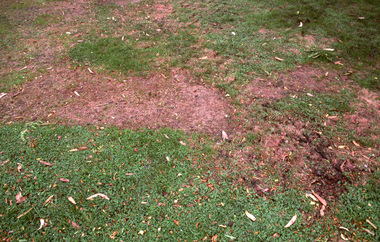
... Colour slides. 3 slides of a brown patch in lawn Apr 85. 1 of plant climbing against a building Administration Building. 14 of students using equipment and renovating a garden bed Cypress Bed? ...students peter may equipment burnley gardens cypress bed lawn damage students working with machinery students working in engineering lawn renovation students working outside Colour slides. 3 slides of a brown patch in lawn Apr 85. 1 of plant climbing against a building Administration Building. 14 of students using equipment and renovating a garden bed Cypress Bed? ...Colour slides. 3 slides of a brown patch in lawn Apr 85. 1 of plant climbing against a building Administration Building. 14 of students using equipment and renovating a garden bed Cypress Bed? Jun 86. 2 labelled "PM" Peter May. Includes prints of 18 and 19.students, peter may, equipment, burnley gardens, cypress bed, lawn damage, students working with machinery, students working in engineering, lawn renovation, students working outside -
 Bendigo Historical Society Inc.
Photograph - LA TROBE UNIVERSITY BENDIGO COLLECTION: BENDIGO TEACHERS' COLLEGE STUDENTS
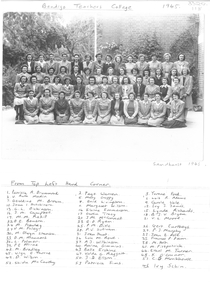
... In the background is a brick building with climbing plants on the walls and a garden with bushes and trees on the left-hand side. ...In the background is a brick building with climbing plants on the walls and a garden with bushes and trees on the left-hand side. ...A black and white photograph of female Bendigo Teachers' College students. It is titled 'Sandhurst 1945'. The women are dressed in the formal fashion of the day in a coat or jacket and skirts or frocks. In the background is a brick building with climbing plants on the walls and a garden with bushes and trees on the left-hand side. There appears to be a flagpole in the centre at the back. The names of the students are listed from the top left-hand corner across - Patricia A. Drummond, Faye Warren, Yvonne Ford, V. Ruth Madin, Mary Guppy, Lois R. Adams, Geraldine M. Brown, Enid Livingstone, Carole Vale, Joan I. Hutchinson, Margaret Wilson, Ivy J. James, G.L. Dickinson, Elaine Emmerson, Lynda Richards, J.M. Campbell, Gwen Tracy, B.J.V. Bryan, M.M. Rahill, J.M. McConnell, V.L. Moore, D.E. Benson, E.D. Ryan, M. Frawley, P.M. Ditle, Gert Curthoys, V.M. Foley, P.V. Sullivan, P.J. Murphy, M.Olwyn Stanson, Joan Hunt, Joan E. Dole, D.M. Manners, Lola M. Rowe, Frances P. Dam, L. Palmer, A.J. Wilhinson, M. Holt, P.E. Mirne, Rosina Gimmins, M. M. Fitzpatrick, M. Bradley, Belle Erskine, Ethel M. Turner, Wilga E. Thorne, Valda G. Raggatt, K. O'Connor, D. Wilson, J.D. Ellson, C.G. Monkhouse, Sheila McCarthy, Patricia Sims, Ivy. S Chin. See 3320.100.education, bendigo teachers' college students, tertiary education, teacher training, sandhurst, bendigo teachers' college, ms. j.c. burnett, mr. geoff. pryor, fashion, clothing, costume, patricia a. drummond, faye warren, yvonne ford, v. ruth madin, mary guppy, lois r. adams, geraldine m. brown, enid livingston, carole vale, joan i. hutchinson, margaret wilson, ivy j. james, g.l. dickinson, elaine emmerson, lynda richards, j.m. campbell, gwen tracy, b.j.v. bryan, m.m. rahill, j.m. mcconnell, v.l. moore, d.e. benson, e.d. ryan, m. frawley, p.m. ditle, gert curthoys, v.m. foley, p.v. sullivan, p.j. murphy, m. olwyn stanson, joan hunt, joan e. dole, d. m. manners, lola m. rowe, frances p. dam, l. palmer, a.j. wilkinson, m. holt, p.m. mirne, rosina gimmins, m. fitzpatrick, m. bradley, belle erskine, ethel m. turner, wilga e. thorne, valda g. raggatt, k. o'connor, d. wilson, j.d. ellson, c.g. monkhouse, sheila mccarthy, patricia sims, ivy schin. -
 University of Melbourne, Burnley Campus Archives
Photograph - Black and white photographs, James (Jim) Pleasance, Pruning Display
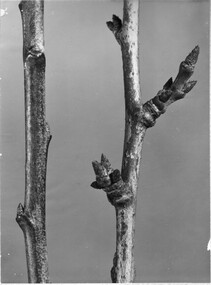
... "(31) "Young climbing rose-ready for planting-July." (32, 33) Grape vine before pruning. (34) Same vine pruned and trained. (35) Older vine pruned...."(31) "Young climbing rose-ready for planting-July." (32, 33) Grape vine before pruning. (34) Same vine pruned and trained. (35) Older vine pruned. ...Black and white photographs of various sizes pasted on cardboard for display purposes. Some annotated. (1) (2) Difference between leaf and fruit buds. (3) "The 'rod' or whip is most suitable plant to commence training." (4) Planted and pruned fruit tree. "School of Horticulture and Primary Agriculture Burnley B. 1 " stamped on reverse. (5) "Pear Tree-Unpruned (1) June." (6) "Same Pear Tree-Pruned (2) June." (7) Young unpruned "William bon Chretien". Reverse, Burnley Stamp. (8) Same tree pruned. Reverse, Burnley Stamp. (9) Unpruned pear tree. (10) "Narrabben" plum before inserting branch spreaders. (11) With branch spreaders. (12) Close up of some of its branches without spreaders. (13) Close up of branch with seaders. (14) Plum tree with spreaders. (16) Close up of fruiting spurs. (17) "Apple Blossom Oct. Reverse, p 163(Oct." )(18) Same photograph enlarged. (20) Close up of fruiting buds. (21) Old unpruned apricot tree. (22) "Unpruned branch of apricot tree." (23) Close up of apricot branch. (24) "Same branch-apricot-pruned June Reverse, p99 (June)."(25) Pruned branch stump of mature fruit tree.(26) "Clean saw cuts with sharp knife." (27) "Treat all large wounds on trees to avoid infection by wood rotting fungus." (28) "Apply coating of lead paint or grafting mastic." (29) "Branch of lemon-unpruned Aug. Reverse, p157 (Sept.)." (30) "Same branch of lemon-pruned Aug. Reverse, p 157 Aug."(31) "Young climbing rose-ready for planting-July." (32, 33) Grape vine before pruning. (34) Same vine pruned and trained. (35) Older vine pruned.fruit bud, rod, whip, school of horticulture and primary agriculture, burnley, pear tree, spreaders, plum tree, apricot tree, fungus, lead paint, lemon, roses, grape vine, leaf bud, training, fruiting spurs, apple blossom, grafting mastic, teaching, a w jessep -
 Glenelg Shire Council Cultural Collection
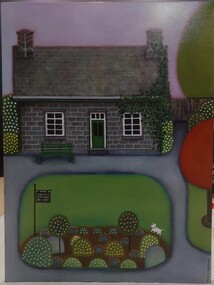
Painting, Tracey Gardner, Curator's Cottage, 2020
... Ivy climbs up the right hand side of the cottage. In the foreground is a small green path of grass with plants and shrubs. ...Ivy climbs up the right hand side of the cottage. In the foreground is a small green path of grass with plants and shrubs. ...A blue stone cottage with a green front door. A window either side. The front door has a step leading up to it. There is a green bench in front of the building. The building has two chimneys. Ivy climbs up the right hand side of the cottage. In the foreground is a small green path of grass with plants and shrubs. There is a small white dog on the lawn. A sign says - Curator's Cottage. Built 1875. The sky is a purple, pink blue colour.Tracey Gardner bottom right.portland botanic gardens, curator's cottage, portland, bluestone -
 Eltham District Historical Society Inc
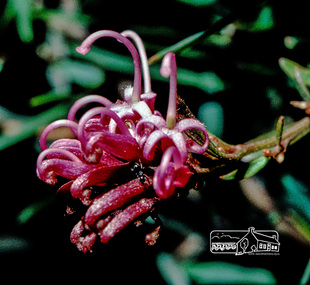
Photograph, Fred Mitchell, Spider climbing over Grevillea in garden of 86 Bible Street, Eltham, 1982, 1982
... fred mitchell collection bible street plants houses 1982 Digital copy of colour photograph Spider climbing over Grevillea in garden of 86 Bible Street, Eltham, 1982 Photograph Fred Mitchell ...Digital copy of colour photographfred mitchell collection, bible street, plants, houses, 1982 -
 Eltham District Historical Society Inc
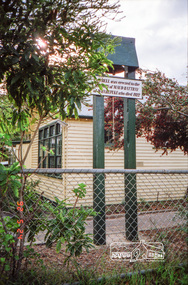
Photograph, St Andrews Primary School, Eltham Heritage Tour, 24 May 1992, 24/05/1992
... Climbing towards Panton Hill the soil was not rich and supported only scarce growth. Perfunctory prospecting and mining had taken place in this area, though not with the diligence applied at Research. Again we saw the ingredients of a settlement, this one organised by Government, the Hotel, the Store, the School. Down from Memorial Park the School grounds had original tree planting...Climbing towards Panton Hill the soil was not rich and supported only scarce growth. Perfunctory prospecting and mining had taken place in this area, though not with the diligence applied at Research. Again we saw the ingredients of a settlement, this one organised by Government, the Hotel, the Store, the School. Down from Memorial Park the School grounds had original tree planting ...ELTHAM HERITAGE TOUR The Society excursion on 24th May 1992 was arranged by David Bick, leader of the team carrying out the Shire's heritage study. David selected a number of sites or buildings identified in the study, some of them lesser known components of the Shire's heritage. The tour commenced at the Eltham Shire Office at 10.00 am. Travel was by private car and mini-bus with stops at about twelve locations for commentary by David.It included a short walk in Hurstbridge and lunch at Kinglake. Highlights of the tour included: - 10 am Leave from Shire Offices - 3 Important Trees - A Physical Link to Eltham's First Settlers - Toorak Mansion Gates - A Surviving Farm House - An Intact Circa 1900 Main Street - First Settlers - Gold Miners, and Timber-getters - An Early Hotel - A Pioneering Homestead - Changing Eltham Shire - 20th Century - 4 pm Afternoon Tea and Finish Tour Extract from ELTHAM CULTURAL HERITAGE TOUR (Newsletter No. 85, July 1992, by Bettina Woodburn) "At St Andrews we noted the old and new schools, the Anglican Church, the Hall, the Bakery and the pub – still a popular watering and eating place. Climbing towards Panton Hill the soil was not rich and supported only scarce growth. Perfunctory prospecting and mining had taken place in this area, though not with the diligence applied at Research. Again we saw the ingredients of a settlement, this one organised by Government, the Hotel, the Store, the School. Down from Memorial Park the School grounds had original tree planting and the School Bell dedicated to Maud Rattray who died in 1922. There is a new Hall and opposite in the grounds of the Church and Sunday School a modest Memorial Cross of granite with inscriptions and in memory of four 'fallen comrades'. This small section of the main road retained the small village atmosphere; although the population had increased there had been little alteration."Record of the Society's history and activities and highlighting various aspects of the Heritage Study undertaken by David Bick used to create the future heritage overlay for the Shire of Eltham and later Nillumbik Shire.Roll of 35mm colour negative film, 4 stripsKodak Gold 100 5095shire of eltham historical society, activities, heritage tour, st andrews -
 Ballarat Tramway Museum
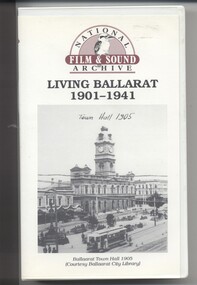
Film - Video cassette tape and box, Chris Long, "Living Ballarat 1901 - 1941", 1990
... Synopsis: based on time - 0.00 - intro, 1901 film, Melbourne, first film in Ballarat, Royal visit to Ballarat, Boer War Monument, first feature length film in Ballarat. 2.50 - Bridge St and Sturt St scenes, filmed from a flat truck pushed by an electric tram, including No. 11 going to City Oval to Lydiard St. 5.00 - Sturt St Military parade, with trams in background and tram running alongside. 6.54 - scene of Alfred Hall and films. 7.32 - scene on Lake Wendouree and paddle steamer - Living Ballarat film - Pathe's Ballarat Gazette local film unit, football ground scene. a children's beauty competition, tree planting at Macarthur St state school, 1911 Ballarat Show, unveiling of the Boer War statue name plates, Lake Wendouree 1912. 13.22 - St Patricks David Pde with trams in the background. 14.24 - Ballarat Kennel club dog show. 15.50 - Royal visit in 1920, Arch of victory opening 17.48 - Day at Macarthur St state school and tree plantation 20.55 - Bakery Hill - Stones Corner with tram tracks, cars, little trams, Sturt St with a tram leaving Grenville St, ESCo 9 turning from Lydiard St to run down to Grenville St. 22.15 - Ballarat Show, Coliseum Hall, 1925, races, machinery shows, boxing troupe. 25.20 - Botanic Gardens Gates, Lake Wendouree area. 25.30 - Gem Picture travelling show - film 26.16 - Formal visit of English pressman to Ballarat, 1925, Botanic Gardens, Eureka Stockade, Avenue of Honor, Moorabool Reservoir. 29.15 - 1927 Fed Govt doco of Ballarat, Black Hill, 1927 Home to Ballarat Festival, Ballarat Commemorative song, Craigs Hotel, Ballarat Post Office, tram centre poles in Lydiard St, tram climbing Sturt St, Town Hall, tram at Lydiard St terminus coursing, 8, Sturt St, view of ESCo Sebastopol car leaving Grenville St, Selkirks Brickworks, the Welcome nugget, Peter Lalor statue, Eureka stockade, sewerage plant, modern housing, Sturt St west, water supply - golf club, the High School, the orphanage, fine homesteads around Ballarat, Lake Wendouree. 41.00 Opening of the Ballarat Aerodrome. 43.11 - Depression work and leading into radio broadcasting - 3BA open 1930, typewriters, radio transmission equipment, radio aerials, boys listening to crystal sets 47.50 - Bluebirds Children session tour to the Gardens, mentions the BTPS, trams 13, 3? ...Synopsis: based on time - 0.00 - intro, 1901 film, Melbourne, first film in Ballarat, Royal visit to Ballarat, Boer War Monument, first feature length film in Ballarat. 2.50 - Bridge St and Sturt St scenes, filmed from a flat truck pushed by an electric tram, including No. 11 going to City Oval to Lydiard St. 5.00 - Sturt St Military parade, with trams in background and tram running alongside. 6.54 - scene of Alfred Hall and films. 7.32 - scene on Lake Wendouree and paddle steamer - Living Ballarat film - Pathe's Ballarat Gazette local film unit, football ground scene. a children's beauty competition, tree planting at Macarthur St state school, 1911 Ballarat Show, unveiling of the Boer War statue name plates, Lake Wendouree 1912. 13.22 - St Patricks David Pde with trams in the background. 14.24 - Ballarat Kennel club dog show. 15.50 - Royal visit in 1920, Arch of victory opening 17.48 - Day at Macarthur St state school and tree plantation 20.55 - Bakery Hill - Stones Corner with tram tracks, cars, little trams, Sturt St with a tram leaving Grenville St, ESCo 9 turning from Lydiard St to run down to Grenville St. 22.15 - Ballarat Show, Coliseum Hall, 1925, races, machinery shows, boxing troupe. 25.20 - Botanic Gardens Gates, Lake Wendouree area. 25.30 - Gem Picture travelling show - film 26.16 - Formal visit of English pressman to Ballarat, 1925, Botanic Gardens, Eureka Stockade, Avenue of Honor, Moorabool Reservoir. 29.15 - 1927 Fed Govt doco of Ballarat, Black Hill, 1927 Home to Ballarat Festival, Ballarat Commemorative song, Craigs Hotel, Ballarat Post Office, tram centre poles in Lydiard St, tram climbing Sturt St, Town Hall, tram at Lydiard St terminus coursing, 8, Sturt St, view of ESCo Sebastopol car leaving Grenville St, Selkirks Brickworks, the Welcome nugget, Peter Lalor statue, Eureka stockade, sewerage plant, modern housing, Sturt St west, water supply - golf club, the High School, the orphanage, fine homesteads around Ballarat, Lake Wendouree. 41.00 Opening of the Ballarat Aerodrome. 43.11 - Depression work and leading into radio broadcasting - 3BA open 1930, typewriters, radio transmission equipment, radio aerials, boys listening to crystal sets 47.50 - Bluebirds Children session tour to the Gardens, mentions the BTPS, trams 13, 3? ...Yields information through movie films of the 1960's of Ballarat trams operating in the streets of Ballarat and has a strong association with the maker - National Film and Sound Archives and Chris Long.Video cassette in a plastic case, titled "Living Ballarat - 1901 - 1941, National Film and Sound Archive (1990)". Copyright provisions - National Film and Sound Archive - segments may not be used without their permission, viewing only. Synopsis: based on time - 0.00 - intro, 1901 film, Melbourne, first film in Ballarat, Royal visit to Ballarat, Boer War Monument, first feature length film in Ballarat. 2.50 - Bridge St and Sturt St scenes, filmed from a flat truck pushed by an electric tram, including No. 11 going to City Oval to Lydiard St. 5.00 - Sturt St Military parade, with trams in background and tram running alongside. 6.54 - scene of Alfred Hall and films. 7.32 - scene on Lake Wendouree and paddle steamer - Living Ballarat film - Pathe's Ballarat Gazette local film unit, football ground scene. a children's beauty competition, tree planting at Macarthur St state school, 1911 Ballarat Show, unveiling of the Boer War statue name plates, Lake Wendouree 1912. 13.22 - St Patricks David Pde with trams in the background. 14.24 - Ballarat Kennel club dog show. 15.50 - Royal visit in 1920, Arch of victory opening 17.48 - Day at Macarthur St state school and tree plantation 20.55 - Bakery Hill - Stones Corner with tram tracks, cars, little trams, Sturt St with a tram leaving Grenville St, ESCo 9 turning from Lydiard St to run down to Grenville St. 22.15 - Ballarat Show, Coliseum Hall, 1925, races, machinery shows, boxing troupe. 25.20 - Botanic Gardens Gates, Lake Wendouree area. 25.30 - Gem Picture travelling show - film 26.16 - Formal visit of English pressman to Ballarat, 1925, Botanic Gardens, Eureka Stockade, Avenue of Honor, Moorabool Reservoir. 29.15 - 1927 Fed Govt doco of Ballarat, Black Hill, 1927 Home to Ballarat Festival, Ballarat Commemorative song, Craigs Hotel, Ballarat Post Office, tram centre poles in Lydiard St, tram climbing Sturt St, Town Hall, tram at Lydiard St terminus coursing, 8, Sturt St, view of ESCo Sebastopol car leaving Grenville St, Selkirks Brickworks, the Welcome nugget, Peter Lalor statue, Eureka stockade, sewerage plant, modern housing, Sturt St west, water supply - golf club, the High School, the orphanage, fine homesteads around Ballarat, Lake Wendouree. 41.00 Opening of the Ballarat Aerodrome. 43.11 - Depression work and leading into radio broadcasting - 3BA open 1930, typewriters, radio transmission equipment, radio aerials, boys listening to crystal sets 47.50 - Bluebirds Children session tour to the Gardens, mentions the BTPS, trams 13, 3? and 14 carrying visitors arriving and getting off and picnic. 48.50 - expansion of 3BA transmitter capacity 51.30 - 1934 visit of the Duke of Gloucester - visit to the Lucas factory, views of the work floor and the factory history and then South St band competition at the Showgrounds. 55.10 - South St Music Festivals, Coliseum and fire. 56.25 - Ballarat Floral Festival March 1938 - Victorian Railways arch of welcome. 57.25 - segment in the shot of 12 and 19? in Sturt St 57.45 - colour segment of the festival, 58.39 - Grenville St tram shelter, Bridge St, Sturt St, arches, Main Road, Council Road Roller, Victoria St, Eureka Stockade Reserve, Botanic Gardens, setting up the flowers, wax papers. 1.01.48 - decorated tram, north side of Sturt St, details of the materials used, Crockers. 1.03.20 - Hospital Fund Raising Gala Day - March 1938, special trains arriving Ballarat Railway Station, fund raising procession, pageant at the Showgrounds, fly past. 1.07.35 - 1939 Summer, motor cycle races at Learmonth, City Oval fire brigade demonstrations, Ballarat (East) Fire Station decorated for the 1939 Floral Festival with tram in the background and No. 29, Floral Tram and others. 1.09.25 - July 1914 - Ballarat at War parade, troops. 1.10.10 - credits. Box has images of a tram and town hall on the front and details of the contents on the rear and who made it etc. See images for details. ballarat, 3ba, floral tram, royal visit, buildings, esco -
 Stawell Historical Society Inc
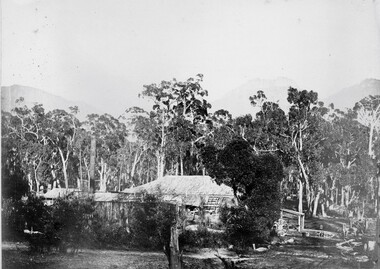
Photograph, Grampians Sunrise over the Saw Mills 1866
... climbed its highest peak and named it Mount William. Owing to the lateness of arrival at the summit they had to spend a very cold and miserable night. Whilst in the Grampians, which he so named because of their likeness to his native Scotland. He collected about 150 plants...climbed its highest peak and named it Mount William. Owing to the lateness of arrival at the summit they had to spend a very cold and miserable night. Whilst in the Grampians, which he so named because of their likeness to his native Scotland. He collected about 150 plants ...Grampians (Sunrise over the Saw Mills). Part of a collection of Photographs by Mr. O.G. Armstrong as commissioned by the Shire of Stawell for the Inter-colonial and Paris Exhibition in Melbourne in 1866. The Grampians were first sighted by Major Thomas Mitchell on the 11th of July 1836. Four days later he and a small party climbed its highest peak and named it Mount William. Owing to the lateness of arrival at the summit they had to spend a very cold and miserable night. Whilst in the Grampians, which he so named because of their likeness to his native Scotland. He collected about 150 plants and sent them to the Professor of Botany, John Lindley at the University of London. It is now known there about 900 different flowering plants in the Grampians, over one third of all those growing in Victoria. stawell industry -
 Sunshine and District Historical Society Incorporated
Film - Connor Shea Climb A New Mountain Documentary 1952 DVD, Connor Shea & Co Pty Ltd, 18th August 1988
... plant operating in the field. Connor Shea Fourth Avenue Sunshine Connor Shea Documentary 52 Mins 18th August 1988 DVD This DVD has been digitised Film Connor Shea Climb A New Mountain Documentary 1952 DVD Connor Shea & Co Pty Ltd ...Connor‑Shea was founded in Sunshine by four former McKay/Massey‑Ferguson employees who left to create a new agricultural‑machinery company. Their factory on Fourth Avenue, Sunshine became a major manufacturer of seeders, ploughs, drills, and cultivation equipment, exporting internationally.This film captures the history of the Connor Shea Sunshine Plant, from design, factory operations, delivery and plant operating in the field.Connor Shea Documentary 52 Mins 18th August 1988connor shea, fourth avenue, sunshine -
 City of Greater Geelong
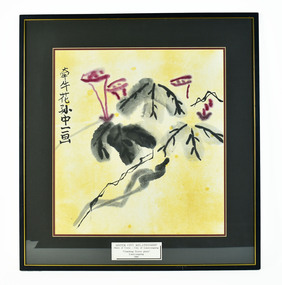
Watercolour, Climbing Flower Plant
... Climbing Flower Plant Watercolour ... -
Whitehorse Historical Society Inc.
Article, Mueller's name on many plants, 1964
... climb Mt Buller and Mt Buffalo. Apart from his activities with the Melbourne Botanical Gardens he was Government Botanist for 43 years. His name is found in the name of some 80 native trees and shrubs. Plants ...Article on the history of Ferdinand von Mueller.Article on the history of Ferdinand von Mueller. He arrived in Adelaide in 1847 (had a PhD from Kiel University). He came to Melbourne in 1853 and was appointed the State's first official botanist. He was the first white man to climb Mt Buller and Mt Buffalo. Apart from his activities with the Melbourne Botanical Gardens he was Government Botanist for 43 years. His name is found in the name of some 80 native trees and shrubs.Article on the history of Ferdinand von Mueller. plants, von mueller, ferdinand, dallachy, john, melbourne botanical gardens -
 Federation University Herbarium
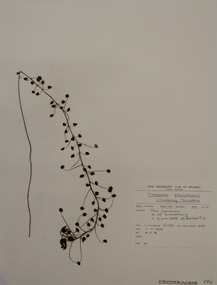
Plant specimen, Alexander Clifford Beauglehole, Drosera planchonii Hook.f. ex Planch, 1/11/1978
... Beauglehole Herbarium Herbarium specimen Botany Herbarium Plant Science Plant Specimen Field Naturalists' Club Ballarat Federation University Herbarium Drosera planchonii Climbing Sundew Droseraceae A mounted botanical specimen. ...Cliff Beauglehole was an orchardist at Portland, Victoria, who throughout hislife took an intense interest in the plants of Victoria. Over his lifetime he collected 90,000 plant specimens as part of a comprehensive study of Victoria's plants and wrote thirteen books under the heading The Distribution and Conservation of Vascular Plants in Victoria, each written to cover the 13 study areas of the Victorian and Conservation Council.A mounted botanical specimen.beauglehole herbarium, herbarium specimen, botany, herbarium, plant science, plant specimen, field naturalists' club ballarat, federation university herbarium, drosera planchonii, climbing sundew, droseraceae -
 University of Melbourne, Burnley Campus Archives
Photograph - Black and white and colour slides, colour negative, Kodachrome, Miscellaneous Horticulture, 1947-1985
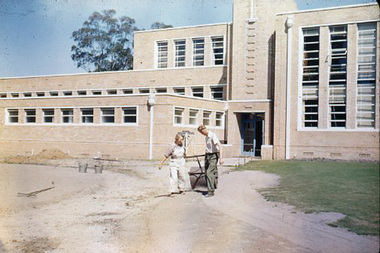
... administration building lawns flemington racecourse mustard-cover crop tree climbing grafting mildura soil probe pests machinery excursions tatura library wilsons promontory plants alnus zygocactus schlumbergia feijoa acca sellowiana protea neriifolia banksia isopogon anemonifolius 57 slides and 1 negative. (3) Men standing around a large horticultural machine. (4) "Lawns Housing Com" Aug "66?" ...57 slides and 1 negative. (3) Men standing around a large horticultural machine. (4) "Lawns Housing Com" Aug "66?" (5) "Flemington Racecourse." (6) "Mustard-Cover Crop. 1960." (7) Tree climbing. (8) "Grafting-scions. BHC." (11) "Mildura-Soil Probe Oct 67." (12) Virus tested stock trees & layout Flemings Apr 70." (13) "Best's Winery Mar 75." (15, 16) Best's single student and group. (17) "Ploughing-Diagram to show incomplete cover of trash? Farm Practices." (18) "Spraying Hand Equipment for Insect Control in and around Buildings USA Yearbook 1952." (19) "Pasture Harrows." (20) "Mould Board Plough-Tractor." (21) "Disc Harrows-Offset-Tractor." (22) Tyne Cultivator-for Tractor." (23) See B91.258." (24) Burnley College libary. (25) "Irrigation-Delver Tatura 12/59." (26) "Tatura 12/59 Delver Ferguson T." (27-29) "W. Prom." (30) Camp 1957 Wilson's Promontary." (34-36) Photographs of plants in book. (35) Alnus? (37) "Meterosideros excelsa." (38) "Rhipsalidopsis rosea." (39) "Protea neriifolia." (40) Banksias-Species." Insects: (41) "Lacewing larva." (42) "Mites Aug 75." (43) "Yellow Mite, Red Spider (Arachnida)." (44) "Jassid-Life Cycle 9/51." (45) "Grape Fruit Crop (Florida) Destroyed by Fruit Fly. Animals without backbones." (46) "Jassid-Vegetable 9/51." (47) "Field Day 57 (Fruit Fly-Enlarged)." (48) "Field Day 57 (Fruit Fly-Stages)." (49) Insect Life Cycle. (50) "Comatibility (sic) Chart." for Insecticides & Fungicides. (51) "Insecticides-Toxicity." (52) "Life Cycle of the Leather Jacket." (53) "Grasshopper-Head Dissected Mouth Parts." (54) "Types of Antennae." (55) "Spider Mites USA Yearbook 1952." (56) "Cultivator." (57) "Organic Phosphates." (58) Negative Isopogon anemonifolius.administration building, lawns, flemington racecourse, mustard-cover crop, tree climbing, grafting, mildura, soil probe, pests, machinery, excursions, tatura, library, wilsons promontory, plants, alnus, zygocactus, schlumbergia, feijoa, acca sellowiana, protea neriifolia, banksia, isopogon anemonifolius -
 City of Melbourne Libraries
Photograph, Bull, Hugh Jones, 1897-1993, Vice-regal visit to Zoo: Lord Huntingfield greets the King of the Beasts
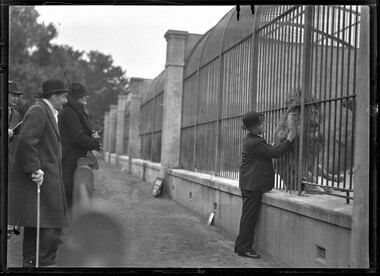
... climbing over the protecting rail for a little game.” A 1930 newsreel film shows Andrew stroking Roy’s mane through the bars and the blissed out big cat lying on his back while lifting his chin for a rub. Another newsreel film from the time shows Andrew stroking a lioness and playfully pulling her tail. The Victorian Acclimatisation Society was founded in 1861 by Edward Wilson, 1813-1878, then owner and editor of The Argus newspaper. He said that Australian indigenous animals were practically useless, providing only “a little sport and an occasional meal”. The Society believed that Australia’s plants...climbing over the protecting rail for a little game.” A 1930 newsreel film shows Andrew stroking Roy’s mane through the bars and the blissed out big cat lying on his back while lifting his chin for a rub. Another newsreel film from the time shows Andrew stroking a lioness and playfully pulling her tail. The Victorian Acclimatisation Society was founded in 1861 by Edward Wilson, 1813-1878, then owner and editor of The Argus newspaper. He said that Australian indigenous animals were practically useless, providing only “a little sport and an occasional meal”. The Society believed that Australia’s plants ...Photographer notations on slide: "Vice Regal visit to zoo B42" Published: The Age, Tuesday 26 June 1934, page 11. Published title: VICE-ROYALTY GREETS THE KING OF THE BEASTS AT THE ZOO. Published caption: “Lord Huntingfield experienced a pleasant “induction ceremony” as Patron of the Royal Zoological and Acclimatisation Society yesterday, when he made a tour of the Zoological Gardens. The picture shows the Governor, accompanied by Lady Huntingfield, inspecting the King of the Beasts, who is submitting to a little playful treatment from the Director of the Gardens, Mr. Wilkie, while the Director whispers in his ear that a distinguished visitor has come to see him.” Trove article identifier: http://nla.gov.au/nla.news-article204818472 Description: A man wearing a hat and suit strokes a caged lion, observed by a man in a hat, scarf and overcoat who is leaning on a walking stick, and a woman in a hat and coat, holding a handbag. They stand behind a protective rail. Research by project volunteer, Fiona Collyer: Andrew Arthur Wellesley Wilkie, 1853-1948, was Director of the Melbourne Zoo from 1923 to 1936 and was associated with the zoo for 70 years. He first worked as a horticultural assistant to Government botanist Baron Ferdinand von Mueller at the Botanical Gardens at the age of 13, along with his older brother David. One of Andrew’s jobs was to capture moths for the National Herbarium. In 1857, a group of prominent Melburnians assembled at St. Patrick’s Hall to form the Zoological Society of Victoria, with the aim of introducing animals and plants from overseas. It was conceived, “For the purposes of science and for that of affording the public the advantages of studying the habits of the animal creation in properly arranged zoological gardens.” The Victorian Government granted 32 acres (13 hectares) of land to the Zoological Society at the southern end of Richmond Paddock on the opposite bank to the Botanical Gardens. (This is where AAMI Stadium and Collingwood Football Club now stand.) In 1861, the Zoological Society of Victoria was renamed The Acclimatisation Society of Victoria. Unfortunately the Yarra River frontage was damp, swampy and subject to flooding, so the animals were briefly housed at the Botanical Gardens until in 1862, the City of Melbourne donated 55 acres (22 hectares) of land at Royal Park for the fledgling zoo. Baron von Mueller secured employment at Royal Park for Andrew and David and they helped to lay out the gardens, plant trees and take care of a collection of deer, pheasants, hares and partridges. Initially the zoo was used for the acclimatisation of animals recovering from the long voyage to Australia and for breeding them for sport. In 1872, the zoo bought two lions, a leopard and a cheetah that had been seized from circus showmen Keith and Phillips when they were unable to pay the bill of butcher Mr T K Bennet of Bourke Street. The first zoo director, Mr. Albert Le Souef, negotiated with captains of ships to buy animals at overseas ports they visited and soon a multitude of exotic species arrived, including a ten-year-old Indian elephant in 1878. In 1923, after being head keeper for some years, Andrew was appointed director of the zoo. By 1933, the zoo had 110 different species of animals, 200 species of birds and 72 species of reptiles under Andrew’s care. He had personally planted all but six trees and laid out the garden beds. As director he lobbied authorities for funds to build more humane enclosures for the animals. In June 1928, Table Talk magazine wrote of Andrew Wilkie: “Up at the Zoo there is a humble gentleman who is a lion among the lions, who knows the proper specific to employ when the boa constrictor has chilblains, and who is a friend and confidant of Queenie the elephant. His fount of zoological lore has never been plumbed. It is bottomless, like his good fellowship and geniality. Every day he may be seen somewhere in the grounds of that growing sanctuary for the strange and arresting fauna and creeping things of the world, and I assure you as one who is privy to his passion that that area and its inhabitants are rarely out of his thoughts.” Andrew retired from the zoo in 1936 at the age of 83 and in 1948 died at his home in Brunswick aged 94. He and his wife Josephine had six children. Roy, aged 28 in 1934, was a former Wirth’s circus lion who had been left at the zoo at 10 years of age. Andrew visited Roy every day on his rounds and the pair formed a close and affectionate bond. Wireless Weekly magazine in February 1933 reported, “Roy was delighted to see Mr Wilkie, and in a docile manner, approached the bars of his cage and had his head vigorously rubbed by the director, who daily carries out this act of kindness.” As reported in The Herald on 27 October 1936, “Mr Wilkie has also found the old lion docile. He has not shown the animal any particular favouritism, but the lion has shown him a faithfulness that none of the keepers can claim. When Mr Wilkie approaches the bars the lion rolls over and lets the director stroke him and pull his tail. He gets very excited if Mr Wilkie passes without climbing over the protecting rail for a little game.” A 1930 newsreel film shows Andrew stroking Roy’s mane through the bars and the blissed out big cat lying on his back while lifting his chin for a rub. Another newsreel film from the time shows Andrew stroking a lioness and playfully pulling her tail. The Victorian Acclimatisation Society was founded in 1861 by Edward Wilson, 1813-1878, then owner and editor of The Argus newspaper. He said that Australian indigenous animals were practically useless, providing only “a little sport and an occasional meal”. The Society believed that Australia’s plants and animals were vastly inferior to those in Europe. They wanted to introduce and acclimatise to Victoria “all innoxious animals, birds, fishes, insects and vegetables, whether useful or ornamental” for sport and for the table, and to spread indigenous animals and plants from the colony around the world. Their motto was “if it lives, we want it”. The Society was primarily responsible for introducing sparrows, starlings, sambar and hog deer, ostriches, brown trout, blackberries, and carp to the Murray River. They released the European songbirds, thrush and blackbird to quell the homesickness of British settlers. The Society also sent Australian animals like platypus, echidnas, kangaroos and koalas to Europe for scientific and novelty purposes. Thomas Austin, a wealthy sheep farmer of Barwon Park, Winchelsea (property now owned by the National Trust) was a member and in 1859 he introduced hares, blackbirds, thrushes and partridges onto his property. He is probably best known for introducing 24 breeding rabbits onto his estate as game for shooting parties. Thomas quipped, “The introduction of a few rabbits could do little harm and might provide a touch of home, in addition to a spot of hunting." In 2022, genomic data confirmed that Australia’s feral rabbit population is entirely descended from these rabbits. Biological control has brought the rabbit population down from an estimated high of 10 billion rabbits in the 1920s to approximately 200 million today, inhabiting 70% of Australian landmass (5.3 million square kilometres). In 1872, the Acclimatisation Society was renamed The Zoological and Acclimatisation Society of Victoria and they focused on importing exotic animals for display purposes to the zoo. In 1937, the Royal Acclimatisation Society of Victoria was recreated as the Zoological Board of Victoria with a focus on research of native animals threatened with extinction. In an editorial for The Argus newspaper, 16 March 1856, Edward Wilson lamented: "…this country has been shamelessly stolen from the blacks. Had they been like the New Zealanders or the North American Indians, we should have bought their land, and supplied them with the means of living when we took it... In less than twenty years we have nearly swept them off the face of the earth. We have shot them down like dogs. In the guise of friendship we have issued corrosion sublimate in their damper, and consigned whole tribes to the agonies of an excruciating death. We have made them drunkards, and infected them with disease which has rotted the bones of their adults, and made such few children as are born amongst them a sorrow and a torture from the very instant of their birth. We have made them outcasts on their own land, and are rapidly consigning them to entire annihilation. There are but a few of them left, comparatively. This is what we would do for that few. We would feed and clothe every one of them.” [Note: this last sentence is italicized in the original newspaper article text]. Lord Huntingfield, (William Charles Arcedeckne Vanneck) 1883-1969, Governor of Victoria 1934-1939, was a British Conservative Party politician and the first ever Australian-born Governor of an Australian state (although he was always considered British). He was patron of the Royal Zoological and Acclimatisation Society of Victoria and was acting Governor-General for six months during the absence of Lord Gowie in 1938. Lady Huntingfield (née Margaret Eleanor Crosby) 1884-1943, his American-born wife showed great interest in social welfare and the advancement of women and children. She was president of the City Newsboys Society and Patroness of the Girls Friendly Society. In 1937, rose breeder Alister Clark named a yellow hybrid tea rose for her. In 1940, the City of Melbourne opened the Lady Huntingfield Free Kindergarten in North Melbourne, now the Lady Huntingfield Early Learning and Family Services Centre. Lady Huntingfield died in London in 1943 after her house was bombed during a German airstrike. The Lady Huntingfield Memorial Scholarship was established after the City of Melbourne raised £1000 in a public appeal conducted in her memory for students undertaking a Social Work degree at the University of Melbourne. It is awarded annually to this day. The Queen Victoria Hospital named a bed in her honour. References: VICE-ROYALTY GREETS THE KING OF BEASTS AT THE ZOO. (1934, June 26). The Age (Melbourne, Vic. : 1854 - 1954), p. 11. Retrieved August 18, 2024, from http://nla.gov.au/nla.news-article204818472 Prominent Personalities ANDREW WILKIE (1928, June 7). Table Talk (Melbourne, Vic. : 1885 - 1939), p. 15. Retrieved August 29, 2024, from http://nla.gov.au/nla.news-article146562949 'Thomas Austin (pastoralist)', Wikipedia, https://en.wikipedia.org/wiki/Thomas_Austin_(pastoralist) 'Edward Wilson (journalist)', Wikipedia, https://en.wikipedia.org/wiki/Edward_Wilson_(journalist) THE WOMAN'S WORLD (1934, June 26). The Herald (Melbourne, Vic. : 1861 - 1954), p. 14. Retrieved August 19, 2024, from http://nla.gov.au/nla.news-article243164806 MR. WILKIE CAN PULL THE OLD LION'S TAIL (1936, October 27). The Herald (Melbourne, Vic. : 1861 - 1954), p. 4. Retrieved August 18, 2024, from http://nla.gov.au/nla.news-article248551307 Director Of Zoo Will Retire Tomorrow--With White Kitten (1936, December 30). The Herald (Melbourne, Vic. : 1861 - 1954), p. 8. Retrieved August 18, 2024, from http://nla.gov.au/nla.news-article244655203 LIGHT CAR CLUB IN CARICATURE (1931, August 25). The Sun News-Pictorial (Melbourne, Vic. : 1922 - 1954; 1956), p. 24. Retrieved August 19, 2024, from http://nla.gov.au/nla.news-article276250310 'The Acclimatisation Society was driven by misguided ideals about 'fixing nature' in Australia', ABC News, https://www.abc.net.au/news/2022-11-04/acclimatisation-society-introduced-species-history-listen/101588262?utm_source=abc_news_app&utm_medium=content_shared&utm_campaign=abc_news_app&utm_content=safari 'Dr Andrew Wilkie Director Of Melbourne Zoo, With Lion (1930) Video', Pond5 Inc., https://www.pond5.com/stock-footage/item/155691351-dr-andrew-wilkie-director-melbourne-zoo-lion-1930 'Kodak Cinegraph Compilation No 12', ACMI Collection, YouTube.com [Zoo footage at 8.33 minutes, Mr Wilkie at 11.04 minutes], https://www.youtube.com/watch?v=OZZqgSNsP0k THE ABORIGINES. (1856, March 16). The Argus (Melbourne, Vic. : 1848 - 1957), p. 4. Retrieved September 28, 2024, from http://nla.gov.au/nla.news-article4833244Photographer notations on slide: "Vice Regal visit to zoo B42".1930-1939, melbourne zoo, animals, hunting, wildlife, royal park, gardens
