
Showing 868 items matching "clothing buttons"
-
 Bendigo Historical Society Inc.
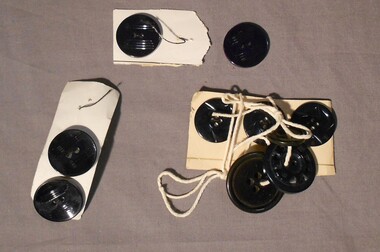
Clothing - MERLE BUSH COLLECTION: BUTTONS
... ...Clothing accessories...buttons...Clothing. Black buttons on cards and length of string. ...COSTUME ACCESSORIES Clothing accessories buttons Clothing. Black buttons on cards and length of string. ...Clothing. Black buttons on cards and length of string. All plastic. Ten buttons. Old box 573.costume accessories, clothing accessories, buttons -
 Flagstaff Hill Maritime Museum and Village
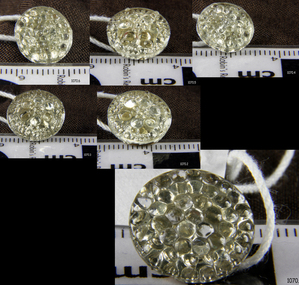
Clothing - Buttons
... ...clothing buttons...Clothing Buttons ...This set of decorative buttons is a replica of buttons that would decorate formal wear in the Victorian era.This set of buttons is representative of buttons work on garments int he Victorian era.Set of six round, clear, diamond-like buttons with gold coloured base and shanks. flagstaff hill, warrnambool, shipwrecked-coast, flagstaff-hill, flagstaff-hill-maritime-museum, maritime-museum, shipwreck-coast, flagstaff-hill-maritime-village, buttons, set of buttons, diamond look buttons, clothing buttons, accessories, fashion -
 City of Moorabbin Historical Society (Operating the Box Cottage Museum)
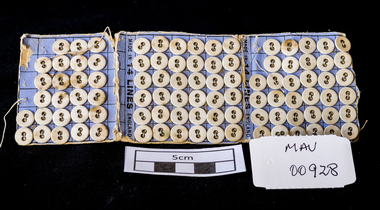
Manufactured Objects, card of buttons, c1900
... ...clothing...buttons...One of their advertising slogans was that they sold "anything from a needle to an anchor". horden anthony senior horden and son pty ltd sydney new south wales moorabbin department stores market gardeners pioneers dressmaking craftwork sewing needles clothing buttons on backing of card a picture of an 'Anchor and Rope , Needle and Thread' / FROM A NEEDLE / TO AN ANCHOR / TRADE MARK / MADE IN ENGLAND. ...Anthony Hordern sen. (1788–1869) came from Staffordshire, as a free immigrant in 1823, and the business was originally established as a drapery store in Pitt Street by his wife Ann. The family moved to Melbourne and remained there but a son Anthony junior purchased land in George Street Sydney in 1842 and set up business with his brother Lebbeus. They broke their partnership in1855 and Anthony took his sons Anthony and Samuel into partnership as they became old enough. Anthony Hordern & Sons was the largest department store in Sydney, New South Wales, Australia. with 52 acres (21 hectares) of retail space, and was once the largest department store in the world . It also operated one of the largest mail order businesses in Australia. One of their advertising slogans was that they sold "anything from a needle to an anchor". A strip of blue cardboard with 95 small, white 2 hole buttons . The cardboard folds into 3 for easy storage with each section holding 36 buttons. 7 buttons are missing - used. The buttons are sewn onto the card with a running thread that is covered by backing paper.on backing of card a picture of an 'Anchor and Rope , Needle and Thread' / FROM A NEEDLE / TO AN ANCHOR / TRADE MARK / MADE IN ENGLAND. inside ' MADE IN 14 LINES ENGLAND 'horden anthony senior, horden and son pty ltd, sydney, new south wales, moorabbin, department stores, market gardeners, pioneers, dressmaking, craftwork, sewing needles, clothing, buttons -
 Kew Historical Society Inc
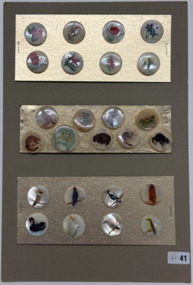
25 buttons on gold card on green card, 1996-1999
... 25 buttons on gold card on green card. Clothing buttons, or to be admired. Made by an individual named 'Heather' in Mt. ...Having made contact and eventually providing Heather with the sets of Mother of pearl buttons, she sent me a set each year in turn, of the flower, bird and animal emblems of each Australian State and Territory." 25 buttons on gold card on green card. Clothing buttons, or to be admired. Made by an individual named 'Heather' in Mt. ...Sally Hearn (1932–2018) was a dedicated button collector and a prominent member of the Victoria Button Collectors Club. Her button collection was featured as a primary display in the 'The Melbourne Story' exhibition at the Melbourne Museum, which opened in mid-2008.The Hearn Collection of locally made and international buttons is historically and aesthetically significant as it illustrates the textile and manufacturing history of button making.25 buttons on gold card on green card. Clothing buttons, or to be admired. Made by an individual named 'Heather' in Mt. Compass (South Australia), through 1996-1999.Original Catalogue Entry: "En route to Victor Harbour we passed through Naracoorte S.A. where a lady in the Op Shop was sporting a lovely hand painted brooch. I asked her where she got it. She said her daughter had made it for her. I asked for her daughter’s details only to discover she lived where we were heading. Having made contact and eventually providing Heather with the sets of Mother of pearl buttons, she sent me a set each year in turn, of the flower, bird and animal emblems of each Australian State and Territory."sally hearn, button collections -
 Moorabbin Air Museum
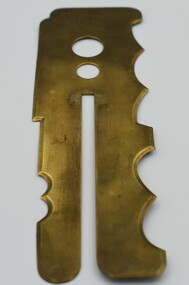
Clothing (item) - Brass Button Polishing Stick, Owned By B.D.Frary
... For protecting clothing when polishing buttons....For protecting clothing when polishing buttons. Brass Button Polishing Stick, Owned By B.D.Frary. ...J.R G&S, marked with a British crow foot for war department. -
 Ballarat Tramway Museum
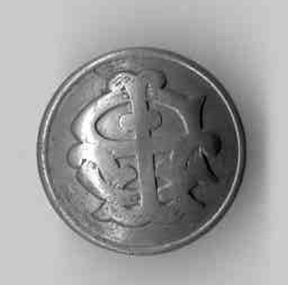
Uniform - Coat Button/s, Buttons Ltd. Birmingham and England
... One worn TB uniform clothing buttons donated by a former Ballarat Tram driver. ...Tram trams MMTB Melbourne Tramways Uniforms Buttons One worn TB uniform clothing buttons donated by a former Ballarat Tram driver. ...One worn TB uniform clothing buttons donated by a former Ballarat Tram driver. Button about 23 diameter, with TB crest, with backing piece and lug for sewing on rear. Nickel plated silver? Badge has been worn on a jacket as in poor condition compared to new. Has name of manufacturer stamped on rear part - "Buttons Ltd" of Birmingham, England with their trade mark, a pair of fully opened scissors. See tm1762i2 for image. Donor of items 1259, 1260 and uniform jackets.tram, trams, mmtb, melbourne tramways, uniforms, buttons -
 Linton and District Historical Society Inc
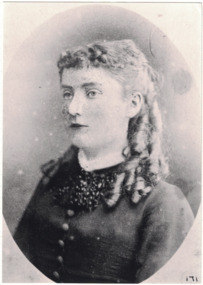
Photograph, Annie O'Meara
... Black and white copy of original photograph showing the head and shoulders of a lady wearing dark clothing with buttons down the bodice, possibly dark beads hanging on neckline, white upright collar. ...Black and white copy of original photograph showing the head and shoulders of a lady wearing dark clothing with buttons down the bodice, possibly dark beads hanging on neckline, white upright collar. ...Annie O'Meara, born 30 Jan 1867, married Francis William O'Beirne on 16 June 1897 at Linton. Annie was a daughter of John O'Meara and Maria O'Meara (nee O'Brien).Black and white copy of original photograph showing the head and shoulders of a lady wearing dark clothing with buttons down the bodice, possibly dark beads hanging on neckline, white upright collar. Light coloured hair in ringlets."Annie O'Meara later Mrs F. O'Beirne".annie o'meara -
 Ballarat Tramway Museum
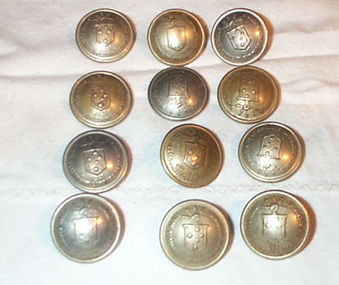
Uniform - Coat Button/s, Stokes & Sons and Melbourne
... Set of twelve SEC uniform clothing buttons from a former Ballarat Tram driver. ...Tram trams SECV Ballarat Tramways Uniforms Buttons Set of twelve SEC uniform clothing buttons from a former Ballarat Tram driver. ...Demonstrates the manufacture of uniform items and their use in uniforms for tramway crews in Ballarat and a larger set and a strong association with a SEC tramway employee.Set of twelve SEC uniform clothing buttons from a former Ballarat Tram driver. Each about 24 diameter, with SEC crest, 1921 and organisation name embossed onto outer surface, with backing piece and lug for sewing on rear. Nickel plated silver? Badges in varying condition of new to worn. Each has name of manufacturer stamped on rear part - "Stokes & Sons Melbourne". Donor of items 1259, 1260 and uniform jackets. Six further buttons added 5/7/2017 from donation of Wendy Hunt.tram, trams, secv, ballarat tramways, uniforms, buttons -
 Ballarat Tramway Museum
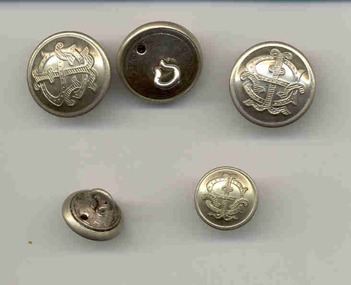
Uniform - Coat Button/s, Stokes & Sons Melbourne
... Set of 17 large and 7 small TB uniform clothing buttons. Large Button about 23 diameter, with TB crest, with backing piece and lug for sewing on rear. ...Tram trams MMTB Melbourne Tramways Uniforms Buttons Set of 17 large and 7 small TB uniform clothing buttons. Large Button about 23 diameter, with TB crest, with backing piece and lug for sewing on rear. ...Set of 17 large and 7 small TB uniform clothing buttons. Large Button about 23 diameter, with TB crest, with backing piece and lug for sewing on rear. Nickel plated silver? Most have two holes in the rear as well. All but one made by Stokes and Sons, Victoria. One large button made by K. G. Luke A/Asia. Small button, approx. 16 diameter, as above, with or without holes in the rear. One button by K. G. Luke A/Asia, four by Stokes and Sons, Victoria and the other two difficult to determine due to dirt etc. Donated by Peter Winspur, from his surplus collection - Nov. 2006 tram, trams, mmtb, melbourne tramways, uniforms, buttons -
 Ballarat Tramway Museum
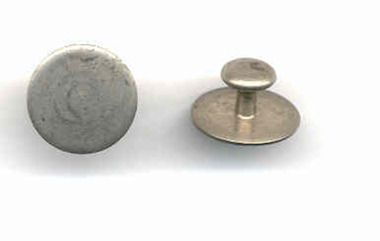
Uniform - Shirt Button/s
... Set of six uniform clothing or shirt buttons or studs. Made from stainless steel, buttons have a flat face, about 14mm wide, with a rounded stud on the rear about 7mm diameter. ...Trams tramways SECV Ballarat Tramways Uniforms Buttons Set of six uniform clothing or shirt buttons or studs. ...Set of six uniform clothing or shirt buttons or studs. Made from stainless steel, buttons have a flat face, about 14mm wide, with a rounded stud on the rear about 7mm diameter. The stud has an overall depth of about 8mm. No details of manufacturer, use etc. known. Assumed belong to Les Denmead.trams, tramways, secv, ballarat tramways, uniforms, buttons -
 Warrnambool and District Historical Society Inc.
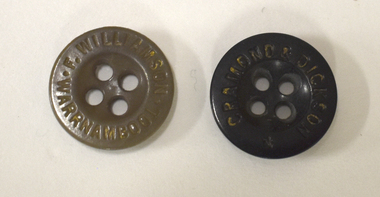
Functional object - Two Tailors' Buttons
... These two buttons are tailors' buttons for clothing made in Warrnambool. The brown one is from the firm of Frederick Williamson who had a tailoring business at 157-159 Liebig Street, Warrnambool. ...These two buttons are tailors' buttons for clothing made in Warrnambool. The brown one is from the firm of Frederick Williamson who had a tailoring business at 157-159 Liebig Street, Warrnambool. ...These two buttons are tailors' buttons for clothing made in Warrnambool. The brown one is from the firm of Frederick Williamson who had a tailoring business at 157-159 Liebig Street, Warrnambool. His father Edward had started the tailoring business with a shop in Timor Street in the second half of the 19th century. Frederick Williamson was a Warrnambool City Councillor on three occasions (1924-1930; 1934-1939; 1942 -1945) and Mayor 1942-1943. The black button came from the Liebig Street, Warrnambool clothing and haberdashery store of Cramond and Dickson who employed tailors and dressmakers to make clothing to order. John Cramond and James Dickson opened their Warrnambool store in 1855 and it was a dominant business in Warrnambool for 119 years, closing in 1974. It was common practice in the first half of the 20th century for tailors and large clothing stores to have their own buttons for their suits etc.These two buttons are of some interest as examples of buttons made specifically for two local Warrnambool businesses. .1 Round button, light-brown in colour with four holes in the centre, a curved back and imprinted letters around the edge. .2 Round black button with four holes in the centre, a curved back and imprinted letters around the edge..1 F. Williamson Warrnambool 2. Cramond & Dicksonfrederick williamson warrnambool tailor, cramond & dickson warrnambool -
 Flagstaff Hill Maritime Museum and Village
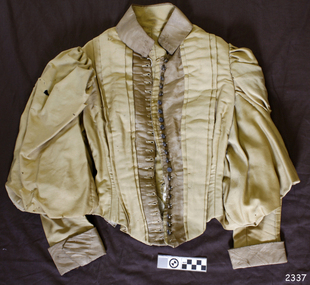
Clothing - Bodice, 1900's
... This practice was used from the 18th century through to the Edwardian era. flagstaff hill warrnambool Bodice ladies clothes whalebone stays baleen stays women's clothing corsetry corset boning female adult hand sewn The bodice is made of gold cotton over the whalebone stays at the waistline. It is trimmed in brown fabric and has twenty-two buttons down the front from top to bottom. ...This bodice is stiffened by what is commonly referred to as natural whalebone, but is actually baleen, which was in use from the 18th century through to the Edwardian era. It was hand sewn in Warrnambool in the 1900's.The bodice is significant for demonstrating the use of historical whalebone, or technically baleen, for its stays. This practice was used from the 18th century through to the Edwardian era.The bodice is made of gold cotton over the whalebone stays at the waistline. It is trimmed in brown fabric and has twenty-two buttons down the front from top to bottom. The sleeves are Leg-o'-mutton style. The bodice has pin tucks down the front. It was hand sewn in Warrnambool in 1900's.flagstaff hill, warrnambool, bodice, ladies clothes, whalebone stays, baleen stays, women's clothing, corsetry, corset boning, female adult, hand sewn -
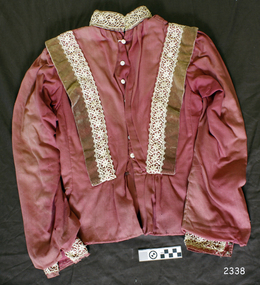 Flagstaff Hill Maritime Museum and Village
Clothing - Bodice
... buttons down the front and pintucks across the top back of the bodice. The sleeve cuffs have a lace border and are closed using hooks and eyes. The bodice is lined, with the lining visibly stitched to the back of the bodice at waist level. The bottom of the bodice is designed as a peplum. Clothing ...Historically the bodice is representative of a style from the early 1900s.As a hand sewn item it is significant to demonstrate the craftsmanship and textiles used in that time period.Deep pink bodice with velvet and lace at collar. Velvet ribbon and lace border on bodice edge next to sleeves, the edging goes from the front of the bodice and over to the back. Seven white mother-of-pearl buttons down the front and pintucks across the top back of the bodice. The sleeve cuffs have a lace border and are closed using hooks and eyes. The bodice is lined, with the lining visibly stitched to the back of the bodice at waist level. The bottom of the bodice is designed as a peplum.flagstaff hill, warrnambool, shipwrecked-coast, flagstaff-hill, flagstaff-hill-maritime-museum, maritime-museum, shipwreck-coast, flagstaff-hill-maritime-village, bodice, ladies bodice, hand sewn, edwardian -
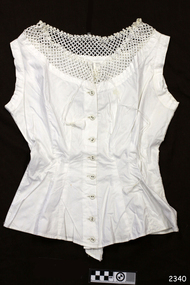 Flagstaff Hill Maritime Museum and Village
Clothing - Camisole
... flagstaff hill warrnambool shipwrecked-coast flagstaff-hill flagstaff-hill-maritime-museum maritime-museum shipwreck-coast flagstaff-hill-maritime-village Camisole lace tatted border Camisole, white lace tatted border including cord at collar, eight buttons down front. Clothing Camisole ...Camisole, white lace tatted border including cord at collar, eight buttons down front.flagstaff hill, warrnambool, shipwrecked-coast, flagstaff-hill, flagstaff-hill-maritime-museum, maritime-museum, shipwreck-coast, flagstaff-hill-maritime-village, camisole, lace tatted border -
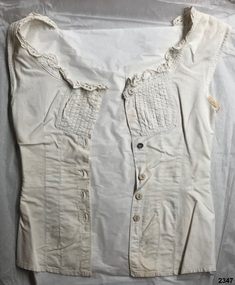 Flagstaff Hill Maritime Museum and Village
Clothing - Camisole
... Great Ocean Road Flagstaff Hill Maritime Museum & Village Flagstaff Hill Warrnambool Maritime Village Maritime Museum Shipwreck coast camisole pin tucks turn of the century ladies camisole Cream cotton camisole, broderie anglaise lace around neck, fine pin tucks on either side of front and four mismatched buttons. Clothing Camisole ...This cream cotton camisole reflects a style of women's undergarments common to the turn of the century. It was possibly made by the owner and repair work is suggested by the mismatched buttons.This item is significant historically and socially as an example of women's undergarments at the turn of the century.Cream cotton camisole, broderie anglaise lace around neck, fine pin tucks on either side of front and four mismatched buttons.great ocean road, flagstaff hill maritime museum & village, flagstaff hill, warrnambool, maritime village, maritime museum, shipwreck coast, camisole, pin tucks, turn of the century, ladies camisole -
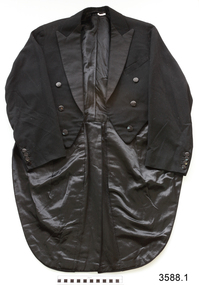 Flagstaff Hill Maritime Museum and Village
Formal suit, 1925
... clothing mira hospital nhill base hospital Jacket has label label "BRAHAM & CO / 614 ALDERSGATE ST E.C / Mr G Hobson, 1925 Aug Trousers nametag "J.C. RENYARD" stamped number on front right pocket lining "163332-2-3398F" Shirt has stamp around neck label "THE AINSLY SHIRT", name in pen "R115 RENYARD Formal suit, worn by Dr Angus, Coat (.1): black double-breasted with tails, black round flat, shank buttons, quilting inside (under armholes), label "BRAHAM & CO / 614 ALDERSGATE ST E.C / Mr G Hobson, 1925 Aug". ...This formal suit, comprising tails coat, trousers, waistcoat and shirt, is believed by Berry McDade (daughter of Dr Angus) to be the one donated to Flagstaff Hill Maritime Village by the family of Doctor William Roy Angus, Surgeon and Oculist, according to the doner.. There is another name on some of the garments, possibly because the suit components were acquired second hand at the time when Dr Angus was in his early practice days. It is part of the “W.R. Angus Collection” that includes historical medical equipment, surgical instruments and material once belonging to Dr Edward Ryan and Dr Thomas Francis Ryan, (both of Nhill, Victoria) as well as Dr Angus’ own belongings. The Collection’s history spans the medical practices of the two Doctors Ryan, from 1885-1926 plus that of Dr Angus, up until 1969. ABOUT THE “W.R.ANGUS COLLECTION” Doctor William Roy Angus M.B., B.S., Adel., 1923, F.R.C.S. Edin.,1928 (also known as Dr Roy Angus) was born in Murrumbeena, Victoria in 1901 and lived until 1970. He qualified as a doctor in 1923 at University of Adelaide, was Resident Medical Officer at the Royal Adelaide Hospital in 1924 and for a period was house surgeon to Sir (then Mr.) Henry Simpson Newland. Dr Angus was briefly an Assistant to Dr Riddell of Kapunda, then commenced private practice at Curramulka, Yorke Peninsula, SA, where he was physician, surgeon and chemist. In 1926, he was appointed as new Medical Assistant to Dr Thomas Francis Ryan (T.F. Ryan, or Tom), in Nhill, Victoria, where his experiences included radiology and pharmacy. In 1927 he was Acting House Surgeon in Dr Tom Ryan’s absence. Dr Angus had become engaged to Gladys Forsyth and they decided he would take time to further his studies overseas in the UK in 1927. He studied at London University College Hospital and at Edinburgh Royal Infirmary and in 1928, was awarded FRCS (Fellow from the Royal College of Surgeons), Edinburgh. He worked his passage back to Australia as a Ship’s Surgeon on the on the Australian Commonwealth Line’s SS Largs Bay. Dr Angus married Gladys in 1929, in Ballarat. (They went on to have one son (Graham 1932, born in SA) and two daughters (Helen (died 12/07/1996) and Berenice (Berry), both born at Mira, Nhill ) Dr Angus was a ‘flying doctor’ for the A.I.M. (Australian Inland Ministry) Aerial Medical Service in 1928 . The organisation began in South Australia through the Presbyterian Church in that year, with its first station being in the remote town of Oodnadatta, where Dr Angus was stationed. He was locum tenens there on North-South Railway at 21 Mile Camp. He took up this ‘flying doctor’ position in response to a call from Dr John Flynn; the organisation was later known as the Flying Doctor Service, then the Royal Flying Doctor Service. A lot of his work during this time involved dental surgery also. Between 1928-1932 he was surgeon at the Curramulka Hospital, Yorke Peninsula, South Australia. In 1933 Dr Angus returned to Nhill where he’d previously worked as Medical Assistant and purchased a share of the Nelson Street practice and Mira hospital from Dr Les Middleton one of the Middleton Brothers, the current owners of what was once Dr Tom Ryan’s practice. Dr L Middleton was House Surgeon to the Nhill Hospital 1926-1933, when he resigned. [Dr Tom Ryan’s practice had originally belonged to his older brother Dr Edward Ryan, who came to Nhill in 1885. Dr Edward saw patients at his rooms, firstly in Victoria Street and in 1886 in Nelson Street, until 1901. The Nelson Street practice also had a 2 bed ward, called Mira Private Hospital ). Dr Edward Ryan was House Surgeon at the Nhill Hospital 1884-1902 . He also had occasions where he successfully performed veterinary surgery for the local farmers too. Dr Tom Ryan then purchased the practice from his brother in 1901. Both Dr Edward and Dr Tom Ryan work as surgeons included eye surgery. Dr Tom Ryan performed many of his operations in the Mira private hospital on his premises. He too was House Surgeon at the Nhill Hospital 1902-1926. Dr Tom Ryan had one of the only two pieces of radiology equipment in Victoria during his practicing years – The Royal Melbourne Hospital had the other one. Over the years Dr Tom Ryan gradually set up what was effectively a training school for country general-practitioner-surgeons. Each patient was carefully examined, including using the X-ray machine, and any surgery was discussed and planned with Dr Ryan’s assistants several days in advance. Dr Angus gained experience in using the X-ray machine there during his time as assistant to Dr Ryan. Dr Tom Ryan moved from Nhill in 1926. He became a Fellow of the Royal Australasian College of Surgeons in 1927, soon after its formation, a rare accolade for a doctor outside any of the major cities. He remained a bachelor and died suddenly on 7th Dec 1955, aged 91, at his home in Ararat. Scholarships and prizes are still awarded to medical students in the honour of Dr T.F. Ryan and his father, Dr Michael Ryan, and brother, John Patrick Ryan. ] When Dr Angus bought into the Nelson Street premises in Nhill he was also appointed as the Nhill Hospital’s Honorary House Surgeon 1933-1938. His practitioner’s plate from his Nhill surgery states “HOURS Daily, except Tuesdays, Fridays and Saturday afternoons, 9-10am, 2-4pm, 7-8pm. Sundays by appointment”. This plate is now mounted on the doorway to the Port Medical Office at Flagstaff Hill Maritime Village, Warrnambool. Dr Edward Ryan and Dr Tom Ryan had an extensive collection of historical medical equipment and materials spanning 1884-1926 and when Dr Angus took up practice in their old premises he obtained this collection, a large part of which is now on display at the Port Medical Office at Flagstaff Hill Maritime Village in Warrnambool. During his time in Nhill Dr Angus was involved in the merging of the Mira Hospital and Nhill Public Hospital into one public hospital and the property titles passed on to Nhill Hospital in 1939. In 1939 Dr Angus and his family moved to Warrnambool where he purchased “Birchwood,” the 1852 home and medical practice of Dr John Hunter Henderson, at 214 Koroit Street. (This property was sold in1965 to the State Government and is now the site of the Warrnambool Police Station. ). The Angus family was able to afford gardeners, cooks and maids; their home was a popular place for visiting dignitaries to stay whilst visiting Warrnambool. Dr Angus had his own silk worm farm at home in a Mulberry tree. His young daughter used his centrifuge for spinning the silk. Dr Angus was appointed on a part-time basis as Port Medical Officer (Health Officer) in Warrnambool and held this position until the 1940’s when the government no longer required the service of a Port Medical Officer in Warrnambool; he was thus Warrnambool’s last serving Port Medical Officer. (The duties of a Port Medical Officer were outlined by the Colonial Secretary on 21st June, 1839 under the terms of the Quarantine Act. Masters of immigrant ships arriving in port reported incidents of diseases, illness and death and the Port Medical Officer made a decision on whether the ship required Quarantine and for how long, in this way preventing contagious illness from spreading from new immigrants to the residents already in the colony.) Dr Angus was a member of the Australian Medical Association, for 35 years and surgeon at the Warrnambool Base Hospital 1939-1942, He served as a Surgeon Captain during WWII1942-45, in Ballarat, Victoria, and in Bonegilla, N.S.W., completing his service just before the end of the war due to suffering from a heart attack. During his convalescence he carved an intricate and ‘most artistic’ chess set from the material that dentures were made from. He then studied ophthalmology at the Royal Melbourne Eye and Ear Hospital and created cosmetically superior artificial eyes by pioneering using the intrascleral cartilage. Angus received accolades from the Ophthalmological Society of Australasia for this work. He returned to Warrnambool to commence practice as an ophthalmologist, pioneering in artificial eye improvements. He was Honorary Consultant Ophthalmologist to Warrnambool Base Hospital for 31 years. He made monthly visits to Portland as a visiting surgeon, to perform eye surgery. He represented the Victorian South-West subdivision of the Australian Medical Association as its secretary between 1949 and 1956 and as chairman from 1956 to 1958. In 1968 Dr Angus was elected member of Spain’s Barraquer Institute of Barcelona after his research work in Intrasclearal cartilage grafting, becoming one of the few Australian ophthalmologists to receive this honour, and in the following year presented his final paper on Living Intrasclearal Cartilage Implants at the Inaugural Meeting of the Australian College of Ophthalmologists in Melbourne In his personal life Dr Angus was a Presbyterian and treated Sunday as a Sabbath, a day of rest. He would visit 3 or 4 country patients on a Sunday, taking his children along ‘for the ride’ and to visit with him. Sunday evenings he would play the pianola and sing Scottish songs to his family. One of Dr Angus’ patients was Margaret MacKenzie, author of a book on local shipwrecks that she’d seen as an eye witness from the late 1880’s in Peterborough, Victoria. In the early 1950’s Dr Angus, painted a picture of a shipwreck for the cover jacket of Margaret’s book, Shipwrecks and More Shipwrecks. She was blind in later life and her daughter wrote the actual book for her. Dr Angus and his wife Gladys were very involved in Warrnambool’s society with a strong interest in civic affairs. Their interests included organisations such as Red Cross, Rostrum, Warrnambool and District Historical Society (founding members), Wine and Food Society, Steering Committee for Tertiary Education in Warrnambool, Local National Trust, Good Neighbour Council, Housing Commission Advisory Board, United Services Institute, Legion of Ex-Servicemen, Olympic Pool Committee, Food for Britain Organisation, Warrnambool Hospital, Anti-Cancer Council, Boys’ Club, Charitable Council, National Fitness Council and Air Raid Precautions Group. He was also a member of the Steam Preservation Society and derived much pleasure from a steam traction engine on his farm. He had an interest in people and the community He and his wife Gladys were both involved in the creation of Flagstaff Hill, including the layout of the gardens. After his death (28th March 1970) his family requested his practitioner’s plate, medical instruments and some personal belongings be displayed in the Port Medical Office surgery at Flagstaff Hill Maritime Village, and be called the “W. R. Angus Collection”. The W.R. Angus Collection is significant for still being located at the site it is connected with, Doctor Angus being the last Port Medical Officer in Warrnambool. The collection of medical instruments and other equipment is culturally significant, being an historical example of medicine from late 19th to mid-20th century. Dr Angus assisted Dr Tom Ryan, a pioneer in the use of X-rays and in ocular surgery. Formal suit, worn by Dr Angus, Coat (.1): black double-breasted with tails, black round flat, shank buttons, quilting inside (under armholes), label "BRAHAM & CO / 614 ALDERSGATE ST E.C / Mr G Hobson, 1925 Aug". Trousers (.2): black, button fly, black braid stripe, nametag "J.C. RENYARD" stamped number on front right pocket lining "163332-2-3398F" Waistcoat (.3): black, 4x 4-holed black buttons. Shirt (.4); white cotton, long sleeves, round neck, long tailed, bib front, 4x button holes each side, stamp around neck "4.AM:25", label "THE AINSLY SHIRT", name in pen "R115 RENYARD", remnants of red cotton stitching on neck (W.R. Angus Collection)Jacket has label label "BRAHAM & CO / 614 ALDERSGATE ST E.C / Mr G Hobson, 1925 Aug Trousers nametag "J.C. RENYARD" stamped number on front right pocket lining "163332-2-3398F" Shirt has stamp around neck label "THE AINSLY SHIRT", name in pen "R115 RENYARDflagstaff hill, warrnambool, shipwrecked-coast, flagstaff-hill, flagstaff-hill-maritime-museum, maritime-museum, shipwreck-coast, flagstaff-hill-maritime-village, formal sout, tails suit, dr w r angus, the ailsley shirt, ophthalmology, formal clothing, mira hospital, nhill base hospital -
 Upper Yarra Museum
Clothing Accessory
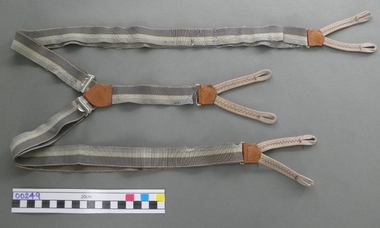
... TODAY http://www.fabsugar.co.uk/Love-Hate-Trousers-Braces-1585776 Androgynous fashion nearly always appears on the catwalk and trousers with braces made an appearance this season at Paul Smith... trousers braces straps Grey Elastic braces forming a y shape at the back, with leather tabs to hold clips and braided loops to attach to buttons on trousers. Clothing Accessory ...Braces - straps worn over shoulders for holding up trousers http://en.wikipedia.org/wiki/Suspenders Suspenders (Am. English) or braces (British English) are fabric or leather straps worn over the shoulders to hold up trousers. Straps may be elasticated, either entirely or only at attachment ends and most straps are of woven cloth forming an X or Y shape at the back. Braces are typically attached to trousers with buttons using leather tabs at the ends or, incorrectly according to traditional protocol, clips.. HISTORY the modern type were first invented in 1822 by Albert Thurston and were once almost universally worn due to the high cut of mid-nineteenth and early twentieth century trousers, a cut that made a belt impractical. After losing popularity in the first World War, as men became accustomed to uniform belts, suspenders were still standard throughout the 1920s. TODAY http://www.fabsugar.co.uk/Love-Hate-Trousers-Braces-1585776 Androgynous fashion nearly always appears on the catwalk and trousers with braces made an appearance this season at Paul Smith...Grey Elastic braces forming a y shape at the back, with leather tabs to hold clips and braided loops to attach to buttons on trousers. trousers, braces, straps -
 Nhill Aviation Heritage Centre
Summer flying suit, boots, leather helmut and goggles
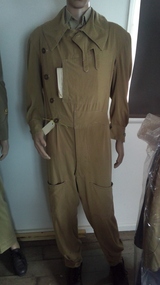
... This clothing was worn by Merv while flying as navigator in B24 bombers from northern Australia in 1945 Cotton khaki colour overall style flying suit with four large buttons and map pouch. ...This clothing was worn by Merv while flying as navigator in B24 bombers from northern Australia in 1945Cotton khaki colour overall style flying suit with four large buttons and map pouch. Black leather flying boots with lamb skin lining and leather strap and buckle at top. Leather flying helmet and goggles. -
 Lara RSL Sub Branch
Uniform, Commonwealth Government Clothing Company, Sergeant Black dress jacket Army, 1969
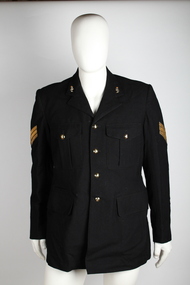
... buttons on front of Jacket. Sergeant Black dress jacket Army Uniform Uniform Commonwealth Government Clothing Company. ...Jacket made in 1969 for use by Australian army personal.Black Dress Jacket with sergeant stripes on the sleeves.Has a signal corps badge on each lapel.Also six brass buttons on front of Jacket. -
 Lara RSL Sub Branch
Sergeant's dress uniform trousers, Commonwealth Government Clothing Company, Army Sergeant's dress uniform trousers, 1969
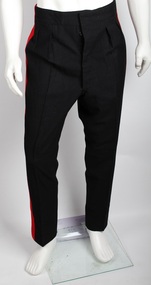
... buttons on waist for braces. Army Sergeant's dress uniform trousers. Sergeant's dress uniform trousers. Commonwealth Government Clothing Company. ...Made for use by Australian army personal.Sergeants black uniform trousers with a 45mm red stripe on both legs.Has buttons on waist for braces.Labels inside for name and number and manufacturing details. -
 Lara RSL Sub Branch
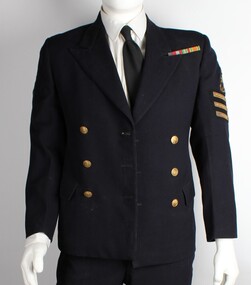
Jacket, Australian Governmentb Clothing Factory, Petty Officer Naval Jacket, 1979
... buttons and a rank bar on the left breast. Chevrons and insignia on the left arm. Petty Officer Naval Jacket Jacket Australian Governmentb Clothing Factory ...Worn by Robert Lawson Promoted to Petty Officer Engineering (MTP) 1979This uniform was worn by Bob Lawson. Bob is a member of Lara RSL, and this uniform is representative of his service in the Royal Australian Navy.Dark blue jacket with brass buttons and a rank bar on the left breast. Chevrons and insignia on the left arm.lara, rsl, military, war, australia, navy -
 Lara RSL Sub Branch
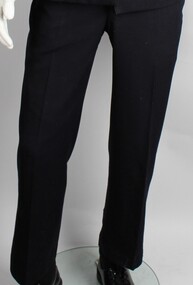
Trousers, Australian Governmentb Clothing Factory, Petty Officer Naval Trousers, 1979
... buttons. Has a large tear in the seat. Petty Officer Naval Trousers Trousers Australian Governmentb Clothing Factory ...Worn by Robert Lawson Promoted to Petty Officer Engineering (MTP) 1979This uniform was worn by Bob Lawson. Bob is a member of Lara RSL, and this uniform is representative of his service in the Royal Australian Navy.Dark blue trousers with brass buttons. Has a large tear in the seat.lara, rsl, military, war, australia, navy -
 Shepparton RSL Sub Branch
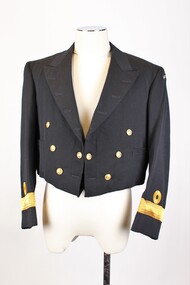
Uniform, Jacket, 8th. July 1971
... Clothing Factory. R.A.N. Which is. Royal Australian navy. Made in australia. Gold Circular Rosette 4.5cm dia. Width of Gold Laceing. 4.5cm. Two Jacket buttons...Clothing Factory. R.A.N. Which is. Royal Australian navy. Made in australia. Gold Circular Rosette 4.5cm dia. Width of Gold Laceing. 4.5cm. Two Jacket buttons ...Peace Time (1971) Navy CommodoreBlack Wool. Royal Australian Navy. Commodore Mess Jacket. Gold Lace Rank to both Lower Sleeves. Gold Buttons (8). Gold Thread Australia to both shoulders. Two Fob Pockets to Front. Black cotton lining. Pocket to left hand inside Australia to both shoulders. Inside left of jacket J.N.Crosthwaite. (John Nevil) C.G.C.F. Which is Commonwealth Clothing Factory. R.A.N. Which is. Royal Australian navy. Made in australia. Gold Circular Rosette 4.5cm dia. Width of Gold Laceing. 4.5cm. Two Jacket buttons Link with metal link. Black cotton lining in side. Lable to Collar C.G.C.F.uniform, royal australian navy, commodore -
 Shepparton RSL Sub Branch
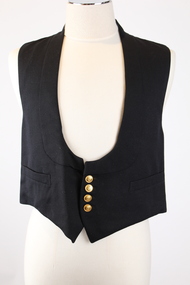
Uniform, Waist Coat, Commodore, 8th. July 1971
... Buttons. Two small pockets to front. Black cotton rear to waist coat. Adjustable strap to rear with metal Buckle. Clothing...Buttons. Two small pockets to front. Black cotton rear to waist coat. Adjustable strap to rear with metal Buckle. Clothing ...Post WW2 Navy CommodoreBlack Material Waist Coat. Satin inner lining. Four Gold Buttons. Two small pockets to front. Black cotton rear to waist coat. Adjustable strap to rear with metal Buckle. Clothing manufactures lable to left hand inside. Coller. C.G.C.F. And Made in Australia. And R.A.N.Manufactures Lables.uniform royal australian navy -
 Shepparton RSL Sub Branch
Uniform, Cape, C. 1950s
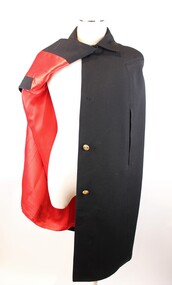
... Clothing Factory”. Interior sewn in label reads “33643/Kilfoyle/Cloak F Bara/[indiscernible characters]”. Buttons...buttons which suggest this cape was issued post 1952 during the reign of Queen Elizabeth II). It is possible, though not confirmed, that this cape was worn by Norma Kilfoyle in a later role after the Second World War. cape second world war world war two world war ii navy royal australian navy ran women telegraph communications Handwritten inscription reads “KILFOYLE”. Manufacturer’s label reads “[Australian coat of arms]/A Quality Garment/BY/Australian Government Clothing ...This cape may have belonged to RAN Telegraphist Norma Ashton Kilfoyle, however the date of her service is not consistent with the style of the article (which has buttons which suggest this cape was issued post 1952 during the reign of Queen Elizabeth II). It is possible, though not confirmed, that this cape was worn by Norma Kilfoyle in a later role after the Second World War.Black thigh-length nurses cape with red satin lining. Fastened along centre with four gold buttons and one press stud at chin (second button from the top is missing). Two slits at waist height on both left and right allow arms through from the interior to the front. Embroidered manufacturer’s label on interior at base of neck, below which there is an ink inscription. Sewn in fabric swatch on interior right.Handwritten inscription reads “KILFOYLE”. Manufacturer’s label reads “[Australian coat of arms]/A Quality Garment/BY/Australian Government Clothing Factory”. Interior sewn in label reads “33643/Kilfoyle/Cloak F Bara/[indiscernible characters]”. Buttons read “[Queen Elizabeth crown over the Navy anchor]/AUSTRALIA” and on interior “STOKES/MELB”cape, second world war, world war two, world war ii, navy, royal australian navy, ran, women, telegraph, communications -
 Flagstaff Hill Maritime Museum and Village
Clothing - Jacket, before April 1874
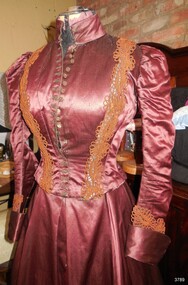
... buttons. The jacket lining has vertical metal stays spaced around the midriff, sides and back. There is an absorbent, removable pad hand-stitched to the underarm section of each sleeve opening. A small satin pocket is stitched discreetly onto the lining above the chest on the right-hand side. There are also two cotton loops sewn onto the lining. Several small metal rings are sewn at intervals around the inside of the waist A satin bow from the same fabric is attached at the centre back of the jacket at waist level. Clothing ...THE JACKET This jacket has been tailored to flatter the wearer’s figure. It also has elements that keep it in good shape and condition, preserve it from soiling and give it a longer life: - the hooks and eyes that join the jacket to the skirt allow the outfit to be made in two pieces but fit close to the body without exposing undergarments - the seams for the metal stays have been cut and stitched to allow maximum movement of the wearer and still keep a trim figure - the discreet breast pocket allows the wearer to keep a handkerchief, coins or other small items close at hand - the lining includes removable padded shields to absorb underarm perspiration - the lining has two cotton loops attached for hanging up to air and freshen it - new cuffs have been attached over the original sleeves that have buttonholes but no buttons. The buttons may have been used to replace missing buttons on the front of the jacket or perhaps to repair worn cuffs The amber coloured satin jacket is fully lined, has turned-back cuffs, a band collar, and looped, coffee-coloured braid trim. A row of closely spaced, round bronze buttons with a floral motif form a decorative closure most of the way down the front of the jacket, below which are metal hooks and eyes that finish at the waist. Underneath the cuffs there is a closely fitted cuff with a row of three button holes but no buttons. The jacket lining has vertical metal stays spaced around the midriff, sides and back. There is an absorbent, removable pad hand-stitched to the underarm section of each sleeve opening. A small satin pocket is stitched discreetly onto the lining above the chest on the right-hand side. There are also two cotton loops sewn onto the lining. Several small metal rings are sewn at intervals around the inside of the waist A satin bow from the same fabric is attached at the centre back of the jacket at waist level. antique satin jacket, colonial evening jacket, ladies evening jacket, 19th century ladies satin jacket, evening outfit -
 Flagstaff Hill Maritime Museum and Village
Clothing - Combination Undergarment, late 19th or early 20th century
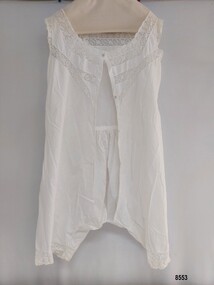
... Flagstaff Hill Maritime Museum and Village Great Ocean Road combinations lady's combinations undergarment lingerie handsewn underwear clothing Victorian era undergarments lady's garment Susan Henry OAM Vedmore Foundation Lady’s white lawn and lace all-In-one combination undergarment. The handmade underwear is a combined chemise and bloomers. It has four buttons ...This item of underclothing, called a "combination" is one of several linen and clothing items belonging to the deceased estate of Susan Henry OAM (nee Vedmore 1944 - 2021) that was donated to Flagstaff Hill Maritime Museum and Village. Susan's family (Harold and Gladys Vedmore) immigrated to Australia from Wales in 1955 and settled in Warrnambool. Susan was well known in the Warrnambool community for her work supporting children and families across the district - particular those with disabilities, or those who were homeless, unemployed or isolated. Susan was the founding trustee of the "Vedmore Foundation" - a Warrnambool philanthropic trust set up in 2010 to support a range of charitable and not-for-profit causes by providing grant assistance. In 2021, she was awarded a Medal of the Order of Australia for services to the community. Combination undergarments combined the chemise and drawers into one garment. The combination is divided, or bifurcated, from the waist to the crotch for easier urinating. This one-piece type of underwear was worn by females from the 1860s and into the early 1900s. The 19th Century garments had front button closures like this one, and those made in the 1900s more often had back closures. Combination underwear was popular because the all-in-one design had far fewer gathers and bulk, making the other clothing look much smoother. Their primary use was to protect clothing from perspiration and because they were made with cotton or linen, were easy to wash. This particular item is made with lawn (a very lightweight fabric) and is sleeveless, making it suitable for hot weather. Although they were worn under the corset next to the skin (and therefore not meant to be seen), they were often decorated with lace or embroidery. This item is an example of the needlework skills of women in the late 19th century - using machine stitching and lace to personalise and embellish a practical item of clothing. It is also significant as an example of a practical solution to the difficulties that women of this era faced with regard to the washing of clothes and household linens.Lady’s white lawn and lace all-In-one combination undergarment. The handmade underwear is a combined chemise and bloomers. It has four buttons in the front and is trimmed with lace on the neckline, armholes, bodice (in a diagonal design) and legs. The left and right sides are divided from the waist to the crutch. The back of the garment is plain with a gathered section at the lower back.flagstaff hill maritime museum and village, great ocean road, combinations, lady's combinations, undergarment, lingerie, handsewn, underwear, clothing, victorian era undergarments, lady's garment, susan henry oam, vedmore foundation -
 Flagstaff Hill Maritime Museum and Village
Clothing - Petticoat, late 19th century to early 20th century
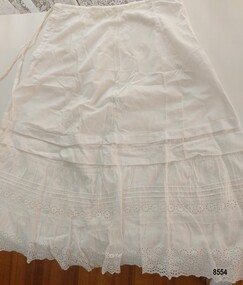
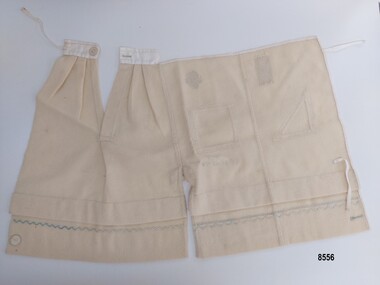
... clothing. It is also significant as an example of a practical solution to the difficulties that women of this era faced with regard to the washing of clothes and household linens. Flagstaff Hill Maritime Museum and Village Great Ocean Road petticoat lady's petticoat undergarment lady's undergarment lingerie Edwardian petticoat broderie anglaise lace machine made lace hand sewn machine sewn draper's shop Susan Henry OAM Vedmore Foundation A white lawn petticoat with a 22.5 cm opening that fastens with 2 small buttons and a drawstring tie. ...This petticoat was one of several items donated from the estate of Susan Henry OAM nee Vedmore (1944 - 2021). It is in very good condition and appears to be from the Edwardian era - early 20th century. A petticoat is a lady's undergarment - worn under a skirt or dress. They provided warmth, modesty and shape to the dress. In the middle of the 19th century, petticoats were worn over hoops, bustles or in layers. Petticoats varied according to the style of the outside skirt or dress. Plain petticoats tended to be worn with everyday wear whilst better dresses (party dresses or silk gowns) were worn with petticoats that often had more trim and embellishments. Edwardian petticoats had less volume than Victorian era petticoats and they had a "dust ruffle" or lining under a lace flounce. The "dust ruffle" protected the lace flounce and gave the petticoat more flare at the bottom, greater freedom when walking as well as saving the flounce (which was often made of finer material) from everyday wear and tear. Tucks are another feature of Edwardian petticoats - when the lace at the bottom became worn, it could be cut off and the tucks released. This extended the life of the petticoat. This petticoat features an intricate trim of broderie anglaise. Although broderie anglaise was a lace that could be made by hand, it was very time consuming to make. St Gallen was a city in Switzerland that had become known for producing quality textiles. At the beginning of the 19th century, the first embroidery machines were developed in St Gallen. Factories used embroidery machines but people also had them in their homes. They were able to produce broderie anglaise for export. By the early 20th century, machine made lace, fabric, ribbons etc. were being sold in drapers shops all over England and Wales to women who were making clothes and furnishings for their families. It is highly likely that the lady who made this petticoat brought the lengths of broderie anglaise already made to embellish and personalise her petticoat. Susan's family (Harold and Gladys Vedmore) immigrated to Australia from Wales in 1955 and settled in Warrnambool. Susan was well known in the Warrnambool community for her work supporting children and families across the district - particular those with disabilities, or those who were homeless, unemployed or isolated. Susan was the founding trustee of the "Vedmore Foundation" - a Warrnambool philanthropic trust set up in 2010 to support a range of charitable and not-for-profit causes by providing grant assistance. In 2021, she was awarded a Medal of the Order of Australia for services to the community.This item is an example of the needlework skills of women in the late 19th century - creating pintucks and adding lace to personalise and embellish a practical item of clothing. It is also significant as an example of a practical solution to the difficulties that women of this era faced with regard to the washing of clothes and household linens.A white lawn petticoat with a 22.5 cm opening that fastens with 2 small buttons and a drawstring tie. It is decorated with two wide pintucks followed by two gathered frills (or flounces) - one decorated with three rows of narrow pintucks and a single row of broderie anglaise and the bottom frilled hem finished with 3 rows of broderie anglaise in a flower design. The two bottom frills are lined with plain white cotton fabric.flagstaff hill maritime museum and village, great ocean road, petticoat, lady's petticoat, undergarment, lady's undergarment, lingerie, edwardian petticoat, broderie anglaise, lace, machine made lace, hand sewn, machine sewn, draper's shop, susan henry oam, vedmore foundation -
 Flagstaff Hill Maritime Museum and Village
Textile - Plain Sewing Sampler, 1897
... clothing for their families. Flagstaff Hill Maritime Museum and Village Great Ocean Road Warrnambool sewing plain sewing sewing sampler plain sewing sampler darning sampler hand sewing textiles Susan Henry OAM Vedmore Foundation sewing techniques L.L. / ?? Yr 1897 A cream flannel sampler made from three smaller rectangular shapes, displaying a wide variety of plain sewing techniques including hand stitched seams (french, bound and herringboned), darned patches, inserted patches, pleats, buttonholes, buttons, a gusset, pintucks, a placket, cross stitch initials and date (L L and 1897) and decorative embroidery. ...A "Plain Sewing Sampler" or "Darning Sampler" was intended to showcase the wide range of sewing techniques and skills a girl or woman had. These skills might include hand sewing techniques such as darning, patching, hemming, mending, structural sewing (making pleats, inserting gussets, joining fabric with seams) making buttonholes and embroidery. Samplers could also be intended for practicing a particular technique. There were several articles printed in Australian newspapers around 1889 referring to the "Plain Sewing Movement". In 1889 a Melbourne branch of the "London Institute for the Advancement of Plain Needlework" was formed by a group of ladies led by Lady Loch and Lady Clarke with the purpose of teaching "plain needlework' to women and girls. "Plain Sewing" included fundamental stitches and techniques that were essential for practical clothing construction and maintenance. Several years later in 1891, another meeting was held at Clivedon (the residence of Lady Clarke) to look into the possibility of improving the teaching of sewing in the state schools. This meeting was attended by several school inspectors and the committee of "the Melbourne Institute for the Advancement of Plain Needlework". This "Plain Sewing Sampler" was donated from the estate of Susan Henry nee Vedmore (1944 - 2021). Susan's family (Harold and Gladys Vedmore) immigrated to Australia from Wales in 1955 and settled in Warrnambool. Susan was well known in the Warrnambool community for her work supporting children and families across the district - particular those with disabilities, or those who were homeless, unemployed or isolated. Susan was the founding trustee of the "Vedmore Foundation" - a Warrnambool philanthropic trust set up to support a range of charitable and not-for-profit causes by providing grant assistance. In 2021, she was awarded a Medal of the Order of Australia for services to the community. It has not been possible to identify the lady (with the initials L. L.) who made this item in 1897 but it was thought to possibly be a female relation in her maternal (or possibly, paternal) grandmother's family. It has many of the same elements and techniques that were taught by the "Plain Sewing Movement" that originated in England at the end of the nineteenth century.This item is a rare example of the handcraft skills needed by women and girls in the late 1890's to construct and maintain practical clothing for their families.A cream flannel sampler made from three smaller rectangular shapes, displaying a wide variety of plain sewing techniques including hand stitched seams (french, bound and herringboned), darned patches, inserted patches, pleats, buttonholes, buttons, a gusset, pintucks, a placket, cross stitch initials and date (L L and 1897) and decorative embroidery.L.L. / ?? Yr 1897flagstaff hill maritime museum and village, great ocean road, warrnambool, sewing, plain sewing, sewing sampler, plain sewing sampler, darning sampler, hand sewing, textiles, susan henry oam, vedmore foundation, sewing techniques -
 Flagstaff Hill Maritime Museum and Village
Footwear - Leather boots, Adler Boots and Shoes, circa 1920
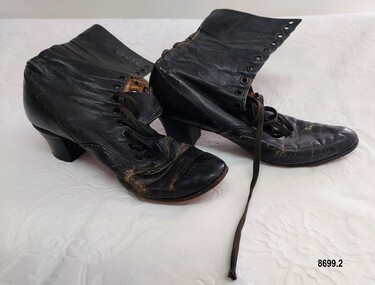
... clothing collection) after Lila died in 1977. Starting in around 1850, women began wearing boots that resembled the ones already worn by men in high society. Victorian women's boots were slightly more feminine in nature, however, than those worn by their male counterparts. The boots first worn by women extended to the middle of the calf so that her ankle would stay properly covered underneath her many skirts. These boots often featured laces or a row of buttons...clothing collection) after Lila died in 1977. Starting in around 1850, women began wearing boots that resembled the ones already worn by men in high society. Victorian women's boots were slightly more feminine in nature, however, than those worn by their male counterparts. The boots first worn by women extended to the middle of the calf so that her ankle would stay properly covered underneath her many skirts. These boots often featured laces or a row of buttons ...This item is one of a collection of clothing items that belonged to the Stephenson family who lived at 22 McCracken Street, Kensington, Melbourne. Matthew Stephenson (1861 – 1943) who had grown up on the Bendigo goldfields and shifted to Melbourne in the early 1900’s was a train driver and later, a fireman with the railways. His wife Elizabeth Jane (Betsy) Wigley (1865 – 1953) also grew up on the goldfields around Majorca and Bendigo. They married in 1885 in Bendigo. They had two daughters – Ethel Evelyn Stephenson (1886 – 1956) and Lillian or Lila (1891 – 1977) who were milliners and dressmakers and who continued to live in the family home after the death of their parents. The family are recorded as living at 22 McCracken Street, Kensington, as early as 1914. It is not known who made or owned the clothing that makes up this collection but as it appears to be from the late Victorian and early Edwardian era, the different pieces were probably made and worn by any of the three ladies of the house – Betsy, Ethel and/or Lila. During W.W.2, a local Warrnambool couple (Meryl and Tony Everard) boarded with them – Tony was in the airforce training paratroopers to jump into (and survive) enemy territory and his wife Meryl worked in the Methodist baby Home. The Everards developed a close friendship with the Stephensons and were responsible for clearing out the house (and finding this clothing collection) after Lila died in 1977. Starting in around 1850, women began wearing boots that resembled the ones already worn by men in high society. Victorian women's boots were slightly more feminine in nature, however, than those worn by their male counterparts. The boots first worn by women extended to the middle of the calf so that her ankle would stay properly covered underneath her many skirts. These boots often featured laces or a row of buttons to keep them secure to the foot and ankle. Although usually made from durable materials like rubber and leather, boots that were worn purely for fashion were sometimes made of more elegant materials like patent leather or dyed suede. Edwardian boots were lace up or button up. The most remarkable thing about women's shoes in the 1920's was that they were visible! This led to an increase in demand for new styles every season which made ordering custom fit shoes a thing of the past. New shoes were made in standard sizes, ready to buy from local clothing stores or mail order catalogues. Working women, however, tended to wear sensible, lace up shoes and boots. These boots appear to be of a practical nature, designed for comfort, warmth, and proof against the rain and mud, rather than high fashion. They feature the brand name "adler" printed on the inner sole and have stamped letters and numbers suggesting ready-made sizes.This pair of boots are a significant example of a working woman's footwear dating around the early 20th century.Pair of lady's black leather, lace up boots featuring 3.75 cm heels, 14 pairs of lacing eyelets, a black leather tongue and black shoelaces. The leather soles have tacks on the heels and near the instep. The boots have a black leather inner sole and the inner shaft and upper part of the boots are lined with a durable cotton type fabric. Both boots have ink markings (handwritten and stamped) at the top of the shaft lining and the inner sole of the left hand boot is labelled "adler".Both boots - "0/128 /X" (handwritten) and "6MC200" (stamped). Left boot inner sole - "adler" left boot upper shaft lining - "X/8FH?" (handwritten)flagstaff hill maritime museum and village, great ocean road, shipwreck coast, warrnambool, boots, lady's boots, footwear, leather boots, lace up boots, adler, stephenson family
