
Showing 45 items matching "clothing repairs"
-
 Flagstaff Hill Maritime Museum and Village
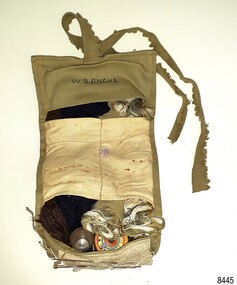
Equipment - Sewing Kit, 1939-1945
... ...clothing repairs...Angus Collection Australian Army Surgeon Captain Ballarat Bonegilla World War 2 Second World War Australian Defence Forces Army Medical Corps Australian Army Medical Corp (Militia) WW 2 ww II AAMC sewing kit sewing roll housewife clothing repairs Military Equipment Army issue "W.R. ...This sewing kit was issued to W.R. Angus during his Military Service in WWII. It is sometimes referred to as a soldier's ‘housewife’ and includes items necessary for mending and adjusting a soldier’s clothing and other fabric items. Earlier Army issue sewing kits were made of leather but were subject to deterioration due to holding moisture if they became wet. The sewing kit is now part of Flagstaff Hill’s comprehensive W.R. Angus Collection, donated by the family of Dr W R Angus (1901-1970), surgeon and oculist. Dr W R Angus was a Surgeon Captain for the Australian Defence Forces, Army Medical Corps, stationed in Ballarat, Victoria, and in Bonegilla, N.S.W. He completed his service just before the end of the war due to suffering from a heart attack. The W.R. Angus Collection: - The W.R. Angus Collection includes historical medical equipment, surgical instruments and material belonging to Dr Edward Ryan and Dr Thomas Francis Ryan, (both of Nhill, Victoria) and Dr Angus’ own belongings. The Collection’s history spans the medical practices of the two Doctors Ryan, from 1885-1926 plus that of Dr Angus, up until 1969. It includes historical medical and surgical equipment and instruments from the doctors Edward and Thomas Ryan of Nhill, Victoria. Dr Angus married Gladys in 1927 at Ballarat, the nearest big city to Nhill where he began as a Medical Assistant. He was also Acting House surgeon at the Nhill hospital where their two daughters were born. During World War II He served as a Military Doctor in the Australian Defence Forces. Dr Angus and his family moved to Warrnambool in 1939, where Dr Angus operated his own medical practice. He later added the part-time Port Medical Officer responsibility and was the last person appointed to that position. Both Dr Angus and his wife were very involved in the local community, including the planning stages of the new Flagstaff Hill and the layout of the gardens there. Dr Angus passed away in March 1970.This item is significant in Australia's War History and its connection with local history. It aids in understanding life in the military and the changes to normal life. Dr W R Angus (1901-1970), surgeon and oculist, collected a range of military objects including those he personally used during his time as Surgeon Captain in the Australian Defence Forces in World War II. The W.R. Angus Collection is significant for still being located at the site it is connected with, Doctor Angus being the last Port Medical Officer in Warrnambool. The Collection includes historical medical objects that date back to the late 1800s.Australian Army sewing kit, WWII era. A rectangular khaki cotton fabric pouch with pockets containing sewing needles, threads of various colours, a thimble and a reel of cotton. The pouch rolls up and is secured with its own ties. It has a handwritten inscription. The cloth patches belonged to Dr W R Angus and are now part of the W. R. Angus Collection."W.R. ANGUS"flagstaff hill, warrnambool, maritime village, maritime museum, shipwreck coast, great ocean road, flagstaff hill maritime museum and village, dr w r angus, w.r. angus collection, australian army, surgeon captain, ballarat, bonegilla, world war 2, second world war, australian defence forces, army medical corps, australian army medical corp (militia), ww 2, ww ii, aamc, sewing kit, sewing roll, housewife, clothing repairs, military equipment, army issue -
 Greensborough Historical Society
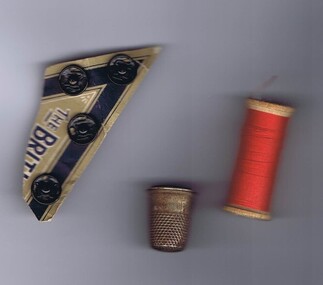
Sewing accessories, Sewing Kit, 1950s
... Probably used in making or repairing clothing...Probably used in making or repairing clothing Portion of card with 4 black 1 cm press studs; cotton reel 3.9 x 1.5 cm with orange thread; metal thimble 2 x 1.5 cm Sewing Kit Sewing accessories ...Probably used in making or repairing clothingPortion of card with 4 black 1 cm press studs; cotton reel 3.9 x 1.5 cm with orange thread; metal thimble 2 x 1.5 cm -
 City of Moorabbin Historical Society (Operating the Box Cottage Museum)
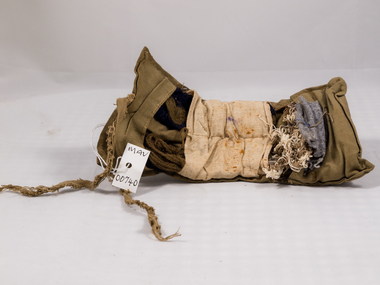
WW11 1939-1945 Australian Army Soldiers Sewing Kit, c1939
... Containing the standard requirements for uniform/clothing repair in the field. Items include:- assorted sewing needles,spare metal (quad hole) buttons and spare cotton/wool thread. ...Containing the standard requirements for uniform/clothing repair in the field. Items include:- assorted sewing needles,spare metal (quad hole) buttons and spare cotton/wool thread. ...1939 - 1945 Australian Army Sewing Kit. This kit is just one of many different brands of sewing kit - issued to Australian troops during the Second World War. Containing the standard requirements for uniform/clothing repair in the field. Items include:- assorted sewing needles,spare metal (quad hole) buttons and spare cotton/wool thread. Originally the "hold-all" (or pouch) was manufactured using leather, which was in plentiful supply in Australia and is quite durable. The major problem with leather however, especially in tropical or damp conditions - is it's susceptibility to moisture. This will then have an adverse affect upon the metal items contained within the kit, obviously resulting in corrosion to the metal sewing needles and buttons. This sewing kit hold-alls was manufactured from a khaki cotton or similar material. The metal thimble is missing.Standard issue sewing kit for Australian Soldiers serving in WW2 1939-45 in New Guinea and tropical areasA rectangular khaki cotton pouch containing wool and cotton threads, needles, metal buttons, folding stainless steel scissors that rolls up and is tied by two cotton bands.world war 11 1939-1945, cotton, khaki, soldier field kit, sewing kit, new guinea, army supply department, australian army, moorabbin, bentleigh, cheltenham, -
 Orbost & District Historical Society
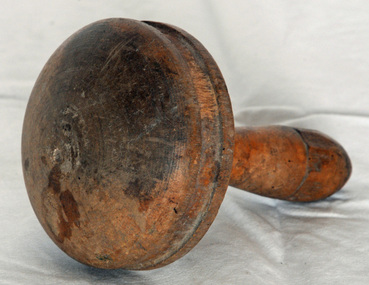
darning mushroom, 1950's
... The mushroom was used to make repairs to clothing and bed linen....The mushroom was used to make repairs to clothing and bed linen. This darning tool was an essential item in 19th and early 20th century household as self-reliant women often had to make and repair all their clothing. darning-mushroom needlework handicraft domestic A mushroom-shaped piece of smooth wood used to stretch and support material being darned. darning mushroom ...The darning mushroom would have been an essential tool in an era when women were constantly repairing worn socks.Before the common use of synthetic materials, socks and other items of clothing were in constant need of repair. Darning would have been considered a necessary skill for girls and young women, part of their education as future wives and mothers. The mushroom was used to make repairs to clothing and bed linen.This darning tool was an essential item in 19th and early 20th century household as self-reliant women often had to make and repair all their clothing.A mushroom-shaped piece of smooth wood used to stretch and support material being darned.darning-mushroom needlework handicraft domestic -
 Flagstaff Hill Maritime Museum and Village
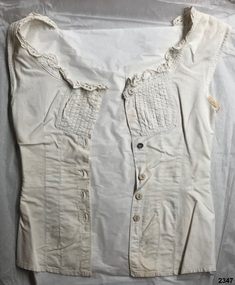
Clothing - Camisole
... repair work is suggested by the mismatched buttons. This item is significant historically and socially as an example of women's undergarments at the turn of the century. Great Ocean Road Flagstaff Hill Maritime Museum & Village Flagstaff Hill Warrnambool Maritime Village Maritime Museum Shipwreck coast camisole pin tucks turn of the century ladies camisole Cream cotton camisole, broderie anglaise lace around neck, fine pin tucks on either side of front and four mismatched buttons. Clothing ...This cream cotton camisole reflects a style of women's undergarments common to the turn of the century. It was possibly made by the owner and repair work is suggested by the mismatched buttons.This item is significant historically and socially as an example of women's undergarments at the turn of the century.Cream cotton camisole, broderie anglaise lace around neck, fine pin tucks on either side of front and four mismatched buttons.great ocean road, flagstaff hill maritime museum & village, flagstaff hill, warrnambool, maritime village, maritime museum, shipwreck coast, camisole, pin tucks, turn of the century, ladies camisole -
 Flagstaff Hill Maritime Museum and Village
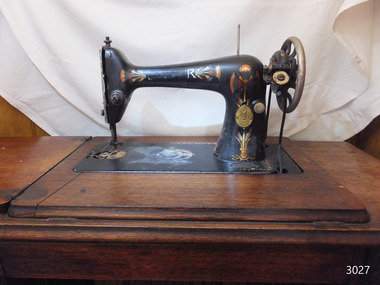
Domestic object - Sewing Machine, Singer Sewing Machine Company, 1922
... It changed the domestic life of many women as more households began to own sewing machines, women as the ones who traditionally stayed home to do chores including making and repairing clothing, found themselves with more free time. ...In 1867 the Singer Company decided that the demand for their sewing machines in the UK was sufficiently high to open a local factory. Glasgow was selected for its iron-making industries, cheap labour, and possibly because at the time the General Manager of the US Singer Sewing Machine Company was George McKenzie, who was of Scottish descent. The company obtained a lease on land near Queen Street Station and machinery and machine parts were shipped over from the US. Demand for sewing machines outstripped production at the new plant and by 1873 a new larger factory was completed near Bridgeton Cross. By now Singer employed over 2,000 people in Scotland but still, they could not produce enough machines. In 1882 George McKenzie, the soon to become President of the Singer Sewing Machine Company undertook the ground breaking ceremony on 46 acres of farmland at Kilbowie, Clydebank and the largest Singer factory in the world started to be built. Originally two main buildings were constructed. Built above the middle wing of the factory was a huge clock tower with the 'Singer' name displayed for all to see from miles around. Many miles of railway lines were laid throughout the factory to connect the different departments and to aid in the shipping of their goods. Railway lines from the factory connected Glasgow, Dumbarton, and Helensburgh stations. The factory was regarded as the most modern facility in Europe at that time. As different departments in the factory were completed, the workers moved from the old sites to the new one at Kilbowie and the factory was finally finished in 1885. With nearly a million square feet of space and almost 7,000 employees producing on average 13,000 machines a week, making it the largest sewing machine factory in the world. The Clydebank factory was so productive that in 1905 the US Singer Company set up the Singer Manufacturing Company Ltd. as a UK registered company. The invention of the sewing machine had several very significant impacts on the lives of many people. It changed the domestic life of many women as more households began to own sewing machines, women as the ones who traditionally stayed home to do chores including making and repairing clothing, found themselves with more free time. Previously several days a week would be dedicated to sewing clothing for herself and her family, a housewife could now complete her sewing in merely several hours, allowing for more free time to pursue hobbies and attain new skills. Sewing and clothing production, in general, became more industrialized activities, taking place less in the home and more in large factories. Industrial sewing machines, in combination with the cotton gin, the spinning jenny, and the steam engine, made clothing production much easier and much cheaper. Sewing machine, treadle operated, "Branded Premier" 5-7-9-2-0-0-" Serial Number Y6243048 (denotes 1922 year of manufacture) flagstaff hill, warrnambool, shipwrecked-coast, flagstaff-hill-maritime-museum, maritime-museum, shipwreck-coast, flagstaff-hill-maritime-village, sewing machine, hand operated, dressmaking, textile machinery, portable, premier sewing machine, premier, singer treadle sewing machine -
 Flagstaff Hill Maritime Museum and Village
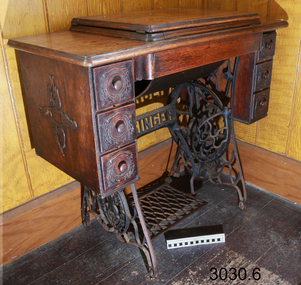
Domestic object - Sewing Machine, Singer Sewing Machine Company, 1907 -1920 (see note section this document for further information regards model identification)
... It changed the domestic life of many women as more households began to own sewing machines, women as the ones who traditionally stayed home to do chores including making and repairing clothing, found themselves with more free time. ...In 1867 the Singer Company decided that the demand for their sewing machines in the UK was sufficiently high to open a local factory. Glasgow was selected for its iron-making industries, cheap labour, and possibly because at the time the General Manager of the US Singer Sewing Machine Company was George McKenzie, who was of Scottish descent. The company obtained a lease on land near Queen Street Station and machinery and machine parts were shipped over from the US. Demand for sewing machines outstripped production at the new plant and by 1873 a new larger factory was completed near Bridgeton Cross. By now Singer employed over 2,000 people in Scotland but still, they could not produce enough machines. In 1882 George McKenzie, the soon to become President of the Singer Sewing Machine Company undertook the ground breaking ceremony on 46 acres of farmland at Kilbowie, Clydebank and the largest Singer factory in the world started to be built. Originally two main buildings were constructed. Built above the middle wing of the factory was a huge clock tower with the 'Singer' name displayed for all to see from miles around. Many miles of railway lines were laid throughout the factory to connect the different departments and to aid in the shipping of their goods. Railway lines from the factory connected Glasgow, Dumbarton, and Helensburgh stations. The factory was regarded as the most modern facility in Europe at that time. As different departments in the factory were completed, the workers moved from the old sites to the new one at Kilbowie and the factory was finally finished in 1885. With nearly a million square feet of space and almost 7,000 employees producing on average 13,000 machines a week, making it the largest sewing machine factory in the world. The Clydebank factory was so productive that in 1905 the US Singer Company set up the Singer Manufacturing Company Ltd. as a UK registered company. The invention of the sewing machine had several very significant impacts on the lives of many people. It changed the domestic life of many women as more households began to own sewing machines, women as the ones who traditionally stayed home to do chores including making and repairing clothing, found themselves with more free time. Previously several days a week would be dedicated to sewing clothing for herself and her family, a housewife could now complete her sewing in merely several hours, allowing for more free time to pursue hobbies and attain new skills. Sewing and clothing production, in general, became more industrialized activities, taking place less in the home and more in large factories. Industrial sewing machines, in combination with the cotton gin, the spinning jenny, and the steam engine, made clothing production much easier and much cheaper. Singer sewing machine treadle type wooden stand with six drawers plus instruction manual Lotus decoration to machinewarrnambool, shipwrecked-coast, flagstaff-hill, flagstaff-hill-maritime-museum, shipwreck-coast, flagstaff-hill-maritime-village, sewing-machine, clothes repair, singer sewing machine -
 Flagstaff Hill Maritime Museum and Village
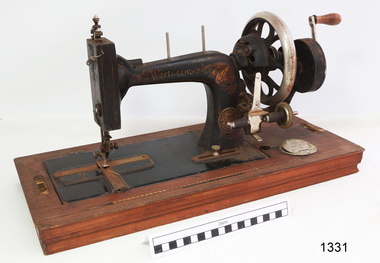
Domestic object - Sewing Machine, 1903
... A sewing machine was a necessary part of each home and this item demonstrates how women of the time managed had to become self-reliant in the repair and making of their families clothes to make their household budgets go further. flagstaff hill warrnambool shipwrecked-coast flagstaff-hill flagstaff-hill-maritime-museum maritime-museum shipwreck-coast flagstaff-hill-maritime-village sewing machine hand operated sewing machine crank handle sewing machine wertheim dressmaking taylor domestic clothing hugo wertheim Joseph Wertheim Wertheim brass trademark badge riveted to the body of the machine of a crouching dwarf with a hammer with the name of the company Wertheim and Frankfurt. ...Hugo Wertheim (1854-1919), was a merchant and manufacturer and was born on the 12th July 1854 at Lispenhausen, in the German electorate of Hesse-Kassel, son of Meyer Wertheim and his wife Minna, née Heinemann. Hugo reached Melbourne in October 1875. He soon began advertising, from premises at 39 Flinders Lane East, as agent for his father's cousin Joseph Wertheim, a well-established manufacturer of sewing machines. Hugo returned to Germany where he married Joseph Wertheim's daughter Sophie Emilie (1864-1953) on 30 August 1885 at Frankfurt. the couple then came to Melbourne. In a short time, with extensive advertising, Hugo established a substantial business, selling sewing machines, bicycles, pianos and other mechanical devices, under brands such as Wertheim, Electra, Planet, Griffin and Hapsburg. He also mounted elaborate displays at agricultural shows and in 1901 at the Pan American Exposition, Buffalo, United States of America. O. C. Beale worked with him before setting up his own piano business in New South Wales. Hugo continued to own 25 per cent of one of Beale's companies, which became Wertheim's Queensland business. In 1908 Wertheim opened a large, innovative piano factory at Richmond, Melbourne, intending to produce 2000 pianos and player pianos annually, predominantly using Australian materials. In laying the foundation stone, Prime Minister Alfred Deakin observed that “few men with such opportunities for a life of ease would have embarked on such an enterprise” Hugo died of chronic hepatitis on 11 July 1919 at his home at South Yarra, his wife, two daughters and three sons survived him; Herbert Joseph (1886-1972), the eldest, continued the business. Rupert became a share broker and went on to represent Victoria in inter-State tennis in 1913-27 and Australia in Davis Cup matches against Czechoslovakia in 1922. The piano factory closed in 1935, becoming a Heinz food processing plant and in 1955, GTV Channel 9 studios and offices.Early Australians had to be self-reliant in regards to making and mending their clothes and utensils. This sewing machine was one of many items used that exhibit the skill and craftsmanship of the women in these early families. A sewing machine was a necessary part of each home and this item demonstrates how women of the time managed had to become self-reliant in the repair and making of their families clothes to make their household budgets go further.Wertheim sewing machine in carry case, hand operated with two spindles, handle with locking pin, which turns lever between spokes of main handle, hand brake. The machine is table-mounted with a Turkish walnut base. The base can be attached to a cast iron table with a foot treadle as an optional extra. The walnut base has marquetry to the front set out as a measure for material. There is also an accessory box inside the carry case containing 20 additional items for use with the machine. Wertheim brass trademark badge riveted to the body of the machine of a crouching dwarf with a hammer with the name of the company Wertheim and Frankfurt. Gold filigree decoration in gold paint adorns the main body of the machine. flagstaff hill, warrnambool, shipwrecked-coast, flagstaff-hill, flagstaff-hill-maritime-museum, maritime-museum, shipwreck-coast, flagstaff-hill-maritime-village, sewing machine, hand operated sewing machine, crank handle sewing machine, wertheim, dressmaking, taylor, domestic, clothing, hugo wertheim, joseph wertheim -
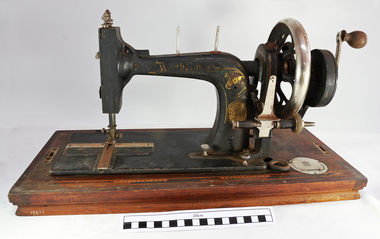 Flagstaff Hill Maritime Museum and Village
Domestic object - Sewing Machine and case, Joseph Wertheim, late 19th century
... A sewing machine was a necessary part of each home and this item demonstrates how women of the time managed had to become self-reliant in the repair and making of their families clothes to make their household budgets go further. flagstaff hill warrnambool shipwrecked-coast flagstaff-hill flagstaff-hill-maritime-museum maritime-museum shipwreck-coast flagstaff-hill-maritime-village sewing machine hand crank sewing machine hugo wertheim wertheim clothing manufacturer sewing syst 182 “WERTHEIM” transfer across front and back of machine body. ...Hugo Wertheim (1854-1919), was a merchant and manufacturer and was born on the 12th July 1854 at Lispenhausen, in the German electorate of Hesse-Kassel, son of Meyer Wertheim and his wife Minna, née Heinemann. Hugo reached Melbourne in October 1875. He soon began advertising, from premises at 39 Flinders Lane East, as agent for his father's cousin Joseph Wertheim, a well-established manufacturer of sewing machines. Hugo returned to Germany where he married Joseph Wertheim's daughter Sophie Emilie (1864-1953) on 30 August 1885 at Frankfurt. the couple then came to Melbourne. In a short time, with extensive advertising, Hugo established a substantial business, selling sewing machines, bicycles, pianos and other mechanical devices, under brands such as Wertheim, Electra, Planet, Griffin and Hapsburg. He also mounted elaborate displays at agricultural shows and in 1901 at the Pan American Exposition, Buffalo, United States of America. O. C. Beale worked with him before setting up his own piano business in New South Wales. Hugo continued to own 25 per cent of one of Beale's companies, which became Wertheim's Queensland business. In 1908 Wertheim opened a large, innovative piano factory at Richmond, Melbourne, intending to produce 2000 pianos and player pianos annually, predominantly using Australian materials. In laying the foundation stone, Prime Minister Alfred Deakin observed that “few men with such opportunities for a life of ease would have embarked on such an enterprise” Hugo died of chronic hepatitis on 11 July 1919 at his home at South Yarra, his wife, two daughters and three sons survived him; Herbert Joseph (1886-1972), the eldest, continued the business. Rupert became a share broker and went on to represent Victoria in inter-State tennis in 1913-27 and Australia in Davis Cup matches against Czechoslovakia in 1922. The piano factory closed in 1935, becoming a Heinz food processing plant and in 1955, GTV Channel 9 studios and offices.Early Australians had to be self-reliant in regards to making and mending their clothes and utensils. This sewing machine was one of many items used that exhibit the skill and craftsmanship of the women in these early families. A sewing machine was a necessary part of each home and this item demonstrates how women of the time managed had to become self-reliant in the repair and making of their families clothes to make their household budgets go further.Sewing machine, Wertheim brand “ Syst 182” hand crank operated machine with folding handle, timber case and carry handle. Metal machine is painted black, with remnants of gold, red and green scrolls and floral decoration. Machine has base with inlaid measuring rule across front and 2 holes drilled through the base (perhaps for mounting machine to a bench). Machine tilts open, hinged on one side, after thumb screw is unwound, revealing machine’s workings and serial number. Base has a fitted round, concave, silver metal pin holder with lid that hinges open, and symbol pressed into lid; several pins are inside. Body of machine has brand name transfer across front and oval metal trademark disc on front. Metal sliding covers over footplates have stamped lettering. Timber machine case or cover includes an accessory box with sliding cover and metal hook and eye latch, and inside the box are 23 metal sewing attachments, a disc and a stick of black crayon with maker’s trademark on it paper cover. Workings of machine have seized up. The crayon wrapper has printed on it “For the wonderful Wertheim new family machine made in Germany ‘Syst. 182’”, and the maker’s symbol with “Trademark” beside it. Made for Hugo Wertheim.“WERTHEIM” transfer across front and back of machine body. Cover of pin holder has symbol ‘Wings above a shield’. Maker’s trademark on gold oval disc, “WERTHEIM / FRANCFURT” and picture of a dwarf with a hammer. Left footplate has script “Syst 182”, right footplate has stamp in oval shape “MANUFACTURED IN - - /SPECIALLY FOR / HUGO WERTHEIM” Serial Number “7501”flagstaff hill, warrnambool, shipwrecked-coast, flagstaff-hill, flagstaff-hill-maritime-museum, maritime-museum, shipwreck-coast, flagstaff-hill-maritime-village, sewing machine, hand crank sewing machine, hugo wertheim, wertheim, clothing manufacturer, sewing, syst 182 -
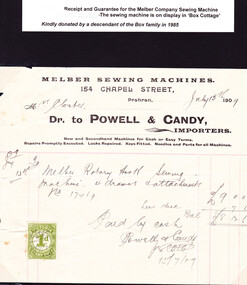 City of Moorabbin Historical Society (Operating the Box Cottage Museum)
Document - Receipt, c1900
... Their nephew Alonzo married Mary Kloster/ Closter in 1918 and she brought with her the 'Melber' sewing machine that she used to provide clothing for the family victoria melbourne clothing brighton moorabbin pioneers sewing box elizabeth box alonzo closter mary kentucky early settlers america craftwork sewing machines melber company u s a prahran kloster martha MELBER SEWING MACHINES / 154 CHAPEL STREET, / Prahran / Mrs Closter July 15th 1909 ( handwritten) / Dr. to POWELL & CANDY, / IMPORTERS / New and Secondhand Machines for Cash and Easy Terms. / Repairs promptly executed Locks repaired. ...Mrs Martha Closter ( Kloster), of Oakleigh purchased the Melber Sewing Machine in 1909 and gave it to her daughter Mary when she and Alonzo Box married in 1918 and settled in Moorabbin Shire. This document was donated by a descendant of the Box family in 1985.William and Elizabeth Box purchased 'Box Cottage' in 1865 from a pioneer settler who had bought part of the land noted in Dendy's Special Survey 1841 Brighton. They raised their family there and established a market garden to supply produce to the population of Melbourne. Their nephew Alonzo married Mary Kloster/ Closter in 1918 and she brought with her the 'Melber' sewing machine that she used to provide clothing for the familyThe original paper Receipt of the Melber Company Sewing Machine, 154 Chapel Street Prahran on July 15th 1909. Mrs Closter purchased a ‘Melber Rotary Hook Sewing Machine , 4 drawers and attachment. No. 17469 costing 9 pounds, less due 7 shillings and 6 pence leaving the sum of 8 pounds 12 shillings and 6 pence Paid by Cash to Powell & Candy per ……… on 15/7/09 ( hand written ) MELBER SEWING MACHINES / 154 CHAPEL STREET, / Prahran / Mrs Closter July 15th 1909 ( handwritten) / Dr. to POWELL & CANDY, / IMPORTERS / New and Secondhand Machines for Cash and Easy Terms. / Repairs promptly executed Locks repaired. Keys fitted. Needles and Parts for all Machines. A stamp 25mm x 30mm is on left corner of document ‘ VICTORIA STAMP DUTY ‘ -at top and base - ‘1d ‘ - centrally victoria, melbourne, clothing, brighton, moorabbin, pioneers, sewing, box elizabeth, box alonzo, closter mary, kentucky, early settlers, america, craftwork, sewing machines, melber company, u s a, prahran, kloster martha -
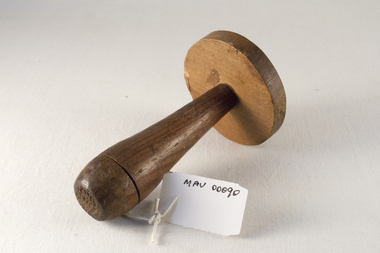 City of Moorabbin Historical Society (Operating the Box Cottage Museum)
Craft - Sewing equipment, darning mushroom, c1880
... This darning tool was an essential item in pioneer household as the early settlers had to make and repair all their clothing. sewing dressmaking craftwork early settlers pioneers moorabbin brighton A timber 'mushroom' shaped darning tool Craft Sewing equipment, darning mushroom Unrecorded early settler ...Darning 'mushrooms' were used to repair any woollen garment, such as socks, jumpers and ladies cotton or Lyle stockings. This darning tool was an essential item in pioneer household as the early settlers had to make and repair all their clothing.A timber 'mushroom' shaped darning tool sewing, dressmaking, craftwork, early settlers, pioneers, moorabbin, brighton -
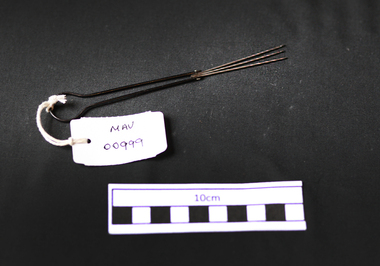 City of Moorabbin Historical Society (Operating the Box Cottage Museum)
Craftwork, lacemaking hooks tiny, c1890
... repaired their own clothes, haberdashery , furnishings, tools and equipment. Lacework was a common pastime for 19thC women. , craftwork crochetwork needlework moorabbin cheltenham pioneers early settlers clothing, brighton, pioneers, dressmaking, market gardeners, early settlers, craftwork, tools, lacework, A set of tiny lace making crochet hooks. ...The women of the pioneer families were very skilled at dressmaking , needlework and lace making. The early settlers had to be self reliant and made and repaired their own clothes, haberdashery , furnishings, tools and equipment. Lacework was a common pastime for 19thC women. , A set of tiny lace making crochet hooks.craftwork, crochetwork, needlework, moorabbin, cheltenham, pioneers, early settlers, clothing, brighton, pioneers, dressmaking, market gardeners, early settlers, craftwork, tools, lacework, -
 City of Moorabbin Historical Society (Operating the Box Cottage Museum)
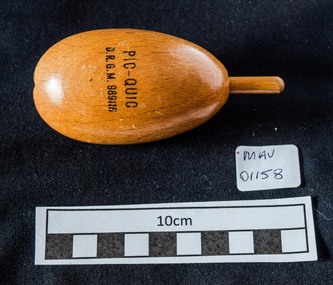
Sewing Equipment , wooden 'Pic-Quic', 20thC
... repair the fault. D.R.G.M., is not a German patent but was instead a way for inventors to register a product’s design or function in all states within Germany. From 1891 to 1952, products manufactured in Germany might have been stamped with this D.R.G.M. designation. This Quic Pic was used by the family of Ailsa Hunt in mid 20thC The women of the post World War 11 estates made clothes and furnishings as their families settled in Bentleigh, McKinnon, Moorabbin ,Ormond in City of Moorabbin c1950s clothing, haberdashery, crochet, doilies, brighton, moorabbin, pioneers, dressmaking, market gardeners, early settlers, craftwork , bentleigh, lacework, moorabbin shire, hunt ailsa, dairy farms, fruit orchards 'PIC - QUIC' DRGM 989116 A wooden egg shaped tool with enclosed steel hook for darning stockings c1950 Sewing Equipment , wooden 'Pic-Quic' DRGM ...The wooden egg has a tiny metal latch hook inserted in the middle (same design as rug making tools). There is a groove down one side. A stocking or knitted fabric is stretched around the egg with the "ladder" in line with the groove. The latch hook is used to pick up the loops in knitted fabric to repair the fault. D.R.G.M., is not a German patent but was instead a way for inventors to register a product’s design or function in all states within Germany. From 1891 to 1952, products manufactured in Germany might have been stamped with this D.R.G.M. designation. This Quic Pic was used by the family of Ailsa Hunt in mid 20thCThe women of the post World War 11 estates made clothes and furnishings as their families settled in Bentleigh, McKinnon, Moorabbin ,Ormond in City of Moorabbin c1950s A wooden egg shaped tool with enclosed steel hook for darning stockings c1950'PIC - QUIC' DRGM 989116clothing, haberdashery, crochet, doilies, brighton, moorabbin, pioneers, dressmaking, market gardeners, early settlers, craftwork , bentleigh, lacework, moorabbin shire, hunt ailsa, dairy farms, fruit orchards -
 City of Moorabbin Historical Society (Operating the Box Cottage Museum)
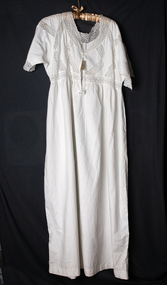
Clothing,Lady's white long cotton nightdress with lace inserts c1900, c1900
... The women of the pioneer families made and repaired their families clothing as they developed the market gardens , dairy farms and fruit orchards ...The women of the pioneer families made and repaired their families clothing as they developed the market gardens , dairy farms and fruit orchards This Lady's white long cotton nightdress with lace inserts is an example of the needlework and dressmaking skills of the early settler women in Moorabbin Shire clothing, brighton, moorabbin, pioneers, dressmaking, market gardeners, early settlers, craftwork , bentleigh, lacework, moorabbin shire blackburn nance, dairy farms, fruit orchards ,Lady's white, long, cotton nightdress with lace inserts, short sleeves and small mother of pearl buttons Clothing,Lady's white long cotton nightdress with lace inserts c1900 Family of Nance Blackburn ...A Lady's white, long, cotton nightdress, with lace inserts and small mother of pearl buttons, was made by an early settler woman in Moorabbin Shire c1900. The women of the pioneer families made and repaired their families clothing as they developed the market gardens , dairy farms and fruit orchards This Lady's white long cotton nightdress with lace inserts is an example of the needlework and dressmaking skills of the early settler women in Moorabbin Shire ,Lady's white, long, cotton nightdress with lace inserts, short sleeves and small mother of pearl buttons clothing, brighton, moorabbin, pioneers, dressmaking, market gardeners, early settlers, craftwork , bentleigh, lacework, moorabbin shire blackburn nance, dairy farms, fruit orchards -
 City of Moorabbin Historical Society (Operating the Box Cottage Museum)
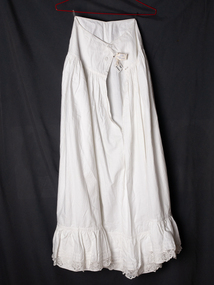
Clothing, Lady's white, long, half petticoat cotton c1900, c1900C
... The petticoat has a placket on the side seam and is fastened with bone buttons, The pioneer families had to be self sufficient making their own tools, clothing, while developing their market gardens, fruit orchards and dairy farms in Moorabbin Shire The pioneer women in Moorabbin Shire had to make and repair the clothes for themselves and their families and were accomplished in dressmaking, needlework , craftwork and knitting clothing, brighton, moorabbin, pioneers, dressmaking, market gardeners, early settlers, craftwork , bentleigh, lacework, moorabbin shire blackburn nance, dairy farms, fruit orchards A Lady's white, long, cotton half petticoat with a wide flounce lace edging and bone buttons at side seam Clothing, Lady's white, long, half petticoat cotton c1900 Unrecorded l Dressmaker ...A Lady's white, long, cotton half petticoat with a gathered flounce and lace insert at hem. The petticoat has a placket on the side seam and is fastened with bone buttons, The pioneer families had to be self sufficient making their own tools, clothing, while developing their market gardens, fruit orchards and dairy farms in Moorabbin Shire The pioneer women in Moorabbin Shire had to make and repair the clothes for themselves and their families and were accomplished in dressmaking, needlework , craftwork and knitting A Lady's white, long, cotton half petticoat with a wide flounce lace edging and bone buttons at side seam clothing, brighton, moorabbin, pioneers, dressmaking, market gardeners, early settlers, craftwork , bentleigh, lacework, moorabbin shire blackburn nance, dairy farms, fruit orchards -
 Montmorency–Eltham RSL Sub Branch
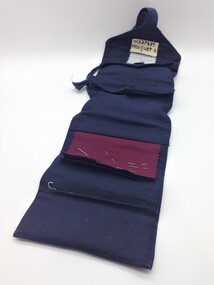
Tool - Sewing Kit
... Clothing...Repair...Clothing Repair kit W 227689 Houguet D on white square tape and Stitch in Time 1968 A F L22L/290 on a square of pale grey mitred material Pockets contain Darning thread , press studs, darning needles, reels of cotton, hooks and eyes and sewing needles Navy cotton material with hanging straps at top and three pockets and extra material swatches to hold pins and needles. ...Navy cotton material with hanging straps at top and three pockets and extra material swatches to hold pins and needles.W 227689 Houguet D on white square tape and Stitch in Time 1968 A F L22L/290 on a square of pale grey mitred material Pockets contain Darning thread , press studs, darning needles, reels of cotton, hooks and eyes and sewing needles clothing, repair kit -
 Flagstaff Hill Maritime Museum and Village
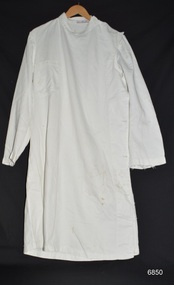
Clothing - Surgeon's Gown, early to mid 20th century
... clothing pukka pukka drills tailored by pero melbourne melbourne taylor Remnants of ‘ANGUS” on inside collar. Maker’s label “It’s a PUKKA” and “PUKKA DRILLS / TAILORED BY PERO MELBOURNE / UNSHRINKABLE” Label has "SIZE 42" White, heavy duty cotton surgeon's gown, part of the W.R. Angus Collection. Gown hasshoulder button fastening. Both cuffs are well worn and fraying, also 'L' shaped tear on front right has been machine repaired ...This surgeon's gown was donated to Flagstaff Hill Maritime Village by the family of Doctor William Roy Angus, Surgeon and Oculist. It is part of the “W.R. Angus Collection” that includes historical medical equipment, surgical instruments and material once belonging to Dr Edward Ryan and Dr Thomas Francis Ryan, (both of Nhill, Victoria) as well as Dr Angus’ own belongings. The Collection’s history spans the medical practices of the two Doctors Ryan, from 1885-1926 plus that of Dr Angus, up until 1969. ABOUT THE “W.R.ANGUS COLLECTION” Doctor William Roy Angus M.B., B.S., Adel., 1923, F.R.C.S. Edin.,1928 (also known as Dr Roy Angus) was born in Murrumbeena, Victoria in 1901 and lived until 1970. He qualified as a doctor in 1923 at University of Adelaide, was Resident Medical Officer at the Royal Adelaide Hospital in 1924 and for a period was house surgeon to Sir (then Mr.) Henry Simpson Newland. Dr Angus was briefly an Assistant to Dr Riddell of Kapunda, then commenced private practice at Curramulka, Yorke Peninsula, SA, where he was physician, surgeon and chemist. In 1926, he was appointed as new Medical Assistant to Dr Thomas Francis Ryan (T.F. Ryan, or Tom), in Nhill, Victoria, where his experiences included radiology and pharmacy. In 1927 he was Acting House Surgeon in Dr Tom Ryan’s absence. Dr Angus had become engaged to Gladys Forsyth and they decided he further his studies overseas in the UK in 1927. He studied at London University College Hospital and at Edinburgh Royal Infirmary and in 1928, was awarded FRCS (Fellow from the Royal College of Surgeons), Edinburgh. He worked his passage back to Australia as a Ship’s Surgeon on the on the Australian Commonwealth Line’s T.S.S. Largs Bay. Dr Angus married Gladys in 1929, in Ballarat. (They went on to have one son (Graham 1932, born in SA) and two daughters (Helen (died 12/07/1996) and Berenice (Berry), both born at Mira, Nhill ) According to Berry, her mother Gladys made a lot of their clothes. She was very talented and did some lovely embroidery including lingerie for her trousseau and beautifully handmade baby clothes. Dr Angus was a ‘flying doctor’ for the A.I.M. (Australian Inland Ministry) Aerial Medical Service in 1928 . Its first station was in the remote town of Oodnadatta, where Dr Angus was stationed. He was locum tenens there on North-South Railway at 21 Mile Camp. He took up this ‘flying doctor’ position in response to a call from Dr John Flynn; the organisation was later known as the Flying Doctor Service, then the Royal Flying Doctor Service. A lot of his work during this time involved dental surgery also. Between 1928-1932 he was surgeon at the Curramulka Hospital, Yorke Peninsula, South Australia. In 1933 Dr Angus returned to Nhill and purchased a share of the Nelson Street practice and Mira hospital (a 2 bed ward at the Nelson Street Practice) from Dr Les Middleton one of the Middleton Brothers, the current owners of what previously once Dr Tom Ryan’s practice. Dr Tom and his brother had worked as surgeons included eye surgery. Dr Tom Ryan performed many of his operations in the Mira private hospital on his premises. He had been House Surgeon at the Nhill Hospital 1902-1926. Dr Tom Ryan had one of the only two pieces of radiology equipment in Victoria during his practicing years – The Royal Melbourne Hospital had the other one. Over the years Dr Tom Ryan had gradually set up what was effectively a training school for country general-practitioner-surgeons. Each patient was carefully examined, including using the X-ray machine, and any surgery was discussed and planned with Dr Ryan’s assistants several days in advance. Dr Angus gained experience in using the X-ray machine there during his time as assistant to Dr Ryan. When Dr Angus bought into the Nelson Street premises in Nhill he was also appointed as the Nhill Hospital’s Honorary House Surgeon 1933-1938. His practitioner’s plate from his Nhill surgery is now mounted on the doorway to the Port Medical Office at Flagstaff Hill Maritime Village, Warrnambool. When Dr Angus took up practice in the Dr Edward and Dr Tom Ryan’s old premises he obtained their extensive collection of historical medical equipment and materials spanning 1884-1926. A large part of this collection is now on display at the Port Medical Office at Flagstaff Hill Maritime Village in Warrnambool. In 1939 Dr Angus and his family moved to Warrnambool where he purchased “Birchwood,” the 1852 home and medical practice of Dr John Hunter Henderson, at 214 Koroit Street. (This property was sold in1965 to the State Government and is now the site of the Warrnambool Police Station. and an ALDI sore is on the land that was once their tennis court). The Angus family was able to afford gardeners, cooks and maids; their home was a popular place for visiting dignitaries to stay whilst visiting Warrnambool. Dr Angus had his own silk worm farm at home in a Mulberry tree. His young daughter used his centrifuge for spinning the silk. Dr Angus was appointed on a part-time basis as Port Medical Officer (Health Officer) in Warrnambool and held this position until the 1940’s when the government no longer required the service of a Port Medical Officer in Warrnambool; he was thus Warrnambool’s last serving Port Medical Officer. (Masters of immigrant ships arriving in port reported incidents of diseases, illness and death and the Port Medical Officer made a decision on whether the ship required Quarantine and for how long, in this way preventing contagious illness from spreading from new immigrants to the residents already in the colony.) Dr Angus was a member of the Australian Medical Association, for 35 years and surgeon at the Warrnambool Base Hospital 1939-1942, He served as a Surgeon Captain during WWII1942-45, in Ballarat, Victoria, and in Bonegilla, N.S.W., completing his service just before the end of the war due to suffering from a heart attack. During his convalescence he carved an intricate and ‘most artistic’ chess set from the material that dentures were made from. He then studied ophthalmology at the Royal Melbourne Eye and Ear Hospital and created cosmetically superior artificial eyes by pioneering using the intrascleral cartilage. Angus received accolades from the Ophthalmological Society of Australasia for this work. He returned to Warrnambool to commence practice as an ophthalmologist, pioneering in artificial eye improvements. He was Honorary Consultant Ophthalmologist to Warrnambool Base Hospital for 31 years. He made monthly visits to Portland as a visiting surgeon, to perform eye surgery. He represented the Victorian South-West subdivision of the Australian Medical Association as its secretary between 1949 and 1956 and as chairman from 1956 to 1958. In 1968 Dr Angus was elected member of Spain’s Barraquer Institute of Barcelona after his research work in Intrasclearal cartilage grafting, becoming one of the few Australian ophthalmologists to receive this honour, and in the following year presented his final paper on Living Intrasclearal Cartilage Implants at the Inaugural Meeting of the Australian College of Ophthalmologists in Melbourne In his personal life Dr Angus was a Presbyterian and treated Sunday as a Sabbath, a day of rest. He would visit 3 or 4 country patients on a Sunday, taking his children along ‘for the ride’ and to visit with him. Sunday evenings he would play the pianola and sing Scottish songs to his family. One of Dr Angus’ patients was Margaret MacKenzie, author of a book on local shipwrecks that she’d seen as an eye witness from the late 1880’s in Peterborough, Victoria. In the early 1950’s Dr Angus, painted a picture of a shipwreck for the cover jacket of Margaret’s book, Shipwrecks and More Shipwrecks. She was blind in later life and her daughter wrote the actual book for her. Dr Angus and his wife Gladys were very involved in Warrnambool’s society with a strong interest in civic affairs. He had an interest in people and the community They were both involved in the creation of Flagstaff Hill, including the layout of the gardens. After his death (28th March 1970) his family requested his practitioner’s plate, medical instruments and some personal belongings be displayed in the Port Medical Office surgery at Flagstaff Hill Maritime Village, and be called the “W. R. Angus Collection”. The W.R. Angus Collection is significant for still being located at the site it is connected with, Doctor Angus being the last Port Medical Officer in Warrnambool. The collection of medical instruments and other equipment is culturally significant, being an historical example of medicine from late 19th to mid-20th century. Dr Angus assisted Dr Tom Ryan, a pioneer in the use of X-rays and in ocular surgery. White, heavy duty cotton surgeon's gown, part of the W.R. Angus Collection. Gown hasshoulder button fastening. Both cuffs are well worn and fraying, also 'L' shaped tear on front right has been machine repaired. Remnants of label on inside collar with name "ANGUS". Also Maker's label, "PUKKA", made in Melbourne.Remnants of ‘ANGUS” on inside collar. Maker’s label “It’s a PUKKA” and “PUKKA DRILLS / TAILORED BY PERO MELBOURNE / UNSHRINKABLE” Label has "SIZE 42" flagstaff hill, warrnambool, shipwrecked coast, flagstaff hill maritime museum, maritime museum, shipwreck coast, flagstaff hill maritime village, great ocean road, dr w r angus, dr ryan, surgical instrument, t.s.s. largs bay, warrnambool base hospital, nhill base hospital, mira hospital, flying doctor, surgeon's gown, surgical clothing, pukka, pukka drills, tailored by pero melbourne, melbourne taylor -
 Cheese World Museum
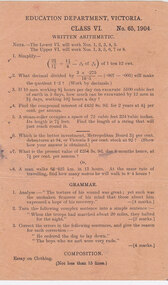
Document, School test -arithemetic Grade VI
... repaired items and examples can be seen in the museum. This item is part of the collection of items given into the care of the Cheese World Museum. The Victorian Education Department compiled set tests for schools. This test aimed at Year 6 students dates from 1904 and includes some complex written arithmetic problems, grammar analysis and an essay on 'Clothing'. ...repaired items and examples can be seen in the museum. This item is part of the collection of items given into the care of the Cheese World Museum. The Victorian Education Department compiled set tests for schools. This test aimed at Year 6 students dates from 1904 and includes some complex written arithmetic problems, grammar analysis and an essay on 'Clothing'. ...The Uebergang family came from Silesia to Australia in 1848 and were early settlers in the Allansford area. The sons and other descendants also purchased farms in the area. The Percy Uebergang family lived at Tooram Park, Allansford from 1912 until 1992. Percy and Myrtle Uebergang's children were twins, Ray and Joyce born in 1926 who lived at Tooram Park until their deaths, Ray in 1986 and Joyce in 1992 after which the property was sold. Neither Ray nor Joyce married and following the death of her brother Joyce set up the Ray and Joyce Uebergang Foundation which supports the local community. The collection of items from their property was put into store for a number of years before being given into the care of the Cheese World Museum. The family often re-used, recycled and repaired items and examples can be seen in the museum. This item is part of the collection of items given into the care of the Cheese World Museum. The Victorian Education Department compiled set tests for schools. This test aimed at Year 6 students dates from 1904 and includes some complex written arithmetic problems, grammar analysis and an essay on 'Clothing'. This test sheet is significant as an example of the level expected of Class VI students in 1904.A single page printed in black ink on dull orange coloured paper with tests arithmetic, grammar and composition for Class VI, No.65, 1904 composed by the Education Department, Victoria.EDUCATION DEPARTMENT, VICTORIA/CLASS VI/No.65, 1904/WRITTEN ARITHMETIC/ … /GRAMMAR/…/COMPOSITIONallansford, grammar, school tests, arithmetic, composition, education department victoria, education, schools -
 Kiewa Valley Historical Society
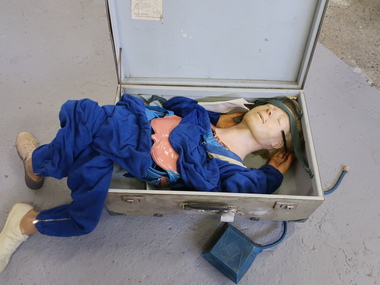
Resusci-Anne and Equipment
... See KVHS 0542 for Resusci-Anne Repair Kit Doll type model with face, arms and legs folded into a 1950s carrying case. The model has blue clothing. ...Wikipedia Used in the Kiewa Valley by Educators of First Aid and emergency workers Resusci Anne first aid emergency education See KVHS 0542 for Resusci-Anne Repair Kit Doll type model with face, arms and legs folded into a 1950s carrying case. The model has blue clothing. ...Resusci Anne was used for teaching both emergency workers and members of the general public. Developed by Asmund S. Laerdal, Peter Safar, and James Elam and produced by the company Laerdal Medical.The first version of rescue Annie was presented by Laerdal in 1960. Later the design was refined and included a simulated carotid pulse, eye pupils that could dilate and constrict and a system for recording the trainee's resuscitation performance on a paper tape. Ref. WikipediaUsed in the Kiewa Valley by Educators of First Aid and emergency workersSee KVHS 0542 for Resusci-Anne Repair Kit Doll type model with face, arms and legs folded into a 1950s carrying case. The model has blue clothing. Enclosed are the instructions for packing the model and papers for treatment of an unconscious patient.resusci anne, first aid, emergency education -
 Kiewa Valley Historical Society
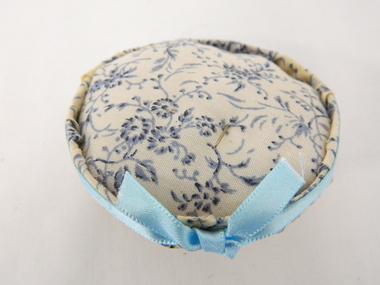
Cushion Pin, unknown, circa mid to late 1900's
... When this item was used it was in a period when distances from haberdashery stores was too far and mail ordered clothing would take weeks to arrive.The ability to make and alter clothing for families within the Kiewa Valley and its regions was a domestic requirement up until the later period(1960's onwards) This pin cushion, although rarely used in the 21st Century, with the availability of "cheap" throw away clothes, was very important to a well run rural household. The emphasis for girls to be able to sew and repair ...This pin cushion was in use when home spun "fashion" clothing was manufactured or altered. When this item was used it was in a period when distances from haberdashery stores was too far and mail ordered clothing would take weeks to arrive.The ability to make and alter clothing for families within the Kiewa Valley and its regions was a domestic requirement up until the later period(1960's onwards)This pin cushion, although rarely used in the 21st Century, with the availability of "cheap" throw away clothes, was very important to a well run rural household. The emphasis for girls to be able to sew and repair clothing was generated by mothers and continued at high schools. Part of the role of women(in this time frame) within the family was to manufacture children's clothing and adjust the growing waistline of their men folk. This item is very significant to the rural households in the Kiewa Valley because of the relative isolation of the region and the amount of wear and tear that clothes go through in a typical rural environment.This pin cushion is "home" made, circular and covered in a blue floral material, encircled with a light blue ribbon (glued on) for extra adhesion. The material encloses a padded surface(allows pins to be safely inserted for storage(future use).sewing, pin-cushion, haberdashery -
 Kiewa Valley Historical Society
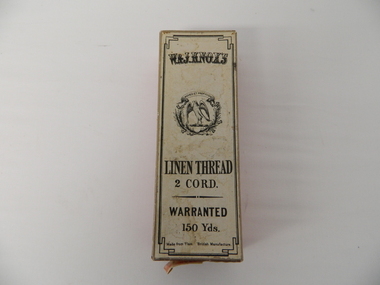
Box Linen Thread, early to mid 1900's
... This box which once contained linen thread manufactured in Scotland and labelled "British" manufacture" was used for the repair/manufacture of clothing by professional seamstresses and those wives required to "do" repair stitching of family clothes. ...This box which once contained linen thread manufactured in Scotland and labelled "British" manufacture" was used for the repair/manufacture of clothing by professional seamstresses and those wives required to "do" repair stitching of family clothes. ...This box which once contained linen thread manufactured in Scotland and labelled "British" manufacture" was used for the repair/manufacture of clothing by professional seamstresses and those wives required to "do" repair stitching of family clothes. This box was manufactured in a period when the title "United Kingdom" was used (late 1700's early 1900's) to describe the union of Britain and Scotland. The label however can be misleading as the"British Manufacture" thread was manufactured in Scotland. The broad term "British Manufacture" was used for the benefit of those in the "colonies" of Australia and New Zealand, during a period when the "coined" phrase "best of British, or British best" was synonymous to "top quality". After World War II the need for "cheaper products" was more persuasive than the quality of the product. In rural areas this shift to cheaper "non British" goods was at a slower rate than in the cities. Goods such as clothing manufactured or altered by seamstresses were regarded as of a higher standard and therefor the use of linen thread from "Britain" was a sign of quality and reliability.This box which contained linen thread, "British" made, is very significant to the Kiewa Valley because it demonstrates the conditions under which households in the late 1800's and early 1900's evolved from a "domestic repair /replacement" of damaged clothing to a consumer of recycled and shop bought clothing and linen. The ability of semi isolated rural based families to purchase "off the rack" clothing was severely affected by weather, long distance over dirt roads(poorly serviced) to large towns(shops), horse/cart or slower driven cars. The purchasing of clothing was, on the whole, from trading house "mail order" consignment orders.This red paper covered box has a white covered lid (top) with black print detailing the manufacturer and contents. This box contained 150 yds of linen thread 2 cord. A small added note pasted on one side "USUAL TWIST (s)" describing the thread's appearance. Two semicircular "finger" holes on two sides of the lid permit easier removal of the lid from the base.On the top lid: "W.&J. KNOX'S" below this a crest with latin motive "MOVEO ET PROFICIOR" English translation "I proceed and am more prosperous" encircling an open winged falcon. below this "LINEN THREAD", "2 CORD." "WARRANTED" "150 Yds." Made from Flax." British Manufacture". On one side "DRABS SOFT FINISH" within a shield "KNOX'S TWO CORD 150 YARDS 30" next to this a trade mark "W & J KNOX below this "made in KILBIRNIE, SCOTLAND"thread, cord. flax, box container, linen thread, seamstress items, cardboard box -
 4th/19th Prince of Wales's Light Horse Regiment Unit History Room
Boots, Ankle, Black, 1960 (estimated)
... boots army clothing Army issue leather boots, black, ankle length. Half-sole repair, steel toe plate and horseshoe protector in heel, leather laces. ...Army issue leather boots, black, ankle length. Half-sole repair, steel toe plate and horseshoe protector in heel, leather laces. boots, army clothing -
 Bendigo Historical Society Inc.
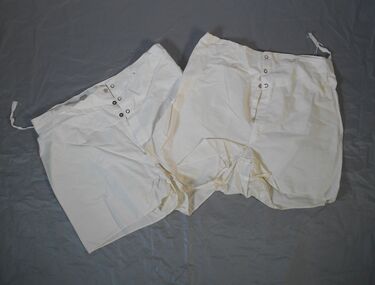
Textile - Men's Drawers
... clothing Underwear Two pairs of men's underwear. "Arrow" Trademark. Made from "Sanforized Shrunk fabric - ironless finished cotton". Cotton tape threaded through the top band allow for some adjustments to sizing. One garment appears to have hand stitching on the top band to allow for resizing or repair ...The Arrow shirt company was founded by William H.Titus and his partner in Chicago, Illinois and in the late 1800s merged with Cluett Peabody. In 1929 Cluett, Peabody & Co. established a national menswear business under the Arrow brand name. The "Arrow" name gradually grew into a product line that included shirts, collars, handkerchiefs, cravats, pyjamas, and underwear for men and boys. (Wikipedia)Two pairs of men's underwear. "Arrow" Trademark. Made from "Sanforized Shrunk fabric - ironless finished cotton". Cotton tape threaded through the top band allow for some adjustments to sizing. One garment appears to have hand stitching on the top band to allow for resizing or repair. Each pair has three silver coloured press studs for front fastening. 1930s - 1940s.arrow clothing, underwear -
Glen Eira Historical Society
Book - Carnegie Primary School No. 2897
... Clothing Industry... Glen Huntly Road... Elsternwick... Painter S.... Thomas J.... Dickson Mrs... Courtney Electrics... Electric Repair...Figure Foundations Clothing Industry Glen Huntly Road Elsternwick Painter S. Thomas J. Dickson Mrs Courtney Electrics Electric Repair Shops Gardiner M. ...A 64 page recipe booklet issued by the Mothers Club of Carnegie State School. date unknown. It includes parents names and local business in the area.truganini road., sturgess mrs, warren mrs., milkbars, carnegie primary school, irwin r, wood d, yates mrs., carnegie state school, winwood m h, wood s, weeks. r, carnegie, coley j, sterey j, muir mrs., state savings bank., rankin n, morrisons milk bar., needham n, piper p., don l, dispensing chemist, chemists, sentrys foodland grocers, grocers, koornang road., davis b, watson mary, jackson v., logan mrs., recipes, mothers’ club, wright mrs, e. a. urguhart, newsgency and stationery, newsagents, carnegie travel agency, marshall e, youngman’s furniture., furniture stores, hulme m., bernie mack pty ltd, general stores, miladys – dressmaking and alteration service, horgan rita., mcdonnell b, mary’s – continental beauty, salon, hairdressers, williams g., carnegie silkstore, fabrics, selboskar phyl, f & l jameson, milk bars, delicatessen’s., saint v. jowett, florists, lyon b, moorfield t., upholsterers, strathearn p., dickson joyce, m & i hardwarp, hardware stores, hulme sloan & co. pty ltd., real estate agents, hawthorn road, caulfield., whelan mrs., figure foundations, clothing industry, glen huntly road, elsternwick, painter s., thomas j., dickson mrs, courtney electrics, electric repair shops, gardiner m., anrep mrs., koornang dry cleaners, dry cleaners, play box toys, toy shops, frankwood removals, removalists -
Warrnambool and District Historical Society Inc.
Functional object - Wrapping Paper (2 sheets), Fletcher Jones and Staff, Warrnambool, c. 1970
... Clothing Company, a major industry in Warrnambool and Australia for many years. Fletcher Jones Warrnambool Warrnambool Businesses .1 Fletcher Jones Says Compare .2 Fletcher Jones, After Sales Service, F.J. Plus 8, Dry Cleaning, Lock Pressing, Form Setting, Adjustments and Repairs ...These sheets of wrapping paper come from the clothing company of Fletcher Jones (Warrnambool). One sheet has been produced for the After Sales Department. David Fletcher Jones (1895-1977) served in World War One and in the 1920s set up as a travelling hawker selling drapery in Western Victoria. In 1924 he leased three shops in Liebig Street, Warrnambool and in 1928 he moved to the Koroit/Liebig Streets intersection with his Man's Shop. He manufactured men's clothing on site. In 1931 he moved into a new set of two-storeyed buildings on the site. In 1946 he opened a men's store in Melbourne and in 1948 he opened a factory in Warrnambool with a new company called Fletcher Jones and Staff (1951). This company extended to other parts of Australia and became well-known throughout Australia for the production of men's trousers and later men's and women's clothing. By 2011 the Warrnambool factory was sold and the company dissolved.These wrapping papers are of interest as a memento of the Fletcher Jones Clothing Company, a major industry in Warrnambool and Australia for many years.These are two sheets of wrapping paper from the Fletcher Jones clothing company. .1 A sheet of grey paper over-printed with a blue logo (shield and needle and thread) and blue printing .2 A sheet of buff-coloured paper (tissue quality) over-printed with a blue logo (shield and needle and thread) and red printing.1 Fletcher Jones Says Compare .2 Fletcher Jones, After Sales Service, F.J. Plus 8, Dry Cleaning, Lock Pressing, Form Setting, Adjustments and Repairsfletcher jones warrnambool, warrnambool businesses -
 National Wool Museum
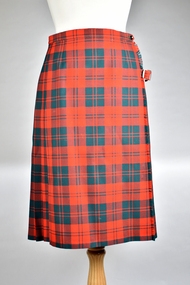
Clothing - Tartan Kilt, Fletcher Jones, 1960s
... Clothing Fashion Tartan Kilt Scottish Wool tag: Fletcher Jones / PURE NEW WOOL / DO NOT WASH / DO NOT BLEACH / VERY COOL IRON / DRY CLEAN ONLY / REMEMBER - FLETCHER JONES / OFFERS EXPERT PROFESSIONAL / CLEANING AND REPAIR SERVICE Red and dark green tartan kilt with eye and hook fastening clips and buttons on three different size settings. ...The donor's mother, Joy Newall owned these kilts. She lived on a wheat/sheep farm in the Wimmera where her husband also bred merino sheep. Joy was well known in the district for the way she dressed when out in public.Red and dark green tartan kilt with eye and hook fastening clips and buttons on three different size settings. A metal clasp fastens on the left side. tag: Fletcher Jones / PURE NEW WOOL / DO NOT WASH / DO NOT BLEACH / VERY COOL IRON / DRY CLEAN ONLY / REMEMBER - FLETCHER JONES / OFFERS EXPERT PROFESSIONAL / CLEANING AND REPAIR SERVICEclothing, fashion, tartan, kilt, scottish, wool -
 National Wool Museum
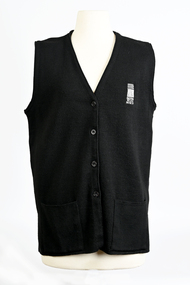
Textile - Black Woollen Vest, 2000s
... repairing some of the garments that may have pulled a thread or a minor fault. I also enjoyed doing ‘stock taking’ in the shop. (Not many staff enjoyed this job, but I did.) In those early days, the Museum staff wore the red blazer and the black wool cardigan." - Lynette Wekwerth Working Life Volunteer National Wool Museum Clothing ...This vest was worn by Lynette Wekwerth when she worked as a volunteer in the National Wool Museum shop during the early 2000s. Lynette volunteered at the National Wool Museum for 25 years from 2001 until her passing in 2025, and was a much loved and respected member of the team. "I was born at Coonara Private Hospital at 173 Yarra Street, Geelong, on the 29th of March 1944, the third of five children. My father was in the RAAF when I was born, and on leaving the air force he became a carpenter/joiner. When I was young, we had the bread and milk delivered. There was a special tin for the bread and a big billy for the milk left of the front veranda to collect these items. My mother, elder sister, Wendy and my younger sister Zaidee, all went to “Physical Culture” held downstairs under the old Plaza Theatre building in Ryrie Street. We girls made our own sports clothes to do exercises (rods, dumbbells, and song and dance). It kept us fit, and we all won medals at some stage at the end-of-year concert. I was the only girl of my age in the street where I lived. There were boys my age, so I learned to play cricket and kick a football, all of which I did well. I attended Tate Street and then went on to Matthew Flinders Girls Secondary College in 1956. Matthew Flinders was a domestic arts school, where I learnt sewing, cookery, home management, and how to be a ‘good’ housekeeper. I enjoyed all the domestic subjects. Ray and I were engaged in August 1963. We purchased our engagement ring in Melbourne and went to dinner at the Playboy Club in Melbourne to celebrate. In preparation for our wedding, I spent many hours making my own wedding dress (with assistance from my mother). We were married at 11 am on Saturday, the 10th April 1965 at St. Matthew’s, Church of England, Geelong. When Ray retired, he responded to an advertisement for volunteers at the National Wool Museum to be a volunteer. He started in 1998. The year that the ‘Pharaohs exhibition’ started. That was fine by me, as he wouldn’t be getting under my feet. At this time I was playing golf regularly and didn’t want to miss out on this activity. I joined the volunteers in the Wool Museum in March/April 2001. I was allocated to the Museum Shop and thoroughly enjoyed being a member of the shop staff. I then became shop assistant. I enjoyed talking and serving the customers. I was soon asked if I would mind repairing some of the garments that may have pulled a thread or a minor fault. I also enjoyed doing ‘stock taking’ in the shop. (Not many staff enjoyed this job, but I did.) In those early days, the Museum staff wore the red blazer and the black wool cardigan." - Lynette WekwerthBlack woollen vest with four buttons at the front, and two pockets. Vest has National Wool Museum logo on left chest. printed [label]: BELLA / Collection / made in australia / WEKWERTH / TO FIT / SIZE / 12working life, volunteer, national wool museum, clothing, uniform, lynette wekwerth, staff, employment, wool clothing, geelong -
 National Wool Museum
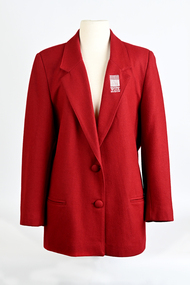
Textile - Red Woollen Jacket, Sabena, 2000s
... repairing some of the garments that may have pulled a thread or a minor fault. I also enjoyed doing ‘stock taking’ in the shop. (Not many staff enjoyed this job, but I did.) In those early days, the Museum staff wore the red blazer and the black wool cardigan." - Lynette Wekwerth Working Life Volunteer National Wool Museum Clothing ...This jacket was worn by Lynette Wekwerth when she worked as a volunteer in the National Wool Museum shop during the early 2000s. Lynette volunteered at the National Wool Museum for 25 years from 2001 until her passing in 2025, and was a much loved and respected member of the team. "I was born at Coonara Private Hospital at 173 Yarra Street, Geelong, on the 29th of March 1944, the third of five children. My father was in the RAAF when I was born, and on leaving the air force he became a carpenter/joiner. When I was young, we had the bread and milk delivered. There was a special tin for the bread and a big billy for the milk left of the front veranda to collect these items. My mother, elder sister, Wendy and my younger sister Zaidee, all went to “Physical Culture” held downstairs under the old Plaza Theatre building in Ryrie Street. We girls made our own sports clothes to do exercises (rods, dumbbells, and song and dance). It kept us fit, and we all won medals at some stage at the end-of-year concert. I was the only girl of my age in the street where I lived. There were boys my age, so I learned to play cricket and kick a football, all of which I did well. I attended Tate Street and then went on to Matthew Flinders Girls Secondary College in 1956. Matthew Flinders was a domestic arts school, where I learnt sewing, cookery, home management, and how to be a ‘good’ housekeeper. I enjoyed all the domestic subjects. Ray and I were engaged in August 1963. We purchased our engagement ring in Melbourne and went to dinner at the Playboy Club in Melbourne to celebrate. In preparation for our wedding, I spent many hours making my own wedding dress (with assistance from my mother). We were married at 11 am on Saturday, the 10th April 1965 at St. Matthew’s, Church of England, Geelong. When Ray retired, he responded to an advertisement for volunteers at the National Wool Museum to be a volunteer. He started in 1998. The year that the ‘Pharaohs exhibition’ started. That was fine by me, as he wouldn’t be getting under my feet. At this time I was playing golf regularly and didn’t want to miss out on this activity. I joined the volunteers in the Wool Museum in March/April 2001. I was allocated to the Museum Shop and thoroughly enjoyed being a member of the shop staff. I then became shop assistant. I enjoyed talking and serving the customers. I was soon asked if I would mind repairing some of the garments that may have pulled a thread or a minor fault. I also enjoyed doing ‘stock taking’ in the shop. (Not many staff enjoyed this job, but I did.) In those early days, the Museum staff wore the red blazer and the black wool cardigan." - Lynette WekwerthRed jacket with two buttons and two pockets at the front, and two decorative buttons on each cuff. Jacket has National Wool Museum logo on the left lapel. printed [label]: SABENA / 14working life, volunteer, national wool museum, clothing, uniform, lynette wekwerth, staff, employment, wool clothing, geelong -
 National Wool Museum
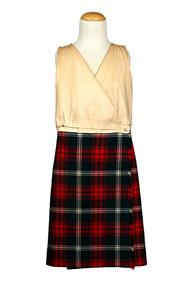
Textile - Children’s Kilt, Fletcher Jones, 1960s
... Fletcher Jones Kilts Family Life Farming 1960s Fashion Children's Fashion Children's Clothing Tartan printed [label]: FLETCHER JONES AUSTRALIA / PURE WOOL / CREATED BY / Fletcher Jones / AUSTRALIA / F. J. DRY CLEANING & REPAIRS ...One of two children’s kilts with bodices owned by Heather White and Sandra Hooker (nee White). The Fletcher Jones kilts were made in the 1960s and are in two different tartan designs. They were designed to be lengthened as the children grew by adjusting the hem of the bodice. An original clothing tag (NWM-9154) features a poem about this, which was greatly treasured by Sandra as a child. Three sisters, Sandra, Heather and Melinda, all had kilts as children growing up in the 1960s on a sheep farm near Torquay. The kilts were worn on special occasions, with woollen jumpers worn on top of the bodices. Photos show Heather (aged 8) and Sandra (aged 6) with their younger sister Melinda (aged 1), wearing the kilts at family farms “South Beach” and “Lambidgee”, both near Torquay, in 1965. The kilts were purchased by the children’s grandmother, most likely from Fletcher Jones in Geelong, and were highly valued by the family. This kilt belonged to Heather.Woollen tartan kilt with cream coloured cotton v necked sleeveless bodice attached. Kilt is green, red and cream. printed [label]: FLETCHER JONES AUSTRALIA / PURE WOOL / CREATED BY / Fletcher Jones / AUSTRALIA / F. J. DRY CLEANING & REPAIRS / SERVICE WILL CARE FOR / THIS GARMENT always fletcher jones, kilts, family life, farming, 1960s, fashion, children's fashion, children's clothing, tartan -
 National Wool Museum
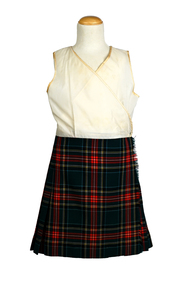
Textile - Children’s Kilt, Fletcher Jones, 1960s
... Fletcher Jones Kilts Family Life Farming 1960s Fashion Children's Fashion Children's Clothing Tartan printed [label]: FLETCHER JONES AUSTRALIA / PURE WOOL / CREATED BY / Fletcher Jones / AUSTRALIA / F. J. DRY CLEANING & REPAIRS ...One of two children’s kilts with bodices owned by Heather White and Sandra Hooker (nee White). The Fletcher Jones kilts were made in the 1960s and are in two different tartan designs. They were designed to be lengthened as the children grew by adjusting the hem of the bodice. An original clothing tag (NWM-9154) features a poem about this, which was greatly treasured by Sandra as a child. Three sisters, Sandra, Heather and Melinda, all had kilts as children growing up in the 1960s on a sheep farm near Torquay. The kilts were worn on special occasions, with woollen jumpers worn on top of the bodices. Photos show Heather (aged 8) and Sandra (aged 6) with their younger sister Melinda (aged 1), wearing the kilts at family farms “South Beach” and “Lambidgee”, both near Torquay, in 1965. The kilts were purchased by the children’s grandmother, most likely from Fletcher Jones in Geelong, and were highly valued by the family. This kilt belonged to Sandra.Woollen tartan kilt with cream coloured silk v necked sleeveless bodice attached. Kilt is green, red, yellow and cream. printed [label]: FLETCHER JONES AUSTRALIA / PURE WOOL / CREATED BY / Fletcher Jones / AUSTRALIA / F. J. DRY CLEANING & REPAIRS / SERVICE WILL CARE FOR / THIS GARMENT always fletcher jones, kilts, family life, farming, 1960s, fashion, children's fashion, children's clothing, tartan
