
Showing 5 items matching "cmp 2"
-
 Tatura Irrigation & Wartime Camps Museum
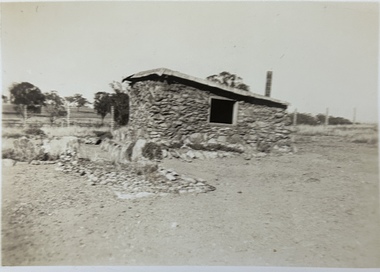
Photograph - Black and white photograph, No 2 Camp hut
... Cmp 2...June 1948 Camp 2 Cmp 2 1948 Tatura Black and white photograph of a stone hut in Camp 2 in 1948. ...June 1948 Camp 2Black and white photograph of a stone hut in Camp 2 in 1948. Remains of stone edged gardens. Tin roof, small window and chiminey.cmp 2, 1948, tatura -
 Bendigo Military Museum
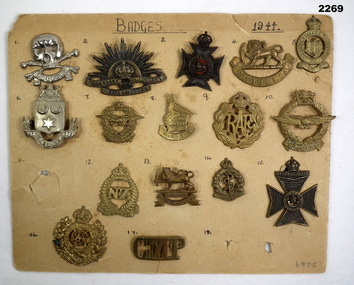
Badge - BADGE COLLECTION, C.WW2
... 2) Rising Sun badge Australian .3) Rhodesian Regiment .4) Lion with Rhodesie. .5) North Humberland Fusiliers. .6) Western Light Horse. .7) S.A.A.F. SALM, Crown, Wings. .8) R.A..A.C. with bird .9) R.A.F. Crown and Wreath .10) Rhodesia lion and eagle .11) Missing .12) NZ onward. crown and wreath .13) Southern Rhodesia volunteers. Lion .14) Rhodesia - crown, dagger, snake\ .15) The Kings Royal Rifle Corp - crown and cross .16) Royal Engineers. crown and wreath .17) "CMP...2) Rising Sun badge Australian .3) Rhodesian Regiment .4) Lion with Rhodesie. .5) North Humberland Fusiliers. .6) Western Light Horse. .7) S.A.A.F. SALM, Crown, Wings. .8) R.A..A.C. with bird .9) R.A.F. Crown and Wreath .10) Rhodesia lion and eagle .11) Missing .12) NZ onward. crown and wreath .13) Southern Rhodesia volunteers. Lion .14) Rhodesia - crown, dagger, snake\ .15) The Kings Royal Rifle Corp - crown and cross .16) Royal Engineers. crown and wreath .17) "CMP ...Items in the collection re Ian McLeod RWAFF, refer Cat No 2262.2 for service details. Badges, metal mounted on cardboard from Allied countries16 in total. Main ones are; .1) Skull and cross bones "FOR GLORY". .2) Rising Sun badge Australian .3) Rhodesian Regiment .4) Lion with Rhodesie. .5) North Humberland Fusiliers. .6) Western Light Horse. .7) S.A.A.F. SALM, Crown, Wings. .8) R.A..A.C. with bird .9) R.A.F. Crown and Wreath .10) Rhodesia lion and eagle .11) Missing .12) NZ onward. crown and wreath .13) Southern Rhodesia volunteers. Lion .14) Rhodesia - crown, dagger, snake\ .15) The Kings Royal Rifle Corp - crown and cross .16) Royal Engineers. crown and wreath .17) "CMP" Letter only .18) Missingbadges, allied, collection -
 Parks Victoria - Gabo Island Lightstation
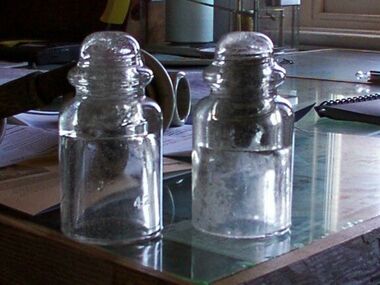
Insulators
... CMP identified remnants of the line from its various phases of operation,231 and these can still be seen in 2016. Other ceramic insulators in the collection are associated with lines supported on utility poles for the transmission of high voltage electricity. The various insulators have second level significance for their historic value and provenance Around lower edge on opposite sides,"C.C / 42" 1. Clear glass insulator. Cyndrical bottle shape with smaller dome -like knob on top. Hollow with inscription on lower edge. Has remains of wooden dowell inside. 2 ...Modern communication tecnology arrived on Gabo Island with the construction of the telegraph line from Eden to Gabo Island in 1870. These and other cylindricial insulators were associated with the original 1870 copper wire telegraph line and later the P.M.G. line. The items of telegraphic equipment comprise a number of ceramic and glass insulators of varying age and type. Two bell-shaped insulators are made of clear glass, one with remains of wooden dowel inside. In addition to insulators, there is a telephone insulator bracket made of metal with wooden pins. It was once attached to the top of a steel pole and some of theseremain in situ along the former telegraph line. Telegraphic communication commenced at the Gabo Lightstation in 1870, just eight years after the lightstation opened.The line from Sydney reached Eden, NSW by 1868 and was then extended to Gabo with the costs shared equally by NSW and Victoria. It was initially carried on posts across the sea to the island but was changed to a line along the seabed after the posts were washed away. The first telegraph office was a timber building on east side of the assistants’ quarters. In 1887 a new concrete telegraph office was built which included quarters for the operator, with Victoria and NSW sharing the construction costs. The 1992 CMP identified remnants of the line from its various phases of operation,231 and these can still be seen in 2016. Other ceramic insulators in the collection are associated with lines supported on utility poles for the transmission of high voltage electricity. The various insulators have second level significance for their historic value and provenance1. Clear glass insulator. Cyndrical bottle shape with smaller dome -like knob on top. Hollow with inscription on lower edge. Has remains of wooden dowell inside. 2.Clear glass insulator. Cyndrical bottle shape with smaller dome -like knob on top. Hollow with inscription on lower edge.Around lower edge on opposite sides,"C.C / 42" -
 Returned Nurses RSL Sub-branch
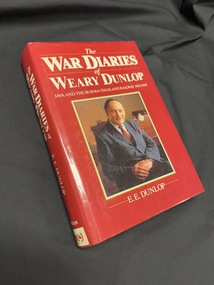
Book, Ernest Edward Dunlop, The war diaries of Weary Dunlop : Java and the Burma-Thailand railway 1942-1945, 1986
... Sir Edward describes how the cmps were organised; he records deaths, cholera epidemics, operations, and torture; his own - rare - despair; the movement of prisoners up and down the line; and his constant struggle to protect the sick from being drafted into Japanese work parties. From February 1942 he was in the following Japanese prison camps; Bandoeng, Tjimahi, Makasura, Changi, Konyu, Hintok, Tarsau, Chungkai and Nakom Patom.' [From inside front dust jacket] 'Book No 2 ...'More than forty years ago Sir Edward Dunlop, then a lieutenant-colonel, began these diaries at the start of his imprisonment by the Japanese in Java and on the Burma-Thailand Railway. His meticulous observations of prison camp life were concealed all through the war; by the time peace cam in 1945, he carried with him a unique record of the lives of prisoners-of-war. As a commanding officer and a surgeon, 'Weary' became a hero and a legend to thousands of Australian and allied prisoners, whose lives were saved with meagre medical supplies and the instruments the medical officers carried on their backs through Java and Thai jungles. He says himself: 'Of some 22,000 who entered captivity, more than 7,000 died or were killed. Of their sufferings... only those who were present can fully comprehend the seeming hopelessness of it all as their bodies wasted and their friends died.' Sir Edward describes how the cmps were organised; he records deaths, cholera epidemics, operations, and torture; his own - rare - despair; the movement of prisoners up and down the line; and his constant struggle to protect the sick from being drafted into Japanese work parties. From February 1942 he was in the following Japanese prison camps; Bandoeng, Tjimahi, Makasura, Changi, Konyu, Hintok, Tarsau, Chungkai and Nakom Patom.' [From inside front dust jacket]Book with a red dustjacket, had a photograph of a seated older man on cover and white text on cover and spinenon-fiction'More than forty years ago Sir Edward Dunlop, then a lieutenant-colonel, began these diaries at the start of his imprisonment by the Japanese in Java and on the Burma-Thailand Railway. His meticulous observations of prison camp life were concealed all through the war; by the time peace cam in 1945, he carried with him a unique record of the lives of prisoners-of-war. As a commanding officer and a surgeon, 'Weary' became a hero and a legend to thousands of Australian and allied prisoners, whose lives were saved with meagre medical supplies and the instruments the medical officers carried on their backs through Java and Thai jungles. He says himself: 'Of some 22,000 who entered captivity, more than 7,000 died or were killed. Of their sufferings... only those who were present can fully comprehend the seeming hopelessness of it all as their bodies wasted and their friends died.' Sir Edward describes how the cmps were organised; he records deaths, cholera epidemics, operations, and torture; his own - rare - despair; the movement of prisoners up and down the line; and his constant struggle to protect the sick from being drafted into Japanese work parties. From February 1942 he was in the following Japanese prison camps; Bandoeng, Tjimahi, Makasura, Changi, Konyu, Hintok, Tarsau, Chungkai and Nakom Patom.' [From inside front dust jacket]australian nurses, world war two, wwii, ww2, prisoner of war, japan -
 Bendigo Military Museum
Mixed media - SOLDIERS MEMORIAL INSTITUTE RESTORATION & REDEVELOPEMENT 2009 - 2015
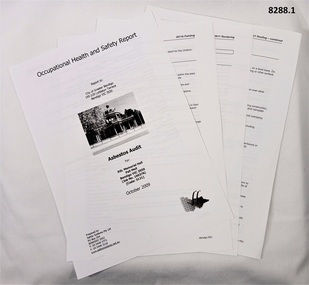
... Facilitator Murray Poustie RSL Historian, C/C Peter and 2 x Museum Sub Committee Marg Andrea and John Young to put together a business plan. 4.1.2013 P2. New CMP...Facilitator Murray Poustie RSL Historian, C/C Peter and 2 x Museum Sub Committee Marg Andrea and John Young to put together a business plan. 4.1.2013 P2. New CMP ...These records, plans, maps and documentation revolve around the Soldiers Memorial Institute Pall Mall Bendigo. (Now Bendigo Military Museum) This sequence of events regarding works begins in 2009 and goes through to 2015.It can be broken up into Phase 1 (P1) ongoing Works and Phase 2 (P2) Redevelopment/Revitalisation as one followed the other and overlapped. The following list by date/year is a very brief outline of the discussions, meetings, planning and works completed. October 2009 P1. Asbestos Audit carried out. 2010 P1. First assessments of Asbestos in the Office, Foyer, Passage & Meeting room. Asbestos was removed from the Men’s toilet. This would also include a new Trap door over the Mine situated under the Billiard room. 11.10.2011 P1. New trap door installed in the Billiard room. 15.10.2011 P1. Mine is checked with ground penetrating Radar. June 2011 P1. Asbestos removal in the kitchen. (Not in use) Following on : Asbestos in the Meeting room & Passage is clear, carpet in the Office to come up, asbestos removal in the Women’s toilets. Structural damage to the front wall of the Office and Fireplace wall, false ceiling in the office (refer Cat No 8218) At this point a group being CoGB Property Manager, Heritage, Contractors, Museum Curator/Chairman Sub Committee Peter Ball (C/C) RSL Secretary Paul Penno, RSL Club Manager Erik & Maiintenance Ken to be involved. C/C Peter to Co Ordinate a time line of works, Museum closures and draw up basic plans for Office upgrade. 1.9.2011 P1. Due to Office walls damage talks decided to upgrade the Office, the room is stripped and the false ceiling comes down. 15.9.2011 P1. Foyer, asbestos tiles removed. 20.9.2011 P1. Floor and timber finish approved by Property Manager. Some works being done in the kitchen. Phase 2 beginnings. P2. During 2011 the Sec RSL Paul discussed with C/C Peter a broader upgrade of the entire building with emphasis on the Rear Fibro addition which incorporated the stage, toilets and storage. Sec Paul, Pres Cliff Richards, C/C Peter met to form a plan forward. 20.10.2011 P2. Letter to C of GB regarding this phase and request for a meeting. 22.11.2011 P2. Meeting between 2 x C o GB and Sec Paul, Pres Cliff, C/C Peter RSL. C/C Peter to draw up a Dot point plan. 23.11.2011 P1. Office is completed enough to move in. 2.1.2012 P1. Works in the kitchen had begun but now to be fully gutted. 20.2.2012 P1. C/C Peter to draw up a basic plan of kitchen for use by the Museum/RSL. Mid July 2012 PI. Kitchen completed enough for use. 23.10.2012 P2. Meeting with C of GB and 3 x Museum to draw up a Business plan, a new Conservation Management Plan (CMP), $ commitment discussed. 10.12.2012 P2. Facilitator Murray Poustie RSL Historian, C/C Peter and 2 x Museum Sub Committee Marg Andrea and John Young to put together a business plan. 4.1.2013 P2. New CMP arrives, number of issues with. 15.1.2013 P2. Meeting with C of GB, Heritage, C/C Peter and M Poustie re corrections CMP. 16.1.2013 P2. First meeting of Museum group with basic plans put together. 23.1.2013 P2. Second meeting of Museum group, alterations made. 30.1.2023 P2. New CMP arrives. 7.2.2013 P1. Final Kitchen finished with Air con installed. 8.2.2013 P2. Plans adopted by Museum group. 13.2.2013 P2. Plans put to Bendigo RSL. 15.3.2013 P2. Plans updated with meeting between C/C Peter, Sec Paul, Pres Cliff, Manager Erik, forwarded to Council. 26.3.2013 P2. Scope of planning arrives back from C of GB. August 2013 P2. New Working group formed, Sec Paul, C/C Peter, Sub/comm member John. Meeting with Ian Ross & 1 SED & W/Group to develope the Business plan further, one item that no works to be done before 1.1.2016 due to 2015 being Centenary of Anzac. A 2nd meeting a week later. P1. At this point the Rotunda was not part of the initial process 23.9.2013 P1. Inspection of the North front wall by C of GB, Heritage & C/C Peter. Asbestos sample taken & positive. Water damage/cracks as in Office Walls. 11.10.2013 P1. C of GB, Heritage have another look at Rotunda. No works before to be done until the dryer months. 11.10.2013 P2. First meeting with Concept planners Lovell Chen x 3, Council x 3, Heritage x 2, SED x 1 & Museum x 3 group. Introductory meeting so all up to date, Museum walk through. 12.11.2013 P2. 2nd meeting of the above with draft proposals of extension upgrade of SMI presented. 18.12.2013 P2. 3rd meeting with above, number of small changes made. 2014 P2. Sec Paul, Pres Cliff, C/C Peter met with full Council to put the case to them. 2014 P1. Meeting with Council, Contractors, C/C Peter re Rotunda maintenance, asbestos removal to be on 30.5.2014 to fit in with current Museum Bookings. 4.11.2014 P2. An Orientation day was held for prospective detailed Planning. 11.11.2014, C/C Peter met with C of GB group to choose the tender for the final detailed drawings, Lovell Chen chosen, to be finalised by April 2015. 20.1.2015 P2. Bore holes drilled at rear of SMI re possible below ground structure. 18.2.2015 P2 1st meeting of Working group, 4 x Lovell Chen, various Council departments x 10, Museum x 3, Art Gallery x 1. 17.3.2015 P2. 2nd meeting of W/Group, a meeting with SED and SED presentation to the RSL. 5.5.2015 P2. 3rd meeting of the W/group with latest plans & possibly final. 4.6.2015 P2. 4th meeting of the W/group, planning permit & Heritage applications will now go ahead. On paper still 2 years planning & 4 years construction. P1. The Rotunda completed with new membrane and touch up painting. 30.6.2015 P2. Final meeting of W/group, from now on just planning, approvals, Heritage & Public objections. Fund raising to begin. Further to this scope. 3.8.2015 P2. Sec Paul & C/C Peter put the plans to Committee BDRSL and are approved. 5.8.2015 P2. Plans signed by Sec Paul and forwarded to C of GB Council. .1) Occupational Health and Safety Report re Asbestos in the Soldiers Memorial Institute Hall Pall Mall Bendigo for the City of Greater Bendigo - prepared by “Safety Systems PTY LTD Bendigo - October 2009”. 55 pages double sided, all print in B & W. .2) Correspondence, 80 pages A4 dated 20.10.2011 to 23.12.2013, letters, emails, plans, maps, fund raising relating to Phase 2. Items involve, RSL, C of GB, Heritage, SED, Political Parties, Government. .3) .4) Conservation Management plans Returned Soldiers Memorial Hall Pall Mall Bendigo, both 65 pages, A4, Colour and B & W, contains Contents, maps, diagrams, charts, photos put together by "Context PTY LTD Brunswick Victoria. .3) Draft copy dated 19.12.2012, has green Texta markings throughout and biro notes. .4) Final report with corrections dated 24.1.2013. .5) .6) Soldiers Memorial Institute Museum Business Plan, January 2013, A4 17 pages, In Colour & B & W, contents, maps and planning. .5) Revised edition in plastic insert folder. .6) Revised edition for presentation purposes. .7) .8) Business Planning documents by Ian Ross SED Advisory 2013. .7) Business Plan A4, B & W, 12 pages, copy of the initial plan dated 19.8.2013. .8) Bendigo Soldiers Memorial Institute Museum Business Plan December 2013, updated presentation version, plastic covers, A4, Colour & B & W, 31 pages, covers, Vision, Priorities, strategic actions/interventions, action/outcome plan. Appendix A, Appendix B. Photos, plans, potential funding and where from. .9) Letter, documents, drawing relating to the replacement of the Balcony Membrane of the Soldiers Memorial Institute. The letter is 4 pages from Meagan, Heritage C of GB to Sec Paul, C/C Peter regarding the replacement of the Membrane dated 18.2.2014. 15 pages of Membrane works prepared by Lovell Chen to be carried out, dated 14.2.2014. The drawing shows the detail of how the replacement will be. .10) Photographs of the Soldiers memorial Institute (55), taken during phase 2, A4, colour showing external walls and roofing and damage, internal taken in the loft, all rooms, damage to areas. .11) Three folders, spiral bound, plastic covers, Colour and B & W images, the 3 front pages are all different. Contents are plans, sketches, proposals, from Demolition maps to final specifications. Folder 1. 11 pages, one sided dated December 2013, Lovell Chen. Folder 2. 14 pages, one sided dated December 2014, Lovel Chen. Folder 3. 21 pages, one sided dated December 2104 and May 2015, Lovel Chen.brsl, smirsl, restoration, asbestos, business, plans, conservation
